Why a Small Hang Tag Changes the Whole Jewelry Box
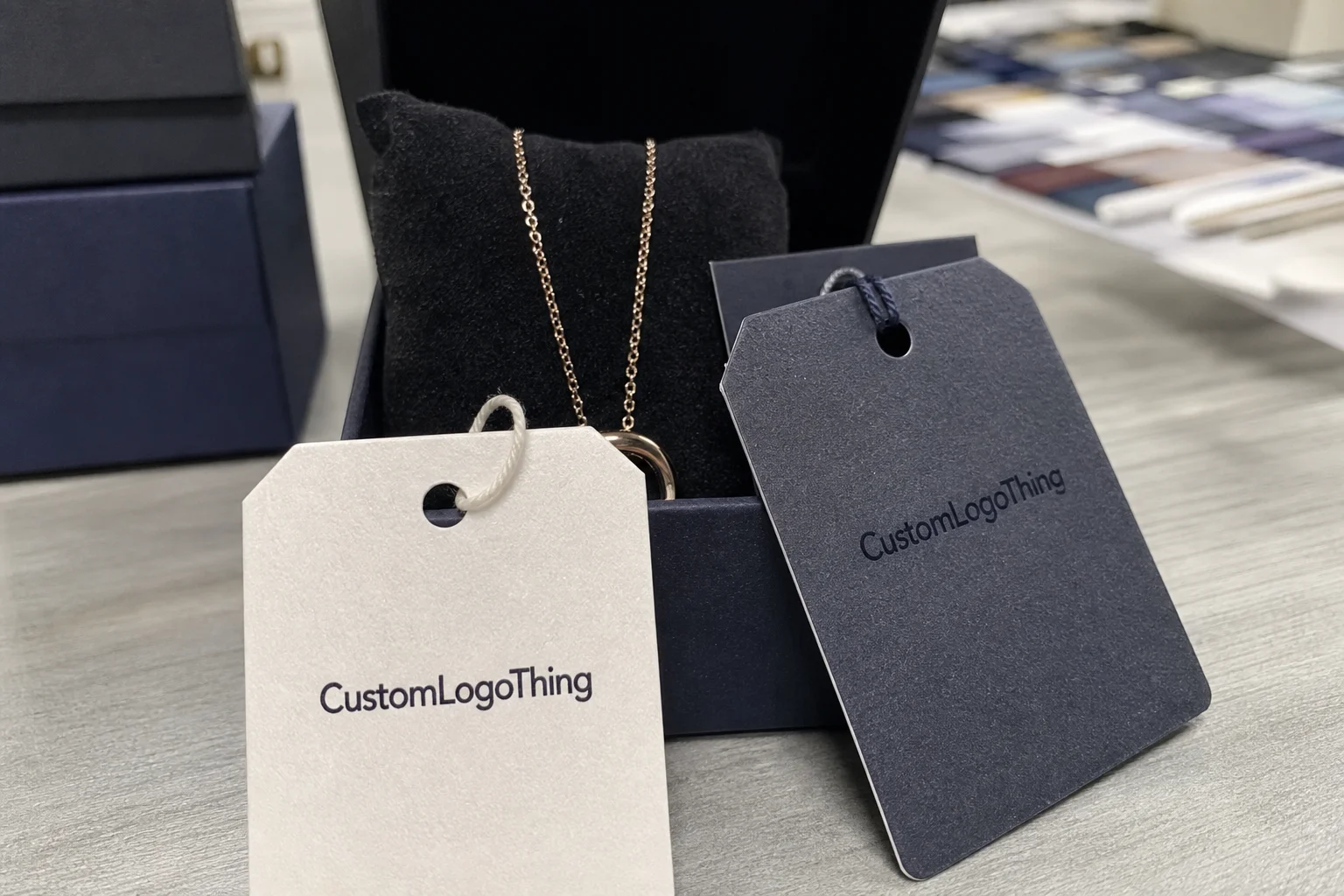
The hang tag is small, but it does a lot of work. It carries the logo, SKU, metal content, gemstone notes, care instructions, and sometimes a barcode or retail price. That is a lot of information for a piece of packaging that may be smaller than a business card.
For jewelry, the tag has to read clearly at a glance, sit neatly on delicate packaging, and survive handling without curling, scuffing, or tearing. If the stock is too light, the tag feels disposable. If the finish is too aggressive, it can clash with the rest of the pack. The best version is usually the one that looks simple because the details are right.
There is also a value signal embedded in the tag. A clean, well-printed hang tag can make a modest box feel more considered. A weak one can pull the perceived value down even when the product quality is strong. That mismatch is easy to miss in a quote sheet and obvious on a sales shelf.
Brands that reorder often feel this most. They need packaging that can scale, stay consistent, and match the rest of the line. That is why the unit cost discussion should start with the spec, not a generic category name.
Materials, Shapes, and Finishes That Actually Move the Needle
Stock choice drives a larger share of the price than many buyers expect. Coated cardstock is usually the baseline because it prints sharply, holds type well, and keeps costs controlled. Uncoated stock gives a softer, more tactile finish and fits brands that want a quieter presentation. Kraft paper signals a natural or recycled look, though the brown tone changes color perception and can mute lighter inks. Heavier board and textured papers move the tag toward premium territory, but they also push the quote up.
Shape is the next obvious cost lever. Standard rectangles are cheapest because they are fast to cut and easy to pack. Rounded corners add a small premium and improve handling. Custom die-cut shapes create a stronger identity, but they introduce tooling cost and more production time. On a low-volume order, the setup charge can outweigh the visual gain unless the shape is part of the brand system.
Printing complexity has a direct effect on the quote. One-color printing on one side is the leanest option. Full-color CMYK on both sides is still common, but it adds setup sensitivity and proofing time. Once foil stamping, embossing, debossing, spot UV, or edge painting enters the spec, the cost climbs quickly. Those finishes can be effective on luxury packaging, but jewelry tags need legibility first. If the typography gets cramped or the finish interferes with readability, the effect works against the package.
The most cost-efficient upgrades are usually the ones buyers actually touch: a stock that feels firm in hand, a trim that stays clean at the edge, and a finish that resists scuffing during packing and transit. Spending on those elements usually makes more sense than layering on decorative effects that add little functional value.
| Option | Typical Feel | Cost Impact | Best Use |
|---|---|---|---|
| Coated cardstock | Clean, sharp, reliable | Lowest to moderate | Most branded jewelry hang tags |
| Uncoated stock | Soft, understated, tactile | Low to moderate | Minimal or natural-looking packaging |
| Kraft paper | Earthy, casual, familiar | Low to moderate | Eco-positioned product packaging |
| Textured premium paper | Heavy, polished, upscale | Moderate to high | Gift sets and luxury retail packaging |
| Die-cut with foil or embossing | High-impact, decorative | High | Hero SKUs and launch pieces |
For buyers comparing material options across suppliers, the broad terminology from the packaging industry can help keep the quotes aligned. The Packaging School and PMMI resources are useful references for print and material vocabulary. They do not replace a sample, but they do reduce misunderstanding when one supplier says "premium board" and another means something very different.
Branded Hang Tags for Jewelry Packaging Unit Cost Breakdown
The unit price of a jewelry hang tag is built from several small decisions rather than one large one. The main cost drivers are stock, size, print sides, finishing, die cutting, stringing or attachment, packing method, freight, and inspection. Miss one of those in the brief and the quote stops being precise.
For a simple printed tag on coated cardstock, pricing can be manageable. At around 5,000 pieces, a straightforward format with one- or two-color print and standard cutting often lands in the $0.10-$0.22 per unit range before shipping. Move into full-color print, a custom shape, soft-touch lamination, foil, or pre-threaded stringing, and the range can shift to $0.18-$0.40+ per unit. That is usually not a markup problem. It is the effect of setup-heavy work on a job that has moved beyond a standard run.
Small orders cost more per piece because fixed charges have fewer units to absorb them. Dies still need to be made. Presses still need calibration. Artwork still has to be checked. Labor does not get cheaper just because the order is smaller. That is why 500 pieces can look expensive while 5,000 pieces suddenly looks reasonable.
Quantity bands matter. A fair quote should show where the price falls at each threshold. If the number barely changes between 1,000 and 3,000 pieces, something is off. Either the setup fee is padded or the supplier is not passing along volume efficiency. Tiered pricing matters because the shape of the curve often tells you more than the single unit price.
Landed cost is the number that matters in procurement. A supplier can quote a low per-tag rate and then add separate charges for stringing, special packing, proof corrections, inspection, and shipping. Another supplier may present a higher base rate but include more in the total. One quote can look better on paper and still cost more once everything reaches your warehouse. Comparing only the headline unit price usually hides that difference.
| Order size | Simple printed tag | More complex tag | What changes the price |
|---|---|---|---|
| 500 pcs | $0.22-$0.55 | $0.40-$0.90+ | Setup fees dominate the math |
| 1,000 pcs | $0.16-$0.38 | $0.28-$0.65+ | Setup spreads out, but not enough to flatten cost |
| 5,000 pcs | $0.10-$0.22 | $0.18-$0.40+ | Volume begins to pull the unit rate down |
That range is directional, not universal. A narrow, one-color tag on standard stock will sit near the low end. A custom die-cut tag with foil and pre-threading will sit near the top or above it. The point is to price the spec, not the category name.
There is one more trap: a low quote that ignores quality control. Thin stock, weak trimming, and poor registration may save a fraction of a cent on paper and cost you more in rejected pieces or brand damage. Once a tag starts curling or printing off-center, the savings disappear fast.
Artwork Specs, Sizes, and Attachment Details Buyers Should Lock First
Accurate pricing starts with the physical spec. Size, orientation, hole placement, number of print sides, and whether the tag needs a barcode or compliance text should all be fixed before quote requests go out. A 30 x 50 mm tag and a 40 x 60 mm tag do not behave the same in production. Bigger tags use more stock. Unusual proportions can slow cutting. A hole placed too close to the edge can tear during handling, which is a preventable failure.
Attachment method is another cost line that gets underestimated. Cotton string is common and inexpensive. Elastic loops are neat and fast. Thin cord gives a more premium feel. Jewelry pin ties suit delicate items, but they are not right for every product line. Pre-threading saves labor during fulfillment, yet it adds cost and often makes sense only when the order volume or warehouse speed justifies it.
Legibility matters more than ornament. Jewelry hang tags often carry a lot of text: logo, metal content, gemstone detail, SKU, care instructions, retail data, and sometimes regulatory notes. If the type size gets too small, the tag becomes decorative clutter. Good layout keeps the information hierarchy clear under normal lighting, which is where the tag will actually be read.
If sustainability claims are part of the brief, they need to be specific. FSC-certified paper is a real material choice, not a decorative phrase. The FSC system is useful if the brand needs paper traceability, but the claim has to be backed by the paper and the supply chain. Vague environmental language usually creates more questions than confidence.
One practical prepress check saves a lot of money: if the proof is hard to read on screen, it will usually be harder to read on press. Font size, spacing, hole position, and back-side alignment should all be resolved before approval. After a die is made, every correction gets more expensive.
Process and Turnaround: From Proof to Production
The production path is predictable: inquiry, quote, artwork check, proof, approval, production, finishing, packing, shipment. The delays usually appear between quote and approval, not after production starts. Unclear dimensions, missing copy, late color changes, and special finishes that need extra setup are the common reasons a schedule slips.
Simple printed tags can move faster than custom die-cut or foil-stamped versions. A clean, standard tag often turns in roughly 10-14 business days after proof approval, depending on order size and queue. Add custom cutting, pre-stringing, or specialty coatings, and 12-18 business days is more realistic. Freight sits outside that clock. Air and ocean are separate planning decisions, not interchangeable delivery options.
Retail launch dates have a way of exposing bad assumptions. A plant can finish on time and the shipment can still miss the window. That is why production lead time and transit time should be tracked separately. Mixing them together is how brands end up blaming the factory for a logistics problem.
Packaging integrity also matters in transit. The shipping-test discipline used by groups like ISTA is a useful reminder that even small packaging items need to survive stacking, vibration, and handling. Tags should arrive flat, clean, and usable, especially when they ship alongside boxes, inserts, or pre-packed jewelry kits.
One approval rule is worth keeping: review the proof carefully once, then approve it cleanly. Repeated changes after die production or press setup create avoidable cost. A supplier can help absorb some of that complexity, but rework is still rework.
What a Spec-Driven Quote Should Include
A useful quote does more than return a number. It shows what is included and what sits outside the base price. If the quote is thin on detail, the job usually becomes expensive later. A strong quote should identify the stock, weight, size, print method, finish, die charge, attachment method, packing method, inspection standard, and freight estimate. If any of those are missing, the number is incomplete.
The order format matters too. Some buyers want tags bulk packed in cartons. Others need nested stacks. Others want them pre-strung or bundled by SKU. Those choices have real labor impact. Bulk packing keeps the rate lower. Pre-stringing and sorting increase the price, but they can reduce work in fulfillment. That tradeoff is legitimate if the warehouse is a bottleneck.
There is also a difference between a one-time launch and a repeatable packaging system. If the tag needs to match existing jewelry boxes across future runs, the spec should be stable enough to reproduce without guessing. In practice, consistency is often worth more than the cheapest possible first run. Reorders are where packaging decisions are tested.
If your package includes more than tags, the same discipline should apply across the line. A tag does not live alone. It has to work with Custom Packaging Products, the box insert, tissue, and any retail-facing packaging around it. If the line includes multiple label types, the same spec logic should extend across Custom Labels & Tags so the print style and material tone do not drift from one item to the next.
The best hang tag is usually the one that looks intentional, reads quickly, and adds almost no friction to the packaging process.
What to Send Next for an Accurate Quote and Fast Order Start
If the goal is a clean estimate, send the facts first. Size, quantity, stock preference, print sides, finish, attachment method, and whether the tags should ship flat or pre-strung are the basics. Leave those out and the quote will be soft. Soft estimates are fine for early concepting, but they are poor procurement tools.
Artwork files should follow the same discipline. Send logo artwork, copy text, color references, and a dieline if one already exists. If the brand has a Pantone target, state it clearly. If the tag needs a barcode or compliance text, include the space allocation up front. That is how the branded Hang Tags for Jewelry Packaging Unit Cost Breakdown stays useful instead of turning into a moving target during proofing.
If the project involves a special paper, a finish that needs testing, or color matching against existing packaging, ask for a sample route before production. Not every order needs it. High-visibility launches often do. It is cheaper to approve one sample than to reprint several thousand tags because the final finish looked different under store lighting than it did on screen.
The clean sequence is straightforward:
- Lock the spec
- Confirm the price band
- Review the proof
- Approve the timeline
- Release production
The main takeaway is simple. Exact specs produce better pricing, cleaner timelines, and fewer surprises. If the quote is built from a complete brief, the unit cost reflects the actual job instead of a guess.
FAQ
How is the unit cost of branded hang tags for jewelry packaging calculated?
The price usually comes from stock choice, size, print sides, finish, die cutting, attachment method, packing format, inspection, and shipping. Setup charges have a bigger effect on small runs because the fixed cost is spread across fewer pieces. The most honest comparison is total landed cost, not just the base unit rate.
What MOQ should I expect for branded hang tags for jewelry packaging?
MOQ depends on whether the tag is a standard printed format or a custom piece with finishing, special cutting, or pre-stringing. Basic tags can often start lower, while foil, embossing, and custom packing raise the minimum. If the order is small, ask for tiered pricing so you can see where the cost drops at the next quantity band.
Which material gives the best value for jewelry hang tags?
Coated cardstock is usually the best balance of print quality, stiffness, and cost. Kraft works well when the brand wants a natural appearance without paying for premium finishing. Textured and heavy board stocks feel better in hand, but they only make sense if the presentation needs that extra weight.
How long does production usually take after approval?
Simple printed tags usually finish faster than custom die-cut or foil-stamped tags. Once proof approval is complete, a standard run can often move in about 10-14 business days, while more complex jobs may need 12-18 business days. Shipping time is separate and should be planned as its own step.
What files do I need to get an accurate quote?
Send the tag size, quantity, material preference, finish choice, and attachment method. Include logo files, copy text, color references, and a dieline if one already exists. The more exact the spec, the less likely the quote will shift after proofing starts.


