Beauty can be deceptive in packaging. A tag may look perfect in a mockup, yet still fail a buyer review because the board is too flimsy, the adhesive backing lifts, the barcode won’t scan, or the finish scuffs after a few minutes in a carton. That is exactly why Custom Hang Tags for jewelry packaging factory audit questions matter: they reveal whether a supplier can actually produce consistent, usable jewelry packaging, not just attractive artwork.
Jewelry buyers often start with aesthetics, which is understandable. But factories judge a tag differently. They look at GSM, coating behavior, die-cut accuracy, ink rub resistance, and repeatability across small runs. In practice, a tag attached to earrings or a bracelet has to do more than brand the piece. It may need to carry SKU data, origin information, care instructions, a QR code, or a price point, all while supporting premium presentation and the wider package branding system.
So treat this as an audit checklist, not a style board. If you are sourcing from a supplier that also handles Custom Packaging Products or Custom Labels & Tags, the real question is not “Can they print it?” It is “Can they repeat the same result on order three, order ten, and the rush reorder that arrives after a product launch?”
Why jewelry hang tags fail audits more often than buyers expect
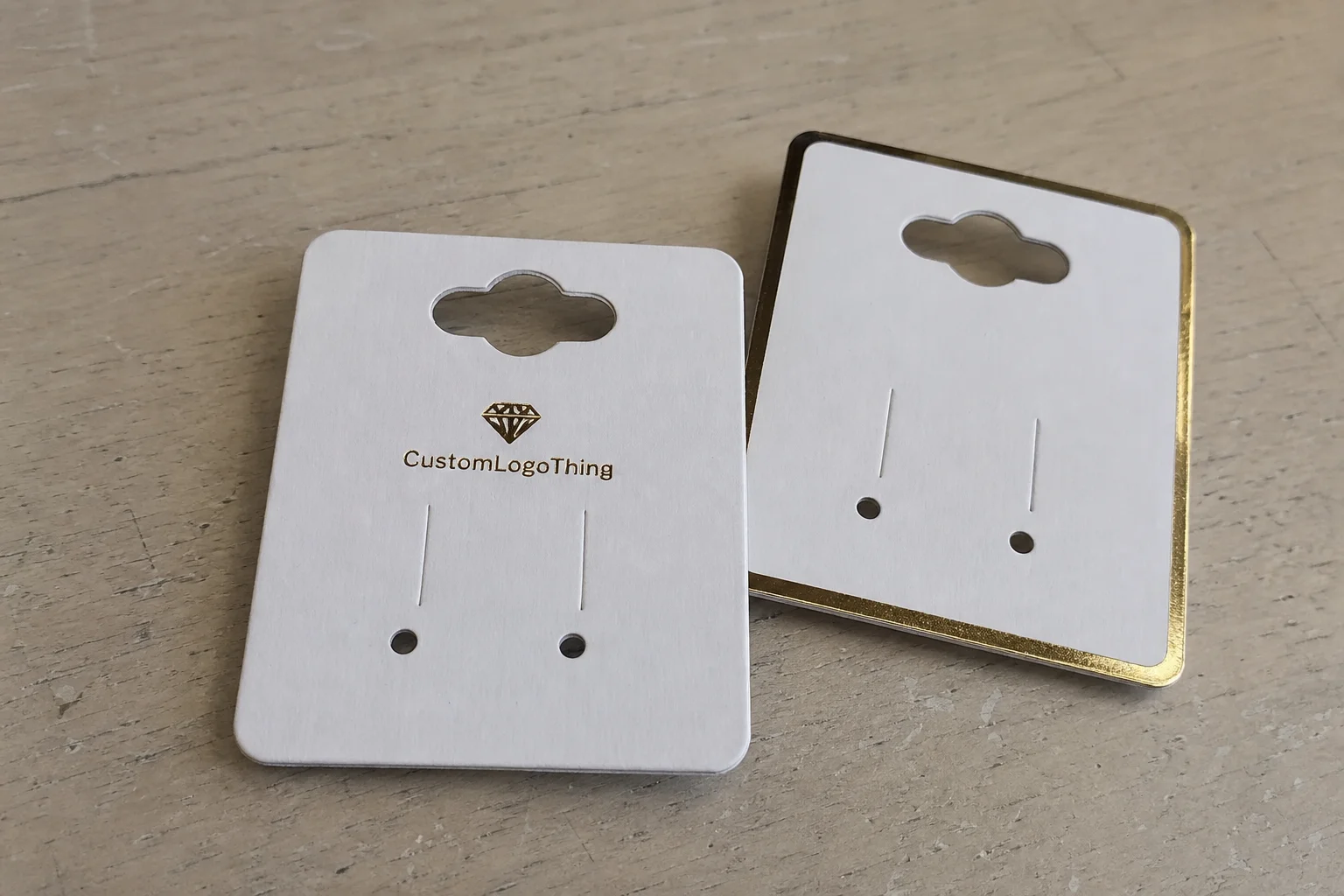
On paper, jewelry hang tags look simple. A small card, a hole punch, some ink, maybe a string or pin. But the failure points stack up quickly. A 300gsm card can feel acceptable in a sample, then curl badly after foil stamping. A soft-touch laminate can look luxurious, then show fingerprints under retail lighting. A barcode can be perfectly placed and still fail if the contrast is too low or the varnish reflects too much light.
Factories audit for measurable issues because they know retail packaging has to survive handling, packing, shipping, and shelf presentation. Buyers, especially those new to branded packaging, often focus on artwork and overlook the production details that control quality. That gap creates avoidable problems.
Custom Hang Tags for jewelry packaging factory audit questions help reveal whether the supplier understands:
- paper weight and board stiffness
- coating and finish compatibility
- precision die-cuts and hole placement
- color consistency across repeated runs
- attachment methods for necklaces, bracelets, rings, and gift boxes
A good audit also tells you whether a factory can handle different product packaging formats in the same line. Jewelry collections often mix tiny earring cards, longer necklace tags, and luxurious gift-box inserts. If a supplier cannot explain how it controls variation, the risk is higher than the quote suggests.
“A pretty sample is not proof of production control. The real test is whether the factory can make the same tag ten thousand times with the same edge quality, color, and finish.”
How the factory audit process works
The best audit process is simple, structured, and boring in the right way. It begins with an inquiry, moves through spec review, and ends with shipment after documented inspection. If the process feels vague at the quotation stage, expect headaches later.
A strong factory usually asks for the same core details up front: dimensions, quantity, paper or board preference, finish, color expectations, attachment method, and how the tag will be packed. If the supplier does not ask these questions, that does not automatically mean it is weak, but it does suggest a lighter process. That can be risky with premium tags or any item that sits inside a higher-end retail packaging program.
In a solid workflow, the stages usually look like this:
- Inquiry and spec collection
- Material and finish recommendation
- Artwork and dieline confirmation
- Sample or proof approval
- Production
- Inspection and packing
- Shipment
The difference between a manufacturer and a reseller shows up here. A factory with in-house printing, die-cutting, finishing, and QC can troubleshoot faster and control tolerances better. A supplier that outsources every step may still deliver good work, but revision cycles often become slower and less transparent. For Custom Hang Tags for jewelry packaging factory audit questions, that distinction matters more than most buyers think.
Ask whether the supplier can provide a pre-production sample, a clear color standard, and traceable QC records. Also ask how they handle revisions. A team that can update artwork without losing track of previous approvals usually has stronger documentation discipline, which is a good sign for repeat orders and private-label program stability.
For broader sourcing context, the FAQ section on a supplier site can reveal how well they explain technical details. The better ones answer questions about board thickness, finish options, and delivery timing without slipping into generic marketing language.
One more practical point: ask whether the factory can keep approved files, die lines, and material references on record for reorder support. Many delays happen because a new contact has to reconstruct an old job from scratch. That is avoidable, and it matters more when the jewelry line carries multiple SKUs with similar tags but different text fields.
Materials, finishes, and durability specs that affect approval
Material choice changes everything. Jewelry hang tags are small, but the substrate controls stiffness, color depth, edge quality, and perceived value. A 350gsm C1S artboard behaves differently from a textured kraft stock. Synthetic paper resists moisture better than standard paperboard, while specialty boards can create a more luxurious feel for higher-end jewelry packaging.
Common material options usually include:
- Coated paper or artboard for crisp print and cost efficiency
- Kraft stock for natural, earthy, or artisan branding
- Textured paper for premium tactile appeal
- Synthetic paper for durability and moisture resistance
- Specialty board for heavier, luxury-oriented presentation
Finishes are where many tags either gain credibility or lose it. Matte lamination reduces glare. Soft-touch coating creates a velvety surface, though it can show oils if the handling environment is rough. Foil stamping adds contrast and shine, while embossing and debossing add depth. Spot UV can work well on some designs, but on small tags it can become visually busy if overused. Rounded corners often improve durability because they reduce edge fraying during handling.
Durability checks should include tear resistance, scuff resistance, color fastness, and attachment wear. If the tag uses a string, pin, or metal loop, the hole area needs enough strength to avoid ripping. A delicate necklace tag can fail if the hole punch sits too close to the edge. That is a production issue, not a design issue.
Print content deserves the same scrutiny. Tiny text for care instructions must remain legible. SKU numbers should not fill in during printing. QR codes and barcodes need enough quiet zone and contrast to scan reliably. If the jewelry line uses serial numbers or store-specific data, test those fields before approving the run. A beautiful tag that fails on barcode readability is not finished packaging; it is a reprint.
From a packaging design point of view, the substrate can alter the brand impression as much as the artwork itself. A rich navy on a coated board may read as luxury. The same navy on absorbent kraft can look muted and slightly gray. That is why sample approval matters so much, especially if the tag is part of a larger system that includes product inserts and outer branded packaging elements.
| Material / Finish | Typical Use | Strengths | Watch Outs |
|---|---|---|---|
| 350gsm artboard + matte lamination | Mid-range jewelry tags | Crisp print, good stiffness, cost-effective | Can scratch if handled roughly |
| Textured stock + foil stamping | Premium gift sets | Luxurious feel, strong shelf impact | Fine details may not reproduce as cleanly |
| Kraft board + black ink | Natural or artisan collections | Warm, eco-friendly appearance | Color vibrancy is more limited |
| Synthetic paper + rounded corners | High-handling or moisture-prone use | Durable, tear-resistant | Costs more than standard board |
Thickness alone should not drive the decision. A thicker sheet can feel more expensive, but if it warps under lamination or cracks at the fold, the higher gsm number is cosmetic. For buyers comparing samples, edge stiffness, surface smoothness, and print holdout usually tell the real story.
Cost, pricing, MOQ, and unit cost questions buyers should ask
Price conversations get messy when buyers compare only the unit number. That is a mistake. The true cost of custom Hang Tags for Jewelry Packaging factory audit questions depends on setup fees, tooling, material grade, finishing complexity, and whether accessories such as strings, pins, or elastic loops are included.
For example, a simple 50 x 90 mm tag printed in two colors on 350gsm board may land around $0.08-$0.18 per unit at higher quantities, depending on region and finishing. Add foil, embossing, or specialty stock, and the price climbs quickly. A premium version with multiple finishes may run $0.20-$0.45 per unit or more, especially at lower volumes. Those ranges are not universal. They shift with quantity, print coverage, and packaging format.
The buyer questions that matter most are practical:
- What is the MOQ?
- Is the die fee separate or included?
- Are plates reusable on reorder?
- Are samples free, credited, or billed?
- Does the price include strings, pins, or packing?
- Is color matching part of the quote?
Ask for tiered pricing. One quote for 1,000 pieces tells you very little. Five breakpoints, such as 1,000, 3,000, 5,000, 10,000, and 20,000 pieces, show where unit economics improve. That matters because many jewelry buyers reorder in bursts tied to launches or seasonal packaging updates. A slightly higher unit cost can still be the cheaper option if it reduces rejects, reprints, or freight rework.
Here is the comparison many buyers skip:
| Quote Element | Low-Detail Supplier | Well-Documented Factory |
|---|---|---|
| MOQ clarity | “Depends” | Specific quantity tiers |
| Tooling and setup | Often hidden | Itemized up front |
| Sample policy | Unclear | Defined timing and cost |
| Reorder economics | Not explained | Clear plate and die reuse terms |
That table is not just about price. It is about predictability. Packaging procurement works better when the supplier explains the cost structure instead of hiding it behind a single attractive number. Buyers should also ask what happens if they change one variable after approval. A small color tweak or hole-size adjustment can trigger a new setup charge, and that should be known before the PO is issued.
Process, timeline, and production steps from proof to shipment
Lead time should be broken into stages. Asking for one total date hides the real bottleneck. A factory might need 1-2 business days for proofing, 2-4 days for sampling, 7-12 days for production, and another 1-3 days for inspection and packing, before shipping even begins. Complex finishes can stretch that timeline.
The most common delay points are predictable:
- unclear or incomplete artwork
- missing dieline approval
- late color revisions
- stock or board shortages
- barcode or text corrections after proofing
Ask for timing by stage. That sounds basic, but it is one of the best Custom Hang Tags for jewelry packaging factory audit questions because it reveals whether the supplier understands production flow. If a factory cannot tell you where delays usually happen, then it probably does not manage them well.
Also ask about rush orders and partial shipments. Some buyers need tags for a product launch while the rest of the line is still in production. A factory that can hold inventory for repeat runs, or at least preserve approved specs and files cleanly, is easier to work with over time.
Documentation is the hidden advantage here. Factories that record each stage, from proof approval to final carton count, usually manage reorders more consistently. Verbal confirmation has a short memory. Written control does not.
If your supplier also produces other branded packaging components, such as inserts, sleeves, or custom printed boxes, ask how they coordinate production across product lines. Shared scheduling can help, but only if the factory controls each workstream separately. Mixed scheduling without clear lot separation is how small errors spread across an entire shipment.
For buyers working on seasonal programs, one useful rule is to add buffer time for revision loops and freight booking. A tag line can be finished on schedule and still miss launch if the shipping window is tight. The production calendar and the logistics calendar rarely align on the first try.
Quality control and compliance checks that protect your brand
QC is where good packaging programs separate from risky ones. A professional supplier should be able to describe incoming material inspection, print registration checks, finishing inspection, final random inspection, and carton verification. Those steps are ordinary in capable factories, but they still need to be asked about.
Ask whether the supplier uses AQL standards, photo reports, or full inspection records. AQL is not a magic word, but it shows the factory has a defined inspection method. For premium jewelry lines, photo evidence is useful because it lets the buyer see color, edge quality, and finish before shipment. That helps reduce disputes, especially when the order sits within a broader package branding rollout.
Compliance depends on the market, but common concerns include non-toxic inks, restricted substances, recycled-content claims, and export labeling accuracy. If your packaging claims FSC certification, the factory should be able to support that with proper documentation. You can verify more about certified materials through FSC. For transport testing and package durability, reference standards from ISTA are also helpful when your tags ship alongside heavier retail packaging or bundled cartons.
Traceability matters more than many buyers realize. Keep the approved sample, note lot numbers, store revision history, and document the final artwork version. If you ever need a reprint, that paperwork shortens the audit trail. It also helps the next buyer, merchandiser, or packaging engineer who inherits the file later.
For sustainability claims or material recovery questions, the EPA’s packaging and waste resources can be a useful background reference at EPA packaging guidance. Not every jewelry tag needs environmental certification, of course, but if the brand positions itself around responsible sourcing, the paper trail should match the message.
One caveat: compliance language on its own does not guarantee performance. A factory can show certificates and still miss basic QC if the last-mile inspection is weak. The stronger signal is how the supplier talks about actual checkpoints, defect thresholds, and what gets quarantined before packing.
Common mistakes buyers make during factory audits
The first mistake is assuming a nice mockup means the factory has control of production. It does not. A rendering can hide weak print registration, poor cutting accuracy, or finish defects that only appear at scale. A second mistake is forgetting to ask about remake policy before approving the quote. If the supplier makes an error, who pays for the reprint? That question should never be left vague.
Third, many buyers send a rough idea instead of a real spec. The factory is then forced to guess thickness, coating, folding, or attachment method. Guessing is bad for pricing and worse for quality. A fourth mistake is ignoring logistics. Tags can be damaged if they are packed without edge protection, bundled too tightly, or mixed with sharper components like metal loops and pins.
Another common miss: buyers do not test small text, foil detail, or barcode scanning before production. Those elements often look fine at proof stage and fail when printed at full volume. That is especially true if the tag includes care instructions or a retail SKU field. In other words, the content that seems least glamorous often causes the most expensive rework.
“If a supplier cannot explain how it protects small details, it probably cannot protect your margin either.”
There is also a pricing mistake that comes up repeatedly. Buyers compare a bare tag quote against a fully packed quote and assume the first one is cheaper. Then they add strings, packing, sample charges, and freight-safe cartons later. Once those costs are folded in, the difference may disappear. A clean quote is not always the lowest quote, but it is usually easier to control.
Expert next steps for a stronger hang tag sourcing decision
The most efficient buyers use a one-page audit sheet. Not a long questionnaire. One page. Put the essentials on it: dimensions, board weight, finish, color standard, attachment method, quantity, acceptable tolerances, sample expectations, and delivery window. Then add the custom hang tags for jewelry packaging factory audit questions you cannot afford to leave unanswered.
Request two proofs when possible. A flat digital proof confirms layout. A physical sample confirms feel, rigidity, color shift, and finish behavior. Digital-only approval is fine for simple work, but premium jewelry tags deserve tactile confirmation, especially if the tag helps define the product packaging experience.
When comparing suppliers, do not rank them only by unit price. Compare documentation quality, responsiveness, inspection transparency, and how clearly they explain cost drivers. Those are the signals that predict whether a factory can deliver repeatable branded packaging instead of just one good-looking sample.
If a supplier can repeat the same finish, the same cut line, and the same color on reorder, that is a stronger partner than one that only performs well on the first job. That point sounds obvious. In practice, it is where many sourcing programs go wrong.
Before you place the order, confirm the approved sample, final pricing, lead time, QC method, and reorder contact. If you do that, your custom hang tags for jewelry packaging factory audit questions become a working sourcing tool, not just a checklist. That is the difference between hoping for good results and controlling them.
One final observation: the best suppliers are usually not the ones with the longest sales pitch. They are the ones that can answer specific questions without hedging on basic production facts. In packaging, clarity is often the most reliable luxury signal of all.
What should I ask in a custom hang tags for jewelry packaging factory audit?
Ask about materials, finishes, MOQ, sample policy, lead time, QC method, and whether the factory handles printing and finishing in-house. Also request examples of similar jewelry work and ask how the supplier prevents color drift and registration errors across repeat runs.
How do I compare pricing for jewelry hang tag suppliers?
Compare total landed cost, not just unit price. Check whether setup, tooling, samples, accessories, inspection, and shipping preparation are included. A quote that looks lower can become more expensive if it leaves out die fees or remake charges.
What is a reasonable lead time for custom jewelry hang tags?
It depends on approval speed, quantity, and finishing complexity. A capable factory should separate proofing, production, inspection, and shipping timing so delays are visible early. For many standard jobs, the production portion is often around 7-12 business days after approval, though special finishes can extend that.
Which materials are best for luxury jewelry hang tags?
Thicker cardstock, textured paper, and specialty boards usually feel more premium. The best choice depends on print detail, durability, and how the tag attaches to the jewelry or packaging. If the collection uses metallic effects or fine typography, ask for a physical sample before approving the run.
How can I tell if a factory can handle repeat orders consistently?
Ask for approved sample retention, revision tracking, and QC records from past runs. Look for clear documentation, stable material sourcing, and the ability to match previous production lots. That consistency matters more than a flashy first sample.


