printed hang tags for candle brands Unit Cost Breakdown is less about the tag itself and more about what the tag forces into the order. Setup, finishing, assembly, proofing, and freight usually matter more than the sheet of paper. That is why a low quote can be misleading if it does not show the full cost structure.
Candle brands feel this more than many packaging buyers because the tag sits beside a sensory product. Texture, glass, wax color, fragrance positioning, and the tag all shape the shelf impression. A weak tag can make a well-made candle look cheaper, while a cleaner stock or finish can lift the product without changing the candle formula.
The practical question is not whether a tag looks nice in isolation. It is whether the spec supports the price point, survives handling, and lands at a cost that still protects margin. That is the standard this article uses.
Why the Cheapest Candle Tag Quote Is Usually Wrong
The first mistake is treating candle hang tags like a simple paper square. On a small order, the stock may be a minor part of the bill. Prepress, die cutting, trimming, inspection, and any hand work tied to stringing or kitting can outweigh the paper cost quickly.
The second mistake is comparing quotes that are not built the same way. One supplier may include proofing, assembly, and freight. Another may quote only print. If the line items are not visible, the apparent savings are often an illusion.
Hidden cost shows up fastest on low-MOQ jobs. Custom dies, extra proof rounds, color changes across SKUs, and small-run freight all push the per-piece cost higher. Those are not surprises once you have seen enough packaging orders, but they still catch buyers when the quote is compressed into a single number.
For candle tags, the cheapest quote is often the one with the most missing line items. Ask for the full breakdown before comparing suppliers.
That is the point of a printed Hang Tags for Candle brands unit cost breakdown. It shows which decisions change the price and which ones only look expensive on paper.
Materials and Finishes That Change the Look and the Unit Cost
Paper choice sets the baseline. Standard coated cardstock, often around 14pt to 18pt, is common because it prints cleanly and feels firm enough for retail use. Uncoated kraft gives a more natural look and works well for eco-led or minimalist brands. Textured stock pushes the piece toward a boutique or giftable presentation.
The cost ladder is predictable. Coated cardstock is usually the most efficient bulk option. Kraft and specialty sheets can cost more because they may waste differently, run less efficiently, or need more handling to keep color consistent. Heavier board can improve perceived value, but only if the rest of the spec supports it.
Finishes are where the quote starts to separate. Matte lamination is usually a modest add-on. Soft-touch raises the finishing burden. Spot UV, foil stamping, embossing, and debossing introduce more tooling, labor, or inspection time. On a small tag, the visual change may be subtle, but the production cost is not.
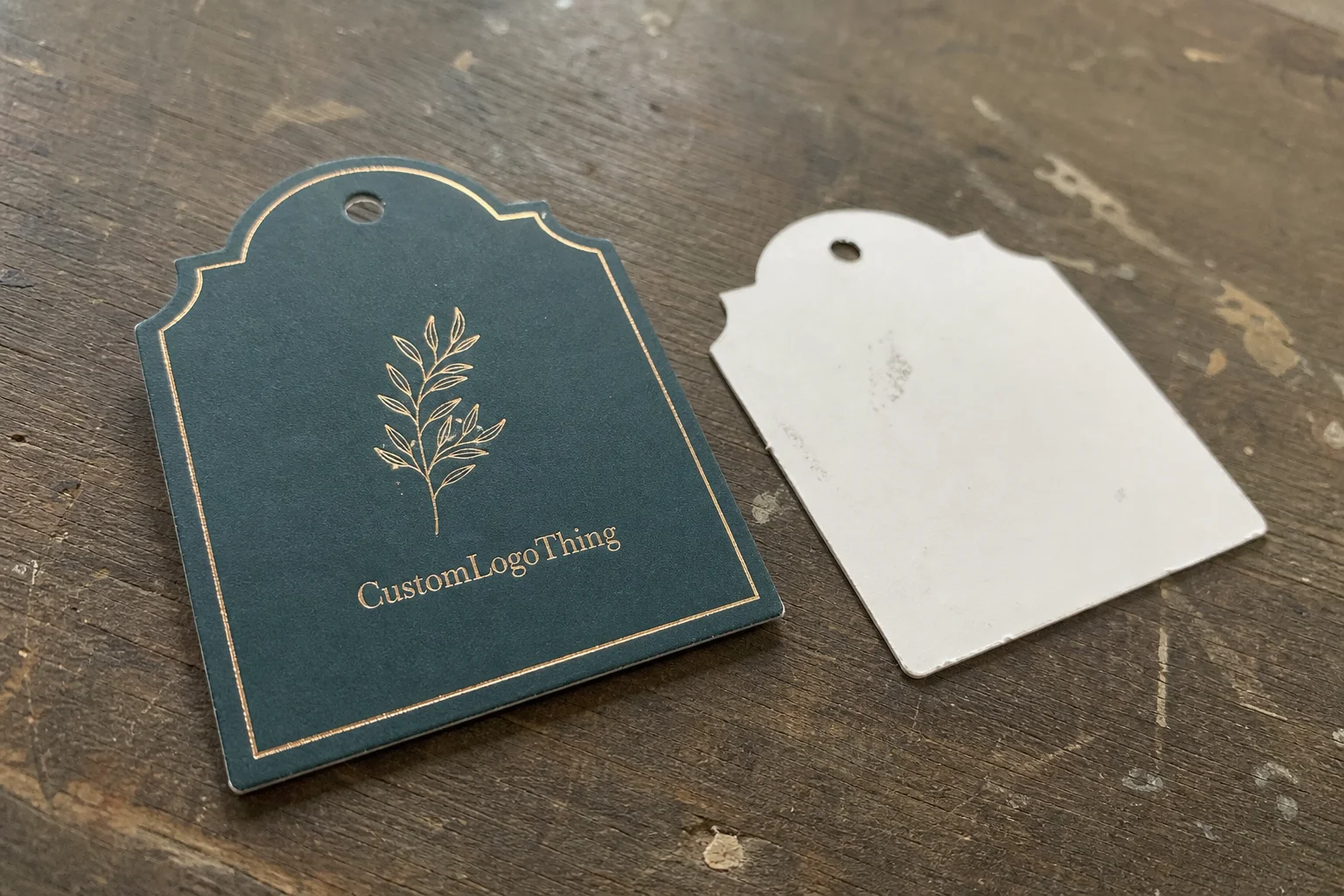
Shape matters too. A square tag with rounded corners is straightforward to price and produce. A custom silhouette changes the die, the waste rate, and often the trimming setup. Hole placement also matters more than it seems, because it can affect layout balance and the usable space for copy.
Attachment is another cost driver buyers often miss. Cotton string, twine, elastic loops, and ribbon all carry different assembly costs. Pre-stringing is convenient, but convenience is labor. For a launch or test run, a simpler attachment usually protects margin better than decorative extras.
Print coverage can influence both look and cost. Dark artwork on uncoated kraft can look intentional, but fine type may soften. On coated stock, the same file may print sharper and need less correction. Buyers who want consistency should ask how the chosen stock behaves with the actual artwork, not just whether the paper feels premium.
What to Specify Before You Request a Quote
Clean quotes start with clean inputs. Before requesting pricing, send the final size, paper stock, print sides, quantity, finish, attachment style, and ship-to ZIP code. If any of those are missing, the supplier will guess or pad the number.
Artwork should be close to print-ready. A PDF or AI file is usually best, with fonts outlined and images at proper resolution. Include brand colors, logo rules, barcode requirements if needed, and any scent notes or safety copy that must fit. Small tags leave little room for correction after the fact.
Hole size and placement should be explicit. A 1/8-inch shift can change the layout or force a re-cut. If the tag will hang on a jar neck, box, or retail loop, the attachment format needs to be locked before quoting. Otherwise the supplier is pricing assumptions.
Buyers should also specify how the tags must arrive. Pre-strung, loose, sorted by SKU, or packed with inserts all affect labor and shipping. A simple stack of loose tags costs less to assemble than a fully finished retail-ready pack, but that difference should be visible in the quote.
Ask for a line-item quote. A useful breakdown shows stock, printing, finishing, assembly, and freight separately. That is how a buyer sees whether the quote reflects real production or just a tidy number built to close quickly.
- Good input: final dimensions, quantity, stock, finish, and packaging method.
- Better input: dieline, artwork file, brand colors, and exact copy.
- Best input: two spec targets, one budget version and one premium version.
Two spec targets make tradeoffs easier to see. One protects margin. The other shows how far the presentation can be pushed before the economics stop working.
Printed Hang Tags Pricing, MOQ, and Unit Cost Drivers
The pricing structure is usually simple once the jargon is stripped away: setup, print, finishing, assembly, and freight. What changes is how those costs behave as quantity rises. That is why MOQ matters so much. Small runs carry a higher cost per piece because the fixed work is spread over fewer tags.
A 500-piece order can cost far more per unit than a 3,000-piece order, even if the artwork barely changes. That is the arithmetic of press setup, die mounting, color checking, and stack inspection. Fixed work is fixed work.
For candle brands, pricing usually improves at familiar breakpoints. Common drops appear around 500, 1,000, 3,000, and 5,000 pieces. The exact tiers depend on sheet size, waste, and finish, but the curve is consistent. Bigger runs generally win on bulk pricing; tiny runs pay for flexibility and convenience.
The biggest cost drivers are custom die-cuts, foil, soft-touch lamination, double-sided print, and pre-stringing. Specialty paper can add cost too, but it does not always dominate the quote. A plain stock with elaborate assembly can cost more than a premium stock with simple finishing.
| Order Type | Typical Unit Cost Range | What Usually Drives It | Best For |
|---|---|---|---|
| Short run, simple stock | $0.38-$0.85 | Setup charges, small MOQ, freight | New launches, test SKUs |
| Mid-volume, standard finish | $0.18-$0.42 | Print efficiency, moderate finishing | Core candle lines, seasonal runs |
| Higher volume, premium finish | $0.12-$0.30 | Tooling fees, foil, die-cut complexity | Retail collections, giftable candles |
| Pre-strung or kitted | $0.22-$0.55 | Assembly labor, packing format | Retail-ready presentation |
These ranges are directional, not guarantees. They are still useful because they show where the money goes. A buyer comparing Printed Hang Tags for Candle brands unit cost breakdown options should ask for at least two versions: a value spec and a premium spec. That makes the margin impact of the finish visible.
If a supplier gives only one number, they are making the choice for you. That can work when the spec is already settled. It is not useful when the buyer is still managing launch economics.
For sourcing context, FSC certification matters if the brand wants traceable paper supply, especially for retail and eco-positioned lines. The standard is outlined at fsc.org. For shipping durability and packaging testing logic, ISTA is worth reviewing, especially when tags are packed with fragile candle goods. Broader packaging material guidance is also available through packaging.org.
Freight can distort the unit economics more than expected on light, low-value goods. A tag order may look cheap ex-works and then lose that advantage once shipping and packing are added. On small runs, shipping can become a larger share of landed cost than the tags themselves.
Process, Proofing, and Turnaround From File to Shipment
The normal flow is quote review, artwork check, digital proof, sample or pre-production approval, print run, finishing, quality control, and dispatch. The difference is how cleanly the buyer moves through it. Fast approvals shorten the schedule. Custom finishes, unusual shapes, and hand assembly always extend it.
Typical turnaround for a straightforward tag order can be around 12 to 15 business days after proof approval, but quantity and queue load matter. Add foil, soft-touch, or stringing, and the schedule expands because each extra operation adds inspection and handling time.
The most common holdups are late artwork, missing dielines, color corrections, and spec changes after proofing begins. A brand that keeps changing stock or hole placement midstream is effectively resetting the quote. The cleanest orders are the ones where the buyer sends final files once and answers comments quickly.
Proofing deserves attention. A digital proof can confirm layout, type flow, and placement, but it cannot fully prove paper feel or finish behavior. If a brand is moving into a premium candle line, a sample or pre-production proof is worth the time.
Quality control should be specific. Check trim consistency, hole punching, print alignment, color density, foil registration if used, and the security of any stringing or bundling. The tag should also stack correctly. Minor warp, scuffing, or edge crush can make a good design look discounted once the box is opened.
What Candle Brands Should Expect From a Direct Supplier
A direct supplier should provide visibility, not just a number. That includes clear material options, honest lead times, a real proof process, and an explanation of why the price lands where it does. If the quote cannot be broken down, it is not useful for decision-making.
Direct production helps most on repeat orders. That matters for candle brands because seasonal fragrances and limited collections often reuse the same tag structure across multiple SKUs. Once the supplier has the die, stock profile, and finish documented, repeat orders become easier to manage.
Support also matters. A good supplier can help with dielines, paper selection, proof corrections, and small presentation choices that affect retail perception. They should be able to show where to save money and where not to. Saving two cents on paper while spending a dollar on decorative extras is a poor trade.
Quality control should be visible in the finished piece. Clean hole punching, consistent trim, stable print alignment, and secure stringing are basic competence. If the tags vary from batch to batch, the brand looks sloppy even when the candle itself is strong.
There is also a strategic benefit to a supplier who understands changeover economics. If a candle brand plans to run one core tag design across ten fragrances, small copy changes can affect price more than expected. A supplier who standardizes the base spec while changing only the variable text usually protects margin better than one who treats every SKU as a fresh job.
From a sourcing angle, Case Studies can help buyers compare how different packaging specs behave across product lines, and Custom Labels & Tags is the natural place to compare related formats if the candle line needs a matched system.
The right supplier reduces uncertainty. If the conversation creates more of it, the buyer has not found a production partner yet.
Next Steps to Get an Accurate Quote Without Back-and-Forth
Send the basics first: quantity, dimensions, artwork, finish preference, attachment style, and deadline. That is enough to start a serious quote. If the tags will be pre-strung or packed with another item, say so immediately because those details affect labor and freight.
Ask for three pricing views if possible: a budget spec, a target spec, and a premium spec. That makes the tradeoff between shelf impact and margin pressure easy to compare. It also reduces internal approval friction because the decision is visible instead of buried in one blended price.
Ask whether samples, batch labeling, or kitting need to be included. Those are not small extras; they belong in the landed cost. Brands often compare quotes that are not actually comparable because one supplier included assembly while another did not.
Use the printed Hang Tags for Candle brands unit cost breakdown as a checklist, not a slogan. If the quote clearly answers stock, print, finish, assembly, and freight, a real decision is possible. If it does not, ask again before paying for a mistake.
Good sourcing is rarely about the lowest number. It is about knowing which variables deserve money and which ones do not. For candle brands, that distinction shows up in the tag long before it shows up in the P&L.
What affects the printed hang tags for candle brands unit cost breakdown the most?
Setup fees, finish choices, and assembly labor usually move the price more than the paper stock itself. Small orders carry a higher unit cost because fixed production costs are spread across fewer tags. Custom shapes, foil, and pre-stringing can add cost quickly, so ask for a side-by-side quote.
What MOQ gives the best price on candle hang tags?
The best price usually appears at the first meaningful volume breakpoint, not at the absolute minimum order. Orders around 1,000 to 3,000 pieces often give a better unit cost than very small test runs. If repeat demand is likely, pricing a larger first run can reduce reorders and save on setup.
How do finishes change the unit cost of candle hang tags?
Matte or uncoated stock is usually the most cost-efficient choice. Foil, soft-touch, embossing, and spot UV add setup or finishing labor, which raises the unit price. If the candle line is positioned as premium retail, the finish may pay for itself in perceived value.
How long does production usually take after proof approval?
Simple Printed Hang Tags can move quickly after artwork approval, while custom finishes or stringing take longer. Turnaround depends on stock, finish, quantity, and whether the files were final before proofing started. Fast approval from the buyer side is one of the easiest ways to protect the schedule.
What files do you need for an accurate candle hang tag quote?
Send the final size, quantity, artwork file, finish choice, and whether the tags need to be pre-strung. Include brand colors, logo usage, and any text that must fit on the tag, such as scent notes or safety copy. A ship-to ZIP code is also useful because freight can change the landed cost.