Buyer Fit Snapshot
| Best fit | Branded Retail Packaging Mailers projects where brand print, material claims, artwork control, MOQ, and repeat-order consistency need to be specified before quoting. |
|---|---|
| Quote inputs | Share finished size, material target, print colors, finish, packing count, annual reorder estimate, ship-to region, and any compliance wording. |
| Proofing check | Approve dieline scale, logo placement, barcode or warning zones, color tolerance, closure strength, and carton packing before bulk production. |
| Main risk | Vague material claims, crowded artwork, missing packing details, or unclear freight terms can make a low unit price expensive after revisions. |
Fast answer: Branded Retail Packaging Mailers: Materials, Costs, Fit should be specified like a repeatable production item. The safest quote records material, print method, finish, artwork proof, packing count, and reorder notes in one written spec.
Production checks before approval
Compare the actual filled-product size with the drawing, then confirm tolerance on folds, seals, hang holes, label areas, and retail display edges. Reserve space for logos, QR codes, warning copy, and material claims before decorative graphics fill the panel.
Quote comparison points
Review material grade, print process, finish, sampling route, tooling charges, carton quantity, and freight assumptions side by side. A quote is only useful when the supplier can repeat the same color, closure quality, and packing count on the next order.
Branded retail packaging mailers do more than move a product from one address to another. They set the tone before the customer sees the item, the tissue paper, or the invoice. That first physical touchpoint carries more weight than people like to admit. A strong mailer makes the order feel intentional. A weak one makes the brand look like it got dressed in the dark.
What makes branded retail packaging mailers useful is the mix of speed, protection, and presentation. These are printed shipping mailers built for retail and e-commerce programs that want a clear brand presence without the weight and cost of a rigid carton. Plain mailers solve the logistics problem. Branded versions solve logistics and presentation at the same time. That is a real advantage, not a garnish.
Teams comparing packaging formats usually land on branded retail packaging mailers as the middle ground. They are lighter than many custom printed boxes, easier to store than folded cartons, and a cleaner fit for soft goods than padded envelopes. If you are sorting through packaging options, the broader range on Custom Packaging Products is a good place to compare formats, while Custom Poly Mailers are worth a look when you need a straightforward retail mailer with strong brand visibility.
What branded retail packaging mailers are and why they stand out
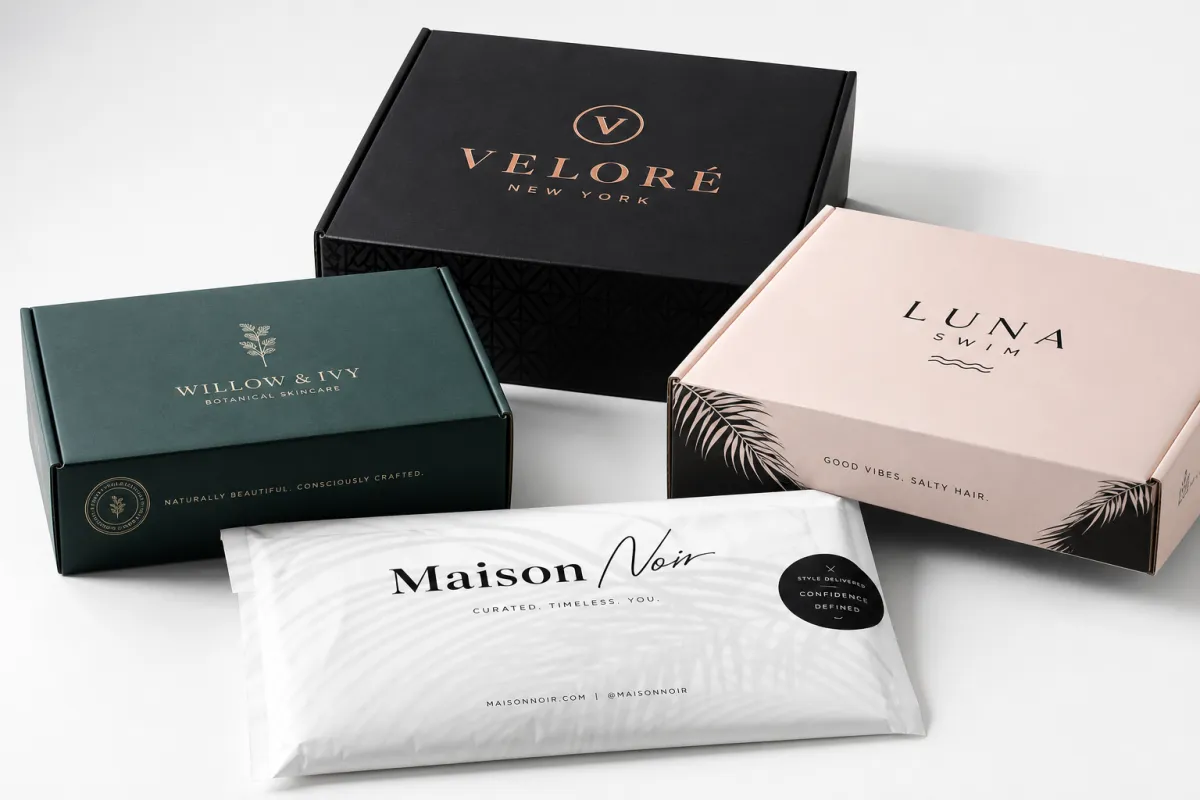
Branded retail packaging mailers are shipping mailers printed with a retailer’s logo, artwork, and message. They are usually made from polyethylene film, co-extruded film, recycled-content film, or paper-based material, depending on the product and the brand’s priorities. The key point is simple: the package is not only there to move goods. It is part of the brand itself. That means the outside has to look deliberate, the seal has to hold, and the size has to fit the product without making the whole thing look sloppy.
Plain mailers cover a shipping need. Branded retail packaging mailers cover a shipping need and a brand problem at the same time. That is why they show up so often in apparel, beauty accessories, print goods, and lightweight retail kits. A plain white or gray mailer can absolutely do the job. A branded one tells the customer, right away, that the order came from a business that pays attention. Small detail. Big signal.
There is a practical side too. A well-built mailer can cut tare weight, speed up handling, and resist moisture better than many paper-only options. When the structure is right, branded retail packaging mailers are quick to load, easy to seal, and compact enough to store in a tight fulfillment area. That combination matters. It keeps the line moving while still giving the shipment a polished look.
I see the same mistake over and over: people treat the mailer like an afterthought. If the product is soft, flat, or otherwise non-fragile, branded retail packaging mailers may be the most efficient format in the whole program. If the item needs crush protection, suspension, or heavy void fill, a carton still makes more sense. The goal is not to force every order into one packaging style. The goal is to match the package to the product and the shipping risk.
"A mailer looks simple from the outside. Then it has to survive packing, transit, the porch, and the opening moment. That is a lot of work for one thin package."
From a production angle, branded retail packaging mailers stand out because they move through fulfillment with fewer steps than many rigid formats. No box folding. No void fill in most cases. Less storage footprint before use. That matters when a team ships hundreds or thousands of units a week. If the design is clean, the seams are strong, and the print reads clearly, branded retail packaging mailers can deliver a sharp first impression with very little friction on the line.
And yes, some brands still try to cram box thinking into a mailer and then wonder why it feels off. The format has its own rules. Once you respect those rules, it starts pulling its weight fast.
How branded retail packaging mailers work in fulfillment
Fulfillment is where branded retail packaging mailers either earn their keep or slow everything down. The packer needs a size that opens easily, holds the product without force, and seals cleanly without extra fuss. Too tight, and the seam wrinkles while the closure becomes unreliable. Too loose, and the product shifts around, the package looks puffy, and the whole thing starts feeling wasteful before it even leaves the dock. Good branded retail packaging mailers are designed for the packing station, not just for a polished mockup.
Material structure matters just as much. A 2.5 mil to 3 mil co-ex poly is often a practical choice for apparel because it balances cost with puncture resistance. Heavier items may need thicker film or a different construction. Seal strength, edge integrity, and opacity all matter because the mailer has to stay presentable as it moves through conveyors, bins, totes, and trucks. If the print sits in the wrong place, or the adhesive zone crowds a graphic, the final package can look off even when the dimensions are technically correct.
Testing resources from ISTA can help if you are reviewing drop, vibration, or compression risk. Not every retail program needs a full lab-style validation process, but a basic pack-out test with the real product weight and the real sealing method usually tells you plenty. Branded retail packaging mailers make that test even more useful because seams, closure lines, and printed areas all affect how the package behaves in the real world.
Branding mechanics also matter in fulfillment. A logo can sit on a broad color field, or it can be placed more quietly so the mailer feels premium without shouting. QR codes, return instructions, social handles, and campaign copy all have a place, but every element competes with legibility and manufacturing tolerance. What looks elegant on screen can get crowded once it wraps around a working mailer. That is why branded retail packaging mailers should be reviewed in the final format, not only as a flat file.
They also shape the unboxing moment in a very specific way. A mailer does not need rigid structure to feel intentional. If the color is consistent, the logo reads cleanly, and the opening feels controlled, the customer gets a small hit of order and care before touching the product. That is why branded retail packaging mailers work so well for apparel, accessories, subscription kits, and flat retail items that benefit from a branded opening sequence without the cost of a full carton system.
Key factors that shape performance, cost, and appearance
Size and fit come first. Oversized mailers waste film, create extra air in transit, and often push postage higher than it needs to be. Undersized mailers force the product against the seam, make loading harder, and wrinkle the printed surface in ugly ways. With branded retail packaging mailers, fit is not just a visual issue. It affects cost, line speed, and how finished the package looks when it lands in the customer’s hands.
Material choice is the next big decision. Virgin film usually gives consistent clarity and strength. Recycled-content film can support sustainability goals. Paper-based alternatives may suit certain retail aesthetics if moisture risk stays low. Some buyers want an FSC-linked paper component, and the FSC system can help with sourcing conversations when certified fiber matters. Branded retail packaging mailers should always be chosen for the real item, not the nicest spreadsheet row. Soft goods and flat merchandise often need flexibility. Products with corners or hardware may need heavier film or a reinforced structure.
Print coverage changes the economics too. A one-color logo on a white or kraft field is usually easier to run than a full-bleed, multi-color layout with tight registration targets. Flood coverage can look sharp, but it can also raise setup complexity and make alignment more sensitive. A common mistake is dropping box artwork onto a mailer and pretending the format does not matter. It does. Branded retail packaging mailers need graphics designed for film surfaces, not artwork borrowed blindly from custom printed boxes.
Operational realities matter just as much. Minimum order quantities, storage space, monthly usage, and seasonal swings all affect the best choice. If a brand ships two main SKU sizes, it may need two mailer sizes to avoid wasted space. If the brand runs campaign-specific artwork, inventory planning gets messier because the team has to carry the right version at the right time. Branded retail packaging mailers work best when the buyer thinks in program terms, not one-time purchase terms. Flashy is nice. Efficient usually wins.
Three planning questions usually surface the right direction:
- Does the mailer need moisture resistance, puncture resistance, or just a clean presentation?
- Will the pack-out line benefit more from one universal size or a small size set?
- Should the design feel bold and retail-forward, or clean and restrained?
Those questions sound basic because they are. They are also the difference between a mailer that supports the operation and one that quietly burns time and money. Branded retail packaging mailers work best when appearance, cost, and handling all point the same way.
Branded retail packaging mailers cost and pricing factors
Pricing for branded retail packaging mailers usually starts with quantity, material structure, dimensions, and print complexity. A small run with heavy ink coverage, multiple colors, and a custom size will almost always cost more per unit than a larger repeat order with a simpler design. Setup costs matter too. Plate charges, proofing, color matching, and artwork adjustments all take time, and time has a price. Buyers who only compare the lowest quote often miss the real cost once freight and reorders show up.
A lower unit price can still create a higher total cost if the mailer is oversized, too thin for the product, or likely to fail in transit. Every damaged shipment triggers customer service time, reshipment expense, and a brand headache that never shows up on a quote sheet. That is why branded retail packaging mailers should be priced as part of the full outbound system, not as a single line item. A slightly better material or tighter fit can pay back fast if it cuts down on replacements.
The table below gives a practical comparison point for common mailer choices. Exact numbers change with size, print coverage, and volume, but this is the kind of range buyers often review when planning branded retail packaging mailers for apparel or similar products.
| Option | Typical Use | Approx. Unit Cost at 5,000 | What It Changes |
|---|---|---|---|
| Basic printed poly mailer | Light apparel, soft goods, low-moisture risk | $0.12-$0.22 | Lowest weight and fastest pack-out, but less premium presentation |
| Co-ex branded mailer, 2.5-3 mil | General retail shipping with strong print visibility | $0.18-$0.32 | Better toughness and a more polished feel for branded retail packaging mailers |
| Recycled-content film mailer | Retail programs with sustainability targets | $0.20-$0.36 | Can support branded packaging messaging, though availability and color options may vary |
| Heavier-duty custom mailer, 3-4 mil | Bulkier apparel or items with sharper edges | $0.26-$0.44 | Improves puncture resistance and seal confidence |
| Padded or hybrid retail mailer | Light protection plus presentation | $0.35-$0.75 | Raises cost and weight, but adds cushioning for more delicate items |
Most pricing levers are pretty straightforward once you know where to look. Tooling or plate charges, one-time artwork setup, freight class, rush fees, and repeat-run cadence all influence the final number. A larger initial order can pull the unit cost down enough to justify inventory holding. A smaller run can make more sense if storage is tight or the design will change soon. Branded retail packaging mailers should be chosen with cadence in mind. How often you reorder matters almost as much as the first invoice.
I always tell people to compare unit cost against landed cost and failure cost. If the mailer saves two cents but creates a 2% damage rate, it is not saving money. If a print upgrade makes the package look noticeably more premium and supports retail positioning, that can be money well spent. The best choice is the lowest-cost option that still feels credible, protects the product, and reinforces the brand story.
Step-by-step process and timeline for ordering
The ordering process for branded retail packaging mailers starts with product dimensions, shipping method, and brand goals. Before artwork gets anywhere near final approval, the buyer needs to know the packed size of the item, whether the product is folded, bagged, or boxed, and how the fulfillment team plans to seal the mailer. Those basics drive the starting size, the recommended material thickness, and the closure type. Miss that part, and the rest gets messy fast.
Once the size and structure are set, artwork prep begins. Good files save time. Vector logos, clean color references, intended copy, and any must-have compliance details should come in early. If the brand uses a specific PMS target or wants color consistency across other packaging pieces, that needs to be stated upfront. Branded retail packaging mailers usually need more layout discipline than people expect because the printable area has to work around seams, folds, and seal zones.
The timeline usually includes proofing, revision, production, and freight. Simple jobs move faster when the artwork is ready and the size is already settled. More complex projects take longer because color review and approvals add back-and-forth. A practical planning window is often 12-20 business days from proof approval to production completion, then additional transit time depending on freight mode and destination. That is not a hard rule, just a realistic frame for many custom orders. Branded retail packaging mailers are not something I would leave to the final week before launch.
Here is the information that speeds things up most:
- Product dimensions and packed thickness.
- Target quantity and expected monthly usage.
- Artwork files, logo placement, and color preferences.
- Seal type, opening style, and any return messaging.
- Any sustainability, certification, or retail compliance requirements.
That information makes it easier to compare options across Case Studies and confirm that the chosen format fits the actual production environment. It also cuts down the chance that a proof looks fine on screen but misses the real pack-out behavior. If the team needs a broader packaging program, compare branded retail packaging mailers with other Custom Packaging Products so the final choice supports both launch timing and future reorder cycles.
Planning ahead matters most during peak selling periods. If inventory will rise before a promotion or seasonal launch, the mailers should be ordered early enough that freight delays do not turn into a packaging crisis. A well-run branded retail packaging mailers program is usually invisible to the customer because the supplies arrive on time, fit the product, and keep the line moving.
Common mistakes when choosing retail packaging mailers
The first mistake is designing for looks alone. A mailer can have beautiful graphics and still fail if the seam splits, the adhesive is inconsistent, or the material is too light for the product. Once the shipment leaves the dock, a weak structure turns into a customer problem fast. Branded retail packaging mailers have to perform in transit, not just pose nicely in a mockup.
The second mistake is ignoring the actual pack-out. If the product is too thick for the chosen size, the package stretches, wrinkles, and distorts the print. If the product is too loose, the shipment feels underfilled and moves around more than it should. Neither one helps the retail presentation. Testing the mailer with the real item is the easiest way to catch these problems before they become expensive. Boring step. Useful result.
The third mistake is obsessing over unit price and ignoring the full cost of ownership. Freight, storage, inventory holding, reorders, and damage replacement all matter. A quote that looks great can still become the expensive choice if the mailers are overbuilt, overstocked, or underperforming. Branded retail packaging mailers should be judged across the entire shipping cycle, from incoming pallet to final delivery.
The fourth mistake is skipping proof review or treating it like a formality. Color shifts, logo placement errors, missing compliance details, and weak copy alignment all show up at proof stage more often than people want to admit. Those problems are much easier to fix before production starts. Good buyers slow down here on purpose. That little bit of discipline usually pays off in cleaner retail packaging and fewer launch delays.
- Match the mailer to the real product thickness, not the flat art file.
- Check print areas near seams, folds, and closures before approval.
- Confirm that the seal method fits your fulfillment process.
- Review freight and storage impact before you lock the order.
Stay disciplined on those points, and branded retail packaging mailers become much easier to manage. The brand image also feels more deliberate from the first shipment onward.
Expert tips for better branded retail packaging mailers
My strongest advice is simple: test with real pack-outs, not just flat mockups. A mailer should be evaluated with the actual product weight, the way it folds, the way the seal behaves, and the way the outside surface looks after handling. Branded retail packaging mailers can seem perfect until a real item goes in, and then the print distorts, the seam pulls, or the package looks too empty. A practical test finds the truth faster than a polished render ever will.
Keep the design disciplined. Strong logo placement, readable type, and a little breathing room often look more premium than a crowded artwork field loaded with slogans and visual noise. That does not mean the package needs to be minimal or boring. It means the surface should feel intentional. Good branded packaging does not need to yell to be memorable, and branded retail packaging mailers benefit from that restraint because the format is already doing double duty as both shipping protection and brand carrier.
Think in program terms, not one-off terms. If the line will grow, choose a mailer size and print approach that can handle repeat orders and modest variation without forcing a full redesign every time. That might mean a neutral core design with seasonal overlays, or a small family of mailer sizes that covers most of the catalog. The brands that get the best long-term value from branded retail packaging mailers usually plan for reorders, not just launch day.
Get marketing, operations, and fulfillment in the same room early. Marketing cares about package branding, operations cares about speed and storage, and fulfillment cares about ease of use and seal reliability. When those groups review the same sample, the decision gets stronger. That kind of cross-functional review is usually where the best retail packaging choices come from, because the final mailer has to satisfy more than one department at once.
A few more habits improve outcomes:
- Approve color against a real sample whenever possible.
- Ask for a sample that matches the final film and print method.
- Keep one version of the artwork as a master file for reorder consistency.
- Set a reorder point before you run low, so the next batch is not rushed.
With those habits in place, branded retail packaging mailers are much more likely to behave like a stable part of the operation instead of a recurring project that needs constant fixing.
Actionable next steps for choosing branded retail packaging mailers
Start with the product, not the print. Measure the item carefully, note the packed thickness, and decide what shipping problem you are trying to solve. Maybe you want a cleaner presentation. Maybe you want lower material cost, fewer damages, or faster pack-out. Once that goal is clear, branded retail packaging mailers get much easier to specify because the selection criteria stop being fuzzy.
Then put together a short vendor brief. Include dimensions, target quantity, artwork goals, preferred material, expected monthly usage, and any budget guardrails. That brief helps you compare options fairly and keeps the conversation focused on fit and function instead of guesswork. If your brand already uses other retail packaging pieces, note that relationship too. Branded retail packaging mailers should fit the system, not fight it.
Request samples or proofs and test them with real products. Watch the seal, inspect the print clarity, check how the material feels in hand, and see how the mailer stores on a shelf or pack bench. That kind of evidence beats a generic promise every time. If the sample performs well, the final order usually follows the same pattern. If it does not, you still have room to adjust before you commit volume.
Finally, set a reorder trigger and a review schedule. The best packaging programs stay in stock, stay current, and stay aligned with the brand. Branded retail packaging mailers should support the next shipment cycle without panic buying, last-minute file changes, or emergency freight. When the size is right, the material is right, and the artwork is built for the format, the package works hard on both the shipping side and the brand side.
Branded retail packaging mailers are at their best when they are treated as a repeatable system, not a one-time purchase. That mindset keeps retail packaging practical, credible, and ready for growth. Measure the real product, test the real pack-out, and lock the artwork to the actual mailer spec. Do that, and the next shipment should feel dialed in instead of kinda improvised.
Frequently Asked Questions
What are branded retail packaging mailers used for?
They are used to ship retail items in a way that protects the contents while creating a branded first impression. They work especially well for apparel, accessories, soft goods, and other lightweight products that do not need a rigid carton. They also help connect fulfillment and marketing by turning a shipping need into part of the customer experience.
How do branded retail packaging mailers affect shipping costs?
Their lighter weight can reduce postage compared with heavier rigid packaging, and the right size helps avoid dimensional waste and unnecessary material spend. Oversized or overbuilt mailers can raise both shipping and production costs, so fit matters. For many brands, branded retail packaging mailers quietly save money over time.
What should I check before ordering branded retail packaging mailers?
Confirm product dimensions, pack-out thickness, and the sealing method your team will use. Review artwork placement, color expectations, and any required compliance or return information. Ask about minimum order quantities, lead times, and sample or proof approval steps so the process stays predictable.
How long does it usually take to produce custom retail packaging mailers?
The timeline depends on artwork readiness, proof approval, order size, and production scheduling. Simple orders move faster when files are finalized and sizing is already confirmed, while more complex branded retail packaging mailers need more revision time. It is smart to plan ahead so the packaging arrives before inventory is needed on the packing line.
Are branded retail packaging mailers a good option for small businesses?
Yes, if the product is lightweight and the brand benefits from a polished shipping presentation. Small businesses often use them to look more established without adding much packing complexity. The best results come from choosing a practical size, a durable material, and a design that is easy to reproduce consistently, which is exactly why branded retail packaging mailers can be such a smart early packaging investment.


