Buyer Fit Snapshot
| Best fit | Branded Unboxing Inserts Wholesale for Premium Packaging projects where brand print, material claims, artwork control, MOQ, and repeat-order consistency need to be specified before quoting. |
|---|---|
| Quote inputs | Share finished size, material target, print colors, finish, packing count, annual reorder estimate, ship-to region, and any compliance wording. |
| Proofing check | Approve dieline scale, logo placement, barcode or warning zones, color tolerance, closure strength, and carton packing before bulk production. |
| Main risk | Vague material claims, crowded artwork, missing packing details, or unclear freight terms can make a low unit price expensive after revisions. |
Fast answer: Branded Unboxing Inserts Wholesale for Premium Packaging should be specified like a repeatable production item. The safest quote records material, print method, finish, artwork proof, packing count, and reorder notes in one written spec.
Production checks before approval
Compare the actual filled-product size with the drawing, then confirm tolerance on folds, seals, hang holes, label areas, and retail display edges. Reserve space for logos, QR codes, warning copy, and material claims before decorative graphics fill the panel.
Quote comparison points
Review material grade, print process, finish, sampling route, tooling charges, carton quantity, and freight assumptions side by side. A quote is only useful when the supplier can repeat the same color, closure quality, and packing count on the next order.
Branded Unboxing Inserts Wholesale for Premium Packaging
A plain mailer can turn into a premium package the second branded unboxing inserts wholesale are built to hold the product with actual purpose. The difference shows up fast. One shipment feels like it was tossed together. The other feels planned from the first lift of the lid. The insert does three jobs at once: it locks the item in place, frames the product for the eye, and gives the packing team a repeatable structure that does not slow fulfillment to a crawl.
For a packaging buyer, branded unboxing inserts wholesale is not just another line item. It is control. Control over movement, protection for fragile goods, and a way to turn the inside of the box into part of the brand story without ordering a fully custom outer carton for every run. That matters for launches, replenishment orders, and subscription programs where consistency matters as much as looks.
I have watched brands spend weeks arguing over print color and then lose the plot on the insert. That's backwards. If the product rattles, shifts, or arrives scuffed, the fancy outer print does not save the experience. The interior has to earn its keep first.
Branded unboxing inserts wholesale: why the insert changes the sale
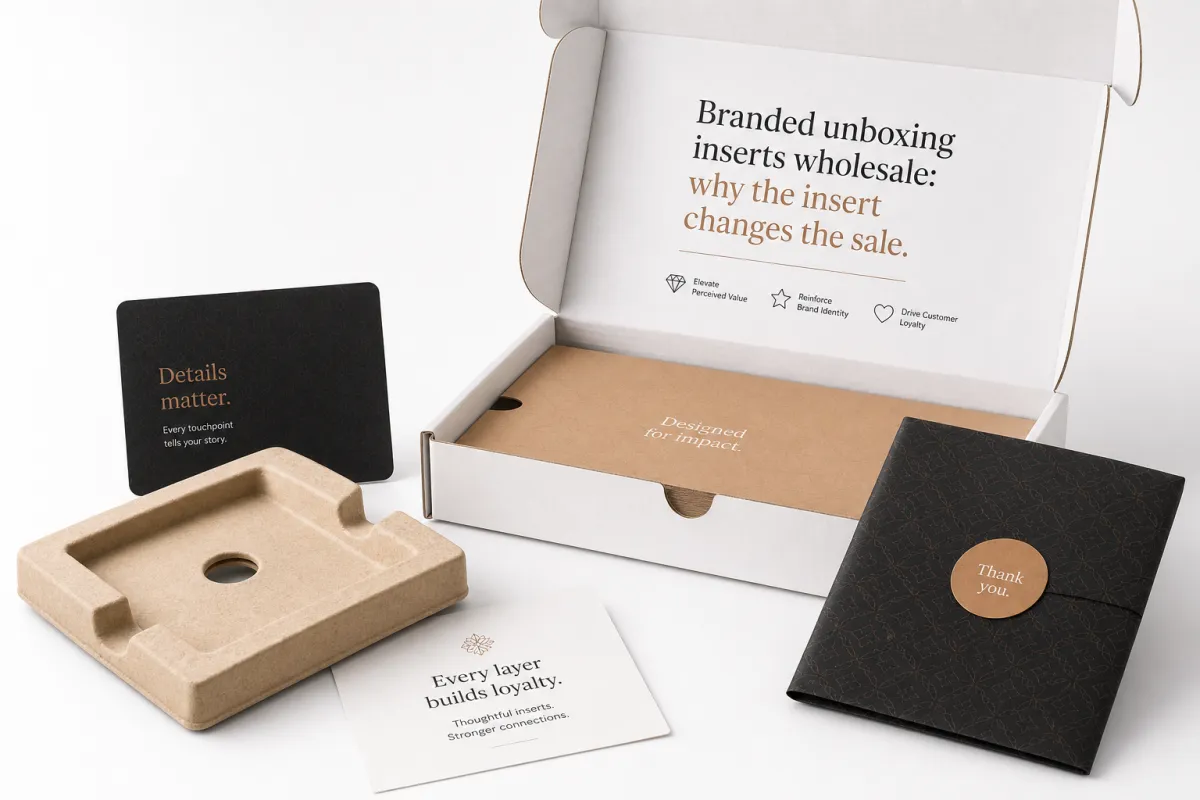
A standard shipping box feels ordinary until the product stops shifting and lands in a dedicated cavity that says, right away, somebody thought this through. That is the practical strength of branded unboxing inserts wholesale. The insert makes a simple outer carton act like a premium package even when the carton itself is plain. Cosmetics, candles, supplements, and electronics accessories all benefit because the product arrives centered instead of smashed into one corner or rubbing against the walls of the shipper.
Buyers like to obsess over graphics. Fine. Graphics matter. Still, the better question is whether the interior is actually doing enough work. A well-made insert cuts breakage, reduces filler, speeds up packing, and gives the customer a cleaner reveal when the box opens. With branded unboxing inserts wholesale, the brand is not only printed on the surface. It is reinforced by the way the product is held, how the lid opens, and the order the customer sees as each piece comes out.
"If the item moves, the package feels cheap. If the item lands where it should, the shipment feels deliberate."
That sounds blunt because it is. It shows up on the packing floor every day. From a brand-owner perspective, branded unboxing inserts wholesale is valuable because it gives repeatability. The same cavities, the same tuck locations, and the same print layout can be produced again and again. That matters when a fulfillment team has to build hundreds or thousands of kits with low error rates. Consistency is not decoration. It is an operational advantage.
There is also a quieter upside. A stable insert can lower support tickets tied to broken glass, leaking bottles, bent accessories, and missing components. That does not sound glamorous, but it saves real money. And unlike a social post, it does not disappear after twenty-four hours.
Branded unboxing inserts wholesale product details and common formats
The most common branded unboxing inserts wholesale formats are paperboard inserts, corrugated dividers, molded fiber trays, folding cartons with internal retention, and custom die-cut carriers shaped around specific products. Each one handles a different kind of load. A lightweight beauty serum may only need an 18pt paperboard cradle, while a heavier accessory kit may need corrugated structure or a molded tray that can take vibration without collapsing.
Multi-piece kits need more than a slot and a prayer. They need separation without turning the pack into a brick. That is where branded unboxing inserts wholesale work well for subscription boxes, PR kits, and launch sets. The insert can organize one item, three items, or ten items into a sequence that feels intentional. Fold-over pockets, locked tabs, and layered compartments keep pieces from knocking into each other during shipment, and they help the packer place every component in the same position every time.
There is a visual side too, and ignoring it is lazy. branded unboxing inserts wholesale can carry one-color logos, full-surface printed copy, inside-lid messaging, QR codes, product names, or short usage prompts that help the customer understand what they are holding. For some brands, the insert is the first place the customer sees the note to recycle, reuse, or register a product. For others, it is the first place the voice gets warmer and less corporate.
The right format depends on the product and the box it lives inside. A rigid insert can make a gift set feel expensive, but a faster-folding paperboard design may be smarter for a high-volume ecommerce launch where labor time matters. That is why branded unboxing inserts wholesale should match the packing method, not just the mood board. The strongest structure is the one that protects the product, speeds the line, and still looks sharp after the customer opens it.
Common applications include:
- Cosmetics, skincare, and fragrance sets that need product separation and a polished reveal.
- Candles and glass jars that benefit from snug retention and less movement.
- Supplements and wellness kits that need a clean interior layout and clear product hierarchy.
- Electronics accessories, chargers, and small devices that require fixed cavities and light cushioning.
- Apparel extras, gift cards, and samples that should arrive in a tidy, branded sequence.
On real programs, the most successful insert is often the one nobody notices until they try to remove the product. That's the goal. If the reveal feels natural and the item is easy to lift, the structure did its job.
Materials, print methods, and structural specifications
Material choice changes everything about branded unboxing inserts wholesale, from print sharpness to crush resistance to the way quality feels in the hand. SBS paperboard is a familiar choice for clean graphics and tight folds. Kraft board brings a natural tone that fits earthy, minimal, or sustainability-forward branding. Corrugated board adds stiffness and shock resistance, especially when the pack has to protect heavier items in parcel shipping. Molded fiber brings a distinct tactile feel and works well when the brand wants a more fiber-forward presentation.
Print method matters just as much. branded unboxing inserts wholesale can be produced with offset printing for strong color control on larger runs, digital printing for shorter or more variable jobs, and simple one- or two-color branding when the budget belongs on structure instead of heavy coverage. Finishes such as aqueous coating, matte varnish, gloss varnish, or soft-touch laminate change the touch point and help with scuff resistance. Soft-touch can feel upscale, but it is not right for every product because some packs need a tougher, easier-to-wipe surface.
The spec sheet should be precise before production starts. For branded unboxing inserts wholesale, the factory needs product dimensions, item weight, product count, shipping method, and whether the insert must fit inside an existing mailer or be built as part of a new packaging system. Thickness is especially important. An 18pt board may suit a light accessory, while a thicker stock or a corrugated caliper may be needed for a heavier item or a wider cavity span. The wrong caliper creates loose fit, bowed walls, or waste the team did not need to pay for.
Good quoting starts with clean data. If the team has to guess at bottle neck diameter, lid height, cable bundle size, or tray depth, the revision cycle gets longer and the risk of a bad fit goes up. That is why seasoned buyers prepare a drawing or measurement list before requesting branded unboxing inserts wholesale. A complete spec sheet reduces back-and-forth, speeds up sampling, and helps the supplier decide whether the job should be run on flat sheet, die-cut board, molded tooling, or a hybrid structure that combines more than one material.
For buyers who want to check transit performance, many parcel shippers validate packaging against ISTA test methods, and those protocols can help confirm whether a chosen insert actually protects the product in distribution. The International Safe Transit Association is a useful reference point for that kind of work. For sourcing expectations around fiber-based material, FSC certification can also matter, especially when the brand wants a chain-of-custody claim on paperboard or molded fiber components; the Forest Stewardship Council provides that framework.
In many programs, the winning combination is not the flashiest one. It is the one that holds tolerance, prints cleanly, and shows up in the warehouse ready to use. That is the real test for branded unboxing inserts wholesale: the insert has to work on the screen, on the sample bench, and on the packing line.
I also tell teams not to over-spec the finish just because it sounds premium. A beautiful coating that scuffs in transit is not premium. It is just expensive disappointment. Sometimes the smarter move is a simpler board with better structure and one clean print hit.
Customization options for branded unboxing inserts wholesale orders
Customization starts with the basics, then can go much further than a logo. branded unboxing inserts wholesale can carry product names, sequence numbers, thank-you notes, QR codes, care instructions, sample callouts, and cross-sell prompts that encourage a second purchase. That is useful for ecommerce brands because the insert becomes a quiet sales tool as well as a support structure. The message does not need to shout. It just needs to sit where the customer naturally looks while removing the product.
Artwork planning should follow the insert structure, not fight it. Folds, lock tabs, glue areas, and cut lines all affect where text and graphics can sit cleanly. With branded unboxing inserts wholesale, the dieline belongs in the creative brief, not in the “we’ll fix it later” pile. Logos placed too close to a fold can distort, and small text that runs into a cavity edge can disappear once the board is folded. A good layout respects the way the board moves during assembly.
File prep saves time and cuts down on avoidable proof changes. Suppliers usually work faster when logos are supplied in vector format, fonts are outlined, bleed is included, and the dieline is clearly marked. That matters with branded unboxing inserts wholesale because the same platform is often used across multiple SKU variations, each with a slightly different cavity, printed panel, or messaging block. Version control keeps the parts from mixing, especially when one insert design supports a family of products.
A practical customization plan usually includes these decisions early:
- Where the logo should appear so it stays visible after the product is placed.
- Whether the interior needs copy, icons, or instructions printed on hidden or revealed surfaces.
- Which parts of the insert must remain blank so barcodes, lot codes, or fulfillment labels can be applied later.
- Whether the design should feel premium, natural, technical, or gift-like.
- How much assembly time the custom layout adds for the warehouse team.
That last point gets ignored too often. A beautiful structure is not successful if it slows the line or causes repeat mistakes during packing. The best branded unboxing inserts wholesale setup supports the brand and the operation at the same time, which is why packaging teams should review sample builds before approving final art. In many cases, a slightly simpler insert wins because it assembles faster and still gives the customer the visual payoff the brand wants.
One more practical tip: ask for a physical sample if the project is headed into a launch or a large replenishment. Screen approvals are fine for color direction, but paperboard tabs, tray depth, and cavity retention are tactile problems. You cannot eyeball those from a PDF. Not well, anyway.
Pricing, MOQ, and wholesale economics for branded unboxing inserts wholesale
The price of branded unboxing inserts wholesale depends on more than size. Material, board thickness, print coverage, finish, cavity complexity, die count, folding steps, and total quantity all affect the quote. A short run with heavy print coverage and a complex die will always cost more per unit than a larger repeat run with a simpler structure. That is not a sales trick. It is setup cost, press time, and tooling getting spread across the order.
MOQ follows manufacturing logic. With branded unboxing inserts wholesale, a straightforward paperboard insert may start at a more flexible quantity than a highly engineered multi-piece structure, because simple runs use less setup and fewer production steps. Buyers should ask for several volume points so they can see the price curve, not just the first number. A quote at 1,000 units tells one story, but the same design at 5,000 or 10,000 units usually tells a better one because unit cost drops as setup gets spread out.
There is a bigger budget question that teams miss all the time. A slightly stronger insert may reduce damage claims, customer complaints, repacking labor, and replacement shipments. That is why branded unboxing inserts wholesale should be compared on total packaging cost, not sticker price alone. If a better insert lowers transit loss and saves packing time, the higher unit cost can pay for itself quickly. Packaging buyers who only compare board price often miss the operational savings that show up later.
Here is a practical planning table that helps compare common options at a wholesale level. These are planning ranges, not fixed quotes, because print coverage, structure, and quantity change the final number.
| Insert Type | Best For | Typical Wholesale Unit Range | Notes |
|---|---|---|---|
| Paperboard insert | Light products, cosmetics, small kits | $0.18-$0.42 | Clean print, fast assembly, good for tighter cavities |
| Kraft board insert | Natural branding, simple retail and ecommerce packs | $0.16-$0.38 | Lower decoration cost, earthy appearance, strong brand fit |
| Corrugated divider or tray | Heavier items, parcel shipping, multi-item kits | $0.14-$0.35 | Better stiffness and stacking strength, slightly bulkier profile |
| Molded fiber tray | Premium fiber presentation, shock protection | $0.22-$0.55 | Distinct texture, good for sustainability-forward packaging programs |
| Rigid or specialty insert | Gift sets, higher-end launch kits, premium electronics | $0.45-$1.20 | Higher material and labor cost, strong shelf and unboxing presence |
Those ranges only make sense when the buyer understands the full package structure. With branded unboxing inserts wholesale, the insert may be a small part of the total box spend, but it has an outsized influence on product protection and customer perception. That is why experienced teams compare like with like: the same product count, the same shipping method, the same print coverage, and the same assembly approach. Otherwise, the cheapest quote can turn into the most expensive solution once labor and damage are included.
Wholesale programs matter for replenishment too. If the brand expects repeat orders every quarter, it is worth setting up the design once and reordering the same format to preserve cost and fit. That is one reason Wholesale Programs matter for packaging teams that want predictable supply instead of starting over every cycle. In many cases, the first branded unboxing inserts wholesale order is the setup order, and later runs get easier to budget because the structure is already approved.
Budgeting gets cleaner if you separate the structure cost from the decoration cost. That way you can see whether the premium is coming from the cavity design, the finish, or the print method. Otherwise, the quote can feel fuzzy. Fuzzy budgets cause weird decisions, and weird decisions are how packaging projects blow up for no good reason.
Production process and realistic timeline for branded unboxing inserts wholesale
The production path is usually straightforward, but every step still matters. A typical branded unboxing inserts wholesale project moves through inquiry, specification review, estimate, structural recommendation, artwork setup, proof approval, sampling if needed, production, finishing, packing, and shipment. If the buyer already has exact product dimensions and a clear box size, the early stages move faster. If the supplier has to interpret measurements from photos or partial sketches, the schedule stretches fast.
For lead time, a realistic range is more useful than a promise that sounds neat. Simple branded unboxing inserts wholesale orders can often move in roughly 12-18 business days after proof approval, while more complex jobs, special finishes, or sampling requests can add several days. Transit time sits on top of production time, and internal receiving or kitting can add more time again. A launch calendar should include all of those layers, not just the manufacturing window.
Most delays come from a small list of predictable issues: missing measurements, late artwork changes, unclear product samples, or a change in insert style after proofing has started. The good news is that these problems are preventable. With branded unboxing inserts wholesale, the fastest projects are the ones where the team locks the product dimensions early, confirms the fit target, and keeps the artwork stable until final approval. Even a one-inch shift in the product or a last-minute copy edit can push the run back several days.
Packaging teams also need to think beyond factory output. The insert might arrive on time, but if the warehouse still has to stage box components, train packers, or load products into separate kitting stations, the actual launch date can slip. That is why branded unboxing inserts wholesale should be scheduled with the whole operation in mind. A supplier can meet production timing and still leave the buyer short if the shipping plan or receiving plan is not aligned.
A dependable partner should communicate milestones clearly and flag problems before they become delays. That matters for programs that coordinate with launch dates, retail windows, or seasonal peaks. A good branded unboxing inserts wholesale schedule leaves room for sample review, a small approval buffer, and transit time. That buffer is not wasted time. It is what keeps the packaging plan from turning into a rush job.
In practice, the strongest timelines are boring. No panic. No last-minute art fix. No one pretending a half-measured product sample is enough. Boring is good. Boring means the insert arrives, fits, and gets used.
Why choose us for branded unboxing inserts wholesale and what to do next
Working with a packaging partner that understands production realities saves time because the recommendation is based on fit, structure, and assembly as much as branding. That matters for branded unboxing inserts wholesale because the insert has to do a practical job before it does a visual one. A supplier that knows board caliper, cavity tolerances, and packing flow can help the buyer avoid overbuilding the part or underbuilding it.
At Custom Logo Things, the best projects usually start with a few clear inputs: product dimensions, box dimensions, quantity, shipping method, and the level of print or finish the brand wants to see. With branded unboxing inserts wholesale, that information is enough to get a useful structure recommendation and a quote that reflects real production conditions rather than vague guesses. If the buyer already has a dieline, even better. If not, the structure can still be developed around the actual product and the intended pack sequence.
The next step is usually simple. Confirm whether the insert must fit inside an existing box or whether the box itself can be adjusted, Choose the Right material for the product weight and presentation goal, then compare the quote at several quantities. That process makes branded unboxing inserts wholesale easier to evaluate because the buyer can see how unit cost changes with volume, and whether a small upgrade in board or finish makes sense for the brand.
Our Case Studies show how packaging decisions play out in real production settings, which helps when a team is deciding between a simple insert, a premium tray, or a more complex kit layout. In that review process, branded unboxing inserts wholesale becomes less about guessing and more about matching the insert to the product, the audience, and the fulfillment model. That is usually where the best value shows up: not in the cheapest board, but in the structure that prevents waste and presents the product cleanly.
If you are ready to move, gather the product measurements, the inside dimensions of the box, a rough quantity target, and any print requirements before requesting a quote. That gives the supplier a clean starting point and helps the first proof come back closer to final. For brands that want a better interior presentation without turning the packaging program into a complicated custom project, branded unboxing inserts wholesale is a practical next move. The right insert turns a shipping container into part of the brand experience, and it does so with structure, consistency, and real production value.
My short version: measure the product, confirm the shipping format, pick the right board for the load, and approve a physical sample before you lock a big order. Do those four things and the whole program gets a lot less annoying. Skip them, and you're kinda asking for a mess.
Frequently Asked Questions
What affects branded unboxing inserts wholesale pricing the most?
Material, print coverage, insert size, die complexity, finishing, and total quantity are the biggest cost drivers. Short runs usually cost more per unit because setup costs are spread across fewer inserts, while larger runs tend to lower the unit cost. More detailed structures or premium finishes can raise price, but they may also improve presentation and reduce damage.
What MOQ should I expect for wholesale branded unboxing inserts?
MOQ depends on the insert style, material, and print method rather than one fixed number for every project. Simpler paperboard or corrugated inserts often allow more flexible starting quantities than complex multi-part structures. The smartest move is to request pricing at several volume levels so you can compare the cost curve before committing.
How do I prepare artwork for branded unboxing inserts wholesale?
Use vector logos, outlined fonts, and the correct dieline from the supplier before placing artwork. Keep critical text away from folds, cut lines, glue zones, and edges that may trim in finishing. Ask for a proof review so the print layout matches the structure before production begins, especially if the insert has multiple cavities or fold points.
How long does production usually take for custom wholesale inserts?
Lead time depends on quantity, structure, print method, and whether a sample or proof approval is needed. Clean files and final dimensions help move the job faster, while late design changes usually extend the timeline. Build in extra time for shipping and internal packing so the inserts arrive before the launch or restock date.
Can branded unboxing inserts wholesale orders fit an existing box?
Yes, many inserts are designed to fit inside an existing mailer, folding carton, or shipping box. Provide exact inside dimensions of the box and the product dimensions so the insert can be engineered for a proper fit. A good fit keeps the product stable, improves presentation, and reduces wasted space inside the package.


