Buyer Fit Snapshot
| Best fit | Mailing Bags for Retail Stores projects where brand print, material claims, artwork control, MOQ, and repeat-order consistency need to be specified before quoting. |
|---|---|
| Quote inputs | Share finished size, material target, print colors, finish, packing count, annual reorder estimate, ship-to region, and any compliance wording. |
| Proofing check | Approve dieline scale, logo placement, barcode or warning zones, color tolerance, closure strength, and carton packing before bulk production. |
| Main risk | Vague material claims, crowded artwork, missing packing details, or unclear freight terms can make a low unit price expensive after revisions. |
Fast answer: Mailing Bags for Retail Stores: Choose the Right Fit should be specified like a repeatable production item. The safest quote records material, print method, finish, artwork proof, packing count, and reorder notes in one written spec.
Production checks before approval
Compare the actual filled-product size with the drawing, then confirm tolerance on folds, seals, hang holes, label areas, and retail display edges. Reserve space for logos, QR codes, warning copy, and material claims before decorative graphics fill the panel.
Quote comparison points
Review material grade, print process, finish, sampling route, tooling charges, carton quantity, and freight assumptions side by side. A quote is only useful when the supplier can repeat the same color, closure quality, and packing count on the next order.
Mailing Bags for Retail Stores: Choose the Right Fit
Most damage claims do not start with a bad bag. They start with a bad fit, a weak seal, or a product that should never have gone into that pack-out method in the first place. That is why mailing Bags for Retail stores deserve real attention instead of the usual “good enough” treatment. Pick the right one and you cut postage, speed up fulfillment, and make the parcel look intentional the moment it leaves the counter.
For apparel, soft goods, accessories, and other non-fragile items, mailing bags for retail stores can be the difference between fast shipping and a mess of repacks, dents, and customer complaints. The right choice depends on product shape, return rate, branding goals, and how much abuse the shipment needs to survive. Cheap is easy. Useful takes a bit more thought.
Mailing Bags for Retail Stores: What They Actually Solve
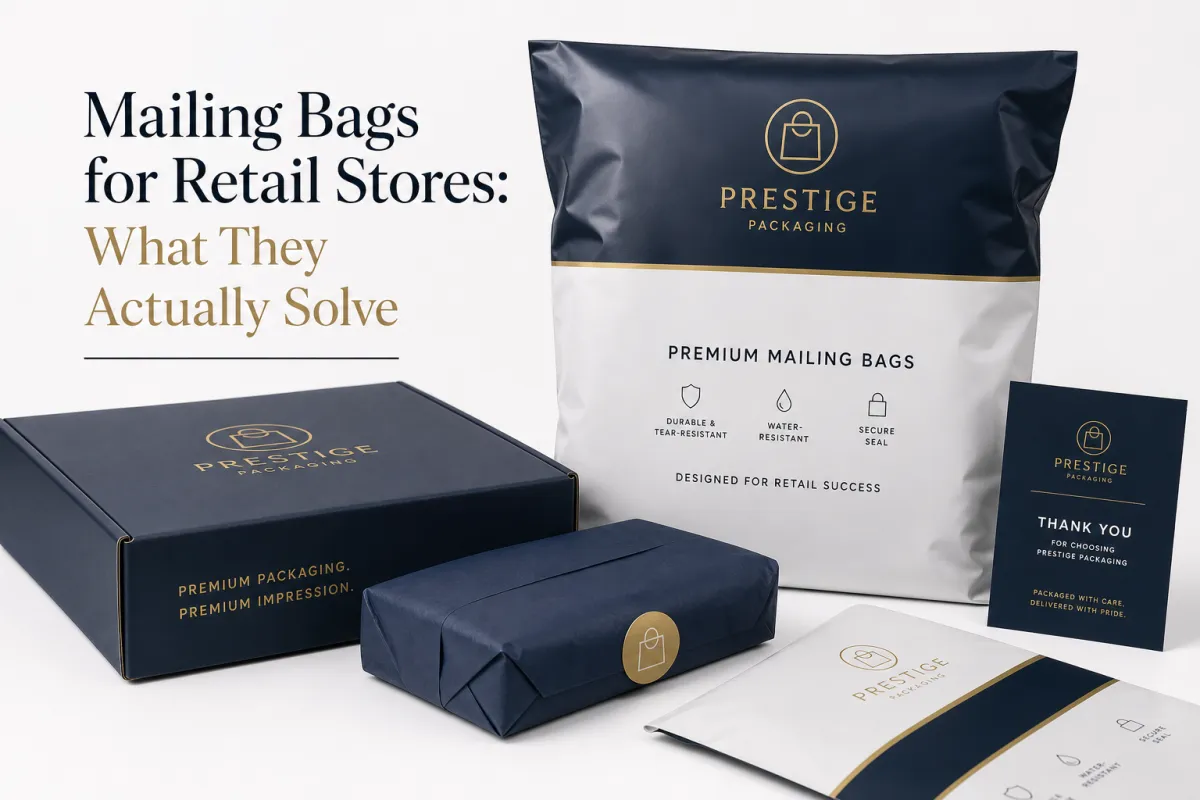
Here is the blunt version: mailing bags for retail stores solve a packaging problem that boxes often overcomplicate. If the product is flat, soft, or flexible, a lightweight poly mailer can protect it without the dead space, extra tape, and higher dimensional weight that come with a carton. That matters for margins. It also matters for packing speed, because a cashier-turned-packer does not need a five-step ritual just to ship a T-shirt.
Most retail stores use mailing bags for retail stores for apparel, socks, scarves, cosmetics pouches, folded prints, stationery, soft home goods, and accessories that do not need rigid protection. In practice, the bag is doing three jobs at once: holding the item, shielding it from moisture and dirt, and presenting the shipment in a way that looks deliberate instead of improvised. That last part gets ignored way too often. A tidy bag sends a cleaner signal than a lopsided box stuffed with void fill.
The practical win is simple. A mailer usually weighs less than a box, stores flatter than a box, and closes faster than a box. That can reduce postage and storage pressure at the same time. For stores that ship from a back room or a small stock area, mailing bags for retail stores are often easier to stage in bulk because a carton of mailers takes up far less shelf space.
Still, not every item belongs in one. If the product can crush, crack, puncture, or shift enough to beat up the outer packaging, a mailer may be the wrong call. The right question is not “What is cheapest?” It is “What does this SKU actually need?” Product shape, return rate, branding, and transit risk all belong in that conversation. Ignore one of them and the packaging starts failing in interesting ways.
If a mailer looks roomy on the packing table, it usually turns sloppy in transit. Packaging has a nasty habit of charging interest on bad assumptions.
That is why mailing bags for retail stores work best as a fit decision, not a decoration decision. Once the fit is right, everything else gets easier: fewer claims, cleaner pack-outs, less wasted material, and a more consistent customer experience.
How Mailing Bags for Retail Stores Work in Fulfillment
The fulfillment flow is simple, which is part of the appeal. The item gets folded or staged, slides into the bag, the adhesive strip gets peeled and sealed, the label gets applied, and the parcel moves into carrier sorting. Basic, yes. The details decide whether it works. Mailing bags for retail stores live or die on small choices: how the film behaves, how well the seal sticks, and whether the bag keeps its shape after the label goes on.
Opacity matters more than many buyers expect. A non-opaque bag can expose the product through the film, which is a privacy issue for some categories and a presentation issue for nearly all of them. Film thickness matters too. Thicker material usually improves tear resistance, but there is a point where extra gauge adds cost without solving the real problem. A 1.5 mil bag can work for very light apparel. Heavier loads, sharper product edges, or more return handling often justify 2.5 mil or 3 mil. That is a practical range, not a sales slogan.
Closure strength is another place where people get lazy. A weak adhesive strip can fail if the bag is packed too full, exposed to dust, or handled roughly before it reaches the carrier. That is why some mailing bags for retail stores use tamper-evident seals or stronger adhesive panels. A tamper-evident seal does not make a parcel invincible, but it does make unauthorized opening more obvious. For higher-value goods, that alone can be worth the extra cost.
There are three common formats worth separating:
- Plain mailers: functional, low-cost, and good for stores that want speed over branding.
- Branded mailers: printed with logos, color, or messaging so the shipment looks deliberate the moment it lands.
- Tamper-evident mailers: built to show if the package has been opened, which can help with trust and returns handling.
Mailing bags for retail stores shine with flat, flexible products. They are not the answer for fragile goods, bulky sets, or anything that needs crush protection. That is where some stores get tripped up: they assume one package type can cover everything. It cannot. Packaging only looks simple from the outside.
If you want a useful testing reference, the ISTA test standards are a smart place to sanity-check transit expectations before you commit to a format that has never been through a real parcel route. That is especially helpful if your store ships across carriers or mixes local and cross-country orders.
I have seen plenty of small retailers skip this step and then act surprised when a mailer with a pretty print fails at the seam. The print was never the problem. The structure was. That kind of mistake is gonna cost you twice: once on the packaging order, and again on the replacement shipment.
Key Factors Before You Choose a Mailer
Size comes first. Not product size alone. Packed size. That difference matters more than people think. A folded hoodie, a knit scarf, or a boxed accessory may look small in the hand but occupy far more space once you add tissue, inserts, or a return card. For mailing bags for retail stores, measure the packed product, not just the naked item. Leave enough room for the seal to close flat, but not so much room that the item slides around like it is trying to escape.
Material choice is next. LDPE is common because it is flexible and economical. Co-extruded films can improve puncture resistance and print performance. Recycled-content options are worth a look if your brand wants a lower-virgin-plastic story, but the claim has to be honest. A recycled mailer is not automatically a better mailer. It still needs to handle the load, seal correctly, and survive carrier handling. Otherwise you are paying extra to create a different kind of problem.
Branding is where mailing bags for retail stores can either help or clutter the experience. A printed logo, a strong color block, or a short message can make the package feel intentional. Heavy coverage and too many colors add cost fast, though. If your shipping volume is modest, a clean single-color print often makes more sense than a full-coverage design that looks expensive and behaves like a billboard. For many stores, the sweet spot is a neutral base with a simple logo and enough contrast to look polished in a customer unboxing photo.
Security and sustainability should be judged together, not treated like separate marketing trophies. A tear-resistant bag with an opaque film and a reliable seal beats a flimsy “eco” mailer that opens on the way to the customer. If you want recycled content, confirm the source and the actual percentage. If you want paper-based alternatives or mixed packaging, look for credible certification such as FSC for paper components. If you are making recycling claims, the EPA has plain-language guidance that helps keep those claims grounded instead of fluffy. Nobody needs more greenwashing, least of all your customer.
Here is a simple way to think about the selection:
- Lightweight apparel: thin to mid-gauge mailers, clean seal, minimal print.
- Heavier soft goods: stronger film, better tear resistance, room for inserts.
- Premium branding: custom print, controlled color palette, neat finish.
- Eco positioning: recycled content or alternative materials, but only if they still pass real handling tests.
If you are evaluating product options, Custom Poly Mailers are a practical place to start because they let you compare fit, film, and print without guessing from a catalog image. That beats buying from a pretty mockup and hoping the line survives contact with reality.
Cost and Pricing for Mailing Bags for Retail Stores
Pricing is where buyers get distracted by the wrong number. Unit price matters, sure. But mailing bags for retail stores should be judged on total shipped cost, not just the quoted per-piece number. A mailer that costs a few cents more can still save money if it reduces repacking, lowers weight, or cuts damage claims. Cheap packaging that creates waste is not cheap. It is just quietly expensive.
For plain stock mailers, a rough buying range might land around $0.06-$0.12 per unit at larger quantities, depending on size and gauge. Custom Printed Mailers often move into the $0.12-$0.28 range at around 5,000 pieces, though heavier film, full coverage printing, and special finishes can push higher. Recycled-content mailers may run a little more, sometimes $0.14-$0.32 per unit, because you are paying for the material story and not just the plastic. Those numbers are directional, not universal. Size, artwork coverage, and minimum order quantity change the math fast.
The biggest drivers behind the quote are pretty consistent: bag dimensions, film thickness, print colors, custom artwork, and MOQ. If you ask for a branded mailer with a larger format and a stronger seal, the price will climb. That is normal. What is not normal is pretending those changes should cost nothing. They always cost something. The only question is whether the added cost is buying you fewer returns, faster pack-out, or a better brand impression.
| Option | Typical Unit Range | Best For | Tradeoff |
|---|---|---|---|
| Plain stock mailers | $0.06-$0.12 | Fast fulfillment, low branding needs | Least distinctive, limited presentation value |
| Custom printed mailers | $0.12-$0.28 | Branding, repeat customers, social sharing | Higher setup cost and longer lead time |
| Recycled-content mailers | $0.14-$0.32 | Eco positioning, retail storytelling | Needs careful quality checks and honest claims |
| Tamper-evident mailers | $0.10-$0.26 | Higher-value shipments, trust-sensitive categories | Added cost for the seal system |
There are hidden costs too. Freight can erase a low unit price if the order ships in awkward cartons or from a distant warehouse. Storage space has value, especially for small stores that cannot dedicate half a shelf to packaging. Over-ordering the wrong size is another classic mistake; those bags sit around until everyone starts calling them “extra inventory,” which is retail code for “we made a bad buy.”
Then there is postage creep. Oversized packaging often pushes dimensional weight higher than it needs to be. A one-ounce mistake multiplied by hundreds or thousands of shipments becomes real money. That is why mailing bags for retail stores need to fit the packed product closely. The cheapest bag is not cheap if it forces you into a more expensive shipping bracket.
One more operational wrinkle: if your team packs a mixed stream of orders, a mailer that is slightly easier to load can save more labor than a cheaper bag ever will. I have watched teams lose minutes per shift to packaging that was just a little awkward. It sounds small until you multiply it across a month. Then it gets annoying fast.
Mailing Bags for Retail Stores: Process and Timeline
Good ordering starts before you ask for quotes. First, audit your SKUs. Group products by packed dimensions, weight, thickness, and fragility. A store with twenty product lines does not automatically need twenty bag sizes. Usually it needs a small set of well-chosen options. That is how mailing bags for retail stores stay manageable instead of turning into a drawer full of half-used guesses.
- Measure the packed product: include inserts, tissue, and any return card.
- Request samples: ask for the actual film, not a photo or a vague promise.
- Run a real pack-out test: use your own items, your own labels, and your own team.
- Confirm artwork and specs: lock down thickness, seal type, MOQ, and proof details.
- Build the timeline: proofing, production, and freight all need room to breathe.
Sampling is where many buyers save money in the long run. A sample that looks fine on a desk can fail once it has an insert, a folded hem, or a slightly awkward closure. That is normal. Packaging is judged by real handling, not by how it sits under a lamp. For mailing bags for retail stores, the sample test should include at least a handful of actual shipments or mock shipments that mirror your live order profile.
Typical timing depends on what you buy. Plain stock mailers can move fast, sometimes in a few business days if the supplier has inventory. Custom printed orders often need more room, especially if artwork revisions are involved. A practical timeline is often 12-20 business days from proof approval to production readiness, plus transit. If your launch is tied to an event, a seasonal drop, or a store opening, add buffer time. Otherwise a delayed proof or freight issue will become everyone’s favorite fire drill.
Confirm the proof in plain language. The product size, print placement, film gauge, seal style, and quantity should all be written down. That avoids the charming retail tradition of discovering later that “we thought it meant something else.” If you are placing a first order, a focused option like custom poly mailers for retail shipping can be easier to validate than a full custom packaging stack, because you can test one variable at a time.
From an operations point of view, the best mailing bags for retail stores are the ones that reduce decisions on the packing line. Fewer decisions means fewer errors. Fewer errors means fewer returns, fewer remakes, and fewer awkward customer emails about a product that arrived in bad shape.
Common Mistakes Retail Stores Make With Mailers
The most common mistake is oversizing. A bag that is too large lets the product move, which makes the parcel look sloppy and can damage the contents during handling. It also wastes material and can increase postage. If the product rattles around in the bag, you did not “leave room for flexibility.” You bought the wrong size. That is all.
Another mistake is choosing the printed look before checking performance. A glossy mockup can make mailing bags for retail stores look polished, but a weak seal, thin film, or poor opacity will ruin the experience faster than a plain bag ever could. Buyers sometimes fall in love with the visual and forget the mechanical side. The customer, unfortunately, cares about both.
Skipping real-world testing is another expensive habit. A sample might pass on the counter and fail once it is packed with inserts, label stock, or a return slip. A mailer also behaves differently when stacked, dropped, squeezed, or stored in heat. If you want a reality check, use a small pack-out run and look at the failure points: seal lift, corner tear, print scuffing, and label adhesion.
The fourth mistake is trying to force every SKU into one bag. That sounds efficient until you realize one size is too loose for tees, another is too small for sweaters, and a third creates a postage problem. A smarter setup for mailing bags for retail stores is usually two or three sizes, matched to the actual product mix. Standardization is good. Pretending one size fits all is not standardization. It is denial with a PO number.
Here is the short version of what usually goes wrong:
- Oversized mailers create movement and waste.
- Thin film fails when the product is heavier than expected.
- Pretty print gets approved before the seal strength is checked.
- One universal size gets forced onto a mixed catalog.
If you are fixing packaging problems after launch, you are paying retail prices for avoidable mistakes. Testing before ordering is cheaper. Every time.
For stores that want better results from mailing bags for retail stores, the cure is not complicated. Measure packed dimensions, test actual product loads, compare a few realistic sizes, and reject the idea that a packaging sample on paper tells you enough. It does not.
Expert Tips and Next Steps for a Better Rollout
Start by standardizing around two or three sizes. That gives you enough flexibility without turning the back room into a packaging museum. For many retailers, one small size and one medium size cover most soft goods, with a larger bag reserved for bulky apparel or bundled sets. That is usually enough for mailing bags for retail stores to stay efficient without becoming fragile or confusing.
Match the mailer to the product mix instead of the brand mood board. Apparel can usually tolerate lighter film than a mixed accessory kit. Folded prints and soft home goods may need more attention to corner protection. A premium-looking package is nice, but a package that survives transit is better. One pays you back in customer satisfaction. The other just photographs well for a day.
After launch, track four simple numbers: damage rate, pack time per order, postage cost, and customer comments about packaging appearance or fit. You do not need a giant dashboard to see whether mailing bags for retail stores are doing their job. A small monthly review is enough to catch the obvious issues, like a size that is too loose or a seal that is getting ugly under pressure.
If recycled content is part of your packaging story, keep the claim tight and documentable. The EPA has straightforward guidance on recycling and material claims, which is useful because customers are far less forgiving of vague “eco-friendly” language than brands like to think. Good packaging sustainability claims are specific. Bad ones sound like they were written by someone trying to dodge the details.
Here is a practical rollout sequence:
- Measure your top-selling SKUs with inserts included.
- Order samples of a few realistic sizes and film gauges.
- Run a pack-out test with the actual team that ships orders.
- Place the first order only after the test holds up.
- Review results after a few hundred shipments, then adjust.
If you want a simple buying rule, use this: choose the smallest mailing bags for retail stores that protect the product, seal cleanly, and keep the shipment looking intentional. That is the whole job. Not glamorous. Just useful. And useful packaging is what keeps margins from leaking out through a dozen small mistakes.
Done right, mailing bags for retail stores lower freight waste, speed fulfillment, and make the customer receive something that looks like it was packed on purpose. That is the real payoff. Not hype. Not trend language. Just a better fit for the products you already sell.
If you are choosing your first setup, start with one light-duty size, one mid-range size, and a sample run before you buy in volume. That keeps the decision practical and stops you from locking into packaging that only looks right on a screen. Pretty simple, really.
What size mailing bags for retail stores should I start with?
Start with your top-selling SKU sizes, not your whole catalog, and measure the packed product with inserts included. Leave just enough room for a clean seal without extra slack that lets the item slide around. If your catalog is broad, use a small size set instead of one universal bag that fits nothing well. That is usually the smarter first move for mailing bags for retail stores.
Are mailing bags for retail stores better than boxes?
Use mailers for soft, non-fragile goods where lower weight and faster packing matter more than rigid protection. Choose boxes when the item can crush, break, or needs internal support to survive transit. The better choice is the one that lowers damage, postage, and packing time for that specific product, not the one that looks more proper.
How thick should mailing bags for retail stores be?
Use a thicker film when the bag holds heavier items, has sharp edges, or needs a more premium feel. A thinner bag can work for lightweight apparel, but it still has to seal cleanly and resist tearing in transit. Always test the actual product load before you commit, because film specs on paper do not show real handling performance for mailing bags for retail stores.
How long does it take to order custom mailing bags for retail stores?
Expect time for sampling, artwork approval, production, and shipping, not just the production run itself. Simple plain mailers move faster; custom printed orders usually need more lead time because of proofing and setup. If the launch date matters, build a buffer so a delayed proof or freight issue does not stall the rollout.
What should I compare when pricing mailing bags for retail stores?
Compare unit price, minimum order quantity, freight, and the size that best fits your top products. Check whether the quote includes print, custom sizing, and any setup fees before you call it cheap. A slightly higher quote can be the better buy if it reduces damage, postage creep, or repacking time, which is often how mailing bags for retail stores save money in practice.


