Buyer Fit Snapshot
| Best fit | Bulk Shipping Bags for Online Stores projects where brand print, material claims, artwork control, MOQ, and repeat-order consistency need to be specified before quoting. |
|---|---|
| Quote inputs | Share finished size, material target, print colors, finish, packing count, annual reorder estimate, ship-to region, and any compliance wording. |
| Proofing check | Approve dieline scale, logo placement, barcode or warning zones, color tolerance, closure strength, and carton packing before bulk production. |
| Main risk | Vague material claims, crowded artwork, missing packing details, or unclear freight terms can make a low unit price expensive after revisions. |
Fast answer: Bulk Shipping Bags for Online Stores: Protect Every Order should be specified like a repeatable production item. The safest quote records material, print method, finish, artwork proof, packing count, and reorder notes in one written spec.
Production checks before approval
Compare the actual filled-product size with the drawing, then confirm tolerance on folds, seals, hang holes, label areas, and retail display edges. Reserve space for logos, QR codes, warning copy, and material claims before decorative graphics fill the panel.
Quote comparison points
Review material grade, print process, finish, sampling route, tooling charges, carton quantity, and freight assumptions side by side. A quote is only useful when the supplier can repeat the same color, closure quality, and packing count on the next order.
Bulk Shipping Bags for Online Stores: Protect Every Order
Bulk shipping bags for online stores are not glamorous, but they are operationally ruthless in the best and worst way. They are the part of the fulfillment chain people barely notice until one split seam or weak peel turns a routine delivery into a replacement shipment, a support queue, and a bad first impression. I have watched this play out in stores moving 2,000+ parcels a day: one weak seam can quietly eat an afternoon of labor and still leave a customer wondering if the brand can be trusted. A bag that saves a few dollars at purchase can cost far more than that once returns, freight, and repacking are added to the total.
That is why these bags should sit beside packaging performance, handling risk, and margin planning, not in the branding afterthought bucket. If a bag survives a day of warehouse abuse but looks like it can blow apart under a scanner, or vice versa, the business loses twice. The first category is reliability, the second is brand credibility, and both are required if online retail is going to scale without drama.
For many teams, this means replacing a single “cheapest quote” mindset with an operational-loss mindset. The cheapest bag is not necessarily the cheapest outcome. The right bag is the one that keeps delivery outcomes stable over many lots and many routes.
Bulk Shipping Bags for Online Stores: The Cost Leak You Can See on Every Return
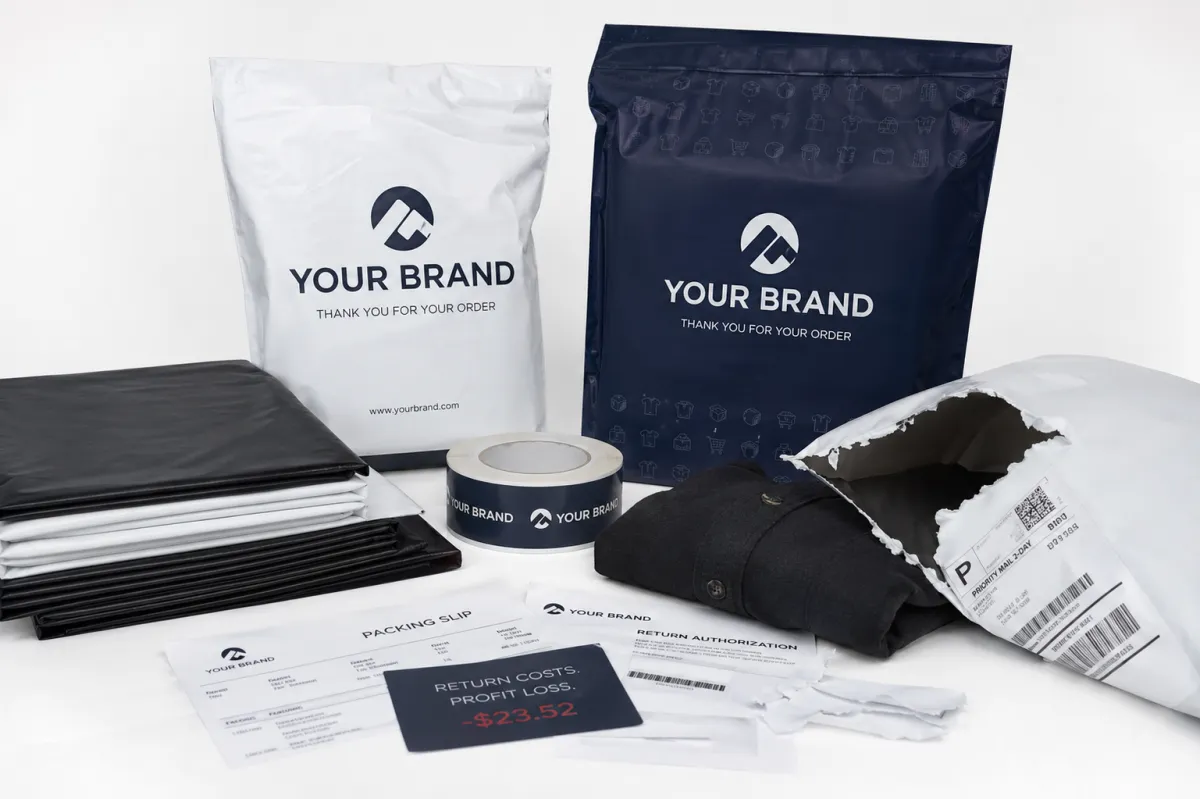
From a fulfillment perspective, bulk shipping bags for online stores are hard control points. A seam tear does not only fail one shipment; it creates a micro-shutdown in the flow: pickers pause, scanners fail, labels get corrected, and customer service takes over for what should have been a silent handoff to the courier. When that happens, the first person hurt is not the packing team, it is the margin dashboard.
I saw this clearly in a spring campaign for a skincare client that was pushing 1,000 orders a day through a temporary fulfillment setup. The initial package style looked fine in photos, but within two days, weak corners and peel issues started showing on Monday and Tuesday batches. By the second week, they were burning almost the same amount on redeliveries as they had saved on initial printing, and no one could blame courier delay alone anymore.
That is where the 1-ply versus 2-ply decision becomes less technical and more financial. A 1-ply bag is usually enough for folded light goods, stationery, and soft accessories, but it is also less forgiving when order mix shifts toward sharp-lipped or repeatedly handled goods. 2-ply improves tear margin and seal consistency under compression and heat, and reinforced constructions go further when route vibration and sorter abrasion are real risks.
First impressions in ecommerce happen before the unboxing video, and often before the thank-you page matters. If the bag arrives looking thin, bent, or wrinkled, the buyer may already assume the process is improvised. If the matte finish reads clean, seams hold, and the bag has the right body for the product shape, the operation feels intentional before the product is even checked.
Practical rule: if one replacement shipment costs more than the margin you keep on the average order, the cheapest-sounding mailer is already the expensive option.
The strongest purchase logic still follows the same sequence: first performance, then print and brand fit, and finally unit economics. I often see teams reverse this and get boxed in by cosmetic choices they cannot defend later at the returns desk. The reliable approach is boring, practical, and often cheaper in week two than any one-off decorative idea could ever be.
Product Details: What Makes These Poly Mailers Right for Ecommerce
Most bulk shipping bags for online stores are built around polyethylene structures, either standard PE builds or co-extruded formats. Co-extrusion is useful because one layer can tune stiffness, another print response, and another puncture behavior. That means you can match the bag’s behavior to the product mix without buying a completely different concept for every SKU.
In many stores, the product mix shifts daily: one day apparel, next day accessories, then bundles and promotional kits. A single universal bag seems efficient on paper, but in the bay it becomes a guess. Guessing is expensive in shipping, and expensive guesses become expensive customer complaints.
Film Construction And Finish
Finish choice affects both perception and durability. Matte film often reads better after handling and hides minor surface wear in transit. Glossy film can pop brand colors and improve visual clarity on labels or logos in bright light, which matters for some fashion-first stores. The right call is less about style and more about what the package will physically touch: scanners, sorters, picker gloves, tote friction, and curbside exposure.
Printing choice is also a tactical decision. Flexographic processes are efficient for stable artwork and long runs; digital is typically better for shorter or variable campaigns with frequent changes. Spot UV can create tactile interest and a premium surface, but it cannot rescue weak seal structure or insufficient puncture resistance. A stylish bag that fails at first touch is not an upgrade; it is a delayed cost center.
Closure And Seal Options
Self-adhesive closures dominate for a reason: speed, low training load, and less operator decision fatigue at packing speeds. A closure that behaves predictably on first press reduces inconsistency in a line where volume stress is always present. Heat seals can improve tamper resistance and a cleaner look, but they demand tighter control at setup, plus ongoing monitoring during production and handling.
Press-to-close systems are workable in controlled workflows and can be useful when packers reuse the same carton shape repeatedly, but they become risky in mixed throughput windows. I have seen teams run them well in dedicated teams and fight them badly in high-mix, high-variation operations. For broad online demand, simplicity usually beats sophistication for actual uptime.
Reinforced mouth folds are one of those details everyone loves to postpone and everyone regrets late. They keep the top edge stable under side pressure, reduce edge fatigue from repeated contact, and improve seal integrity on route. The effect is subtle until your complaints graph spikes after two weeks.
Material Choices Buyers Should Compare
No single material should win by default. You need to compare standard PE, co-extruded PE, recycled-content films, and compostable alternatives with clear use-case assumptions. A recycled option may support sustainability reporting and procurement targets, but stiffness, optical behavior, and print consistency can shift between film lots and finishing methods.
Compostable films can fit some brands, especially in short regional supply loops, but they can also demand tighter storage management in warm, humid conditions. The best buyers treat sustainability claims like operating requirements: what happens to the bag in this warehouse, this climate, and this carrier network?
Environmental language needs evidence beyond packaging marketing. Pair supplier claims with certification documentation, disposal routes, and practical waste handling. A useful reference for teams doing due diligence is epa.gov, which keeps the language around material stewardship grounded in real lifecycle management.
Industry testing standards are useful only if you apply them to route abuse. Terminology and test methods from bodies like ista.org can separate decorative promises from measurable resilience. If you map those standards to your real shipping profile, you get less guesswork and more evidence-based sourcing.
For brands wanting one coherent packaging language, bulk shipping bags for online stores can be paired with Custom Poly Mailers and Custom Packaging Products so inserts, labels, and secondary layers all fit the same physical and visual logic.
Some SKUs still belong in boxes, especially rigid, delicate, or high-claimed-value products. The route-risk rule is simple: choose the format that lowers total landed risk, not the one with the neatest online description. For padded textiles, soft goods, and low-impact items, a quality mailer can improve speed and cut freight weight. For glass, ceramics, and exposed electronics, the “cost per unit” on paper can still be a false economy if the mailer cannot protect the content.
What Should You Check Before Buying Bulk Shipping Bags for Online Stores?
Most mistakes in bag selection start before the sample is approved. The top-level buyer starts with friction points, then asks how this bag performs under their exact pick/pack pattern. Product mix, weight distribution, route length, barcode workflow, and whether cartons are reopened for exchanges all matter before color count.
That is where we usually see teams save money with fewer assumptions. A hoodie and a candle can post similar prices at checkout, yet one can survive a quick toss while the other punishes the first weak seam. If your catalog has both, one bag family will never perform well enough for both without clear boundaries.
A useful pre-order checklist usually includes:
- Whether the SKU is soft, rigid, or irregular in shape
- Average shipment weight and any outlier “spike” weights
- Distance and handling style: local courier, regional consolidation, or long-haul parcel networks
- Scan model: barcode-based flows or mainly visual checks
- Brand touchpoint expectations versus pure protective function
- Return and exchange behavior that may require bag reuse or repacking
Matching bulk shipping bags for online stores to the real order mix beats matching to an aspirational catalog. If you start with one “average” order profile and keep forcing exceptions into it, you end up paying twice: once in shipping cost and again in operational recovery.
Wrong sizing has a quiet cost. Oversized bags force bulky fill, higher dimensional weight, and awkward packing; undersized bags add pressure to the seam and encourage manual fixes that slow labor. A five-cent bag difference does not look bad on paper, but if it causes one hundred extra seconds of repacking per hour, the arithmetic changes immediately.
Specifications Buyers Actually Use, Not Marketing Claims
Strong decisions for bulk shipping bags for online stores are measurable, test-backed, and repeatable. Teams that track dimensions, thickness class, burst and tear resistance, seal strength, color tolerance, and registration tolerance have fewer surprises than teams that rely on adjectives like “premium feel.” If a supplier cannot provide test conditions clearly, treat that as a risk signal, not a harmless omission.
Dimension planning should begin with usable interior volume, not just nominal outer dimensions. A 10x13 bag can work for a folded top when products are lightweight, but it can fail fast with multi-piece packs or thick materials. Thickness classes like 2.5, 3, and 4 mil remain practical starting points, with higher gauges for heavier or sharper loads.
In my own sourcing audits, we often find that 2.5–3 mil works for paper and light apparel, while 3–4 mil helps with accessory collections and irregular loads. As soon as a line starts carrying heavier items or corner stress, the same thickness becomes a reliability risk in transit rather than a money saver.
Pre-production quality checks should happen before full commitment. Draw tests are useful for load behavior, seam strength tests for long-run durability, and drop/crease checks for the real-world abuse that does not appear in static photos. For larger programs, sampling at multiple lot points (for example, near 1,000 and 5,000) can reveal process drift before one bad run becomes a full recall.
Match The Mailer To The Product
Light apparel, soft textiles, papers, and simple soft bundles usually do fine in standard poly mailers. Orders with abrupt bulk, rigid corners, or uneven weight benefit from reinforced body construction and stricter closure settings. If the shipment is near dimensional-weight thresholds, tighter fit and better compressibility can beat simple upsizing on freight cost.
Padded versus unpadded is never a branding call. It is an impact-risk call. If even slight movement can produce scratches or deformation, padding and/or a more structured solution is usually the rational choice. If internal packaging is already doing that work, an unpadded option can reduce weight and keep packing throughput clean.
Check The Shipping Details That Actually Break Jobs
Barcode placement is a frequent failure point in high-volume systems. A code over seam or fold lines can fail scan logic, which slows parcel flow and can push handoffs into manual mode. Address windows may be less common in some poly formats, but print-safe zones and orientation marks should still be defined before proofs are finalized.
Anti-counterfeit features only matter when product risk is real, yet they are often ignored until resale channels create pressure. If imitation risk is in play, these controls should be part of the control plan, not the marketing plan.
Large batches also punish small visual drift. A subtle density shift in one of ten thousand units can pass design review and still create a rejection loop at the bench. The root causes are almost always measurable: lot-to-lot film variation, print calibration, or closure set-up. Tight tolerances and documented sign-off points reduce dispute friction.
| Product Type | Typical Mailer Choice | Suggested Thickness | Why It Fits | Watch-Out |
|---|---|---|---|---|
| Light apparel | Standard poly mailer | 2.5-3 mil | Fast packing, low material spend, reliable for folded goods | Do not over-size and trigger dimensional-weight penalties |
| Accessories and kits | 2-ply or co-extruded mailer | 3-4 mil | Better puncture resistance and consistent print response | Check corner seal strength and insert fit at full load |
| Heavier soft goods | Reinforced poly mailer | 4 mil or higher | Higher durability in handling and repeated compression | Confirm carrier limits and closure pull force requirements |
| Fragile items | Padded mailer or box | Depends on protection need | Lower breakage potential than plain film in rough transit | Sometimes a rigid parcel is cheaper than repeated damage claims |
For bulk shipping bags for online stores to work, the specification package must behave like a contract and not a wish list. Include numeric tolerances, lot traceability, approved sample points, and a defined correction process. If a lot drifts on thickness, closure, or print, everyone should know the next step before customer-impact starts.
Pricing & MOQ for Bulk Shipping Bags for Online Stores
Pricing for bulk shipping bags for online stores generally breaks into raw film, print and setup, and freight, then each layer pushes total landed cost in nonlinear ways. A tiny design change can increase setup burden as much as a heavier film change, and freight strategy can erase per-unit gains if volumes are mismatched to route economics.
That is why teams should review cost in total landed terms. A low unit price from one supplier can become the highest internal cost if it triggers repeat corrections, delayed launches, or return-driven replacement cycles. The cheapest quote should be treated as a hypothesis, then validated with process assumptions.
For many small to mid-size programs, 500 to 1,000 units is common for starter stock runs, while 1,000 to 5,000 is more common for custom print with stronger quality and control needs. Smaller launches are possible, but fixed resources do not scale down as well: prepress, review, proofing, and QC support still consume real capacity.
In practical terms, a rough planning band can help internal approvals:
- 500 units: pilot campaigns, limited SKUs, and launch tests
- 1,000 units: early brand consistency with controlled spending
- 5,000 units: where setup is spread more effectively and consistency improves
- 10,000 units: stronger margin room for better film, better quality gates, and process consistency
As a planning anchor, standard PE programs can land around $0.14–$0.28 per unit near 5,000 pieces, while reinforced construction or heavy color work commonly moves to $0.22–$0.45 per unit. Treat these as directional bands, because finish, color count, and required handling can move pricing materially.
Setup costs rise with complexity: plate count, custom shapes, revision loops, and dieline changes are the usual offenders. Ask for a setup-to-production handoff map before you sign, because most “lowest quote” cases become “add-on correction” cases mid-project.
The biggest untracked costs are often outside the bag itself: label and customs paperwork, pallet build, freight surcharges, and rushed logistics. Cross-border buyers should confirm duties and incoterms early, especially if freight mode shifts. A sea-based price can become a very different total if air transport is triggered by campaign timing.
Healthy procurement planning aligns pricing to return-rate improvements, not only to unit cost. If a store has a 4% return and damage profile, modestly higher mailer spend can be self-funding through fewer re-ships. Bulk shipping bags for online stores should reinforce margin, not squeeze it through hidden waste.
Common finish ladders usually look like this:
- Plain stock mailer: low entry cost, minimal brand customization
- Single-color branded mailer: stronger brand recognition at controlled spend
- Full custom print with stronger film: higher cost, stronger control of durability and message
Demand forecasting matters most when choosing tiered runs. A two-reorder forecast in advance usually beats one-off panic buying, especially for new products with uncertain repeat rates. If margin planning and replenishment rhythm agree, the sourcing model stays predictable instead of reactive.
Process and Timeline: From First Sample to Full Bulk Delivery
Execution becomes predictable when data inputs are complete up front. The standard flow is inquiry, proofing, sample review, approval, production, QC, packing, and dispatch. Delays in this chain almost always come from missing measurements, unclear print rules, or late changes, not from machinery moving slowly.
A practical timeline in many cases runs like this: 1–2 business days for inquiry and first quote, 2–4 for proofing and artwork exchange, 3–7 for sample build where needed, and 10–15 days for production post-approval before dispatch variables are added by freight and route. Special finishes, mixed variants, or heavy revision loops can stretch that by several days.
If this sequence is treated as fixed, teams can plan around it. If it is treated as flexible, it tends to stretch toward “ship next week, but maybe.” At launch scale, that ambiguity costs slots in fulfillment calendars and creates avoidable overtime.
What Slows A Job Down
Most delays come from human loops, not machines: vague artwork instructions, missing dimensional references, or unclear brand color targets. Changing size after sampling is especially costly because it disturbs closures, loading behavior, and sometimes test assumptions at the same time.
Quality systems should include pre-production checks, in-line sampling, final lot review, and documented sign-off before release. If photo proofs and sample retention are not available, teams lose speed during escalations because root causes are no longer visible.
Large volume programs usually need batch-level traceability across runs. If a defect appears in week two, traceability helps decide whether it came from film batch variation, setup drift, or print-side drift. Without that signal, teams run blind and often overcorrect.
Communication That Keeps The Order Moving
Boring communication wins here. Share milestones, file versions, photo proof checkpoints, and a clear escalation ladder from the start. A single accountable point of contact between design, production, and operations beats a committee of unknown owners, especially in campaign weeks.
Seasonal demand windows are not a place for last-minute packaging. If artwork and tests are late, rush handling appears, and rush handling often turns into compressed options and higher freight. Most teams lose more than they save when they push packaging decisions past the quiet planning window.
Build sample review and one correction cycle into campaign schedules. That rhythm gives flexibility without emergency pressure. Treat packaging as part of launch execution, not an afterthought order because it is easier to optimize a box before it ships than after a complaint thread has started.
Why Choose Us for High-Volume Poly Mailer Supply
For all the talk about “great sample quality,” consistency is the true signal. A first sample can be perfect and still fail by lot three if controls drift. In high-volume online operations, what matters is whether spec behavior holds through multiple runs and multiple dates.
An effective sourcing partner should make file handoff less painful and more consistent: stable tolerances, clearer checkpoints, practical response windows, and fast diagnosis between artwork issues and material/process issues. Buyers need that distinction quickly to avoid repeating the same fix in a larger quantity.
Risk terms should be explicit before production starts. Define defect thresholds, rework limits, replacement triggers, and escalation timing in writing. Trust is not built on promises alone; it is built on tested response habits when things go wrong.
Cross-program buyers often gain by pairing bulk shipping bags for online stores with Wholesale Programs, Custom Shipping Boxes, and related secondary materials. Coordinated sourcing cuts SKU mismatch risk and reduces the chance of urgent swaps at the warehouse.
Supplier quality is shown in routine responses: clear acceptance criteria, stable lead times, and a documented correction path. If your packaging vendor can explain a mismatch fast, with root-cause evidence, you are less exposed during peak loads.
Good partners should also be willing to recommend a cheaper route when it improves outcomes. I have seen stores save by switching to a slightly simpler construction once route risk was understood. Honest recommendations build long-term retention because they protect margin, speed, and shipping confidence at the same time.
Order Steps for Your First Bulk Shipping Bags Purchase
Bulk shipping bags for online stores are easiest to execute when the first brief is short and complete. Start with your dominant shipment profile, lock size family and weight bands, then state closure style, closure strength target, print colors, and quantity assumptions. When possible, request two samples: standard and reinforced. Real fulfillment data from handling will settle the right choice far faster than debate.
Use this sequence:
- Choose the bag size and style based on your most common shipment shape.
- Provide product dimensions, weights, and any hard-to-pack geometries.
- Request baseline and upgraded construction samples.
- Approve artwork, seam specs, and closure behavior before the weekly cut-off.
- Confirm MOQ, payment terms, freight mode, and delivery window in writing.
Your full brief should include SKU groupings, label placement, barcode dimensions, and warehouse handling notes. If scanning is automated, print-safe zones and contrast requirements are non-negotiable. Send these details before artwork lock, not after.
Before the PO is raised, run a short execution checklist:
- Brand and operations teams have approved artwork and technical spec together.
- Fallback stock size is confirmed for replenishment disruption scenarios.
- Launch date has at least one contingency day in the calendar.
- First-mile label and barcode tests are performed on actual material surface.
- Budget includes one revision cycle or small correction lot, just in case.
Consolidating spec, budget, and timeline into one shared document reduces translation risk across teams. If the supplier can mirror this summary accurately, execution usually starts cleanly. If not, it is time to resolve gaps before production.
Many brands do a stress check with real staff, real labels, and actual route simulation before scaling. Track seam hold, mouth fold behavior, pull force, print rub, and complaint patterns in that first lot. If it passes, scale. If not, revise and retest instead of pouring more money into repeat failures.
After one quarter of this process, the pattern is usually clear: bulk shipping bags for online stores should be treated like production equipment. Pick material and construction based on route, shape, and return risk. If your first measurable test pass rate is above target, keep the spec; if not, adjust before volume goes live.
FAQ
How do bulk shipping bags for online stores compare by price when I need custom logo printing?
Custom printing introduces setup cost, then unit pricing drops as volume rises. For bulk shipping bags for online stores, compare quotes on exact size, thickness, color count, and finish details rather than just the headline price. Ask for a clear fee table that separates setup stages from per-unit pricing so surprises are less likely once files are approved.
What is the best MOQ for bulk shipping bags for online stores if I am on a low budget?
MOQ is shaped by print detail, size, and turnover cycle. A practical starting point for many stores is still 500–1,000 units in the first phase. A focused SKU mix for this early stage usually keeps inventory movement safer and avoids storage overhangs that quietly drain working capital.
How long should I expect from sample approval to shipment for bulk shipping bags for online stores?
Most standard programs move from approved proof to production in roughly 10–15 business days, with sample creation adding a few days when needed. Multi-color approvals, revised dimensions, or special coatings can extend timelines. In practice, review cycles and revisions, not tooling limits, create the longer delays.
Can bulk shipping bags for online stores work for fragile items and still keep shipping costs under control?
Yes, if design and protection level are matched to risk. For fragile SKUs, reinforced bulk shipping bags for online stores, padded options, and even rigid alternatives can each be correct depending on movement severity and product value. The lowest print spend can become the highest total spend once rework and re-ship costs are counted.
What happens if a run of bulk shipping bags for online stores misses the spec sheet?
Define defect thresholds, evidence standards, and correction windows before production. As soon as a miss happens in size, print, or sealing behavior, you should trigger a documented review and hold further release until root cause is known. A pre-defined response process protects launch timing and reduces disputes.
Any simple rule I can use before placing my first order?
Yes: run one pilot batch with the two strongest candidates from your shortlist, measure seam pull, seal consistency, and complaint behavior through one real route, then finalize only after the first real data arrives. That one decision point cuts expensive assumptions and usually saves budget before the first full restock.


