Buyer Fit Snapshot
| Best fit | Buy Compostable Corrugated Mailer Bundles for Shipping projects where brand print, material claims, artwork control, MOQ, and repeat-order consistency need to be specified before quoting. |
|---|---|
| Quote inputs | Share finished size, material target, print colors, finish, packing count, annual reorder estimate, ship-to region, and any compliance wording. |
| Proofing check | Approve dieline scale, logo placement, barcode or warning zones, color tolerance, closure strength, and carton packing before bulk production. |
| Main risk | Vague material claims, crowded artwork, missing packing details, or unclear freight terms can make a low unit price expensive after revisions. |
Fast answer: Buy Compostable Corrugated Mailer Bundles for Shipping should be specified like a repeatable production item. The safest quote records material, print method, finish, artwork proof, packing count, and reorder notes in one written spec.
Production checks before approval
Compare the actual filled-product size with the drawing, then confirm tolerance on folds, seals, hang holes, label areas, and retail display edges. Reserve space for logos, QR codes, warning copy, and material claims before decorative graphics fill the panel.
Quote comparison points
Review material grade, print process, finish, sampling route, tooling charges, carton quantity, and freight assumptions side by side. A quote is only useful when the supplier can repeat the same color, closure quality, and packing count on the next order.
Compostable Corrugated Mailer Bundles for Shipping
If your team is evaluating where to buy compostable corrugated mailer bundles, the first win is not a greener headline. It is operational predictability. A bundle format with known counts, defined dimensions, and clear disposal guidance removes guesswork from the packaging flow. Fulfillment rooms rarely punish the wrong people, but they punish the wrong choices. In practical terms, one predictable shipment format can be worth more than a perfect marketing claim.
What usually changes first is not cost per piece, but behavior on the bench. Teams stop dithering over five different options. They stop stopping to decide whether that order needs fold-over tape or a tuck strip. They stop arguing about what “compostable” means for one line item and what it means for the next. That seems small, then you process 10,000 parcels a week and it becomes a real line saver.
There is a reason a lot of brands revisit this decision after one seasonal cycle: hidden labor. A mailer with a slightly better price can quietly burn budget on repacks, touchpoints, and replacements. One percent damage on 10,000 units means 100 incidents; at 12 to 20 minutes each in investigation and correction, that is more than 1,000 minutes lost. The warehouse does not notice the unit cost until a Friday night when packing still runs long.
From the procurement side, one standardized bundle structure can make replenishment feel almost mechanical. SKU management gets easier. Forecasting turns less chaotic. Carton footprints become predictable, and that affects how your shelves breathe. In a crowded facility, cleaner storage is not cosmetic; it is throughput.
And yes, the environmental argument matters, but only if it is technically true. I have seen teams announce “fully compostable” packaging that collapsed back into confusion because the ink, adhesive, and closure strip were not actually part of the same end-of-life system. If a sustainability claim is going to be on your labels, it has to be defensible in a distributor audit, not just in a brochure. That is where buying compostable corrugated mailer bundles gets meaningful.
"The cheapest mailer is often not the one with the lowest unit price, but the one that keeps operations moving and avoids a second touch."
That mindset is practical, not preachy. The sections below unpack what arrives in each bundle, which technical specs quietly control performance, how pricing bends by volume, and what to confirm before scaling. If you are trying to buy compostable corrugated mailer bundles without surprises, this is the level where decisions should land.
Why Buy Compostable Corrugated Mailer Bundles
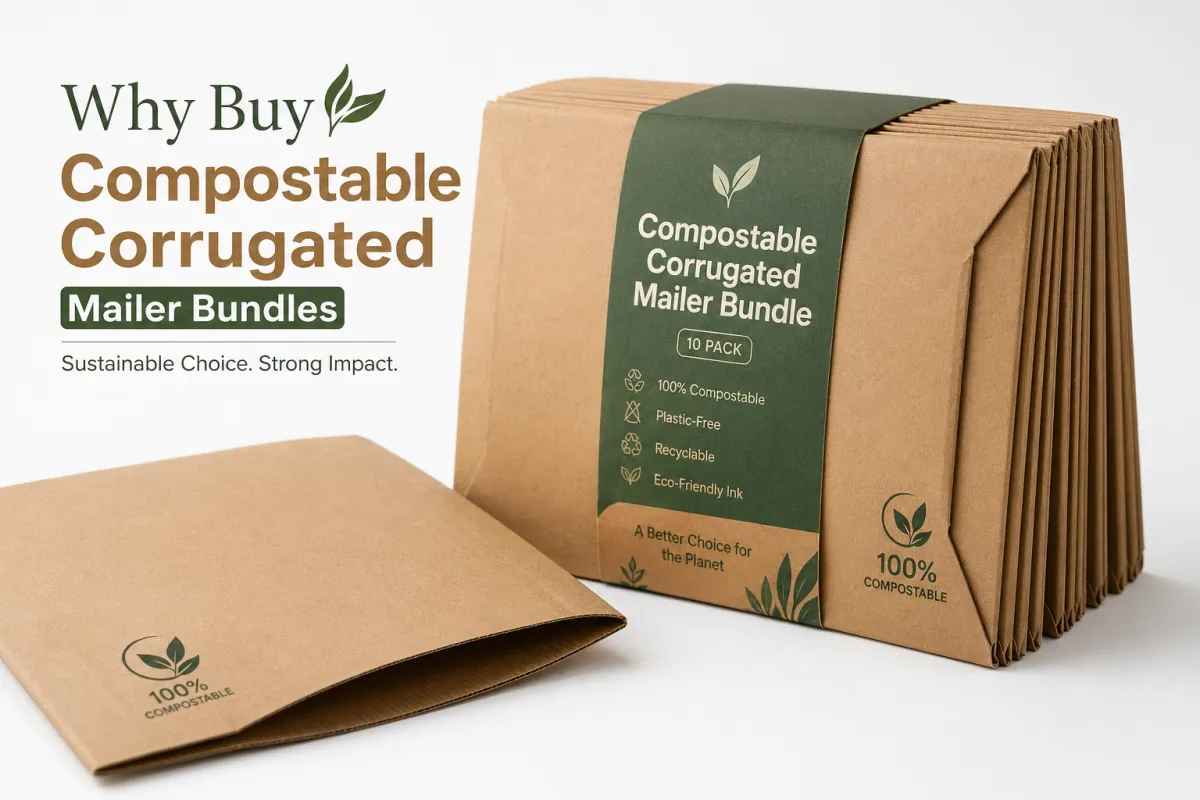
Most teams do not switch because one department asked for greener packaging and everyone nodded. They switch after live operations expose a mess of mixed systems that work in PowerPoint but not on a conveyor. Wrong-size picks happen. Products are repacked or double-boxed. Returns rise because the package looked fine at staging but not in the delivery chain. A bundle-based mailer format closes some of that loop.
In one fulfillment review I watched, a subscription apparel brand moved from five mailer types to two standardized bundle structures for 7,000 monthly units. Their picking accuracy improved, and the team stopped wasting time choosing the "closest match." The result was not dramatic on social media, but internals improved enough to cut packing exceptions by enough to justify the change. That is why this decision is usually about operations first, not headlines.
Buyers often discover an unexpected branding benefit too. A plainly printed, clearly labeled compostable corrugated mailer bundle can reduce downstream confusion at the customer touchpoint. People handling the parcel can actually read disposal instructions in seconds. Nobody is forced to guess whether to recycle, compost, or toss.
Three operational changes surface early:
- Cleaner procurement - fewer SKUs, fewer reorder mistakes, fewer approval threads between teams.
- Faster staging - packers know how many pieces are in a bundle and where each bundle family sits on the shelf.
- More consistent ship-out experience - customers receive the same package format, so expectations become stable and complaints drop.
For many operations, the key is matching packaging to route profile instead of product stereotype. A lightweight T-shirt from one state to another may behave very differently than a premium metal accessory moving through multiple distribution hubs. Thickness, closure architecture, and external print all change how it performs. Ignore one spec, and cost starts slipping.
The intent here is not to romanticize material choices. A compostable structure is not a silver bullet; it is a better control surface. It makes the process simpler, and simple usually survives stress better than clever. In my experience, simplification is what lets these programs pay for themselves after the first full replenishment cycle.
What should you check before you buy compostable corrugated mailer bundles?
Start with fit, then verify claims. That ordering might feel obvious, but in real orders it gets flipped. Confirm internal dimensions, required compression strength, closure type, and the exact compostability pathway before placing any order. If the product includes labels, inserts, or foam-free cushioning, factor those into internal volume too.
One practical question to anchor a buyer interview is simple: is the claim about the complete structure or just the outer shell? A full claim should include board, adhesive points, closures, varnish, and print stack. If those parts shift in one supplier’s process, your end-user disposal instructions become unreliable. That can create legal and reputational risk, especially if you sell in regions with strict material claims checks.
- Dimensions - measure at longest, widest, and thickest points, then add space for insertion and closure.
- Material build - verify whether you are buying fiber board only or board with any additional polymerized layers.
- Documentation - request test records for compostability pathway, recycled-fiber claims, and certificate validity.
- Operations readiness - clarify bundle size, MOQ, lead time, storage stackability, and stock rotation logic.
Do not skip route simulation. The same mailer that performs on a short local route can fail when it sees multiple handling transfers across parcel hubs. Test the structure with the actual item and the actual line speed. If your team can run five mock runs before quoting, that one extra test saves you from a lot of hindsight.
Also, ask for how the final disposal language was approved. If the mailer is designed for industrial composting only, calling it “compostable” in direct-to-consumer messaging can be misleading in regions without proper collection infrastructure. Honest language may feel slower, but it avoids complaints later. Transparency, in this niche, is a risk-control tool.
Product Details: What Comes in Compostable Corrugated Mailer Bundles
What buyers get with these bundles is not glamorous, but it dictates how quickly your line runs. Most programs are shipped as 25 or 50 mailers per inner bundle, then grouped into master cartons or on a palletized load. That ratio affects not just receiving, but also pick-pack planning and partial release timing. If you run replenishment on a weekly cadence, these details affect the number of emergency requisitions you file.
At a technical level, structure is usually a lightweight corrugated configuration tuned for moderate-strength ecommerce transit. You often see single-wall or equivalent board structures with a compostable adhesive path and selected inks that are intended not to break the end-of-life stream. The phrase "compostable" is only reliable if the board, adhesives, and print chemistry are part of the same material logic.
Common workloads include:
- Apparel and accessories - knitwear, soft goods, flat footwear add-ons, belts, hats, and similar low-weight forms.
- Beauty and personal care - refill sets, sample kits, and compact kits where presentation and protection both matter.
- Supplements and wellness - secondary packaging tiers, compact bundles, and repeat dispatch programs.
- Subscription shipments - high-consistency dispatch where a stable format matters more than short-term novelty.
Performance is better judged by practical outcomes than adjectives. Track whether the package holds closure under light-to-moderate load, whether corners stay sharp after drops, and whether stacks remain stable after a few pallet movements. If the outer stacking edge caves in, presentation and protection fail at once, and you lose margin on customer retention.
Where sustainability narratives are involved, separate the claims carefully. Industrial compostability and home compostability follow different decomposition systems; mixed-fiber sourcing adds another dimension. FSC or equivalent fiber claims add sourcing transparency but are separate from biodegradation testing. If your operations team says yes to one and procurement says yes to another without reconciling them, you can end up with contradictory labeling.
Ask for a full sample bundle, not one isolated piece. A single mockup never shows how bundles nest, how master cartons open, or whether the shipment feels usable once unpacked at receiving. We see this in real warehouses: the bundle can be technically compliant but physically annoying, and annoying is just expensive in packing labor.
One caution from real operations: if one line uses humid climates or high-temperature transport, ask whether coating or seal strategy can affect fiber integrity after transit. Not every compostable board behaves the same in heat and moisture. A tiny spec gap can feel invisible until return labels start multiplying.
Specifications That Affect Protection, Fit, and Compostability
If one metric defines this decision, it is internal size. For buying compostable corrugated mailer bundles, start with usable internal length, width, and depth, not the outer dimensions on a marketing sheet. Corrugated walls and fold architecture eat up real space. If you do not account for that, you get a mailer that looks roomy but collapses in practice.
Use a sizing method teams can repeat:
- Set the product’s maximum dimensions at its longest, widest, and tallest points.
- Add closure compensation and handling tolerance.
- Confirm whether the supplier’s quote uses nominal or finished internal measurements.
- Run one quick dry run for at least two SKUs before approving mass tooling.
Strength is the next layer. Board grade, caliper, ECT profile, burst resistance, and compression behavior are not buzzwords; they are your insurance policy. A short-lane order may pass with one test threshold, while a cross-country distribution route may fail on repeated sorting impacts. If your parcels touch many conveyors and manual sort points, you need realistic transportation simulation, not a single tabletop compression check.
Think in route math: if a package gets four to eight more handling touches than expected, edge crush tolerance can become the hidden failure point. Ask for relevant test references, not just generic statements. If the supplier can speak in repeatable format terms, you are in a stronger position to compare options. In the absence of data, you are buying opinion, not performance.
Printing changes more than aesthetics. Full-color coverage can be brand positive, but it often adds cost and may influence ink compatibility with certain compostable claims. If a message says "compostable," the finish and adhesive path still have to remain within your claims and the region’s labeling standards. Keep print decisions aligned with route function and scanability from day one.
Closure choice is often the silent winner or loser. Tuck closures improve open/close comfort and can be cleaner for light parcels. Self-adhesive strips speed pack speed but can fail if the surface or adhesive cure window is wrong for the board. Tear-off strips may help with customer ease, though they can alter stack integrity if they weaken edges. The right style depends on your product fragility, return rate, and unpack path.
Compliance is part of technical quality. If the supplier quotes FSC chain of custody, ask for the current certificate and verify grade. If you need distribution resilience, request ISTA-relevant validation or equivalent distribution data, because package behavior in the network is a different question than visual inspection at pallet load. Standards language exists for a reason.
None of this is overkill. It is quality control done early. If a supplier cannot walk through board grade, closure architecture, and full compostability scope without confusion, pause. A clear spec sheet should read like a production file with verifiable checkpoints, not like a polished pitch deck.
Pricing for Compostable Corrugated Mailer Bundles
Unit price is only the opening line of the story. For buy compostable corrugated mailer bundles, cost is also driven by board composition, print density, bundle format, setup complexity, compliance paperwork, and whether freight is consolidated. A plain stock option often lands lower than a custom print and custom-closure option. That is normal, as long as nobody confuses visible cost with total landed cost.
For teams managing monthly budgets, the most useful metric is landed economics per live shipment. Add unit cost, sample rounds, setup fees, shipping to the manufacturing site, and any expedited surcharge into one spreadsheet. The quote can look clean while receiving and repack costs turn your savings plan into a gap.
| Option | Typical MOQ | Approx. Unit Price | Lead Time | Best Fit |
|---|---|---|---|---|
| Stock-style compostable mailer bundle | 500-1,000 units | $0.42-$0.68 | 10-15 business days | Pilot programs, low-complexity ecommerce |
| Custom printed compostable mailer bundle | 1,000-3,000 units | $0.58-$0.92 | 12-18 business days | Branded shipping, subscription boxes, seasonal launches |
| Fully custom size and print program | 3,000+ units | $0.72-$1.25 | 15-25 business days | Higher-volume replenishment and premium presentation |
Pricing tiers above are planning ranges, not fixed offers. As quantities move up, setup and handling charges are spread across more output, which can lower effective per-unit cost. Larger runs can also reduce order admin, because teams place fewer purchases over the year. That administrative savings is often invisible but very real.
Three hidden line items are easy to forget:
- Sample and approval loops - each additional revision round can add both time and cost.
- Special freight packaging - dense, protected shipments can raise inbound and outbound handling costs.
- Expedited adjustments - rush changes often erode the apparent savings in custom quotes.
If a buyer is comparing this format to another packaging option, the strongest comparison is not only cost per unit but the impact on operations. Ask whether it reduces void fill, lowers claim volume, and improves pack-out speed. Those gains can justify a modest price increase that would otherwise look expensive.
For teams under sustainability scrutiny, tie cost decisions to quality and waste reduction together. A higher-cost option can still be the right option if it reduces exceptions and makes your packaging process harder to break. That is the kind of argument that survives review with finance and executive stakeholders.
Order Process and Timeline for Compostable Corrugated Mailer Bundles
Buying compostable corrugated mailer bundles is easier if treated as a staged production job instead of a “just send me a quote” task. A cleaner process is usually: inquiry, fit confirmation, sample approval, proof sign-off, production, QA, and freight. You can shorten timelines by running each gate with complete inputs.
In a typical non-custom run, quotes may clear in one to three business days when dimensions, quantities, and destination terms are ready. Sampling may add several days, especially if a custom die is involved. Production for standard programs often lands in 12 to 15 business days; complex packaging or large quantities can extend that window. If your campaign has a fixed launch date, those buffers are not optional.
Fastest projects usually share a pattern:
- Clear dimensions upfront - fit is confirmed before pricing negotiation stretches too long.
- Approved artwork early - legal, claims, and brand copy are reviewed before production waits.
- Clean freight instructions - no back-and-forth on Incoterms, drops, or hold locations.
- Fast sample response - one short review cycle, not a drawn-out chain of partial approvals.
Most schedule slips come from three preventable causes: unclear size, late design edits, and unclear compostability wording after approval. The remedy is simple but discipline-heavy. Lock technical specs before brand edits enter the loop, not after.
Build buffer stock when your launch is tied to peak demand. Packaging is not the right department to run with zero safety. A late replenishment shipment can cascade into fulfillment delays, increased support costs, and temporary service-level damage. A small reserve stockholding cost is usually cheaper than a panic reprint.
If your portfolio uses more than one shipping structure, include secondary Packaging Lead Times in the same order plan. For heavier SKUs, teams sometimes pair this format with Custom Shipping Boxes. For ultra-light items, Custom Poly Mailers can outperform on speed and logistics. In most mature programs, a hybrid mix beats a single rigid standard.
So, if you are trying to buy compostable corrugated mailer bundles for a launch week, treat the quote as the beginning of planning, not the finish line.
Why Choose Us for Compostable Corrugated Mailer Bundles
Execution matters more than promises, and consistency matters more than creative language. The best packaging partner should give you repeatable dimensions, reliable material disclosures, and clear communication when edge cases come up. If you are buying compostable corrugated mailer bundles for a recurring program, that reliability is worth more than a one-off deal discount.
At a practical level, a good partner should not force one spec across all goods. They should size the package to your route, your fill profile, and your order cadence. If a pilot works with 50-unit bundles and your growth doubles monthly volume, they should be able to adjust without forcing a re-architecture of process every time.
Quality control in this category should include incoming checks, print verification, and packaging tolerance checks against approved proofs. If a bundle is sold as 50 units, a random sample at receiving should confirm it is exactly 50. If board class is specified, test pieces need to match that class. Anything less is a management issue waiting to become a fulfillment one.
Compostability claim support should be part of customer service strategy, not a legal afterthought. If your order includes ASTM/EN/compost pathway claims, documentation and labeling guidance need to be available early. I have seen teams forced to scrub product pages because claims were not harmonized; that costs more than good pre-order diligence.
Common reasons people stay with a supplier in this segment:
- Less confusion because packaging specs are reconciled before production starts.
- Fewer exceptions from measured dimensional and print checks done at the right stage.
- More stable reorders because approved samples and first-run outputs match.
- Broader format knowledge from comparing alternatives, not forcing a single default.
That last point matters, because not every product belongs in the same shell. A brittle item may need more rigid protection. A lightweight set might be better in another format. If your team needs a second perspective, comparing with Custom Poly Mailers or Custom Shipping Boxes before finalizing is practical, not contradictory.
If your operation plans to buy compostable corrugated mailer bundles long-term, a strong partner should act like a packaging control layer. They should make your process safer, not louder.
Next Steps to Buy Compostable Corrugated Mailer Bundles
If the goal is to buy compostable corrugated mailer bundles for a real fulfillment workload, the next step is documentation, not urgency. Start with five inputs: accurate dimensions, expected order window, claim scope (industrial, home, or fiber source), preferred branding depth, and first shipment date. Those basics usually collapse twenty-odd follow-up questions.
A practical sequence that works:
- Measure longest, widest, thickest points per SKU, plus handling tolerance.
- Decide whether one format can handle one SKU, several SKUs, or only a defined family.
- Set print scope (unprinted, one-color, or full-color) based on brand and operational speed.
- Choose the compostability claim and documentation level required by legal, ecommerce, and destination markets.
- Lock launch date and schedule a safety buffer for sampling, freight, and approval loops.
If the product is premium, fragile, or route-sensitive, sample before full commitment. One sample bundle can reveal closure behavior, insertion speed, board stiffness, and real stackability in a way a PDF cannot. That is where most teams earn their margin: test first, order second.
Then build your landed-cost model. Include freight bands, setup fees, expected replacement risk, and reorder frequency in the first calculation. A slightly higher quote can be the right decision if it reduces returns and labor friction. Budget meetings are easier when claims are backed by measured behavior, not assumptions.
Keep claim language under control. If packaging copies mention compostability, recycled fiber, or FSC sourcing, approvals should happen before production. Last-minute claim edits are a major timeline sink, and they can also weaken trust if teams start over-editing after prepress.
One last practical rule: packaging choices should be portfolio decisions. Bundle mailers, inserts, and outer cartons all affect the same shipping outcome. If they are not aligned, the cheapest mailer becomes a weak link.
If your numbers, timing, and material criteria align, place the pilot order and set one clear pass/fail test after launch. If it passes on fit, damage rate, and clarity of claims, you have more than a greener package option. You have a repeatable shipping method that supports operations and brand credibility at the same time. For teams buying compostable corrugated mailer bundles at scale, that outcome is the real indicator of whether the decision was right.
How do I buy compostable corrugated mailer bundles in the right size?
Start with the actual product dimensions at the longest, widest, and thickest points, then add enough internal clearance for the closure and movement inside the packer’s hand-off path. Ask for confirmed internal dimensions, not only outer dimensions, because board thickness removes usable space in non-obvious ways. If multiple SKUs are in the mix, choose the size that fits your largest common item safely without too much void in the remaining floor area.
Are compostable corrugated mailer bundles suitable for ecommerce shipping?
For lightweight to moderate-weight parcels with controlled handling, yes, they can be a solid option. They perform best when matched to route duration, item weight, closure type, and internal cushioning logic. Before you scale orders, run physical tests in your own fulfillment flow with actual pick speed and real return handling, especially if your brand has any fragility thresholds.
What MOQ should I expect when ordering compostable corrugated mailer bundles?
Minimum order quantities vary by size, print complexity, and whether the setup is stock-based or custom-built. Custom tooling and material validation usually raise MOQ because those fixed costs are spread over more units. Ask for a pilot quantity and full production quote to compare the true cost curve, because small and big quantities can invert expected savings in unusual ways.
How long does production usually take for compostable corrugated mailer bundles?
Timing depends on sampling depth, artwork readiness, and quantity. Typical workflow is quote, sample, approval, production, inspection, then ship. With final-ready artwork and quick sample approval, standard runs can be straightforward, while complex print or revisions push lead time higher. If launch timing is fixed, include buffer for freight and final checks.
Can I print branding on compostable corrugated mailer bundles?
Yes, with most suppliers. You can usually add logos, handling guidance, and shipment notices depending on print process and ink compatibility. Confirm that branding materials do not conflict with the compostability pathway you intend to claim. If speed and budget are top priorities, limit print coverage and keep the proof-to-approval loop tight.


