Buyer Fit Snapshot
| Best fit | poly mailers for subscription boxes planning review for packaging buyers comparing material specs, print proof, MOQ, unit cost, freight, and repeat-order risk where brand print, material, artwork control, and repeat-order consistency matter. |
|---|---|
| Quote inputs | Share finished size, material target, print colors, finish, packing count, annual reorder estimate, and delivery region. |
| Proofing check | Approve dieline scale, logo placement, barcode or warning zones, color tolerance, and any recyclable or compostable wording before bulk production. |
| Main risk | Vague material claims, crowded artwork, or missing packing details can create delays even when the unit price looks attractive. |
Fast answer: Poly Mailers for Subscription Boxes Planning Review: Film, Closure, Print, and Fulfillment should be specified like a repeatable production item. The safest quote includes material, print method, finish, artwork proof, carton packing, and reorder notes in one written spec.
What to confirm before approving the packaging proof
Check the product dimensions against the actual filled item, not only the sales mockup. Ask for tolerance on folds, seals, hang holes, label areas, and retail display edges. If the package carries a logo, QR code, warning copy, or legal claim, reserve that space before decorative graphics fill the panel.
How to compare quotes without losing quality
Compare board or film grade, print process, finish, sampling route, tooling charges, carton quantity, and freight assumptions side by side. A lower quote is only useful if the supplier can repeat the same color, closure quality, and packing count on the next order.
Best Poly Mailers for Subscription boxes are rarely the ones that look premium on a sample board. They are the ones that keep teams moving during peak week, hold their seams under real handling, and still arrive looking intentional. If you are shipping monthly kits where the clock is always close, mailer performance is as much an operations decision as it is a design choice. Over the last few campaigns I ran, the expensive-looking package that failed at the dock always hurt the business faster than the plain-looking one that survived.
Most teams start with corrugated because it feels like a safe default, then discover they paid for stronger materials only to absorb re-packaging cost, extra labor, and returns. In subscription fulfillment, the failure point is usually not one thing: profile, corner load, seal reliability, and presentation goals all compete for attention. Some programs do best with matte, plain mailers because speed matters; others need custom printing with a reliable peel-and-seal structure to protect brand memory at first touch.
So the short answer is this: the Best Poly Mailers for subscription boxes are defined by four mechanics, not one spec. Think film construction, seam behavior, opacity control, and how much visual signal you need during delivery. I evaluate every program with the same ruthless questions: what fails first, where does operator delay spike, what does it cost to fix a bad send, and what does a customer notice before opening the package.
Here is the hard part: design-only choices do not survive a bad seal. A sleeve that prints beautifully can still lose trust if it bursts on a conveyor edge or if the closure peels in a warm truck bay. For subscription logistics, aesthetics always has to pass through practical stress first.
“A brand does not need the priciest mailer on the page. It needs a mailer that seals consistently, survives the lane, and still communicates the brand promise after one rough week in shipping.”
What Are the Best Poly Mailers for Subscription Boxes?
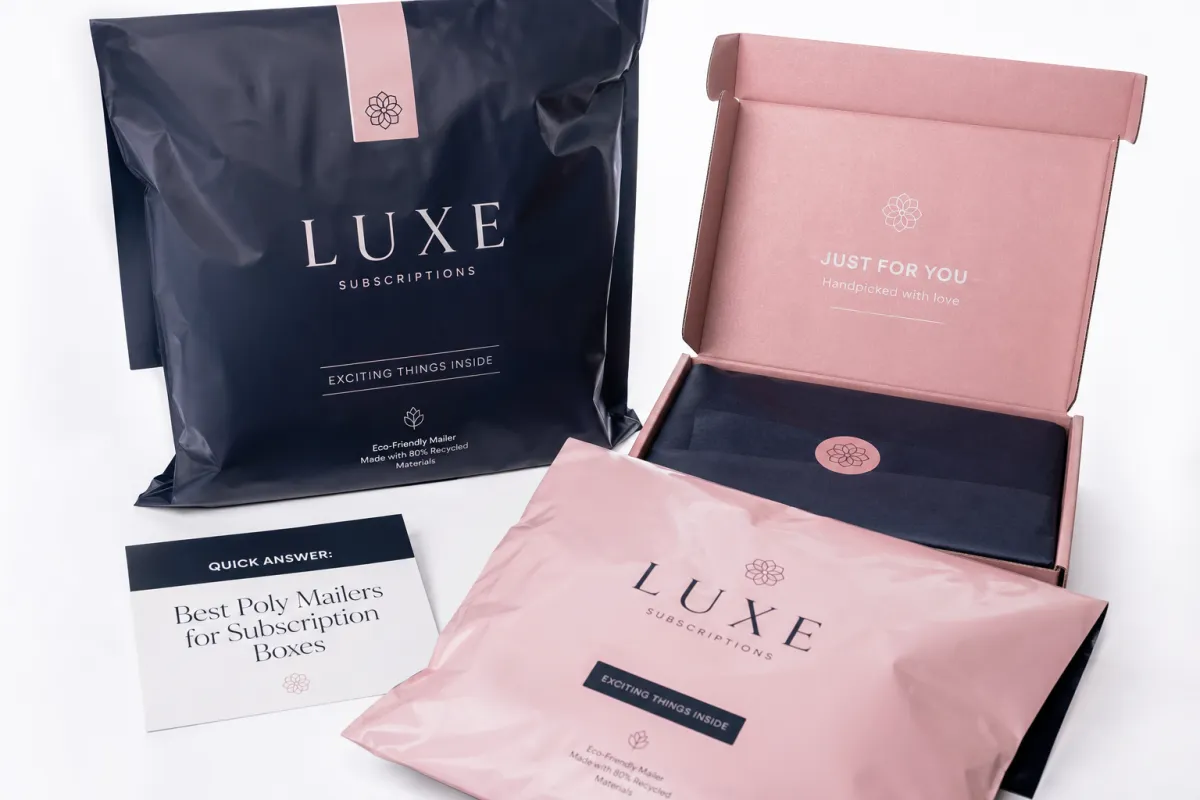
If you need one practical map, start here. For soft-only, low-complexity bundles, standard poly is usually enough. For kits with edges, inserts, or moving components, co-extruded construction is usually more dependable. If the package has fragile content, bubble-lined and reinforced options enter the shortlist quickly. This framework is simple because the mistake rate in launch weeks is usually from wrong assumptions, not lack of products.
Many operators think film thickness is the whole game; it is not. A 2.5 mil mailer with stable hot-melt and good film behavior can outperform a thicker option that seals poorly. In operations I reviewed last quarter, teams with similar outbound volume saw fewer returns after switching to stable closure chemistry and better seam overlap, even before changing thickness class. That is exactly why the best Poly Mailers for Subscription Boxes sit at the balance point between durability and process consistency.
A quick checklist for sourcing helps: gauge, adhesive class, opacity, print fidelity, and multi-stop fulfillment behavior. Start with an internal benchmark and align with independent handling references before you place anything at scale. It is tempting to pick the sample with the sharpest print, but real procurement discipline starts with repeatability rather than initial visual impact.
One operational rule I never break: test after the kit is fully assembled and the labels, inserts, and protection are in place. If your mailer only works on a naked product, you are kidding yourself about transit failure. The right best poly Mailers for Subscription boxes absorb the final geometry, including tissue, cards, pouches, and inserts, without forcing workers into micro-stretch at the seal edge.
Top Options Compared for Subscription Boxes
There is no universal winner, and pretending there is one gets people burned. Standard poly moves fastest and costs less up front, which is why teams return to it in early phases. Co-extruded mailers run tougher under puncture and corner compression. Bubble mailers buy impact cushioning. Kraft-lined mailers shift perception and feel more intentional, while custom prints layer branding into the shipment itself.
Selection always tracks two real variables: what is being shipped and how it is handled before it leaves your dock. Apparel and soft goods usually do best with smooth, opaque film that folds fast and stacks clean. Beauty products, metal parts, and mixed kits usually need stronger structural performance, not just a thicker bag. Books or media bundles can work inside bubble mailers if edges are controlled and they are not overfilled.
| Mailer Type | Typical Thickness | Best For | Indicative Unit Cost at 5,000 Units | Main Tradeoff |
|---|---|---|---|---|
| Standard poly mailer | 2.5-3 mil | Apparel, soft goods, lightweight accessories | $0.12-$0.22 | Lowest cost, least premium feel |
| Co-extruded poly mailer | 3.5-4.5 mil | Heavier kits, sharper edges, higher transit stress | $0.18-$0.32 | Better durability, slightly higher price |
| Bubble mailer | Outer film plus bubble lining | Books, cosmetics, small fragile items | $0.20-$0.36 | More protection, more bulk |
| Kraft-lined mailer | Paper outer with polymer barrier | Premium presentation, brand-forward subscriptions | $0.28-$0.45 | Better shelf appeal, heavier ship weight |
| Custom printed poly mailer | 2.5-4 mil | Scaled brands, branded unboxing, repeat subscriptions | $0.16-$0.38 | Higher setup complexity, better branding |
If throughput is your only KPI, plain poly dominates first choice in most programs. But when unboxing quality is a repeat-value lever, custom print often becomes worth it before you hit any “big-brand” phase. In lines with repeated drops, heavy sorting, or stacking, co-extruded mailers usually earn their premium faster than expected because they reduce the number of compromised parcels entering support.
Presentation is not just print tone; it is system design. Opaque white can be reliable and cost-effective. Matte black looks premium when closures and logos are clean. Kraft-lined mailers add emotional texture but can push logistics cost and dimensions. Bubble mailers imply practical strength but still feel utilitarian in many lifestyle brands. For a coherent packaging system, test the mailer in combination with your labels, inserts, and fill policy, ideally at Custom Packaging Products.
One thing I learned the hard way: brands often underestimate the power of the “last 20 percent” visual. If the edge looks sloppy, the whole presentation can look rushed. If the seal edge lands cleanly every time, customers infer care even before they notice the logo.
Detailed Reviews of the Best Poly Mailers for Subscription Boxes
Standard poly mailers are the boring hero choice for a reason. They are fast, often affordable, and easy to line up with high-speed packing. Their weakness shows up where seam stress, corner pressure, and repeated movement are high, especially with mixed-content kits. If your product is consistently soft and flat, this is a very practical starting point for the best poly mailers for subscription boxes.
Co-extruded mailers are often my go-to recommendation for steady monthly programs. The layered film gives better puncture resistance than mono-film equivalents and usually handles motion better in a tote or van handoff. For one campaign I helped review, moving from mono-film to co-extruded cut edge split incidents enough to reduce re-packaging events during peak launch week. That outcome sounds simple, but it changed fulfillment confidence more than any design refresh.
Bubble mailers are built for impact management, period. They do not win style contests, but they stop common failure modes in books, compact electronics, mascara pallets, and rigid components that shift during transit. The downside is volume: they are bulkier and can increase storage and dimensional charges if your carton density is already tight. In fragile SKUs, I still rank them near the top because damage control usually outperforms pure visual polish.
Kraft-lined mailers occupy the midpoint between shipping and gifting. They support premium perception and are especially effective when your subscription experience is about ritual, not just replenishment. The tradeoff is material mass and handling cost. For gift-led subscriptions, this can still be the best-performing option even after the extra shipping overhead, as long as your product profile fits the added stiffness.
Custom Printed Poly Mailers create debate because setup feels expensive at low volume. That reaction is understandable. The economics improve as quantity grows, and the operational value appears earlier than people expect: fewer secondary sleeves, fewer ad hoc label workflows, and cleaner brand consistency in one layer. For repeat customers, this can reduce confusion and speed up training because the visual system is embedded in the mailer itself.
For technical diligence, ask suppliers for ASTM D882 data and sealing-window details, then run your own warehouse stress checks. Fill a mailer with a completed kit, seal it, run drop tests, edge rubs, and pull-seal cycles from realistic conveyor contact points. A best-in-class specification should hold across heat and humidity, not just on a lab bench.
For sustainability-focused teams, paper-backed and recycled materials can be a strong fit, but only when the physical chemistry supports real-world use. A recycled look without durable performance is a brand-risk move, especially when returns spike. If buyers care about environmental claims, track outcomes that prove it: fewer damage incidents, reduced void fill, and lower repack cycles. That is how “best poly mailers for subscription boxes” should be judged in practice.
For new programs, use a side-by-side pilot. I usually run three variants—standard opaque, co-extruded, and custom printed—using one complete kit format. Record packing time per unit, seal consistency, and post-shipment look after a simulation lane. The winner is never clear from an isolated sample card; it appears when the same order volume is pushed through the process.
Best Poly Mailers for Subscription Boxes: Price Comparison
People compare unit prices and call it done. That is where most procurement plans go wrong. Freight, artwork re-runs, setup complexity, and additional cushioning change total landed cost faster than the quote line. A “cheap” mailer becomes expensive when it creates packing delays, return leakage, and storage churn.
At low volume, plain stock normally wins pure unit economics. In higher tiers, the custom-printed lane usually becomes financially practical as volume grows, because incremental branding costs level out. In my own workflow, that crossover often comes sooner than teams expect if you include labor savings and reduced secondary labeling.
| Order Size | Plain Stock Poly | Custom Printed Poly | Premium / Specialty Mailer | Best Value Pick |
|---|---|---|---|---|
| 500 units | $0.22-$0.35 | $0.55-$0.95 | $0.70-$1.10 | Plain stock poly |
| 2,500 units | $0.14-$0.24 | $0.24-$0.42 | $0.38-$0.68 | Depends on branding needs |
| 5,000 units | $0.12-$0.22 | $0.16-$0.32 | $0.30-$0.55 | Custom printed poly |
| 10,000+ units | $0.10-$0.18 | $0.13-$0.26 | $0.24-$0.45 | Custom printed poly |
Hidden charges are where teams get surprised, especially at the start. Artwork and plate work can add meaningful fixed cost, and complex color standards can increase that quickly. Bubble and kraft constructions usually increase freight and storage drag, and resealable systems add direct unit cost. If your team adds extra tape, corner caps, or void fill to every box, compare that to the total line, not just invoice line 1.
Labor is an underrated cost multiplier. A good seal that closes correctly every time saves seconds, and those seconds multiply into a meaningful capacity swing. At 5,000 units, an extra three seconds per package is over four hours of labor. Most operators do the math only after the line misses a wave cutoff and starts sprinting at 2 a.m.; better to price that risk ahead of time.
My purchasing sequence is consistent across programs: plain stock for predictable soft kits, co-extruded when damage risk rises, then custom print once brand contact is central or volume supports setup. This sequence protects margin and still leaves room for customer-facing quality. Every one of these lanes is a decision, not a branding mood.
How to Choose Poly Mailers for Subscription Box Fulfillment
Start with the finished kit, not the product SKU. A single rigid piece changes risk for the whole batch even if 90% of the contents are soft. Many teams still size from the lightest item and then wonder why operators force seals on heavy days. The best poly mailers for subscription boxes must fit the final shape under label and instruction sheet.
Fit is where small teams get burned, and it is fixable. Too tight and operators over-stretch then micro-fracture the seal. Too loose and the bundle balloons, shifts, and looks messy at handoff. Measure the packed profile and include seal width in your test plan, usually 1–2 inches depending on closure style and seam architecture.
Closure behavior is climate-sensitive and under-tested. Peel-and-seal is easy and fast, but humidity and heat shift tack significantly. Dual-seal systems can be worth the extra cost for returns-heavy campaigns because they survive repeated customer opening patterns. Ask for recommended application temperature and dwell profiles if the supplier provides them; that tells you whether a design holds outside an office environment.
Opacity affects perceived quality more than people admit. Thin films reveal shape, which can conflict with a luxury narrative and even expose sensitive contents. Black, white, or specialty opaque films each solve visibility differently, and print has to hold through heat and line stress, not just under booth lights. If ink shifts after a few minutes in motion, your parcel looks low effort before the customer starts opening.
Sustainability matters, but outcomes beat logos. A lighter specification can cut freight and storage; only choose that route if integrity remains stable at the exact handling profile. If you include recycled material, ask for chain-of-custody and verified standards where customer confidence is high. In honest shipping programs, the best-performing choice is often the one with lower total failure and lower re-ship volume.
Here is a practical framework for final approval:
- Soft and flat: standard or custom printed poly.
- Light and slightly rigid: co-extruded plus protective insert if needed.
- Fragile or scuff-prone: bubble or reinforced mailer.
- Premium feel: custom printed or kraft-lined structure.
- High-volume: prioritize seal speed, storage density, and stock consistency.
For a first build, integrate labels, tissue, inserts, and void fill at the same planning stage instead of bolting on later. It is usually cheaper to fix specs together than to patch after packing starts. Teams comparing options across the whole system can reduce rework by checking compatibility in Custom Poly Mailers and then locking cadence early.
Process and Timeline for Ordering Subscription Box Mailers
The sequence is usually straightforward but fragile in execution: sample request, size confirmation, artwork, proof, production, freight, receiving. Most delays happen before manufacturing, often from logo changes and last-minute dimension edits. The critical point is this: Custom Printed Mailers succeed or fail in your pre-production definition step, not in the print run itself.
A practical custom timeline often looks like this: 2-4 days for sample review, 1-3 days for artwork corrections, 12-15 business days for production after proof sign-off, and 3-7 days for domestic freight when stock is close to destination. International lanes vary with season and lane congestion, so add contingency if you are riding a holiday drop. For seasonal campaigns, I usually build a 3-4 week buffer because a delayed mailer can shift the entire fulfillment calendar.
Color control is where many operations get blindsided. A logo can pass digital review and drift by the time it comes off the press, especially between Matte and Glossy substrates. Ask for proofs on front, back, and seal zones, and compare side-by-side under normal warehouse lighting. If a hue fails at this stage, it is a spec issue, not a design preference, and you should lock it down before approval.
Reorder rhythm deserves governance. A simple reorder window helps finance and operations coordinate better: many teams reset around 6-8 weeks before stockout for custom work, especially when seasonal graphics are involved. That window reduces panic, protects campaign timing, and prevents emergency downgrades. This kind of planning is boring, which is exactly why it works.
Use receiving QA as a gate, not a formality. Check counts, verify print registration, test seal adhesion, and compare delivered stock against the approved proof. Run random seam checks and a mini stress loop before packing starts. A disciplined routine protects margin, labor consistency, and customer trust, while reducing the chance that the best poly mailers for subscription boxes become a recurring support issue.
Our Recommendation and Next Steps for Subscription Boxes
My operating recommendation is boring and effective. Use standard opaque poly for soft, low-risk goods; use co-extruded where puncture and crush risk is real; use custom print when the mailing experience is part of your retention strategy; use bubble or reinforced construction when breakage risk is materially higher. That sounds simple because the hardest part is usually discipline, not catalog choice.
If I were building a program today, I would run three samples and run three fully packed kits through each option. Then I would run handling, drop, and seal checks under your actual courier path, not just a tabletop trial. The best poly mailers for subscription boxes usually expose one major weak point early, and that is exactly where you want to lose time—before real deliveries, not after.
Before you place any PO, evaluate five items: final packed dimensions, film thickness, adhesive chemistry, proof quality, and total landed cost. Compare at least two suppliers to avoid anchoring to one price and one machine spec. Then match the final decision to product mix, delivery service profile, and expected customer handling. A setup that works on your line can fail in your customers' garages if not tested in both environments.
For teams running brand-led subscription models, packaging is one of the few touchpoints where operations and marketing can agree on outcomes. It needs to protect, move fast, and feel intentional every time it arrives. The winner is not the loudest design, but the best-performing poly mailer for subscription boxes against your actual lane conditions.
Clear takeaway: pick a baseline mailer, run a real pilot with your exact kits, choose the option that cuts rework and support pressure the most, and only then scale with a single supplier backup plan to avoid line disruption.
FAQ
What thickness is best for poly mailers for subscription boxes?
For many soft kits, 2.5-3 mil is usually the starting line. If your mix includes heavy, rigid, or edge-heavy items, teams typically move to co-extruded grades or add reinforcement where needed. The best poly mailers for subscription boxes are chosen by seam stress and product geometry, not thickness alone.
Are poly mailers cheaper than boxes for subscription boxes?
Often, yes, especially if your contents are soft and the profile is controlled. Savings can come from lower packaging labor, lighter freight, and faster packing throughput. If your kit needs bulky protection or premium finishing, the gap narrows, and some programs still benefit from hybrid packaging. In many cases, the best poly mailers for subscription boxes still produce better landed cost than equivalent cartons.
How do I size poly mailers for subscription box products?
Measure the fully packed unit after labeling, insertion, and quality controls are done. Leave enough width for the closure to sit flat without stretching, and test at least two sizes if your kit dimensions vary between batches. If you guess small, you get seal pressure failures; if you guess large, handling and appearance suffer. Choose the size that tolerates your real operator workflow without appearing sloppy.
Will custom printed poly mailers slow down fulfillment?
They can slow things early if your art, size, or adhesive specs keep changing. Once specs are frozen, custom prints usually improve pace because branding is pre-integrated. The risk most teams hit is in supplier scheduling and freight timing, not the packing station speed itself. In many operations, the best poly mailers for subscription boxes improve rhythm after the approval phase is stable.
What is the best closure type for subscription mailers?
Peel-and-seal remains the high-volume workhorse because it is fast and dependable. Dual-seal systems help when parcels are likely to be opened and re-sealed, but they add cost and handling complexity. Match closure type to actual behavior: one-way promos, returns-heavy SKUs, and frequently reopened shipments all respond differently. The best poly mailers for subscription boxes are the ones whose closure survives both courier handling and customer handling.