Buy Custom Holographic Labels for Clothing Brands
Custom holographic labels can change the way a garment is read before anyone touches the fabric. That sounds like a small thing. It is not. In a crowded category, first impressions are often made in under two seconds, and finishes that catch light tend to register faster than flat, matte branding. A reflective label can make a basic tee feel more deliberate, a hoodie feel more collectible, and a limited drop feel less interchangeable with the rest of the rack.
The attraction is not just visual. A holographic surface creates contrast, movement, and a sense of depth that standard woven or printed tags do not deliver on their own. It can support package branding, improve shelf visibility, and make unboxing feel more considered. The catch is that the finish only works if the construction is right. A label that looks strong in a mockup but cracks, peels, or distorts after handling is not premium. It is a liability with a bright surface.
That is why buyers need to think about these labels as a production decision, not a styling flourish. Material choice, adhesive performance, heat tolerance, wash resistance, and placement all shape the result. If those pieces are aligned, the label does more than decorate. It becomes part of the brand system, sitting alongside hang tags, inserts, and custom printed boxes as another cue that the product was built with intent.
What Custom Holographic Labels Actually Do for Apparel
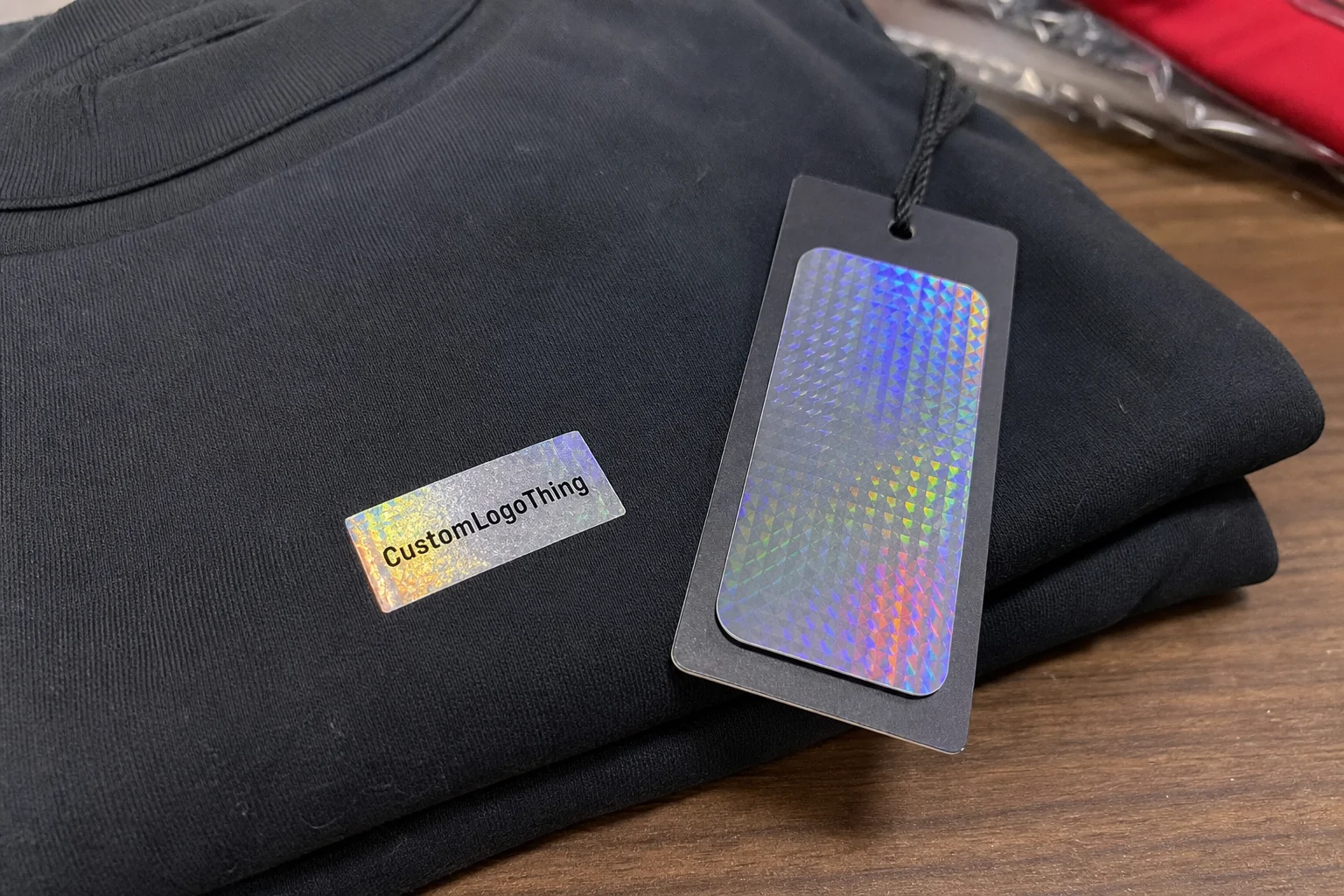
At a practical level, custom holographic labels are branding components that use a reflective, light-shifting finish to create motion as the viewing angle changes. They may be sewn in, heat applied, adhesive-backed, or built into hang tags and packaging elements. The effect is immediate. Light hits the surface, color shifts across the label, and the eye stops for a fraction longer than it would on a plain tag. That fraction matters more than people admit.
For apparel brands, the use cases are straightforward. Premium basics need a visual lift without becoming loud. Streetwear benefits from finishes that feel modern and a little technical. Kidswear and giftable garments gain a sense of novelty that can justify a higher perceived value. Even simple products can benefit when the rest of the presentation is disciplined. A reflective label does not rescue poor garment design, but it can sharpen the overall read.
There is also a merchandising advantage. On a rack or in a retail image, reflective details separate faster from the background than flat ink does. The same logic applies to packaging: a small bright element often does more than a bigger but ordinary one. For brands using Custom Labels & Tags as part of a coordinated presentation, the holographic finish can reinforce the broader visual language instead of feeling like an isolated gimmick.
The real decision is whether the effect matches the product’s price point and audience. If the garment is utility-first and price-sensitive, a premium finish may be overkill. If the line is positioned around drops, special editions, or elevated basics, the label can support the story without needing to explain itself. The strongest use cases are usually the simplest: fewer colors, clean type, clear placement, and a finish that is noticeable without overwhelming the garment.
A reflective label is not automatically a better label. It is better only when the finish, substrate, and application method fit the fabric and the wear cycle.
That distinction matters because apparel moves. It folds, rubs, stretches, and gets washed. Packaging can survive a wider range of decorative decisions than clothing can. A label that works well on an outer mailer or product insert may fail on a side seam or collar once the garment starts moving through real life. The buyer who ignores that difference tends to learn it the expensive way.
How the Holographic Finish Is Made and Applied
Most holographic effects come from a coated film, foil layer, embossed texture, or printed diffraction pattern that splits light into shifting colors. The base material can be polyester film, woven stock, PVC-free film, or another substrate chosen for flexibility and durability. The result may look similar from a distance, but the construction underneath can be completely different. That is where performance either holds up or falls apart.
The production process usually starts with vector artwork. The supplier confirms dimensions, line thickness, and any small text that needs to stay readable on a reflective surface. After that comes the choice of base material and finish method. Some labels use a laminated holographic film. Others use a printed effect on top of a reflective layer. A few rely on embossing or metallic treatments. Each route has different implications for cost, sharpness, and wear resistance.
Application method matters just as much as the finish. Sew-in labels are usually the safest for long-life apparel because they are physically attached and can tolerate repeated handling. Heat-seal constructions are common when production speed matters, but they need controlled temperature and pressure. Adhesive-backed options are useful for packaging, swing tags, or temporary branding, though they are not the right answer for every textile. If the adhesive is too aggressive, it can damage a delicate fabric. If it is too weak, the label lifts early. There is no free pass here.
The same label also behaves differently depending on where it sits. A collar tag faces different stress from a waistband patch. A cuff label bends more often. A hem label may rub against itself or other garments in storage. Seams, folds, and stretch zones all increase the chance of edge lift or visual distortion. That is why placement should be part of the spec, not something left for the factory to interpret on the fly.
For brands building a packaging system rather than a single garment detail, the label should work with the rest of the presentation. If the project also includes Custom Packaging Products, the finishes should feel related. A holographic label on the garment and a matte, recycled outer box can work together. A chaotic mix of effects usually reads as indecision. Cohesion is worth more than novelty.
Testing also belongs early, not after launch. A useful approval process includes checks for rub resistance, fold behavior, color shift under different lighting, and bond integrity after application. For broader packaging systems, standards-driven thinking helps. The ISTA approach to transit testing is useful when labels are part of a retail-ready package, and FSC certification can matter when the brand wants its paper components to support a credible sustainability story. Neither solves the label problem by itself, but both help frame the wider system.
Cost, Pricing, and MOQ Factors That Move the Quote
Pricing is usually determined by a small set of variables, and they are predictable once the spec is clear. Material type, size, finish complexity, attachment method, and quantity do most of the work. Add custom cutting, stronger adhesive systems, multi-layer effects, or tighter tolerances, and the price moves up. The largest surprise for new buyers is not the unit price itself. It is how much the unit price drops when setup costs are spread across a larger order.
MOQ is the tipping point. A small run pays the same setup burden as a large one, which is why 250 pieces can feel disproportionately expensive compared with 5,000. The press setup, proofing, sampling, and file preparation often cost nearly the same whether the order is tiny or substantial. Once volume rises, those fixed costs dilute. That is not a trick. It is the basic math of custom production.
As a rough planning range, simple custom holographic labels often land around $0.18 to $0.40 per piece at moderate volumes, while more complex constructions can move higher. A decorative label intended for packaging may sit at the lower end. A garment label that needs stronger bonding, higher abrasion resistance, or tighter cut quality will usually cost more. Rush production, extra proof rounds, and special packaging for inserts can also push the quote up. Buyers often focus on the nominal unit cost and miss the hidden cost of rework, which is usually where the real waste sits.
| Option | Best Use | Typical Feel | Rough Price at 5,000 Pieces |
|---|---|---|---|
| Printed holographic film label | Fashion branding, hang tags, visual accents | Bright, smooth, highly reflective | $0.18-$0.30 |
| Heat-seal holographic patch | Streetwear, denim, applied branding on garments | More durable, slightly thicker | $0.24-$0.40 |
| Sew-in holographic label | Long-life apparel, interior branding, premium basics | Flexible, garment-friendly | $0.22-$0.38 |
| Adhesive holographic label | Retail packaging, swing tags, temporary branding | Convenient, less wash-focused | $0.14-$0.25 |
Lowest price does not equal best value. A cheaper label can save pennies and create dollars of problems if it scuffs early, curls at the edge, or fails after the first wash. That kind of issue spreads quietly: returns, replacement shipments, support tickets, and the sort of brand damage that is hard to measure but easy to feel. A realistic quote should include what the label needs to survive, not just what it needs to look good on approval day.
Key Material, Adhesive, and Placement Factors
Material choice determines how the finish behaves under pressure. Polyester film gives a crisp reflective effect and clean edges. Woven stock feels softer and often integrates better with apparel. Coated plastic surfaces can deliver stronger visual punch, but they may feel stiffer against the body. That difference matters more on lightweight garments or close-to-skin items, where thickness can become a comfort issue quickly.
Flexibility is part of the spec, not an afterthought. A rigid label can look sharp on a flat sample card and still fail on a stretch tee. Textured fabrics create another problem: they reduce the contact area under adhesive-backed pieces and can leave air pockets that weaken the bond. Waterproof or heavily coated textiles can do the opposite, resisting adhesion if the application method is not matched to the material. None of these outcomes is unusual. They are the normal consequences of combining different surfaces.
Adhesive choice deserves its own review. Permanent adhesive works for some packaging uses and certain garment applications, but it can be too aggressive on delicate cloth. Removable adhesive is easier on the fabric but may not satisfy durability needs. Heat-activated systems are common in apparel because they can create a strong bond when temperature and pressure are controlled properly. The problem is that real production lines are not laboratory benches. If the heat is too low, the bond weakens. If it is too high, the surface can warp or gloss over in the wrong way.
Placement changes the wear pattern. A collar label sees different friction than a waistband patch. A cuff label folds more often. A side seam label may avoid direct abrasion but can distort if the underlying fabric stretches unevenly. The placement decision should be made with the same seriousness as the artwork. If the garment is thick, structured, and low-stretch, more options are available. If it is thin, soft, and elastic, the safe choices narrow fast.
A useful rule: if the garment will be handled often, folded tightly, or washed repeatedly, the label should be specified for those conditions first and for appearance second. The best-looking sample is not the best-performing one if the use case is wrong.
Process and Turnaround: From Artwork to Approved Sample
The cleanest jobs follow a predictable path. Artwork is submitted. Dimensions and placement are confirmed. The substrate and finish are selected. A digital proof is reviewed. If the construction is new or the garment is sensitive, a physical sample is approved before production starts. That sequence looks simple, but each step protects against a different type of failure. Skip one and the risk moves downstream.
The most common delays are also predictable. Missing vector files cause redraws. Unclear Pantone targets lead to color disputes. Late revisions add time, especially if the holographic effect needs to be balanced against legibility. One more proof round can move the shipment several days. A sample can add more. If the label is tied to a launch date, the schedule should be based on the garment calendar, not the marketing calendar. Those are often not the same thing.
Simple jobs can move quickly once approval is locked. More complex constructions take longer because they require more checking. Typical lead times for straightforward custom holographic labels often fall in the 12 to 15 business day range after proof approval, though that is not a promise and it is not a universal standard. Special finishes, stricter tolerances, and sample revisions can extend the timeline. Buyers often try to skip the sample stage to save time. That is sensible for low-risk packaging. It is a poor trade for anything that needs to survive wear.
A physical sample is not overhead. It is the lowest-cost way to find out whether finish, adhesive, and fabric actually work together.
There is also value in connecting the label timeline with the rest of the brand rollout. The same artwork decisions that affect the label often affect inserts, swing tags, and custom printed boxes. If the visual system is coherent, the customer reads it as intentional. If every part is styled independently, the packaging starts to feel assembled rather than designed. That distinction can be subtle, but customers notice it faster than teams usually expect.
Common Mistakes That Make Labels Fail Faster
The most common mistake is choosing style over function. A label can look excellent on a screen and fail in the real world because it is too stiff, too thin, too glossy, or simply built for the wrong use case. That happens often on stretch garments and delicate textiles, where even a small mismatch shows up quickly. If the label is expected to behave like a woven tag but is actually a stiff film patch, the failure is usually predictable.
Specification gaps are another source of trouble. Buyers sometimes ask for a holographic finish without defining the intensity, wash target, adhesive type, or application method. Then everyone involved has to guess. Guessing costs time, and time costs money. A useful brief includes exact dimensions, garment fabric, placement, use conditions, and quantity. If the label has to work with a particular launch schedule or retail presentation, that should be stated plainly as well.
Placement errors are easy to miss because they are not obvious in the mockup. A label near a seam may look clean in a rendered image but fail once the garment bends. A patch placed where the fabric folds repeatedly can curl at the edges or wrinkle in the middle. High-friction zones create another problem: surface wear can dull the reflective effect faster than expected. Sometimes the right fix is a different size. Sometimes it is a softer construction. Sometimes it is moving the label two centimeters away from a problem area. Small changes can have outsized results.
Under-testing remains the quiet failure point. Wash tests, rub tests, and fold tests are not ceremonial. They show whether the label can survive actual use. If a supplier cannot explain how the sample was tested, what application settings were used, or what kind of wear guidance they recommend, that is a reason to slow down. For performance-sensitive apparel, evidence matters more than confidence. That is especially true when the label will be one of the few visible signals of brand quality on the product.
Expert Tips and Next Steps for a Smarter Order
Start with a pilot run whenever the label is new, the fabric is unusual, or the launch is important. A small batch will reveal more than a spec sheet. Check how the finish reads under natural light and under store lighting. Check whether the text stays legible from arm’s length. Check whether the label still sits flat after the garment is folded, bagged, and handled a few times. Those tests sound basic. They are also the ones that tend to expose real-world problems fastest.
Bring a proper production checklist before requesting a final quote. Good quotes are built on usable inputs, not general intent. Include artwork format, exact dimensions, garment fabric, application method, target quantity, expected turnaround, and any wash or abrasion requirements. If the label is part of a larger packaging system, say so. A label that sits beside inserts, mailers, and branded cartons should be evaluated differently from one that functions as a one-off decoration. The broader the system, the more important consistency becomes.
- Artwork: vector file, logo version, and finish direction
- Specs: exact size, thickness, and placement
- Fabric: cotton, denim, knit, stretch blend, or coated textile
- Use: wash durability, packaging use, or garment attachment
- Quantity: pilot run, standard MOQ, or larger rollout
Choose the finish based on the brand story, not only on visual impact. A subtle shift can feel more expensive than a loud rainbow effect, especially on elevated basics or adult streetwear. A stronger effect may suit youth fashion, event merch, or limited drops where attention is part of the product logic. There is no universal winner. There is only the best match for the price point, audience, and fabric.
Ask for performance details before you approve production. Wash guidance. Heat tolerance. Abrasion notes. Recommended application settings. Those details are not extras. They are what separate a decorative concept from a repeatable branding asset. When the sample survives wear testing and still looks clean, the label stops being a novelty and starts doing real work for the brand.
Final Take
Custom holographic finishes are useful when they support the garment instead of competing with it. They can sharpen retail visibility, improve the perceived quality of a product, and make the opening moment feel more memorable. They can also become expensive clutter if the substrate is wrong, the adhesive is weak, or the placement ignores how the garment actually moves.
The right approach is practical. Match the material to the fabric. Match the adhesive to the attachment method. Match the finish intensity to the audience. Test before you commit to volume. That is how the label stays premium without sacrificing durability. It is also why the smartest buyers treat custom holographic labels as part packaging decision, part product decision, and part brand decision. One label can carry all three, but only if the spec is built for the real world.
Are custom holographic labels durable on clothing?
They can be, but durability depends on the base material, adhesive, placement, and how the label is applied. Sew-in and properly heat-applied constructions usually hold up better than decorative-only options. Ask for wash and abrasion guidance before approving production, especially for everyday wear.
What affects the price of custom holographic labels?
Quantity, material choice, finish complexity, and custom cutting are the biggest cost drivers. Smaller runs cost more per piece because setup is spread across fewer units. Rush timing, extra proofs, and stronger performance requirements can also raise the quote.
How long does production usually take?
Simple orders can move in roughly 12 to 15 business days after proof approval, while complex builds take longer. Delays usually come from artwork revisions, sample approval, or nonstandard finishing. Build buffer time into the schedule before a launch.
Can custom holographic labels work on stretch or delicate fabrics?
Yes, but the construction has to be chosen carefully. Stretch and delicate fabrics often need a softer, lighter, or more flexible label to avoid edge lift, distortion, or discomfort. A sample on the actual garment is the safest way to verify compatibility.
What should I check before approving a sample?
Check the shine level, readability, color shift, edge quality, attachment strength, and how the label behaves after folding or handling. If the label is for apparel, test it on the finished garment rather than on a flat swatch. That is the only way to see how it will actually perform.