Custom large tote bags look straightforward on a spec sheet. Then the order hits production and the details start to matter: the fill weight is heavier than expected, the handles sit a little too high, the gusset collapses under boxed goods, or the print looks clean until the bag is carried in daylight and every registration flaw shows up. That is usually where the difference between a useful package and a weak one becomes obvious.
For packaging buyers, these bags sit between retail packaging and branded packaging. They are not just carriers. They can become the visible shell of a product kit, an event handout, a retail takeaway, or a shipping insert that stays in the customer’s hand long after the original purchase. That makes the build more important than the label suggests. A tote can carry a message, but it still has to carry weight first.
The practical test is simple: does the bag hold its shape, protect what is inside, and still feel deliberate in the hand? Oversized dimensions alone do not answer that. A bag can be large and still fail if the handles bite into the hand, the seal line is weak, or the side panels buckle as soon as the contents settle.
What Custom Large Tote Bags Actually Need to Do
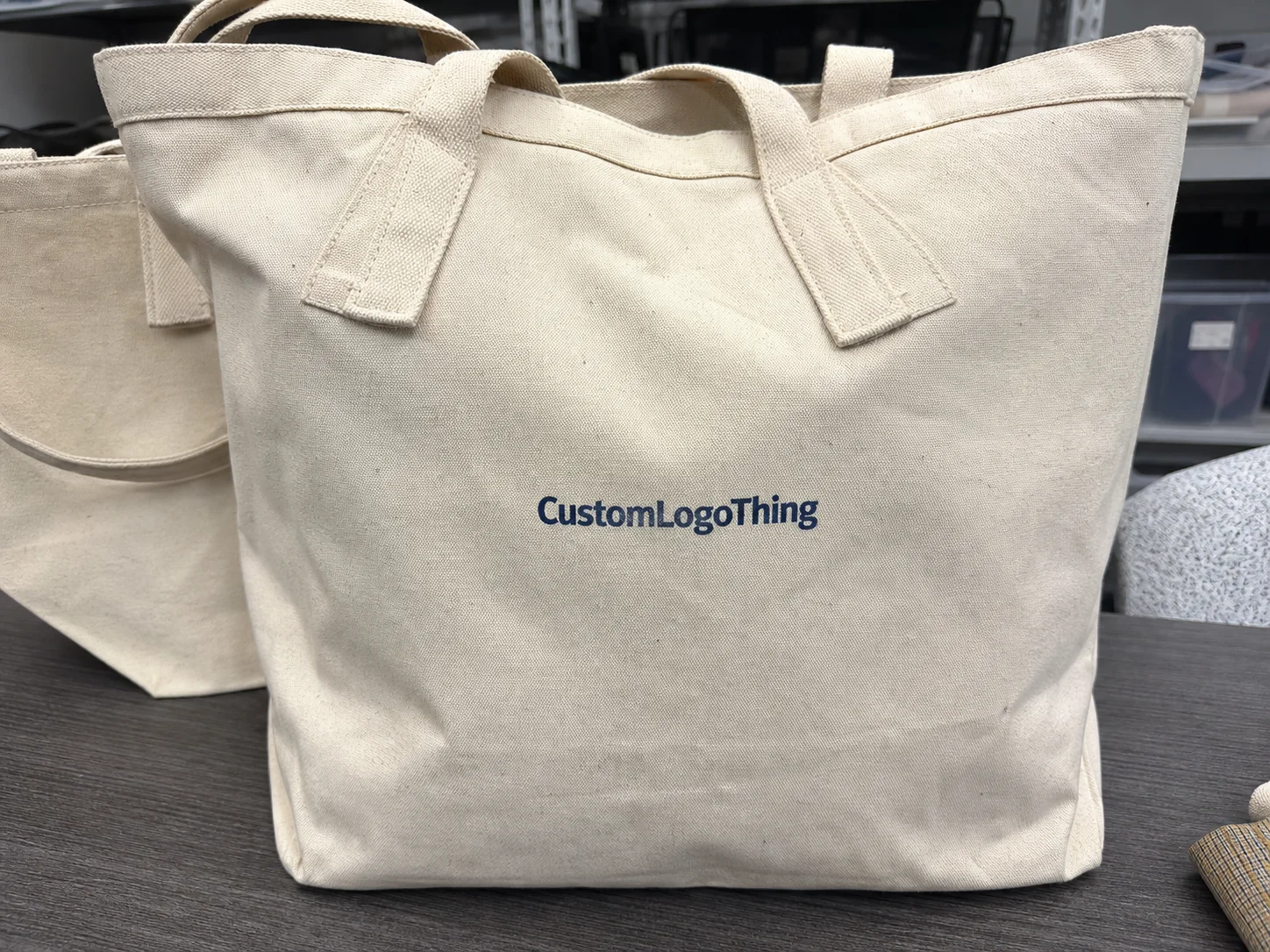
The starting point is not artwork. It is load profile. If the bag is meant for boxed sets, apparel bundles, trade show materials, or retail items with real weight, the structure has to support that load without looking overbuilt or collapsing into a loose pouch. Size, by itself, is only the first variable. Fit is what decides whether the bag works.
Useful spec questions are concrete. What is the heaviest item the bag will carry? Will the contents be rigid, soft, or mixed? Does the bag need to stand upright on a counter or only survive a short carry? Those answers change the right combination of width, height, gusset depth, handle style, and film gauge. They also change the acceptable cost range.
Retail teams often choose this format because it does more than transport goods. The bag becomes visible in the store, on the street, at conferences, or in the hands of a customer leaving an event. That is why the design has to do two jobs at once. It needs to perform mechanically, and it needs to make the brand look intentional.
That is also why generic oversizing is a poor strategy. A bag with too much empty volume can look wasteful and feel unstable. A bag with too little depth can force the contents to lean or press against the seals. Either way, the customer notices. Packaging buyers usually do not get a second chance to correct a bad first carry.
How the Bag Structure and Printing Process Work
Most large tote bag programs begin with material selection, then move into converting, sealing, handle formation, and print application. For poly and plastic tote formats, the film choice affects clarity, stiffness, tear resistance, and the way the finished bag hangs. A thicker film can improve the feel, but only if the sealing and handle construction are engineered to match.
Print quality is where many orders become more sensitive than expected. Artwork is not just placed on a surface; it has to align with the usable face area, stay away from the seal margins, and remain readable when the bag is filled and flexed. Large tote bags give more room for graphics, which is useful for package branding, but that same space exposes registration drift, color mismatch, and weak ink coverage faster than a smaller format would.
Handle style changes both appearance and performance. Loop handles usually feel more retail-ready. Die-cut handles can work well for simpler carrier formats. Reinforced handles distribute stress more evenly and are usually worth the added cost if the bag carries dense or boxed contents. A strong print on a weak handle is still a weak package.
The bag build should also be reviewed as a system. Seal width, bottom construction, handle attachment, and print placement all affect the final result. If one part is off, the whole bag looks less considered. That is why buyers comparing packaging formats should evaluate these tote bags the same way they evaluate any other custom packaging product: form, function, and finish need to agree with each other.
If the bag is going to sit in public view, ask for a placement proof before production starts. A logo that looks centered on a flat mockup can shift once gussets are introduced. The best placement often changes after you account for fold lines, panel widths, and the way the bag hangs from the hand.
Custom Large Tote Bags Pricing: What Drives Unit Cost
Pricing for custom large tote bags is driven by more than finished size. Dimensions matter, but unit cost usually moves most with film thickness, print color count, print coverage, handle construction, reinforcement, and order volume. A larger bag with a simple one-color mark is not in the same production class as a reinforced tote with full-panel graphics.
Quantity remains one of the biggest pricing levers. Lower volumes spread setup and production overhead across fewer units, so the unit price climbs quickly. Higher quantities usually improve efficiency, but only if the spec stays fixed. Any revision after quoting can wipe out the savings. Buyers sometimes underestimate how expensive late changes become once the production line is set.
Artwork has more impact on cost than many teams expect. A centered logo on one side is a light production ask. Full-coverage printing across multiple panels is a different job entirely. More ink, tighter registration, and higher waste all affect the quote. If the design wraps around the bag, the supplier will need to manage more color movement and more quality checks.
Freight and storage should be part of the budget from the beginning. Large bags take up space, and that space costs money. Pallet density, carton size, and handling protection can change landed cost in a meaningful way. A quote that looks attractive on the unit line may stop looking attractive once shipping and warehousing are added.
| Spec Profile | Typical Quantity | Common Unit Cost Range | Best For |
|---|---|---|---|
| Lightweight poly, one-color print | 5,000 to 10,000 | $0.22 to $0.38 | Retail handouts, light product carryout, promotional kits |
| Midweight film, one- to two-color print | 5,000 to 15,000 | $0.28 to $0.55 | Heavier retail packaging, event use, mixed item bundles |
| Reinforced build, larger artwork area | 10,000+ | $0.45 to $0.85 | Premium branded packaging, higher-load carryout, visible public use |
Those ranges are directional. A specific order can land outside them if it uses special handles, stronger reinforcement, tighter color matching, or a more demanding print layout. If a supplier quotes far below the market spread, ask what was excluded. Sometimes the low number is real. Sometimes it leaves out the part that makes the bag usable.
For shipping performance, packaging buyers often benefit from thinking beyond the plant floor. The ISTA test methods provide a useful frame for understanding how packed goods behave under vibration, stacking, and handling stress. You do not need a full lab program for every tote order, but you do need a realistic view of what happens after the bags leave production.
Process and Lead Time From Proof to Delivery
The order flow is usually predictable: spec confirmation, artwork review, proof approval, scheduling, production, quality check, and shipping. The part that creates most delays is usually not the press run itself. It is the front end. Missing dimensions, unclear artwork, or indecision between two versions of the same design can stall the schedule before production even begins.
Lead time should be planned backward from the date the bags are actually needed. That sounds obvious, but many programs are built from the order date instead. If the bags support a launch, seasonal promotion, or event, the schedule has to include proofing, corrections, queue time, production, and transit. A fast quote does not compensate for slow approvals.
Simple runs move faster. A clean one-color design on a straightforward tote structure is easier to release than a multi-color order with special handles and reinforcement requirements. That does not mean complex orders are a problem. It means they need more controlled sequencing and fewer assumptions.
The proof should be treated as a production document. Confirm the dimensions, print placement, finish, handle style, and delivery address before releasing the order. That discipline prevents the sort of correction that sounds minor and turns into an avoidable delay. A bag run is not hard to manage once the spec is locked. It is hard to recover once the run starts wrong.
For teams building a broader kit, custom packaging products should be coordinated together rather than bought as separate pieces. If the tote, insert, and outer packaging all need to arrive at the same time, the production calendar should reflect the entire package flow, not just the tote order on its own.
For standard programs, 12 to 15 business days after proof approval is a common planning range. More complex builds can take longer. Shipping method can shorten or extend the delivery window, but the approval cycle usually matters more than transit once the order enters production.
Key Specs That Decide Fit, Strength, and Shelf Presence
The first spec to lock down is size: width, height, and gusset depth. The bag needs to fit the contents in real use, not just on paper. If the gusset is too shallow, boxed products force the sides outward and the bag feels underbuilt. If the bag is too tall or too wide for the contents, the package can look sloppy even if the print is excellent.
Film gauge matters, but it is not the only indicator of strength. Seal integrity, handle reinforcement, and the path of the load from the handles into the body are equally important. Buyers often focus on print quality because it is easier to see. The carry path is the part that takes the abuse.
Opacity and finish affect shelf presence. Large tote bags are often seen in public spaces, so the surface treatment changes the impression. A matte finish tends to look softer and more premium. A glossier surface usually makes colors feel more vivid. Neither choice is universally better. The right choice depends on the brand tone and the product category.
Use-case constraints also matter. If the tote is used near food, the material and inks should be checked for suitability. If sustainability claims are part of the brief, avoid vague language and specify the actual disposal or recycling expectations. If the tote is part of a larger program that includes paper carriers or custom printed boxes, material alignment matters more than people think. Mixed packaging systems can look inconsistent fast.
Buyer rule: if the bag is supposed to carry real weight, test the sample by hand with the intended load. If it feels awkward in your hand, the customer will feel the same thing later.
For quality review, ASTM film tests such as puncture, tear, and tensile methods are useful references. They do not replace practical testing, but they help explain why one film or construction choice performs better than another. A good supplier should be able to connect the chosen gauge and build style to the intended load instead of giving a vague assurance that the bag is “strong enough.”
Common Mistakes That Create Reprints or Delays
The most frequent mistake is measuring the bag flat and ignoring the way the gusset changes the usable shape. A tote may look large enough on a drawing and still fail in packout because the contents need more depth than the spec allows. If the product list is not part of the conversation, the bag can be technically correct and still wrong for the job.
Handle choice creates another avoidable problem. A handle style that works for a lightweight giveaway may be uncomfortable on a retail bag carrying boxed goods. The handle drop and reinforcement have to match the actual load, not a sample that was nearly empty during review. Empty samples can be deceptive. They always feel better than they perform.
Artwork issues are expensive because they are visible and late-stage. Low-resolution files, missing bleed, weak contrast, and graphics placed too close to the seal line can all trigger rework. On larger bags, those problems are easier to see because the print area is more exposed. Bigger surface area means more room for the design, and more room for mistakes.
- Wrong dimensions: the product fits on paper but not in a real packout.
- Weak artwork files: logos blur, colors shift, or the layout sits off-center.
- Underestimated quantity: the second order costs more because it has to be rushed.
- Unclear approval: the proof is signed without confirming handle style, finish, or print placement.
Quantity errors create their own form of waste. Ordering too few bags can force a second run with new setup costs and extra freight. Ordering too many traps cash in inventory and storage. The better approach is to base the order on a realistic usage forecast, not a hopeful one. That may sound conservative. It is usually cheaper.
To avoid reprints, build approval around the final spec sheet, not the artwork alone. A bag can look polished and still be wrong if the dimensions, handle placement, or seal margins were never confirmed. That is the point where most avoidable problems begin.
What to Confirm Before You Request a Quote
Start with the end use. Is the tote for retail carryout, a promotion, product bundling, or shipment support? That one answer should guide the size, material, handle style, and print approach. Buyers who define the use case clearly usually get better pricing and fewer revisions because the spec has less room to drift.
Then gather the core details: target dimensions, quantity, material preference, print colors, finish, and delivery date. Clear input produces a cleaner quote. It also gives the vendor a chance to flag conflicts before the order is released. That matters more than it seems, especially on custom large tote bags, where one small spec change can alter the entire build.
If the artwork is complex, request a proofing step before production release. That is cheap insurance. A quick review now is better than discovering after the run that the logo sits too close to the handle, the color match is off, or the branding panel is not centered the way you expected.
For teams building a broader brand package, product packaging should feel consistent across every piece. The tote, the insert, the outer shipper, and any secondary material should look like part of the same system. If they do not, the program reads as assembled instead of designed.
The practical sequence is not complicated. Compare a small set of configurations, check landed cost rather than unit price alone, and lock the final spec before production begins. If the input is disciplined, custom large tote bags are straightforward to buy and predictable to run.
What size should custom large tote bags be for retail use?
Start with the largest item the bag needs to carry, then add room for the gusset and a comfortable handle drop. A good retail tote fits the product without forcing the handles to strain or the side panels to bow outward.
How do custom large tote bags pricing tiers usually work?
Pricing usually moves with quantity, film thickness, print complexity, and handle construction. Larger runs generally lower the unit cost because setup is spread across more bags, while specialty builds raise the price.
What is the typical lead time for custom large tote bags?
Lead time depends on proof approval, production queue, print method, and shipping distance. Clean artwork and fast approvals shorten the schedule more effectively than trying to rush the plant later.
Can I print full-color artwork on custom large tote bags?
Yes, but the print method and artwork setup need to match the bag material and production process. Full-color designs usually require tighter file prep and more careful proof review than simple one-color graphics.
What should I verify before ordering custom large tote bags in bulk?
Verify dimensions, quantity, print layout, handle style, and the delivery date before approving production. A final spec check reduces the risk of reprints, storage issues, and a bag that looks right but performs poorly.