Buyer Fit Snapshot
| Best fit | Buy Eco Corrugated Pallet Boxes for Shipping projects where brand print, material claims, artwork control, MOQ, and repeat-order consistency need to be specified before quoting. |
|---|---|
| Quote inputs | Share finished size, material target, print colors, finish, packing count, annual reorder estimate, ship-to region, and any compliance wording. |
| Proofing check | Approve dieline scale, logo placement, barcode or warning zones, color tolerance, closure strength, and carton packing before bulk production. |
| Main risk | Vague material claims, crowded artwork, missing packing details, or unclear freight terms can make a low unit price expensive after revisions. |
Fast answer: Buy Eco Corrugated Pallet Boxes for Shipping: Board, Finish, Dieline, and Unit Cost should be specified like a repeatable production item. The safest quote records material, print method, finish, artwork proof, packing count, and reorder notes in one written spec.
Production checks before approval
Compare the actual filled-product size with the drawing, then confirm tolerance on folds, seals, hang holes, label areas, and retail display edges. Reserve space for logos, QR codes, warning copy, and material claims before decorative graphics fill the panel.
Quote comparison points
Review material grade, print process, finish, sampling route, tooling charges, carton quantity, and freight assumptions side by side. A quote is only useful when the supplier can repeat the same color, closure quality, and packing count on the next order.
Buy eco corrugated pallet boxes with the same discipline you would bring to a steel rule die or a palletizer changeover, because the box spec shapes freight weight, dock handling, and damage risk in ways that show up fast on the floor. I remember standing on a loading dock in Mobile, Alabama, in 92-degree heat and 78% humidity, watching a receiver slice open a worn wood crate with a utility knife and then immediately shake out a handful of splinters like he had just lost a fight with the packaging. That was the moment I stopped treating the box as an afterthought. When the package is right, the whole operation feels calmer: fewer snags, fewer complaints, and a lot less muttering from the dock crew.
The best buyers do not begin with a product photo. They start with the load, the lane, and the handling problem, then they buy eco corrugated pallet boxes that fit those realities instead of asking the freight to adapt to a generic container. That approach serves bulk parts, seasonal replenishment, export freight through Savannah, Georgia, inter-plant transfers from Guadalajara to El Paso, and regional distribution moves where every added pound shows up in labor, fuel, or claims. Honestly, I think that is where the real savings live anyway, not in glossy brochure language but in the stubborn little details that keep a shipment from becoming a headache.
One food client I worked with on the Gulf Coast retired a heavy wood crate and replaced it with a double-wall corrugated pallet box that cut 23 pounds per unit from the tare weight. The warehouse team felt the difference on day one because the package no longer needed two people to rotate it onto a stretch-wrapped pallet. A Midwest automotive supplier had a different problem: nail heads were catching gloves and tearing shrink film. After the move to corrugated containers, the line settled back into rhythm without changing the product load. That is the practical side of buy eco corrugated pallet boxes: less friction in the building, not just better language on a sustainability slide. And, frankly, fewer nail-related curses echoing across the dock, which I have heard more times than I care to admit.
Why buy eco corrugated pallet boxes for heavy loads?
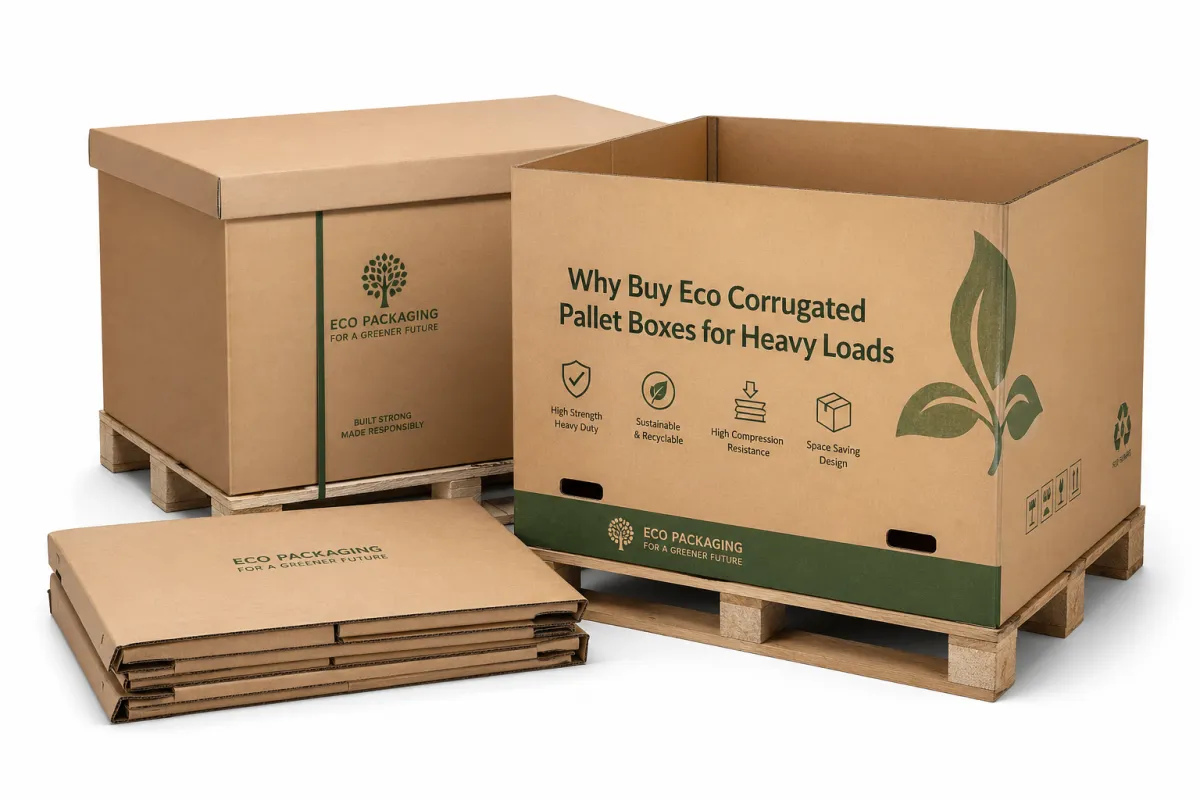
When a buyer tells me they want to buy eco corrugated pallet boxes, I usually ask a plain question first: how much does the load weigh, and how long does it sit before it moves again? A 420-pound parts load headed for local truck freight behaves very differently from a 1,100-pound export pallet that spends eight days in a container, a yard in Long Beach, and a cross-dock in Reno. The box has to survive the lane, not just the rendering. I learned that the hard way early on, when a box that looked perfectly fine in a clean sample room in Charlotte turned into a soggy, unhappy mess after three days in a hot trailer. The sample looked elegant; the trailer did not care.
A well-built corrugated pallet box can replace a heavier wood container and still improve cube efficiency because the structure is built around the pallet footprint, the wall height, and the way the load stacks. I have seen a 48 x 40 x 34-inch fiber container take the place of a rough lumber crate that weighed nearly twice as much empty, and the freight team immediately saw the tare weight drop on every outbound shipment. That matters when 500 units a month are moving and the carrier rate is tied to every pound above the pallet deck. It also matters to the person who has to lift, shift, and stage the thing at 6:15 a.m. before coffee has fully done its job.
The eco part is not decoration. Recyclable fiber construction works because most plants already handle paper recovery, and the material stream is easier to sort than mixed wood, metal fasteners, and plastic straps locked into a compromised crate. The EPA keeps useful guidance on recycling and material recovery at EPA recycling resources, and the logic on the floor is simple: the cleaner the material family, the cleaner the disposal path. If your distribution center already separates corrugated from stretch film and mixed waste, a corrugated pallet box fits that flow far better than a lumber-based alternative.
Buy eco corrugated pallet boxes when you want a package that one operator can handle more easily, one that is less likely to shed splinters, and one that stays more consistent from run to run. Wood quality changes with moisture content, grain direction, and fastener placement, especially in humid places like Tampa or New Orleans. Corrugated board can be specified with tighter control over flute profile, liner weight, and crush performance. That consistency matters in plants where a half-inch dimension drift can create a stacking headache on the warehouse rack. I have seen people spend an hour arguing with a box that should have taken them ten minutes to trust.
"We stopped fighting nail pops and warped boards the week we moved to corrugated pallet boxes. The dock crew noticed the difference before accounting did."
Buyers sometimes overcomplicate the decision. If the load is clean, unitized, and headed for a lane that rewards lower tare weight, buy eco corrugated pallet boxes and test the stack. If the shipment is oily, wet, or likely to be dragged across rough concrete with no overpack, wood may still belong in the conversation. The right answer depends on the product, the route, and the abuse the box will actually take. I am biased toward the cleaner solution, but I have also seen enough real docks in Memphis, Atlanta, and Monterrey to know that pretty packaging does not win arguments with wet floors.
Common use cases include bulk molded parts, packaged components, refill kits, textile bales, folded liners, seasonal retail replenishment, and export freight that needs a recyclable outer pack. I have also seen plants use these boxes as a cleaner transfer container between a co-packer in Puebla and a regional distribution center in Dallas, where inbound case packs move as full pallet units and are broken down later in the network. That is a strong fit for buy eco corrugated pallet boxes because it reduces handling touches without forcing a redesign of the whole material flow. And fewer touches usually means fewer opportunities for somebody to jab a fork tine in exactly the wrong place, which somehow always happens on a Friday.
Buy eco corrugated pallet boxes: Product Details
At the product level, to buy eco corrugated pallet boxes means ordering a pallet-size corrugated container built around three core parts: the base, the wall set, and an optional lid or top cap. Some buyers prefer a drop-in pallet style, where the board assembly sits on a separate wood or plastic pallet. Others want an integrated base style, where the corrugated structure and pallet footprint are engineered as one pack. The choice affects handling, stack height, and how the box behaves when forklift tines enter from the front. I like integrated builds when the line is disciplined and the dimensions are stable; I like drop-in styles when the warehouse team wants flexibility and nobody wants to argue with the pallet deck at the last second.
Board selection matters more than most people expect. For lighter industrial loads, single-wall board with the right flute can be enough, especially if the contents are uniform and the box is wrapped or strapped. For heavier freight, double-wall is often the starting point, and for demanding export lanes or taller stacks, heavy-duty multiwall construction earns its keep. In practical terms, that might mean a BC-flute double-wall assembly for a 300 to 700-pound load, or a stronger multiwall build when the load sits near 1,000 pounds and must stay upright for days. I would rather specify a little more board up front than spend a week listening to a plant manager explain why the bottom layer flattened like a bad pancake.
In converting terms, the box can be stitched, glued, tab-locked, or die-cut depending on the run size and the handling profile. A stitched seam gives a tough mechanical closure. A glued seam can be cleaner for automation. Tab-locked designs save assembly steps on the packing line. Die-cut assemblies help when hand holes, venting, or a lock-in lid need to be built into the geometry from the start. If you want to buy eco corrugated pallet boxes for repetitive packing, the construction method should match the speed of your line, not just the carton sketch. I have seen more than one plant lose its mind over a box that was technically right but a total nuisance at the pack station.
Customization turns the package into a working tool instead of a plain container. Buyers often ask for printed branding, pallet-footprint matching, venting for airflow, hand holes for safer carrying, reinforced corners for compression, dividers to separate parts, and load retention features that keep the contents centered. I have seen a simple printed top cap add real value on a 60-box run because it carried handling marks, SKU data, and a destination panel that helped the receiving dock move a few minutes faster per truck. Tiny improvements add up, which is annoying in a way because it means all those tiny mistakes also add up.
For buyers building a wider packaging program, our Custom Packaging Products catalog gives a broader view of the other structures that can sit beside a corrugated pallet box, and our Custom Shipping Boxes page shows how pallet programs can connect to unit cartons, inner packs, and retail-ready packs. That matters because the best way to buy eco corrugated pallet boxes is often to align them with the rest of the packout, not treat them as a one-off purchase. A pallet box that fights the rest of the system becomes a problem child, and every plant already has enough of those.
Specifications That Control Performance and Fit
Before you buy eco corrugated pallet boxes, lock down the exact specification list. The numbers that matter most are internal dimensions, pallet footprint, wall height, board grade, flute profile, and target load weight. If the inner size is off by even half an inch, a nested parts tray or a divider set can fail to seat correctly. If the pallet footprint is wrong, the load may overhang the deck and create a lifting hazard on the warehouse floor. I have watched a team discover, too late and with a lot of groaning, that "close enough" is not a packaging spec.
I always want to know the compression target. In a busy plant in Columbus or a humid warehouse in Houston, buyers sometimes ask for "strong enough" and stop there, but compression strength, edge crush strength, and stack test data are what tell you whether the box can survive two-high or three-high storage. For export freight, I also ask about moisture resistance and average dwell time in a dock or container, because humidity softens board faster than people expect, especially when a shipment crosses warm and cool zones in the same lane. I have seen board lose its confidence in a humid week faster than some people lose patience in a meeting.
If the program is being tested for transit performance, the structure should be checked against the right standard. The International Safe Transit Association provides good context for shipping tests at ISTA transit testing standards, and that matters when a buyer wants confidence beyond a basic lab number. A box that passes a compression test on paper is not the same thing as a container that survives warehouse racking, banding, and a long ride in a closed trailer from Chicago to Phoenix. Paper victories are nice; broken corners on delivery are not.
Handling details matter just as much as strength. I look for forklift entry clearance, overhang rules, lid fit, strap channels, and whether the box needs to clear stretch wrap without tearing the corners. If the box will be banded, the corners should resist crush at the strap line. If the box will be wrapped, the wall surface should stay smooth enough that the film does not snag during the first rotation. Those details separate a spec that sounds fine from a spec that works all shift long. And yes, I have seen a wrap job fail because of a tiny corrugated burr that one person waved off during approval, and that one still bothers me.
Environmental exposure is another place where buyers save money by asking the right questions early. Will the load sit in a humid Southeast warehouse, a cold-chain transfer point near Minneapolis, or a dry inland distribution center in Salt Lake City? Will it move by truck only, or does it need to tolerate ocean container condensation and a long port delay in Los Angeles or Savannah? A corrugated structure that performs well in a dry inland route can behave differently in a maritime lane, so I do not like to buy eco corrugated pallet boxes without first matching them to the route and the weather. Packaging that ignores climate usually ends up teaching a very expensive lesson.
- Internal dimensions: match the product pack and divider layout exactly, not roughly.
- Pallet footprint: common sizes include 48 x 40 inches, but export programs may differ.
- Board grade: single-wall, double-wall, or multiwall, selected by load and stack height.
- Performance target: compression, stacking, and humidity resistance based on the lane.
- Handling method: fork entry, banding, wrap, and lid closure should be decided before quoting.
One supplier meeting I remember well was with a consumer goods plant in Indianapolis that wanted a 42-inch tall box for a mixed load of bottled components and printed inserts. The first sketch looked fine until we checked pallet overhang and realized the lid would collide with a top strap and the outer corners would crush under a three-high stack. We adjusted the board grade, lowered the wall by 2 inches, and the whole shipment became safer without changing the product mix. That is why I tell buyers to buy eco corrugated pallet boxes only after the fit and handling rules are written down. The product did not need a miracle; it needed a measurement that had actually been verified by a human being.
Pricing, MOQ, and Total Cost by Run Size
Pricing for buy eco corrugated pallet boxes is driven by dimensions, board strength, print coverage, die-cut complexity, coating, reinforcement, and whether the job needs custom tooling. A plain rectangular box with standard print and a common board grade is a different buying event from a die-cut structure with hand holes, venting, and a custom lid profile. The more unique the build, the more setup work the factory absorbs before the first finished unit comes off the line. I always tell people to expect that uniqueness has a price tag, because factories in Dongguan, Foshan, and Suzhou are not magical and corrugated board does not assemble itself out of goodwill.
Minimum order quantity is not just a supplier rule; it usually reflects setup cost, board procurement, and converting efficiency. Prototype runs might sit around 25 to 100 units, pilot quantities often land in the 250 to 500 range, and repeat production can begin near 1,000 units or more depending on the geometry. If you are trying to buy eco corrugated pallet boxes for a first-time launch, it often makes sense to approve a small test run first, then scale into a cleaner unit price once the structure is proven on the floor. I like the test-run approach because it saves everyone from pretending a sketch is the same thing as a working container.
The table below shows working price ranges I would use as a planning guide for a typical industrial program. These are not fixed quotes, because freight lane, artwork, and board availability can move the number, but they are useful for comparing options before you send an RFQ. A 5,000-piece repeat on a standard double-wall build might even land near $0.15 per unit for a simple insert or component panel, while a full pallet box with print and reinforced corners will sit much higher; the geometry decides the math.
| Build | Typical Load | Indicative Unit Price | Best Fit | Notes |
|---|---|---|---|---|
| Single-wall corrugated pallet box | Up to 250 lb | $2.40-$4.10 at 1,000 units | Light industrial parts and transfer loads | Lowest tare weight, simplest assembly |
| Double-wall corrugated pallet box | 250-700 lb | $4.90-$8.30 at 1,000 units | Most warehouse and regional freight programs | Balanced cost, stack strength, and handling |
| Heavy-duty multiwall pallet box | 700-1,100 lb | $8.90-$13.50 at 1,000 units | Export freight and high-compression loads | Better for long dwell times and rougher lanes |
| Printed custom die-cut pallet box | Varies by structure | $6.50-$15.00 depending on tooling | Branded industrial programs with handling marks | Tooling and print coverage change the price fast |
Total cost is where smart buyers separate themselves from shoppers who only look at the line-item carton price. If you buy eco corrugated pallet boxes at $1.20 more per unit but cut outbound freight weight by 18 pounds, reduce damage claims, and remove a disposal fee tied to mixed-material crates, the actual savings can be larger than the carton premium. I have seen plants save money simply because the lighter box let them ship more units per truck while keeping the same freight class. A purchasing spreadsheet can miss that kind of win if nobody asks what the box does after it leaves the loading dock.
There is also labor cost, which often stays invisible until it is measured. A team that spends 45 seconds wrestling a warped wood crate can load a corrugated box in under 20 seconds when the fit is right and the closure is straightforward. Across 2,000 shipments, that time difference becomes real payroll. I prefer to talk about landed cost, not just unit price, because landed cost includes freight, handling, storage, disposal, and the claims that never happen when the pack is engineered well. Claims that never happen do not look exciting in a meeting, but they are usually the best line item in the room.
A practical buying rule holds up well: larger runs usually unlock better pricing, but the right spec choice matters more than chasing the lowest unit cost. If one board grade keeps your stack upright and another cheaper grade creates a collapse at the dock, the cheaper unit is not actually cheaper. That is why buyers who want to buy eco corrugated pallet boxes should start with performance, then move to economics. I know that sounds obvious, but obvious things get forgotten the minute someone says, "Can we save twelve cents?"
Process and Timeline From Quote to Delivery
The buying process stays manageable if you send the right information. First comes the spec review: dimensions, weight, pallet footprint, handling method, and print needs. Next, the engineering recommendation narrows the board grade and construction style. Then the quote gets approved, artwork or structural drawings are confirmed, and the order moves into production. If you want to buy eco corrugated pallet boxes without back-and-forth, that first information packet matters more than most buyers expect. It is a little like handing a mechanic the right noise description instead of saying, "It's doing a thing." The better the input, the less everyone suffers.
- Request the quote: send dimensions, quantity, destination, product photos, and load weight.
- Review the structure: confirm board grade, lid style, wall height, and handling notes.
- Approve the sample or drawing: check fit with the actual product or a live pallet mockup.
- Release production: confirm artwork, palletization, and ship date before board is cut.
- Book freight: align the pickup window with your receiving dock and labor plan.
Timing depends on complexity, but a normal program might look like this: 3 to 5 business days for quoting and structure review, 5 to 7 business days for samples or sample-board approval, 3 to 8 days for board procurement if the grade is readily available, and 8 to 12 business days for manufacturing and quality checks once the order is released. For a straightforward repeat build in Guangdong or Jiangsu, many factories can ship in 12 to 15 business days from proof approval, while a new die, custom print, or multiwall export spec can stretch the schedule toward 18 to 25 business days. If the job needs special print, unusual board supply, or a new die, add time for those steps. Simple repeat orders usually move faster because the structure is already proven. The nice part is that once the first run is dialed in, the whole thing gets a lot less dramatic, which is always welcome in packaging.
Most delays come from bad data, not slow factories. Missing dimensions, unclear weight, no pallet footprint, artwork revisions, and freight appointments booked too late can each add several days. I once watched a project lose almost a week because the customer gave outside dimensions instead of internal dimensions, and the lid height did not clear the top layer of product. That is an expensive mistake for a program that only needed one extra measurement. If you want to buy eco corrugated pallet boxes on a tight schedule, give the supplier the full picture on day one. I would even call it a kindness, which feels odd to say about packaging data, but there you go.
Rush orders are possible, but they work best when the box is a repeat structure with approved artwork and a stable board spec. First-time custom builds need more time because the geometry, closure style, and shipping plan all have to be checked. I tell clients to think in terms of engineering stages, not just calendar days. A verified structure is fast; an unverified guess is slow. That rule has saved more launch dates than any promise of overnight production ever did. Also, overnight production sounds great until the one missing detail turns the whole job into a mess nobody wants to explain after lunch.
Why Choose Custom Logo Things for Packaging Supply
Custom Logo Things fits the kind of buyer who needs a packaging partner that understands both the plant floor and the freight lane. If you are trying to buy eco corrugated pallet boxes, the question is not just who can print board; it is who can help you choose a structure that survives the way your team actually loads, bands, and ships product. I like suppliers who talk in terms of pallet footprints, compression, and dock handling, because that language shows they understand industrial packaging rather than just carton graphics. A pretty sample that fails at the dock is just expensive decor.
I have seen too many packaging quotes fail because the vendor pushed a generic box without asking whether the load would sit in humid storage, whether the box would be banded, or whether the receiving site needed hand holes for lift-off. A good supplier should catch those details early. At Custom Logo Things, the value is in practical guidance, clear quoting, and a production process that keeps the box consistent from the first sample through repeat runs. That consistency is essential if you want to buy eco corrugated pallet boxes and make them part of a repeatable shipping program. Repetition is boring in the best possible way.
Quality control is not a slogan in this category. It means checking the dimensions, confirming the board construction, verifying print placement, and making sure the box behaves the same on the sample table and the packing line. It also means communicating clearly when a request needs a different construction or a more realistic compression target. I trust a supplier more when they tell me, "That grade will work for 350 pounds and two-high stacking, but not for a wet export lane through Veracruz," than when they promise everything without checking the load. Honest constraints save people from very avoidable disappointment.
For buyers building a larger package lineup, Custom Logo Things can help keep the pallet pack aligned with the rest of the shipping system. That matters if your operation uses unit cartons, retail shipper packs, and larger palletized cartons together. A coordinated set of structures cuts the number of surprises in the warehouse, which is exactly what you want if you plan to buy eco corrugated pallet boxes as part of a broader packaging program. The most pleasant packaging systems are the ones nobody has to babysit.
"The best packaging partner gave us two options, a sample, and a straight answer on compression. That saved us three rounds of guesswork."
From a buyer's point of view, trust is built on communication. Clear revision notes, clean drawings, and realistic delivery windows matter more than polished sales language. When a supplier can translate a plant requirement into a board spec and then explain why the quote moved by $0.40 because of a heavier liner or a custom die, that tells me they know the work. That is the kind of help I want when I choose to buy eco corrugated pallet boxes for a load that cannot afford trial and error. I would rather hear the awkward truth early than the polished excuse later.
Next Steps to Buy Eco Corrugated Pallet Boxes
If you are ready to buy eco corrugated pallet boxes, start with the load, not the artwork. Measure the internal product dimensions, confirm the pallet footprint, estimate the total filled weight, define the stack requirement, and decide whether print is required. Those five details are enough to get a solid starting quote, and they prevent the back-and-forth that slows most custom orders. I have a soft spot for projects that start with facts, because facts tend to save time and reduce the strange little dramas that crop up later.
- Measure the load: length, width, height, and total weight in pounds or kilograms.
- Confirm the pallet: 48 x 40 inches is common, but your lane may need a different footprint.
- State the handling method: fork truck, pallet jack, banding, stretch wrap, or lid closure.
- Add the shipment details: destination, transit mode, and whether humidity is a factor.
- Share the branding needs: handling marks, logo print, SKU data, or no print at all.
For the fastest RFQ response, send product photos, a sketch with dimensions, quantity, destination, and any special handling notes. If the order is for export, say that plainly. If you need a pilot run of 100 units before a larger release, say that too. The cleaner the input, the tighter the quote. That is especially true when you want to buy eco corrugated pallet boxes for a launch window that already has freight booked and labor assigned. Nothing raises blood pressure quite like discovering the packaging is late after the truck is already scheduled.
The next operational step is simple: approve a sample or structure drawing, verify fit with one live load, then release the production order. I have seen companies skip the sample stage and regret it when the lid interfered with a strapped top layer or a divider set sat too loose. A one-box test on the dock can prevent a hundred-box mistake. Once that check passes, you can move with confidence and keep the line moving. The whole point is to make the shipment boring in the best possible sense.
Here is the clearest version: buy eco corrugated pallet boxes when you want lower tare weight, cleaner material recovery, and a pack that behaves better in the warehouse than a rough wood container. If the load, the lane, and the handling method are matched properly, the box pays back in freight, labor, and fewer claims. That is the kind of result buyers remember. I still remember the first time a plant manager told me, with visible relief, that nobody had complained about the boxes for an entire month. That was not a glamorous victory, but it was a real one.
Where can I buy eco corrugated pallet boxes for export shipments?
Choose a supplier that can size the box to your pallet footprint and cargo weight, then confirm stacking strength for the export lane. If the load will face humidity, condensation, or long container dwell times, ask for a heavier board grade and a clear compression target before you place the order. I would also ask for a sample if the route is unforgiving, because export lanes have a funny way of exposing every weakness you thought you could ignore.
How much do eco corrugated pallet boxes usually cost?
Price is driven by dimensions, board grade, print, reinforcement, and quantity, so the best quote starts with exact specs. As a working range, a double-wall industrial box may sit around $4.90 to $8.30 at 1,000 units, while heavier multiwall builds can move higher depending on the die and the finish. For a simple component insert or divider panel, 5,000 pieces can land near $0.15 per unit, but a full pallet box will be far above that. If a vendor quotes a suspiciously low number, I immediately ask what they left out, because something is usually missing.
Are eco corrugated pallet boxes strong enough for stacking?
Yes, if the board grade, wall design, and compression target are matched to the load and stack height. Ask for stacking or compression data, then verify the design with one loaded test before you scale the program into regular production. I like a real-world test better than a cheerful promise every time, especially if the stack is going three-high in a warehouse outside Chicago in January.
What information do I need before requesting a quote to buy eco corrugated pallet boxes?
Provide internal dimensions, pallet footprint, product weight, quantity, shipment mode, and destination. Add photos, special handling notes, print requirements, and whether the order needs samples or a pilot run so the first quote is accurate enough to use. If you have a sketch, include it; if you have a messy warehouse photo with a tape measure in frame, that helps too more often than people expect.
Can I order custom printed eco corrugated pallet boxes?
Yes, most buyers can add branding, handling marks, or product identification without changing the core structure. Keep artwork simple, confirm print area and ink limits, and approve proofs early so the production schedule stays on track. Printed boxes are useful, but I always say the print should help the dock crew, not distract them like a billboard in the middle of a forklift lane.

