Buyer Fit Snapshot
| Best fit | buy gift shipping boxes wholesale for packaging buyers comparing material specs, print proof, MOQ, unit cost, freight, and repeat-order risk where brand print, material, artwork control, and repeat-order consistency matter. |
|---|---|
| Quote inputs | Share finished size, material target, print colors, finish, packing count, annual reorder estimate, and delivery region. |
| Proofing check | Approve dieline scale, logo placement, barcode or warning zones, color tolerance, and any recyclable or compostable wording before bulk production. |
| Main risk | Vague material claims, crowded artwork, or missing packing details can create delays even when the unit price looks attractive. |
Fast answer: Buy Gift Shipping Boxes Wholesale: Cost, MOQ, Proof, and Reorder Checks should be specified like a repeatable production item. The safest quote includes material, print method, finish, artwork proof, carton packing, and reorder notes in one written spec.
What to confirm before approving the packaging proof
Check the product dimensions against the actual filled item, not only the sales mockup. Ask for tolerance on folds, seals, hang holes, label areas, and retail display edges. If the package carries a logo, QR code, warning copy, or legal claim, reserve that space before decorative graphics fill the panel.
How to compare quotes without losing quality
Compare board or film grade, print process, finish, sampling route, tooling charges, carton quantity, and freight assumptions side by side. A lower quote is only useful if the supplier can repeat the same color, closure quality, and packing count on the next order.
Buy Gift Shipping Boxes Wholesale: Best Options & Pricing
If you buy gift Shipping Boxes Wholesale and ignore the hard specs first, the savings turn into a false economy very quickly. I have watched teams save on unit price and then spend more on freight, returns, and reshipments because the carton’s outer size was off by just a little. Outer dimensions, board grade, closure behavior, and insert logic are not “details.” They are the real cost drivers for shipping margins, damage rates, and how premium the opening feels.
That distinction matters because the box is not just a container. It is a fulfillment tool and a brand touchpoint that has to do two jobs at once: protect the gift through the carrier network and preserve the premium feel the moment the customer opens it. In practice, one of my bigger lessons from years in packaging reviews is simple: the carton that “looks fine on screen” can still bankrupt a launch if your freight profile wasn’t engineered from day one.
So here, the practical path starts with control, not decoration. Buy gift shipping boxes wholesale with a coherent structure plan, then tune the graphics and finish around that plan. That way you can compare apples to apples on both fulfillment efficiency and margin impact, even when you’re evaluating stock options versus fully custom formats.
Buy Gift Shipping Boxes Wholesale to Cut Freight Surprises
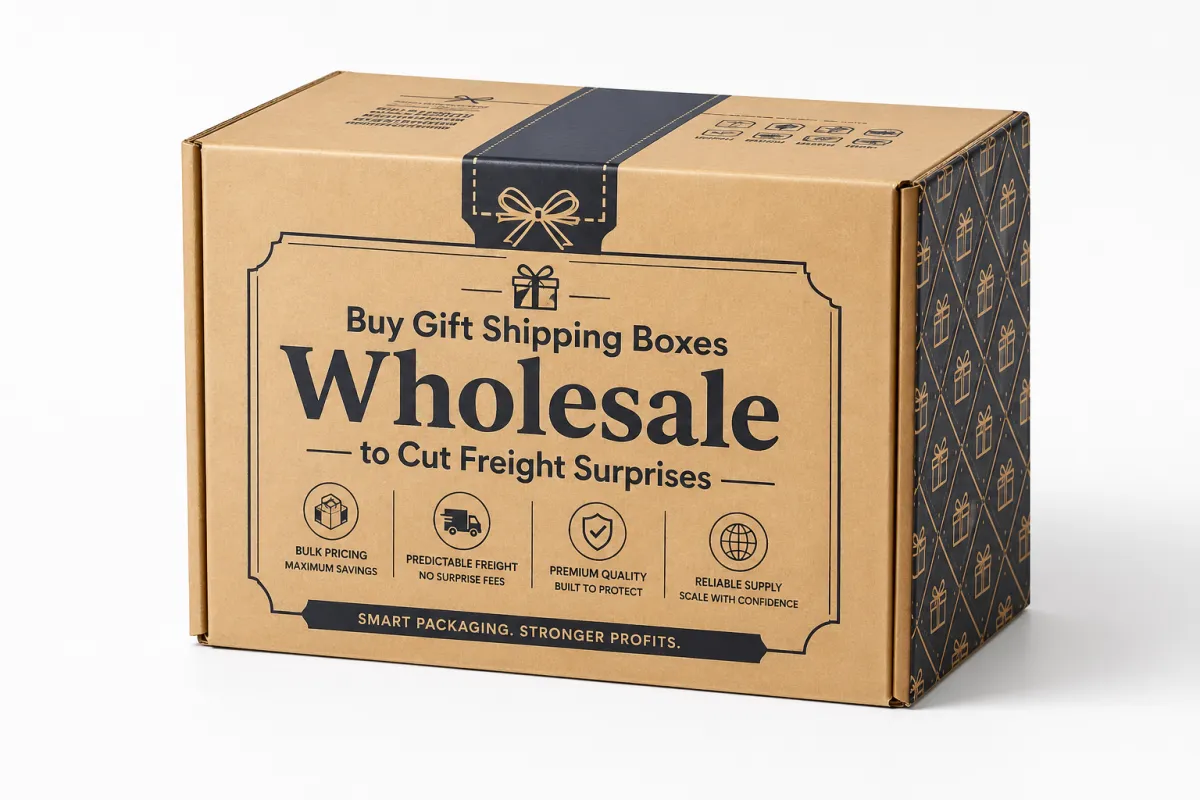
Most buyers start with the right intention: lower unit cost, better control, and cleaner branding. The problem appears in replenishment cycles, not in the quote sheet. If you buy gift shipping boxes wholesale and your carton width, height, or length is even slightly oversized, dimensional weighting can push your parcels into a cost band they were never meant to be in. I’m not exaggerating. One extra inch in an axis can flip a shipment tier, especially on lighter but bulky product lines.
If you buy gift shipping boxes wholesale, treat the outer shell like engineering, not decoration. A strong carton has to do three things with consistency: carry the contents, survive handling, and stay within carrier dimensional thresholds. A box that is 3/4-inch too wide might still pass visual approval, yet quietly cost you thousands over a season through higher freight classification.
Wholesale procurement is really a systems problem. You are not buying one-off hero packaging; you are buying repeatable behavior for a fulfillment pattern. The strongest programs use a controlled set of structures, standardize critical tolerances, and keep product families aligned with a repeatable pack method. That structure is what prevents you from revalidating dimensions, inserts, and packaging consumables every single batch.
For gift brands, that control has a direct commercial effect. A tighter box can cut packing volume and improve scan/handling speed at the warehouse; a too-large box can look expensive but still deliver poor economics. In the best setups, shipping cartons are calibrated to the same precision as pricing logic: if they increase margin, they stay; if they cause waste, they get swapped.
A good gift shipping box earns its keep twice: once in transit, and once at the moment the customer opens it.
Presentation is still real performance. If the recipient cares about what the box looks and feels like, and they do, then board choice and structure are part of your marketing mix. Rigid presentation styles, corrugated mailer formats, and well-designed inserts all matter, but only when the dimensions and compression behavior are controlled from the outset. A premium-feeling box with weak structure is just expensive fragility.
If you are starting fresh, I suggest matching your carton family to your product family first, and then checking carrier limitations and average packout profiles. This is the route that keeps margin intact after launch. You can do smaller tweaks later, but if the first version is structurally wrong, everything else is temporary.
For buyers comparing broader options, it helps to benchmark Custom Shipping Boxes against your full Custom Packaging Products architecture. The outer carton, inserts, and protective layers should support one logic, or your team will end up spending effort on mismatched pack methods.
Product Details: Stock vs. Fully Custom Gift Shipping Boxes
When you buy gift shipping boxes wholesale, the first structural decision is not branding, it is workflow. Stock packaging usually launches faster and costs less to set up, while fully custom programs offer tighter fit and stronger brand control. Neither is universally better; each works when aligned to order rhythm and product behavior.
Stock styles usually win where velocity matters most. If you are doing a seasonal push, a standard launch run, or a fast reprint cycle, stock structures get production moving and keep the team in a stable process. A standard corrugated mailer with a clear logo application can still feel deliberate if your fit and insert system are disciplined.
Fully custom builds are usually worth it when the outer carton carries meaning. Gift bundles, subscription-first deliveries, and premium retail-forward assortments often require exact sizing, custom opening geometry, and more controlled board behavior. In those cases, if you buy gift shipping boxes wholesale using a generic carton, the result often looks clever at first but costs you in cushioning and returns later. If the container is part of the value equation, custom fit usually beats generic speed.
The recurring structures in gift programs are usually these:
- RSC corrugated boxes for efficient parcel shipping and repeatable pack operations.
- Telescoping styles for cleaner visual opening and stronger premium positioning.
- Tuck-end cartons for lighter, retail-oriented products that still need durable shipping.
- Rigid mailer-box hybrids when edge stability and presentation both matter.
- Rigid inserts for high-precision protection in mixed bundles with glass, ceramics, or variable components.
Board grade drives a lot of the performance curve. E-flute is a practical default in many lightweight ecommerce contexts because it balances printability with manageable profile depth. B-flute gives more crush resistance and often works better on heavier lines, especially when parcels stack high in distribution channels. Where visual clarity and stiffness are part of the brand message, chipboard, SBS-coated paperboard, or premium rigid board can be better—if transit stress is understood.
| Option | Typical Use | Strength | Brand Presentation | Common Cost Range |
|---|---|---|---|---|
| Stock corrugated mailer | Fast-moving ecommerce shipping | Good for light to medium loads | Basic logo or one-color print | $0.45-$1.10 per unit at volume |
| Custom printed RSC | General parcel shipping with branding | Strong, depending on ECT and flute | Moderate to strong | $0.60-$1.60 per unit at volume |
| Rigid mailer-box hybrid | Premium gift sets and curated bundles | Very good if sized well | High-end feel | $1.20-$3.50 per unit at volume |
| Fully custom rigid box | Luxury gifting and display-led programs | Excellent with proper insert design | Highest | $2.00-$6.00+ per unit at volume |
Closures alter both performance and margin. Magnet options feel upscale, but they add cost and assembly complexity. Slip lids are slick for customer experience, yet they demand tighter tolerances. Self-locking systems reduce manual labor in fulfillment and often reduce unit handling time. Paper locking tabs can be a cleaner circularity choice if your program wants lower mixed-material content and simpler disposal behavior.
Finishes should be intentional and defendable. Matte lamination softens visual contrast and can hide minor print variation. Spot UV is strongest when used as a hierarchy element, not a decorative layer on every surface. Foil and embossing can be compelling, but they can also add setup burden and slower touch-up if your file control is inconsistent. Anti-scratch and water-resistant treatments are practical when boxes move through varied handling conditions or damp environments.
Most teams eventually settle into one of two routes: standardized structure plus limited branding, or full custom structure plus controlled production discipline. The expensive trap is choosing premium options without measuring their freight, labor, and damage impact. If you buy gift shipping boxes wholesale, your spec should show both brand value and shipping cost consequences side by side.
What helps in real projects is a versioned test protocol before commitment. I’ve seen teams reduce rework simply by building two internal versions: baseline production candidate and a preapproved backup with simpler finishing. Yes, it can feel like extra planning, but it often saves calendar days later.
Specifications That Protect Your Gift Brand in Transit
Good specs are where the phrase “buy gift shipping boxes wholesale” becomes operational. You need more than art approval and a shipping quote; you need dimension logic, mechanical performance, and a realistic handling assumption. If you buy without fit testing, you are betting on samples and hoping the process repeats in production exactly.
Start with inner dimensions, then work outward. A lot of buyers decide based on external measurements and lose sight of clearance behavior. A half inch of breathing room might be okay for soft textiles, but glass sets need rigid spacing and anti-shift geometry. For mixed SKU programs, map by product family and lock the accepted tolerance window before you pull quotes.
Compression performance cannot be reduced to flute choice alone. You should also track ECT, edge crush resistance, and how coatings and die-cut geometry affect strength after finishing. In my experience, teams that monitor these metrics before production can cut carton-related damage incidents significantly in the first 60 days. Typical lightweight gift sets might work with 32 ECT in many lanes, while heavy or irregular parcels often need 44 ECT or a stronger profile.
Score lines and die accuracy can make the difference between “premium” and “problematic.” Loose folds create popping edges. Tight folds can crack under stress. A good dieline review is one of the cheapest forms of insurance you can buy before tooling. The right fold lines also reduce fulfillment variance because your team packs the same geometry every time.
Carrier compatibility is another engineering constraint. Labels, barcodes, and shipping marks need clear placement and enough free space, or automated sortation gets delayed. Handling icons should be purposeful, and return strategy should be defined if your channel relies on exchange or re-delivery. For fragile tiers, corner reinforcement and secure sealing methods often return real value, especially where line-haul handling is rough.
Before scaling, verify all compliance claims against documentation. If recycled content is part of your promise, retain chain records for each batch. If FSC is used in marketing language, verify certificate scope and chain-of-custody in practice, not just in PDF claims. For broader sustainability context, one useful source is the EPA sustainable materials guidance; for forest-management standards, check FSC. These links help, but your internal supplier file is still the legal decision document.
Testing standards also matter. ISTA protocols are useful for simulated parcel behavior, and they often reveal weak points you cannot see in CAD. If your cartons go through heavy distribution, at least one compression and vibration-aligned sample run is a smart baseline. ASTM references can support your procurement language and make quality expectations actionable in supplier conversations.
My practical recommendation is to build quality criteria around the carton system, not only artwork. If you buy gift shipping boxes wholesale, insist on this checklist before final approval:
- Pre-production sample review for fit, print registration, and closure behavior.
- First-article inspection against approved dieline revision history.
- Dimensional verification on a random sample from initial production.
- Lot sampling for board integrity, scoring consistency, and closure fit.
- Packout tests with actual products, packing materials, and label placement.
That process turns subjective preference into repeatable quality language. It also gives the team a baseline when reorders come in six months later and prevents “looks okay to me” from replacing measurable acceptance.
What Does It Cost to Buy Gift Shipping Boxes Wholesale?
Packaging pricing goes wrong when people compare only unit prices. If you buy gift shipping boxes wholesale and ignore handling cost, freight, and sampling overhead, your quote comparison is incomplete by design. The real number is landed cost across fulfillment reality: materials, setup, tooling, consumables, freight, and post-production risk.
To stay practical, I usually group costs into six layers: production, finishing, consumables, logistics, revisions, and post-launch adjustments. That approach usually reveals why a box with a higher unit price can be cheaper once dimensional efficiency and damage reduction are included. It also shows why a cheaper option may be expensive later if your carton creates avoidable touches during packing.
Indicative price bands at scale can still help planning, but they vary by region, print complexity, and specification detail. As a rough benchmark in many high-volume contexts, stock corrugated options and simple custom prints often range around $0.35-$1.10 each, while premium rigid and advanced-finish builds can move well above that. Treat these as directional guides, not fixed tariffs.
MOQ is two-part, and many teams only see one part. The first is production minimum, the second is approval minimum for artwork and process readiness. If you buy gift shipping boxes wholesale in the wrong quantity band, you either absorb setup overhead or carry slow-moving inventory. The practical goal is usually the smallest stable MOQ that preserves predictable re-order economics.
Use this formula to compare quotes from a procurement perspective:
Total box cost = setup charges + tooling + print/finish + (unit cost × quantity) + packing consumables + freight + inspection/revision contingency + duties/clearance (if applicable).
That structure avoids two common blind spots. First, a lower per-unit quote can hide higher revision risk if sample fit fails. Second, a premium carton might increase cost but pay off through better freight fit and lower damage claims. Neither outcome is inherently wrong; the issue is only whether the outcome was intentional.
Quantity breaks remain the cleanest lever in cost control. For stable product lines, moving from 1,000 to 5,000 units often improves unit economics materially, and 10,000 can improve it further if tooling is stable. But if your line is campaign-driven, a lower run may be safer than tying up cash and space. In short, buy gift shipping boxes wholesale for velocity and forecast certainty, not just for lower unit math.
Inventory economics are the other half of the puzzle. Packaging is physical capital in your warehouse. A pallet of oversized boxes does not just cost money on order date; it costs handling, pick path complexity, and potentially storage congestion. If a style is campaign-specific, make sure your inventory policy reflects that before you confirm the order.
Here is the practical difference between stock and custom from a numbers perspective:
| Decision Area | Stock Box | Fully Custom Box |
|---|---|---|
| Lead time | Shortest | Longer due to tooling and proofing |
| Setup cost | Lower | Higher |
| Brand fit | Moderate | High |
| Shipping efficiency | Good if standard size works | Excellent if dimensions are optimized |
| MOQ flexibility | More flexible | Usually tighter |
| Best use | Fast launch and replenishment | Premium gifting and repeat brand programs |
A hybrid model is common, and often smartest: standard structure plus custom graphics, inserts, or finish layering. The carton size stays stable and efficient while brand differentiation still exists where it matters most.
Revision economics can quietly destroy a quote. Ask up front which changes are billable and which are credited to the current run. If the first sample needs one revision, that may be routine; if you need three, costs rise quickly. For teams buying gift shipping boxes wholesale repeatedly, transparent revision terms can protect your timeline and margin just as much as any initial discount.
If you buy broader packaging together, sync this with Wholesale Programs so forecasting, reorder cadence, and SKU consolidation move together instead of as disconnected purchases.
Process & Timeline: How to Buy Gift Shipping Boxes Wholesale with Fewer Delays
Most delays start before paper touches production. If you buy gift shipping boxes wholesale with partial files, the job moves in circles, and every missing spec becomes a late correction. I keep seeing this in reviews: teams send three rounds of changes on closure, two on insert depth, and then wonder why launch timing slipped by two weeks.
A typical workflow is simple but strict: inquiry, technical brief, concept proof, sample review, revised sign-off, production release, quality checkpoints, and shipment. The key is owner clarity at each step. One team owns artwork, one owns materials, one owns operations, and one owns fulfillment assumptions. When roles overlap without coordination, issues multiply and ownership disappears.
Lead times vary with complexity. Stock adaptations can move quickly, while custom line and advanced finishes can trigger extra proof and tooling stages. In practical projects, simple runs may complete in roughly 10-15 business days after proof acceptance, while high-detail programs take longer if revisions, print changes, or added testing are involved. If you buy gift shipping boxes wholesale for a fixed launch, include at least one explicit revision window and a cutoff date.
Sampling should match your risk profile. If geometry is odd, use laser measurement and physical checks before aesthetics. If the product is a multi-item bundle, validate with pack-out simulation, not isolated mockups. Camera-ready proofs help with print confidence, but only physical samples can validate fold behavior, edge strength, and hand-feel.
Control your data early. Build one approved file set per SKU family: dimensions sheet, final dieline file, print profile, insert stack-up, and closure method. If marketing signs off on an artwork variant that fulfillment does not receive, you get avoidability issues on day one. A simple shared version-control standard is often worth more than a design enhancement budget.
Communication is a packaging control tool, not a courtesy task. You need one dispatch package for buyer, designer, production, and warehouse teams. Include label placement, tape expectations, insert count, expected carton defects tolerance, and receiving QC steps. If you buy gift shipping boxes wholesale and skip these details, the team that packs 300 boxes an hour is going to invent their own method.
For teams buying at scale, this internal sequence has worked well:
- Confirm internal product dimensions, insert thickness, and target outer carton size.
- Select a structure family that fits both presentation and transport behavior.
- Lock board grade, closure type, and finish stack before final proofing.
- Approve sample using measurement checkpoints, not only visual checks.
- Release production only after the art files and dieline are versioned and frozen.
If launch velocity is tight, reduce the spec surface rather than forcing a sprinted execution. Dropping one finish element, simplifying tape logic, or using a standard board for first release often protects your date better than any late-night push. That is one of those situations where “good enough to run well” beats “perfect on paper but late.”
For teams with frequent campaigns, keep one alternate carton and one alternate closure option pre-approved. It sounds like extra work, but it creates resilience. I have seen teams recover from last-minute changes with less stress when they have that backup path ready.
Why Choose Us for Gift Shipping Boxes Wholesale Supply
Choosing a supplier for gift shipping boxes wholesale is really about risk management. A capable partner must understand structural logic, not just print look, because a broken box destroys experience faster than a color mismatch. At Custom Logo Things, the goal is to support design ambition without weakening supply reliability.
We evaluate every proposal through three practical lenses: fit, strength, and repeatability. That means helping buyers test whether the structure supports their product mix, what board behavior to expect under real handling, and where a feature adds value versus adds noise. Many discussions still get stuck on visuals, while the real breakage issue sits in closure, insert compression, or carton tolerance.
Revision control is a major differentiator. The most expensive errors are rarely dramatic. They are tiny mismatches: version drift between approved sample and production artwork, or an unnoticed change in closure tolerance. A strong system should include documented QC checkpoints, sample sign-off discipline, and a visible revision log so approvals stay traceable across reorders.
Reliability is procedural. Ask direct questions before committing: What are sample lead expectations? How fast is escalation response? What is the response timeline for defects, and who owns final correction? These are not red flags; they are the baseline of a mature wholesale program. If answers are vague, the order might be technically attractive but operationally risky.
Replenishment design also belongs in the procurement conversation. A carton stack that is easy to count, stage, and move saves labor and reduces receiving errors. For gift brands where fulfillment speed matters, storage configuration can influence service performance almost as much as the outer shell. Flattening logic, pallet height planning, and shipping unit size all affect whether your team can move from receiving to outbound confidently.
The upside of a disciplined supplier relationship is measurable. Better cartons reduce support tickets, lower rework rates, and improve first-impression quality for customers. You cannot always quantify “brand emotion” perfectly, but you can measure returns, damage claims, and repeat purchase friction. A good packaging partner makes that link visible.
If your operation also uses lighter SKUs or alternate fulfillment modes, aligning cartons with Custom Poly Mailers can improve internal speed. A consistent system reduces training overhead and reduces the chance of mismatched materials in high-turn lines.
Most decisions in this area come down to real-world behavior. Board performance shifts with flute profile, print build, and ambient humidity. A finish that looks sharp in the studio can slow packing if it affects tear resistance or handling. That trade-off is ordinary, but it is where most “premium” projects succeed or fail. A good supplier helps you choose correctly before production, not after the freight bill lands.
If you buy gift shipping boxes wholesale and want fewer surprises, your partner should be able to defend three things clearly: why this structure, how this timeline, and what quality metrics will be tested before full release.
Conclusion: Action Steps to Buy Gift Shipping Boxes Wholesale
If your team wants to buy gift shipping boxes wholesale with confidence, narrow the universe before pricing. Select three product archetypes, lock dimensions and weight assumptions for each, and compare quotes by landed cost per shipped carton, not by unit price alone. That one shift usually removes most of the “hidden cost” confusion.
Use a short execution cadence. Day 1-2: collect packaging constraints, carrier limits, and sample requirements. Day 3-6: finalize structure, inserts, and graphics for a tested variant. Day 7-10: run the first mock production checks and validate freight assumptions. Day 11 onward: lock files, review QC checkpoints, and release if all criteria pass. If timing compresses, simplify finish before you force non-critical upgrades.
Before final approval, verify four checkpoints at minimum: dimensional tolerance, ECT/strength assumptions, print consistency, and handling behavior after packout. If any checkpoint fails, correct the spec before production full-release. That is where most preventable cost and delay are removed.
If you buy gift shipping boxes wholesale at scale, keep a fallback configuration ready: one alternate carton size and one alternate material stack. In my work, teams that pre-approve an alternate path avoid emergency sourcing stress and usually preserve launch dates. It is a practical safeguard, not overengineering.
Clear takeaway: if your goal is lower freight volatility, safer delivery, and stronger unboxing, buy gift shipping boxes wholesale with a finalized inner-dimension spec, a written revision protocol, and a cost model that includes logistics and quality testing. Do that, and the boxes will perform as both protective logistics equipment and a brand asset.
FAQ
What is the minimum order quantity when I buy gift shipping boxes wholesale?
MOQ changes by format and complexity. Stock cartons often allow smaller initial runs; fully custom structures usually need larger order bands to cover setup and tooling. A common path is to start with one validated structure and one color scheme, then scale the same family after demand data confirms repeat velocity. If your assortment is broad, consistency across styles helps reduce reorder friction and cost surprises.
How much does it usually cost to buy gift shipping boxes wholesale?
It depends on the structure, print, finishing, freight assumptions, and review cycle. Setup and consumables matter as much as the quoted unit cost. If you buy gift shipping boxes wholesale, ask for a landed-cost quote that includes dimensional assumptions and likely handling outcomes. That gives you a real compare instead of a pretty-looking unit number.
How long does it take to produce custom boxes when I buy gift shipping boxes wholesale?
Production timelines vary by complexity. Basic custom stock adaptations can move relatively quickly, while new dielines and advanced finish stacks add proofing and revision time. A realistic schedule should include sample testing and a revision window with clear freeze dates. Lock those dates before production so your launch planning remains realistic, especially for campaign dates.
Can I request samples before placing a wholesale order for gift shipping boxes?
Yes, and you should treat sampling as mandatory, not optional. Validate dimensions, print color consistency, closure action, and real-product behavior before scaling. A signed dimensional sample sheet gives quality teams a clear benchmark, and it helps prevent variation when the line moves into full production.
What if gift shipping boxes arrive damaged or out of specification?
Use a documented defect process immediately: photos, measurements, batch details, weight check, and issue description. Then request a corrective action timeline and replacement/credit terms based on severity. Transparent policies reduce operational drag and keep fulfillment continuity when problems occur, which is especially important when you buy gift shipping boxes wholesale for active sales windows.
If your team is serious about control, don’t postpone the boring work: freeze a versioned spec, confirm dimensions and closure, and buy gift shipping boxes wholesale with a timeline tied to both launch and replenishment. This is the setup that protects both packaging quality and margin once order volume actually starts moving.

