Buyer Fit Snapshot
| Best fit | Custom Folding Boxes Wholesale projects where brand print, material claims, artwork control, MOQ, and repeat-order consistency need to be specified before quoting. |
|---|---|
| Quote inputs | Share finished size, material target, print colors, finish, packing count, annual reorder estimate, ship-to region, and any compliance wording. |
| Proofing check | Approve dieline scale, logo placement, barcode or warning zones, color tolerance, closure strength, and carton packing before bulk production. |
| Main risk | Vague material claims, crowded artwork, missing packing details, or unclear freight terms can make a low unit price expensive after revisions. |
Fast answer: Custom Folding Boxes Wholesale: Pricing, Specs, Process should be specified like a repeatable production item. The safest quote records material, print method, finish, artwork proof, packing count, and reorder notes in one written spec.
Production checks before approval
Compare the actual filled-product size with the drawing, then confirm tolerance on folds, seals, hang holes, label areas, and retail display edges. Reserve space for logos, QR codes, warning copy, and material claims before decorative graphics fill the panel.
Quote comparison points
Review material grade, print process, finish, sampling route, tooling charges, carton quantity, and freight assumptions side by side. A quote is only useful when the supplier can repeat the same color, closure quality, and packing count on the next order.
For brands buying at scale, Custom Folding Boxes Wholesale is rarely just a packaging decision. It is a supply chain decision, a cash-flow decision, and sometimes the thing that keeps a launch from wobbling at the exact moment everyone thinks the hard part is over. I have seen teams spend weeks polishing artwork only to discover the carton itself was the real bottleneck. That is the sort of avoidable mess that eats margin without making any noise.
The strongest advantage is not a prettier carton or a slightly sharper logo. It is usually system-level gain: lower handling effort, cleaner forecasts, and a package structure that behaves the way operations assumes it will.
If your catalog includes repeat SKUs, subscription programs, or seasonal runs, Custom Folding Boxes Wholesale starts to outperform ad hoc production once the run count climbs into the low thousands. Fewer production resets, fewer reshipments, fewer late calls from fulfillment, and less scrap when spec changes show up in the last 48 hours - those are the recurring signs of a mature folding carton strategy.
This matters even more if you treat the structure as a commercial asset rather than a one-off print job. When teams compare routes, they should review Custom Packaging Products and Wholesale Programs early, while there is still room to adjust fit, board, and finishing before budget gets pinned down.
In practice, Custom Folding Boxes Wholesale can trim roughly 12% to 18% of line friction for teams that lock clean specs and keep them stable across reorder windows. That reduction does not usually come from discounting alone; it comes from predictability: the same fold profile, the same file integrity, the same tolerance logic.
Why Custom Folding Boxes Wholesale Fits High-Volume Brands
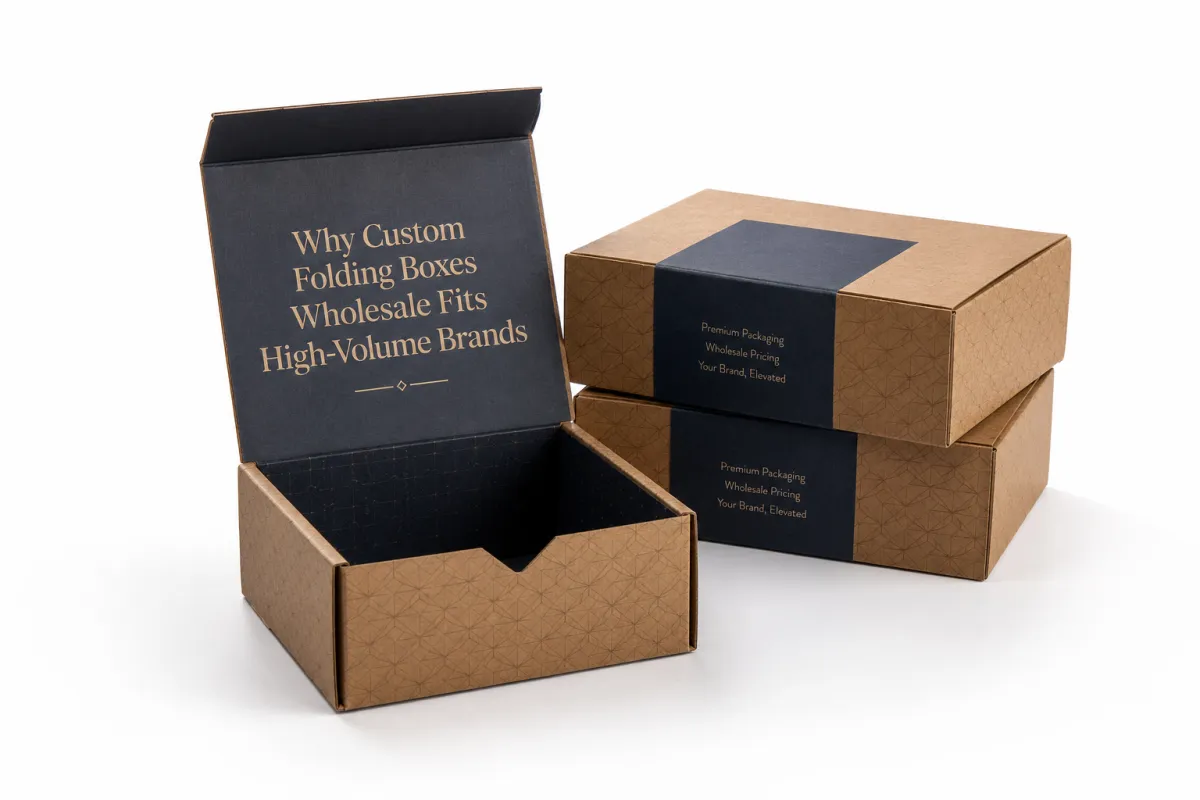
Lower unit price gets the first glance, but Custom Folding Boxes wholesale works for larger brands because it makes operations easier to defend. You get a cost base that is easier to forecast, a carton that performs similarly from batch to batch, and a structure you are not rebuilding every quarter because someone new touched the brief.
Flat-shipped cartons reduce friction on day one
One practical advantage shows up only after cartons hit the warehouse. Flat-shipped cartons take up far less room than assembled formats, and that single shift in geometry changes both labor and freight math quickly. Depending on carton footprint and board thickness, nested blanks can stage roughly 20% to 40% more units per pallet than assembled rigid packaging.
That is not a tiny difference. It can change how often a team clears receiving space, how many forklift moves are needed, and how much time gets spent opening lanes for production.
To quantify it, the same team running a 2,500-piece launch on a 250- to 300-gsm carton board can see fewer forklift moves, less blocked aisle time, and fewer handling touches before fill. The biggest win is compounding: what saves time once now saves space and labor every time a replenishment lands.
In practical terms, a Custom Folding Boxes wholesale workflow often behaves like a better inventory variable than a line item in finance. That is why mature packaging teams ask for fold profiles before they ask for final art approvals.
Where volume-heavy brands see the best fit
Custom folding boxes wholesale is strongest where product geometry stays stable and the retail promise does not mutate every ten days. Common examples include:
- Retail replenishment for a core SKU that runs across 6 to 12 selling cycles
- Subscription kits with fixed insert counts and repeating panel layouts
- Seasonal promotions that reuse core art and only swap date blocks or accent color
- Multipack lines needing repeatable cartonization and shelf-ready handling
- Cross-border refill programs where barcode placement and panel repeatability cannot drift
Those programs benefit from a stable structural baseline. Switching suppliers for marginal style reasons can cost more than it saves, especially when folding carton manufacturing still depends on measured setup continuity.
Speed and motion on the packing line
Folding cartons expose weak specs quickly. A reverse tuck end or straight tuck end that is scored correctly can move at high speed with low variation. A flap off by 1 mm can hide in mockups and still stop a line when volume rises.
In one mixed-shift test, a 1 mm closure variation caused intermittent handling delays on a ten-minute fill cycle; over 6,000 units, the added pause became a real throughput loss. That is why Custom Printed Boxes with stable fold geometry usually beat a cheaper option that only looks right on a monitor. The weak side of a bad fold is not the invoice; it is the queue downstream.
Wholesale as planning architecture, not just price leverage
Buying at wholesale volume is not only about negotiation. It is a planning architecture for structural consistency. A single approved system for custom folding boxes wholesale can lock reorder reliability, reduce dieline drift, and shorten changeover because every production batch starts from the same measurable reference.
In growth phases, teams often discover this late: when demand doubles, they are asked to match quality and timeline with materials that were never standardized. If fit, board behavior, and printing stability are already fixed, the jump from one run to the next is usually smoother than building a new specification.
What surprises some teams is that discipline can improve shelf performance more than extra decoration. The carton that survives logistics simulation is often the carton that looks the calmest in a supermarket aisle.
Custom Folding Boxes Wholesale Specifications and Options
Spec quality determines everything from first impression to damage claims. The phrase custom folding boxes wholesale sounds concise; the process is not. Structure, coating, board, finishing, and logistics all interact. Treat that interaction as one chain and you reduce expensive corrections later.
Think of the project as paperboard packaging engineering, not art placement. If any one link in the chain drifts, the finished fold carton becomes sensitive to handling, humidity, or transport stress in ways that are expensive to fix after press-up.
Paperboard choices: SBS, CCNB, kraft
Solid bleached sulfate (SBS) gives a clean print surface, strong color consistency, and a bright visual baseline for retail-facing graphics. For premium branded packaging, SBS is often the first choice when contrast and sharpness need to remain stable across channels.
CCNB - usually a coated recycled board, though supplier naming can vary - stays useful when budget control matters and a white background is not mandatory. It prints well in standard CMYK and can deliver adequate strength for repeated shipping cycles with lower cost risk.
Kraft board creates a natural texture with visible fibers and supports eco-forward brand narratives, but it can reduce contrast. Dark text, fine details, and photographic art sometimes need white underprint or adjusted ink density to stay crisp.
Board thickness still matters as much as board type. A light accessory carton may work at 250-300 gsm. Heavier loads often need 300-350 gsm plus local reinforcement around fold and tuck regions. A brittle-feeling carton in hand is usually warning of a mechanical issue at the line as well.
The teams that win repeat business are not always the most premium on paper. They are the most consistent on measured board behavior, and that is a less glamorous truth that kind of makes all the difference.
Structure: reverse tuck, straight tuck, lock styles, and window options
Structure is the most under-briefed cost center. Reverse tuck and straight tuck both appear often in custom folding boxes wholesale, but each serves different mechanical behavior. Reverse tuck often favors cleaner top closure and stacking alignment, while straight tuck can support lower-profile cartons with cleaner profile stacking.
Auto-lock bottom structures cut assembly time, but they require close control of scoring and glue timing. Tuck top with additional seal can be better for moisture-sensitive goods or fulfillment channels with higher handling vibration.
Windowed cartons look straightforward until humidity and die wear change edge behavior. Open-face paper windows and plastic film windows do not age the same. Plastic film raises waste handling complexity, changes closure strategy, and shifts procurement footprint. For gifting channels, a smaller hidden window often balances reveal value with durability by protecting contents during transit and minimizing visual strain.
The folding carton format rewards specificity. A clear structure note written before proof review can save an entire revision cycle.
Print and finish stack
CMYK remains the baseline for most production runs. Four-color process usually offers the shortest path from sample to full production because of reliable workflow assumptions. Pantone spot colors become essential when brand color cannot drift even slightly across markets.
Matte and gloss remain the first finish decision. Gloss increases contrast, but can cause glare under retail lighting. Matte often reads easier under shelf conditions and tolerates minor scuffs with fewer visual penalties. Soft-touch laminate gives a premium tactile signal and supports a more controlled visual language, though it may add 10% to 20% finishing time depending on batch complexity.
Foil stamping, embossing, debossing, and spot UV all add texture and attention, but they also add setup complexity and prepress checks. Comparing them against one another often reveals a non-linear cost rise. A decision that sounds minor visually can produce a disproportionate scheduling impact.
Function adds value where the channel needs it
Functional elements are part of the structure spec, not an afterthought. Inserts keep orientation. Hang tabs support display readiness. Perforations can simplify split packs and promo kits. Barcodes, QR codes, and tamper-evident features matter most in regulated or track-and-trace channels.
Many custom folding boxes wholesale issues begin when teams decide features are “easy edits” after the first proof. By then, the geometry is often already locked, and the new elements do not map cleanly. Lock those needs before artwork approval, especially when channel demands are clear.
How to choose structure by real-world stress
Weight, handling distance, shelf life, and moisture exposure should drive structure more than brand mood boards. A 500 g item in SBS 250 gsm may look strong in a render and still fail under stacking pressure in distribution. Humidity can swell coatings and trigger seam instability near glue seams.
E-commerce needs edge stiffness and fold retention because corner impacts increase as fulfillment touches rise. Retail channels prize shelf appearance, but not at the cost of corner crush in outbound lanes. A carton that looks elegant but arrives damaged has no commercial advantage in either channel.
If this helps your internal planning, include a simple stress rule: one reference carton per 10,000 handling events. If the fold and closure still survive, the structure is likely valid for live fulfillment.
Custom Folding Boxes Wholesale Sizing, Dielines, and Artwork
Most rework starts with dimensions that were described as “close enough.” They almost never are. A custom folding boxes wholesale project only succeeds when fit is engineered before artwork is finalized. Product size, tolerance, and insert geometry must be measured against one shared standard, otherwise the die reflects hope, not reality.
For brands running multiple Custom Carton Packaging variations, consistency starts here. If the first pass is wrong by 1 or 2 mm, every future run carries that inefficiency.
Measure for real fit, not package visual size
Measure length, width, and height using worst-case dimension, not nominal spec. Add allowance for inserts, corner radii, and protective layers. A practical rule is 2 to 4 mm of internal clearance for many rigid goods, with larger buffers when foam or rigid inserts are used.
If a tuck flap exists, account for its closure envelope too. Teams often forget this space and only see the problem when cartons resist sealing under automation. That 3 mm gap can be the difference between a calm launch and a stalled fill cycle.
Example: a product at 120 x 80 x 40 mm with a 3 mm insert lip requires an internal target around 123 x 83 x 43 mm, plus fold and closure tolerance. The increase is small in design files and huge in fulfillment reliability.
Dielines: the production map you cannot ignore
A dieline is the production map for folding cartons: folds, bleeds, glue zones, safe areas, and knockout points. With custom folding boxes wholesale, it is the difference between controlled repeat and visual chaos.
If you are ordering across multiple SKUs, request one master dieline and add version labels for each size. That keeps panel placement, legal blocks, and brand marks consistent while still allowing controlled differentiation where necessary.
Dieline review usually includes:
- Panel geometry checks at fold intersections
- Bleed margins and legal-safe text zones
- Glue flap and lock-tab validation
- Score-line direction and line strength requirements
- Version control checks for future reorder accuracy
In one brand program, this checklist reduced prepress rework by nearly 25% over two quarters because the same error pattern stopped being repeated.
Artwork package that does not stall production
Vector logos, high-resolution linked assets, and outlined fonts reduce prepress risk. Raster logos at reduced scale soften under profiling and may fail in legibility tests. Legal copy and tiny labels need font-weight and contrast checks before file handoff.
Use CMYK for standard carton production unless there is an agreed reason for exceptions. If spot colors are brand-critical, specify exact Pantone references and whether they replace or coexist with process colors. For bleed work, include sufficient margin for trim movement and lock line alignment.
If sustainability coordination is part of your brief, ask how stock profile and material assumptions are handled in prepress rather than retrofitting them after proof. That small question can save a round of corrections nobody budgeted for.
Prototype review for first-time or sensitive builds
When the SKU is oddly shaped, heavy, moisture-prone, or dependent on premium finishing, a preproduction sample is often the most rational spend. You catch closure reliability and panel alignment before full build and avoid the expensive lesson that only full runs reveal.
That is where custom folding boxes wholesale proves itself as more than a procurement tactic. It becomes a repeatability mechanism: less interpretation, more measurable consistency.
One reliable pattern for complex formats is to run a small pilot lot before committing to the full quantity. It can reveal glue timing issues, print drift under coating, and insertion stress without sacrificing the whole production calendar.
Compliance and channel labeling
Retail, e-commerce, and export channels each bring different labeling requirements. Ingredient panels, warning text, recycling marks, GTIN/UPC, and region symbols should be agreed with legal and compliance before prepress begins.
For cross-border moves, language blocks and country labels must be decided early because late changes carry both time and setup penalties. A strong spec packet defines who signs off legal text, when approvals happen, and what happens when a late regulatory check appears.
“My biggest lesson from custom folding box projects is simple: if legal text and fold behavior are not approved in the same cycle, the schedule slips even when the design itself stays unchanged.”
Custom Folding Boxes Wholesale Pricing and MOQ
Now the numbers. Custom folding boxes wholesale pricing usually shifts with five variables: size, board grade, print coverage, finish complexity, and quantity. Quantity matters because setup, prepress, and press calibration are absorbed differently at each run size.
A high-volume line can compress per-unit cost not only through scale, but through reduced variance in setup amortization. If setup and correction risks stay controlled, the same carton family can hold margin stability across campaigns with only minor proof iteration.
Why higher volume lowers unit cost
Setup items like file handling, plate prep, and press calibration are fixed per run, so the larger the run, the lower the unit ratio. A carton at 1,500 units and the same carton at 5,000 or 10,000 should follow that pattern, though exact numbers depend on finish, colors, and structure.
Data from production teams often shows a meaningful crossover: once volume reaches an efficient range, the difference between “on budget” and “under budget” is often less about print cost and more about rework prevention. If custom folding boxes wholesale avoids one full reprint, the margin swing is often larger than the unit discount from the first quote.
MOQ reality check by structure and finish
MOQ is not universal across all builds. A simple CCNB structure with two-color CMYK can be viable at lower runs. A carton with foil, soft-touch, or die-cut windows usually needs a higher minimum to recover setup and finishing time.
Auto-lock bottoms and premium enhancements are frequently above the minimum of a plain tuck-end carton. The structure determines economics, not just the printed surface.
Some brands split runs to reduce cash impact: one batch for launch, a second when demand confirms. This works only if artwork and structure stay frozen. A spec change between batches cancels the economics.
What to budget beyond unit cost
Most teams compare only unit price first, then discover total landed cost in post-production reviews. A fuller budget includes:
- Proofing cycles and color correction rounds
- Structural reviews and dieline validation
- Freight, customs, and duty differences by destination
- Insert materials, packaging hardware, and tamper options
- Storage, staging, and handling through launch week
One late proof correction can erase expected savings very quickly. In that situation, prepress support is not optional; it is risk control.
| Spec level | Typical board/finish | Quantity range | Typical unit range (USD) | When to use |
|---|---|---|---|---|
| Value | CCNB 260 gsm, 1-2 color + CMYK | 1,500-5,000 | $0.14 - $0.22 | Trial runs, budget SKUs, short campaigns |
| Balanced | SBS 300 gsm, CMYK, matte or gloss option | 3,000-10,000 | $0.21 - $0.34 | Retail-facing product packaging with stable visuals |
| Premium | SBS 350 gsm, soft-touch, foil, spot UV | 5,000-15,000 | $0.32 - $0.47 | Premium launches, gifting, shelf impact priority |
| Special channel | High-glue reinforcement, reinforced bottom, inserts | 5,000+ with setup | $0.36 - $0.60 | E-commerce, heavy products, high drop stress |
The ranges above are directional, and that distinction matters. Compare a value, mid-tier, and premium option of the same structure before approving. The goal is not “lowest possible unit.” The goal is where cost jumps become meaningful against performance.
Quote strategy that protects the buying decision
Request at least three finish tiers with the same artwork baseline: standard CMYK + coating, matte, and premium soft-touch or foil. When upgrading a finish costs less than the margin increase you expect from premium shelf performance, that can be the right move.
Because a late change in custom folding boxes wholesale can exceed 15% of the initial estimate in some cases, align legal, brand, and fulfillment sign-offs before final proof. That checkpoint is almost always cheaper than post-proof correction.
Use standards and references in discussions
For durability assumptions, ask which handling tests were simulated. Suppliers that reference ISTA and related transport stress tests provide clearer reliability signals than those who rely only on visual inspection.
For example: ISTA and ASTM-based assumptions can materially change claims around vibration and stacking behavior for a high-finish run. If a partner cannot explain the protocol, the quote is often a price number without a measurable risk basis.
Environmental claims need similar rigor. If fiber sourcing affects buying, verify FSC content trail and include chain-of-custody language as part of commercial review. Not every channel requires full proof depth, but every premium brand should track it consistently.
For additional clarity, request carbon and waste handling details even if only one of your channels requires them. Transparent procurement assumptions prevent last-minute credibility gaps.
How Long Does Custom Folding Boxes Wholesale Production Take?
Timeline confusion usually starts when proof time is mistaken for manufacturing time. The custom folding boxes wholesale process becomes manageable when each stage has an owner, an input list, and a hard date.
In teams that run this system well, the phrase “we are waiting on supplier” appears less, while “we need one more spec check from legal” appears more - and that is a much healthier workflow.
Flow from quote to shipment
A practical sequence is:
- Inquiry and requirements capture: dimensions, quantity, materials, finish, and channel
- Specs review and quotation with alternatives
- Dieline creation or verification
- Artwork setup, prepress corrections, and proof generation
- Proof approval and multi-party sign-off
- Production, finishing, and QC checkpoints
- Freight booking and final delivery
Proof review is usually the bottleneck, not press capacity. Teams that begin design approval on Friday often discover they have already lost almost a week by the time the gap is visible.
Where delays come from in real projects
Common timeline risks are usually:
- Unclear measurements, especially tolerance and insert space
- Non-print-ready artwork (wrong profile, raster-only logos, missing bleeds)
- Repeated legal edits after the proof cycle has started
- Underspecified fold and glue geometry
- Unexpected finish limitations discovered too late
Every issue creates a correction loop. Small production fixes are usually cheap. Time is not.
For custom folding boxes wholesale programs, cleaner input quality is a measurable timeline accelerator. Most teams recover more time by reducing ambiguity than by adding urgency requests.
Time planning by phase
Plan backward from launch. Proofing typically needs 2 to 4 business days when files are complete. Production commonly takes 7 to 14 days depending on finish and quantity. Domestic freight may add 2 to 5 days; international freight is usually longer with customs and carrier coordination.
For global programs, add 2 to 4 business days for labels and shipping documents. If premium finishing is part of the build, schedule finishing windows as real milestones, not invisible assumptions.
When teams treat custom folding boxes wholesale like a fixed process instead of a late-stage design problem, the variance between planned and actual delivery often narrows by several days.
Can you do rush?
Some partners can support a constrained rush profile for simple structures and approved-ready files. Rush only helps when all inputs are complete and unchanged. If closure style is still open and the legal block is not finalized, rush fees usually shift delay rather than remove it.
Faster outcomes usually come from earlier sign-off and cleaner approvals, not magical print speed. The deadline does not care how nicely the file was named.
“The cleanest 10-day turnaround I have seen was not a speed trick. The structure was stable, the files were correct, and no one had to reopen the proof.”
Why Work With a Packaging Partner Instead of a Generic Printer
For folding cartons, the gap between a printer and a packaging partner is practical, not cosmetic. A packaging-focused supplier brings board behavior, fold mechanics, and fulfillment realities into the same conversation. That is what converts a good-looking carton into a working carton.
Packaging logic beats pure print logic
A generic printer can execute color well and still miss how a carton behaves under stacking. A packaging partner is expected to understand stress points: where board bends under heat, where glue fails near corners, and how a lock behaves under repeated handling.
For custom folding boxes wholesale, that difference compounds with volume. A 50 gsm shift in board can change shelf perception and in-transit survival at the same time, which is exactly why the partner must connect art and structure before production.
Prepress support and practical feedback
Packaging specialists should challenge weak inputs early. Examples include:
- Insufficient fold allowance for lock systems
- Type that loses legibility after bending
- Finishes that increase edge cracking risk under motion stress
- Insert design that does not match interior geometry
That kind of early correction lowers material loss and protects launch dates. A vendor that only receives files and runs them is more likely to discover problems when they are already expensive.
Repeatability, not just first run quality
The first run is informative; reorders are the true test. Monthly replenishment only works when color, fit, and closure stay stable across every batch. A packaging partner that tracks dieline versions and color control can protect long-run consistency.
If continuity is part of your positioning, ask for a locked specification archive and revision policy. Hidden drift in panel sizing or registration looks small until several runs are in circulation.
Honest positioning
The upside is not hype. It is fewer avoidable failures, better technical guidance from people who handle paperboard daily, and clearer ownership of final performance. In this category, confidence comes from process control, not branding language.
If sustainability claims are part of your commercial identity, request material tracking and recyclability guidance early. High-volume buyers increasingly treat packaging credibility as a commercial condition, not a footnote.
Public guidance from environmental agencies can be used as a review baseline, including EPA references for packaging practices and waste handling.
Next Steps to Lock In Your Wholesale Order
Good outcomes begin with a complete spec packet. Before final pricing, gather dimensions with tolerance, target volume, structure, board choice, finish, legal copy, and destination logistics. This single step reduces custom folding boxes wholesale revisions and shortens internal review cycles.
If you want measurable stability, also include a short acceptance matrix: what is acceptable on fold retention, color tolerance, and finish consistency for this campaign.
Core input checklist
- Product weight, dimensions, and fragile-risk rating
- Preferred channel mix: retail, e-commerce, event, subscription
- Expected stacking height and drop profile in transit
- Dieline confirmation or request to build one from measurement data
- Print file format, color mode, and legal approval sequence
- Destination logistics and import/export requirements
Request smart comparisons
Do not request only one quote. Ask for at least two structures: one economical and one premium. A practical workflow often compares SBS/CMYK baseline, CCNB simplified coating, and premium enhancement. Three tiers compress uncertainty and produce faster decision confidence.
If your team is sourcing Custom Printed Boxes for a campaign, this comparison prevents the classic late-stage pause where visuals look right but cost is misaligned.
Collect quoted unit costs at meaningful cutoffs (1,500, 3,000, 5,000, 10,000). Identify where break-even shifts for your structure and finish, then choose a range that protects both cash flow and campaign timing.
For custom folding boxes wholesale orders with a long runway, run one conservative and one growth-ready plan. Unexpected demand is easier to absorb with a stable spec than with a rebuild.
Lock proofs and approvals before production
If closure reliability is critical, require a pre-production proof and a short pilot review. Keep legal copy, barcodes, QR placement, and UPC checks within the same approval window. Once proof is approved, freeze the spec and avoid late redesigns for decorative reasons.
Build launch calendars backward. Include proof response windows, production slots, freight timing, and customs clearance if international movement is involved. That planning eliminates the common late scramble where aesthetic preference overruns operational readiness.
For high-run custom folding boxes wholesale purchases, this discipline is one of the strongest margin protectors in the process.
Business planning and commercial discipline
Done well, custom folding boxes wholesale is a controlled packaging investment: less guesswork, fewer delays, better consistency across channels, and clearer margin reporting. If teams treat it as an ad-hoc graphic task, even excellent suppliers cannot recover schedule reliability.
Align the packaging team with demand planning early. A stable carton is both a commercial decision and an operational one. The more repeatable the order packet, the lower the hidden cost of complexity.
Conclusion: Why Custom Folding Boxes Wholesale Works Best as a Controlled Supply Decision
Teams win with custom folding boxes wholesale when they separate aesthetics from engineering, then reunite them in the right sequence. Start with product fit, confirm board and structure, validate artwork, lock the timeline, and choose between value and premium paths using real behavior data.
The cleanest outcomes are rarely the loudest. Often it is repeatable carton behavior, fewer revisions, and a landed-cost profile that does not wobble each campaign cycle. That is the operational logic behind custom folding boxes wholesale in high-volume programs.
If your packaging program depends on stable SKUs, repeat demand, and disciplined approvals, this model is usually the strongest route. With strong proofing and a partner that handles production detail, it becomes a dependable base for packaging branding, stronger retail packaging execution, and channel resilience.
The takeaway is simple: freeze dimensions, confirm the fold style, sample the board, and only then compare price tiers. If you do those four things in that order, you remove most of the expensive surprises before they get a chance to happen.
Can custom folding boxes wholesale answer these common questions?
What is the minimum order for custom folding boxes wholesale?
MOQ depends on style, board, and finish complexity, and it varies by supplier. A simple carton with standard construction and controlled print often begins lower than a complex structure with specialty coating, foil, or auto-lock mechanics. If you run multiple SKU sizes, confirm whether total MOQ can be split across matched structures or if each size has a separate minimum. A transparent quote should show unit price by volume so you can identify whether a slightly larger first run lowers final per-box cost.
From a planning perspective, teams often compare launch-ready and holdout scenarios. If first-run volume is the risk point, splitting into a controlled pilot plus a second run can work only if the specification remains unchanged.
How do custom folding boxes wholesale prices change with finishes?
Each finish adds process steps and control points. CMYK with standard coating is typically efficient. Foil, embossing, soft-touch, and spot UV can increase cost through materials, machine handling, and press control requirements.
Full-bleed artwork and heavy ink coverage can also affect print behavior and setup time. Ask for a plain version and a premium version of the same structure before committing; it usually gives a clearer upgrade curve than a visual sample alone.
What artwork files do you need for a wholesale folding box order?
Use production-ready files from the start, especially for multiple panels and tight legal text. Vector logos, high-resolution content, correct bleed, safe zones, and outlined fonts reduce errors that trigger reproof cycles.
Before prepress, make sure color profiles, Pantone references, and material assumptions align with the chosen custom folding boxes wholesale structure. That preparation is often the difference between a smooth and a delayed proof stage.
Which board stock is best for custom folding boxes wholesale?
Selection depends on visuals, channel, and handling stress. SBS is often used when brightness and color accuracy are critical. Kraft fits natural or eco-forward stories with visible fiber texture, while CCNB offers a balanced option when cost control and performance both matter.
Short physical samples can be more useful than a spec sheet because texture and stiffness are often process dependent. A sample run may reveal flex behavior and fold memory under load that digital files cannot predict.
How long does custom folding boxes wholesale production usually take?
Timelines vary with proof readiness, finishing complexity, quantity, and delivery distance. Most teams plan in three buckets: proof review, production, and shipment. A clean, approved package for a simple carton can move quickly; specialty finishes and complex structures add time.
In many programs, proof iteration is the largest source of delay. Budget proof and correction windows before you commit internal launch messaging, and the process becomes far more predictable.

