Two pouch products can sit side by side with the same net weight, same flavor claim, and same price point. The matte zipper bag often looks quieter, cleaner, and easier to photograph. Less glare. Better contrast. Fewer ugly reflections from retail lighting.
That is why Matte Zipper Bags Unit Cost logo print specification work should not start with “How cheap can this be?” Start with what the bag has to do: protect the product, carry the brand, survive packing and shipping, and still look decent after someone handles it.
Matte Zipper Bags Unit Cost Logo Print Specification Starts With Shelf Impact
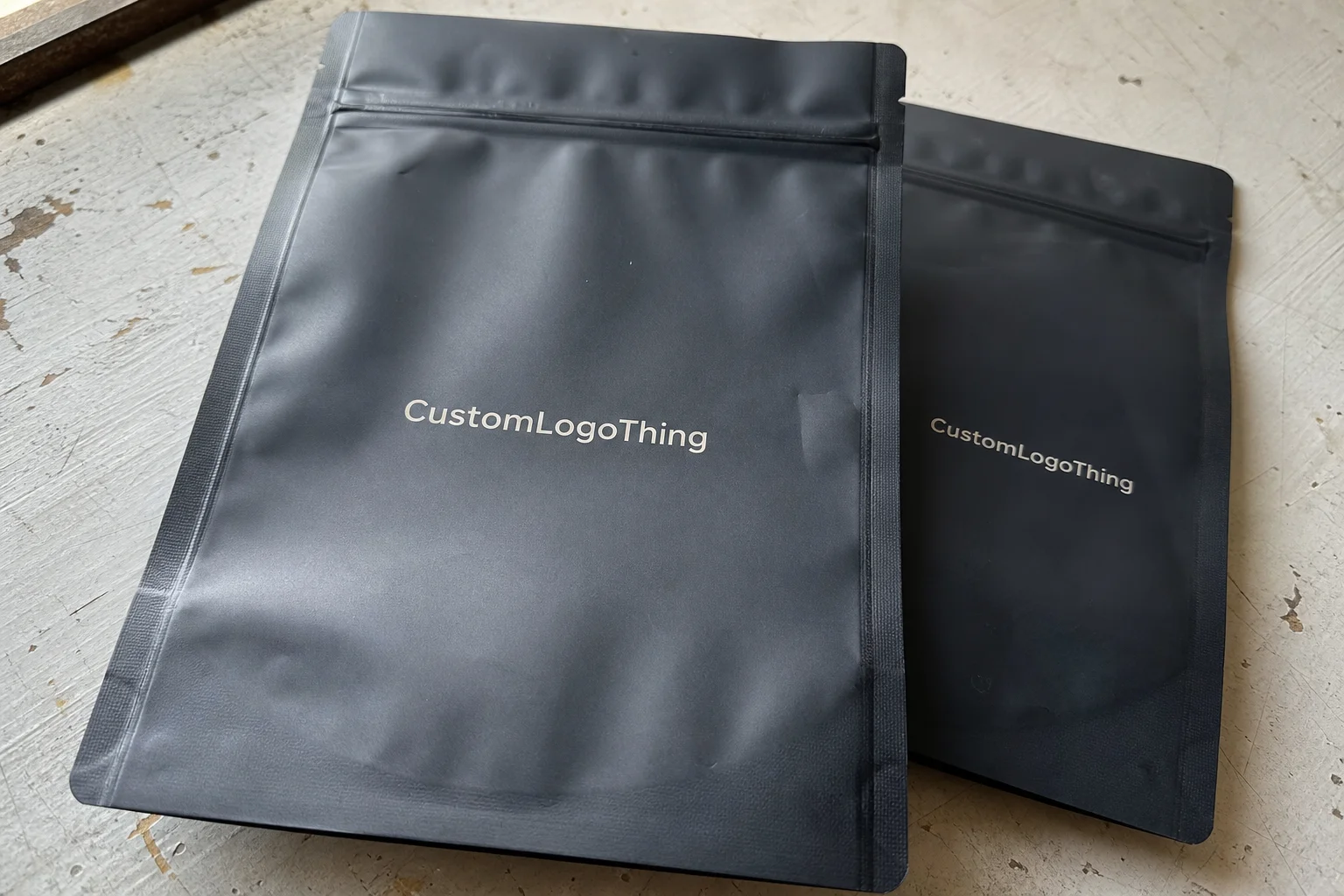
Packaging buyers usually ask for unit cost first. Fair. Nobody has unlimited budget, despite what some packaging mood boards seem to believe. But the sharper number is cost per saleable impression. The pouch appears on a shelf, in a marketplace image, inside a shipment, in a customer’s hand, and sometimes in a pantry or drawer for weeks.
Matte zipper bags are popular because they solve several practical problems at once. Matte film reduces glare under store lights and studio photography. A zipper closure supports repeated opening and closing. Logo printing turns the front panel into controlled brand space instead of a plain commodity pouch.
These bags show up across snacks, supplements, cosmetics, cannabis accessories, coffee samples, pet treats, apparel add-ons, refill products, and small hardware kits. Those categories do not need the same pouch. A 28 g coffee sample has different barrier needs than a 500 g pet treat pouch. A cosmetic refill may need stronger scuff resistance than a single-use snack pack. A hardware kit may need puncture resistance before anyone worries about the exact shade of beige.
The quote path usually moves through seven decisions: pouch size, film structure, barrier level, zipper type, print method, order quantity, and finishing tolerance. Change one variable and the final price can move by 5%, 20%, or more. A clear window may look minor on the dieline, but it can affect material choice, print coverage, barrier performance, and inspection.
Buyer reality: the lowest per-bag number is not always the lowest commercial cost. A bag that photographs poorly, scuffs during fulfillment, or fails at the zipper can hurt a launch faster than a few cents saved on film.
Use that frame before comparing quotes. Define the bag that can sell, protect, and be reordered consistently. Then push for cost efficiency. Not the other way around.
Product Details Buyers Should Confirm Before Ordering
A matte zipper bag is a flexible pouch with a resealable zipper and a non-gloss exterior finish. It may be a flat pouch, stand-up pouch, or three-side-seal bag. Stand-up pouches use a bottom gusset, often between 25 mm and 80 mm depending on the bag size, to create shelf presence. Flat pouches often cost less because they use less material and convert faster.
Material structure matters more than most first-time buyers expect. PET/PE is common for general dry goods and accessories. PET/VMPET/PE adds a metallized barrier layer for stronger moisture, aroma, and oxygen protection. Kraft-laminated matte films create a natural look, although kraft appearance does not automatically mean recyclable, compostable, or higher barrier. Those claims need documentation. Always.
Clear-window matte builds are useful when shoppers need to see product texture, color, or fill level. The window cannot be treated as decoration after the design is finished. It affects the print layer, unprinted area, product visibility, and sometimes barrier performance. If the product is light-sensitive or aroma-sensitive, ask whether the window weakens the protection you actually need.
- Standard press-to-close zipper: suitable for many snacks, refill packs, powders, and accessories.
- Wide-track zipper: useful for heavier products or packs opened many times.
- Child-resistant zipper: relevant for regulated categories, but it should be tested with real users before approval.
- Tear notch: usually placed above the zipper so the first opening feels clean and controlled.
Application features add cost, but some earn their keep. Hang holes support peg displays. Rounded corners reduce snagging for cosmetics and accessories. Degassing valves matter for coffee because roasted beans release carbon dioxide after packing. A valve is not a cute little circle on the front panel. It affects material choice, placement, production handling, and unit cost.
Product safety is not a vague checkbox. Confirm food-contact suitability if the pouch touches edible goods. Ask about odor control for tea, coffee, supplements, or cannabis-adjacent accessories. Check puncture resistance for sharp pet treats, hardware, brittle inclusions, and dry snacks with hard edges. For oily, powder, or granular products, seal contamination is a real failure mode; powder in the seal area can weaken closure strength and make zipper tracks feel gritty.
Send product weight, fill volume, storage conditions, and sales channel details before assuming a standard pouch will work. A pouch stored for six months in a humid warehouse has different requirements than a small apparel add-on shipped within seven days. The material recommendation should match the product, not the prettiest sample in the supplier’s catalog.
Logo Print Specifications That Change the Final Bag
Logo printing is not just “put the mark on the bag.” That sentence causes more delays than it deserves. Print requirements define plate needs, proofing time, color control, registration tolerance, and finishing. For any Matte Zipper Bags Unit Cost Logo Print Specification comparison, separate the design ambition from the production method.
Digital printing is useful for lower quantities, multiple SKUs, seasonal artwork, or packaging that may change after a market test. It can avoid traditional plate costs in many setups and supports faster iteration. Flexographic printing often becomes more economical at higher volumes and is widely used for flexible packaging. Gravure printing can deliver strong consistency for long runs, but tooling costs and MOQ expectations are usually higher. Offset printing appears in some packaging discussions, but it is less common for laminated flexible pouches than for cartons.
Artwork files should be production-ready. That normally means AI, EPS, or press-quality PDF files with vector logos, outlined fonts, Pantone references, bleed allowance, safe zones, barcode sizing, and minimum line thickness. Fine reverse text below about 5 pt can fill in or lose clarity depending on film, ink, and press setup. Barcodes need enough quiet zone and contrast. A screen mockup is not a barcode test.
Matte surfaces absorb and scatter light differently than glossy films. Rich black may need a specific CMYK build or spot color strategy. Gradients can band if artwork is not prepared correctly. Metallic effects are harder to represent on matte laminated films unless the structure and ink system support the look. Buyers should not approve final color from a phone screenshot. That is not quality control; that is wishful thinking with a battery icon.
| Print Choice | Best Fit | Cost Impact | Specification Watchpoint |
|---|---|---|---|
| One-color logo | Simple brand marks, trial runs, accessories | Lower print cost and easier proofing | Confirm line weight and logo contrast on matte film |
| Two-sided print | Retail packs needing instructions or nutrition panels | Moderate increase from artwork setup and coverage | Keep text away from zipper, gusset, and seal zones |
| Full-coverage artwork | Premium snacks, supplements, cosmetics, coffee | Higher ink use and stricter color control | Request proofing for dark solids and gradients |
| Window design | Products where visibility improves trust | Can raise cost through dieline and material decisions | Check barrier performance and print interruption |
Compliance and sales-channel markings need space before the dieline is approved. Nutrition panels, ingredients, batch codes, recycling icons, warning labels, QR codes, country-of-origin statements, and certification marks are not leftovers to squeeze into the back panel later. If a retailer requires a minimum barcode size or warning panel, that requirement belongs in the first layout review.
A sensible approval chain includes a digital mockup, dieline confirmation, color proof where needed, and final prepress review before plates or production files are released. For higher-stakes launches, ask whether a printed proof uses the same film structure and print method as the final run. Sometimes it does. Sometimes it is only a visual reference. Those are not the same thing.
Unit Cost, MOQ, and Quote Variables to Compare
Unit cost falls as order quantity rises because setup, artwork preparation, plate costs, machine time, and waste are spread across more bags. That is the normal curve. The curve is not smooth. Moving from 1,000 to 5,000 bags may produce a noticeable drop with digital printing, while moving from 10,000 to 30,000 bags may be where flexographic printing starts to make more sense.
For many custom matte zipper bags, a low-volume digital order may land around $0.25–$0.75 per unit depending on size, print coverage, and material. Larger plate-based runs can move lower, sometimes into the $0.08–$0.30 range for simpler sizes and structures. Treat those as planning ranges, not promises. Freight, duties, special films, zipper complexity, and urgent timelines can change the number quickly.
The main cost drivers are pouch size, material thickness, barrier layer, zipper style, gusset construction, print colors, print coverage, window shape, and added features. A 100 micron PET/PE structure will not price like a 140 micron high-barrier matte pouch with a wide zipper and full-coverage print. A small bag with a one-color logo can be cheaper than a larger unprinted high-barrier pouch. Size and structure often beat decoration as cost drivers.
MOQ deserves careful reading. Digital production may support smaller custom orders, sometimes in the low thousands. Flexographic and gravure printing usually need higher quantities to make plates, setup, and press time sensible. If a supplier quotes a very low MOQ for a complex custom pouch, ask what is being simplified: material, print method, color tolerance, size options, inspection level, or delivery schedule.
| Quote Variable | Lower-Cost Direction | Higher-Cost Direction | Buyer Question |
|---|---|---|---|
| Quantity | Higher volume spreads setup cost | Small runs carry more setup per bag | Can you quote a trial MOQ and reorder tier? |
| Film structure | PET/PE for non-sensitive goods | Metallized or specialty barrier laminates | What barrier data supports this recommendation? |
| Print coverage | Front logo or one-color mark | Two-sided full-coverage graphics | Are plates, proofing, and ink coverage included? |
| Zipper type | Standard press-to-close zipper | Wide-track or child-resistant zipper | Has the zipper been tested with my fill weight? |
| Freight | Consolidated slower transit | Rush air or split shipments | Does the quote include shipping, duties, and cartons? |
Compare quotes line by line. Ask whether pricing includes plates, samples, shipping, duties, artwork adjustment, proofing, and overrun or underrun allowances. A quote that looks 12% cheaper may exclude plate charges or freight. Another may use thinner film. Another may allow wider color variation. The invoice is not the only cost signal.
For a clean quote request, send target quantity, reorder forecast, finished bag dimensions, product weight, print sides, artwork file, delivery ZIP code, and deadline. That gives the supplier enough information to quote the actual bag rather than a placeholder pouch. It also makes unit cost and logo print specification comparisons far more reliable.
Production Process and Lead Time From Artwork to Delivery
A custom pouch order moves through a predictable chain: requirement review, material recommendation, dieline setup, artwork placement, proof approval, printing, lamination if required, curing, bag converting, inspection, packing, and shipping. Miss one approval point and the schedule can slide.
Typical production after final proof approval may take 12–25 business days for many custom printed flexible pouches. Specialty films, custom zippers, high-volume runs, plate-based printing, and freight constraints can stretch that window. Rush work is possible in some cases, but rush production is rarely free. It can also reduce the time available for color proofing, filling trials, and internal review.
The usual delays are painfully ordinary. Incomplete artwork. Late regulatory text. A barcode supplied as a low-resolution JPEG. A brand team changing a Pantone reference after prepress. Custom zipper sourcing. Specialty matte film that is not in stock. Proof approval sitting in an inbox for four days. None of this sounds dramatic. It still burns calendar time.
Samples are not all the same. A stock sample shows material feel, zipper function, and approximate size. A digital mockup shows layout, not physical performance. A printed proof improves color confidence. A pre-production sample is useful for higher-stakes launches, retailer reviews, or products filled on automated equipment. If a filling line uses heat sealing, test the pouch before the main run. Guessing at seal behavior after 20,000 bags arrive is a terrible hobby.
Inspection should cover film thickness, seal integrity, zipper alignment, print registration, color consistency, cut accuracy, tear notch placement, and carton labeling. For shipping performance, buyers can reference test protocols from the International Safe Transit Association, especially if filled pouches move through parcel networks. For paper-based or kraft-look components, certification claims should be checked carefully; the Forest Stewardship Council publishes certification information for fiber sourcing claims.
Plan backward from the launch date. Add time for internal approvals, filling trials, retailer review, photography, freight transit, and receiving inspection. If the product is going into retail, add cushion for carton labeling and case-pack requirements. A bag that arrives two days before filling leaves no room for discovering that the zipper sits too low for the scoop or the hang hole conflicts with the display peg.
Confirm when the supplier’s clock starts. Some count from quote approval. Others count from deposit payment. Many count only after final artwork approval. The safest assumption is simple: the order is not truly moving until money, files, dimensions, and proof approval are all complete.
Costly Specification Mistakes to Avoid Before Approval
The most common mistake is ordering by external dimensions alone. Internal fill space changes with gusset depth, zipper placement, seal width, product shape, and filling method. A 160 mm by 230 mm pouch may work for one 250 g product and fail for another because density and geometry differ.
Film thickness is another trap. Thin film can look fine empty, then fail under sharp, oily, heavy, or powder-based products. Puncture resistance matters for dehydrated snacks and pet treats. Oil resistance matters for nuts, seasonings, and cosmetic refills. Powder behavior matters because fine particles can contaminate seals and interfere with zipper performance.
Artwork errors are avoidable and still common. Low-resolution logos, missing bleed, text placed too close to the seal area, RGB color files, and screen-based color assumptions can all delay production. CMYK values on a monitor do not guarantee the same visual result on matte laminated film. A color-managed proof is not bureaucracy. It is risk control.
Zipper mismatch creates complaints after the invoice is paid. A weak closure can open under heavier contents. An overly stiff zipper can frustrate buyers of single-serve or trial-size packs. Child-resistant features may satisfy a requirement but still create usability problems if the product is aimed at older customers or needs frequent access.
Matte finish also needs handling tests. Some matte films show fingerprints. Some scuff during carton rub. Some look excellent in photography but mark easily during fulfillment. Ask for samples and rub-test them against the carton, insert, or shipper that will be used. A simple 30-second handling check can reveal more than a polished mockup.
For a new product, new filling machine, or new sales channel, run a short pilot or review physical samples before locking the full quantity. The right level of testing depends on launch risk and budget, but skipping physical review to save a week can cost far more if the pouch does not stand, seal, scan, or survive transit.
Actionable Next Steps for a Faster Custom Bag Quote
A faster quote starts with fewer unknowns. Choose the pouch format first: flat pouch, stand-up pouch, or three-side-seal bag. Confirm product weight and estimate fill volume. Select the matte finish, decide whether the bag needs a clear window, choose front-only or two-sided print, and set a target order quantity.
- Measure the product fill, not just the old bag.
- Send exact finished dimensions or a physical reference bag if replacing current packaging.
- Prepare logo files in AI, EPS, or press-quality PDF format.
- Include Pantone colors, barcode files, legal copy, and certification marks.
- Define the sales goal: lowest unit cost, premium shelf presentation, faster launch, retail compliance, or stronger product protection.
- Ask for two quote tiers, such as a lower MOQ trial order and a larger reorder quantity.
Those two quote tiers expose the real cost curve. A 3,000-piece order may be useful for market testing. A 20,000-piece reorder may reduce the per-bag cost enough to justify plate-based printing. The right answer depends on sell-through confidence, storage space, artwork stability, and cash flow.
Share the sales channel too. Retailers may need peg holes, case labels, warning panels, barcode placement rules, or specific case-pack counts. Ecommerce puts more pressure on scuff resistance, product photography, and parcel durability. Subscription refill products may need a zipper that works after ten or more openings, not just on the first day.
Custom Logo Things can quote more accurately when the request is specification-based rather than generic. Send the product details, artwork, quantity target, delivery ZIP code, and deadline, then ask for material and print recommendations with tradeoffs stated clearly. That is the practical way to compare matte zipper bags unit cost logo print specification options before committing to a custom run.
FAQ
What affects matte zipper bag unit cost the most?
The biggest variables are order quantity, pouch size, film structure, zipper type, print method, number of colors, print coverage, and whether custom plates or specialty materials are required. A larger order usually lowers the per-bag cost, but only if the specification stays the same across the run.
What logo print specification is needed for custom matte zipper bags?
Buyers should provide vector artwork, Pantone or CMYK color targets, bag dimensions, print side requirements, bleed, safe zones, barcode files, and any regulatory or retail copy. A dieline review should happen before production so the zipper, seal area, gusset, and tear notch do not interfere with the design.
What MOQ should I expect for custom matte zipper bags?
MOQ depends on the bag size, film structure, print method, and supplier production setup. Digital printing can support smaller runs in some cases, while flexographic printing or gravure printing often becomes more economical at higher quantities.
How long does matte zipper bag production usually take?
Lead time depends on artwork readiness, proof approval, material availability, printing method, lamination or curing time, converting, inspection, and freight method. Buyers should confirm when the supplier’s production clock starts because it may begin only after deposit and final artwork approval.
Can matte zipper bags include clear windows and full logo printing?
Yes, many matte zipper bags can combine a clear window with custom logo printing, but the window shape and placement must be built into the dieline. Window placement can affect print coverage, product visibility, barrier performance, and final unit cost.


