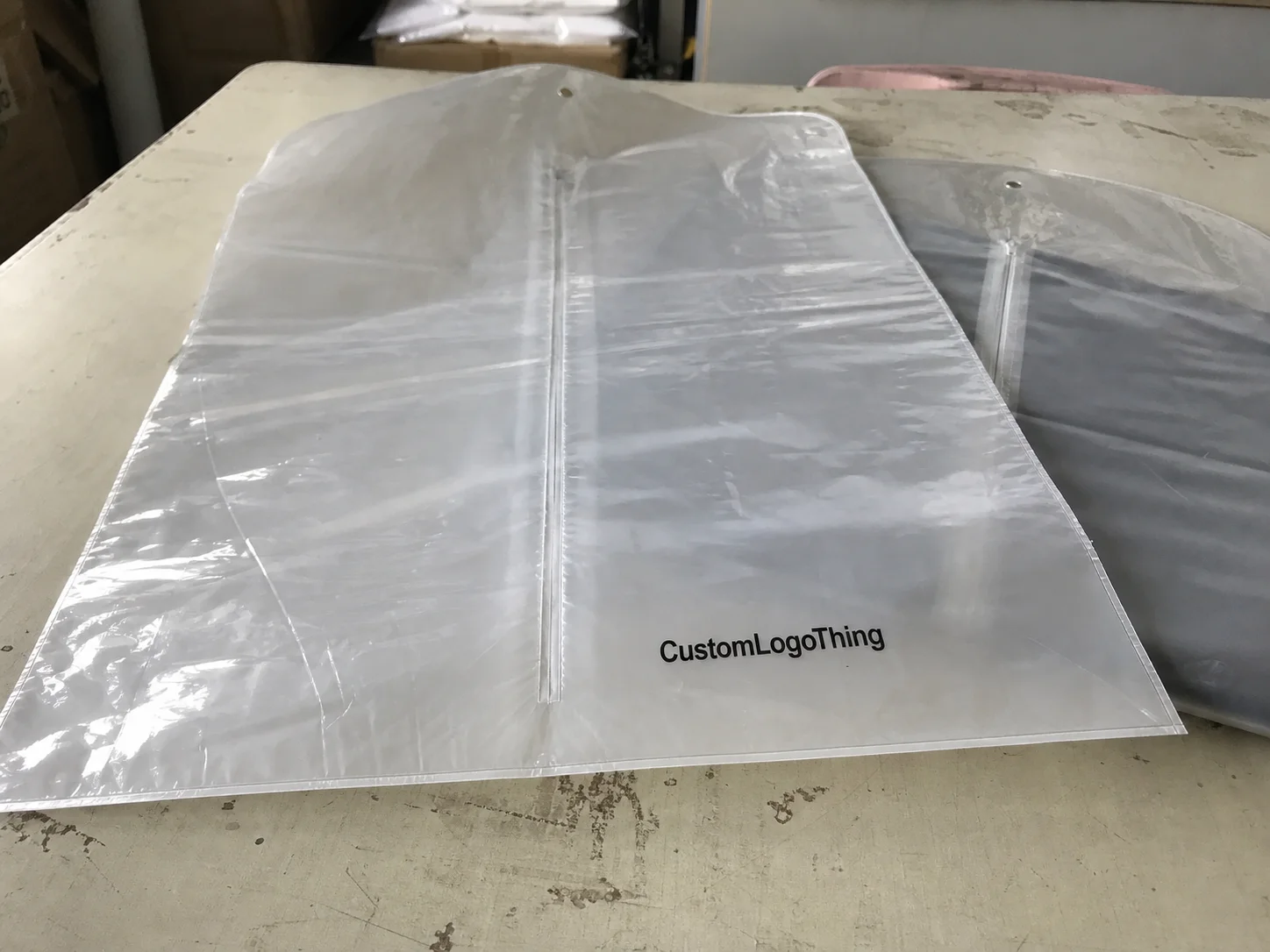
When one late bag shipment stalls an entire apparel launch

Garments can be finished, tagged, and packed, yet a launch still slips because packaging misses the vessel cutoff. That is why Lead Time and MOQ for PVC zipper garment bags need to be set early, not after final apparel counts are done.
These are not minor purchasing fields. They affect launch timing, carton planning, cash tied up in inventory, and whether a brand can test a bag format before committing to a larger run. Push MOQ too high and packaging sits in stock. Accept an unrealistic production promise and the backup plan becomes air freight.
The goal is simple: source a bag that protects the garment, presents well, fits correctly, and arrives on a realistic schedule. That requires early decisions on size, PVC thickness, zipper type, branding, gusset depth, hanger opening, and packing method. Those details drive the quote far more than a broad request for a custom garment bag with logo.
What buyers actually need from a PVC zipper garment bag
A PVC Zipper Garment bag is usually a clear or frosted hanging bag with a zipper closure, top hanger opening, and optional gusset. Branding may be direct printed or added with an insert card. Its job is practical: protect garments from dust, surface scuffs, light moisture, and routine warehouse handling while keeping them visible.
That visibility helps with storage and picking. Transparent bags make style identification faster and reduce handling errors. Suits, gowns, uniforms, outerwear, dancewear, and occasionwear are common uses because they are often stored and shipped on hangers.
The zipper matters because it makes repeated inspection easier. Open-top dust covers and adhesive closures cost less, but they are less useful when staff need to open, check, and reclose the bag without damaging presentation. For bridal, formalwear, costume, and uniform programs, that reusability can justify the extra cost.
Quality varies widely under the same product name. A 0.10mm to 0.12mm bag may be enough for short storage cycles and basic dust protection, but it often feels too light for premium garments. Around 0.15mm to 0.18mm is a common middle ground. Heavier gauges from 0.20mm to 0.25mm feel sturdier and hold up better in repeated handling, though they raise unit cost, freight weight, and carton cube.
The best design is not just attractive in a sample photo. It should zip smoothly, hang correctly, fit the garment without crushing shoulders, and fold into cartons without slowing the packing line.
Specifications that change performance, appearance, and factory feasibility
Specifications determine whether the bag feels disposable, functional, or worth the price. Buyers who ask for a custom PVC Zipper Garment bag with no further detail usually get broad quotes because the brief is incomplete.
The main variables are:
- Bag dimensions: often about 22 to 26 inches wide and 36 to 72 inches long, depending on garment type.
- PVC thickness: commonly 0.10mm to 0.25mm.
- Zipper type: standard nylon, heavier molded zipper, single pull, or double pull.
- Hanger opening: round hole, oval slot, or reinforced top opening.
- Gusset depth: flat for slim garments, often 3 to 6 inches for coats, gowns, or multi-piece outfits.
- Seam construction: heat sealed, stitched, or combined construction.
- Extras: handles, vent holes, binding, insert pockets, barcode labels, or printed cards.
Thickness is usually the first meaningful decision. Lighter film lowers cost but scratches more easily and feels less substantial. Mid-range gauges suit many mainstream fashion and uniform programs. Heavy-gauge PVC is better for premium garments, repeated showroom use, or bags expected to stay with the garment after sale.
Finish also matters. Clear PVC offers maximum visibility and is often easiest to source and quote. Frosted or matte PVC hides light scuffing better and can feel more refined. Tinted film, oversized logos, and heavy print coverage can look impressive, but they add setup complexity and may increase MOQ.
Branding is often overcomplicated. A one-color silk screen logo is frequently enough to identify the brand cleanly while keeping setup simple. Insert cards can help when more graphics are needed, but they add cost, another approval step, and manual packing work.
Some of the biggest delays come from operational details buyers leave until late: fold method, pieces per carton, master carton dimensions, barcode location, and carton weight limits. Many importers prefer cartons around 15kg to 18kg for easier handling, though requirements vary by channel.
Quality checks should cover odor, zipper function, seal consistency, print adhesion, scratch resistance, and size tolerance. If the bags will move through e-commerce fulfillment or rough parcel systems, transit testing principles from ISTA are worth reviewing. If paper insert cards are used, some buyers also look at FSC sourcing standards.
PVC zipper garment bags lead time and MOQ by order type
Buyers often want one fixed answer on PVC zipper garment Bags Lead Time and MOQ, but the real range depends on size, gauge, print complexity, zipper sourcing, and whether the factory is producing a familiar pattern or a more customized construction.
For lightly customized bags based on standard sizes, clear PVC, and simple one-color printing, MOQ often starts around 1,000 to 3,000 pieces. For custom sizing, heavier gauges, special zipper colors, reinforced hanger openings, gussets, or insert cards, MOQ often moves to 3,000 to 10,000 pieces.
Factories also handle small runs differently. Some can support trial quantities by matching your order to existing material runs. Others advertise a low MOQ but make up the margin through higher setup charges, sample fees, or elevated piece pricing. The headline minimum is only part of the cost picture.
Sampling deserves its own timeline. A digital mockup is useful, but a true pre-production sample with approved artwork and target materials is what reveals real issues: bag length too short, weak zipper pull, logo placement on a fold line, or a hanger slot that tears under weight. Sample fees often fall in the $50 to $200+ range depending on complexity.
Lead time is easier to manage when broken into stages:
- Quotation and spec review: 1 to 3 business days if the brief is complete.
- Artwork check and sample preparation: often 5 to 10 business days for a new custom sample.
- Sample approval cycle: depends heavily on buyer response speed.
- Bulk production after approval: commonly 12 to 25 business days.
- Final packing and shipment booking: usually 2 to 5 business days after production finishes.
A simple repeatable order can move quickly. A first-time program with multiple sizes, gussets, zipper color matching, and insert cards will not. One small spec change can add several days, and slow internal approvals often cause more delay than manufacturing itself.
| Order Type | Typical MOQ | Bulk Lead Time | Common Cost Drivers |
|---|---|---|---|
| Standard size, clear PVC, 1-color print | 1,000-3,000 pcs | 12-18 business days | Material gauge, logo size, carton pack |
| Custom size with gusset and zipper color match | 3,000-5,000 pcs | 15-22 business days | Custom cutting, zipper sourcing, setup charges |
| Premium heavy gauge with insert card | 5,000-10,000 pcs | 18-25 business days | Thicker PVC, printed inserts, manual packing |
| Repeat order, unchanged spec | Often same as prior PO | 10-15 business days | Production queue, material stock, shipping slot |
Pricing, unit cost, and MOQ tradeoffs buyers should expect
Higher volume usually lowers cost per piece, but not every quantity increase creates meaningful savings. Ask for at least three quantity breaks so the price curve is visible.
For a basic custom PVC zipper garment bag, a rough buying range often sits around $0.55 to $1.10 per piece at 1,000 to 3,000 units, depending on size, gauge, and print. At 5,000 to 10,000 units, that may drop into the $0.42 to $0.85 range. Heavy-gauge bridal bags, oversized formats, reinforced constructions, and insert-card programs can run higher. Freight, duties, and destination still matter, so ex-factory price is not the full landed cost.
The main price drivers are:
- Material thickness: more PVC increases material cost and often freight weight.
- Bag size: larger panels use more film and shipping cube.
- Zipper quality: smoother and stronger zippers cost more.
- Print coverage: larger logos, extra colors, or inserts add setup and labor.
- Construction details: gussets, handles, reinforcement, vent holes, and pockets add work.
- Packing method: individual polybagging, labeling, and custom carton marks add handling time.
Low MOQ sounds attractive until fixed costs are spread across fewer units. Pattern work, print setup, sample preparation, and production setup still need to be paid for, which is why a very small custom run can carry a surprisingly high unit cost.
A better RFQ compares realistic scenarios such as 2,000, 5,000, and 10,000 pieces across two gauges like 0.12mm and 0.18mm. That quickly shows whether the extra spend buys better durability, whether the higher MOQ really improves margin, and whether the savings justify inventory risk.
Seasonal programs need extra caution. Saving a few cents per bag is not efficient if thousands of leftover bags remain after a soft launch or style cancellation.
Production process and timeline from artwork approval to packed cartons
A typical order moves through inquiry, spec review, quotation, artwork check, sample production, approval, bulk manufacturing, QC, packing, and shipment. Most delays come from incomplete buyer information or late changes rather than major factory breakdowns.
Common problems include missing dimensions, low-resolution artwork, vague zipper requirements, late carton marks, slow sample feedback, and spec changes after approval. If the supplier is still asking whether the bag should be 24 x 40 inches or 24 x 54 inches, the schedule is already slipping.
For a first-time custom order, a practical timeline often looks like this:
- Inquiry and quotation: 1 to 3 business days if the specification sheet is complete.
- Artwork review and sample planning: 2 to 4 business days.
- Sample production: 5 to 10 business days.
- Buyer review and approval: ideally 1 to 3 business days.
- Bulk production: 12 to 25 business days depending on complexity and volume.
- Inspection and export packing: 2 to 5 business days.
That puts a new custom program at roughly 3 to 6 weeks from confirmed specs to packed cartons, before transit time. A repeat order with locked dimensions, artwork, and packing rules may land closer to 2 to 4 weeks.
Build in a buffer. For first orders, adding at least 7 to 10 extra calendar days before the required ship date is usually safer than relying on a best-case schedule. Multi-SKU orders need more room because one mistake in size, print position, or carton assortment can slow the whole run.
Practical rule: if the garment bag is tied to a fixed launch date, count backward from the ship date and lock sample approval early.
How to compare suppliers without getting trapped by cheap quotes
Piece price matters, but it is not the whole comparison. Sample quality, communication speed, dimensional tolerance, zipper consistency, print registration, and export packing discipline all affect whether the order lands cleanly.
Warning signs usually appear early: vague answers on material gauge, no clarity on MOQ assumptions, extremely short lead times for fully custom work, no questions about carton specs, or no interest in sample approval. A supplier who agrees to everything immediately may be postponing the conflict until production.
Stronger suppliers usually ask more questions. They want garment type, dimensions, quantity, use case, shipping deadline, branding method, and whether the bag is for short-term protection or repeated use. That suggests the quote is based on manufacturing reality rather than optimism.
Useful supplier support can also improve fold efficiency, trim unnecessary size, align barcode placement with warehouse requirements, and prevent awkward carton weights. Those are operational advantages that help avoid rework.
Before bulk release, document every approval in writing: artwork, dimensions, thickness, zipper color, fold method, and carton details. Many disputes start with “that is not what we meant.” Clear records reduce that risk.
Next steps to request the right quote and shorten approval time
A useful quote starts with complete information. Prepare the garment type, target dimensions, preferred PVC thickness, finish, logo files, zipper preference, estimated quantities, packing requirements, and required ship date before asking for pricing.
Request two or three realistic options instead of many hypothetical scenarios. Comparing 2,000, 5,000, and 10,000 pieces across two gauges is often enough to show the real tradeoffs in MOQ, unit cost, freight impact, and material feel.
For a new size, premium garment, or presentation-sensitive program, ask for a pre-production sample. Use it to verify dimensions, zipper movement, clarity, logo placement, and fold method. Then set an internal approval deadline so packaging does not slip behind apparel decisions.
Do not leave carton quantity, master carton size, barcode labels, shipping method, or final carton marks for later. Those details seem minor until they delay dispatch.
Teams that hit their dates usually do three things well: specify early, compare suppliers on more than price, and approve quickly once the sample is right.
What is the typical lead time and MOQ for PVC zipper garment bags?
PVC zipper garment Bags Lead Time and MOQ vary with construction. For standard-size bags in clear PVC with simple one-color printing, MOQ often starts at 1,000 to 3,000 pieces, with bulk lead times around 12 to 18 business days after approval. More customized orders with gussets, thicker film, insert cards, or matched zipper colors often require 3,000 to 10,000 pieces and 15 to 25 business days. Sampling usually adds 5 to 10 business days before bulk production begins.
What is the typical MOQ for custom PVC zipper garment bags?
MOQ usually depends on size, PVC gauge, and print complexity. Simpler stock-like constructions may start around 1,000 to 3,000 pieces, while fully custom runs with gussets, insert cards, or specialty zipper details often land in the 3,000 to 10,000 piece range. Ask for several quantity breaks rather than focusing on one minimum number.
How long is the lead time for PVC zipper garment bag orders?
Separate the schedule into sample stage and bulk stage. A new sample often takes 5 to 10 business days. Bulk production after approval commonly takes 12 to 25 business days depending on complexity, volume, and current capacity. Repeat orders with unchanged specifications are usually faster.
What affects the price of PVC zipper garment bags the most?
The biggest drivers are dimensions, PVC thickness, zipper quality, print coverage, insert cards, reinforcement details, and packing format. Low-volume custom runs usually cost more per piece because setup work is spread across fewer units. Landed cost matters more than the lowest ex-factory quote.
Can I order samples before committing to the full MOQ?
Yes, and for new sizes or upgraded branding, that is usually the safer move. Samples may involve a fee, and a handmade mockup may not fully match mass production if normal tooling and processes are not used. The sample should confirm size, zipper function, material feel, and branding placement before bulk release.
How can I reduce delays when ordering custom garment bags?
Send complete specifications early, including dimensions, gauge, logo files, quantity, packing details, and required ship date. Approve artwork and samples quickly. Avoid changing size, print, or zipper details after signoff unless extra time and added cost are acceptable. For broader sourcing questions, the FAQ page is a useful starting point.