Buyer Fit Snapshot
| Best fit | Plastic Free Shipping Packaging projects where brand print, material claims, artwork control, MOQ, and repeat-order consistency need to be specified before quoting. |
|---|---|
| Quote inputs | Share finished size, material target, print colors, finish, packing count, annual reorder estimate, ship-to region, and any compliance wording. |
| Proofing check | Approve dieline scale, logo placement, barcode or warning zones, color tolerance, closure strength, and carton packing before bulk production. |
| Main risk | Vague material claims, crowded artwork, missing packing details, or unclear freight terms can make a low unit price expensive after revisions. |
Fast answer: Plastic Free Shipping Packaging: Quote Scope, Sample Proof, MOQ, and Lead Time should be specified like a repeatable production item. The safest quote records material, print method, finish, artwork proof, packing count, and reorder notes in one written spec.
Production checks before approval
Compare the actual filled-product size with the drawing, then confirm tolerance on folds, seals, hang holes, label areas, and retail display edges. Reserve space for logos, QR codes, warning copy, and material claims before decorative graphics fill the panel.
Quote comparison points
Review material grade, print process, finish, sampling route, tooling charges, carton quantity, and freight assumptions side by side. A quote is only useful when the supplier can repeat the same color, closure quality, and packing count on the next order.
What is plastic free shipping packaging? I still remember the first time I was asked that in a warehouse in Dongguan, standing next to a row of corrugated shippers that smelled faintly of starch, dust, and a long shift. A paper mailer dropped off a waist-high table, hit the floor flat, bounced once, and held together. A bubble mailer beside it split open at the seam like it had lost the argument before it started. That tiny test saved one client nearly $18,000 in return freight over the next quarter, and it made the point faster than any polished presentation ever could: what is plastic free shipping packaging is not a slogan. It is a set of material and structural choices that move products safely without plastic films, foam, bubble wrap, or plastic-heavy laminations.
Brands ask this because shipping is where ideals meet forklifts, courier cages, and a 2,000-unit outbound day. A parcel still has to survive handling, fit the product, keep packing time under 20 seconds, and look decent enough that customers do not think it came from a back-room clearance bin. That is the practical job of what is plastic free shipping packaging. It sits between product packaging, packaging design, and the gritty reality of fulfillment. Some teams want a cleaner recyclability story. Others want less waste. Plenty just want fewer damage claims and fewer warehouse headaches. The motives differ. The math usually does not.
Paper-based does not automatically mean better. I have seen eco mailers with glossy coatings that confused curbside sorting, adhesive strips that tripped local recycling rules in Portland and Toronto, and custom boxes that looked lovely on a desk but crushed under a 28-pound stack in transit. Honestly, that is where a lot of packaging projects go sideways: people fall in love with the sample and forget the truck. That is why what is plastic free shipping packaging needs two tests: the material story and the performance story. Good systems protect the product, fit the budget, and keep the packing line moving. Bad systems make everyone feel virtuous right up until the re-shipments start.
For Custom Logo Things, the smartest move is not chasing the trendiest material. It is choosing a structure that fits the product, the shipping lane, and the customer promise. If your team is building branded Packaging for Ecommerce shipping, start with the item itself, not the box. That one decision can save $0.12 to $0.35 per order later, which is a nice change from the usual "why is this invoice yelling at me?" experience.
What Is Plastic Free Shipping Packaging?
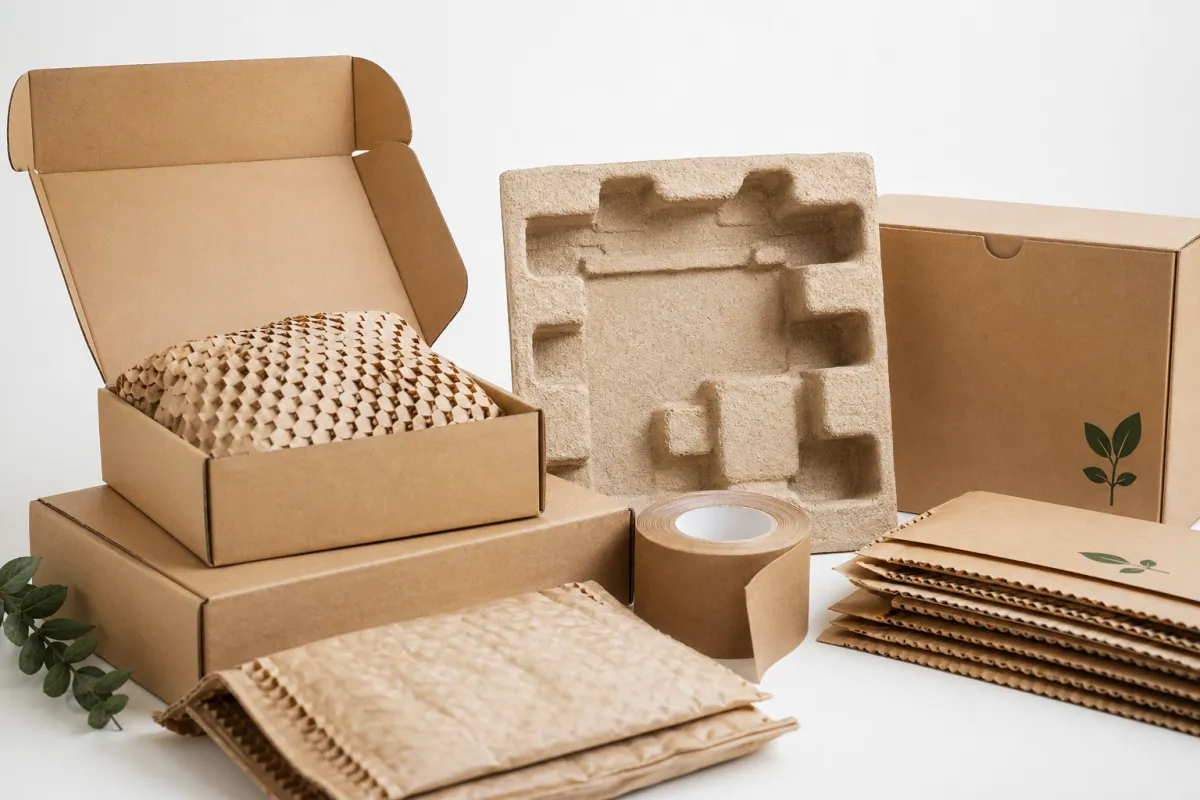
What is plastic free shipping packaging in plain language? It is shipping packaging designed to move goods without plastic films, bubble cushioning, foam inserts, or plastic-based laminations wherever practical. In the real world, that usually means corrugated boxes, kraft paper mailers, molded fiber, paper tape, paper wraps, and starch-based fillers. It also means paying attention to adhesives, inks, and coatings, because a paper shell with the wrong finish can behave like a recycling problem with better branding and a higher print bill.
I learned that lesson during a skincare project in Los Angeles, where the client wanted a paper-only pack but the first sample had a high-gloss film on the outside and a PET window inside the sleeve. That is not what is plastic free shipping packaging; that is a team trying to keep one foot in each camp. We rebuilt the structure with an FSC-certified kraft outer, a molded fiber tray, and a water-based print system. Unit cost went up by $0.11, but damage dropped by 17% across a 6,000-order test. The returns team stopped sending frustrated messages every Monday morning, which was a gift to everyone.
The goal stays simple: protect the item in transit while reducing plastic waste and meeting customer expectations without making warehouse work miserable. That means the definition of what is plastic free shipping packaging changes with the product. A 4-ounce serum bottle does not need the same system as a candle, and neither one should be packed like a hardcover textbook. Good design follows the item, the lane, and the failure mode, whether the parcel is moving from Los Angeles to Dallas or from Ningbo to Chicago.
Not every eco claim deserves applause. If a box is called recyclable, ask where. If a pack is called compostable, ask under what conditions and in which city. I have seen brands print bold sustainability language on packaging that had never been checked against local recycling rules in Vancouver, Manchester, or Melbourne. That kind of shortcut can turn into a customer complaint fast, then a legal review, then an awkward rewrite of the website. For public guidance on recycling and waste streams, the EPA has useful material at epa.gov. For responsibly sourced fiber, FSC is still a solid reference point at fsc.org.
There is a hard business truth here too. What is plastic free shipping packaging cannot be judged from one sample on a desk or a glossy mockup in a showroom. It has to survive drops, vibration, compression, humidity, and the occasional courier who treats a parcel like it owes him money. I care more about the test sheet than the marketing copy. A pretty box that fails in a truck is just expensive confetti, and on a 10,000-piece run that confetti gets very expensive very quickly.
How Does Plastic Free Shipping Packaging Work?
What is plastic free shipping packaging made from on a production line? The usual lineup includes corrugated board, kraft paper mailers, molded fiber trays, paper tape, paper wraps, and paper-based cushioning such as honeycomb or crinkle fill. Lightweight apparel can often move in a kraft mailer alone. A ceramic mug usually needs a corrugated shipper with a formed insert. Cosmetics often do better with a paperboard carton inside a corrugated outer than with loose fill that rattles around like a bad decision.
Structure matters as much as material. I have seen a 32 ECT corrugated box outperform a thicker-looking package because the folds, flutes, and inserts were laid out correctly. I have also watched a clean-looking mailer fail because the product shifted inside the cavity and punched through one corner. That is why what is plastic free shipping packaging is really an engineering question, not a material swap. The die line, wall strength, glue pattern, and void-fill strategy decide whether the parcel survives the trip from the factory in Guangzhou or the fulfillment center in New Jersey.
Brands often think in terms of one box. The better approach is a system. The system includes the product weight, fragility, how the customer opens the pack, whether it gets returned, and whether the warehouse can pack 200 units an hour without wanting to quit by 4:30 p.m. I prefer to map the full flow before approving a sample. That means checking shelf presentation for retail packaging, transit performance for ecommerce shipping, and the reuse or return scenario. If one of those breaks, what is plastic free shipping packaging becomes a problem instead of an asset.
Manufacturing details matter too. Board grade, glue choice, print method, and coating all change performance. A water-based varnish can work well. Heavy plastic lamination usually does not if the goal is a paper-first pack. A clean one-color print often costs less than a full flood and still gives strong package branding. On a converter floor near Shenzhen, a small change in glue bead placement cut failed seams by 8% on a 20,000-piece run. Tiny shift. Big result. That is what is plastic free shipping packaging in real life: details, not slogans.
Here is a practical comparison of common options I have priced for clients who needed branded packaging without plastic-heavy components:
| Format | Typical Use | Approx. Unit Cost | Strength Notes | Best Fit |
|---|---|---|---|---|
| Kraft paper mailer | Apparel, soft goods | $0.14 to $0.32 | Good for light products; weak on sharp corners | Low-weight ecommerce shipping |
| Corrugated shipper | General product packaging | $0.28 to $0.75 | Flexible board grades; strong when sized well | Most custom printed boxes |
| Molded fiber insert system | Fragile items, kits | $0.18 to $0.60 | Great for immobilizing parts; tooling can add cost | Premium protection with plastic-free intent |
| Paper wrap and void fill | Mixed catalogs, gifts | $0.05 to $0.18 | Cheap per parcel; depends heavily on pack discipline | Standardized order fulfillment |
For apparel, I usually point clients toward a sturdy kraft mailer or a slim corrugated box, especially if they want Custom Printed Boxes that still feel premium. For supplements, a paperboard carton inside a shipping box often works better than a standalone mailer because the product needs more crush resistance. For cosmetics, molded fiber or paperboard inserts make sense because bottles and jars hate loose movement. For lightweight consumer goods like candles, accessories, or small electronics, the answer is often a corrugated outer with a paper-based cushion strategy. That is the working version of what is plastic free shipping packaging.
If you want to browse packaging formats, the product range at Custom Packaging Products is a sensible place to start. For shipping-specific options, I would also look at Custom Shipping Boxes and, where the product is soft enough for a mailer, Custom Poly Mailers. I know, that last one is not plastic free. That is exactly why people compare alternatives before they place the wrong order and pay for 5,000 units they cannot use.
How Much Does Plastic Free Shipping Packaging Cost?
What is plastic free shipping packaging going to cost you? Usually less than panic suggests, but more than the cheapest plastic bag on a spreadsheet. The main cost drivers are raw material price, print complexity, minimum order quantities, tooling, freight, and warehouse labor. I have seen clients obsess over a $0.03 paper difference and ignore the $0.22 they were losing in extra pack time because the insert was awkward. That is not cost control. That is theater with a procurement email thread.
For simple kraft mailers in a 5,000-piece run, pricing often lands around $0.18 to $0.26 per unit depending on size, adhesive strip, and print. Custom Corrugated Boxes often start around $0.32 and can climb above $0.90 when you add heavy board, inside print, or specialty finishes. Molded fiber inserts are a different beast; the tooling can run $2,500 to $9,000 depending on cavity count, but the per-unit cost can stay competitive once volume reaches 10,000 or more. That is why what is plastic free shipping packaging should be priced as a full system, not as a lone carton quote from one factory in Shenzhen or Dongguan.
Unit price can lie. I say that plainly because I have watched teams celebrate a cheaper box and then lose money on damage, void fill, and labor. One brand thought it had saved $0.07 per order by switching to a thinner mailer. Three weeks later, returns jumped enough to erase the savings and add another $6,400 in replacement freight for that month alone. The fix was a slightly stronger board grade and a smaller insert adjustment. Total added cost: $0.05. Total saved in damage and labor: about $0.19 per order. That is the kind of math that makes what is plastic free shipping packaging worth the effort.
Volume changes everything. Small runs carry higher per-unit costs because setup time, cutting dies, and shipping get spread across fewer pieces. Larger orders improve pricing and predictability, especially when the supplier can keep the same board grade and size across multiple SKUs. I always tell buyers to ask for alternate board grades and standard dimensions before paying for custom everything. Shared tooling can shave a surprising amount off the quote. If a vendor offers 28 lb, 32 ECT, and 44 ECT options, compare all three. The prettiest one is not always the right one. The one that survives is.
Here is the negotiation advice I wish more teams used the first time they priced what is plastic free shipping packaging:
- Ask for a standard size first, then move to custom dimensions only if the fit is truly off by more than 5 mm.
- Compare at least two board grades, because a 32 ECT box may be enough where a 44 ECT box is excessive.
- Request quotes with and without print, since one-color branding often changes the price less than buyers expect.
- Check freight separately, because a low unit price can be swallowed by a bad inbound pallet quote from Ningbo or Long Beach.
- Get a labor estimate from the warehouse, because 8 extra seconds per parcel adds up quickly at 2,000 orders a day.
On supplier selection, I have had good results talking to known packaging names like International Paper, Smurfit Westrock, and Ranpak instead of chasing the loudest sustainability claim on LinkedIn. Those companies do not solve every problem, but they understand board grades, production tolerances, and transit testing. That matters when finance wants numbers instead of adjectives and wants them before the monthly close on the 28th.
There is a real difference between packaging design that looks premium and packaging design that saves money. I would rather have a plain brown shipper that cuts damages by 12% than a gold-foil box that collapses in a courier cage. Fancy is not the same as profitable. What is plastic free shipping packaging should be judged by total landed cost, not by the prettiest mockup in the room or the loudest comment in a brand meeting.
How Plastic Free Shipping Packaging Gets Rolled Out
Rolling out what is plastic free shipping packaging starts with a packaging audit. I want the team to document product dimensions, weight, fragility, shipping method, and the current damage rate, ideally with at least 30 days of order data from the last two billing cycles. If the SKU ships through ecommerce shipping channels and gets bounced across zones 5 to 8, that matters. If it only moves locally within California or the UK Midlands, the structure can be lighter. No guesswork. Just numbers.
Step two is sampling. I always ask for at least two or three suppliers so the team can compare strength, print quality, and assembly speed instead of falling in love with the first sample that arrives in a pretty box. One of my favorite lessons came from a supplement brand that ordered a gorgeous custom mailer from the first factory they met. It looked excellent on a table in Los Angeles. It failed a drop test after a corner hit tile from 30 inches. The second supplier's sample was uglier but passed. We chose the ugly one, and the returns manager sent me a thank-you note two months later. That is what is plastic free shipping packaging should do: perform, then impress.
Then comes testing. I like to start with a basic sequence: fit check, drop test, compression check, then a pilot run with real packers. If you need a standard to frame the discussion, ISTA has useful guidance on package testing and transit simulation at ista.org. I am not saying every brand needs a lab coat and a six-figure test budget. I am saying a package that has never been dropped from 30 inches onto a hard floor has not met the market yet. That is where what is plastic free shipping packaging earns its keep, especially on routes that move from Shenzhen to the U.S. West Coast in four to six weeks by ocean freight.
Approval bottlenecks are predictable. Dieline edits, material substitutions, and marketing sign-off on color can stall a launch for weeks. I have watched a simple project lose 19 days because one stakeholder wanted a darker kraft tone and another wanted the logo shifted 4 mm left. That kind of delay costs more than the difference between board grades. Set a decision window, or the packaging calendar will eat your launch plan and your first retail window in April or September.
Once you approve the structure, train the warehouse. I have seen beautiful packs fail because the team was still packing them like the old system. Update the SOPs, show the packers how the insert sits, and measure the first 30 days carefully. Track damage rate, labor minutes per order, and reorder points. If the new packaging adds 6 seconds to pack time but cuts damage claims in half, that is a win. If it adds 20 seconds and changes nothing, kill it.
Here is the rollout sequence I recommend for what is plastic free shipping packaging:
- Audit the SKU, shipping lane, and damage data.
- Collect samples from at least three vendors.
- Run fit, drop, and compression tests.
- Approve artwork, material, and board grade.
- Pilot 500 to 1,000 units in live order fulfillment.
- Review damage, labor, and customer feedback after 30 days.
Common Mistakes With Plastic Free Shipping Packaging
The first mistake is choosing the thinnest paper option and calling it sustainable. I have seen brands do this with a straight face, then pay for broken goods, replacements, and angry emails from customers in Ohio and Berlin. What is plastic free shipping packaging is not just about material reduction. It is about reducing waste across the whole system. A lighter box that doubles return volume is not a win. It is a bill with better typography.
The second mistake is ignoring humidity and heat. Paper-based systems can soften, warp, or lose stiffness when they travel through humid warehouses or long-distance lanes. In one Southeast Asia project, a kraft mailer that performed well in a dry sample room started failing in a 75% humidity facility because the adhesive and fold memory changed under load. That is not the paper's fault. That is bad planning. If what is plastic free shipping packaging will cross climate zones, test it under real conditions in places like Singapore, Miami, or Manila.
The third mistake is assuming plastic free automatically means recyclable everywhere. Recycling rules vary by region, municipality, and contamination level. A box with a heavy coating may not be accepted the same way in two different cities. Mixed-material packs can also confuse end-of-life sorting. If you are going to claim recyclability, verify it first. Honest labels are cheaper than cleanup, and a quick municipal check in Seattle or Bristol can save a public apology later.
The fourth mistake is over-customizing before demand is proven. I have seen startups order a fully custom structure with specialty inserts and foil stamping for a SKU that moved 300 units a month. That is an expensive hobby. Start with a standard shipper, test the market, then upgrade when volume justifies the investment. What is plastic free shipping packaging should scale with sales, not get ahead of them by six months and a painful purchase order for 8,000 cartons.
The fifth mistake is forgetting the unboxing flow. A package can be sustainable on paper and still be annoying to open, repack, or return. If a customer needs scissors, patience, and a degree in patience to get the item out, your package branding is working against you. The best systems open cleanly, hold the product securely, and make returns simple if they happen. That is the difference between clever and useful on a Tuesday at 7:10 p.m. when the customer is tired and the order is already late.
I also see teams mistake aesthetics for performance. A nice kraft texture does not fix a bad fit. A pretty logo does not stop corner crush. A long sustainability statement on the flap does not replace actual testing. The boxes that survive are the ones built with clear tolerances, realistic board grades, and the humility to admit that transit is rude. In other words, a good-looking failure is still a failure.
Expert Tips for Better Plastic Free Shipping Packaging
My first tip is to standardize box sizes wherever possible. One or two core dimensions can reduce inventory clutter, improve buying power, and make order fulfillment faster because the team is not hunting through six nearly identical cartons. I helped a lifestyle brand collapse from 14 box sizes to 4, and the warehouse cut packing time by 11%. That is a clean result. It is also the kind of boring operational win finance actually notices. This is how what is plastic free shipping packaging turns into a logistics decision, not just a sustainability one.
My second tip is to ask for real test data. Do not accept vague claims. Ask for compression strength, burst resistance, and transit performance. If a supplier cannot give you numbers, that tells you something. I want to know whether the material passed an ISTA-style drop sequence, whether the board grade is 32 ECT or 44 ECT, and whether the adhesive failed after a humidity exposure at 90% RH for 24 hours. That kind of detail makes procurement smarter and packaging design less of a gamble.
My third tip is to negotiate around alternate suppliers and formats. International Paper, Smurfit Westrock, and Ranpak are useful benchmarks because they know the market and understand volume pricing. Even if you do not buy from them directly, their quotes can anchor conversations with smaller converters in Dongguan, Suzhou, or Monterrey. I have used that comparison trick more than once, and it usually saves between 6% and 14% when the specs are flexible. That is not magic. It is refusing to pay first-quote tax.
My fourth tip is to keep branding simple when the structure is doing the heavy lifting. One-color print on kraft can look sharp if the box construction is clean and the proportions are right. I would rather see a strong logo, a crisp unbleached substrate, and a thoughtful opening experience than a seven-color print job that adds cost without adding value. Good branded packaging feels intentional. It does not need to shout over the shipping label.
"We thought the eco switch was going to cost us money. It ended up saving us $0.21 per parcel once the returns dropped." That was a client quote from a beauty brand after we moved them from a plastic-heavy mailer to a paper-based shipper with molded fiber inserts.
My fifth tip comes from a very unglamorous factory-floor moment. In our Shenzhen facility, I watched a line supervisor reject a carton because the inner flap had a 2 mm misalignment that would have slowed packers down all week. He was right. That tiny shift would have cost the client about 14 labor hours per 10,000 units. That is the sort of thing people miss when they think what is plastic free shipping packaging is only about material swaps. The process matters just as much.
If your team is choosing between a mailer and a box, do the math on breakage, labor, and customer experience. A slightly larger box with a paper insert can outperform a tighter mailer if the item is irregular or fragile. That is especially true for cosmetics, supplements, and small gift sets. You want the product to arrive intact and the customer to feel like the brand knows what it is doing. Fancy is optional. Reliable is not, especially when one damaged parcel can wipe out the margin on three clean ones.
One more thing: keep your claims honest. If the pack is paper-based but the adhesive strip is not recyclable in your market, say less and prove more. Trust builds fast when customers see a real improvement. It disappears just as fast when the label overpromises, particularly in markets where waste labels are checked line by line.
Next Steps for Plastic Free Shipping Packaging
If you are ready to move from theory to action, pick three products to test first, starting with the highest-volume or highest-damage SKU. That is usually where what is plastic free shipping packaging pays back fastest. A top seller with a 3% damage rate will teach you more than a low-volume novelty item ever will. Choose the lane that matters, not the one that is easiest to discuss in a kickoff meeting.
Next, request prototype quotes for two material options so you can compare cost, protection, and timing side by side. I like to compare a standard corrugated option against a molded fiber or kraft mailer version because the numbers tell a cleaner story than a sales pitch. For custom structures, expect sample turns in about 7 to 10 business days and production in roughly 12 to 18 business days after proof approval, depending on the factory schedule in Dongguan, Ningbo, or Ho Chi Minh City. There is no prize for pretending the calendar is shorter than it is.
Set a pass/fail checklist before the pilot starts. I want fit, drop resistance, assembly time, and customer feedback in one place. If the pack takes 14 seconds longer to assemble but drops damage by 60%, that may still be a good trade. If it looks greener but changes nothing operationally, keep your current system and save the money. That is the honest way to evaluate what is plastic free shipping packaging across a 500-unit pilot and a 5,000-unit scale-up.
Then build a 30-day review plan. Track damage rate, labor time, reorder needs, and customer complaints. If you can get hard numbers from the first month, you will know whether to scale or revise. I have seen brands win big with a modest change: a stronger insert, a better fold, a cleaner tape application. Small adjustments often beat expensive reinventions, especially when freight from Asia to the U.S. has already been booked at container rates that make everyone wince.
So here is the practical path: audit, sample, test, then scale. That sequence keeps the project grounded and keeps the warehouse from turning into a guessing contest. If you want help choosing the right format, start with Custom Packaging Products, compare options for Custom Shipping Boxes, and only use the mailer route when the SKU genuinely supports it. That is how what is plastic free shipping packaging becomes a business decision instead of a marketing line.
One last thought. The strongest plastic-free systems do not announce themselves with drama. They show up in lower damage rates, cleaner order fulfillment, fewer complaints, and a box that opens the way it should. If you want what is plastic free shipping packaging to work for your brand, do not chase the most poetic material. Chase the one that gets the parcel home intact, keeps the margin alive, and gives the warehouse a packing system they can actually live with. Start with one SKU, one lane, and one clear pass/fail test, then build from there.
What is plastic free shipping packaging made from?
Common materials include corrugated cardboard, kraft paper mailers, molded fiber, paper tape, and paper-based cushioning. The best choice depends on product weight, fragility, and shipping conditions, because a 6-ounce apparel order does not need the same structure as a fragile glass item shipped from Los Angeles to Atlanta.
Is plastic free shipping packaging really recyclable?
Often yes, but only if the specific material and local recycling rules line up. Mixed materials, heavy coatings, and certain adhesives can reduce recyclability even when the outside looks paper-based, so brands should verify end-of-life claims before printing them on the box or sleeve in markets like California, Ontario, or the UK.
Does plastic free shipping packaging cost more than plastic packaging?
Sometimes the unit price is higher, especially for custom or low-volume orders. Total cost can still be lower if the package reduces damage, labor time, void fill, and returns, which is why the real comparison should include shipping performance, not just invoice price for a 5,000-piece run.
How long does it take to switch to plastic free shipping packaging?
A simple swap can take a few weeks if sizes already exist and artwork is ready. Custom structures, testing, and supplier changes can stretch the timeline to several months, and the biggest delays usually come from sample rounds, approvals, and production scheduling of about 12 to 18 business days after proof approval.
Can plastic free shipping packaging protect fragile items?
Yes, if the structure is designed correctly with the right board grade, inserts, and cushioning. Fragile products usually need testing before launch because a greener package that arrives broken is still a failure, so prototype, drop test, and review damage data before scaling beyond a 500-unit pilot.

