Buyer Fit Snapshot
| Best fit | Compare Biodegradable Custom Packaging Bag Types Fast projects where brand print, material claims, artwork control, MOQ, and repeat-order consistency need to be specified before quoting. |
|---|---|
| Quote inputs | Share finished size, material target, print colors, finish, packing count, annual reorder estimate, ship-to region, and any compliance wording. |
| Proofing check | Approve dieline scale, logo placement, barcode or warning zones, color tolerance, closure strength, and carton packing before bulk production. |
| Main risk | Vague material claims, crowded artwork, missing packing details, or unclear freight terms can make a low unit price expensive after revisions. |
Fast answer: Compare Biodegradable Custom Packaging Bag Types Fast should be specified like a repeatable production item. The safest quote records material, print method, finish, artwork proof, packing count, and reorder notes in one written spec.
Production checks before approval
Compare the actual filled-product size with the drawing, then confirm tolerance on folds, seals, hang holes, label areas, and retail display edges. Reserve space for logos, QR codes, warning copy, and material claims before decorative graphics fill the panel.
Quote comparison points
Review material grade, print process, finish, sampling route, tooling charges, carton quantity, and freight assumptions side by side. A quote is only useful when the supplier can repeat the same color, closure quality, and packing count on the next order.
If you need to compare biodegradable custom packaging bag types, start with the annoying truth: “biodegradable” is not a free pass. It usually means the material breaks down under specific conditions, and those conditions are exactly where a lot of buyers stop paying attention. That mistake gets expensive fast. The right bag depends on product weight, moisture, shelf life, sealing method, and where the package ends up after use.
From a packaging buyer’s point of view, the best choice is never the flashiest label. It is the bag that survives the product, the packing line, and the customer’s handling without wrecking your margin. If you compare biodegradable custom packaging bag types honestly, the field usually narrows quickly: paper for dry retail, PLA for clear display, PBAT and starch blends for flexible shipping formats, and cellulose when presentation matters more than rough treatment. For brands also building Custom Packaging Products, that decision has to fit the rest of the product packaging, not fight it.
I have watched plenty of teams fall for a sample that looked great under office lights and then turned into a problem the moment it met a humid dock, a hot truck, or a tired fulfillment crew. Packaging does not care about good intentions. It cares about structure. It cares about seals. It cares about whether the film or paper can actually do the job. That is the part people skip when they are in a hurry, and then they act surprised later. Classic move.
Most of the confusion comes from marketing language that sounds cleaner than the supply chain reality. A bag can be “eco-friendly” and still be wrong for your product. It can be compostable and still fail in storage. It can look premium in a sample photo and then wrinkle, tear, or haze once it sits in a humid warehouse. That is why I compare biodegradable custom packaging bag types by performance first, and by the label second.
How do you compare biodegradable custom packaging bag types?
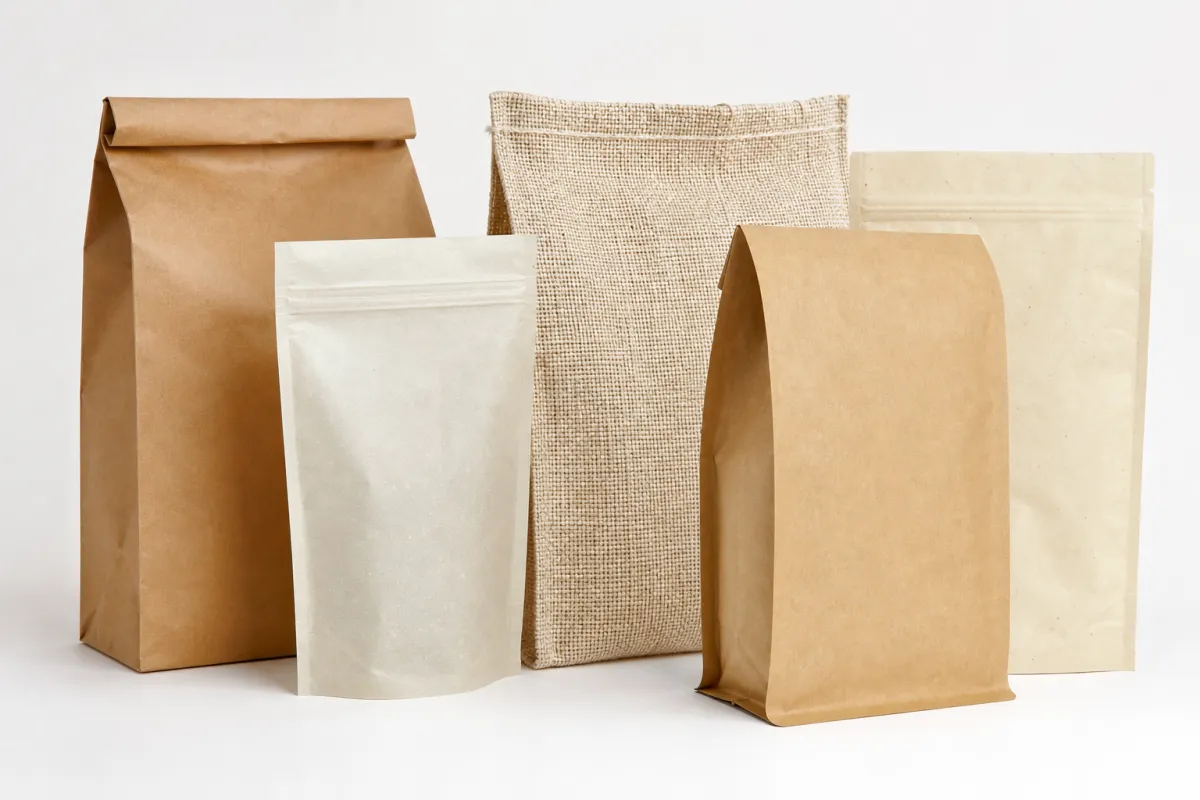
If you compare biodegradable custom packaging bag types in a hurry, use this filter: paper is usually the safest choice for dry, light retail goods; PLA works best for clear display and premium visibility; PBAT and starch blends are stronger bets for flexible mailers and shipping abuse; and cellulose is the look-good option when shelf appeal matters more than rough handling. That is the blunt version. The prettier version is usually what gets quoted. The blunt version is what gets shipped.
A decision matrix helps because it cuts through the nonsense. A bag is not “better” because it sounds greener. It is better if the barrier, seal, and surface finish match the actual use case. A paper bag with a matte print may be perfect for dry tea or apparel accessories. Put that same construction near grease, condensation, or a long transit lane, and it turns into packaging drama with a logo on it.
Here is the practical ranking I use when clients compare biodegradable custom packaging bag types for branded packaging, retail packaging, or subscription-style shipments:
- Dry retail goods: paper or paper-based laminate options with biodegradable liners.
- Clear shelf display: PLA or cellulose film if visibility drives conversion.
- Flexible mailers: PBAT-starch blends for better bending and puncture tolerance.
- Light cosmetics and sample kits: cellulose or PLA if the product stays dry and cool.
- Back-of-house handling: thicker paper structures or blend films with stronger seal margins.
If you compare biodegradable custom packaging bag types only by “biodegradable” claims, you miss the part that matters: what actually happens after filling, sealing, stacking, shipping, and opening. The material has to fit the weight of the product, the environment it sits in, and the customer experience you want to protect. That is especially true for brands investing in package branding and packaging design, where the bag is doing more than just containing a thing.
Bottom line: compare biodegradable custom packaging bag types by use case first, then by barrier performance, then by print quality, then by end-of-life claim. If you reverse that order, you are buying a story instead of a bag.
Top Biodegradable Custom Packaging Bag Types Compared
To compare biodegradable custom packaging bag types properly, it helps to separate the materials into real families instead of treating them like interchangeable “green” options. The main groups are Kraft Paper Bags, PLA bags, PBAT-starch blend bags, cellulose film bags, and recycled-paper laminate structures with biodegradable liners. Each one has a different personality. Some are stiff and clean. Some are flexible and durable. Some look premium on a shelf but are not thrilled about humidity. That is normal. Materials always have tradeoffs, despite what a sales sheet pretends.
Paper bags are the workhorse. They are easy to print, easy to source, and often the most forgiving when you need a straightforward retail format. PLA and cellulose film are the showpieces. They give you visibility, which is useful if the product itself sells the package. PBAT and starch blends are the practical flexible-film choices, especially for mailers and soft goods. Recycled-paper laminate options with biodegradable liners sit in the middle and often make sense when you want a paper-first look with a better internal barrier.
When teams compare biodegradable custom packaging bag types, the first question is usually which one looks most premium. That is not the smartest first question, but it is a fair one. On a shelf, cellulose and clear PLA usually win the visual contest. In transit, PBAT blends usually behave better. In dry retail, paper can look just as premium if the print, coating, and structure are done properly. That is where a lot of retail packaging decisions go sideways: the best-looking sample is not always the best-performing bag.
| Material | Best Fit | Strength | Moisture Tolerance | Print Finish | End-of-Life Claim | Typical Starting Cost at 5,000 Units |
|---|---|---|---|---|---|---|
| Kraft paper | Dry retail, apparel, light goods | Good stiffness, fair puncture resistance | Low to moderate | Excellent for matte, spot color, and simple branding | Recyclable or compostable only in certain builds | $0.10-$0.22 per unit |
| PLA film | Clear display, sample kits, premium visibility | Moderate, but sensitive to heat | Moderate | Very clear, good for clean branded packaging | Industrial compostable in approved structures | $0.18-$0.40 per unit |
| PBAT-starch blend | Flexible mailers, shipping bags, soft goods | Good flexibility and tear tolerance | Moderate | Good, usually best with simpler graphics | Often industrial compostable, depending on formulation | $0.16-$0.38 per unit |
| Cellulose film | Premium visibility, food and gift presentation | Moderate, can be more brittle than blend films | Moderate | Excellent clarity and high-end look | Compostable in certified structures | $0.22-$0.48 per unit |
| Paper + biodegradable liner | Dry goods needing extra barrier | Good if built with enough structure | Better than plain paper | Strong branding, good tactile feel | Depends on the full structure, not just the outer layer | $0.20-$0.42 per unit |
The table makes something obvious: you do not compare biodegradable custom packaging bag types by price alone. The cheapest option can fail in the wrong environment, and the most expensive option can be overkill for a dry, light product. If you are also considering product packaging solutions beyond bags, the same logic applies: match the material to the abuse, not the mood board.
A bag that looks compostable but softens in transit is not a sustainability win. It is a refund with nicer typography.
Detailed Reviews of Each Biodegradable Bag Type
To compare biodegradable custom packaging bag types like a buyer, not a brochure writer, you need to look at the failure points. Every material has one. Usually more than one. That is normal. The trick is deciding which weakness you can live with and which weakness will blow up your customer experience.
Kraft Paper Bags
Paper is still the safest default for dry retail. It prints well, folds cleanly, and feels familiar in the hand. That matters for package branding because customers still judge a package in the first three seconds, and paper gives you a lot of control over surface texture, ink density, and shape. For apparel, tea, stationery, supplements in secondary packaging, and simple gift bags, paper can be excellent. The structure can be simple or reinforced, and it usually plays well with Custom Printed Boxes and matching inserts if you are building a coordinated set.
Where paper loses ground is moisture. Humidity can make a bag wrinkle, weaken seams, and distort tight folds. Grease is worse. Once the fiber structure absorbs enough moisture, the bag behaves differently. That does not make paper bad. It makes paper honest. If you compare biodegradable custom packaging bag types for a dry product that ships in controlled conditions, paper is often the least risky choice. If the product is oily, chilled, or handled in damp storage, paper becomes a lot less romantic.
Verdict: best for dry retail and light products. Biggest risk is moisture. Worth the extra cost only if the visual and tactile feel matter enough to justify the structure.
PLA Bags
PLA gives you clarity and a clean, polished look. That is the main reason buyers compare biodegradable custom packaging bag types and land here for premium sample kits, display packs, and products where the contents need to stay visible. If the product itself is visually strong, PLA lets it do the selling. It is a decent fit for branded packaging when the goal is “see the thing, trust the thing, buy the thing.”
The tradeoff is heat sensitivity. PLA does not love warm storage, hot trucks, or rough handling in high-temperature conditions. It can soften earlier than people expect. For product packaging, that means you need to pay attention to warehouse conditions and transit routes. If your package sits in a warehouse with uneven climate control, test it. Do not assume the sample on your desk represents the pallet in summer. That assumption costs money. Usually twice: once in production, once in replacement.
Verdict: best for clear presentation and retail display. Biggest risk is heat and deformation. Worth it when shelf appeal drives conversion and the supply chain stays controlled.
PBAT and Starch Blend Bags
PBAT-starch blends are the sensible answer when you compare biodegradable custom packaging bag types for flexible shipping applications. They bend better than brittle film structures, and they usually survive handling abuse more gracefully than a delicate clear pouch. For mailers, soft goods, light apparel, and general e-commerce packaging, that flexibility matters. The bag can absorb a little roughness instead of turning every bump into a tear.
The catch is that print and finish are often less dramatic than what you get from paper or high-clarity films. You can absolutely make them look good, but if you want heavy ink coverage, sharp luxury cues, or very complex graphics, you need to specify the film and print process carefully. Seal area design also matters more than people expect. A weak seal on a flexible compostable bag is a failure waiting to happen, and no amount of “eco” language will save it.
Verdict: Best for Shipping and flexible formats. Biggest risk is weak seals and thin constructions. Worth the cost for mailers, soft goods, and products that need more give.
Cellulose Film Bags
Cellulose is the premium-looking option. It has a natural clarity and a softer visual feel than many synthetic films, which makes it attractive for gift packaging, food presentation, and cosmetic kits. When brands compare biodegradable custom packaging bag types and want something that feels less industrial, cellulose often lands on the shortlist quickly. It gives a refined look without pretending the product is something it is not.
Cellulose is not magic. It can be more brittle than PBAT blends, and it can be less forgiving under abuse. Strong visual appeal does not cancel out the need for good engineering. If your package will be crushed, stretched, or exposed to temperature swings, you need to test it like a skeptic. I would rather see a buyer use a slightly plainer structure that arrives intact than chase a prettier sample that fails in a carton.
Verdict: best for premium visibility and light handling. Biggest risk is brittleness. Worth the premium when shelf presence matters more than rough transport.
Recycled-Paper Laminate With Biodegradable Liners
This family sits between the obvious paper choice and the fully clear compostable options. It often makes sense when you want the tactile feel of paper but need more barrier performance inside the bag. Think dry snacks, powdered goods, or product packaging where you need a bit more protection against scent loss, dust, or minor humidity changes. Buyers compare biodegradable custom packaging bag types in this category when they want the brand story to feel premium and grounded at the same time.
The key here is that the full structure matters. Do not let anyone sell you on one layer and ignore the rest. If the outer paper is recycled and the liner is compostable, the total claim depends on the complete construction. This is where certification and documentation matter more than the sales pitch. Ask for the actual build, not just the broad category.
Verdict: best for dry goods needing extra barrier. Biggest risk is confusing the outer layer with the full structure. Worth it when you want paper aesthetics without giving up too much performance.
For brands that keep refining packaging design across multiple SKUs, the practical lesson is simple: compare biodegradable custom packaging bag types by the job they must do, not by the mood they create in a sample review. Mood is nice. Shipping reality is better.
For deeper sourcing questions, material certification and source transparency matter. If you are specifying paper-based options, FSC chain-of-custody documentation is worth asking for, and the FSC site is the place to start if you want to understand what that certificate actually covers. For packaging abuse testing, the ISTA standards are a far better reality check than a glossy sample photo.
Price Comparison When You Compare Biodegradable Custom Packaging Bag Types
Price is where the conversation gets honest. When brands compare biodegradable custom packaging bag types, the quote sheet often looks manageable at first and irritating by the third line. That is normal. Material choice, print coverage, size, closures, and order quantity all pull in different directions. A small run can make every option feel overpriced. A larger run can make a better material suddenly look reasonable.
The main cost drivers are not mysterious. They are just annoying. Thickness raises material cost. Custom size raises waste and setup complexity. More print colors raise prep and quality control time. Specialized closures raise labor. Certification paperwork raises coordination time. If you need industrial compostable documentation or food-contact confirmation, expect extra review. None of this is shocking. It is just the part of procurement that people forget when they compare biodegradable custom packaging bag types based on the low number in the first email.
Here is the way I would read a quote for custom printed packaging:
- Paper bags: usually the cheapest starting point, especially for simple prints and standard sizes.
- PLA and cellulose: cost more because the film itself and the handling requirements are tighter.
- PBAT-starch blends: often sit in the middle to upper-middle, depending on thickness and print setup.
- Paper + liner structures: can climb quickly once barrier performance and compliance documentation enter the picture.
At 1,000 pieces, a custom biodegradable bag can look expensive because setup, print prep, and material minimums are spread over fewer units. At 5,000 pieces, the unit price usually makes more sense. At 20,000 pieces, the conversation shifts again, because material savings and production efficiency start to matter more than the first quote shock. That is why I tell buyers to compare biodegradable custom packaging bag types on landed cost per usable bag, not on quote price alone. A cheap bag that tears, sags, or gets rejected in receiving is not cheap. It is just a future invoice with a compostable label.
Watch for hidden costs too:
- Tooling or plate fees for custom artwork.
- Sampling rounds, especially if you want to test seal strength or barrier behavior.
- Shipping, duty, and freight on heavier paper structures.
- Extra compliance checks for food contact or compostability claims.
- Rush charges when artwork or specifications change late.
If you compare biodegradable custom packaging bag types with those costs included, the ranking sometimes changes. Paper is not always the cheapest. PLA is not always the most expensive. PBAT blends are not always the best deal. The right answer depends on the full order, the print finish, and how much risk you are willing to carry through the supply chain.
How to Choose the Right Biodegradable Custom Packaging Bag Type
If you compare biodegradable custom packaging bag types the sensible way, the decision framework is simple. Start with the product. Then the environment. Then the look. Then the cost. In that order. If the product is dry and light, paper may win. If the product needs visibility, PLA or cellulose may win. If shipping durability matters most, PBAT-starch blends usually move to the front. If you need a little barrier and a paper-first appearance, a recycled-paper laminate with a biodegradable liner can be the better compromise.
The question I ask first is not “Which material is greenest?” It is “Which material survives your real use case?” That means checking product weight, moisture exposure, temperature range, storage time, and whether the bag will be sealed before or after filling. It also means being clear about shelf life. A bag that works for a 7-day turnover might fail for a 90-day retail program. Buyers compare biodegradable custom packaging bag types as if they are static objects. They are not. They are part of a moving system.
Use this checklist before you place an order:
- Confirm exact dimensions and fill weight.
- List the product’s moisture and heat sensitivity.
- Decide on seal type: heat seal, adhesive, fold-over, zipper, or tie.
- Choose matte, gloss, or natural finish based on the brand look.
- Check whether the claim needs industrial compostable or home compostable documentation.
- Ask for food-contact confirmation if the product sits near food.
- Review artwork for ink coverage, edge bleed, and seal-clearance zones.
That last point is where packaging design meets production reality. The same artwork that looks clean on custom printed boxes can behave differently on a bag. Curves warp. Text near seams gets lost. Solid blocks of ink can crack if the material flexes. If your brand uses coordinated retail packaging, keep the visual system consistent but adapt the art to the substrate. Good package branding is not copying the same layout everywhere. It is making each format look like it belongs to the same family.
There is also the claims problem. Biodegradable is broad. Compostable is specific. Industrial compostable is not the same as home compostable. ASTM D6400 and ASTM D6868 are common reference points for compostability claims in the U.S., but the right standard depends on the material and construction. Do not slap a claim on the bag because it sounds nice. Verify the paperwork first. That is how you avoid awkward customer service emails later.
For a practical rule, I usually say this: choose the simplest material that survives your product, your packing line, and your customer’s handling. Fancy is optional. Surviving is not.
Process and Timeline: From Spec Sheet to Shipment
When buyers compare biodegradable custom packaging bag types, they often underestimate how much the process itself affects the final result. A good spec sheet can save weeks. A vague spec sheet can create three rounds of revisions and a quote that no longer means anything. Start with the basics: dimensions, material target, fill weight, seal style, print count, and expected storage conditions. If you can provide those up front, the conversation gets more useful immediately.
The normal workflow looks like this: gather requirements, request samples, review artwork, approve the proof, confirm certifications, move to production, then ship. That sounds simple because it is simple. The hard part is the detail inside each step. Sampling might take 3-7 business days. Artwork revisions can eat another 2-5 days if the dieline is not clear. Production for plain paper may run around 10-15 business days after approval. Custom compostable films often run longer, especially when the order includes special seals, barrier expectations, or documentation review.
Here is the practical timeline I would expect in a normal custom order:
- Requirements and quote: 1-3 business days if the information is complete.
- Sampling: 3-7 business days for standard builds, longer for special structures.
- Artwork and proof approval: 2-5 business days, sometimes more if the layout needs resizing.
- Production: about 10-15 business days for simpler paper bags, 15-25 business days for more complex film builds.
- Freight: a few days domestically, longer for international shipments.
Delays usually come from the same predictable places. The artwork does not fit the seal area. The customer changes size after proof approval. The seal method is not defined clearly enough. A compliance document is missing. Someone realizes too late that the product needs more barrier than the original sample provides. None of that is mysterious. It is just normal packaging work, the kind that gets ignored until it shows up as a delay.
If you want to speed things up, give the supplier the boring details early. Share exact fill weight. Share whether the bag will be stored in heat or humidity. Share whether the product is oily, dry, or sharp-edged. Share if the bag needs to be shelf-ready or only used in back-of-house packing. The more specific you are, the less time everyone wastes pretending the first sample is the final answer.
For brands that treat custom packaging as part of the full product packaging system, this step matters more than people admit. The bag, the label, the insert, and the box all need to work together. If your Custom Packaging Products mix includes different substrates, build the timeline around the slowest one. That is the honest way to plan. Everything else is wishful thinking with a spreadsheet.
Our Recommendation and Next Steps
If you compare biodegradable custom packaging bag types and want the shortest possible answer, here it is: choose paper for dry retail, PBAT-starch blends for flexible mailers, PLA or cellulose for premium visibility, and paper-liner structures when you want more barrier without abandoning a paper-first look. That is the cleanest practical split. It will not solve every edge case, but it will keep you out of most of the obvious mistakes.
My recommendation is to order samples before you commit to a full run, especially if the package will face heat, humidity, long transit, or heavy handling. Samples are cheap compared with a production batch that fails in real use. Test them with the actual product, not a generic fill. Seal them the way your team will seal them. Store them the way your warehouse will store them. If the bag survives that, you are closer to the right answer. If it does not, well, the sample did its job. Better to learn that now than after the freight bill lands.
Before you sign off, compare three things line by line:
- Performance: strength, barrier, sealability, and print quality.
- End-of-life claim: biodegradable, compostable, industrial compostable, or home compostable, with proof.
- Landed cost: unit price plus setup, freight, samples, and any compliance work.
If one quote is far lower than the others, check what disappeared from the spec. If one quote is much higher, check whether you are paying for features you do not need. Either way, the real answer is not “Which bag is best?” The real answer is “Which bag survives the job without wasting money?” That is how you compare biodegradable custom packaging bag types without buying a story.
For buyers building branded packaging that has to look good and behave well, the next move is straightforward: request samples, test them with the actual product, compare quote sheets against the real spec, and ask for certification documents before you approve production. That is the part most teams skip, then act surprised when the result is underwhelming. No mystery there.
So if you need to compare biodegradable custom packaging bag types for your next order, keep the filter simple: performance first, claim second, price third. That order saves time, protects the brand, and usually produces a better package than chasing the cheapest or greenest headline.
FAQs
Which biodegradable custom packaging bag type is best for food?
For dry food, paper or compostable film can work well if the seal and barrier match the shelf life. For oily, moist, or heat-sensitive food, test the bag with real product, not just a spec sheet. Ask for food-contact confirmation and barrier details before you approve production.
Are biodegradable custom packaging bag types the same as compostable bags?
No. Biodegradable means it can break down over time; compostable means it meets a defined composting standard. Some bags need industrial composting, which is not the same as tossing them in a backyard pile. Check the certification and disposal instructions before you use the word on-pack.
How much do biodegradable custom packaging bag types cost per unit?
Paper bags are usually the lowest-cost starting point, while compostable films and specialty blends cost more. Small orders carry a higher unit price because setup, printing, and material minimums get spread over fewer pieces. The real comparison is landed cost per usable bag, not just the quote line item.
What lead time should I expect for custom biodegradable bags?
Simple paper bags can move faster than custom printed compostable films, especially if artwork is already approved. Sampling, certification checks, and artwork revisions are the usual reasons schedules slip. Build in extra time if you need custom sizes, special closures, or barrier testing.
Which biodegradable custom packaging bag type holds up best for shipping?
Flexible PBAT-starch blends often handle shipping abuse better than thin paper or brittle films. If the product is light and dry, reinforced paper can work, but humidity is the enemy. Always test the bag with the actual packing method, not a dummy fill.

