Buyer Fit Snapshot
| Best fit | Custom Debossed Packaging projects where brand print, material claims, artwork control, MOQ, and repeat-order consistency need to be specified before quoting. |
|---|---|
| Quote inputs | Share finished size, material target, print colors, finish, packing count, annual reorder estimate, ship-to region, and any compliance wording. |
| Proofing check | Approve dieline scale, logo placement, barcode or warning zones, color tolerance, closure strength, and carton packing before bulk production. |
| Main risk | Vague material claims, crowded artwork, missing packing details, or unclear freight terms can make a low unit price expensive after revisions. |
Fast answer: Custom Debossed Packaging: How It Works and What It Costs should be specified like a repeatable production item. The safest quote records material, print method, finish, artwork proof, packing count, and reorder notes in one written spec.
Production checks before approval
Compare the actual filled-product size with the drawing, then confirm tolerance on folds, seals, hang holes, label areas, and retail display edges. Reserve space for logos, QR codes, warning copy, and material claims before decorative graphics fill the panel.
Quote comparison points
Review material grade, print process, finish, sampling route, tooling charges, carton quantity, and freight assumptions side by side. A quote is only useful when the supplier can repeat the same color, closure quality, and packing count on the next order.
Custom Debossed Packaging changes the way a package feels before a buyer has fully decided what they think about it. That sounds small. It is not. A recessed mark catches light, creates shadow, and gives the hand something to register before the brain finishes its little retail speed-run. For brands trying to make packaging feel premium without stuffing the surface with extra graphics, custom debossed packaging is one of the cleaner moves available.
The effect is not magic, though. Custom debossed packaging depends on stock choice, artwork discipline, tooling quality, and the press setup behind it. A shallow impression on weak board can look nice in a mockup and underwhelm in person. A better-built impression on the right substrate can feel polished, expensive, and strangely convincing. That gap between preview and reality is where a lot of packaging decisions go sideways.
It also works across more structures than people assume. Custom debossed packaging can show up on rigid gift boxes, folding cartons, mailers, sleeves, subscription kits, and retail packs that need shelf presence. It is especially useful where touch matters almost as much as visual impact. If you are comparing options, it helps to review Custom Packaging Products alongside the finish so the structure and tactile effect are pulling in the same direction instead of wrestling each other.
A recessed mark is rarely loud, and that is exactly why it works. In packaging, restraint often reads as confidence.
From a buyer's point of view, the appeal of custom debossed packaging is simple: it creates depth without clutter. The brand mark stays controlled. The rest of the surface still has room for copy, product details, and compliance text. That balance is harder than it looks, which is why a single strong impression often outperforms a busy layout with three finishes fighting for attention.
Why does custom debossed packaging stand out in the hand?
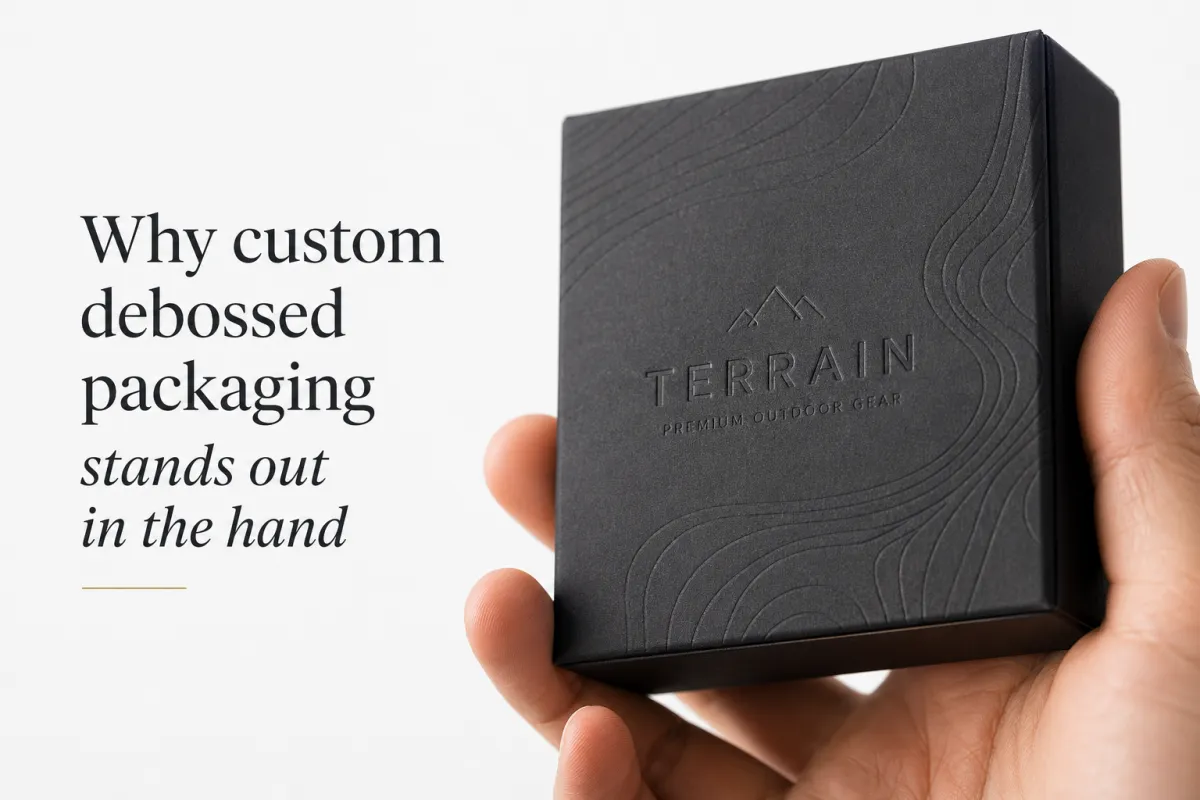
Most packaging decisions start with the eye, but the better ones finish with the hand. Custom debossed packaging stands out because the body notices depth fast. A logo pressed below the surface creates a shadow line that shifts with movement, lighting, and finger pressure. That is a different experience from ink alone. A printed mark gets read; a debossed mark gets felt. The second one sticks around longer in memory.
The effect is especially useful for custom debossed packaging used in categories where finish influences perceived value: cosmetics, small electronics, premium food, beverage gifting, wellness, accessories, and subscription kits. In those lanes, the package is not just protecting a product. It is setting expectations before the box opens. A clean recessed mark signals care, control, and some actual attention to detail. Which, frankly, is not always a given.
Here is the practical difference: visual decoration says, "look at me." Physical depth says, "touch me." That matters because hands usually show up before the eyes have finished scanning the whole design. A customer may feel the deboss on a mailer flap before they read the copy. In-store, a buyer may run a thumb across a sample while deciding whether the line feels expensive enough to justify the shelf space.
Custom debossed packaging is also a smart Choice for Brands that want texture without adding more ink or visual noise. Minimal branding, white space, quiet typography, one-color layouts — all of that pairs nicely with a recessed mark. The deboss becomes part of the material instead of sitting on top of it like an afterthought. It behaves more like structure than decoration.
There is a limit, though. The best result usually comes from restraint, not crowding. Fine typography, hairline strokes, and dense icon sets can blur once they are pressed into paperboard. I have seen gorgeous artwork get flattened into mush because someone insisted the logo needed one more detail. It didn’t. That is how you end up paying for a premium finish and getting a fancy-looking compromise.
How custom debossed packaging is made
The process behind custom debossed packaging is pretty straightforward. A metal die or matched tool applies pressure to the substrate and pushes the design into the surface, creating a recessed impression. Simple on paper. Less simple once you factor in depth, stock resilience, press pressure, and how the material behaves after finishing.
Board choice matters more than many first-time buyers expect. Paperboard with enough thickness and fiber density will hold a clearer impression, while thin stock can flatten the artwork or ripple around the edges. Coated stocks reflect light differently than uncoated papers, which changes how depth reads. Soft-touch lamination can make custom debossed packaging feel smoother and more luxurious, but it also changes how the surface responds under pressure. Uncoated stocks usually give a more natural edge and a slightly less polished, more tactile feel.
Tooling is another major variable. A single-level deboss is often the cleanest option and the easiest to control. Deeper or multi-area impressions can create drama, but they also raise the risk of surface distortion. On a rigid box, that may be fine. On a folding carton with folds nearby, it can turn into a problem fast. The press has to respect the structure. Otherwise, the structure wins.
Custom debossed packaging is often paired with other finishes, and that is where the design conversation gets more interesting. Foil stamping can highlight the recessed area. Emboss can create contrast. Spot UV can add a glossy counterpoint. Soft-touch lamination can give the whole package a more deliberate feel. The mistake is stacking too many effects on a small surface. One tactile cue is strong. Four cues can feel like a committee wrote the box.
The tradeoff is simple: more depth can increase drama, but more depth can also distort fine detail or weaken the surface if the substrate is not suited to the press. That is why a supplier should evaluate the structure, not only the artwork file. A recessed logo on a 2 mm rigid board behaves differently from the same design on a 350 gsm folding carton. Custom debossed packaging rewards patience at setup. Rushing it is how you buy problems.
For brands building a repeatable program, it helps to think about how the packaging will hold up across runs. A die that works beautifully on one batch should reproduce cleanly on the next, assuming the stock and press settings stay consistent. That is why complete spec notes matter. A good supplier can repeat custom debossed packaging with very little drift if the original build details are documented clearly.
If the design depends on exact shadow depth, ask for a physical sample rather than relying on a PDF proof. Photos can hide distortion. PDFs cannot show how a finger catches the edge. In packaging production, the gap between a flat proof and a finished sample is often the difference between "fine" and "worth the budget."
Custom debossed packaging cost factors that change pricing
The first question buyers ask is usually price. Fair enough. Custom debossed packaging pricing comes down to a few predictable factors, and tooling sits near the top of the list. A custom die or plate is often the main upfront cost, and that expense has to be absorbed before the per-unit number starts to look friendly. Small orders feel that impact hardest because setup costs are spread across fewer pieces.
Run length changes the quote quickly. A short run of custom debossed packaging may land in a higher per-unit range because the supplier still has to create tooling, calibrate the press, and inspect the first pieces closely. Larger orders usually reduce the unit cost because the fixed setup is diluted across more boxes. That does not mean the total spend is lower. It just means the math stops being rude one carton at a time.
Substrate choice is another major lever. Rigid boxes, premium paperboard, and specialty stocks all behave differently under pressure. A simple deboss on a sturdy folding carton may be fairly direct, while the same effect on a laminated rigid box can need more care at finishing. If a supplier needs additional passes, extra handling, or tighter quality checks to protect the surface, that affects price. Material is never just material. It is also how much trouble it is going to cause later.
Design complexity matters too. A large solid deboss area, multiple hit locations, or tight registration with print can slow production and increase waste. The more exacting the layout, the more labor and quality control it tends to need. That is especially true for custom debossed packaging where the impression has to align with foil, a window, a fold, or a seam. Alignment is one of those things that looks easy until you are paying for rework.
Timing affects cost as well. If a launch date is fixed and the project needs a compressed schedule, the premium is usually not for the artwork itself but for the production slot. Rush work narrows the window for sampling, revision, and queue time. In other words, the calendar can raise the price even when the design stays exactly the same. Annoying, yes. Also normal.
Typical pricing signals buyers should watch
Not every quote is comparable. One vendor may include tooling and setup in the unit price. Another may list them separately. A third may exclude shipping, proofing, or secondary finishing entirely. For that reason, custom debossed packaging should be quoted on an itemized basis whenever possible.
| Packaging option | Typical use | Deboss impact | Price pressure |
|---|---|---|---|
| Folding carton on SBS or C1S board | Retail packaging, cosmetics, small electronics | Crisp with moderate depth if the board is strong | Usually lower tooling and faster setup |
| Rigid setup box with wrap | Gift sets, premium product packaging, luxury kits | Best tactile depth and strong shadow lines | Higher material and labor cost |
| Mailer box with print | E-commerce and subscription shipments | Works well on simple marks, especially on flat panels | Moderate, depending on print coverage and size |
| Paper sleeve or band | Simple branded packaging for secondary presentation | Clean for small logos or symbols, but limited depth | Lower material cost, but less dramatic effect |
For most buyers, the real budget question is not just unit cost. It is how the fixed tooling and setup charges spread across the run. At small volumes, custom debossed packaging can get expensive quickly because those fixed costs are not diluted. At larger volumes, the unit price improves, but the total commitment grows. That is why it helps to compare 1,000-piece and 5,000-piece scenarios with the same print and finish assumptions instead of guessing from a single quote.
As a rough planning pattern, many projects separate setup and tooling from per-unit manufacturing. Exact numbers vary too much to promise a universal range, but the rule stays consistent: simpler structures, fewer finishing steps, and longer runs tend to lower the unit cost. If the quote does not separate those pieces, ask for a revised version. Custom debossed packaging deserves transparent pricing because the buyer needs to know what is fixed and what scales.
There is also a sourcing question hiding in the cost discussion. FSC-certified board can affect price, but it can also support brand claims and procurement requirements. If sustainability is part of the brief, check the certification path with the supplier and review the source material at fsc.org. The right recycled or certified stock can work very well for custom debossed packaging, but the final appearance still depends on fiber structure and finish.
For shipping durability, appearance is only part of the job. If the box has to survive distribution testing, ask how the structure aligns with accepted procedures such as the standards used by ISTA. A package that looks great on the table but fails in transit is not premium packaging. It is a reprint with a nicer backstory.
A step-by-step custom debossed packaging process and timeline
The cleanest way to manage custom debossed packaging is to treat it like a production project, not just an artwork request. Start with the brief. Define the product, audience, order quantity, target unit cost, and the emotional tone the package needs to carry. "Premium" is too vague. Better language is specific: muted, elegant, minimalist, heritage-inspired, tactile-first, or restrained. Those words help a packaging team make better decisions before anyone opens a file.
Next comes dielines and artwork setup. This is where the supplier checks safe zones, fold locations, and panel placement. A deboss should land where the structure can support it. If a mark sits too close to a seam or glue flap, the impression can weaken. If it lands near a fold line, the panel may deform. Good custom debossed packaging starts with disciplined layout choices rather than rescue work later.
Sampling matters more here than on many other packaging jobs. Flat proofs show text, color, and placement, but they do not show depth. A physical mockup or sample run is usually worth the time, especially if the packaging is meant to signal luxury or if the logo depends on subtle tactile cues. The sample lets the buyer inspect clarity, edge integrity, and how light falls across the recessed surface.
The production sequence usually follows a familiar order: die creation, printing or lamination, debossing, any additional finish, inspection, and packing. The exact order can vary depending on the structure and finish mix, but the important thing is that each step affects the next. A lamination that is too slick can change how the press reads the stock. Heavy ink coverage can alter how the impression sits. Custom debossed packaging is a chain, and the weak link usually shows up in the hand.
As for timing, many straightforward runs move in roughly 12 to 20 business days after proof approval, while more involved builds can take longer if there are revisions, new tooling, or added finishes. Physical sampling adds time, but it lowers risk. If a launch date is tied to a trade show, seasonal promotion, or retail delivery window, build a buffer. Custom debossed packaging has more moving parts than a plain printed carton, and compressed schedules tend to expose that fast.
What the timeline usually includes
- Brief and specification review
- Dieline confirmation and artwork placement
- Tooling or die setup
- Sample or proof review
- Printing, lamination, and debossing
- Inspection, carton packing, and shipment
That sequence is not glamorous, but it is what keeps the final result predictable. If the supplier skips a step, ask why. For custom debossed packaging, the approval trail is often more valuable than the design file because it records the actual build decisions behind the box.
If you want to compare how different structures behave before committing, a supplier's product range can help. Reviewing Custom Packaging Products alongside your target board spec makes it easier to see whether a rigid box, sleeve, or mailer is the better base for the finish.
Common mistakes when ordering debossed packaging
One of the biggest mistakes with custom debossed packaging is overcomplicating the art. Tiny text, hairline rules, and tightly packed symbols often disappear or blur once the stock is pressed. A mark that looks precise on a screen can become muddy in the real world. The fix is usually boring but effective: increase line weight, simplify the mark, and give the deboss room to breathe.
Stock selection is the next common miss. Thin material can flatten the effect, and some boards will show distortion around the impression if the press force is too aggressive. The result may still be usable, but it will not feel refined. For that reason, many teams prefer thicker paperboard or a rigid structure when the brand goal is premium tactile impact. Custom debossed packaging tends to reward materials with enough body to hold the edge cleanly.
Budget surprises happen when buyers treat tooling as an afterthought. The quote might look manageable until setup, sampling, and minimum order expectations are added in. That is not a supplier trick. It is just how custom manufacturing works. Asking for an itemized breakdown early avoids confusion later and helps compare bids on equal footing.
Skipping prototypes is another expensive habit. A package can look elegant in a digital proof yet feel too shallow, too deep, or too sharp in person. That is especially true for custom debossed packaging, where the whole point is physical presence. A sample is not a formality. It is the only reliable way to judge the actual tactile result.
There is also a logistics blind spot. Buyers sometimes focus on aesthetics and forget the box still has to ship, store, and open cleanly. If the design increases wall thickness, changes dimensions, or alters stackability, it can affect fulfillment and freight costs. Distribution testing standards such as ASTM D4169 or ISTA protocols can help predict whether the package will survive the journey, which matters just as much as shelf appeal.
Symptoms that the design needs a reset
- The deboss loses clarity near folds or corners
- The artwork looks sharp digitally but fuzzy on stock
- The package feels weak after lamination or pressing
- The finish mix crowds the logo instead of supporting it
- The production quote rises because the layout is hard to align
Those are usually signals to simplify, not to push harder. A better version of custom debossed packaging often uses less surface drama, not more. That restraint reads especially well in product packaging where the brand already has enough visual language elsewhere.
Expert tips for stronger custom debossed packaging results
If the goal is a package that feels expensive without shouting, keep the deboss mark bold and simple. A monogram, symbol, or short brand name usually performs better than a paragraph of information. The more important the tactile cue, the more the impression should stand on its own. That is a useful rule for custom debossed packaging because the surface itself becomes part of the brand story.
Design for touch first and sight second. That sounds backward to some teams, but it matches how the package is actually experienced. Before the box is opened, fingers run across the lid, flap, or sleeve. A restrained impression can feel more premium than a large one because it allows the material to do the talking. In many cases, the smartest version of custom debossed packaging is the one that does not try too hard.
Finish choice changes readability. Matte surfaces and soft-touch lamination usually make recessed details easier to see because shadows stand out more clearly. Glossy coatings can look beautiful, but they sometimes reduce depth visibility, especially under bright retail lighting. That does not make gloss wrong. It just means the design needs to account for the environment where the package will live.
Test the sample under real conditions. Hold it in natural light, fluorescent light, and lower light. Rotate it. Touch it. Open and close it. If the package is headed for retail packaging, shelf tests matter. If it is going into fulfillment, shipping tests matter. If it feels right in a conference room but weak at the doorstep, the design still needs work. Custom debossed packaging only earns its keep if it survives the full journey.
Here is a useful comparison: large graphics often get attention, but smaller, more disciplined impressions tend to feel more luxurious over time. That is one reason debossing works so well in cosmetics, beverages, and premium gift packaging. A subtle recessed mark usually ages better than a loud visual gimmick because it does not depend on trend cycles to feel current. That is a nice bonus, since trend-chasing packaging gets tired fast.
If you are choosing between effects, ask what the package is supposed to accomplish in the first three seconds. If the answer is "feel premium," then custom debossed packaging may be a better investment than a larger print area or a busier pattern. If the answer is "communicate a lot of information," then the design probably needs a different balance. Not every box needs to perform every job.
What should you do before ordering custom debossed packaging?
Before you place an order for custom debossed packaging, gather the basics in one place: final artwork, exact box dimensions, preferred stock, order quantity, target unit cost, and delivery deadline. That sounds obvious, but it is the fastest way to avoid endless revision loops. A clean brief shortens the path from concept to sample because the supplier is not guessing about the finish or the build.
Ask for samples if the deboss depth is a critical part of the presentation. Side-by-side comparisons tell you more than screenshots ever will. One stock might hold the mark beautifully; another might compress too much or leave the logo looking shallow. If the package is central to the launch, that comparison is worth the extra day or two.
Request an itemized quote. Tooling, setup, printing, finishing, and shipping should be visible as separate lines whenever possible. That makes comparison shopping easier and protects the budget from hidden assumptions. For custom debossed packaging, transparency is not a courtesy. It is part of good procurement.
Confirm the approval milestones early. If a revision is likely, build it into the schedule. If the packaging needs to arrive before a launch event, add a buffer. If fulfillment is already booked, verify carton counts and ship dates before signing off. A package that arrives late costs more than a slightly more expensive but reliable version. That is especially true for branded packaging tied to retail dates, seasonal sets, or media shipments.
Finally, document the production spec once the sample is approved. Save the board type, lamination, die notes, depth preference, and artwork version. The next run of custom debossed packaging will be faster and more consistent if the build record is complete. That is one of those unglamorous habits that saves time, money, and frustration later. Future-you will be glad somebody bothered.
Custom Packaging Products can be a useful starting point if you want to compare formats before locking the finish. Seeing the structure options alongside your brand goals often makes the tactile decision easier.
How much does custom debossed packaging usually cost?
Pricing depends on tooling, quantity, stock choice, and whether the deboss is combined with print, foil, or another finish. Short runs usually cost more per unit because setup costs are spread across fewer pieces. Ask for an itemized quote so you can compare suppliers on the same basis. For many buyers, custom debossed packaging becomes more economical once the order quantity is high enough to dilute tooling and setup.
What materials work best for custom debossed packaging?
Thicker paperboard and rigid box materials usually give the cleanest, most durable impression. Coated and uncoated stocks can both work, but texture, thickness, and finish will change the final look. Very thin materials may flatten the design or distort nearby print. In practice, custom debossed packaging performs best on stocks with enough body to hold the recessed edge without spring-back.
How long does the custom debossed packaging process take?
Timeline depends on artwork readiness, sampling needs, tooling, and the production queue. A straightforward run may move in roughly 12 to 20 business days after approval, while more complex projects take longer. Physical proofing adds time, but it reduces the risk of expensive surprises later. Rush schedules are possible, though they usually limit options and raise cost. Custom debossed packaging benefits from a little breathing room.
Can custom debossed packaging be combined with foil or embossing?
Yes, debossing is often paired with foil, emboss, or specialty coatings for a layered premium effect. The design has to be planned carefully so the finishes do not crowd each other. A supplier should confirm whether the chosen stock can support all requested effects cleanly. Done well, custom debossed packaging can create contrast without becoming visually busy.
What is the best way to approve a custom debossed packaging sample?
Check the sample in hand, not just in photos, because depth and shadow matter. Review readability, alignment, surface integrity, and how the package closes and ships. Approve only after confirming the final sample matches the intended unboxing experience. That is the most reliable way to judge whether custom debossed packaging will do its job in the field.
If you are choosing a finish for a launch, the safest path is usually the simplest one: clear specs, a physical sample, and a production partner who will tell you when the structure needs adjusting. Custom debossed packaging works best when it is planned like a manufacturing decision, not treated like decoration bolted on at the end. Lock the stock, define the depth, and approve the sample before production starts. That is the part that saves you from expensive regret later.

