Buyer Fit Snapshot
| Best fit | Compare Compostable Poly Mailer Options projects where brand print, material claims, artwork control, MOQ, and repeat-order consistency need to be specified before quoting. |
|---|---|
| Quote inputs | Share finished size, material target, print colors, finish, packing count, annual reorder estimate, ship-to region, and any compliance wording. |
| Proofing check | Approve dieline scale, logo placement, barcode or warning zones, color tolerance, closure strength, and carton packing before bulk production. |
| Main risk | Vague material claims, crowded artwork, missing packing details, or unclear freight terms can make a low unit price expensive after revisions. |
Fast answer: Compare Compostable Poly Mailer Options: Material Claims, Seal Quality, and Freight Cost should be specified like a repeatable production item. The safest quote records material, print method, finish, artwork proof, packing count, and reorder notes in one written spec.
Production checks before approval
Compare the actual filled-product size with the drawing, then confirm tolerance on folds, seals, hang holes, label areas, and retail display edges. Reserve space for logos, QR codes, warning copy, and material claims before decorative graphics fill the panel.
Quote comparison points
Review material grade, print process, finish, sampling route, tooling charges, carton quantity, and freight assumptions side by side. A quote is only useful when the supplier can repeat the same color, closure quality, and packing count on the next order.
If you compare compostable Poly Mailer Options by looks alone, you can make the wrong call fast. The cleanest sample on the table is not always the one that survives humid dock doors, rough conveyor handling, and a day in the back of a delivery van. That is why I tell buyers to compare compostable poly mailer options against the actual shipping lane, not just the marketing claim.
Quick Answer: Compare Compostable Poly Mailer Options Fast
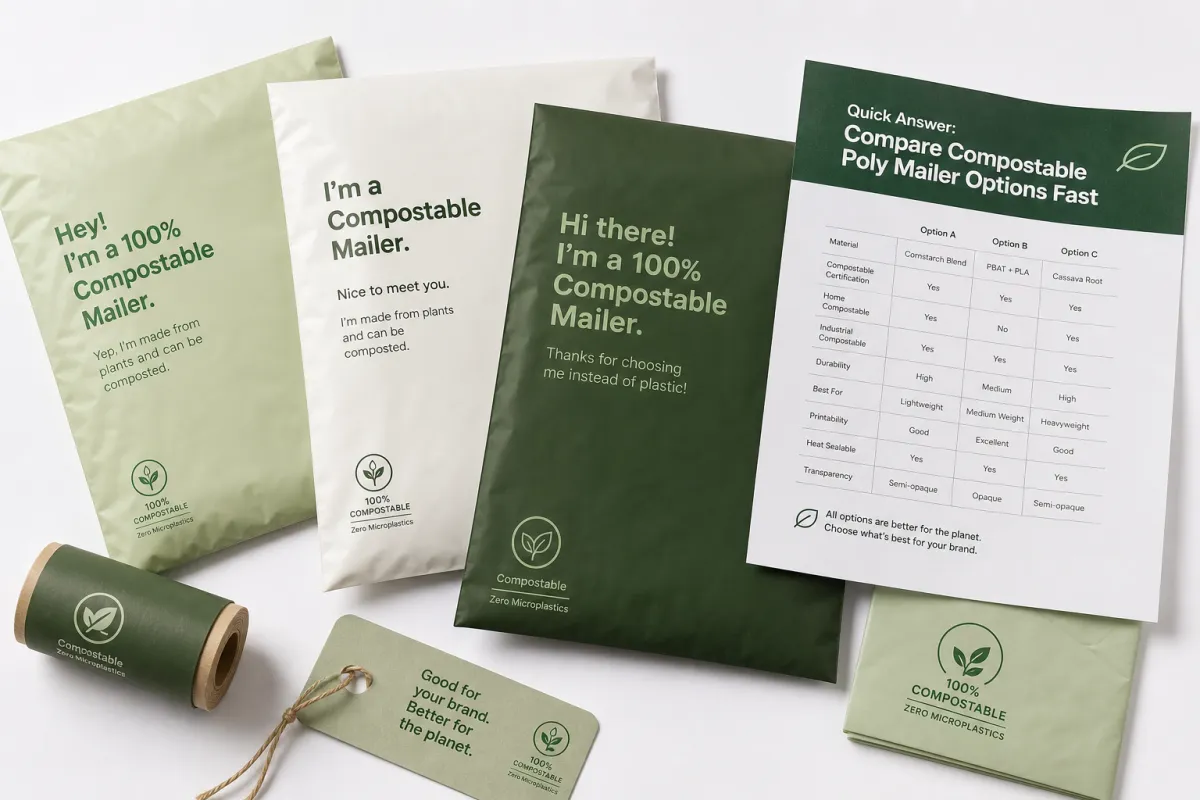
Here is the plain answer: compare compostable poly mailer options by use case first, not by the sustainability label printed on the spec sheet. If you ship apparel, soft goods, flat accessories, or other low-moisture items, a compostable mailer can make sense when you want a cleaner packaging story without moving to a rigid carton that pushes up both cost and carbon footprint.
The best-looking compostable bag is not automatically the best-performing one. The real test is whether the film resists punctures, the seal strip holds through sorting, the print stays sharp, and the bag still behaves predictably after a few days in heat or humidity. That is why I like to compare compostable poly mailer options using a practical filter set: material type, certification, thickness, puncture resistance, seal reliability, lead time, and minimum order quantity.
For most brands, the decision usually comes down to three questions. First, what are you shipping and how hard is the lane? Second, do you need home compostable or industrial compostable documentation? Third, can you live with the tradeoff between compostability claims and the strength, shelf life, and print quality that a standard poly mailer might deliver more easily?
A compostable claim only matters if the whole package behaves well in the warehouse, in transit, and at disposal.
If you are trying to compare compostable poly mailer options for branded retail shipping, start with a sample pack, a realistic weight test, and a blunt conversation about what happens if the customer stores the mailer in a warm garage for a week before opening it. That small detail is where a lot of packaging optimism gets exposed. I have seen nice-looking bags go kinda soft or fussy after bad storage, and that is not a fun surprise to find after launch.
Compare Compostable Poly Mailer Options Side by Side
When buyers compare compostable poly mailer options, the labels can blur together fast. Suppliers may say “eco-friendly,” “plant-based,” or “green packaging,” but those phrases do not tell you whether the bag is home compostable, industrial compostable, partially bio-based, or simply made with a blend that sounds better than the actual end-of-life path. From a packaging buyer’s point of view, that distinction matters more than brochure language.
The most common structures fall into four buckets: PLA-based blends, PBAT-starch blends, industrial-compostable mailers, and home-compostable mailers. Each one handles moisture, stretch, stiffness, and print differently. If you compare compostable poly mailer options without separating those categories, you can end up choosing a film that looks right but performs wrong.
| Option | Typical Strength Profile | Print Surface | Typical Unit Cost at Scale | Best Fit |
|---|---|---|---|---|
| PLA-based blend | Stiffer feel, moderate tear resistance, can be less forgiving in hot lanes | Usually good for sharp graphics, can feel slightly slick | $0.18-$0.32 per unit at 5,000-10,000 pieces | Light apparel and premium-branded programs |
| PBAT-starch blend | More flexible, often closer to standard poly in handling | Strong for printed logos and simple branding | $0.20-$0.38 per unit at 5,000-10,000 pieces | General shipping, subscription boxes, soft goods |
| Industrial-compostable mailer | Balanced performance, usually built around a certification target | Good, but ink and adhesion specs should be checked carefully | $0.22-$0.40 per unit depending on size and print coverage | Brands with a defined composting partner or verified disposal path |
| Home-compostable mailer | Often more sensitive to heat, storage, and supply variation | Can print well, though film feel and stiffness vary a lot | $0.28-$0.55 per unit, sometimes higher for small runs | Premium sustainability programs with strong consumer education |
That table is not a lab report, but it reflects the tradeoffs I see most often when brands compare compostable poly mailer options for real fulfillment. PLA usually wins on presentation, PBAT-starch blends often win on handling, industrial-compostable bags tend to be the most straightforward for compliance-driven buyers, and home-compostable choices usually require the most education and the most careful testing.
One point deserves extra attention: end-of-life claim and disposal infrastructure are not the same thing. A mailer can be certified for compostability and still be a poor choice if your audience has no access to the right composting stream. The EPA’s guidance on composting basics is a useful reality check for buyers who want to avoid overstating what a package can do in the real world: EPA composting resources.
If your team compares compostable poly mailer options for high-volume retail shipping, do not ignore the adhesive strip. A weak closure is the fastest way to turn a sustainability win into a returns problem. The same goes for opacity, seam consistency, and the ability to withstand abrasion from carton corners and warehouse bins. A mailer that looks fine for five seconds on a desk can still fail once it meets a real packing line.
Detailed Reviews of the Main Compostable Poly Mailer Types
PLA-based mailers are usually the first option buyers notice when they compare compostable poly mailer options, because they often present a crisp, slightly premium look. In practical terms, they can be a good match for lighter apparel, flat accessories, and slower-moving fulfillment programs where the package is not being crushed, flexed, and rubbed as aggressively as a heavier shipping lane might demand. I like them when the brand wants a neat, polished appearance and the product itself is light and forgiving.
The downside is simple: PLA-based films can feel stiffer and less forgiving than a conventional poly mailer. If the package needs to stretch around bulky seams or odd shapes, that stiffness can become a liability. They also deserve careful storage control; leave them in a hot space too long and you can see performance drift. That is not a reason to reject them outright, but it is a reason to compare compostable poly mailer options in the same temperature and humidity conditions where the order will actually live.
PBAT-starch blends are usually the most practical middle ground. They often feel closer to standard poly mailers, which means better handling on packing tables, fewer surprises at the seal strip, and a more forgiving response when a garment bundle is slightly irregular. If I had to pick one category for a brand trying to compare compostable poly mailer options without overcomplicating the launch, this is often where I would start.
Industrial-compostable mailers deserve a separate review because the certification target matters. These are often the easiest to explain to a compliance-minded team, especially when the vendor can show documentation tied to a clear standard such as ASTM D6400 or EN 13432. The claim must match the entire finished mailer, not just part of the resin blend or a single layer. I have seen too many buyers compare compostable poly mailer options and miss that detail entirely.
Home-compostable mailers are the most appealing on paper and the most demanding in practice. The end user must have the right conditions, patience, and understanding of what “home compostable” actually means. That is not a problem for every brand, but it does mean these mailers need tighter communication. If your audience already understands zero waste habits and you can back the claim with real documentation, the category can work. If not, it can create more confusion than trust.
For heavier orders, sharper products, or routes with more handling abuse, I advise testing against the real shipping lane before committing. If the mailer has to live through a rough distribution network, the standard to beat is not the sample envelope on the desk; it is a packaging test that feels closer to ISTA transit conditions. The International Safe Transit Association publishes useful testing guidance for shippers who want to validate package performance before scaling: ISTA testing resources.
Here is the short version when you compare compostable poly mailer options by product type:
- Light apparel: PLA-based or PBAT-starch blends usually work well if the weight is modest and the film does not need to stretch much.
- Subscription basics: PBAT-starch or industrial-compostable options often balance presentation and reliability better than very stiff films.
- Premium sustainability programs: Home-compostable mailers can strengthen the story if the customer base understands disposal instructions.
- Rough shipping lanes: Test thicker gauges, ask about seal strip performance, and do not assume the greener option is the tougher one.
When people compare compostable poly mailer options, they often ask whether the film feels “close enough” to standard poly. That is the wrong question. The better question is whether the bag meets the shipping conditions, the brand story, and the disposal story at the same time. Those are different requirements, and the best answer changes by product, lane, and customer base.
Price Comparison: Material, MOQ, and Shipping Costs
Price is where many brands compare compostable poly mailer options honestly for the first time, because the numbers remove the romance. A compostable mailer can absolutely fit a smart packaging budget, but the landed cost needs to be evaluated as a complete picture: material price, print setup, freight, overage, spoilage, and the cost of defects if the seal fails or the bag tears in transit. The cheapest quote is not always the cheapest outcome.
For a typical custom run, I would expect broad ranges like these: lower-complexity compostable mailers may land around $0.18-$0.28 per unit at higher quantities, while more specialized or certified options may rise into the $0.30-$0.55 range depending on size, print coverage, and gauge. Small runs usually cost more per unit. If someone offers a price that looks far below the market, compare compostable poly mailer options more carefully, because something in the spec may be missing.
MOQ is just as important as unit price. A 5,000-piece minimum can be manageable for a growing brand, but a 20,000-piece commitment changes cash flow and storage risk fast. I have seen teams approve a great-looking compostable mailer, then discover they need a second quarter of sales before inventory gets anywhere near comfortable. That is not a failure of compostability; it is a planning issue.
Hidden cost factors show up everywhere in packaging. Custom printing plates or setup charges can add a few hundred dollars. Freight can climb if the mailer is bulky, because air-filled cartons move less efficiently than flat stacks of conventional film. Thicker gauges and specialty finishes may improve presentation, but they also increase material cost. When you compare compostable poly mailer options, ask for the landed cost per shipped order, not just the quoted factory price.
Here is the practical place to save without hurting performance:
- Standardize on one or two mailer sizes instead of carrying too many SKUs.
- Limit print colors to keep setup and ink cost under control.
- Choose the lightest gauge that still passes your transit test.
- Order pilot quantities before you lock into a large annual buy.
- Match the claim to the real disposal path, so your carbon footprint story stays credible.
If you are already comparing compostable poly mailer options against other branded shipping formats, it may help to look at standard Custom Poly Mailers for a baseline. In many cases, the question is not whether compostable packaging is good or bad. The question is whether the added cost buys a meaningful sustainability benefit for your audience, or whether a different format from our Custom Packaging Products range would perform better in the same budget.
One thing buyers sometimes miss: a higher-priced compostable mailer can still be cheaper overall if it reduces damage, prints cleanly, and lets you avoid overpacking. That is why I push people to compare compostable poly mailer options on total performance cost, not on the per-piece figure alone. The invoice is only one line in the story.
Process and Timeline: From Sample to First Shipment
The buying process is usually simple on paper and slightly messier in practice. When you compare compostable poly mailer options with a supplier, the normal path runs through brief, material recommendation, artwork review, sample approval, production, quality check, and delivery. Each step can move quickly when the project is well defined, or slow when the dimensions, print coverage, or certification language still need to be confirmed.
Sample approval is the first place time gets lost. If the artwork needs a contrast adjustment or the dimensions are not quite right for folded product, the sample round can add several days. A realistic timeline for custom compostable mailers is often 7-14 days for sampling, 12-20 business days for production after approval, and additional freight time depending on where the goods are going. If the material is specialty stock or the season is busy, add some cushion.
Certification checks also take time, especially when the team wants to verify whether the claim covers the full finished mailer or only a resin component. That is not a box-ticking exercise. It is a basic diligence step. When buyers compare compostable poly mailer options and skip the documentation review, they often create internal delays later when compliance or retail partners ask for proof.
If the item is heavy, sharp-edged, or likely to be packed in a warm and humid environment, I strongly recommend a pre-production sample or a short pilot run. That extra step can expose seal issues, film stretch, print rub, or adhesive failure before you commit to a larger order. A pilot is usually cheaper than a rush rework. Also, it saves everyone from the awkward “why did this only fail after launch?” conversation.
Good timeline control usually comes down to a few discipline points:
- Lock dimensions early, before artwork is finalized.
- Confirm the seal method and verify that the strip survives storage and transit.
- Approve the proof fast and in writing.
- Ask for a sample that matches the final gauge and print count, not a rough substitute.
- Build freight time into launch planning so the first shipment is not late by accident.
When brands compare compostable poly mailer options, they sometimes assume that eco-friendly packaging automatically requires a slower path. Not always. A cleanly specified order with one print color, a standard size, and a clear certification target can move at a sensible pace. The delays usually come from indecision, not the material itself.
How to Choose the Right Compostable Poly Mailer
If you want the shortest possible answer, compare compostable poly mailer options against the product first and the promise second. A soft T-shirt order has very different needs than bundled accessories, and a low-moisture clothing shipment is a completely different problem than a dense kit with metal hardware or boxed items inside a secondary wrap. The packaging should fit the product, not the other way around.
Start with the shipping environment. Will the mailer travel through air-conditioned fulfillment centers, or through hot trailers and damp regional routes? Will it be handled by automated equipment, or packed mostly by hand? Will the customer expect a premium unboxing moment, or is the objective simply to reduce plastic waste without changing the order experience too much? These questions shape the answer more than a general sustainability slogan does.
Next, ask for the paperwork. If a supplier says the mailer is compostable, request the actual standard, the certificate number, and the exact product code covered by that claim. Home-compostable and industrial-compostable are not interchangeable. A full mailer certification is not the same as a resin certification. That detail matters if you are comparing compostable poly mailer options for compliance, labeling, or retailer approval.
Then look at the physical traits. Seal strip reliability is critical, puncture resistance is non-negotiable, and opacity matters if the contents should not be visible. Print area affects branding, and the film feel influences how customers perceive the package. If the mailer has to run on an automated line, make sure the stiffness and dimensions work with the equipment. A beautiful bag that jams production is a poor bargain.
Here is the decision checklist I would use before placing an order:
- Product weight: match gauge and film strength to the real shipped item.
- Lane difficulty: test for humidity, compression, and abrasion.
- Claim type: home compostable, industrial compostable, or partially bio-based.
- Print needs: one-color branding, full coverage, or a premium retail look.
- MOQ and budget: make sure the cash outlay matches the brand stage.
- Customer education: confirm whether buyers will understand disposal instructions.
Packaging professionals also think about the circular economy in a practical way. A mailer that truly fits the use case may lower waste, but a poor fit can create more returns, more re-shipping, and more material use overall. That is why I recommend balancing the sustainability story with durability and fulfillment efficiency. Good green packaging should earn its place through performance, not just intention.
One useful habit is to request two material samples and test them with your actual product. A generic sample does not tell you how the bag behaves once it is stuffed, sealed, stacked, and dropped. A real test might reveal that the film is fine but the seal strip needs a stronger adhesive, or that the customer-facing print looks excellent but the bag scuffs too easily. Those are the details that separate a polished launch from a packaging headache.
In short, when you compare compostable poly mailer options, choose the one that matches the product, the lane, the brand promise, and the way your customers actually dispose of packaging. That approach is far more reliable than picking whichever sample looks nicest under showroom lighting.
Our Recommendation: What to Order Next
If I were helping a brand place its first order today, I would not start with the fanciest claim. I would compare compostable poly mailer options through a small pilot that proves seal strength, print quality, and customer reaction. The safest first move is usually two sample materials, one clear performance test, and a landed-cost comparison against your current shipping format.
For low-risk apparel and soft goods, a PBAT-starch blend is often the best all-around starting point. It tends to handle more like a conventional mailer, which helps the packing line and keeps employee training simple. If the brand wants a stronger premium story and has a customer base that understands disposal instructions, home-compostable options can be worth the extra scrutiny. If compliance and documentation are the main concern, industrial-compostable mailers are often easier to justify internally.
For any brand that wants to compare compostable poly mailer options without making a rushed call, I would use this order of operations:
- Request a sample of the top two material types.
- Pack the actual product, not a substitute item.
- Test seal integrity, scuff resistance, and fit after compression.
- Compare landed cost, including freight and setup.
- Check documentation for the exact compostability claim.
- Run a pilot before scaling to full volume.
That process protects the budget and keeps the brand story honest. It also makes it easier to decide whether compostable mailers are the right move, or whether another format from our Custom Poly Mailers page would deliver better value for the same use case. If your team is still shaping the broader packaging program, the full Custom Packaging Products catalog can help you compare formats side by side before you commit.
The honest recommendation is simple: compare compostable poly mailer options against your real shipping needs, not just the spec sheet. If the packaging survives the route, supports the sustainability message, and keeps the numbers sane, it is a good fit. If it only looks good in a sample photo, keep testing until the answer is clearer.
When the right compostable mailer is chosen well, it can support a credible eco-friendly packaging strategy, reduce unnecessary plastic use, and fit into a more responsible zero waste conversation without creating fulfillment problems. That is the balance worth aiming for, and it is why I still tell buyers to compare compostable poly mailer options with the same discipline they would use for any other high-volume shipping material. The next step is practical: pick the top two material families, run them through your actual product, and choose the one that survives the lane with the cleanest paperwork and the fewest surprises.
How do I compare compostable poly mailer options for apparel shipping?
Prioritize puncture resistance, seal reliability, and enough flexibility to fit folded garments without overstretching the film. Then check whether the bag keeps its shape through sorting and transit, because soft packages can tear when they catch on equipment or stack pressure. Ask for sample packs and test them with your real product weight, not a generic placeholder. If the mailer is meant to feel premium, also check scuffing after a few hand-offs, because that is where a lot of nice finishes start to look tired.
Are compostable poly mailer options better than recycled mailers?
Compostable mailers are better when the brand needs a compostability story and the disposal path is realistic for the customer base. Recycled mailers often win on durability and cost, so the better choice depends on shipping conditions and sustainability goals. The right answer is usually the one that performs well, is honestly labeled, and matches how buyers dispose of packaging. If the audience is not likely to compost the bag correctly, the claim can become more of a talking point than a real-world benefit.
What certifications should I check before ordering compostable mailers?
Look for clear evidence of the exact standard claimed, plus documentation that shows whether the entire mailer or only part of it meets the requirement. Confirm whether the claim is home compostable or industrial compostable, because those are very different disposal environments. Request written spec sheets, not just marketing language, so your compliance review is based on something verifiable. If the vendor cannot show the exact finished-item certificate or a matching test report, keep asking until they can.
How long do compostable poly mailer orders usually take?
Sample approval is often the first time sink, especially if artwork or dimensions need revision. Custom production lead times can expand when the material is specialty stock or when the order needs a specific print setup. Build in extra time for freight and approval steps if you are launching a new product or changing packaging specifications. A clean, well-scoped order can move quickly; the delays usually show up when the team keeps changing the brief halfway through.
Can compostable poly mailers handle humid or warm shipping routes?
Some can, but performance varies a lot by formulation, thickness, and seal quality. Humidity and heat can expose weak seals or films that feel fine on paper but do not hold up in real transit. If your route is harsh, test samples in the same conditions before committing to a large order. I would also watch storage time closely, because a mailer that sits in bad conditions before use can behave differently from a fresh sample pulled out of the box.


