Buyer Fit Snapshot
| Best fit | Compare Eco Kraft vs Rigid Boxes projects where brand print, material claims, artwork control, MOQ, and repeat-order consistency need to be specified before quoting. |
|---|---|
| Quote inputs | Share finished size, material target, print colors, finish, packing count, annual reorder estimate, ship-to region, and any compliance wording. |
| Proofing check | Approve dieline scale, logo placement, barcode or warning zones, color tolerance, closure strength, and carton packing before bulk production. |
| Main risk | Vague material claims, crowded artwork, missing packing details, or unclear freight terms can make a low unit price expensive after revisions. |
Fast answer: Compare Eco Kraft vs Rigid Boxes: Cost, Look, Use Cases should be specified like a repeatable production item. The safest quote records material, print method, finish, artwork proof, packing count, and reorder notes in one written spec.
Production checks before approval
Compare the actual filled-product size with the drawing, then confirm tolerance on folds, seals, hang holes, label areas, and retail display edges. Reserve space for logos, QR codes, warning copy, and material claims before decorative graphics fill the panel.
Quote comparison points
Review material grade, print process, finish, sampling route, tooling charges, carton quantity, and freight assumptions side by side. A quote is only useful when the supplier can repeat the same color, closure quality, and packing count on the next order.
Compare eco kraft vs rigid boxes and the answer usually shows up fast: rigid boxes carry more luxury weight, while eco kraft often makes more sense for brands that want a natural, handmade, or sustainability-first packaging story. That is the real split. Rigid boxes are built to impress. Eco kraft is built to do the job without pretending to be something it is not.
If you are choosing between the two, do not start with the prettiest render on the mood board. Start with product value, shipping method, margin, and the unboxing experience you actually want customers to remember. Compare eco kraft vs rigid boxes the right way and one structure usually wins before the coffee gets cold.
Pretty packaging that breaks in transit is still a problem. Nice-looking damage is just expensive damage.
This is not a paper-thin comparison. Materials, labor, finishing, and fulfillment behavior differ enough that the wrong call can crush margin or make a product feel badly priced. If you want to compare eco kraft vs rigid boxes properly, look at appearance, protection, cost, production speed, and the customer experience each box creates. Also, a quick reality check: eco kraft is marketing shorthand more often than a formal material spec. Sometimes it means kraft paperboard with a natural finish. Sometimes it means recycled board dressed up to look earthy. The details matter.
Quick Answer: Compare Eco Kraft vs Rigid Boxes Fast
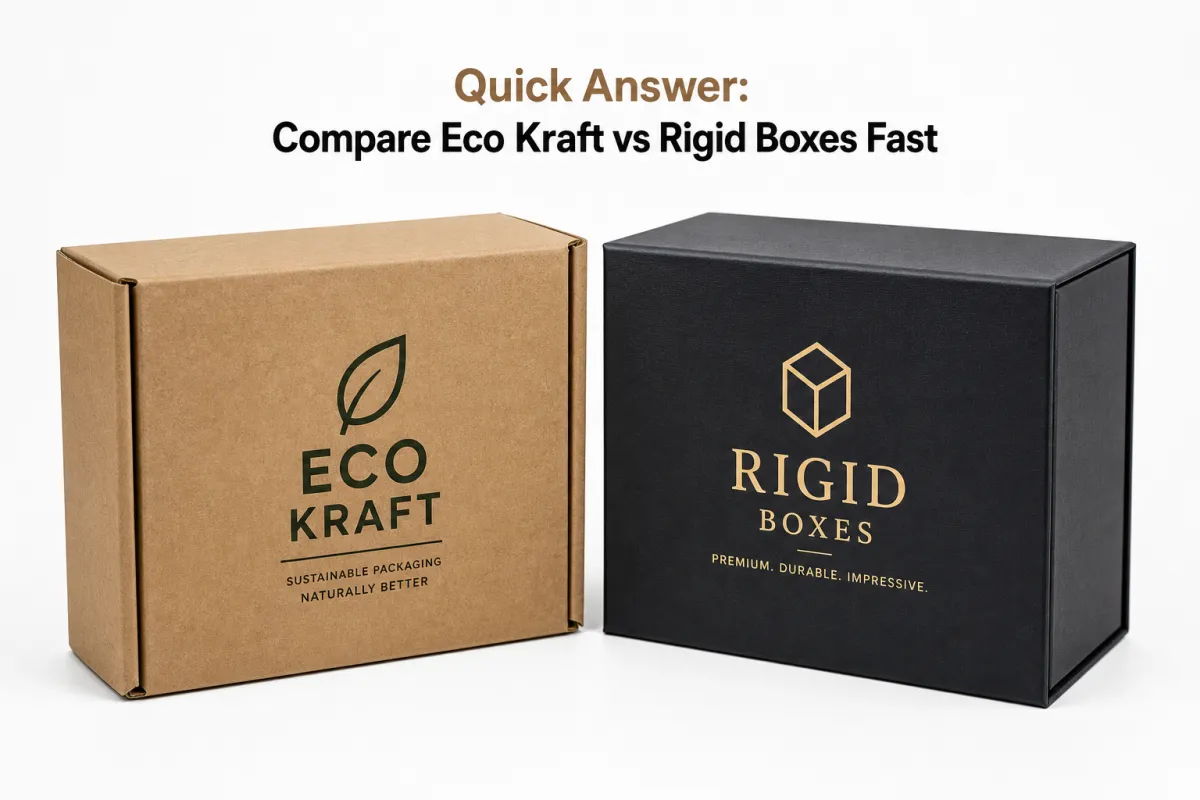
Here is the short version. If you want the strongest premium signal, compare eco kraft vs rigid boxes with rigid boxes at the top of the luxury ladder. They have weight, structure, and a reveal that feels deliberate the second someone lifts the lid. If you want lower shipping weight, cleaner economics, and a more grounded eco message, eco kraft usually wins.
The main rule is blunt because the decision is blunt: choose rigid boxes for premium unboxing and giftability; choose eco kraft when cost control, lighter weight, and a cleaner eco message matter more. Packaging is not a poetry contest. It is a buying decision.
Compare eco kraft vs rigid boxes from the product outward, not the catalog inward. A $28 candle set, a $90 fragrance kit, and a $250 skincare gift box all behave differently. A box that feels “high end” in one category can feel wasteful or oddly heavy in another. A rigid setup may be the right move for a launch kit or a holiday gift set, while eco kraft can be the smarter answer for repeat shipments, subscription orders, and products that do not need theater.
There is also a real operational difference. Eco kraft boxes often use less board, simpler wrapping, and fewer manual steps. Rigid boxes usually need thicker chipboard, wrapped panels, and more finishing labor. That is why compare eco kraft vs rigid boxes is not just a style debate. It is a cost and workflow decision.
For brands that want a natural or artisanal look, eco kraft can feel more honest than a box trying too hard to look expensive. For brands selling premium gifts, luxury accessories, or PR kits, rigid boxes make the opening experience feel like part of the product itself. If you need a quick litmus test, compare eco kraft vs rigid boxes using this question: do you want the package to fade into the purchase, or do you want it to be remembered as part of the value?
If you need to compare structures across formats, browse our Custom Packaging Products and look at how different box styles behave before you lock a spec. A decent sample saves more money than a pretty mockup ever will.
Top Options Compared: Compare Eco Kraft vs Rigid Boxes by Use Case
Compare eco kraft vs rigid boxes by use case, and the picture gets sharper. Rigid boxes usually make the most sense for fragrance, jewelry, electronics, luxury gift sets, and anything sold as an experience as much as a product. Eco kraft often fits apparel, candles, wellness, tea, subscription packaging, and products that want a cleaner, more practical first impression.
That matters because buyers do not open every category the same way. A fragrance customer often expects a dramatic reveal, a snug insert, and finish details like foil or soft-touch wrap. A candle buyer may care more about sustainability cues, shipping safety, and a package that stacks neatly in a retail backroom. When you compare eco kraft vs rigid boxes honestly, “best” depends on the buying moment.
Unboxing is the biggest emotional divider. Rigid boxes deliver a structured, high-end reveal. The lid lifts with resistance, the product sits in place, and the packaging has enough weight to feel deliberate. Eco kraft delivers a more straightforward, earthy first impression. That can still feel premium, but it is a different kind of premium. Less champagne. More well-made workshop.
Shipping and shelf behavior are different too. Eco kraft is usually lighter, easier to stack, and less expensive to move in bulk. That helps when fulfillment costs are already chewing through margin. Rigid boxes hold shape better on shelves and in display settings, which is why they show up in retail launches and gift presentations so often. If you compare eco kraft vs rigid boxes for logistics alone, eco kraft usually wins the quiet battle.
Branding is another split. Rigid boxes suit foil stamping, magnets, ribbon pulls, velvet trays, and molded inserts. They give designers room to play with contrast and shine. Eco kraft works better with minimal print, bold typography, one- or two-color branding, and natural textures. If the material itself is part of the story, eco kraft does not need to pretend to be something else. That is a feature, not a compromise.
For brands lining up SKUs, I usually think about the product’s replacement cycle. If people reorder monthly, compare eco kraft vs rigid boxes with unit economics front and center. If the package is a once-in-a-while gift or a high-ticket launch item, compare eco kraft vs rigid boxes with perceived value front and center. Different answer. Same logic. No mystery, just the boring math that keeps a program alive.
Need a wider options scan? You can also review custom packaging products to match inserts, closures, and print styles with the product instead of forcing one box style to do everything.
Detailed Reviews: Eco Kraft Box Strengths and Weaknesses
Eco kraft does a few things very well, and it deserves credit for that. It signals natural, recyclable, and practical without trying too hard. That is exactly why it can feel more credible than overdesigned luxury packaging. When a brand sells handmade soap, candles, organic snacks, or wellness products, compare eco kraft vs rigid boxes and you will often find that eco kraft tells the story more cleanly.
The material usually works best when the brand leans into restraint. Uncoated surfaces, one- or two-color print, clean die lines, and simple inserts usually beat glossy effects that fight the texture. A heavy black ink on kraft can look striking. A muddy full-coverage print can look cheap very quickly. The same goes for board weight. If the board is too light, the box flexes, corners crush, and the whole thing reads as bargain-bin packaging no matter how well the logo was set.
That is the part many people miss when they compare eco kraft vs rigid boxes. They assume the lower-cost choice automatically looks lower quality. Not true. A well-made eco kraft carton with a sturdy board, crisp folds, and controlled print can look intentional and expensive in a quiet way. The opposite is also true. A sloppy eco kraft box looks like someone saved money in all the wrong places.
From a practical standpoint, eco kraft is often a smarter pick for repeat orders and faster replenishment. It usually needs less hand assembly than rigid packaging and less material per unit. For brands placing recurring runs of 1,000, 3,000, or 5,000 pieces, that difference starts showing up on the invoice and in the warehouse. If you compare eco kraft vs rigid boxes for a subscription program, eco kraft can lower your pain on both cost and storage.
There is also an eco message benefit, but it has to be real. Ask for recycled content, verify whether the board is FSC-certified, and do not rely on a brown surface alone to do the sustainability work. FSC chain-of-custody matters if you want the claim to hold up. You can read more about that standard directly at FSC. Pretty brown paper is not the same thing as responsible sourcing. Buyers notice when a brand confuses the two.
Eco kraft also plays nicely with operational realities. It stacks well in cartons, tends to be lighter in freight, and can be easier for a small packing team to handle. That sounds boring because it is boring, and boring is profitable. If you compare eco kraft vs rigid boxes in a fulfillment-heavy business, the boring choice is often the right one.
The weaknesses are plain. Eco kraft can feel flimsy if the structure is underspecified. It can also lose its charm if the printing is too dense, the tint is off, or the die lines are messy. And while eco kraft can look premium, it does not deliver the same ceremonial opening as rigid packaging. If the whole brand promise is “giftable luxury,” eco kraft has to work harder to carry that weight.
Honestly, I think eco kraft is best when the product itself already has credibility. If the formulation, craftsmanship, or story is strong, the box does not need to shout. It just needs to support the product and look like it belongs. That is the sweet spot. Not flashy. Not apologetic. Just right.
Detailed Reviews: Rigid Box Strengths and Weaknesses
Rigid boxes still dominate luxury for a reason. They deliver structure, weight, and a premium feel the moment someone picks them up. When you compare eco kraft vs rigid boxes side by side, rigid packaging usually wins the first five seconds. That first impression matters a lot for gifting, launches, PR kits, and products where the box is part of the value.
The construction is what gives rigid boxes their authority. A typical build uses 1.5 mm to 3 mm chipboard wrapped in printed or specialty paper, with options like magnets, ribbon pulls, foam, velvet, molded pulp, or paperboard inserts. That extra structure is not decorative fluff. It creates the sense that what is inside deserves protection and ceremony.
Rigid boxes shine for high-value goods. Fragrance, jewelry, watches, electronics, premium skincare, and luxury gift sets all benefit from the physical confidence a rigid box provides. Even before the customer sees the product, the packaging communicates that something important is inside. If you compare eco kraft vs rigid boxes for prestige launches, rigid wins because it does the emotional heavy lifting for you.
But let us be honest about the downside. Rigid boxes cost more. They take more labor. They often need more manual fitting and more quality inspection. The wrapping stage alone adds time and risk, especially when edges must stay sharp and corners must stay clean. Add a magnetic closure, a multi-part insert, or a soft-touch wrap, and the unit price climbs quickly.
That is why compare eco kraft vs rigid boxes becomes a margin discussion as much as a design discussion. If the product sells for $20 to $35 and margins are thin, a premium rigid box can feel like a very expensive costume. If the product sells for $120 or is part of a gift set, the same box can feel like money well spent. The box has to earn its keep.
Finish options also change the economics. Foil stamping, embossing, debossing, matte lamination, soft-touch wrap, magnets, and custom inserts all increase perceived value, but they also increase price and lead time. From a production point of view, every extra touch adds a point where something can go wrong. That is not cynicism. That is packaging reality.
When I compare eco kraft vs rigid Boxes for Luxury Brands, I look at whether the packaging is supposed to be a keeper. If customers will store the box and reuse it, rigid packaging makes sense. If the outer pack is likely to be discarded quickly, then paying for a high-end rigid build may not make business sense unless the unboxing is central to the sales story.
For shipping performance, rigid boxes are not automatically stronger in every scenario. They are better at holding shape, yes. But they still need a proper outer shipper, cushioning, and a tested packout. If the product is fragile, I want the final pack tested against a reasonable protocol like an ISTA-style drop test rather than judged by hand. You can find good testing references at ISTA. A fancy box that explodes in transit is a bad investment with a nice costume on.
Price Comparison and Process Timeline
If you compare eco kraft vs rigid boxes by headline price alone, you will miss the point. Look at the cost drivers. Eco kraft usually costs less because it uses less board, less wrapping labor, and simpler assembly. Rigid boxes usually cost more because the board is thicker, the wrapping is more detailed, and the setup is more manual.
For a practical buying range, simple custom eco kraft boxes often land around $0.45 to $1.40 per unit at common custom run sizes, depending on size, print coverage, insert style, and quantity. Custom Rigid Boxes often start closer to $1.80 to $5.50 per unit and can move higher once you add specialty paper, magnets, foam, velvet, or premium finish work. Those are not magic numbers. They are realistic working ranges, not promises carved into stone. Geography, supplier tier, and the level of hand work can push those numbers around pretty fast.
Compare eco kraft vs rigid boxes at 500 units and at 5,000 units, and the gap usually gets even more obvious. Eco kraft benefits more quickly from volume because the structure is simpler. Rigid boxes also get cheaper with volume, but labor remains a bigger component of the unit cost. A small rigid run can look expensive because it is expensive. No mystery there.
Here is the kind of comparison buyers actually need:
| Feature | Eco Kraft Boxes | Rigid Boxes | Best Fit |
|---|---|---|---|
| Typical board | Folding carton or kraft paperboard, often 16pt-24pt | 1.5 mm-3 mm chipboard wrapped in printed paper | Eco kraft for lighter products; rigid for high-value gifts |
| Unit cost | Usually lower, especially in simple one- or two-color runs | Usually higher because of wrapping and hand assembly | Eco kraft for margin control |
| Lead time | Often faster to sample and approve | Usually longer because of structure and insert fitting | Eco kraft for speed |
| Unboxing feel | Natural, practical, understated | Premium, weighty, ceremonial | Rigid for gifting, eco kraft for honest branding |
| Shipping weight | Lower | Higher | Eco kraft for fulfillment savings |
| Best inserts | Paperboard or molded pulp | Foam, velvet, magnetic trays, custom compartments | Depends on product fragility and price point |
| Eco claim | Can support recycled or FSC-certified content if specified | Can also use recycled board, but specialty wraps may limit recyclability | Depends on coatings, adhesives, and local recycling rules |
Now the timeline. Eco kraft jobs are often faster to sample because the structure is simpler. A straightforward run may move from quote to proof approval to production without much drama, especially if the artwork is clean and the dieline is standard. Rigid boxes take longer because there is more to approve: the wrapped shell, the insert fit, the closure method, and the final presentation.
A typical process looks like this: quote, dieline, sampling, proof approval, production, packing, and shipping. Delays usually happen at proof approval or when the insert does not fit the actual product the first time. If the buyer changes art after sample approval, the clock resets in all the annoying ways. If you compare eco kraft vs rigid boxes on speed, eco kraft usually wins because there are fewer places for the process to trip.
One more practical note: if you are planning custom packaging through Custom Packaging Products, line up the box style, insert, and print method before you ask for pricing. Half-baked briefs make for messy quotes. Clean briefs save everyone time.
How to Choose Between Eco Kraft and Rigid Boxes
Do not choose by instinct alone. Compare eco kraft vs rigid boxes using a decision framework built around margin, product value, shipping method, and brand position. Fancier is not always better. Cheaper is not always smarter. The right box is the one that fits the product and the business model.
Use eco kraft when the product is affordable, the order quantity is recurring, the brand story is earthy or functional, and shipping weight matters. It is a strong fit for candles, wellness products, apparel accessories, tea, subscription kits, and items that need to look intentional without feeling overpackaged. If the customer is likely to reorder every month, compare eco kraft vs rigid boxes with repeat purchase economics in mind.
Use rigid boxes when the purchase is high-ticket, the unboxing is part of the marketing, or the packaging needs to feel like a gift the moment it is opened. That includes fragrance, jewelry, premium electronics accessories, press kits, and limited-run launches. If the product has high perceived value, rigid packaging can support the price without looking out of place.
Here is a simple scorecard I use when I compare eco kraft vs rigid boxes:
- Cost sensitivity: Eco kraft usually wins if budget pressure is real.
- Premium feel: Rigid boxes usually win because they have weight and structure.
- Eco positioning: Eco kraft usually wins if the brand wants a natural, low-waste message.
- Protection: Rigid boxes often win for fragile or prestige items, but the outer shipper still matters.
- Speed: Eco kraft usually wins on sampling and production simplicity.
That scorecard is not theory. It reflects the same questions buyers ask during real packaging runs. How much can the box cost without wrecking margin? How much does freight matter? Does the product need a giftable reveal, or does it need practical protection and clean presentation? When you compare eco kraft vs rigid boxes in that order, the answer usually becomes obvious.
Another useful test is shelf behavior. If the box will sit in a retail display and compete for attention, rigid boxes have a stronger shelf presence. If the box will go straight from carton to customer and the brand wants a cleaner, quieter look, eco kraft often feels more aligned. The wrong choice is usually the one that fights the product story.
For safety and transit, I recommend real testing, not wishful thinking. Run a drop test on the final packout, not just the empty box. Check the insert hold. Shake the product. Put it through a shipping simulation if the order value is high enough to justify it. Compare eco kraft vs rigid boxes after you see how the actual product behaves, because paper specifications alone do not tell the whole story. ASTM-style handling references and ISTA guidance are useful here, but the main point is simpler: test the thing you will actually ship.
Our Recommendation and Next Steps
Here is my direct verdict. If the buyer wants the strongest premium signal, rigid boxes win. If the buyer wants value, speed, and a cleaner eco message, eco kraft usually wins. That is the honest answer, and it covers most packaging briefs better than a pile of vague adjectives ever will.
Compare eco kraft vs rigid boxes one last time with this question: what does the packaging need to do for the business? If it needs to act like part of a gift, support a higher price point, or create a memorable reveal, rigid boxes earn their place. If it needs to lower freight, support repeat orders, and keep the brand looking responsible and practical, eco kraft makes more sense.
My practical advice is to order two samples, not one. Put the same product into a finished eco kraft sample and a finished rigid sample. Compare the closure, the print quality, the insert style, and the way the product sits inside each one. Then test them side by side in a real workflow. Shipping test. Shelf test. Unboxing test. That is the boring part that saves expensive mistakes.
And yes, compare eco kraft vs rigid boxes with the actual numbers in front of you. Not guessed numbers. Real numbers. Ask for the quote with the same dimensions, the same print coverage, the same insert style, and the same quantity. Otherwise you are not comparing packaging. You are comparing fantasy to fantasy. That kind of spreadsheet theater gets old fast.
If you are building a custom packaging line, start with the structure that matches the product’s value and the channel’s demands. You can always add finish later. It is much harder to rescue a bad structure after the fact. If you want a place to start, review the available packaging options and narrow the shortlist before you lock artwork.
Pick the box that makes the product make sense. That is the whole job.
Bottom line: compare eco kraft vs rigid boxes against budget, timeline, shipping, recyclability claims, and perceived value, then choose the structure that makes the strongest business sense. If the product is premium and the unboxing matters, rigid boxes usually carry more weight. If the brand is sustainability-first, cost-sensitive, or fulfillment-heavy, eco kraft usually does the better job. The takeaway is simple. Sample both, test both with the actual product, and choose the one that survives the real-world math without the packaging trying to be the hero.
Frequently Asked Questions
Is eco kraft cheaper than rigid boxes for small custom runs?
Usually yes. Eco kraft uses less material and less hand assembly than a rigid setup, so the unit price is typically lower. The gap gets wider when rigid boxes need magnets, wrapped lids, foam inserts, or specialty paper. A very simple rigid box can still look expensive compared with eco kraft, so price alone is not the full story when you compare eco kraft vs rigid boxes. The better question is whether the extra cost buys you anything the customer will actually feel.
When should I compare eco kraft vs rigid boxes for shipping protection?
Compare eco kraft vs rigid boxes for shipping protection when the product is fragile, high-value, or being sold as a luxury gift. Rigid boxes are often better for presentation and shape retention, but eco kraft can work well when the outer shipper does most of the protection and weight savings matter. Always test the final packaging with the actual product, not a placeholder sample. A box that looks indestructible on a desk can still fold like a cheap chair in transit.
Can eco kraft boxes still look premium in a custom packaging line?
Yes, if the print is clean, the board is sturdy, and the design leans into minimal, natural branding. Blind embossing, simple foil, and a tight dieline can make eco kraft feel intentional instead of cheap. If the brand promises luxury first, rigid boxes still have the easier job when you compare eco kraft vs rigid boxes. That is not a knock on kraft. It is just how perception works.
How long does it take to produce eco kraft vs rigid boxes?
Eco kraft is often faster to sample and approve because the structure is simpler. Rigid boxes usually need more time for wrapping, insert fitting, and manual assembly. Timeline still depends on print complexity, quantity, and whether the artwork is approved on the first round. If speed matters, compare eco kraft vs rigid boxes with the proofing schedule included, not just the production date. A tidy dieline can shave days off a project. A messy one can eat a week without even trying.
Which is better for inserts: eco kraft vs rigid boxes?
Rigid boxes are better for foam, velvet, magnetic, and high-end presentation inserts. Eco kraft works well with molded pulp, paperboard inserts, and simple product locks. Pick the insert based on product safety first, then match the box style to the brand. That is the cleanest way to compare eco kraft vs rigid boxes without overcomplicating the job. If the insert does not hold the product, the rest is just pretty packaging trying to cover for a bad fit.