Buyer Fit Snapshot
| Best fit | compare paper bags vs poly mailers for packaging buyers comparing material specs, print proof, MOQ, unit cost, freight, and repeat-order risk where brand print, material, artwork control, and repeat-order consistency matter. |
|---|---|
| Quote inputs | Share finished size, material target, print colors, finish, packing count, annual reorder estimate, and delivery region. |
| Proofing check | Approve dieline scale, logo placement, barcode or warning zones, color tolerance, and any recyclable or compostable wording before bulk production. |
| Main risk | Vague material claims, crowded artwork, or missing packing details can create delays even when the unit price looks attractive. |
Fast answer: Compare Paper Bags vs Poly Mailers: Film, Closure, Print, and Fulfillment should be specified like a repeatable production item. The safest quote includes material, print method, finish, artwork proof, carton packing, and reorder notes in one written spec.
What to confirm before approving the packaging proof
Check the product dimensions against the actual filled item, not only the sales mockup. Ask for tolerance on folds, seals, hang holes, label areas, and retail display edges. If the package carries a logo, QR code, warning copy, or legal claim, reserve that space before decorative graphics fill the panel.
How to compare quotes without losing quality
Compare board or film grade, print process, finish, sampling route, tooling charges, carton quantity, and freight assumptions side by side. A lower quote is only useful if the supplier can repeat the same color, closure quality, and packing count on the next order.
Compare Paper Bags vs Poly Mailers: Which Fits Best?
How do you compare paper bags vs poly mailers?
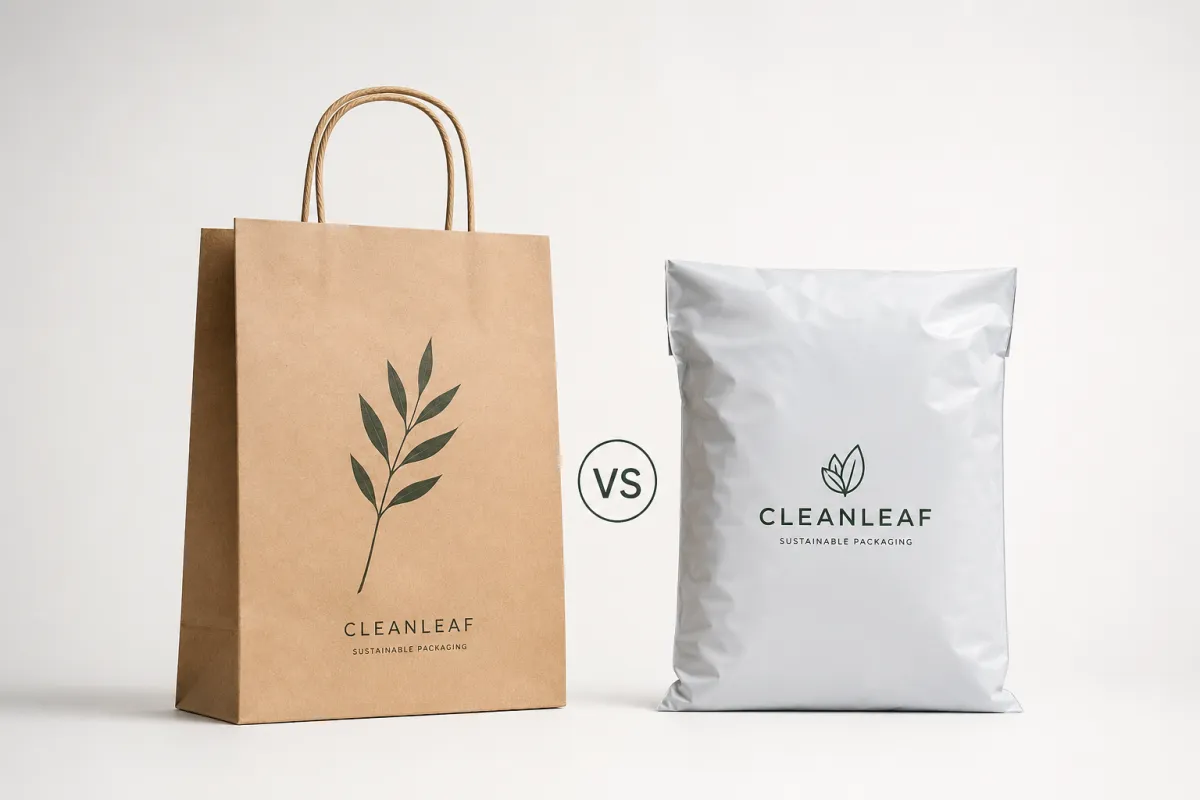
If you Compare Paper Bags vs Poly mailers for real shipping work, the first surprise is how fast a single ounce or a slightly wider footprint can affect the bill. The second is more human: paper tends to feel deliberate and tactile the moment a customer touches it, while poly feels efficient, tidy, and better suited to the rough math of parcel transit.
The rule is simple, though the implications are not. Poly mailers usually make more sense when protection, packing speed, and lower freight matter most. Paper bags usually make more sense when presentation, in-person handoff, and brand feel carry more weight. That is the cleanest way to compare paper bags vs Poly Mailers Without getting distracted by a polished mockup that never had to survive a conveyor belt.
From a packaging buyer's perspective, the answer shifts with the product and the channel. A clothing brand shipping basics usually benefits from a lightweight poly mailer because it trims shipping weight, stores flat, and keeps pack-out moving. A boutique sending giftable items may prefer paper bags because the hand-feel, structure, and carryout experience do some of the branding before the box or mailer is even opened. Food sellers and subscription brands can land somewhere else entirely, because moisture resistance, crush risk, and fulfillment speed can outweigh appearance in ways that are easy to miss from a catalog page.
I have watched brands change packaging after one bad stretch of weather, one spike in returns, or one warehouse move. That is often the moment the theory gets tested. A material that looked elegant on paper can turn fussy in production. A mailer that looked plain can quietly save hours every week. Packaging has a way of being honest in a hurry.
Practical takeaway: compare paper bags vs poly mailers by asking which failure would hurt more: a package that feels less premium, or one that arrives damaged, wet, or costly to ship.
This comparison looks at material strength, print quality, shipping cost, workflow, sustainability claims, and what customers notice first. For a broader look at matching formats to product lines, browse Custom Packaging Products alongside format-specific options such as Custom Poly Mailers.
Compare Paper Bags vs Poly Mailers by Use Case
The easiest way to compare paper bags vs poly mailers is to stop treating them as generic packaging and start matching them to the product. Apparel, cosmetics, documents, lightweight accessories, and takeaway items each create their own stress points. A kraft paper bag that feels elegant on a retail counter can become the wrong tool once it is exposed to rain, stacking pressure, or a driver who jams it into a tote with fourteen other parcels. A poly mailer that looks plain in a boutique can suddenly become the smarter package once volume, labor, and transit risk enter the picture.
Paper bags work best when the customer interacts with the package in person or within a short delivery loop. They fit retail handoff, premium store presentation, gift purchases, and brand moments where structure matters more than weather resistance. If the package is likely to be carried a short distance, seen by other shoppers, and associated with a thoughtful in-store experience, paper bags often feel right. They also support recycled-content and FSC-certified sourcing stories better than many buyers expect, although the sustainability claim still depends on the paper grade, ink coverage, coatings, and whether the bag is actually reused instead of tossed in the car park.
Poly mailers, by contrast, shine in direct-to-consumer shipping. They are light, flat, and easy to stack. A 10 x 13-inch mailer can disappear into a fulfillment workflow in a way a paper bag usually cannot. For soft goods, folded apparel, small accessories, and repeat orders, that matters. Compare paper bags vs poly mailers on volume and the answer often shifts quickly once a brand moves from a few dozen orders a week to a few hundred. The more packs you move, the more labor and storage start to matter as much as the unit price.
One hidden driver gets ignored far too often: the best package is not the one that looks nicest in isolation. It is the one that fits the item, the channel, and the expectation. A giftable candle sold at a market stall has a different packaging need than the same candle shipped across the country. A paper bag may win the first case, while a poly mailer wins the second. That is why compare paper bags vs poly mailers should begin with the order profile, not the catalog image.
If you want to compare paper bags vs poly mailers for specific product groups, use this simple lens:
- Apparel: poly mailers usually win for shipping speed and protection; paper bags can still work for boutique pickup.
- Cosmetics: paper bags feel more upscale in person, but poly mailers are better if leakage or rough handling is a concern.
- Documents and print collateral: paper bags can be fine for handoff; poly mailers reduce moisture and corner damage in transit.
- Light accessories: both can work, but the better option depends on whether the item needs structure or a slimmer parcel profile.
- Takeout or short-haul food service: paper bags are common, yet moisture and grease exposure still need careful handling.
Compare Paper Bags vs Poly Mailers: Detailed Review
Durability is usually the first real test. When you compare paper bags vs poly mailers under shipping conditions, poly almost always has the edge. A co-extruded poly mailer resists tearing, handles abrasion well, and tolerates the scuffs that happen on conveyor belts, in van piles, and during repeated handling. Paper bags can be strong too, but strength is far less predictable. The paper grade, handle construction, folds, coatings, and print coverage all change how the bag behaves. A 120gsm kraft bag is not the same thing as a heavier 150gsm or 170gsm version, and a matte finish can look refined while still showing moisture and edge wear faster than a film-based mailer.
Branding is where the comparison gets more interesting. Paper bags have a tactile advantage. People feel the material, hear the rustle, and read the package as a retail object rather than a shipping shell. That effect matters. Poly mailers, though, can win on visible print impact. They are ideal for bold logos, bright brand colors, repeatable positioning, and clean full-bleed graphics. A well-printed mailer can look sharper across thousands of pieces than a paper bag that depends on alignment and handling consistency. Compare paper bags vs poly mailers closely and you will notice that paper can feel more premium in the hand, while poly often looks more confident in a fulfillment setting.
Customer experience follows the same pattern. A paper bag says boutique, gifting, counter pickup, or short-haul purchase. A poly mailer says speed, direct shipping, and operational efficiency. Neither signal is wrong. The mistake is using the wrong signal for the job. Compare paper bags vs poly mailers for a premium brand and the answer may still be poly if the item is moving through rough parcel networks and the customer cares more about product condition than unboxing theater.
Workflow is the other practical divider. Paper bags often need folding, assembly, or careful filling so they stay square and presentable. Add tissue, inserts, or a thank-you card, and pack time rises quickly. A simple poly mailer usually takes less time to load, seal, and stage for carrier pickup. In a busy warehouse, that difference compounds. A pack-out that takes 12 seconds instead of 28 seconds does not sound dramatic until you multiply it by hundreds of orders a day. Then compare paper bags vs poly mailers becomes a labor conversation, not just a packaging one.
For shipping validation, I prefer to think in test terms rather than guesswork. If a package needs to survive parcel handling, ISTA test protocols are a better reference point than a glossy product sheet; see ISTA's testing standards for the kind of drop, vibration, and transit logic that matters. If you are still weighing material choices, compare paper bags vs poly mailers against the likely abuse path: corner crush, moisture, friction, and stacking pressure.
None of that means paper bags are weak by default. It means they are a different tool. A well-made bag can be excellent for carrying, presentation, and short-distance transport. A poly mailer can be excellent for parcel logistics, but it will not create the same tactile brand cue. The best operators compare paper bags vs poly mailers by asking which kind of failure would be more expensive: a damaged item, a missed brand impression, or a slower packing line.
Compare Paper Bags vs Poly Mailers Pricing and Hidden Costs
Unit price matters, but it is the least honest place to stop. To compare paper bags vs poly mailers properly, you need to look at total landed cost: packaging unit cost, freight, storage, damage rates, return handling, inserts, and the labor needed to complete each order. A package that costs less at the quote stage can cost more once it enters real operations.
At common order quantities, poly mailers are usually cheaper per unit. A stock or lightly customized poly mailer might land in the $0.05-$0.18 range at mid-volume, depending on size, print coverage, film thickness, and whether you are using a simple one-color logo or a full-coverage design. Custom Paper Bags often start higher. Depending on size, handle style, paper grade, and print method, a realistic range for a 5,000-piece run might land around $0.18-$0.45 per unit, sometimes more if you add specialty finishing. Compare paper bags vs poly mailers on quote alone and the mailer usually looks lighter on the budget.
Freight changes the story. Poly mailers ship and store flat. That lowers inbound freight and warehouse space. It also reduces the chance that you are paying to move air. Paper bags, especially handled retail bags, take more carton space and more care in packing. If you are ordering from Custom Poly Mailers, the savings often show up in the secondary costs, not just the printed price tag. Compare paper bags vs poly mailers on dimensional weight and poly usually wins again because the package profile stays slimmer.
Damage rates matter too. A cheap package that fails in transit creates expensive side effects: reships, replacements, refunds, and support tickets. Even a modest defect rate can erase the savings from a lower unit cost. If a paper bag lets moisture or abrasion in, the hidden cost appears later. If a poly mailer is too thin for the product or too light on seal strength, the failure can be just as costly. Compare paper bags vs poly mailers not by asking which one is cheaper in a spreadsheet cell, but by asking which one costs less after the inevitable exceptions.
There is also a volume effect. At small runs, custom printing and setup fees can flatten the price difference. At higher runs, the gap often widens because poly mailers scale efficiently. Paper bags can still justify themselves if the brand experience supports a higher retail value, but that value has to be real. A boutique that charges premium prices and hands the order over the counter can absorb a more expensive bag more easily than a high-volume e-commerce store shipping everyday basics.
| Factor | Paper Bags | Poly Mailers | Typical Advantage |
|---|---|---|---|
| Typical custom unit cost | $0.18-$0.45 at 5,000 pcs | $0.05-$0.18 at 5,000 pcs | Poly mailers |
| Storage footprint | Higher, especially with handles | Very low; ships flat | Poly mailers |
| Packing speed | Moderate to slower | Fast | Poly mailers |
| Premium hand-feel | Strong | Moderate | Paper bags |
| Transit moisture resistance | Lower unless coated | Higher | Poly mailers |
| Retail carryout presence | Strong | Lower | Paper bags |
Sustainability claims also affect cost perception. The EPA's materials guidance keeps the conversation grounded in source reduction rather than wishful thinking; see EPA sustainable materials management basics for the broader framework. In practice, the greener package is often the one that uses less material, causes fewer damages, and fits the supply chain with less waste. Compare paper bags vs poly mailers from that angle and the answer is not automatic. Paper is not always better. Poly is not always worse. The real question is how much total waste each format creates over the full order lifecycle.
One caution here: recycling claims are messy, and packaging buyers get sold a lot of half-truths. A paper bag with heavy lamination or mixed-material accents can be harder to recycle than it looks. A poly mailer made from mono-material film may be recyclable in some programs, but not every curbside system accepts it. That nuance matters if you are trying to be accurate instead of merely agreeable.
Process and Timeline for Custom Orders
Ordering custom packaging is rarely just a logo upload. To compare paper bags vs poly mailers in a production setting, you need to look at the whole flow: sizing, artwork, proofing, material selection, sampling, approval, and manufacturing. The more custom the build, the more decisions pile up. That is true for both formats, but paper bags usually involve more finish choices and more visible construction details.
A typical Custom Poly Mailer project starts with size selection, film thickness, print layout, and closure style. After that come proofs and a production sample if the design is complex. Many stock or lightly customized mailers move faster because there are fewer moving parts. A straightforward order can often be turned around in roughly 10-15 business days after proof approval, depending on factory load and shipping distance. Compare paper bags vs poly mailers and the mailer often wins on speed because the production path is simpler.
Paper bags take a little more care. You may need to decide between twisted paper handles, flat handles, die-cut grips, rope handles, matte or gloss coating, and whether the bag needs extra reinforcement at the top fold or base. If the art uses multiple inks or specialty finishes, proofing can take longer. A realistic timeline for Custom Paper Bags might sit in the 12-20 business day range after approval, with longer lead times if you add specialty details or a higher GSM material. That extra time is not always a problem, but it should be planned.
Delays usually come from the same handful of places: logo placement, print method, coating choices, handle style, closure type, and minimum order quantities. If a brand wants a very specific shade of black on a natural kraft bag, or a full-coverage print on a bag with handles, the sample stage becomes more important. Compare paper bags vs poly mailers at the planning desk and you will often find that the bag needs more iteration simply because the customer can touch more surfaces and see more construction details.
Operationally, it helps to build time for revisions and freight transit. A launch that depends on a new package should have a small buffer, not a last-minute scramble. One bad assumption about lead time can create a real bottleneck, especially if the packaging is tied to a seasonal promotion or a product drop. If you are building a mixed packaging line, a broader catalog of Custom Packaging Products makes it easier to match the format to the channel without forcing every item into the same box.
Here is the practical rule: compare paper bags vs poly mailers early, not after artwork is finished. A package choice can change the dieline, the print method, the proof schedule, and the amount of handwork required at pack-out. If you discover that late, the launch gets more expensive before it gets better.
How to Choose Between Paper Bags and Poly Mailers
If you need a practical framework, compare paper bags vs poly mailers across five variables: fragility, moisture risk, customer perception, shipping distance, and return rate. That is usually enough to tell you which format belongs in the lead. A fragile product with high moisture risk and a long shipping route points toward a poly mailer or a stronger secondary package. A premium retail handoff with low transit stress points toward a paper bag.
Start with the item itself. Soft goods and folded apparel usually travel well in poly because they do not need rigid protection. Lightweight accessories can go either way, but the package has to match the item's shape and the likelihood of scuffing. Documents and print collateral often benefit from the extra moisture resistance of poly when they move through carriers. Compare paper bags vs poly mailers by asking what the product fears most: water, crushing, tearing, or looking underwhelming at the moment of delivery.
Then look at the buyer journey. In-store handoff favors paper bags because they create a visible moment. Parcel delivery favors poly mailers because the package has to survive more handling and cost less to move. High return rates also push the decision toward poly, because the same package may travel twice and still need to hold together. A paper bag can be fine once. A poly mailer usually behaves better through repeated touch points.
There is one more step that brands skip too often: test with real packers and real orders. Do not pick a format from a catalog image and call it done. Run two or three sample SKUs through the actual fulfillment line. Measure pack time, seal quality, failure rate, and customer reaction. Compare paper bags vs poly mailers after one week of live orders, not after one glance at a rendering. Real use reveals the small annoyances that mockups hide.
A short checklist helps keep the decision grounded:
- Target cost per order: include freight and labor, not only unit price.
- Shipping weight: watch dimensional weight tiers and parcel class changes.
- Brand tone: decide whether the package should feel retail-like or shipping-first.
- Sustainability goals: measure material use, damage reduction, and reuse potential honestly.
- Public visibility: think about whether the package will be seen on a counter, in a carrier bin, or on a doorstep.
That checklist is where compare paper bags vs poly mailers becomes a business decision instead of a style debate. If the item needs to arrive looking clean, dry, and inexpensive to ship, poly is usually the safer default. If the package itself is part of the brand show, paper can justify the extra spend.
If the answer still feels close, that usually means the product is giving you a clue. Packaging choices are rarely 50/50 in the field. One format tends to make the workflow calmer. The other tends to make the unboxing nicer. Those are not the same thing, and mixing them up costs money.
Our Recommendation and Next Steps
My honest recommendation is straightforward: most e-commerce brands should start with poly mailers for shipping efficiency, then reserve paper bags for retail, gifting, or premium handoff moments. That is not a universal rule, but it is the most practical starting point when compare paper bags vs poly mailers for ordinary apparel, soft goods, and repeat fulfillment.
The exception is equally clear. If moisture, rough transit, or high-volume packing is the dominant problem, poly mailers usually win. If tactile branding, display value, and customer-facing presentation matter more, paper bags can justify the higher cost. Compare paper bags vs poly mailers in that context and the package choice starts to look less like a procurement decision and more like a channel strategy.
Here is how I would move next: request samples, compare finished pack-out costs, test one week of live orders, and measure damage, labor time, and customer feedback. Not just the postcard version of the package. The real one. The one with a tired packer, a wet loading dock, a rush order, and a customer who notices whether the parcel arrived intact.
If you want to keep the process simple, compare paper bags vs poly mailers on the products that matter most first. Start with your top-selling SKU, your heaviest pack, and the item most likely to face weather or rough handling. Then compare the result to your brand goals. That is usually enough to show which format deserves the volume and which one should stay in reserve.
My final take: choose the format that reduces the most expensive failure. If your pain point is damaged goods or high shipping cost, go poly. If your pain point is a weak first impression in a retail setting, go paper. That answer is not glamorous, but it is the one that holds up after the first hundred orders.
Frequently Asked Questions
Compare paper bags vs poly mailers: which is cheaper for shipping apparel?
Poly mailers are usually cheaper overall for apparel because they weigh less and take up less space in transit. Paper bags can raise shipping cost if they push the parcel into a larger dimensional tier. The cheapest option still depends on pack-out weight, order volume, and whether you need inserts or extra protection.
Compare paper bags vs poly mailers for fragile products: which is safer?
Poly mailers are usually safer for soft, non-fragile products because they resist tearing and moisture better. Paper bags are a weaker choice when corner crush, rain exposure, or abrasion is likely. For fragile items, neither is ideal without internal cushioning or a stronger secondary package.
Do paper bags or poly mailers print better for custom branding?
Paper bags often feel more premium to touch and can support a strong retail presentation. Poly mailers are better for bold, repeatable full-color graphics and efficient large runs. The better choice depends on whether you want tactile luxury or high-visibility shipping branding.
Can paper bags be used for e-commerce fulfillment?
Yes, but They Work Best for light, low-risk items and brands that want a softer, more boutique presentation. They are less protective than poly mailers during wet weather and rough parcel handling. If fulfillment speed and damage reduction matter more, poly mailers are usually the safer bet.
How do I choose between paper bags and poly mailers for a small business?
Start with your product type, then compare shipping cost, packing speed, and customer experience. Ask for samples and test them with real orders before you commit to a full run. Choose paper bags for premium handoff moments and poly mailers for efficient shipping operations.

