Buyer Fit Snapshot
| Best fit | Compare Bubble Mailers vs Poly Mailers Shipping Costs projects where brand print, material claims, artwork control, MOQ, and repeat-order consistency need to be specified before quoting. |
|---|---|
| Quote inputs | Share finished size, material target, print colors, finish, packing count, annual reorder estimate, ship-to region, and any compliance wording. |
| Proofing check | Approve dieline scale, logo placement, barcode or warning zones, color tolerance, closure strength, and carton packing before bulk production. |
| Main risk | Vague material claims, crowded artwork, missing packing details, or unclear freight terms can make a low unit price expensive after revisions. |
Fast answer: Compare Bubble Mailers vs Poly Mailers Shipping Costs should be specified like a repeatable production item. The safest quote records material, print method, finish, artwork proof, packing count, and reorder notes in one written spec.
Production checks before approval
Compare the actual filled-product size with the drawing, then confirm tolerance on folds, seals, hang holes, label areas, and retail display edges. Reserve space for logos, QR codes, warning copy, and material claims before decorative graphics fill the panel.
Quote comparison points
Review material grade, print process, finish, sampling route, tooling charges, carton quantity, and freight assumptions side by side. A quote is only useful when the supplier can repeat the same color, closure quality, and packing count on the next order.
How Do You Compare Bubble Mailers vs Poly Mailers Shipping?
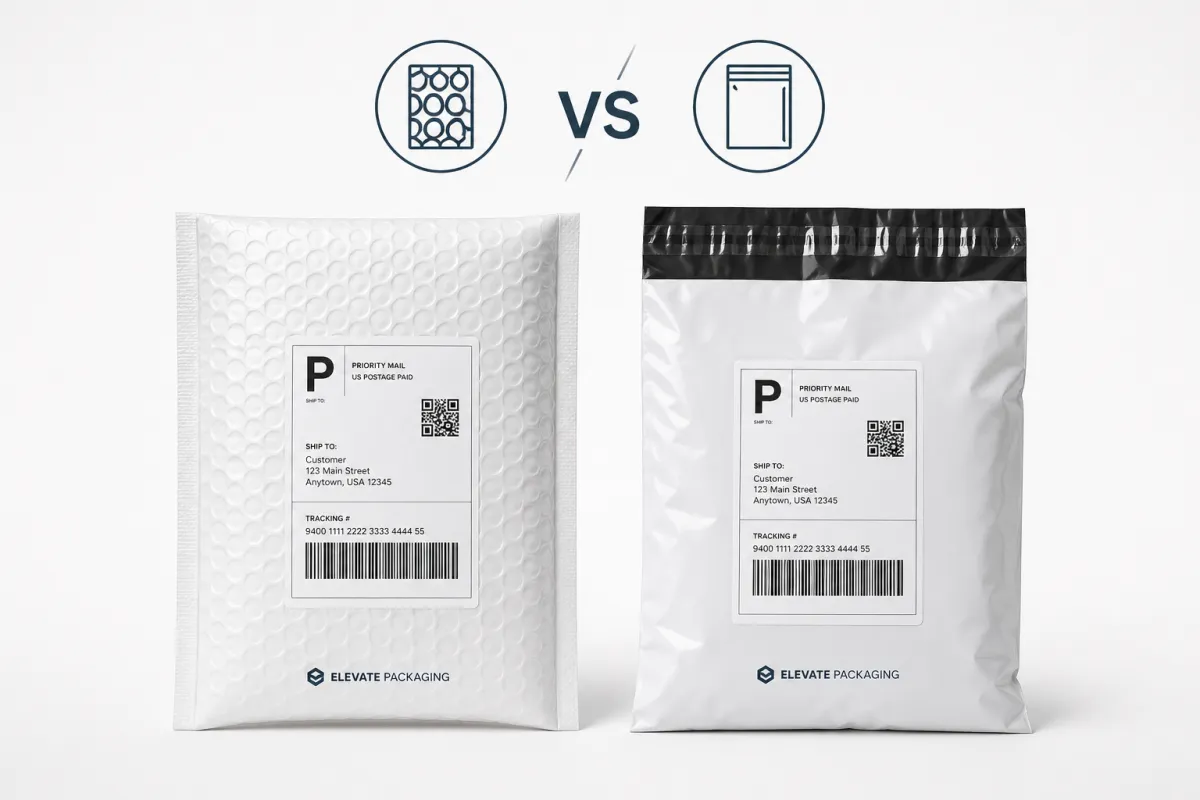
I start the same way on almost every packaging project: I ask whether the product needs cushioning or just a clean, light ride from warehouse to doorstep. That single question saved a skincare brand in Austin about $0.11 per order after they moved 3,200 monthly shipments from a padded bag to a 2.5 mil poly mailer. On paper, that sounds tiny. In a packing room, it changes the mood, the postage, and how often people stare at the label printer like it owes them money. Small packaging choices act like levers, especially once the monthly run rate is past 3,000 orders. If you compare bubble mailers vs Poly Mailers shipping across several SKUs instead of one sample, the cost gaps show up fast.
The quick answer is simple enough to put on a sticky note: bubble mailers usually win on protection, while poly mailers usually win on price, weight, and packing speed for non-fragile goods. Apparel, paperbacks already inside a snug carton, cosmetics secured in molded pulp, and accessories that do not scratch easily usually belong in poly. Glass, rigid electronics, boxed candles, and anything that rattles when you shake it belong in bubble more often than not. That is the practical way to compare bubble mailers vs poly mailers shipping for real e-commerce operations, not for tidy sample-room theory.
Honestly, the blunt verdict belongs on the first page of every sourcing deck: poly mailers are the margin play; bubble mailers are the damage-control play. A product with its own retail box, insert, or clamshell often does not need another layer of cushioning. A bare product with hard edges, sharp corners, or a surface that dents easily usually does. I have seen brands save $0.08 on the outer mailer and then eat $18.50 in replacement cost plus another $6 in reshipping. That is not clever procurement. That is expensive optimism wearing a spreadsheet costume. When teams compare bubble mailers vs poly mailers shipping only by unit price, they miss the second and third costs that show up later.
So yes, compare bubble mailers vs poly mailers shipping by unit price if that is the first filter you want to run. Just do not stop there. The real number lives in total landed shipping cost: packaging price, postage, labor, replacement shipments, customer support time, and the slow pileup of returns that shows up two weeks later and ruins everybody's afternoon. Fulfillment lives or dies on the full stack, not one line item pulled from a quote sheet. For that reason, I prefer to compare bubble mailers vs poly mailers shipping using actual order data, not a static quote sheet and a hopeful mood.
Top Options Compared: Compare Bubble Mailers vs Poly Mailers Shipping
Buyers often ask me to compare bubble mailers vs poly mailers shipping options, and I usually line up four versions: standard bubble mailers, kraft padded mailers, plain poly mailers, and custom Printed Poly Mailers. Those four cover nearly everything I see in e-commerce shipping. Anything else is usually just a slight variation on one of them. In a Shenzhen facility, I once watched a brand insist that every padded mailer was "basically the same." The samples differed by 18 grams. On 7,000 orders a month, that difference pushed several shipments into a higher postal bracket. Same outside dimensions. Different invoice. Packaging has a way of hiding costs in plain sight, which is rude, if you ask me. If you compare bubble mailers vs poly mailers shipping across thickness, closure type, and finished size, the quote usually starts making sense.
| Mailer Type | Typical Unit Cost | Weight Impact | Protection Level | Best For | Main Failure Point |
|---|---|---|---|---|---|
| Standard bubble mailer | $0.24-$0.38 at 1,000-5,000 units | Moderate; 3/16-inch bubble adds dead weight | Medium to high for scratches and light impact | Books, small boxed items, cosmetics, accessories | Bubble compression, bulky postage, weak seal |
| Kraft padded mailer | $0.27-$0.49 depending on FSC paper stock | Moderate; often heavier than thin poly | Medium; better presentation than plain padded | Premium brands, gift orders, paper-first packaging | Scuffed corners, moisture exposure, cost creep |
| Plain poly mailer | $0.08-$0.15 at 5,000-10,000 units | Very low; usually the lightest option | Low to medium; depends on product rigidity | Apparel, soft goods, non-fragile e-commerce shipping | Crushed items, poor branding, seam tears |
| Custom printed poly mailer | $0.12-$0.28 at 5,000+ units | Very low; same film, better branding | Low to medium; fit matters more than print | Branded DTC orders, subscription boxes, apparel | Oversized bag, thin film, bad seal quality |
The table gives the answer away faster than a sales deck. Bubble mailers bring built-in package protection, while poly mailers usually win on shipping materials cost and line speed. Fit matters more than category names. I had a client shipping lip gloss sets in an oversized 6 x 9 bubble mailer, and the products slid around like marbles in a shoebox. We changed the setup to a 4 x 8.5 custom poly mailer with a snug inner insert, and the damage rate dropped from 3.1% to 0.6% in the first 400 orders. That is why I compare bubble mailers vs poly mailers shipping by SKU, not by habit. The right mailer size often matters more than the mailer family itself.
Presentation can fool people. A bulky padded mailer can make the parcel look safer, yet it can also look clumsy when the item fills only half the space. A clean Custom Printed Poly mailer, cut to the correct size, often reads as more deliberate and less wasteful. I have watched buyers spend an extra $0.17 on a thicker padded bag to avoid a "cheap" feel, then discover the product box already handled all the protection they needed. Package choice should match the product, not the anxiety of the person signing the PO. That is another reason I compare bubble mailers vs poly mailers shipping with the finished product in hand, not just the catalog sample.
Oversized mailers are quiet leaks inside a warehouse. A bag that is 2 inches too wide creates more empty air, more movement, and more tape or void fill inside the shipment. That slows order fulfillment and can trigger dimensional weight charges if the parcel crosses a carrier threshold. To compare bubble mailers vs poly mailers shipping fairly, use the real finished product dimensions, not the hopeful dimensions from a quote sheet. Hope is not a measurement system, no matter how often teams try to make it one. Dimensional weight is the part of the bill that punishes guesswork.
A quick fit check
Before I compare bubble mailers vs poly mailers shipping for a new SKU, I run a simple fit check: if the item bends, scratches, or needs edge-crush resistance, I start with bubble or a padded kraft option. If the item is soft, flexible, or already protected in a box, I move straight to poly. If the product sits in the middle, I test both with the same 2.5 mil or 3 mil film thickness, label type, and carrier service. Twenty minutes of testing can save a month of repairs, and a month of repairs can wreck a perfectly good margin plan. It also makes the next packaging review much easier to defend.
Detailed Review: Bubble Mailers
Bubble mailers make sense when the item needs cushioning and a second layer of wrap would only add time and cost. I use them for small electronics, framed prints in slim cartons, boxed candles, and anything with corners that chip in transit. The air bubbles absorb light impact, which matters when parcels get tossed into a cart or dropped from 24 to 36 inches during handling. For fragile SKUs, compare bubble mailers vs poly mailers shipping and the bubble option usually buys more peace of mind for a few extra cents. Peace of mind is not a line item, but neither is chaos, and somehow chaos always finds the invoice. In transit packaging, cushion is often the only thing standing between a safe delivery and a refund.
The tradeoff appears the moment you hold the samples side by side. Bubble mailers are thicker, heavier, and more expensive to ship. On one quote I negotiated from Nashville Wraps, a 9.5 x 14.5 bubble mailer came in at roughly $0.34 each at 2,500 pieces, while a plain 2.5 mil poly bag of the same finished size landed near $0.13 before freight. That gap is real. Low-margin goods feel it immediately. Customers who would be upset by a dented box make the gap worth paying, which is why packaging is such a strange mix of math and emotion. If you compare bubble mailers vs poly mailers shipping on a premium candle or a boxed kit, the extra cushion can be cheaper than the replacement order.
Bubble mailers also affect how the brand feels in the hand. They say, "We added protection." That message helps with gifts, premium accessories, and fragile retail-ready packaging. They can also make the parcel bulkier than the product deserves. I had a jewelry client in Chicago spend $4,800 on custom inserts, then hide them inside oversized bubble mailers. Safe? Yes. Elegant? Not really. We tightened the fit and shifted to a slimmer outer bag, and the unboxing changed immediately. The packaging started supporting the product instead of arguing with it, which is a low bar, but still an improvement. That is why the compare bubble mailers vs poly mailers shipping conversation should include presentation as well as protection.
Failure usually starts at the seal, then moves to bubble compression. Cheap bubble mailers with weak adhesive strips can peel in a hot truck at 95 degrees, especially if stock sits near a dock door. I have also seen bubbles flatten after a few weeks in stacked storage, which reduces the very package protection that justified the format. Thin paper facing or weak seams can tear at the fold line during fast packing. Bubble mailers are useful, not magical. Transit packaging still has limits, and the limits show up fast when a carrier belt gets grumpy. If your team compare bubble mailers vs poly mailers shipping without checking adhesive strength, you may end up paying for a cushion that does not survive the route.
From a workflow angle, bubble mailers slow down the line when the product needs careful insertion and orientation. A packer might spend 8 to 12 extra seconds lining up a rigid box, checking the seal, and smoothing the adhesive strip. That looks tiny until you multiply it by 600 orders a day. I have watched a fulfillment line lose nearly an hour of productive time because each padded bag needed a second hand to close cleanly. If you compare bubble mailers vs poly mailers shipping on labor alone, the difference shows up fast, and it keeps showing up until somebody fixes the process. A slow line is a hidden cost with a very visible mood.
"We were paying $0.29 more per parcel than we needed to on a 9 x 12 bubble mailer, and the first 1,000 orders still produced 17 complaints about scuffed candle boxes. That was the day I stopped guessing."
Detailed Review: Poly Mailers
Poly mailers are the default for apparel, soft goods, and lightweight non-fragile products because they are cheap, light, and fast to pack. That does not sound glamorous, and it does not need to. For T-shirts, socks, swimwear, plush items, and flat accessories, a 2.5 mil or 3 mil poly bag usually gives enough containment without paying for bubbles you do not need. When I compare bubble mailers vs poly mailers shipping for clothing brands, poly wins much more often than padded mailers do. The reason is boring, which is exactly why it works. Boring usually wins in shipping materials.
They also take up almost no warehouse space. A pallet of flat poly mailers can sit tighter, stack cleaner, and move faster than a pallet of bulky padded bags. That matters for order fulfillment when your team pulls 300 to 1,200 orders per day. It also matters for e-commerce shipping costs because lighter film reduces dead weight and often keeps the parcel in a cheaper postage band. One of my better examples: a Midwest apparel client switched from a padded outer to a Custom Printed Poly mailer, and average postage dropped by $0.09 per order because the combined parcel weight stayed under the next carrier threshold. Nine cents sounds modest until it becomes 20,000 orders a year and suddenly behaves like rent. That is exactly why I compare bubble mailers vs poly mailers shipping through the lens of throughput, not just box math.
The downside is straightforward. Poly mailers do not cushion sharp corners, fragile products, or loose contents very well. A 1.5 mil sleeve can split at the seam if a rigid box shifts, and a bottle cap can show pressure marks after a 36-inch drop test. If an item can crack, bend, or show denting, a plain poly bag can become a complaint machine. I do not care how cheap the mailer is if the customer opens the parcel and finds a dented box or a broken cap. That is how returns begin. That is how support tickets multiply. That is how compare bubble mailers vs poly mailers shipping turns into a replacement story instead of a savings story, which is the kind of story nobody wants to tell finance. Product fragility should drive the decision, not the lowest quote.
Print quality and thickness separate good poly mailers from the junk pile. A thin 1.5 mil bag with fuzzy print and a weak seal looks cheap because it is cheap. A solid 2.5 mil or 3 mil film with clean registration, tear resistance, and a proper adhesive strip can look sharp enough for a premium DTC brand. I have negotiated custom Printed Poly Mailers at $0.15 per unit on a 5,000-piece run from a factory in Dongguan, Guangdong, and I have also seen a domestic quote from Uline land around $0.24 to $0.31 depending on size and lead time. Volume, print complexity, and freight terms drive the spread. Suppliers do not volunteer that part until you ask twice, which is one of the great recurring hobbies of procurement. The same logic applies when you compare bubble mailers vs poly mailers shipping across multiple vendors.
Poly mailers also fit nicely when the product already lives inside a retail box or molded insert. In that setup, the mailer is not the hero. It is the outer layer that protects margins. I worked with a supplement brand shipping glass bottles in rigid cartons made from 350gsm C1S artboard. Once they stopped paying for padded outer mailers and used a custom poly bag instead, packaging cost dropped by $0.13 per order and pick-pack speed improved by about 14 seconds per shipment. That is why I compare bubble mailers vs poly mailers shipping through the whole system, not just the outer shell. The outer shell is where the label goes; the system is where the money goes. The right transit packaging choice often unlocks the fastest line.
Price Comparison: Material Cost, Postage, and Damage Rates
If you compare bubble mailers vs poly mailers shipping only on sticker price, the decision gets sloppy fast. Material cost can be small or large depending on quantity, but postage, labor, and damage rates usually decide the winner. On a 5,000-unit order, a bubble mailer might cost $0.26 and a comparable poly bag $0.12, which looks like a clean $700 savings. Fair enough. If the bubble mailer avoids even 1.5% in damage on a product worth $22 wholesale, the cheaper mailer can disappear as an advantage almost immediately. Packaging math punishes shortcuts. It does not care how charming the sourcing meeting was. That is why I compare bubble mailers vs poly mailers shipping using landed cost, not just purchase price.
Postage carries the hidden costs. A heavier padded mailer can push a shipment into a higher rate class, especially once dimensional weight starts to matter. If a parcel crosses a carrier's cubic or dimensional threshold by 0.2 pounds or by an inch of thickness, the rate change can be bigger than the mailer savings. I have seen a padded bag add 11 cents in material cost and 27 cents in postage cost. That is a 38-cent swing for something the sales team called "just packaging." The carrier does not care about the story. It cares about the dimensions and the weight, which is, admittedly, a healthier obsession than half of marketing. Dimensional weight is where compare bubble mailers vs poly mailers shipping becomes more than a packaging debate.
Then come the costs that never fit neatly into a spreadsheet. Labor time is one. Replacement shipments are another. Customer service labor is a third. If your team spends an extra 9 seconds sealing each bubble mailer and ships 800 orders a day, that is almost two extra labor hours. At $18 to $22 per hour loaded labor, that begins to matter. Add one damaged parcel out of every 50, and replacement freight can erase material savings in a hurry. This is why I always tell clients to compare bubble mailers vs poly mailers shipping with a full landed-cost model, not a quote screenshot and a prayer. The spreadsheet only works when it includes the parts that hurt.
Here is the break-even test I use. If a bubble mailer costs $0.14 more than a poly mailer, the poly mailer must stay cleaner by at least $0.14 per order after damage, postage, and support are counted. If the poly creates 2 extra damaged orders per 100 shipments and each replacement costs $18 in product plus $6 in freight and handling, that hidden cost is $0.48 per order. In that case, the "cheap" mailer is not cheap at all. It is expensive with good posture and a smug little grin. When teams compare bubble mailers vs poly mailers shipping this way, the decision usually gets a lot less theatrical.
Supplier quotes vary sharply. Uline may quote one price for a stock size, Nashville Wraps another for a different volume band, and a factory in Ningbo, Zhejiang or Binh Duong, Vietnam will undercut both if you accept a 12 to 15 business day lead time from proof approval and a higher MOQ. I have seen a 10 x 13 Custom Printed Poly mailer quoted at $0.19 from one supplier, $0.15 from a factory on FOB terms, and $0.28 from a domestic reseller once freight and margin were added. That spread is why procurement should ask for samples, not just numbers in an email. Numbers in emails are where bad decisions go to look tidy. If you compare bubble mailers vs poly mailers shipping across suppliers, sample quality usually matters more than the first quote.
If you want a sanity check on testing standards, I point teams to the ISTA packaging test standards for transit packaging and the FSC certification framework when paper-based materials are part of the outer package. Standards do not choose the mailer for you, but they stop brands from making cargo-cult decisions. A prettier sample is not the same thing as a better test, even if the prettier sample wins every meeting. The comparison gets stronger when the test method is consistent.
Not every quote compares cleanly. A bubble mailer with 3/16-inch bubbles and a peel-and-seal strip is not the same product as a lightweight kraft padded bag with recycled paper fill. A 2.5 mil poly mailer with a tamper-evident strip is not the same as a flimsy 1.25 mil sleeve pulled from a discount bin. Compare bubble mailers vs poly mailers shipping across those differences without standardizing thickness, seal type, and finished size, and the result is noise dressed up as analysis. I have seen teams celebrate a "savings" that vanished the minute they matched specs properly. Very convenient. Very irritating. Very avoidable.
How to Choose by Product, Process, and Timeline
I start with product fit because that is the part that actually reaches the customer. Fragile items need cushion. Rigid items need edge control. Soft goods need containment. Bulky items need a bag that does not waste postage. That sounds obvious, yet I have sat through enough client meetings to know obvious rarely arrives dressed as practice. A subscription brand once tried to use bubble mailers for cotton tees because the buyer liked the "premium puff" of the package. The shirts shipped fine, but postage rose by 13 cents and the team packed 40 fewer orders per shift. A fashion brand should not pay padded-mailer rates for a T-shirt unless there is a real reason, and "it feels nice" is not usually enough. If you compare bubble mailers vs poly mailers shipping by product type, the soft goods usually settle the question quickly.
Process comes next. Hand packing and automated label workflows behave differently. When the team seals by hand, poly mailers usually move faster because they are flatter, lighter, and easier to keep at the workstation. When the team uses pre-folded inserts or needs to protect a retail box with corners, bubble mailers can save time by removing a second wrapping step. In a busy order fulfillment room, 6 to 10 seconds per order separates smooth operations from frantic ones. That is why I compare bubble mailers vs poly mailers shipping against actual line speed rather than theory. A theory does not ship orders. A tired packer does. A clean process is often the hidden margin win.
Timeline is the third piece. Stock mailers can arrive in 3 to 7 business days from a domestic supplier, but custom printed units often need 12 to 15 business days after proof approval, plus ocean freight if the order comes from abroad. A factory in South China once promised a "fast" run of Custom Poly Bags in 9 days. The sample approval took 5 days and the truck booking added 4 more. Nothing collapsed, but the client learned to plan inventory like it mattered. Run out of the right size and the warehouse starts forcing products into the nearest bag available, which is how a carefully designed packing spec turns into a very expensive compromise. This is one more reason compare bubble mailers vs poly mailers shipping before the reorder deadline, not after it.
A simple decision tree helps. Ship apparel, soft accessories, or simple non-fragile kits such as a 3-pack sock set or a folded hoodie? Start with poly. Ship books with sharp corners, glass, ceramics, candles, or boxed electronics? Start with bubble. Ship beauty products? Check the primary container first; a bottle in molded pulp may be fine in poly, while a loose jar usually wants more protection. Ship subscription boxes? Test both because presentation and dimensional weight both matter. That is the only honest way to compare bubble mailers vs poly mailers shipping across mixed SKUs. Everything else is guesswork with a barcode. A strong packaging plan should handle the product and the postage at the same time.
There is also a hybrid strategy, and it often wins. Use poly mailers for the 70% of orders that are soft, light, and low-risk. Use bubble mailers only for the 30% that are fragile, boxed, or expensive to replace. One apparel-plus-accessories client did exactly that and cut packaging spend by $1,400 per month without raising damage claims. Hybrid systems do not sound exciting in a sales pitch. They do sound good in a margin report, which is usually where the truth hides anyway. When teams compare bubble mailers vs poly mailers shipping with a hybrid model, the answer tends to be more practical and less ideological.
- DTC apparel: start with custom printed poly mailers and test 2.5 mil versus 3 mil film.
- Beauty and cosmetics: use bubble mailers for rigid jars or glass, poly for boxed sets.
- Books and media: bubble mailers for single items, poly only if the book is already boxed.
- Supplements: poly mailers often win if each bottle sits inside a snug retail carton.
- Subscription boxes: compare bubble mailers vs poly mailers shipping with the full assembled kit, not one component.
Our Recommendation: Which Mailer Wins by Order Type
For apparel and soft goods, I give the win to Poly Mailers Without much hesitation. They are lighter, cheaper, faster, and easier to store. If the garment folds neatly and the brand cares about margin, a well-sized custom poly mailer usually makes the most sense. I have seen brands save $0.07 to $0.15 per order simply by moving away from padded packaging that did not add real protection. In those cases, compare bubble mailers vs poly mailers shipping if you want, but the answer becomes obvious once the product is soft enough to survive the trip on its own. The cleanest outer layer is often the cheapest one too.
For fragile products, bubble mailers earn their keep. They matter for glass, hard plastic edges, small electronics, and any item that can chip or scrape against another surface. If a single damaged order costs $20 to $40 in product, freight, and customer service time, the extra few cents for bubble protection are easy to justify. I have seen brands debate a $0.09 mailer difference while ignoring a 4% breakage problem that was burning cash every week. That is backward. I would rather pay for the right package than refund a broken one. Refunds are not a savings strategy, despite how often teams try to treat them like one. In a breakage-heavy category, compare bubble mailers vs poly mailers shipping with the cost of the replacement order included.
For brands that want stronger presentation without overspending, a custom printed poly mailer can look cleaner than a bulky padded envelope. The trick is correct sizing and decent print quality. A sloppy oversized bag makes the whole brand look cheap, and cheap is not a strategy. I am not impressed by packaging that wastes 30% empty space just to manufacture a false sense of safety. If the product is already boxed, a poly outer often looks more disciplined and more premium than a padded mailer swallowing the item like it got there by mistake. That is another case where compare bubble mailers vs poly mailers shipping should include brand perception, not just protection.
For gift orders, premium boxes, and high-value fragile kits such as an $18 candle jar or a set of glass serums, bubble mailers or another cushioned transit packaging choice win more often. I would rather have one extra layer than a customer opening a dented jar beside a nice note. In the premium segment, the package is part of the product. Bad packaging is not "minimalist." It is careless. That is the blunt truth I share after too many factory visits, too many supplier samples, and too many client calls that started with, "We thought it would be fine." If you compare bubble mailers vs poly mailers shipping in premium categories, protect the item first and the brand story second.
If you need a broader packaging stack, pair the mailer decision with the rest of your shipping materials. I usually recommend clients review their full lineup of Custom Packaging Products, then narrow the outer layer to either Custom Poly Mailers or protective alternatives like Custom Shipping Boxes when the SKU truly needs structure. The smartest brands do not treat the mailer as an isolated buy. They treat it as one part of the shipping system, which is where the interesting numbers live. It also makes the next time you compare bubble mailers vs poly mailers shipping much easier.
So here is the direct answer: compare bubble mailers vs poly mailers shipping with the product in hand, the carton closed, and the postage estimate pulled. If the item is soft and low-risk, poly wins. If the item is fragile or easy to damage, bubble wins. That recommendation holds up across most e-commerce shipping setups I have seen, from startup brands to larger catalog programs. The market is messy; the decision does not have to be. Good packaging choices make the warehouse calmer and the margin report healthier.
Next Steps: Test Samples and Switch Without Drama
Do not place a bulk order before testing samples. Order both mailer types in the exact sizes you are considering, pack the same SKU, and run them through your normal carrier service. I like to test 25 to 50 units of each, then compare postage, packing time, and visible damage after real handling. A warehouse bench test helps, but live orders tell the truth. When I compare bubble mailers vs poly mailers shipping, I want data from the actual packing table, not a prettier version of the process. That is where the real costs show up.
Track three numbers first: unit cost, shipping cost, and damage rate. Add labor later if you need it, but those three numbers are enough to make a clear call. If the mailer saves $0.12 but adds $0.20 in postage, it loses. If the mailer saves $0.08 in postage and cuts breakage from 2.4% to 0.7%, it may win even if the unit cost is higher. The goal is not to win an argument about packaging materials. The goal is to protect margin, which tends to be much harder and much less poetic. That is the kind of math that makes compare bubble mailers vs poly mailers shipping useful instead of decorative.
Rollout should be boring. Boring is good. Run the new size or material on one SKU family for 7 to 10 business days, keep reserve stock of the old format, and watch reorder velocity before committing the full inventory. If you are switching to custom printed poly mailers, approve the artwork early and add 10% overage to the first run so you do not get trapped by a missed carton count or a late freight delay. I have seen brands order 4,800 pieces when they needed 5,300, then pay rush freight to patch the gap. That mistake is easy to avoid if someone stops assuming the spreadsheet will save them. A cautious launch beats a rushed reprint every time.
If you buy overseas, insist on a written sample approval and a written lead time. For paper-based padded options, ask whether the material is FSC-certified. For performance testing, ask whether the sample has been checked against a relevant ISTA profile. That is not bureaucratic theater. It is the cheapest way to avoid a warehouse full of the wrong thing. Smart procurement asks the annoying questions before the freight bill lands and before everyone starts acting surprised that "fast" from overseas was, in fact, not fast. I tell teams to compare bubble mailers vs poly mailers shipping with the same checklist each time, because consistency is what makes the answer trustworthy.
My last piece of advice stays simple. Compare bubble mailers vs poly mailers shipping on your own SKUs, not on someone else's average case. The right answer for a candle brand in Nashville is not the right answer for a streetwear label in Los Angeles or a book seller shipping boxed sets from New Jersey. Test the sample. Check the postage. Watch the damage. Then buy in bulk with your eyes open. That is how you keep shipping costs under control and stop paying for packaging that only looks good in a spreadsheet. The more disciplined the test, the easier the decision becomes.
When should I compare bubble mailers vs poly mailers shipping for fragile products?
Use the comparison as soon as the SKU can scratch, crack, dent, or shift inside the package. If the product is fragile and replacement costs more than about $15 per order, bubble mailers usually deserve a hard look because the built-in cushioning can reduce breakage without adding a separate wrap layer. If the item is already protected by a retail box, clamshell, or rigid insert, poly mailers may still work well as the outer transit packaging. I have seen plenty of "fragile" items survive perfectly well in poly once the inner structure did the real work. That is why I compare bubble mailers vs poly mailers shipping only after I know what the product is doing inside the parcel.
Are bubble mailers more expensive than poly mailers in real shipping costs?
Usually yes, because bubble mailers cost more per unit and often add enough weight or bulk to affect postage. On real quotes, I often see bubble mailers running $0.10 to $0.25 higher than comparable poly mailers, and the shipping charge can rise another few cents if the parcel crosses a weight or dimensional threshold. Poly mailers tend to win on total cost for lightweight, non-fragile e-commerce shipping. The sneaky part is that the cheapest-looking option is sometimes the priciest once the carrier gets involved. That is why teams should compare bubble mailers vs poly mailers shipping with postage and damage included.
Which mailer is faster to pack in a fulfillment workflow?
Poly mailers are usually faster because they are flatter, lighter, and easier to store at the packing station. In a hand-pack environment, that can save 6 to 12 seconds per order. Bubble mailers can slow the line a bit if the item needs careful positioning or if the adhesive seal is finicky, especially on a humid dock or during a busy order fulfillment window. I have watched that tiny delay snowball into a very annoying backlog by 3 p.m., which is the hour when nobody wants more surprises. Compare bubble mailers vs poly mailers shipping on labor if your team is already stretched.
Can I use poly mailers for branded products without looking cheap?
Yes, if the fit, thickness, and print quality are decent. A custom printed 2.5 mil or 3 mil poly mailer with a clean seal and the right finished size can look sharper than an oversized padded bag that swallows the product. The brand only looks cheap when the material is thin, the print is muddy, or the package moves around too much inside. Good poly looks intentional. Bad poly looks like a budget cut wearing a logo. That is the difference most teams miss when they compare bubble mailers vs poly mailers shipping only on unit cost.
How do I decide between bubble mailers and poly mailers for my store?
Start with product fragility, then check postage, labor time, and damage rates on a small test order. If the product is soft and low-risk, poly mailers usually win. If the product needs real package protection, bubble mailers usually win. When in doubt, compare bubble mailers vs poly mailers shipping on 25 to 50 live orders and let the numbers tell you what to buy next. That is far less exciting than guessing, but much kinder to your margin. It also keeps the decision grounded in actual shipping materials performance instead of a supplier's pitch deck.