Buyer Fit Snapshot
| Best fit | Compare Paper Mailers vs Poly Mailers projects where brand print, material claims, artwork control, MOQ, and repeat-order consistency need to be specified before quoting. |
|---|---|
| Quote inputs | Share finished size, material target, print colors, finish, packing count, annual reorder estimate, ship-to region, and any compliance wording. |
| Proofing check | Approve dieline scale, logo placement, barcode or warning zones, color tolerance, closure strength, and carton packing before bulk production. |
| Main risk | Vague material claims, crowded artwork, missing packing details, or unclear freight terms can make a low unit price expensive after revisions. |
Fast answer: Compare Paper Mailers vs Poly Mailers: Quote Scope, Sample Proof, MOQ, and Lead Time should be specified like a repeatable production item. The safest quote records material, print method, finish, artwork proof, packing count, and reorder notes in one written spec.
Production checks before approval
Compare the actual filled-product size with the drawing, then confirm tolerance on folds, seals, hang holes, label areas, and retail display edges. Reserve space for logos, QR codes, warning copy, and material claims before decorative graphics fill the panel.
Quote comparison points
Review material grade, print process, finish, sampling route, tooling charges, carton quantity, and freight assumptions side by side. A quote is only useful when the supplier can repeat the same color, closure quality, and packing count on the next order.
I have spent enough time on packing floors in Chicago, Shenzhen, and northern New Jersey to know that compare paper Mailers vs Poly Mailers is rarely a tidy sustainability debate. A material that looks better on a quote can still trigger more damage claims, more labor, and more re-shipments if it misses the product or the workflow. I have watched a brand save $0.07 per order on material cost and lose more than that on returns after one wet week and one rough carrier route through the Midwest. Packaging has a way of humbling neat theories, mine included.
The short answer is simple. Paper mailers usually win on brand feel and perceived sustainability. Poly mailers usually win on unit cost, weather resistance, and packing speed. If your shipments are light, presentation-led, and not exposed to much moisture, paper often makes sense. If you are pushing volume, watching labor minutes, or shipping through rain, snow, or porch exposure, poly still holds the edge. That is why I tell buyers to compare paper mailers vs poly mailers through the whole system, not just the price line on a quote from a plant in Dongguan or Suzhou.
This is not a materials lecture. It is a buyer's guide built around product protection, labor friction, freight weight, storage space, and the way customers actually react when they open the parcel. I have had clients swear by kraft paper until a 400-unit apparel run landed in a humid warehouse in Atlanta and the flap edges started curling after 48 hours. I have also watched a poly mailer calm down a fulfillment line that was losing 12 to 15 seconds per order because staff kept re-taping weak paper seams. So yes, we are going to compare paper mailers vs poly mailers as working packaging tools, not as symbols.
The decision rule I use is blunt. Choose paper for lighter, presentation-driven shipments where the unboxing matters almost as much as the item itself. Choose poly for high-volume, low-friction fulfillment where the real goal is to get the order out cleanly, cheaply, and intact. That rule will not fit every SKU, but it will fit more of them than the marketing copy does. It also saves me from a lot of circular "but the brochure says..." conversations in rooms where somebody is staring at a spreadsheet with 18 tabs open.
Which should you choose when you compare paper mailers vs poly mailers?
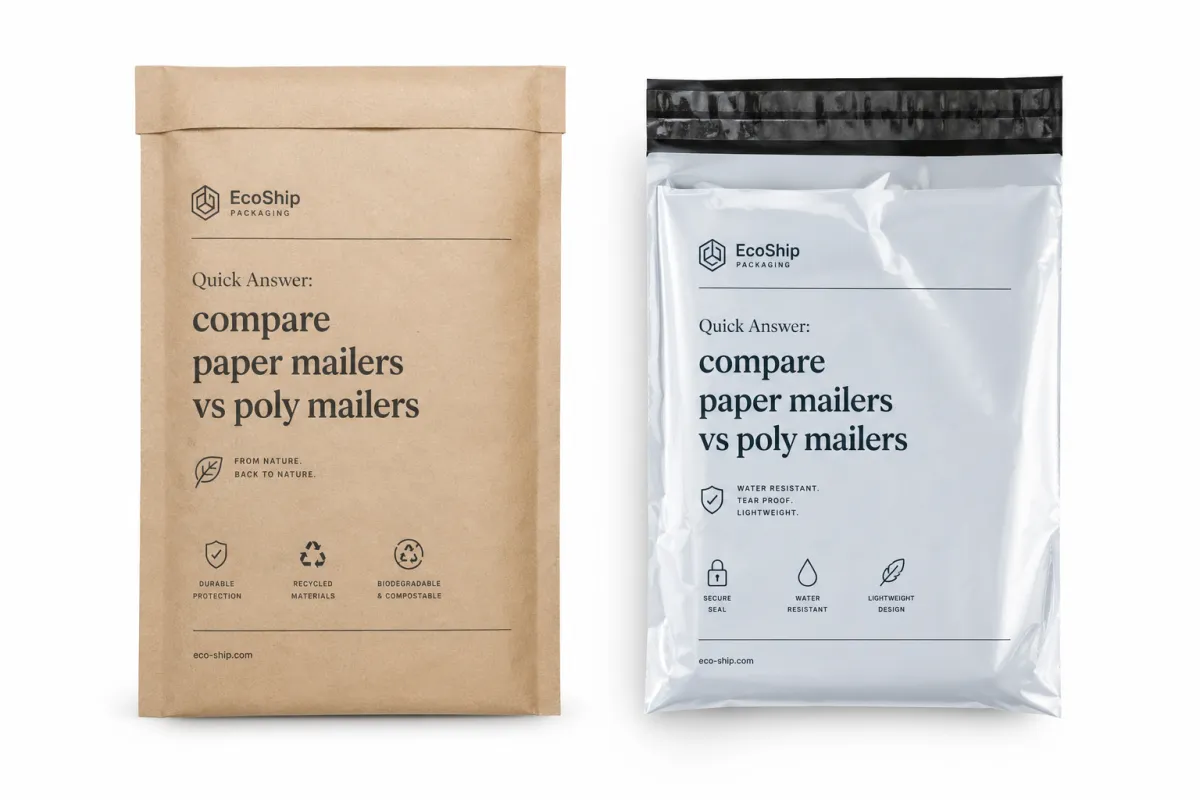
If you want the shortest honest answer, paper mailers are usually the better fit for premium apparel, giftable goods, and brands that want a natural, tactile presentation. Poly mailers are usually the better fit for high-volume orders, moisture-prone routes, and operations that care most about speed, lower labor cost, and a stronger moisture barrier. If your shipment may face sharp corners, rain, or long dwell times, poly usually wins. If the package itself helps sell the product, paper often earns its place. That is the answer I keep coming back to after years of watching stock kraft mailers and custom-Printed Poly Mailers behave very differently once they leave the warehouse.
One practical twist: the right answer can change by SKU. A soft sweater in a premium line may deserve paper, while the same brand's basic tees may ship better in poly. So when you compare paper mailers vs poly mailers, do not stop at the brand level. Split the decision by product type, route risk, and the pace of your packing line. That is where the real difference hides.
Top Options Compared: compare paper mailers vs poly mailers side by side
To compare paper mailers vs poly mailers properly, I like to strip the conversation down to six things: hand feel, tear resistance, moisture protection, weight, print quality, and what happens to the mailer after delivery. Those six points decide far more than the label on the material sheet. A 60 gsm kraft mailer can look elegant on a table. A 2.5 mil poly mailer can look plain. Yet the second one may survive a wet truck transfer, a rough conveyor, and a porch drop with less drama. I have learned not to trust the sample that only ever sits under nice lighting on a conference table in Los Angeles.
Here is the practical difference I see most often. Paper feels textured, structured, and intentionally branded. Poly feels slick, flexible, and operational. That difference shows up immediately at the packing station. Paper often needs a more careful tuck, a cleaner seal, and a little more hand alignment. Poly slides faster, compresses better around the product, and usually behaves more predictably when staff are moving at pace. If you compare paper mailers vs poly mailers in a live pack-out, the gap shows up in seconds, not theories.
| Factor | Paper mailers | Poly mailers |
|---|---|---|
| Typical material feel | Matte, structured, premium | Slick, flexible, utilitarian |
| Common unit cost at 5,000 pcs | $0.18-$0.38, depending on 60 gsm to 90 gsm kraft and print coverage | $0.08-$0.16, depending on 2.0 mil to 3.0 mil film and stock color |
| Moisture resistance | Low to moderate | High |
| Tear and puncture behavior | Stronger on flat surfaces, weaker at corners and fold lines | Very good on flex and crush, weaker on sharp edges if film is thin |
| Print appearance | Natural, muted, premium | Bold, high contrast, bright color possible |
| Best-fit products | Apparel, books, soft goods, gifts | Apparel, accessories, cosmetics, lightweight hardgoods |
| Packing speed | Moderate | Fast |
| Customer perception | More premium, less plastic-heavy | More practical, less gift-like |
Across product categories, the pattern repeats. Apparel is the obvious crossover category, but the better choice depends on price point and destination mix. A boutique sweater brand in Brooklyn can use paper and look expensive without spending much more than $0.10 to $0.20 extra per order. A discount basics brand shipping 3,000 units a week from Dallas may not recapture that spend. Books and flat media can ship in either format, but sharp corners and long transit times make the edge cases matter. Cosmetics and accessories also split neatly: paper looks better on a shelf and in a social post, while poly handles odd shapes and occasional leakage better. If you compare paper mailers vs poly mailers by category instead of by ideology, the answer changes faster than most buyers expect.
One more operational point matters. Paper mailers are usually easier to label on a clean matte surface, and that matters if your team prints carrier labels in batches of 250. Poly mailers are easier to stack, easier to store in narrow aisles, and often friendlier to semi-automated pack stations. I have watched a small 3PL in Indianapolis shave 1.8 seconds per order simply because the poly mailer fed into the operator's hand more cleanly than the paper version. That sounds minor until you multiply it by 8,000 orders a month. Then it starts to look like actual money, which is always the moment everyone suddenly pays attention.
Detailed Reviews: where paper mailers outperform
Paper mailers earn their keep in places where presentation influences repeat purchases. I am talking about boutique apparel, artisan goods, limited drops, subscription kits, and giftable products where the customer is likely to photograph the package before they touch the item inside. When I visited a mid-size apparel brand's packaging line in Portland, the founder told me their social engagement improved after they switched to kraft paper because the mailer looked intentional instead of disposable. That is not a lab metric, but it is real revenue behavior. Real people buy with their eyes first, even when they insist otherwise.
Branding and unboxing
Paper gives you a stronger story surface. It takes ink well, it accepts simple one- or two-color branding cleanly, and it reads as more tactile in hand. A 70 gsm or 80 gsm kraft paper mailer can hold a logo, a message, and a return address without fighting the material. That is why I often recommend paper for brands that want a soft premium signal without paying for a rigid box. If you compare paper mailers vs poly mailers on perceived value alone, paper wins more often than not. The first time I held a well-printed kraft mailer from a small candle brand in Austin, I remember thinking, "That costs less than a box and does twice the emotional work." Slightly annoying for box people, I know.
There is also a trust factor. Customers who are primed to dislike plastic notice paper immediately. I have had clients tell me, "The mailer became part of the product story." One skincare founder in Toronto said that after switching to paper, customers were more willing to forgive a delayed delivery because the parcel felt thoughtful. That is not magic. It is packaging psychology. The outer layer frames the whole transaction. If the outside feels cared for, people often assume the inside was too.
Where paper still struggles
Paper mailers are not a free pass into sustainability credibility. They can scuff, absorb moisture, and weaken at folds if the product has sharp corners or if the warehouse runs humid. I have seen corners of hardcover books mark through a 60 gsm envelope in transit, and I have seen paper seams soften after a delivery truck sat open in drizzle for 20 minutes near Philadelphia. If you compare paper mailers vs poly mailers only by how the material looks on day one, paper can fool you. The real test is what happens after four conveyor bends and a dirty porch drop.
That is why I would not use paper for products with hard edges, pointed closures, or any shipment likely to sit outside in wet weather. I also avoid it for storage rooms that swing above 65% humidity, because paper can lose its crisp feel before it ever reaches the customer. If the item itself is expensive enough to justify a return headache, the wrong mailer becomes a small but visible cost leak. A single damaged order at $42 retail can erase the savings from 8 or 9 cheaper mailers. I have seen the finance team discover that with the same expression people wear when the printer jams for the third time before noon.
"We liked the paper sample on day one, but once our Midwest orders went through a rainy week, the damage rate rose enough that we had to rethink it." That line came from a founder meeting in Columbus, and I remember it because the tone was not dramatic. It was exhausted. Packaging decisions have a way of sounding elegant until they meet 14 days of bad weather and a carrier yard with no roof.
If fiber sourcing matters to your brand claims, ask for documentation instead of assuming the logo on the mailer tells the full story. I look for FSC chain-of-custody support when a customer wants to make a responsible sourcing claim, because the paper source should be provable, not implied. For brands that want packaging claims to stand up in a tough conversation, that level of documentation matters more than a marketing sentence printed on the flap. A certified mill in Vietnam's Binh Duong province or a paper convertor in Poland can give you better paper traceability than a pretty label ever will.
Honestly, paper works best as a strategic choice, not a moral badge. If the shipment is light, dry, visually driven, and not high risk, paper is smart. If the shipment is heavy, sharp, or weather-exposed, paper can become expensive very quickly. That is the split I keep seeing in the field, over and over, no matter how elegant the sample swatch looks in the sales kit. A good decision is usually boring at first glance and easier to defend six months later.
Detailed Reviews: where poly mailers still win
Poly mailers remain the default for a reason: they move fast, they cost less, and they shrug off conditions that would make paper look tired. On a packing line, that matters. A 2.5 mil poly mailer can be loaded, sealed, and labeled with almost no resistance. The material flexes around the product, which reduces bulk and often lowers dimensional weight pressure compared with a box. If you compare paper mailers vs poly mailers from the standpoint of throughput, poly is often the practical answer. I would be lying if I said I have not quietly rooted for the poly option during a brutal Cyber Monday rush.
Why high-volume operators keep buying poly
High-volume fulfillment usually revolves around seconds, not aesthetics. I have watched a team of four packers in Phoenix process 1,000 orders in a morning with poly because the motion was simple: insert, peel, seal, slap on the label. Paper required more alignment and more attention at the flap, which slowed the line enough to matter. When labor runs $18 to $24 an hour, even a 5-second difference per order adds up to real money by the end of the month. If your team ships 20,000 orders, that is nearly 28 labor hours. And if you have ever seen a supervisor count those seconds on a clipboard, you know the mood in the room gets weird fast.
Poly also stores well. It stacks flatter, occupies less cubic space, and tends to survive warehouse handling without curling or fraying. That makes it easier for operators who buy in 10,000-unit runs and stage material in tight bins. A 10 x 13 inch poly mailer bundle might take one shelf cube in a facility in Atlanta, while a thicker paper equivalent can hog enough room to matter when aisles are already narrow. If you compare paper mailers vs poly mailers in a warehouse where space is expensive, poly can reduce friction before the order is even packed.
What poly does not solve
Poly's weakness is perception. Some customers still read it as cheap, even if the product inside is excellent. It can also raise sustainability objections, especially if the brand has already promised a lower-plastic story. I have been in supplier negotiations where the conversation turned less on cost and more on brand reputation. One procurement manager asked me whether a 10 x 13 inch White Poly Mailer at $0.11 per unit would hurt the company's premium positioning more than a $0.26 paper alternative would help it. The answer was yes, for that brand and that customer base, but not for a basics retailer selling socks by the dozen from a warehouse in Memphis.
That honesty matters. Poly is not automatically the wrong choice just because it is plastic. It is the right choice for some fulfillment models because it lowers re-pack risk, it resists rain, and it protects product margins. If a shipment may sit on a loading dock, ride through a storm, or move through a lot of conveyor contact, poly usually gives you fewer surprises. If you need transit validation, I would rather see the packaging tested against an ISTA-style drop and compression framework than trust a sales claim that says "strong enough" without evidence. A lab report from a facility in New Jersey or Michigan beats a hand-wavy promise every time.
There is also a labor reality that people undercount. Poly is often easier on packers with varied training levels. The film gives a little. The seal is predictable. The finished mailer looks consistent even when the product inside varies by a few millimeters. In operations terms, that consistency is worth more than a lot of branding language. If you compare paper mailers vs poly mailers under actual shift conditions, poly often wins because it keeps the line calm. Calm lines ship orders. Fussy lines just create new problems for the next shift.
Price Comparison and total cost over time
The mistake I see most buyers make is treating unit price as the whole purchase. It is not. A proper compare paper mailers vs poly mailers exercise has to include damage rates, labor time, custom printing, freight, storage, and the cost of a re-ship when something fails. A paper mailer at $0.24 can be cheaper than a poly mailer at $0.11 if the paper version improves brand value enough to lift repeat order rate by even 2% over 90 days. The reverse is also true if paper raises a 1% damage rate on wet routes. I have watched a few cents turn into a very expensive lesson, which is a fun sentence nobody likes to hear in a budget review.
Here is the way I model it with clients: mailer price + pack time + damage risk + storage cost + brand value = more realistic total cost. That formula is not elegant, but it is better than chasing the lowest line item. I have seen a $0.06 savings disappear after one extra support ticket, one re-ship, and one refund issued to calm an irritated customer in Seattle. If you compare paper mailers vs poly mailers using the full cost stack, the outcome often flips. Fast. Sometimes embarrassingly fast.
| Cost factor | Paper mailers | Poly mailers |
|---|---|---|
| Stock unit price at 5,000 pcs | $0.18-$0.38 | $0.08-$0.16 |
| Custom print setup | $180-$350 depending on size, colors, and plate count | $120-$280 depending on size, colors, and plate count |
| Average pack time impact | Slower by 2-6 seconds per order in many flows | Faster by 2-6 seconds per order in many flows |
| Damage sensitivity | Higher in wet or sharp-edged shipments | Lower in wet or crush-prone shipments |
| Storage footprint | Moderate | Low |
| Freight impact | Usually slightly heavier | Usually lighter |
Custom printing changes the math again. A plain stock paper mailer might feel expensive until you compare it with the branding value of a custom-printed poly mailer that sends the wrong impression. I have seen a brand absorb a $1,200 setup fee because the printed mailer helped unify a product line that was scattered across three SKUs and two warehouses. That kind of expense only makes sense if the design is stable and the monthly volume is real. If you are still changing logos or colorways every quarter, stock mailers may be the wiser move. I know that sounds boring. It is also how people avoid expensive reprints.
Minimum order quantities also matter. Paper converters often want larger runs because the material and print setup are less forgiving, while poly suppliers may offer more flexible quantities on basic stock. Freight adds another layer. A higher-weight paper mailer may cost a little more to ship, and that difference becomes visible on long-distance replenishment moves from Los Angeles to Miami or from Shenzhen to Rotterdam. I have had clients compare paper mailers vs poly mailers at the unit level, then discover that the landed cost gap widened by 8% after freight and storage were added.
My rule is plain. If your brand lives on margin and throughput, poly is usually the better spend. If your brand lives on presentation and a stronger tactile story, paper can be worth the higher unit price. The best answer is rarely "always." It is usually "for this SKU, this season, and this customer mix." That answer is less dramatic, but it actually holds up in real operations and survives the quarterly review.
How to Choose a mailer by product, budget, and process
I tell teams to compare paper mailers vs poly mailers by asking four questions in order: What are you shipping, where is it going, how fast do you need to pack it, and what story do you want the package to tell? That order matters. Product fragility comes first. Climate comes second. Fulfillment speed comes third. Branding comes fourth. Too many buyers reverse that sequence and then wonder why the mailer looks nice but causes complaints. I have sat through those meetings in Toronto and Dallas, and they are never as charming as the mood boards.
If the product is soft, flat, and relatively light, paper becomes more viable. If the product has corners, slip cases, closures, or any chance of puncture, poly usually deserves the first test. If the shipping footprint includes coastal humidity, rainy regions, or porch exposure, poly gains ground again. If the order volume sits below 1,000 units a month, the labor savings from poly may matter less than the brand upside from paper. That is why I always ask for SKU-level details before I give a recommendation. A 350gsm C1S artboard insert card changes the feel of a kit, but it does not change the need for a mailer that can survive the trip.
Testing before switching
My favorite method is small but strict. Order samples of both materials. Pack the same SKU 25 times in each. Measure the pack-out time, the seal quality, the label adhesion, and the fit at the corners. Then do a short field test with real carriers, not just a desk test. I like to compare the result against an ISTA-style transit mindset because actual shipping is not gentle. A 36-inch drop, compression in a truck, and a damp-handling scenario tell you more than a sales sheet ever will. The sales sheet is polite; the truck is not. If the sample set comes from a mill in Zhejiang or a converting plant in Ho Chi Minh City, so much the better, because you will see the real finish instead of a camera-filtered version.
For custom projects, I usually advise a sourcing timeline of 12-15 business days from proof approval for printed stock if the specification is simple, and 18-25 business days if the artwork, sizes, or finish need extra setup. That time can stretch if the supplier is juggling peak season or if the artwork requires revision rounds. A straightforward order for 5,000 units with one-color flexo printing is one thing; a three-color print with a matte varnish or a custom gusset is another. If you need more packaging formats in one program, our Custom Packaging Products catalog can help you compare multiple substrates without starting from zero.
Budget and timeline pressure
For a launch pilot, paper makes sense when you want the packaging to say something specific about the brand and you can tolerate a bit more handling care. For an established operation that ships every weekday, poly often wins because it reduces friction across the line. I have seen teams waste two full meetings arguing material philosophy while the real issue was a 90-second bottleneck at the tape station. If you compare paper mailers vs poly mailers with the line supervisor in the room, the answer usually gets sharper fast. The person with tape on their fingers all day tends to have opinions worth hearing.
Check the basics before you commit. Verify seal strength. Confirm the product does not move inside the mailer. Measure packing speed with the same packer across both materials. Ask customer service how many damage complaints they have logged in the last 90 days. Then weigh brand presentation against that data. If a supplier cannot give you sample pricing, lead time, and a written spec sheet, I would keep shopping. That applies even more if you are considering custom poly and want a reference point from our Custom Poly Mailers options, which are often quoted with 2.2 mil, 2.5 mil, or 3.0 mil film thickness depending on the SKU.
One more thing: do not make the choice in a boardroom only. Put both mailers on a real bench, with real items, under real time pressure. The right answer often changes by season, by region, and by fulfillment method. A mailer that looks perfect in a design review can become awkward on a Tuesday morning when three part-time packers are trying to process 600 orders before lunch. I have seen that happen in both New Jersey and California, and nobody in the room was smiling by 11:15.
Our Recommendation: compare paper mailers vs poly mailers by use case
Here is the clearest recommendation matrix I can give after testing both materials across different product lines and speaking with brands that live and die by repeat orders. If you compare paper mailers vs poly mailers for brand-led shipments, paper is often the better pick. If you compare them for speed-led, cost-sensitive, weather-exposed shipments, poly usually wins. That is not a slogan. It is a pattern I keep seeing in supplier quotes, damage logs, and pack station observations from facilities in Illinois, Guangdong, and South Carolina.
Use paper if your order mix is mostly apparel, gifts, artisan goods, soft accessories, or light products where the outer package has a role in the brand story. Use poly if your mix includes high-volume basics, heavier soft goods, or anything that may face moisture, rough handling, or tight margin pressure. Use paper if the customer is likely to notice texture and finish. Use poly if the customer is likely to notice only whether the order arrived intact and on time. If you compare paper mailers vs poly mailers honestly, the right answer depends on the job the mailer has to do.
My practical next step is simple: order samples of both, pack the same SKU in each, run a small live test, and track damage, speed, and customer feedback for at least 50 to 100 orders. Do not guess. Do not rely on the prettiest render. The cheapest material is not the cheapest outcome if it causes rework, while the nicest-looking material is not the best if it slows the line by 4 seconds per order. A focused pilot will tell you more than a week of opinions, especially if you are comparing stock mailers against a custom run approved from PDF proof to production in under 14 business days.
If I had to choose for a brand with one hero SKU and a premium story, I would start with paper and prove the fit. If I had to choose for a growing fulfillment team processing 500+ orders a day, I would start with poly and protect the operation first. Then I would revisit the decision after the first 30 days, because real order data beats hunches every time. That is how I would compare paper mailers vs poly mailers in my own business before placing a large order.
For brands that need a custom package program broader than one mailer type, start with the structure, then the print, then the line flow. That is how the best packaging systems are built. Not by chasing the cheapest number in isolation, but by matching the material to the product, the promise, and the warehouse reality. Boring? Maybe. Effective? Absolutely. A 350gsm C1S artboard thank-you card, a matte paper mailer, and a poly backup SKU can live in the same program if the sequence is right.
Which is cheaper when I compare paper mailers vs poly mailers?
Poly mailers are usually cheaper per unit, especially at 5,000 pieces or more. In the quotes I see most often, basic poly lands around $0.08 to $0.16 each, while paper often sits closer to $0.18 to $0.38. Paper can still win on total cost if the brand value is higher or if it reduces damage and support tickets, especially when a higher-end paper mailer is produced in a plant in Suzhou or Monterrey with tight quality control.
Are paper mailers or poly mailers better for apparel shipments?
Paper works well for premium apparel, boutique drops, and brands that want a more tactile unboxing moment. Poly is often better for basic tees, activewear, and higher-volume apparel orders where speed and unit cost matter more. If the apparel has hang tags, delicate trims, or a presentation-heavy story, paper usually feels better in hand, especially for shipments headed to urban addresses where the unboxing is likely to be photographed.
Do paper mailers hold up in rain as well as poly mailers?
No. Poly mailers resist moisture far better. Paper can soften, scuff, and weaken when it sits in rain, damp storage, or humid transit conditions. If your parcels may sit on porches or move through wet climates like the Pacific Northwest, the UK, or coastal New Jersey, poly is the safer protective choice by a wide margin.
How long does it take to switch from poly to paper mailers?
A stock-to-stock switch can happen quickly once samples are approved. A custom-printed paper mailer usually takes longer. I normally plan 12-15 business days from proof approval for straightforward runs, and longer if the artwork, size, or finish needs revision. If your calendar is tight, sample early, keep one fallback SKU on hand, and make sure the supplier confirms production in writing rather than verbally.
Can I custom print paper mailers the same way I custom print poly mailers?
Yes, both can be custom printed, but the result looks different because the surfaces behave differently. Paper usually gives a softer, more natural finish, while poly can deliver sharper color contrast and a brighter brand pop. The choice is less about whether printing is possible and more about the visual story you want the customer to feel in the first three seconds, whether the job runs one-color in Kansas City or full-color in Shenzhen.