Buyer Fit Snapshot
| Best fit | Custom Kraft Paper Tubes Bulk projects where brand print, material claims, artwork control, MOQ, and repeat-order consistency need to be specified before quoting. |
|---|---|
| Quote inputs | Share finished size, material target, print colors, finish, packing count, annual reorder estimate, ship-to region, and any compliance wording. |
| Proofing check | Approve dieline scale, logo placement, barcode or warning zones, color tolerance, closure strength, and carton packing before bulk production. |
| Main risk | Vague material claims, crowded artwork, missing packing details, or unclear freight terms can make a low unit price expensive after revisions. |
Fast answer: Custom Kraft Paper Tubes Bulk: Board, Finish, Dieline, and Unit Cost should be specified like a repeatable production item. The safest quote records material, print method, finish, artwork proof, packing count, and reorder notes in one written spec.
Production checks before approval
Compare the actual filled-product size with the drawing, then confirm tolerance on folds, seals, hang holes, label areas, and retail display edges. Reserve space for logos, QR codes, warning copy, and material claims before decorative graphics fill the panel.
Quote comparison points
Review material grade, print process, finish, sampling route, tooling charges, carton quantity, and freight assumptions side by side. A quote is only useful when the supplier can repeat the same color, closure quality, and packing count on the next order.
The first time I watched a buyer compare crushed cartons to rigid tubes on a factory floor in Dongguan, Guangdong, the arithmetic was ugly in the best possible way. The carton cost about $0.07 less per unit, but the damaged returns on the first 4,800-unit shipment erased that savings fast. I remember standing there with a clipboard and thinking, "Well, that went exactly how bad packaging usually goes." That is why Custom kraft paper tubes bulk keeps surfacing in serious packaging conversations: the tube costs a little more upfront, then pays for itself where the damage usually happens, in transit and in the customer’s hands.
I’ve seen the same pattern with tea, candles, poster sets, supplements, and cosmetics in Shenzhen, Foshan, and Ningbo. A buyer walks in expecting a plain shipping format and leaves asking for branded packaging that can sit on a shelf, survive a 1.2-meter drop test, and still look sharp from a few feet away. Custom Kraft Paper tubes bulk does that job without pushing the order into the price tier of heavy luxury rigid boxes. If you’re ordering 5,000 pieces, 10,000 pieces, or more, the per-unit gap gets easier to defend once replacement claims and tired shelf presentation stop eating into the margin.
My rule is simple: if the package has to do three jobs at once, the cheapest-looking option usually loses. Custom Kraft Paper Tubes bulk can protect a glass candle jar, hold a rolled poster, frame a serum set, or turn a basic apparel accessory into something that feels intentional. That is package branding, not guesswork. A 65 mm x 220 mm tube with a 0.8 mm paperboard core and a 120 gsm natural kraft wrap can do more than a glossy carton that folds after two warehouse scans. Packaging theater is expensive. Real protection is boring, and boring is often the point.
Why custom kraft paper tubes bulk works for real brands
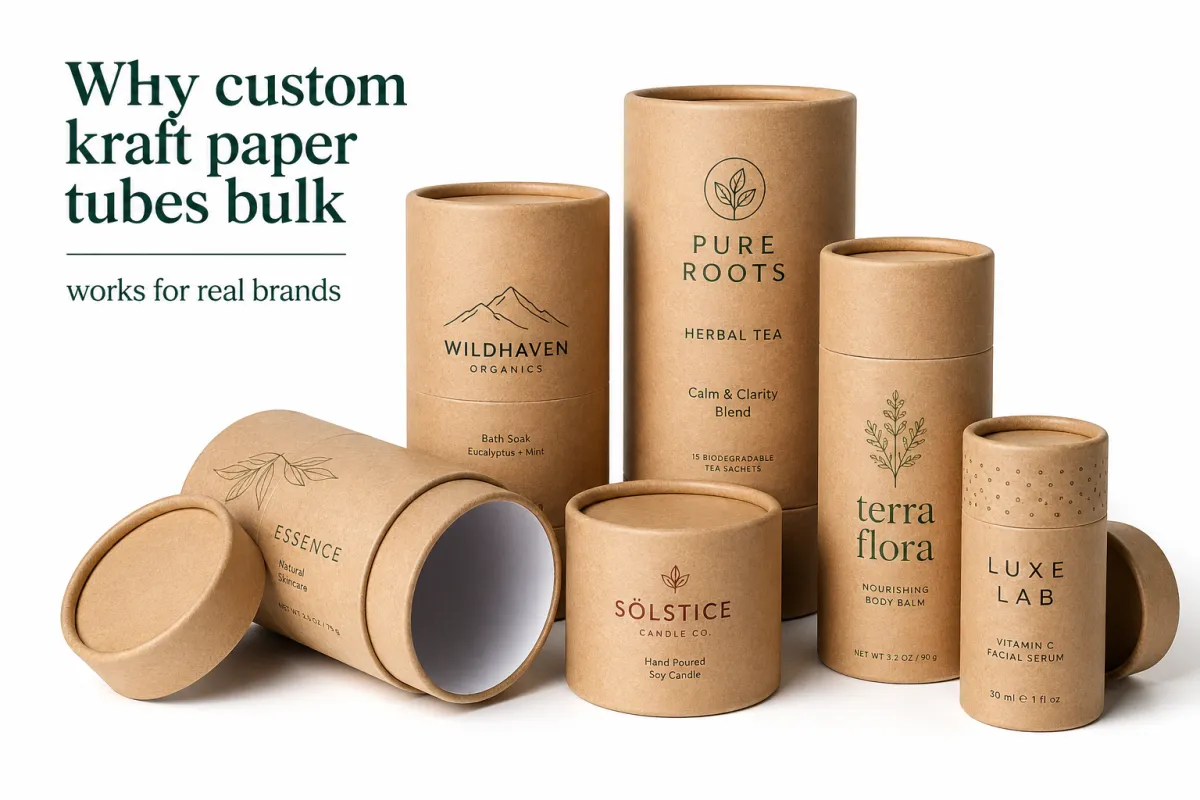
Brands do not buy Custom Kraft Paper tubes bulk because they are obsessed with paper tubes. They buy them because the tube solves practical problems that folding cartons and flimsy inserts do not. A 60 mm x 200 mm tube with a paperboard core and a friction-fit cap can hold a candle, a tea tin, or a pair of premium socks without collapsing in a shipper. I’ve watched a cosmetics buyer compare that with a thin carton that started bowing under 18 kg of mixed freight in a warehouse near Guangzhou. The tube won that argument in about 30 seconds, which was about how long it took the carton to look defeated.
The better question is not whether it looks fancy. The better question is whether it lowers the total cost of getting product to the customer. In custom kraft paper tubes bulk, the answer is often yes. You get better shelf presence than plain corrugated cardboard, tighter stacking than soft pouches, and a cleaner customer experience than a generic mailer. For candle brands, the cylinder shape signals substance. For tea, it protects aroma bags and loose-leaf tins. For posters and apparel accessories, the format keeps the product from arriving bent, scuffed, or dusty after a 22-day ocean lane from Yantian to Long Beach.
“We cut our damage claims almost in half after moving the gift set into custom kraft paper tubes bulk,” one buyer told me after a trial run of 8,000 pieces in Dongguan. “The package looked better, and the warehouse stopped re-taping weak corners every week.”
That quote sounds blunt because it is. The buyer was comparing a tube against Custom Printed Boxes and a cheap sleeve that looked fine in a mockup but failed during pallet stacking. A lot of teams get trapped by unit price alone. A $0.14 difference on 10,000 units sounds dramatic until you compare it with a $1,200 damage claim, three hours of labor rework, and a retail buyer asking why the display looks tired before it even lands on the shelf. Custom kraft paper tubes bulk is a volume decision, not a decoration. It is also the kind of move that makes procurement teams look wise six months later, which is a rare and delightful event.
There is also a supply chain angle people miss. Tubes stack cleanly, they resist corner crush better than light cartons, and they are easier to nest in finished goods warehouses. In my experience, that matters once the order is crossing a long lane from Shenzhen to Chicago or from Ningbo to Rotterdam. If you want a practical reference point, look at transit testing standards like ISTA transit testing and build the spec around the actual drop and compression risk, not around what looked pretty in a sales sample. A product that survives a realistic drop and vibration sequence is worth more than a package that only survives a studio photoshoot.
Custom kraft paper tubes bulk also fits retail packaging that needs a premium signal without the waste of overbuilt construction. I’ve seen it work for supplement launches, small apparel accessories, artisan chocolate, and gift sets where the buyer wanted a branded package that felt deliberate at a $24 to $48 retail price point. If the product has enough margin to absorb a better package, the tube usually makes sense. If the product is a commodity and the customer never sees the package, I’d probably keep the money in the product instead. That opinion has saved more than one team from a very expensive shiny mistake.
One more thing: the tube format is not automatically sustainable just because it is paper-based. The claim has to be supported. If a supplier cannot show the paper chain of custody, recycled content paperwork, or the exact coating used, the environmental story gets shaky fast. That is where honest sourcing beats marketing copy every time.
Custom kraft paper tubes bulk: product details that matter
Construction is where custom kraft paper tubes bulk either earns its keep or turns into an expensive headache. A good tube is usually built from a kraft paper wrap on the outside, a paperboard core in the middle, and an inner liner that may be plain paper, food-safe paper, or a moisture-resistant layer depending on the product. That layered build gives you crush resistance and a print surface that takes ink better than a rough corrugated surface. If you want the logo to stay crisp, the substrate matters as much as the artwork. I learned that the hard way on a run where the artwork looked beautiful on screen and a little fuzzy in real life on 157 gsm kraft wrapped around a 1.0 mm grayboard core. The printer was right, which is an annoying sentence to write, but there it is.
Closure style matters just as much. I’ve negotiated with cap suppliers in Shenzhen who wanted to push metal lids on every order because they carried a higher margin. Sure, a metal cap looks nice on a 90 mm tube, but it is not always the right move for a subscription candle brand shipping 12,000 units a month from Foshan. Friction-fit paper caps, shoulder-and-neck styles, and open-ended display tubes solve different problems. For retail packaging, a tight cap with a clean seam is usually enough. For shipping inserts or poster storage, an open end can be smarter and cheaper by $0.03 to $0.11 per unit. That difference sounds tiny until it lands on a 30,000-piece order.
Printing is where brands often overcomplicate things. Full-wrap graphics are possible in custom kraft paper tubes bulk, but a strong one-color logo or a two-color mark can look more expensive than a busy print that tries too hard. I learned that at a client meeting with a tea brand in Austin. They brought a concept with six colors, foil, and a busy background pattern. We cut it down to a dark green logo, one warm accent, and a matte kraft finish. The final tube looked sharper, cost less, and ran faster because the press setup was simpler. I still remember the art director staring at the pared-down version as if we had taken away his favorite toy. We had, and the result was better.
Finish choices change the entire feel. Matte lamination gives a quieter, more modern look. Gloss adds brightness, but it can fight the natural texture that makes kraft paper appealing in the first place. Soft-touch coating feels premium, though it adds cost and can be overkill for items that are meant to feel earthy or utilitarian. In custom kraft paper tubes bulk, I usually tell buyers to start with the product story. If the brand is organic tea, clean beauty, or hand-poured candles, the kraft texture should do most of the talking. If the item is a collector’s gift set, then the finish can work harder.
For industry fit, here is the short version. Candles want a snug tube with a chip-resistant liner. Cosmetics want accurate diameter control and good label real estate. Teas need odor control and a clean barcode zone. Apparel accessories can use a lighter wall thickness if the product is soft and low-risk. Posters need length accuracy and a cap that stays put. Supplements often need a liner or coating that handles moisture and label compliance. That is why custom kraft paper tubes bulk is not one spec. It is a family of specs, and pretending otherwise is how teams end up with expensive reprints and a room full of awkward silence.
One practical detail I keep seeing on cosmetic and tea launches is a 350 gsm C1S artboard insert card inside the tube for instructions, batch code, or a tasting note. That small piece of board can raise perceived value by a few dollars at retail without changing the tube size at all. A buyer in Ningbo once told me the insert card did more for sell-through than the foil stamp on the lid, which is a reminder that packaging is often a sequence of modest choices, not one grand gesture.
Specifications for custom kraft paper tubes bulk orders
If you want an accurate quote for custom kraft paper tubes bulk, start with the numbers that actually define the tube. I need inner diameter, outer diameter, height, wall thickness, paper weight, cap style, and print area. If any of those are missing, the quote is just a rough guess dressed up as certainty. A 50 mm inner diameter tube is a completely different animal from a 70 mm one, even if both are the same height. The product fit changes. The freight pallet count changes. The damage risk changes. Everything changes. It is a bit like asking a tailor for “medium” and expecting a wedding suit to appear from the fog.
Tolerance is not a technical footnote. It is the difference between a product that slides in cleanly and a product that rattles around like loose change. In practical terms, I like to see diameter tolerance around +/-1 mm and height tolerance around +/-2 mm for most custom kraft paper tubes bulk programs, but that depends on the product and the line. A rigid candle jar with a shoulder can tolerate less movement than a soft textile item. A poster tube needs enough clearance to insert paper without scuffing, but not enough slack to turn the package into a drum. On a 300 mm poster tube made in Dongguan, that 1 mm difference is the distance between “premium” and “why is the poster bent?”
Artwork files are where many orders get derailed. Send a vector PDF or AI file, not a low-resolution JPEG from a sales deck. I’ve had buyers send me a 600-pixel logo and then wonder why the printer could not make the edge look clean on a 220 mm cylinder. Use the proper dieline, keep 3 mm bleed, and leave at least a 5 mm safe zone away from the trim. On a tube, the seam and curve matter. Bad placement makes even a strong design look amateur. Good placement, by contrast, can make a simple mark feel expensive without any extra decoration doing the heavy lifting.
There are also compliance and label issues to think through before production starts. Food-contact tubes may need a liner choice that supports odor control and safe-contact claims. Cosmetic tubes need room for ingredients, batch code, and any local labeling requirements. If the product sits in a humid warehouse, ask about moisture resistance or a coating that protects the kraft surface. If the brand is making sustainability claims, I push for paper sourced through the right chain, and I will happily point a buyer to FSC-certified paper sourcing before they write a claim they cannot support. A seller in Zhejiang once tried to claim recycled content without paperwork; that lasted about as long as a bad haircut in a humid summer.
Here is the spec checklist I ask for before I quote custom kraft paper tubes bulk:
- Diameter: inner and outer size in millimeters, plus product insert clearance.
- Height: finished tube height, cap overlap, and any shoulder depth.
- Wall thickness: light, medium, or heavy build, usually tied to product weight.
- Print method: one-color, two-color, full-wrap, or special finish.
- Closure: paper cap, metal lid, shoulder-and-neck, or open-ended.
- Compliance notes: food, cosmetic, barcode, label, or moisture requirements.
I keep that checklist tight because it prevents the worst kind of surprise: a sample that looks nice and ships badly. In custom kraft paper tubes bulk, the spec sheet is the package design. The rest is decoration. And decoration, by itself, does not survive freight from Shenzhen to Seattle.
Pricing and MOQ for custom kraft paper tubes bulk
Pricing for custom kraft paper tubes bulk is not random. It follows a short list of cost drivers, and once you know them, the quotes stop looking mysterious. Size is first. A 50 mm x 180 mm tube uses less board than a 90 mm x 300 mm tube, so the material cost is lower. Wall thickness is next. A heavier build uses more kraft paper and more adhesive. Print complexity follows closely behind. One-color branding is cheaper than full-wrap artwork, especially if the design needs careful seam alignment.
MOQ works the same way. Smaller formats usually allow lower minimums because they are easier to run, easier to pack, and easier to store. Special caps, custom tooling, high-color graphics, and specialty finishes push the MOQ up because the line has to be set and checked more carefully. For a buyer comparing suppliers, the real question is not what the lowest MOQ is. It is what MOQ gets me a clean unit price without creating dead stock I cannot move. That is the kind of question that protects margin.
Here is the pricing pattern I see most often for custom kraft paper tubes bulk, based on standard dimensions and common closures:
| Tube style | Typical MOQ | Unit price at 5,000 pieces | Setup / extra costs | Best use case |
|---|---|---|---|---|
| 35 mm x 120 mm mini tube sleeve, one-color print, no lamination | 1,000 to 2,000 | $0.15 to $0.24 | $45 setup, $28 per color plate | Sample sets, small accessories, insert packaging |
| 50 mm x 180 mm, one-color print, paper cap | 1,000 to 2,000 | $0.42 to $0.58 | $60 setup, $35 per color plate | Teas, small accessories, sample kits |
| 65 mm x 220 mm, two-color print, paper cap | 2,000 to 3,000 | $0.62 to $0.84 | $85 setup, $50 to $70 proofing | Candles, cosmetics, gift sets |
| 90 mm x 300 mm, full-wrap print, matte finish | 3,000 to 5,000 | $1.08 to $1.62 | $120 setup, $90 plate and color control | Posters, premium retail packaging, collector items |
Those numbers are not fairy dust. They are the kind of ranges I see when the spec is stable, the artwork is prepared correctly, and the freight is quoted separately. If a supplier gives you a unit price but hides setup fees, plate charges, carton packs, and shipping, the quote is incomplete. I would rather see a clear $0.74 unit price with a $110 setup than a fake bargain that turns into a surprise bill later. I have seen too many “cheap” quotes behave like a cat knocking a glass off a table: fast, loud, and somehow your fault.
Bulk savings show up once production is standardized. The first sample might cost $35 to $120 depending on complexity. The initial production run carries setup work, color adjustment, and line calibration. Once the spec is locked, the price often drops by 8% to 18% on repeat orders because the factory is not re-solving the same problem. That is one reason custom kraft paper tubes bulk makes sense at scale. The order gets cleaner with each run, and nobody has to relearn where the seam should go.
Freight is the part buyers underestimate most. A pallet of tubes is not heavy, but dimensional weight can still bite you if the tubes are long or packed loosely. I’ve seen a buyer save $0.09 per unit in production and lose $0.14 per unit in shipping because they chose a tube height that forced a weak carton configuration. Ask for shipping quotes that separate factory pickup, export cartons, and the final freight lane. If the supplier ships from a Shenzhen facility, I want the incoterms spelled out before anyone approves the order, and I want the carton count per 20-foot container written down in black ink, not guessed in a phone call.
For a simple planning rule, think of custom kraft paper tubes bulk in four cost buckets: sample, setup, production, and freight. If any one of those buckets is hidden, the quote is not useful. I tell buyers to compare at least three offers by total landed cost, not by unit price alone. That is how you avoid getting tricked by a cheap-looking spreadsheet. Spreadsheets can lie politely; freight bills usually do not.
Production process and timeline for custom kraft paper tubes bulk
The order flow for custom kraft paper tubes bulk is straightforward if the buyer keeps the approvals moving. First, you send specs and artwork. Then the supplier confirms price, structure, and cap style. Next comes the dieline review, which should be checked by someone who understands print offsets, not just someone who likes the logo color. After that, you approve a sample or pre-production proof. Only then does the factory start the full run. Once production ends, the tubes are inspected, packed, and shipped. A plant in Dongguan will usually run this process differently from a plant in Zhejiang, but the sequence should still stay the same.
Timing varies by spec, but I like to give buyers real numbers instead of cheerful nonsense. Quote review usually takes 1 to 2 business days if the dimensions are clear. Dieline and artwork cleanup can take 1 to 3 business days. A physical sample typically needs 7 to 10 business days. Production usually takes 12 to 15 business days from proof approval for a standard custom kraft paper tubes bulk order. Sea freight to a U.S. West Coast port can add 18 to 32 days, while air freight can land in 5 to 8 days if the cargo is ready and the paperwork is clean.
Where do delays happen? Usually in the same four places. Artwork revisions drag when a buyer keeps moving the logo after the dieline is approved. Color approval slows down when the reference swatch is vague or the buyer wants a perfect Pantone match on an uncoated kraft surface. Cap sourcing causes headaches when a supplier changes material or finish at the last minute. Dimension changes after sample review can push the whole line back a week because the core size and cap fit have to be reset. I’ve seen all four happen in one project in Guangzhou. Nobody was surprised except the buyer, which is usually the problem.
If the launch date is fixed, I build the schedule backward. For urgent custom kraft paper tubes bulk jobs, I want the final artwork approved at least 3 weeks before the ship date, and I want freight booked before the production line starts filling cartons. For standard jobs, 5 to 6 weeks of total lead time is a safer plan if the shipment is going by sea. If the brand is tied to a trade show in Las Vegas or a retail reset in Toronto, this buffer saves money. Last-minute air freight is a brutal teacher, and it rarely gives out partial credit.
Inspection is not optional. I want dimensional checks, print alignment checks, and carton count verification before cargo leaves the line. On one factory visit in Foshan, I watched a supervisor reject 300 sleeves because the seam drifted by 2.5 mm on the third pallet. The buyer never saw the issue, but the line team caught it before the shipment moved. That is the kind of discipline that keeps custom kraft paper tubes bulk from becoming a customer service problem two months later. One wrong pallet can eat an entire month of good decisions.
Why choose Custom Logo Things for custom kraft paper tubes bulk
I like working with teams that speak in measurements, not slogans. At Custom Logo Things, the value is practical: clear quoting, direct answers on MOQ, and a habit of asking the question that saves a buyer from a costly reprint. If a tube needs a 62 mm inner diameter for a glass jar with a cap, I want that number confirmed before anyone talks about foil. If the goal is retail packaging for a candle launch, I want to know whether the brand is selling 3,000 units or 30,000. The spec changes. The price changes. The plan should change with it.
Quality control is where a lot of suppliers get lazy. We do not have that luxury. A custom kraft paper tubes bulk order needs dimensional checks, print alignment review, color consistency checks, and final pack inspection. I learned that on a visit to a plant that was running four tube lines at once in Shenzhen. The fastest line was also the sloppiest line, and the buyer had no idea until we measured the cap fit against the product insert. The fix took 40 minutes. If we had shipped that batch, the warehouse would have spent hours sorting returns by hand. Nobody wants that kind of surprise, least of all the warehouse team, who already have enough to do.
We also help buyers Choose the Right spec instead of the most expensive one. That sounds obvious, but I’ve watched too many suppliers push a heavy matte finish, a metal lid, and a fancy insert on a product that needed none of it. If the margin on the item is $6.50, adding $0.40 to the package might be fine. If the margin is $1.90, the same upgrade is a bad habit. That is where Custom Packaging Products and Wholesale Programs become useful paths, because the order structure can match the real sales model instead of someone’s idea of premium.
Communication is the final piece. Buyers want less drama and more detail. They want to know if the MOQ is per size, per color, or per design. They want the lead time stated in business days, not vague promises. They want the freight lane named. I get that. I’ve sat across the table from a procurement manager who had three missed launches behind her and zero patience for fluffy sales talk. We rebuilt the order spec line by line, and the next shipment landed on time because every number was written down before production started.
That is why custom kraft paper tubes bulk belongs with a supplier that understands both packaging design and factory reality. Pretty mockups are easy. Clean runs at scale are the hard part. The difference is not a slogan. It is a 2 mm tolerance, a correct dieline, and a factory that will stop the line when the print drifts. I trust that more than any polished sales deck with stock photos and a fake coffee cup on the desk.
What should you prepare before a custom kraft paper tubes bulk order?
Before you ask for a quote, measure the product in millimeters, not guesses. Decide the target quantity. Pick the cap style. Gather the logo file in vector format. If you already know the product weight, include that too. For custom kraft paper tubes bulk, those four details cut the back-and-forth in half. I can build a better recommendation when I know whether the tube holds a 120 g candle, a 250 g tea tin, or a rolled poster with a 3 mm curl.
Then compare three numbers, not one: unit price, shipping cost, and the cost of getting the spec wrong. A quote that saves $0.06 per unit but causes 4% rejection is not a bargain. Ask for a sample or pre-production proof if the design is new, especially if the logo wraps around the seam or the product sits close to the cap. Cheap mistakes are still mistakes, and I have seen them burn through a launch budget faster than a rushed air shipment out of Hong Kong.
If the order is for food or cosmetics, tell the supplier that up front. If you need moisture resistance, say so. If barcode space matters, mark it on the dieline. If the tube must travel inside corrugated cardboard for secondary shipping, mention the outer carton size too. The more honest the input, the cleaner the result. That is why custom kraft paper tubes bulk works best when the buyer treats the quote like a technical brief, not a shopping cart.
Here is the practical takeaway: lock the dimensions, wall thickness, closure style, print method, and freight lane before you compare prices. Do that, and the quote will tell you something useful. Skip it, and you are mostly comparing guesses.
FAQ
What is the usual MOQ for custom kraft paper tubes bulk orders?
MOQ depends on tube size, print complexity, and cap style, but larger runs usually unlock better pricing faster. A simple one-color tube may start around 1,000 to 2,000 pieces, while a full-wrap format with a special finish can push the floor closer to 3,000 or 5,000 pieces. Always ask whether the MOQ applies per size, per design, or per color before you compare suppliers, because that detail changes the real Cost of Custom kraft paper tubes bulk. I have seen a quote look fantastic right up until the buyer learned the minimum was per color, not per style. That small detail has a way of rearranging budgets.
How do I get an accurate quote for custom kraft paper tubes bulk?
Provide exact dimensions, product weight, artwork files, closure preference, and target quantity. Share whether the tube is for retail display, shipping protection, or gift packaging, because the build spec changes the cost. Ask for a quote that separates unit price, setup charges, sample cost, and freight so the total is actually useful. If the supplier cannot break those numbers apart, the quote is not ready for a purchase decision on custom kraft paper tubes bulk. A clean quote should read like a map, not like a treasure hunt.
Can custom kraft paper tubes bulk be printed with full-wrap branding?
Yes, full-wrap printing is common, but artwork quality and color count will affect pricing and lead time. A clean one- or two-color design is often more cost-effective when the tube already has strong kraft texture and a clear logo. Make sure the printer receives a proper dieline and safe-area setup to avoid cut-off logos or misaligned copy. That matters even more on custom kraft paper tubes bulk because the seam line can expose weak artwork fast. I have seen a gorgeous design ruined by a logo landing right on the seam, which is the packaging version of stepping on a rake.
How long does production take for custom kraft paper tubes bulk?
Typical timing includes quote approval, sampling, production, and shipping, with each step adding its own calendar days. Artwork revisions and sample approvals are the most common reasons schedules slip. If the order is tied to a launch date, confirm the timeline before you approve the final proof. For many custom kraft paper tubes bulk projects, the realistic window is several weeks, not a few days, unless you are paying for urgent freight and a very simple spec. The fastest way to lose patience is to assume the sample will appear tomorrow because the quote looked simple.
Are custom kraft paper tubes bulk suitable for food or cosmetic products?
Yes, but the tube needs the right liner, coating, and labeling space for the product category. Food and cosmetics may require moisture resistance, odor control, or compliant ink and material choices. Ask for a spec recommendation based on the product first, not after the order is already in production. That is the safer path for custom kraft paper tubes bulk because the package has to protect the product, not just look good in a photo. I would rather spend ten extra minutes on the spec than explain a failed launch to a client who trusted the wrong surface finish.

