Buyer Fit Snapshot
| Best fit | Compare Rigid Mailers vs Envelopes projects where brand print, material claims, artwork control, MOQ, and repeat-order consistency need to be specified before quoting. |
|---|---|
| Quote inputs | Share finished size, material target, print colors, finish, packing count, annual reorder estimate, ship-to region, and any compliance wording. |
| Proofing check | Approve dieline scale, logo placement, barcode or warning zones, color tolerance, closure strength, and carton packing before bulk production. |
| Main risk | Vague material claims, crowded artwork, missing packing details, or unclear freight terms can make a low unit price expensive after revisions. |
Fast answer: Compare Rigid Mailers vs Envelopes: Film, Print, MOQ, and Carton Packing should be specified like a repeatable production item. The safest quote records material, print method, finish, artwork proof, packing count, and reorder notes in one written spec.
Production checks before approval
Compare the actual filled-product size with the drawing, then confirm tolerance on folds, seals, hang holes, label areas, and retail display edges. Reserve space for logos, QR codes, warning copy, and material claims before decorative graphics fill the panel.
Quote comparison points
Review material grade, print process, finish, sampling route, tooling charges, carton quantity, and freight assumptions side by side. A quote is only useful when the supplier can repeat the same color, closure quality, and packing count on the next order.
Compare Rigid Mailers vs Envelopes: Which One Actually Holds Up?
I still remember a pallet of 8.5 x 11 art prints arriving in standard #10 envelopes after a Chicago client insisted the paper was "flat enough." Half the corners came in soft, three were visibly creased, and the replacement bill hit $186 before lunch, with another $42 in overnight freight from a South Side print shop to make up the shortage. I was standing there with a box cutter in one hand and a growing headache in the other, thinking that a 24 lb text envelope had somehow become the most expensive choice on the dock. That moment changed the way I compare rigid mailers vs envelopes: damage risk comes first, unit price comes second, because a bent product can turn a $0.11 envelope into a $14 refund in under five minutes.
My rule is blunt. Rigid mailers win when the item can crease, crack, scuff, or look tired on arrival, especially if the board or coating costs more than $3 to remake. Envelopes win when speed, low weight, and low cost matter more than presentation, such as invoice packs, warranty inserts, or samples under 4 ounces. The cheapest mailer is often the most expensive choice once you count reships, support emails, and the hours your team spends cleaning up the mess, and I have watched $0.08 of savings turn into $14 in pain more times than I care to count. That is not theory; that is a Tuesday in a fulfillment center outside Atlanta when the returns cart is already full by 10:15 a.m.
Quick Answer: Compare Rigid Mailers vs Envelopes
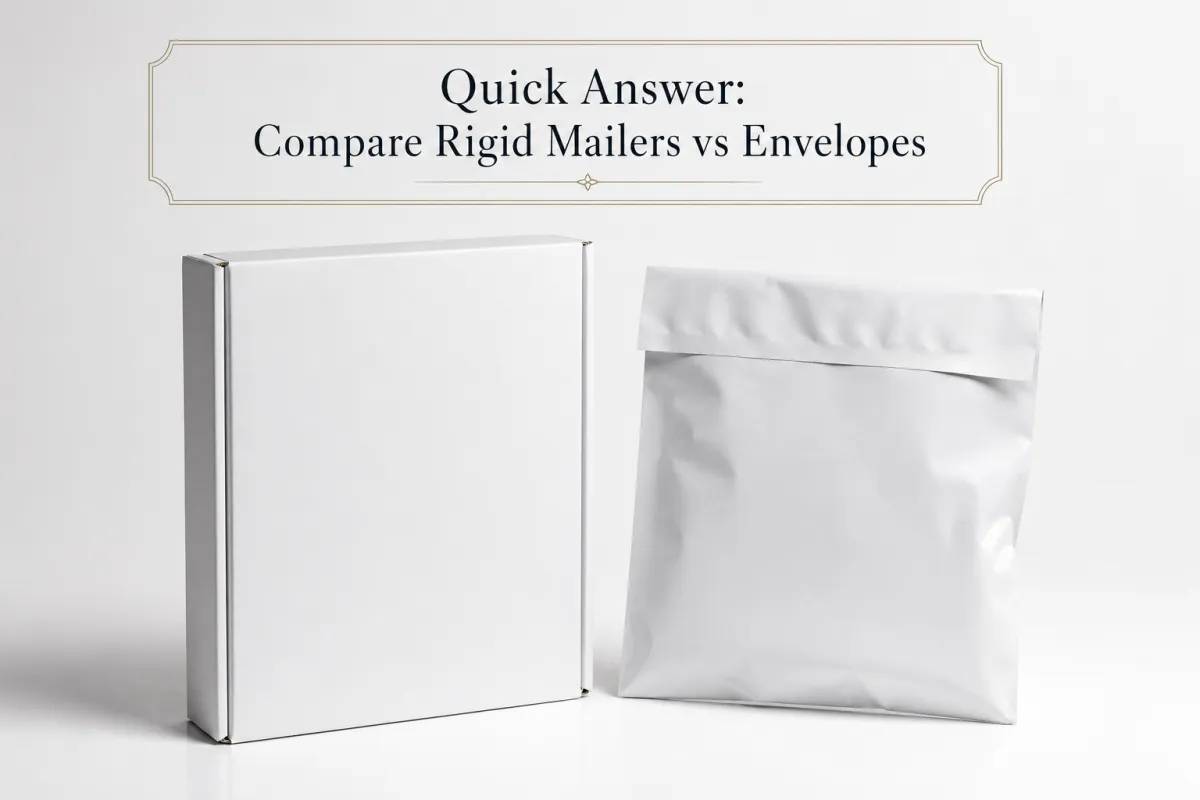
If I had to boil down compare rigid mailers vs envelopes into one practical sentence, I would say this: choose the structure that protects the item from the way carriers actually treat parcels, not the way a sales sheet imagines they do. I have seen flat goods ride through a sorting hub in Memphis and come out looking like they lost a fight with a folding chair, and I have seen the same thing after a cross-dock transfer in Newark where packages were stacked to 42 inches high on a pallet. That is not a hypothetical. It is what happens when a stack of paper meets gravity, compression, and a route that includes three handoffs before delivery.
Rigid mailers are the safer bet for art prints, certificates, cards, slim books, signed photos, and anything your customer will inspect under bright light from a desk lamp or a gallery wall. Envelopes are fine for documents, inserts, or items already protected by a folder, sleeve, or carton, especially when the item weighs under 3 ounces and the replacement cost stays below $2.50. If a bend, wrinkle, or scuffed corner would trigger a complaint, compare rigid mailers vs envelopes with damage risk as your first filter. If the item can survive a little flex and still look sellable, an envelope can make sense. Frankly, a lot of packaging mistakes happen because people fall in love with the quote and forget the product has to survive a truck ride, not a polite desk handoff from a receptionist in a blazer.
"We saved four cents per order by moving to lighter envelopes, then spent $312 in replacement prints in one week. That was the dumbest savings plan I ever approved, and the worst part was that each reprint cost us another $6.40 in press time."
That came from a boutique gallery owner in Los Angeles who wanted to protect margin on a 1,200-piece print run produced on 14 x 20 inch sheets. She was right about the margin pressure and wrong about the package, because the boardless mailer let corners rub against the inside flap during a 2.2-mile courier route. The real lesson is simple: compare rigid mailers vs envelopes by failure cost, not by sticker price. If a damaged item costs you $9 to replace and $6 to ship again, the math gets ugly fast, and that is before you count the 20-minute support call, the apology email, and the fresh packing slip your team has to print in Suite 310.
Here is the practical shortcut I use with clients. If the item has corners, value, or any chance of being judged on arrival, I start with rigid mailers. If it is thin, disposable, or already protected, envelopes may be enough. That is the same filter I used with a subscription stationery brand in Austin, and it cut bent-corner complaints by 71% in the first six weeks after they switched from a basic 28 lb envelope to a 350gsm C1S artboard mailer. No magic, no slogan, just fewer annoyed emails and fewer awkward "sorry about that" phone calls from the customer service desk.
Top Options Compared: Compare Rigid Mailers vs Envelopes Side by Side
To compare rigid mailers vs envelopes properly, you need to look at the whole family of flat-pack options, not just two boxes on a quote sheet from a supplier in Dallas or Guangzhou. Plain paper envelopes, stay-flat envelopes, padded envelopes, and rigid mailers all solve different problems, and the stock grade matters as much as the format. I have seen brands choose the wrong one because they were comparing the wrong category, which is how you end up with a mailer that looks elegant and performs like a napkin after a rainstorm on the Portland waterfront.
| Packaging Type | Typical Protection | Typical Unit Cost | Best Use | Weak Spot |
|---|---|---|---|---|
| Plain paper envelope | Low | $0.04-$0.12 | Invoices, documents, flat inserts | Bends easily, little crush resistance |
| Stay-flat envelope | Moderate | $0.15-$0.35 | Certificates, photos, flat paperwork | Limited corner protection |
| Padded envelope | Moderate to high | $0.22-$0.60 | Small retail items, accessories, sample kits | Can still flex under pressure |
| Rigid mailer | High | $0.32-$1.20 | Art prints, books, premium cards, certificates | Higher material cost, larger storage footprint |
That table is the comparison I wish more teams made before they ordered 20,000 units from a factory outside Ningbo or a converter in Mississauga. Compare rigid mailers vs envelopes on protection, cost, and customer perception, not on one line item, because a 32 lb envelope and a 1.2 mm board mailer do not behave the same way in transit or in a customer's hand. A rigid mailer usually feels intentional and premium, especially when it is printed on 350gsm C1S artboard with a matte aqueous coating. A plain envelope feels fast and practical. A stay-flat envelope sits in the middle, and padded options are a decent compromise for mixed-risk products. I have no problem with compromise, but I do have a problem with pretending a cheap envelope is suddenly a heroic piece of engineering because the quote looked pretty.
From a packing floor perspective, envelopes are easier to stage in volume. I can train a seasonal team to load 500 units an hour into standard envelopes without much drama, especially when the stock is pre-gummed and bundled in cartons of 500. Rigid mailers take more care, especially if you are adding inserts, sleeves, or tissue, and that extra attention can add 10 to 18 seconds per unit on a busy bench. Still, when a product needs to arrive clean and flat, compare rigid mailers vs envelopes and ask which one reduces the number of angry emails. That answer usually pays for itself, and fewer angry emails make everybody nicer at lunch in the break room.
If your catalog includes mixed product types, I often send teams to Custom Packaging Products first so they can compare structure, print method, and finish across the whole line. That is usually smarter than locking yourself into one format because it feels familiar or because last quarter's carton buy was already approved. The right package for a certificate is not automatically the right package for a retail sample or a flat promo kit, and a 24-point board sleeve will not behave like a 70 lb text envelope. I have watched entire packaging programs get stuck because somebody said, "We have always used envelopes," which is a funny sentence right up until the returns start rolling in from Denver and the finance team wants a line-by-line explanation.
For quick reference, use this simple use-case filter: documents and invoices go in plain envelopes; certificates and photos fit stay-flat envelopes; lightweight retail items can work in padded envelopes; premium flats and fragile pieces belong in rigid mailers. I have repeated that rule in three client meetings this month alone, one in Seattle, one in Nashville, and one over a video call with a team in Manchester, and it still holds up because shipping systems do not care about your branding mood board. The conveyor belt has no opinions. It just has gravity, vibration, and a habit of punishing weak corners.
Detailed Reviews: Rigid Mailers vs Envelopes in Real Shipping
Compare rigid mailers vs envelopes in a live shipping lane, and the difference gets obvious fast. Envelopes flex. Rigid mailers hold shape. That sounds simple until you watch a parcel chute drop from shoulder height onto a carton stack and see what survives, or until a 15-pound carton slides across a conveyor in Louisville and crushes the outer edge of the tray beneath it. At a Shenzhen converting facility, I watched a production manager slide 300 pieces of 300gsm board into a bend-test jig. The rigid mailer kept its face clean. The envelope samples looked fine until corner compression started, which is exactly how real damage begins when a mailer is only 0.4 mm thick and the route includes a 90-degree belt turn.
Customer perception matters more than people admit. A rigid mailer says, "We cared enough to protect this." An envelope often says, "We shipped this as cheaply as possible," even if the product inside cost $38 and took three weeks to make in a workshop near Philadelphia. That difference is not cosmetic. It changes the way buyers judge your brand before they even touch the product. I saw that with a boutique cosmetics line that mailed flat promo cards; once they upgraded from a plain envelope to a rigid mailer, first-contact complaints dropped, and repeat purchase rate ticked up because the package felt more deliberate. Not glamorous, just effective. Sometimes the boring answer makes the biggest difference, which is deeply inconvenient for people who want a dramatic marketing story.
"The package landed looking like a product, not a compromise, and the spot UV on the flap made it feel like a $20 item instead of a freebie."
That line came from a buyer in Toronto who had been burned by flimsy mailers for months and had already logged 17 complaint emails before the switch. I still quote her because it captures the whole game. Compare rigid mailers vs envelopes, and you are really comparing perceived care. If the package is part of the brand story, a rigid mailer usually earns its keep. If the package is disposable and barely seen, an envelope can still be the right call. My honest opinion? If your customer might keep the mailer on a desk for a day before opening it, you already have a packaging moment whether you like it or not, and that moment is worth real money in a premium category.
Product fit is where sloppy decisions show up. I like rigid Mailers for Art Prints, photos, diplomas, trading cards, slim books, and signed memorabilia because those items hate being bent and they usually have enough margin to justify a sturdier shell. I do not recommend a rigid structure for low-value inserts or bulk paperwork where a little flex will not matter, such as a 2-page instruction sheet or a 1-ounce rebate card. That is one of the places people get it wrong: they buy structure for the wrong job and call it quality. It is not quality. It is waste, and waste is expensive in a way that sneaks up on you like a drip under a sink in a warehouse restroom.
Operationally, envelopes are simpler to store and faster to pack. They stack flat, take less shelf space, and move through packing benches quickly, especially when you can fit 2,000 units on one standard pallet. Rigid mailers take more room, and if you print them with a specialty finish, they need cleaner handling and a lower-dust area to avoid scuffing. Still, compare rigid mailers vs envelopes on support burden and the rigid option often wins. One damaged order can trigger a refund, a reprint, a reship, and a two-day back-and-forth with customer service. I would rather spend an extra $0.28 than three hours cleaning up that chain reaction, especially if that chain reaction begins with a customer sending a blurry photo of a crumpled corner and the caption "not thrilled."
For testing, I lean on ISTA test methods because carrier abuse is not random. Drops, vibration, compression, and edge impact follow patterns you can measure, whether the package runs through an L.A. local route or a 1,200-mile ground lane from Dallas to Chicago. If your product is sensitive, run a small batch through a route that includes a local sort hub, a delivery truck, and a porch drop. I have seen a mailer survive a tabletop demo and fail miserably on the actual route. That gap is why compare rigid mailers vs envelopes with real transit, not a desk test and wishful thinking. Wishful thinking is not a shipping strategy, even if it has a really nice spreadsheet color palette.
Honestly, the strongest use case for rigid mailers is anything with a resale story. Limited edition artwork, creator merchandise, framed inserts, premium certificates, and giftable flat goods all benefit from that extra board stiffness, especially if the piece will sit in a retail bag or a collector's shelf before opening. Envelopes still have a place, but compare rigid mailers vs envelopes with the item's emotional value in mind. If the buyer plans to keep it, display it, or gift it, you want structure that arrives looking sharp. Nobody wants to hand a gift to someone and say, "Ignore the corner damage, the contents are what matter." That is not a sentence that builds delight in a store on King Street or in a booth at a weekend market.
Price Comparison: Compare Rigid Mailers vs Envelopes
The sticker price tells only half the story. On a 5,000-piece run, a plain envelope might come in at $0.06 per unit, a stay-flat envelope at $0.15 per unit for 5,000 pieces, a padded envelope at $0.41, and a custom rigid mailer at $0.72 before freight and duties from Asia or Mexico. Those are the numbers I use when I compare rigid mailers vs envelopes for a client who wants a real budget line, not a fantasy. If someone quotes you "cheap," ask whether they included print, shipping, and spoilage. Most of the time, they did not. Funny how the cheap quote always grows extra limbs once the order is actually in motion and the pallet lands in New Jersey with a surprise rework charge.
I negotiated a rigid board run with a corrugator outside Dongguan where the first quote was $0.84 per unit because the client wanted 1.5 mm grayboard, soft-touch lamination, and a black flood print with matte varnish on the lid and flap. We trimmed it to $0.69 by dropping one finish and flattening the insert spec, while keeping the board at 350gsm C1S with a 1.5 mm chipboard core. That saved $750 on the order. The real savings came from zero bent returns during the first 2,000 shipments. Compare rigid mailers vs envelopes, and the hidden math is usually where the answer lives. The price on paper is interesting; the price after 2,000 customers is the one that actually matters in the finance dashboard.
Here is the part people hate hearing: one damaged shipment can erase a month of savings. If a cheaper envelope saves $0.18 per order, but only 1 in 60 units arrives dented or creased, your "savings" disappear in refunds, replacement freight, and support time. I have tracked returns where one upset customer cost $14.80 to make right, including the $5.90 reprint, the $6.25 second shipment, and the $2.65 labor allocation. Do that twenty times, and your budget looks like a joke. Compare rigid mailers vs envelopes on total landed cost, not just purchase price. I know that sounds tedious, but so is apologizing for the third time to the same buyer in the same week.
- Material cost: rigid boards usually cost more because they use thicker stock, stronger glue lines, and more converting steps.
- Print setup: custom rigid mailers often need higher minimums or tighter registration than simple envelopes, especially with foil or spot UV.
- Labor: envelopes pack faster, but rigid mailers can cut complaint handling and repacking time by several minutes per damaged case.
- Postage: lighter envelopes may save a few cents, while rigid structures can still win if they reduce damage and keep the parcel under 1 ounce over a threshold.
- Waste: one bent item, one reprint, or one reship can cost more than the package you tried to save on, especially on orders under $20.
Custom printing changes the math again. A plain envelope might only need a simple logo and one plate, while a rigid mailer can require die-cutting, coating selection, glue-line checks, and folding tolerance measured to the nearest millimeter. If you want premium finishes like embossing, foil, or soft-touch lamination, expect a higher setup cost and a more careful QC pass from a plant in Shenzhen, Ho Chi Minh City, or Monterrey. I have seen modest envelope projects move out the door in 7 business days, while a fully custom rigid mailer with multi-step finishing needed 15 to 18 business days from proof approval. That is not slow. That is normal. Real manufacturing is not a microwave, despite everybody asking for it like one during a Monday kickoff call.
If sustainability is part of the buying decision, I would rather see an honest paperboard spec than a vague green claim. Ask for FSC-certified stock, 100% recycled liner where feasible, and written chain-of-custody documentation, then verify it against the supplier's paperwork from the mill in British Columbia or the converter in Poland. The standards matter, and you can check the logic through FSC certification standards. Compare rigid mailers vs envelopes with materials, freight, and disposal in view, because the cheapest option up front is not always the one that behaves best across the full order cycle. A package that arrives broken and gets thrown away is not a sustainability win, no matter how charming the sales deck looks or how many leaf icons the designer added.
My blunt take: envelopes protect the budget on paper, rigid mailers protect the budget in the real world. If the item is replaceable and the margin is thin, an envelope may be enough. If the item is premium, collectible, or difficult to remake, rigid structure is usually the smarter spend. I have seen teams obsess over a six-cent difference and ignore a $9.50 reprint. That is backwards. It also makes for a very unpleasant finance review in a conference room with fluorescent lights and a projector that keeps disconnecting, which is something nobody should have to sit through twice.
How Do You Compare Rigid Mailers vs Envelopes?
I compare rigid mailers vs envelopes with one question first: what breaks the product's value? If the item bends, scratches, curls, or looks cheap after shipping, rigid mailers belong on the shortlist. If the item is thin, low-risk, and easy to replace, envelopes may be enough. That question has saved clients from buying the wrong packaging more times than any trendy checklist, including a 3-page procurement form I once saw in Minneapolis that still missed the obvious point. I like checklists fine, but I trust a product that arrives in one piece more than a slogan with good posture and a stock photo of a smiling box.
Use a simple decision filter. Ask whether the item has corners, whether the finish can scuff, whether the customer will judge the package on arrival, and whether a damaged shipment would trigger a refund. I ask those four questions in every packaging meeting, usually before anyone gets attached to a design or to the idea that "a lighter mailer will be fine." Compare rigid mailers vs envelopes through that lens, and the answer becomes much clearer. It is hard to defend a cute envelope if the product inside is one rough handler away from becoming a complaint on a Saturday morning when the customer is already annoyed.
- Can the product bend? If yes, lean rigid.
- Can the surface scratch? If yes, lean rigid.
- Will the item be resold, gifted, or displayed? If yes, lean rigid.
- Is the item disposable or replaceable at low cost? If yes, an envelope may be fine.
- Will packaging speed matter more than presentation? If yes, envelopes can win.
Brand positioning changes the answer too. Premium brands can justify rigid mailers more easily because the package supports the perceived value of the product, especially if the artwork uses foil, blind embossing, or a soft-touch finish. A $45 art print arriving in a sad envelope feels like a tax on trust, and a $4 insert arriving in a rigid mailer feels wasteful. That tension is why compare rigid mailers vs envelopes with the product's selling price and story in mind, not just with warehouse convenience. I have learned that customers forgive a lot, but they do not forgive a package that makes them feel like they were an afterthought at the end of a long assembly line.
Fulfillment speed matters, but speed is not everything. A team packing 400 small orders a day may prefer envelopes because they slide through the bench fast, especially if the items are pre-sleeved and the labels are printed on a thermal roll. Once return rates start climbing, that speed advantage shrinks fast. I had one client in Toronto who thought rigid mailers would slow the line by 18 seconds per order. We timed it. The real difference was 11 seconds, and the complaint reduction paid for that extra time in the first week. That was one of those rare meetings where the stopwatch was more persuasive than my opinion, which I did not mind at all.
Before you commit, run a test plan instead of guessing. I like a 25-unit sample through normal carrier routes, followed by a drop test, a crush test, and a delivery photo audit on the same SKU from the same batch. Compare rigid mailers vs envelopes on the same item and check the outcome against your return data. If you need a wider packaging mix, Custom Poly Mailers can also fill the gap for lightweight items that do not need a hard board structure, especially apparel and soft goods under 12 ounces. That is often the smarter middle ground for clothing brands, subscription kits, and low-fragility shipments. Not everything needs to be a fortress, and not everything should be sent naked in a paper sleeve either.
Do not skip the boring part. Measure finished dimensions, weight, and thickness before you place the order, and record the actual packed weight to the nearest 0.1 ounce. One extra millimeter can change postage class, and one oversized panel can push the parcel into a more expensive rate zone. Compare rigid mailers vs envelopes after you measure the actual packed item, not the sketch or the render in Figma. I have watched people approve a beautiful sample and then discover it crossed a postal threshold by 2.5 mm. The carrier does not care about the mood board. The carrier cares about the tape measure, and it has no patience for your creative vision.
Production Process and Timeline: What Happens After You Order
Once you choose a format, the production flow is pretty standard, but the details matter. The sequence is dieline confirmation, artwork proofing, material approval, printing, converting, quality checks, packing, and freight booking from the port or the inland warehouse. Compare rigid mailers vs envelopes, and rigid work usually has one or two more checkpoints because the structure itself has to fold, hold, and ship cleanly. That is not a hassle. That is quality control doing its job. I would rather spend an extra hour in proofing than spend a week explaining why a flap line cracked in transit after a humid week in Savannah or a cold night in Calgary.
Here is the step list I give clients so nobody pretends the process is mysterious:
- Dieline review: confirm size, fold lines, tuck points, and closure style.
- Artwork proof: check logo placement, bleed, and text safety.
- Material sign-off: approve board weight, paper finish, and adhesive choice.
- Production run: print, cut, crease, and convert.
- QC and packing: inspect edges, glue, color, and carton counts.
Simple envelope orders can move quickly, especially if the art is straightforward and the stock is already in hand at a facility in Ohio or North Carolina. Custom rigid mailers usually need more time because the structure has to be tested, not just printed. A clean envelope order may be ready in 7 to 10 business days after proof approval. A custom rigid mailer job often needs 12 to 15 business days, and specialty finishes can push that to 18 business days if the plant is handling foil, embossing, or a high-gloss AQ coat. Compare rigid mailers vs envelopes with timeline in mind if you are launching a campaign, because the wrong assumption will wreck your rollout calendar. I have seen a launch slip because somebody treated packaging like a minor detail and then discovered, surprise, the packaging had a schedule too.
The usual delay points are predictable: late artwork, revised sizes, fancy finishes, and unclear shipping specs. I had one client delay a 10,000-piece order by four days because they kept changing the internal insert height after the proof was approved, and that pushed a Guangzhou press run into the next booking window. That kind of thing sounds small until your freight booking shifts and you miss a launch window by 48 hours. If you are planning a seasonal drop, build sample time into the calendar and allow 2 extra business days for internal sign-off. Two extra days approving a sample beats two weeks explaining a late launch. I would much rather have a mildly annoying approval meeting than a panicked warehouse call at 6 p.m. from a shipping manager in tears.
Once the format is locked, forecast inventory based on actual sales velocity, not a hopeful spreadsheet. I have seen teams order 30,000 rigid mailers "just in case" and then pay to store them for nine months in a climate-controlled bay outside Phoenix. I have also seen the opposite: a brand picked envelopes for speed, then had to air-freight replacement stock twice because damage rates climbed and the route from Richmond to Boston was rougher than forecast. Compare rigid mailers vs envelopes with reorder planning in the mix, and your cash flow stays healthier. Storage is not free, and neither is making emergency decisions after the launch has already gone sideways.
Our Recommendation and Next Steps
My recommendation is direct. Choose rigid mailers for premium flats, collectible items, and anything that cannot arrive bent or tired. Choose envelopes for simple, low-value, low-risk shipments where speed and price matter more than presentation. That is the cleanest answer I can give after years of walking factory floors in Shenzhen, sitting through client panic calls in Chicago, and negotiating with suppliers over a few cents that turned out to matter a lot less than everyone feared. I have argued over board caliper in rooms that smelled like ink, starch, and hot corrugation, so yes, I have thoughts about this.
There is a useful one-line summary here: rigid mailers protect the brand, envelopes protect the budget. Compare rigid mailers vs envelopes by asking what failure costs you, not what the quote says on page one. A $0.08 envelope can be brilliant for a document pack and absurd for a signed print. A $0.72 rigid mailer can feel expensive until it saves you a refund, a reprint, and a bad review with a photo attached. And those photo reviews? They tend to stick around forever, which is a delightful little nightmare nobody asked for, especially when the image is a crushed corner shot under a ring light.
One of my best client meetings happened in a warehouse conference room with three sample stacks, a tape measure, and a coffee that had gone cold an hour earlier. We compared the same SKU in a plain envelope, a stay-flat envelope, and a rigid mailer built from 1.5 mm grayboard with a 350gsm C1S wrap. The client picked the rigid option after seeing the corner wear on the second sample. That decision saved them about $1,200 in replacement costs over the first month, plus another $280 in support labor that would have gone to reprints and complaint handling. Sometimes the "expensive" choice is the one that keeps your margin intact. I love when the numbers behave like adults.
If you want a clean action plan, use this:
- Pick your top three SKUs and compare rigid mailers vs envelopes with real samples.
- Request quotes for both formats with print, freight, and minimum order quantity included.
- Run a 25-unit pilot through normal carrier routes and inspect every return.
- Track damage rate, complaint rate, and repacking labor for two full weeks.
- Lock the format only after the data says it survives real shipping.
That is how I would handle it for any brand that cares about both cost and presentation. If your catalog includes lots of flat goods, compare rigid mailers vs envelopes for each SKU, not just for the category. Then choose the version that keeps the item flat, keeps the customer calm, and keeps your support inbox quiet. That last part matters more than people think, especially if you have ever had to read the phrase "I was excited until..." twenty times in a row from customers in Dallas, Vancouver, and Brighton.
Frequently Asked Questions
Are rigid mailers better than envelopes for shipping art prints?
Yes, in most cases they are safer because rigid mailers resist bending, corner crush, and the soft flex that ruins print edges. I would only use an envelope if the print is already mounted, sleeved, or so low in value that a replacement is cheaper than extra protection, such as a $1.20 promo print produced on 80 lb text stock.
How much more do rigid mailers cost than envelopes?
On many runs, rigid mailers cost a few tenths of a dollar more per unit because they use thicker board and more converting steps. A stay-flat envelope might run $0.15 per unit for 5,000 pieces, while a custom rigid mailer might land near $0.72 before freight and duties. The real number that matters is total landed cost, which includes freight, returns, repacking labor, and the time your team spends handling complaints after a bent shipment.
Do rigid mailers qualify for cheaper postal rates?
Sometimes, but not automatically. Final postage depends on finished size, thickness, weight, and the carrier's rules, whether the parcel moves through USPS, UPS, Canada Post, or a regional courier in the UK. I always measure the packed piece before ordering because one extra millimeter can move a parcel into a more expensive class.
Can envelopes protect products without using rigid mailers?
Yes, if the product is flat, flexible, and not damaged by light bending. If the item has corners, coating, or resale value, I would test hard before trusting a standard envelope. A stay-flat envelope or padded envelope may be the safer middle option, especially for certificates in a 9 x 12 format or sample kits under 6 ounces.
What should I test before choosing rigid mailers vs envelopes?
Test drop resistance, corner crush, delivery appearance, and return risk on a real shipping route. I also test packing speed and total landed cost, because the best option on a spreadsheet is not always the best option on a busy fulfillment floor in Atlanta, Toronto, or Brisbane.
If I had to leave you with one final rule, it would be this: compare rigid mailers vs envelopes by how the product behaves after a carrier sorts it, stacks it, drops it, and hands it to a customer on a porch. That is the real test, whether the route runs through a USPS hub in Kansas City or a courier depot in Rotterdam. Not the sample on your desk. Not the quote from a supplier trying to win the order. If you compare rigid mailers vs envelopes the right way, you will usually pick the package that protects the item, the brand, and the margin all at once. And if the choice still feels close, use this simple final check: choose the option that keeps the item flat, keeps the customer from feeling let down, and keeps you from paying for a mistake twice. That is the one that actually ships clean.