Buyer Fit Snapshot
| Best fit | Corrugated Corner Protectors Wholesale for Shipping Teams projects where brand print, material claims, artwork control, MOQ, and repeat-order consistency need to be specified before quoting. |
|---|---|
| Quote inputs | Share finished size, material target, print colors, finish, packing count, annual reorder estimate, ship-to region, and any compliance wording. |
| Proofing check | Approve dieline scale, logo placement, barcode or warning zones, color tolerance, closure strength, and carton packing before bulk production. |
| Main risk | Vague material claims, crowded artwork, missing packing details, or unclear freight terms can make a low unit price expensive after revisions. |
Fast answer: Corrugated Corner Protectors Wholesale for Shipping Teams should be specified like a repeatable production item. The safest quote records material, print method, finish, artwork proof, packing count, and reorder notes in one written spec.
Production checks before approval
Compare the actual filled-product size with the drawing, then confirm tolerance on folds, seals, hang holes, label areas, and retail display edges. Reserve space for logos, QR codes, warning copy, and material claims before decorative graphics fill the panel.
Quote comparison points
Review material grade, print process, finish, sampling route, tooling charges, carton quantity, and freight assumptions side by side. A quote is only useful when the supplier can repeat the same color, closure quality, and packing count on the next order.
Corrugated corner protectors wholesale is a small purchase with a large downstream effect. The line item looks ordinary. The damage bill does not. One crushed pallet corner can trigger repacking, a missed dock appointment, a receiver photo, and a chargeback that wipes out the margin on an entire order. I have seen buyers spend hours chasing a problem that started with a part costing less than a cup of coffee. That is why corrugated corner protectors wholesale belongs in the same buying conversation as cartons, wrap, and straps, not buried in packaging footnotes.
Packaging teams usually learn this the hard way. A few cents of edge reinforcement can help freight survive forklift contact, trailer vibration, strap pressure, and the kind of warehouse stacking that makes neat labels feel optimistic. Corrugated corner protectors wholesale also supports steady supply for programs that ship every week, not just during seasonal spikes. Once volume climbs, tiny unit costs start behaving like magnifying glasses.
Custom Logo Things works with buyers who need repeatable packaging, not guesswork dressed up as strategy. Standard sizes, custom cuts, print options, and lane-specific requirements all shape the right corrugated corner protectors wholesale program. Done well, the result is less damage, cleaner pallet presentation, and fewer headaches for the receiving team on the other end. That is the real payoff, and it shows up faster than people expect.
How Does Corrugated Corner Protectors Wholesale Cut Damage Costs?
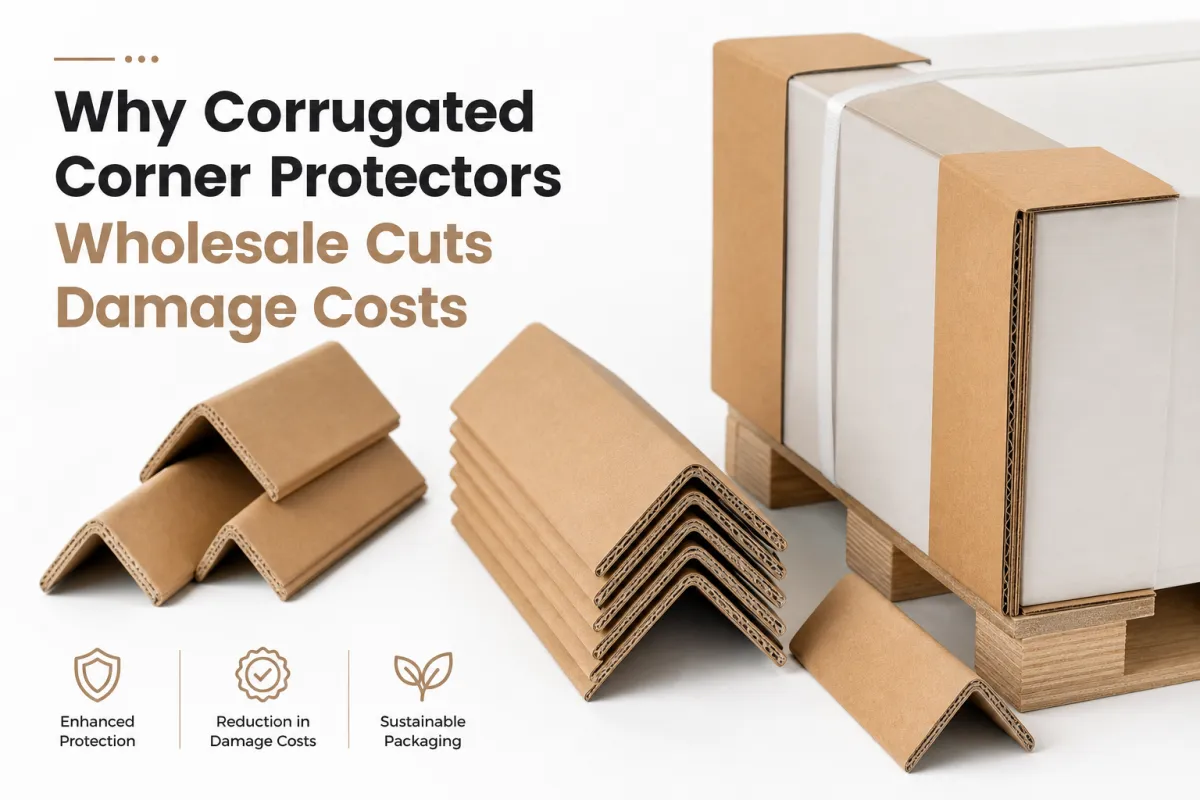
Damage usually shows up in three places: the warehouse floor, the customer dock, and the accounting system that has to reconcile the mess. A pallet corner absorbs a surprising amount of abuse when straps bite down, stretch wrap pulls inward, or another load leans against it in transit. Corrugated corner protectors wholesale spreads that force across a wider surface, so the carton edge is less likely to fold, split, or bow under pressure. The idea sounds plain. The impact is not.
The stress point changes when the board is in place. A narrow point load becomes a broader contact area. A soft carton wall becomes a stiffer vertical edge. Corrugated corner protectors wholesale can also improve stack behavior on mixed pallets, where box sizes and panel strength are rarely identical. The protector gives stretch wrap a firm edge to press against, which helps the load stay compact while it moves through handling and transport.
Many teams only count the physical protection. The better lens includes labor time, customer trust, and the appearance of the shipment itself. A pallet that arrives with one smashed corner often gets inspected more closely, photographed more often, and paid more slowly. That turns a packaging issue into a process issue. Corrugated corner protectors wholesale is a relatively small spend that can cut a much larger trail of indirect costs.
Wholesale buying makes sense because edge damage is not rare enough to treat as an exception. A distribution center that sends out dozens of pallets a day needs stable supply, not last-minute searching. Corrugated corner protectors wholesale turns a reactive purchase into a planned operating expense, which helps procurement keep the spec aligned across repeat orders. Consistency matters more than buyers sometimes expect. If the board grade shifts or the dimensions drift, wrap tension and compression support can change with them.
"A cheap protector stops being cheap the moment one damaged corner creates a claim, a return, and an hour of rework."
That is why experienced buyers ask for measurable outcomes instead of polished language. Ask how corrugated corner protectors wholesale affects damage rate, stack stability, wrap usage, and chargebacks. A supplier that cannot discuss those details in concrete terms probably has not done the math. Put the quote beside your actual loss profile and the picture gets clearer fast.
Presentation matters too, and not only for retail shipments. Clean corners make pallets look controlled, and controlled pallets tend to move faster through internal checks. Some customer-facing operations treat corrugated corner protectors wholesale as part of their visual standard because damaged freight sends the wrong signal before anyone opens the carton. The product is inexpensive. The message it sends is not.
Corrugated Corner Protectors Wholesale Product Types and Uses
Corrugated corner protectors wholesale comes in several forms, and the right one depends on what the pallet carries. The most common style is an L-shaped edge protector made from compressed paperboard. It reinforces carton corners, bundled goods, and stacked product. Heavy-duty angle boards use thicker construction and suit loads that need stronger compression resistance. For export freight or longer transit lanes, the board grade can matter as much as the shape.
Recycled kraft options are popular in high-volume programs where recycled content and cost control both sit high on the list. Moisture-resistant variants suit cold-chain staging, humid docks, or shipments that wait outside before loading. Corrugated corner protectors wholesale can also be ordered with pre-cut lengths, custom leg dimensions, or printed handling marks for teams that want quicker identification on the floor.
The use case matters more than the category label. Palletized cartons usually need reinforcement on the outer edge so wrap tension does not crush the vertical face. Bagged goods often need stronger boards because the product shifts as it settles. Boxed consumer goods can use lighter boards that protect presentation while still resisting wrap damage. Appliances, parts kits, and warehouse interlocks often need heavier angle boards because the risk is not only corner crush; it is movement during handling.
Mixed-SKU operations turn corrugated corner protectors wholesale into a sourcing question as much as a packaging one. One buyer may need to cover a short box, a medium carton, and a taller pallet build. Standardization usually helps. If most shipping lanes use three or four common heights, simplifying the protector range often makes more sense than custom-building every SKU. Fewer sizes mean fewer ordering mistakes and less slow-moving inventory sitting on the floor.
- L-shaped edge protectors: Good for everyday pallet stabilization and carton edge reinforcement.
- Heavy-duty angle boards: Better for taller stacks, heavier freight, and stronger strap pressure.
- Recycled kraft options: Useful when cost, recycled content, and dependable supply are top priorities.
- Moisture-resistant variants: Better for chilled storage, export lanes, and damp receiving areas.
- Custom lengths or print: Best when line speed, branding, or lane-specific instructions matter.
For teams already buying through Wholesale Programs, corrugated corner protectors wholesale can sit alongside recurring packaging items without making the buying process harder. If the load also needs the carton redesigned, pairing corner boards with Custom Shipping Boxes can improve the full pack-out rather than patching only the edge.
The main point is simple: corrugated corner protectors wholesale is not one product family. It is a set of tools. The right version depends on pallet height, carton strength, wrap method, and how rough the shipping lane actually is. Once the use case is pinned down, the quote gets easier to judge.
Specifications That Matter for Bulk Corner Protectors
Spec sheets can get slippery fast, and slippery spec sheets usually turn into expensive surprises. When evaluating corrugated corner protectors wholesale, the first numbers to confirm are leg length, thickness, total length per piece, and whether the profile is meant for inner corners, outer pallet edges, or both. A protector that is too short will not support the upper layers. One that is too large wastes material and complicates wrapping. Buyers who skip these measurements end up paying for the mistake twice.
Board grade is the next issue. Corrugated corner protectors wholesale may use single-wall, double-wall, or dense recycled board construction. Denser board usually handles compressive force better, though heavier does not automatically mean better for every load. A lightweight carton may only need enough rigidity to resist strap cut-in, while a tall stack of filled cases may need a much stiffer profile to avoid bowing. That distinction matters, because a protector that is overbuilt can make a pallet harder to wrap without adding meaningful protection.
Flute structure and ply count matter as well. Buyers often hear "corrugated" and assume the material behaves the same across suppliers, but the internal structure changes how the protector crushes, bends, and rebounds. In practice, that affects wrap retention and edge compression performance. Corrugated corner protectors wholesale with stronger construction can help a pallet keep its shape during trailer vibration, which is where a lot of damage begins without announcing itself.
Moisture is another detail that gets ignored until the boards start softening. Cold storage, outdoor staging, and export containers expose packaging to humidity that can weaken lower-grade board. In those settings, corrugated corner protectors wholesale should be reviewed for moisture resistance, fiber quality, and storage conditions before the order is approved. If the boards spend half a day on a damp dock, the real-world result can drift far from the datasheet. That gap is one of the fastest ways to lose trust in a supplier.
Performance numbers should be requested plainly. Good suppliers can discuss edge crush resistance, compression support, and wrap compatibility without hiding behind marketing language. For testing references, it helps to align with industry frameworks such as the ISTA testing standards. For fiber sourcing questions, especially when recycled content or chain-of-custody claims matter, the FSC certification system can be useful when comparing material options.
A clear checklist makes quote comparison easier. Corrugated corner protectors wholesale should be checked against the same five data points every time:
- Leg length and overall height.
- Board thickness and construction type.
- Quantity per bundle, case, or pallet.
- Moisture or humidity resistance requirements.
- Print, labeling, or handling mark needs.
That is how many procurement teams save real money. They stop comparing slogans and start comparing numbers. If two suppliers both claim "heavy duty," but one offers a 50 x 50 x 1200 mm protector and the other offers a 40 x 40 x 1000 mm protector, those are not interchangeable parts. Corrugated corner protectors wholesale becomes a clean buying category only when the spec is pinned down tightly.
Corrugated Corner Protectors Wholesale Pricing and MOQ
Pricing for corrugated corner protectors wholesale depends on several variables at once: board grade, custom sizing, print requirements, pack configuration, and freight method. Buyers usually fixate on unit price, yet landed cost is the number that really shapes the budget. A protector that looks cheaper on the quote can become more expensive once shipping, pallet counts, handling, and storage inefficiency are added in.
For common standard sizes, prices may sit in a range like $0.08-$0.16 per unit at around 5,000 pieces, depending on board strength and pack format. Heavy-duty or moisture-resistant versions can move into the $0.14-$0.34 range, especially when the board construction is thicker or the order needs custom cutting. Printed or branded corrugated corner protectors wholesale can land higher still, usually because setup and inspection add time to the run. Those are market patterns, not fixed rules, so they should be tested against your own lane and volume.
MOQ structures vary as well. Some suppliers sell by the bundle or case, others by pallet quantity, and larger facilities may qualify for full-truck pricing. Corrugated corner protectors wholesale is often easier to control when standard sizes are used, because standard dimensions usually mean less setup time, faster approval, and less risk of spec drift. Custom runs still make sense in the right program, but only when volume is steady enough to justify them.
Think about the savings in context. If one damaged shipment costs $150 to repack and another $300 in customer service time, then a few cents per protector can pay for itself quickly. Corrugated corner protectors wholesale does not need to eliminate every damaged pallet to justify the spend. It only needs to reduce enough incidents to improve the total cost picture. That is a more realistic standard, and a more useful one.
For buyers managing multiple lanes, the smartest approach is usually to compare options by load profile rather than by product label. A light retail carton lane may need a lower-cost board, while a long-haul industrial lane may call for a more rigid protector. The table below shows how pricing and performance often line up in corrugated corner protectors wholesale programs.
| Option | Typical Use | Approx. Unit Price | MOQ Pattern | Lead Time Range |
|---|---|---|---|---|
| Standard recycled L-shape | Everyday carton edges and pallet wrap support | $0.08-$0.16 | Commonly by bundle or pallet | Often 7-12 business days |
| Heavy-duty angle board | Taller stacks, stronger compression needs | $0.14-$0.28 | Usually pallet-based | Often 10-15 business days |
| Moisture-resistant board | Cold-chain, export, humid staging areas | $0.18-$0.34 | Frequently custom quoted | Often 10-18 business days |
| Printed or branded protector | Handling marks, size codes, visible branding | $0.20-$0.40 | Best on steady repeat programs | Often 12-20 business days |
A useful cost-control rule is to compare standard sizes against custom runs before approving anything. Corrugated corner protectors wholesale in a standard dimension usually costs less, approves faster, and is simpler to reorder. Custom sizing becomes the better choice only when the existing range wastes material or fits poorly. In other words, the simplest answer often wins, provided it truly matches the load.
Freight packaging deserves a close look too. Some suppliers ship loose, some ship in bundles, and some palletize for easier warehouse handling. That choice affects transit damage and receiving labor. If your team has to count every bundle by hand, the savings on unit price may disappear fast. Corrugated corner protectors wholesale should be judged on what arrives ready to use, not only on what leaves the dock with a low sticker price.
Ordering Process and Lead Time for Wholesale Supply
A clean ordering process saves time in ways buyers rarely see at first. Corrugated corner protectors wholesale usually begins with spec confirmation, then a quote, then sample approval, and finally production scheduling. If those steps are rushed or incomplete, lead time stretches. If the key details are captured early, the order moves in a much more predictable way.
The information that shortens lead time is not complicated, but it has to be exact. You need dimensions, annual or monthly quantity, delivery location, packaging format, and any print requirements. Corrugated corner protectors wholesale also moves faster when the buyer explains how the boards will be used. A supplier can recommend the right grade much sooner if they know whether the load is cartonized goods, bagged product, or heavier industrial stock.
Sample timing deserves attention. Standard products may ship sample pieces quickly, while custom sizes or nonstandard cuts usually need more time. In many corrugated corner protectors wholesale programs, the sample is the point where the buyer checks fit against the real carton or pallet, not just the drawing. That small test can prevent a bad run later, especially if the pallet wrap zone is tight.
Repeat orders are where the best suppliers prove themselves. Once the dimensions and board grade are locked, corrugated corner protectors wholesale should become a stable reorder instead of a new project every time. Forecast-based replenishment helps shipping teams avoid panic buying, and it also improves consistency across sites. If a multi-warehouse operation uses the same spec in several locations, the product should arrive the same way every time. No one wants to relearn the packaging playbook every quarter.
Lead time often looks like this in practice:
- Stock standard: Often 7-10 business days plus transit.
- Custom cut, no print: Often 10-15 business days plus transit.
- Printed or branded: Often 12-20 business days plus approval time.
- High-volume replenishment: Can be scheduled against forecast, which reduces surprises.
Logistics details matter just as much as production. Ask how corrugated corner protectors wholesale will be palletized, how many units ship per carton or bundle, and whether your receiving team needs a specific skid height or label format. If your warehouse counts by bundle but the supplier ships by loose stack, someone will spend time reconciling the difference. That friction is avoidable.
Approvals can slow things down more than the board itself. If your brand or handling copy is printed on the protector, confirm artwork early. A missing file, the wrong logo version, or a late color change can hold the whole order. Corrugated corner protectors wholesale is fastest when the artwork, dimensions, and quantity are approved together. Everything else becomes delay.
For teams that also manage outer packaging changes, it helps to align the corner protector order with box sourcing and pallet build standards at the same time. The broader packaging plan starts to behave like a system instead of a pile of separate purchases.
Why Choose Us for Corrugated Corner Protectors Wholesale
Buyers do not need more packaging jargon. They need consistent board quality, accurate sizing, and dependable fulfillment. That is the clearest reason to source corrugated corner protectors wholesale through a packaging partner that treats the spec like a production requirement rather than a sales guess. If the dimensions are right, the board is uniform, and the reorder arrives when promised, the purchasing decision gets easier each time.
Custom Logo Things focuses on programs where repeatability matters. Corrugated corner protectors wholesale should not drift from one order to the next. When the same size is purchased again, the customer should receive the same build, the same count, and the same packaging format. That reduces receiving complaints and protects internal confidence. It also means fewer surprises for the shipping floor, where packaging mistakes tend to show up first.
Technical guidance matters too. Some customers begin by asking for a price, but the better question is how the protector should perform on the actual load. Corrugated corner protectors wholesale can be matched to carton height, wrapping process, and pallet weight. That is where a packaging recommendation becomes more useful than a quote sheet. A lower-cost option is not always the right answer, especially if the load is top-heavy or the route is rough.
Program coverage is another advantage. Large buyers often need one partner for standard and custom work, multiple sites, and contract packers. Corrugated corner protectors wholesale is easier to manage when the supplier already understands replenishment rhythm, pallet quantities, and receiving constraints. That makes it simpler to keep procurement and operations in sync.
Trust comes from documentation. Ask for samples, confirm the written spec, and verify that production can repeat the same result after the first order. Corrugated corner protectors wholesale should come with a clear approval trail, not just a verbal promise. If your team wants to compare options across categories, the same supplier relationship can also support other packaging needs, including cartons and shipping formats through Custom Shipping Boxes.
There is a supply-chain side to this as well. Consistent sourcing reduces substitutions, and substitutions are where packaging programs often drift off course. If a board grade changes without notice, the pallet wrap pattern may need to change too. If the length shifts, the protection may no longer reach the vulnerable edge. Corrugated corner protectors wholesale works best when the manufacturing standard stays stable.
In practical terms, the value is control. Corrugated corner protectors wholesale gives shipping teams a repeatable way to protect corners, improve stack stability, and reduce avoidable claims. When the supplier is organized, the purchasing process gets easier, and that matters just as much as the board itself. It is not glamorous, but it saves real money.
Next Steps to Place a Wholesale Order
Start with the load, not the catalog. List your top three shipping formats and the pallet or carton dimensions that need protection. That gives corrugated corner protectors wholesale a real application instead of an abstract quote request. If you know the package height, the wrap zone, and the typical stack weight, the recommendation will be stronger from the start.
Next, request a quote with exact quantities, target MOQ, preferred sizes, and any print or moisture-resistance requirements. Corrugated corner protectors wholesale is easier to price accurately when the supplier does not have to guess about the use case. A short note about lane conditions, such as outdoor staging or export use, can change the material recommendation in a meaningful way.
Then compare samples against your current packaging. Check fit, edge compression, and ease of application during wrapping. Corrugated corner protectors wholesale should make the load easier to handle, not harder. If the board feels awkward on the line or too rigid for the pace of the operation, the spec may need a small adjustment before a full rollout. A protector that fights the process is usually the wrong protector.
If your volume is still uncertain, run a small pilot shipment first. Track damage rates, labor time, and receiving feedback. That gives you actual data instead of assumptions. Corrugated corner protectors wholesale is most convincing when the pilot shows fewer crushed corners and less rework, because then the financial case is visible to operations and finance at the same time.
Once the results are in, turn the pilot into a replenishment plan. Decide on reorder points, bundle counts, pallet counts, and who approves changes. Corrugated corner protectors wholesale works best when procurement, shipping, and receiving all follow the same playbook. That is how the program stays a system instead of becoming another one-off order.
For teams that want a broader packaging review, the smart move is to look at corner protection alongside carton strength, pallet wrap, and cube efficiency. That way, corrugated corner protectors wholesale becomes part of the shipping system rather than a patch for avoidable damage. If the numbers support it, the next order becomes a simple decision.
Corrugated corner protectors wholesale is the kind of purchase that pays for itself quietly. It reduces crush, sharpens pallet presentation, and supports repeat shipping control without adding much complexity. The clearest next step is to match one actual load to one actual protector spec, test it against your current packaging, and lock the result into a reorder plan before the next damaged pallet forces the issue.
What size should I order for corrugated corner protectors wholesale?
Match leg length to the protected edge height and the wrap zone on the pallet. Choose thickness based on stack weight, compression needs, and transit distance. If your cartons vary a lot in size or load profile, ask for a sample before you commit to corrugated corner protectors wholesale in volume.
What is the minimum order quantity for wholesale corner protectors?
MOQ usually depends on board grade, custom sizing, and whether the order is a standard run or made to spec. Standard sizes often allow smaller starter quantities than custom cuts, while larger orders can lower the unit price. Corrugated corner protectors wholesale only saves money if the MOQ fits your storage space and usage rate.
How do corrugated corner protectors help reduce shipping damage?
They spread pressure along the edge so stretch wrap and strap tension do not crush the carton corner. They also improve stack stability during warehouse handling and truck movement. Corrugated corner protectors wholesale can reduce claims tied to edge collapse, shifting loads, and wrap failure.
Can corrugated corner protectors wholesale orders be custom printed?
Yes, many suppliers can add logos, size codes, or handling instructions. Printing works best when your volume is steady and the message is simple. Confirm artwork requirements early so print setup does not extend lead time on corrugated corner protectors wholesale.
How long does a wholesale order usually take?
Standard products often move faster than custom sizes because there is no special cutting setup. Lead time depends on quantity, location, and whether samples or approvals are required. Ask for a production window plus transit time so your receiving team can plan corrugated corner protectors wholesale accurately.


