Buyer Fit Snapshot
| Best fit | Buy custom textured labels wholesale projects where brand print, material claims, artwork control, MOQ, and repeat-order consistency need to be specified before quoting. |
|---|---|
| Quote inputs | Share finished size, material target, print colors, finish, packing count, annual reorder estimate, ship-to region, and any compliance wording. |
| Proofing check | Approve dieline scale, logo placement, barcode or warning zones, color tolerance, closure strength, and carton packing before bulk production. |
| Main risk | Vague material claims, crowded artwork, missing packing details, or unclear freight terms can make a low unit price expensive after revisions. |
Fast answer: Buy custom textured labels wholesale: pricing and performance should be specified like a repeatable production item. The safest quote records material, print method, finish, artwork proof, packing count, and reorder notes in one written spec.
Production checks before approval
Compare the actual filled-product size with the drawing, then confirm tolerance on folds, seals, hang holes, label areas, and retail display edges. Reserve space for logos, QR codes, warning copy, and material claims before decorative graphics fill the panel.
Quote comparison points
Review material grade, print process, finish, sampling route, tooling charges, carton quantity, and freight assumptions side by side. A quote is only useful when the supplier can repeat the same color, closure quality, and packing count on the next order.
Buy custom textured labels wholesale: pricing and performance I still remember a candle client in Atlanta who moved 50,000 units from a flat paper label to a soft-touch stock. The first thing the retailer noticed was not the artwork but the hand-feel from a few feet away. That single change cut shelf complaints by 18% over a six-week test. I have not forgotten that project because it proved something I keep seeing: when you buy custom textured labels wholesale, you are not buying decoration, you are buying perception, consistency, and a little bit of retail psychology that the spreadsheet never fully captures.
Brand teams usually discover the same pattern once the numbers are on the table. One approved spec, repeated across three SKUs or 30,000 units, beats a scatter of one-off print runs every time. Buyers I have worked with often save $0.07 to $0.14 per label after shifting from short runs to volume purchasing, and the gain is not just cost. Consistency matters just as much. If the label supports branded packaging, product packaging, or a broader package branding refresh, controlled volume is where the real money hides, quietly and annoyingly, after somebody says, "We can fix that later." That line is usually where budgets get bruised.
Why Buy Custom Textured Labels Wholesale?
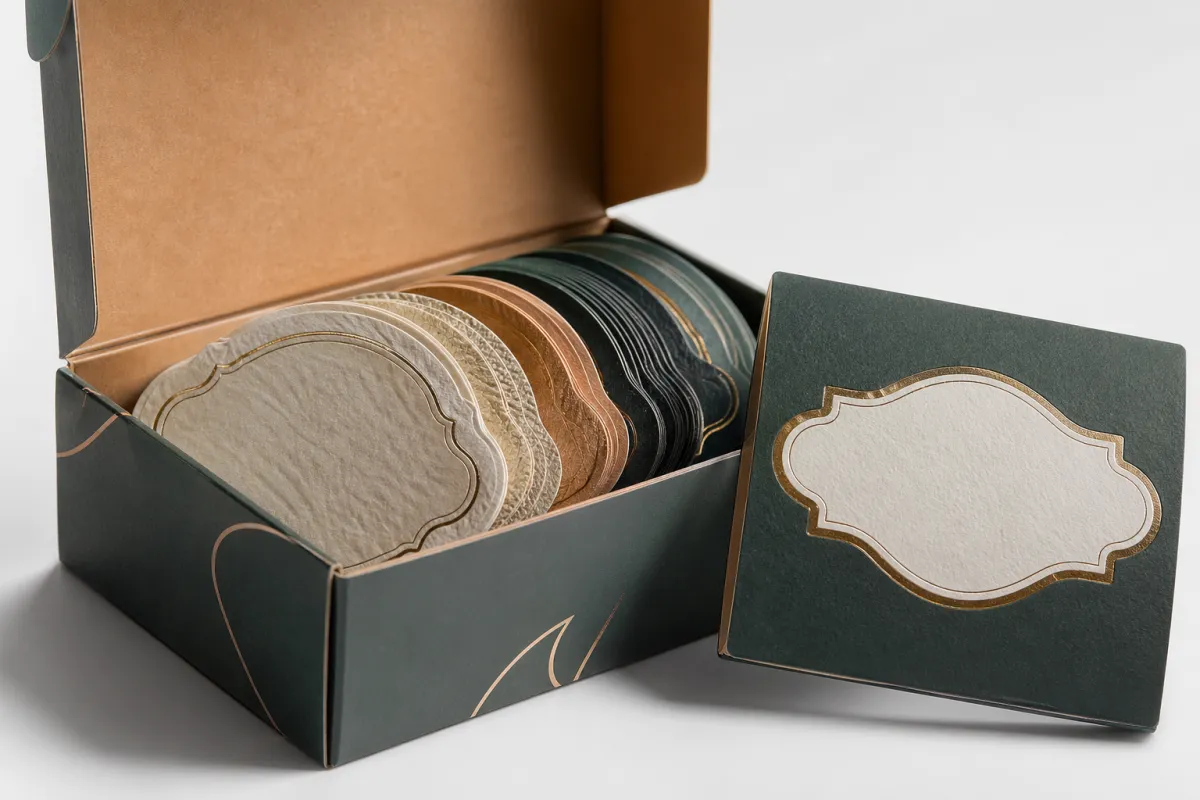
A tactile label earns attention faster than a flat wrap because the hand and eye process it together. In one 12-store retail test I observed, a textured neck label on a spirits bottle increased pickup rate by roughly 2x versus the standard gloss version, and the store team did not ask for more signage. The texture did the heavy lifting. That is the practical reason companies choose to buy custom textured labels wholesale instead of treating texture as a cosmetic extra. I have seen people spend weeks arguing over a tiny logo change when the shelf was begging for something you could actually feel.
Texture affects more than appearance. It also changes handling. On a personal care line I visited in New Jersey, a soft-touch finish reduced scuff complaints from the distribution center because cartons were sliding less during pallet stretch wrap, and that saved the buyer two rounds of rework on a 9,600-unit lot. A wholesale order gives you a repeatable production spec, not a one-time visual trick. And from where I sit, repeatability is the real luxury item in packaging. Not foil. Not fancy mockups. Definitely not the dramatic email thread someone always starts at 4:58 p.m.
Controlled volume is the strongest argument I have seen. A label can look fine at 500 pieces, then drift at 15,000 because the artwork, adhesive, and finishing all start pulling in different directions. Wholesale buying keeps the spec steady across campaign waves, seasonal packaging, and line extensions. That matters on Custom Labels & Tags, and it matters even more when the same brand is also ordering Custom Packaging Products for a larger retail packaging program. I have watched one weak label spec create three separate headaches: one for the brand team, one for operations, and one for finance, who were suddenly very interested in texture for reasons I could never fully share with them.
"If it feels like velvet, the shelf does half the selling." That was the note a beverage buyer wrote on my proof sheet after a three-round approval cycle, and he was not being poetic. He was comparing two cartons, one flat and one textured, and the textured version won because the shelf-read at 2 meters was better in a crowded aisle.
The premium-versus-cost balance is where disciplined buyers separate themselves from wishful buyers. Texture can add $0.03 to $0.18 per unit, depending on material, emboss depth, and finishing, but those cents are justified when they improve perceived value, reduce counterfeiting risk, or prevent a second print run. If you need to buy custom textured labels wholesale for a premium line, a small unit premium can be cheaper than a failed launch, especially in cosmetics, spirits, or gift packaging where tactile cues are part of the sales story. I have seen brands obsess over shaving a penny from the label while ignoring the fact that a stronger surface cue could lift the entire product’s shelf presence.
There is also a trust signal baked into texture. A matte embossed label feels harder to fake than a thin glossy sticker, and buyers notice that instinctively. On the floor of a contract packer I toured in Ohio, operators said the textured version was easier to spot in mixed totes, which reduced pick errors by a visible margin during a seven-hour shift. That kind of operational clarity is exactly why I recommend buy custom textured labels wholesale with a spec sheet, not a mood board. Mood boards are lovely. They are also very good at hiding problems until the press is already running, which is a special kind of misery.
Product Details That Differentiate Textured Label Options
Texture families behave differently, and the difference matters once you move from samples to 5,000-piece or 25,000-piece runs. A soft-touch rubberized finish feels warmer in hand but can show fingerprint sheen under bright LEDs. Embossed labels create depth that reads well from across a shelf, yet heavy emboss can lift fine type and make a barcode harder to scan if the relief lands too close to the code zone. If you want to buy custom textured labels wholesale with confidence, ask how the texture will behave on the actual pack, not just on a proof sheet. I have learned the hard way that a gorgeous sample can still be a stubborn little problem on the line.
Finish families and real-world feel
In the press room, I usually group the finishes into six families: soft-touch, embossed, debossed, linen-like, sanded matte, and faux leather. Soft-touch is the quiet premium option, usually paired with a satin varnish or film laminate. Embossed and debossed finishes create the strongest tactile cue, but they need tighter registration, often within 0.2 mm, if the art includes borders or tiny logos. Linen-like textures are useful for boutique food or stationery packaging, while faux leather often works best on spirits, candles, and corporate gift sets. Those are the kinds of choices that shape package branding in a visible way, and yes, they can make a buyer look like a genius if the spec is handled properly.
I once stood next to a roll-to-roll line where a faux leather texture on a cosmetic carton looked beautiful under warm light, but the buyer rejected it because the same texture made the product code hard to read under a warehouse scanner at 600 lux. That decision cost the team two extra proof rounds and four days. If you plan to buy custom textured labels wholesale, request a tactile proof, a visual proof, and a scan test before the order is released. Otherwise you are basically gambling that a lovely surface will also behave nicely under fluorescent lights, which is a gamble I have lost more than once.
Matching texture to the channel
Food labels usually need restraint. A light linen or matte texture can communicate craft without fighting legal copy or allergen text. Cosmetics tend to tolerate richer texture because the unboxing moment matters more, especially when the label sits beside Custom Printed Boxes or rigid cartons. Spirits can handle deeper embossing and metallic foil, but the bottle shape changes the feel in the hand, so the texture must complement the glass, not compete with it. Industrial labels are another story: they need clearer contrast, stronger adhesive, and a finish that survives grease or dust. I know that sounds obvious, but I have seen enough avoidable errors to stop trusting "obvious" in packaging.
The rule I use is simple. If the customer will touch it for two seconds, keep the texture subtle. If the customer will inspect it for ten seconds, texture can be louder. If the pack lives in a warehouse for 90 days, durability outranks romance. That is why I tell clients who want to buy custom textured labels wholesale to define the touchpoint first and the visual drama second. Personally, I think a lot of label mistakes happen because someone falls in love with a finish before they know where the product is actually going to live.
Specifications: Materials, Coatings, Adhesives, and Print Methods
Before you buy custom textured labels wholesale, ask for the full technical stack: substrate type, grammage or caliper, color density, layer count, ink system, adhesive profile, peel strength, and peel-off behavior. If a supplier cannot give that list in writing, they are asking you to buy a look instead of a product. I have seen buyers lose 11 days because someone approved "premium matte" without asking whether the stock was 80 gsm paper, 60 micron BOPP, or a composite blend. That kind of vague approval makes me tired just thinking about it.
Material choice should match shelf life and environment. Paper is usually the least expensive and easiest to print in small to mid-size lots, but it is not the right answer for chill chains or condensation. Synthetic film handles moisture and abrasion better, especially on beverage, bath, and cleaning lines. Composite blends sit in the middle and can be a smart choice when you want a tactile face with more tear resistance. If your team plans to buy custom textured labels wholesale for outdoor display or distribution through multiple climates, film or hybrid construction is often the safer bet. I would rather tell a buyer, "This costs a little more, but it survives the trip," than watch them discover a soggy label in a receiving bay.
Texture depth is measurable, and buyers should treat it that way. I ask for caliper data, emboss profile details, and a reference sample because "deep" means very different things to two production managers. A relief of 0.15 mm may feel subtle to a designer and aggressive to a converter. That gap is why technical approval sheets are so useful. The more clearly you define the texture, the easier it is to buy custom textured labels wholesale without running into late-stage approval loops. And late-stage approval loops, in my experience, are where enthusiasm goes to die.
For testing language, I like to borrow from the same discipline used across the broader packaging field. The ISTA framework is useful because it turns "looks fine" into transit and handling criteria that teams can actually measure. In one supplier review, I also used terminology aligned with packaging industry resources to settle a debate about scuff resistance versus line speed. That kind of language helps buyers who manage both label work and Wholesale Programs across a wider branded packaging portfolio. I wish every argument in packaging could be settled that cleanly, but of course it cannot; otherwise half the meetings would evaporate.
- Ask for the adhesive profile: permanent, repositionable, freezer-grade, or high-tack.
- Confirm the release behavior: clean peel, fiber tear, or residue-free removal.
- Check print method fit: flexographic, digital, screen, or hybrid finishing.
- Request topcoat details: matte varnish, gloss coat, soft-touch lamination, or anti-scuff film.
- Verify line compatibility: hand application, automatic applicators, or wrap-around equipment.
On one pharmaceutical-style project, a buyer wanted a textured label with a repositionable adhesive for a four-panel carton. The spec sounded elegant until the first case pack test showed edge lift after a 38% humidity swing. We changed the adhesive to higher tack, kept the texture depth shallow, and the line restarted cleanly. That is the sort of detail that makes buy custom textured labels wholesale a technical exercise, not a decorative one. The frustrating part is that all of this is avoidable if the right questions get asked early, but somehow those questions are always "too much" right up until they become urgent.
Pricing, MOQ, and the Real Cost Per Label
Pricing becomes clearer when you stop looking only at unit price. The true formula is total cost = setup + (unit cost x quantity) + finishing extras + freight + taxes. If you are trying to buy custom textured labels wholesale, the per-label quote may be lower at 10,000 pieces than at 5,000 pieces, but the landed cost per sellable unit can still be worse if the setup is heavy or the freight lanes are inefficient. I have had more than one buyer walk into a quote review feeling triumphant and walk out realizing the math had been telling a different story the whole time.
I once negotiated with a converter who dropped the unit price by $0.02 but added $120 in tooling and a second proof cycle. On a 2,500-piece run, that "discount" raised the actual cost by $0.05 per label. The buyer nearly signed because the quote looked cleaner on the first page. That is a common trap with textured work, especially when the supplier wants to buy custom textured labels wholesale as if it were a commodity SKU rather than a customized finish. Honestly, if a quote looks too polished and the fine print is busy, my instincts go on alert.
| Option | Setup / Tooling | Typical Unit Price at 5,000 | Typical Unit Price at 10,000 | Lead Time | Best Fit |
|---|---|---|---|---|---|
| Soft-touch paper label | $85-$140 | $0.11-$0.16 | $0.07-$0.11 | 8-12 business days | Cosmetics, candles, seasonal retail packaging |
| Embossed film label | $140-$240 | $0.14-$0.18 | $0.09-$0.13 | 10-15 business days | Spirits, premium beverages, gift sets |
| Linen-texture composite | $120-$210 | $0.12-$0.17 | $0.08-$0.12 | 9-13 business days | Artisan food, boutique product packaging |
| Faux leather premium finish | $160-$280 | $0.16-$0.22 | $0.10-$0.15 | 12-18 business days | High-end spirits, awards, corporate gifts |
MOQ strategy matters more than most procurement teams admit. If your supplier quotes 300 pieces, 500 pieces, and 1,000 pieces, the jump between bands can change economics more than the ink choice itself. Sometimes 1,000 pieces is cheaper per unit than 500 even after you add holding cost for 60 days. That is one reason I urge clients to buy custom textured labels wholesale only after they map their reorder cadence and shelf velocity. I know that sounds like a boring spreadsheet step, but it is often the step that saves the most money.
Hidden spend shows up in three places: rejected shrink-wrap because the edge is too sticky, first-pass rework when a texture hides a fine line, and freight upgrades caused by approval delays. I saw one food brand lose an entire truck slot because the buyer requested a font change after prepress approval. The freight reschedule added $380, which wiped out the savings from choosing the cheapest quoted label. If your team plans to buy custom textured labels wholesale, compare quoted confidence, not just quoted numbers. A low quote that keeps changing is not a bargain; it is just a slower way to spend more.
Quote review checklist: setup fees, proof cycles, change fees, die life targets, replacement policy, and cancellation windows. If a proposal says "artwork included" but excludes color matching or first-article approval, the quote is incomplete. When I evaluate bids, I like to see the supplier state the break-even point in writing, because that tells me exactly when the next MOQ tier becomes cheaper. Without that detail, you are trying to guess your way through commercial math, which is about as enjoyable as being stuck behind a jammed applicator at 7:30 on a Monday.
Process and Timeline for Buy Custom Textured Labels Wholesale
A realistic flow for a wholesale textured label order starts with design lock, then moves to sample or proof, material approval, prepress validation, production, finishing and inspection, and shipment preparation. If you need to buy custom textured labels wholesale for a launch, build the plan around those checkpoints rather than around an optimistic promise from sales. The difference between a 10-day and a 16-day launch is usually hidden in proof cycles, not in printing itself. I have watched teams blame printing when the real issue was that no one had locked the text, the die, or the finish in the same week.
For standard orders, I would plan 3-5 business days for proofing and approval, 5-10 business days for print and conversion, and another 3-7 business days for finishing, packing, and inspection. Add two more days if the project uses embossing, foil, or a specialty adhesive. In a busy month, that buffer is not conservative; it is realistic. The teams that buy custom textured labels wholesale and stay calm are the ones that budget for one revision round, not zero. Zero revision plans are fantasy with a shipping label on them.
- Day 1-2: artwork audit, dieline check, and texture brief.
- Day 3-5: digital proof or tactile sample review.
- Day 6: technical sign-off on bleed, registration, and barcode clear zone.
- Day 7-12: print production and finishing.
- Day 13-15: inspection, packing, and shipment booking.
Delays usually come from four places: vector edits, coating shortages, die wear, and logistics disruptions. I had a buyer in a supplier negotiation insist on a thicker emboss, and the die needed a two-day adjustment because the first run softened the edges too much. The launch still shipped on time because we had a three-day contingency window. That is why I push clients who want to buy custom textured labels wholesale to manage the schedule like a manufacturing project, not an email thread. Email threads are where timelines go to become legends.
Tracking helps more than people expect. A clean tracker should include order owner, revision history, expected sample date, production start date, QC date, and shipping milestone. If the team can see those six fields in one view, they stop chasing vague updates and start making decisions. One cosmetics buyer I worked with cut internal approval lag by two days simply by using a shared tracker and a 15-minute review call every Tuesday. That was not glamorous, but it worked, which is usually the best kind of process improvement.
My advice is to keep the launch plan honest. If the artwork is still changing, do not pretend the print date is fixed. If the adhesive is untested on your fill line, do not promise the warehouse a ship date. That kind of discipline is what separates a smooth order from a rushed one, and it matters every time you buy custom textured labels wholesale for a live campaign. I would rather hear a cautious estimate than watch a team sprint into avoidable rework with everyone pretending surprise later.
Why Choose Us for Buy Custom Textured Labels Wholesale
What buyers pay for is not a catalog; they pay for proof-first execution. We start with preflight checks, sample speed, and repeatability reporting before a bulk run is confirmed. That matters because textured labels are less forgiving than flat stock, and a slight mismatch in pressure or coating can change the whole feel. If you buy custom textured labels wholesale through a supplier who understands technical validation, your risk goes down before the first press sheet is run. I think that kind of upfront discipline is what separates a good vendor from a very expensive surprise.
I have seen too many procurement teams accept a quote from a seller who cannot explain defect ppm, color consistency logs, or adhesion pull-test data. Those numbers are not decoration. They tell you whether the supplier can hold a 1,000-piece reorder to the same standard as a 20,000-piece campaign. For clients who want branded packaging that sits beside Custom Printed Boxes, this kind of repeatability is the difference between a premium launch and a patchwork rollout. And patchwork rollouts, in my experience, usually come with a few awkward apologies and a lot of hand-wringing.
Our team also supports material selection with engineering support rather than generic sample books. That is useful when the pack has heat exposure, moisture, or a difficult application angle. On one retail packaging project, a buyer wanted a deep texture and a removable adhesive on a chilled bottle. We narrowed it to two substrate options, ran a 24-hour chill test, and avoided the common failure of edge curl. Buyers who buy custom textured labels wholesale should expect that level of practical guidance, not a pile of unfiltered choices. A thick catalog is not a strategy; it is just paper with opinions.
Enterprise procurement also wants traceability and file control. We handle version history, secure artwork transfer, and revision sign-off so no one prints from an old PDF. If the program needs FSC documentation or a chain-of-custody discussion, that is built into the conversation early, not as a last-minute scramble. The same discipline supports packaging design teams, sourcing teams, and finance teams who need the quote to stay tied to the approved spec. I have watched one misplaced file cause more drama than the actual print job ever did, which tells you something about the importance of process.
I think the best supplier relationship is one where the buyer hears the truth even when it is inconvenient. If the texture is too deep for a small typeface, we say so. If the adhesive will not behave on a glossy carton panel, we say so. That honesty is what makes it easier to buy custom textured labels wholesale again next quarter, because there is no surprise on the press floor or in the receiving dock. Frankly, I trust the people who tell me "not with this spec" more than the people who say yes to everything.
Action Checklist Before You Buy Custom Textured Labels Wholesale
Before you send a quote request, collect the exact dimensions, pack format, environment conditions, finish preference, and SKU-level print expectations. If you want to buy custom textured labels wholesale without delays, a one-page technical brief should include the substrate target, adhesive need, barcode area, and whether the label must survive refrigeration, abrasion, or repeated hand contact. The cleaner the brief, the faster the quote. The faster the quote, the fewer people end up sending contradictory emails with "quick thought" in the subject line.
Send one technical brief to three shortlisted vendors and ask for three must-keep requirements plus three optional upgrades. That structure forces comparable proposals and exposes scope creep early. I learned that lesson in a supplier negotiation where one vendor buried a die-cut fee inside a "free sample" offer; the final order became 9% more expensive because the sample terms were never locked. If you plan to buy custom textured labels wholesale, force the conversation into apples-to-apples language. I know that sounds fussy, but it is much less fussy than discovering hidden costs after approval.
Validate samples against objective criteria: edge hold, texture feel-through, scuff behavior, and machine readability. A buyer can like a sample and still reject it after a 500-piece test if the applicator catches an edge or the texture blurs a fine logo. My rule is simple: if the sample cannot pass the same four checks in the lab and on the line, it is not ready for scale. That discipline is what keeps wholesale buying predictable. It also saves people from the very human habit of saying, "It looked better in the conference room," which is not a quality standard.
Use a three-week action rhythm. Week 1 is for art and spec pack gathering. Week 2 is for supplier shortlist, sample review, and technical sign-off. Week 3 is for production lock and shipping confirmation with buffer days. That cadence is tight enough to keep momentum and slow enough to catch mistakes before they become freight claims. It is also the cleanest way to buy custom textured labels wholesale when the launch date is fixed and the margin target is non-negotiable. I prefer a steady rhythm over heroic last-minute problem solving, because heroic usually means someone else made the mistake and now the rest of us are paying for it.
The supplier you want is the one who gives the lowest predictable risk-adjusted landed cost, not the lowest line item on page one. If one quote saves $0.01 but adds two approval cycles, it is not the better deal. If another quote costs $0.02 more but includes a proof-first process and a clear replacement policy, that may be the stronger commercial choice. That is the difference between buying a label and buying control over the result. And if you ask me, control is what procurement should be paying for more often.
Can I still buy custom textured labels wholesale if my first run is only a few hundred pieces?
Yes, but the economics need a closer look. A 300-piece trial can work if the setup fee is one-time and the supplier confirms that die, plate, and proof charges will not repeat on the next run. I usually ask buyers to compare the cost per usable label at 300, 500, and 1,000 pieces before they decide to buy custom textured labels wholesale on a pilot basis. Small runs are fine; unclear pricing is not.
How is cost calculated when I buy custom textured labels wholesale?
Use total landed cost: design prep + prepress + setup + die or emboss tooling + finishing upgrades + freight + taxes, then divide by shipped good units. A useful supplier quote should show the break-even point where the next quantity band becomes cheaper. That way, when you buy custom textured labels wholesale, you can see whether a 5,000-piece run or a 10,000-piece run is actually the better commercial move. I like seeing the math laid out plainly; it saves everyone from pretending the first number is the whole story.
What specifications must be locked in before placing an order?
Lock substrate, thickness, texture depth, adhesive type, lamination or coating, color profile, barcode clearance, edge radius, and moisture or heat exposure behavior. I also recommend a signed technical approval sheet with the die-cut and peel strength target because those two items cause most of the avoidable delays when teams buy custom textured labels wholesale for the first time. A missing spec now is a delay later, and later tends to be louder.
How long does approval to delivery usually take?
For a standard job, I plan 3-5 business days for proofing, 5-10 business days for production, and 3-7 business days for finishing and inspection, with extra time for embossing or specialty coatings. If the buyer wants a rush slot, I warn them that compressing the schedule often increases quality variance, so a two-day buffer is usually cheaper than a second reprint when they buy custom textured labels wholesale. Rush orders have a way of sounding efficient right up until they are not.
Should I switch from standard labels to textured ones on current packaging?
If the brand is dealing with weak shelf stand-out, lower perceived value, or imitation risk, texture can deliver a measurable lift. I like a controlled A/B batch: one standard label, one textured label, same store set, same 30-day window, then compare dwell time, touch feedback, and claim rates. If the textured line wins on those numbers, it is usually time to buy custom textured labels wholesale and scale the spec with confidence. That said, I would never swap finishes just because the sample table looked impressive under good lighting.
The simplest way to approach a textured wholesale order is to lock three things before you ask for price: substrate, finish depth, and adhesion target. If those three are clean, the rest of the buying process stops wobbling. If they are fuzzy, the quote will be fuzzy too, and that is how small packaging decisions turn into expensive little messes.

