Buyer Fit Snapshot
| Best fit | packaging buyers who need clearer specs, stronger internal paths, and repeatable quote decisions where brand print, material, artwork control, and repeat-order consistency matter. |
|---|---|
| Quote inputs | Share finished size, material target, print colors, finish, packing count, annual reorder estimate, and delivery region. |
| Proofing check | Approve dieline scale, logo placement, barcode or warning zones, color tolerance, and any recyclable or compostable wording before bulk production. |
| Main risk | Vague material claims, crowded artwork, or missing packing details can create delays even when the unit price looks attractive. |
Fast answer: Cost for Embossed Kraft Bands: Pricing, MOQ, and Value should be specified like a repeatable production item. The safest quote includes material, print method, finish, artwork proof, carton packing, and reorder notes in one written spec.
What to confirm before approving the packaging proof
Check the product dimensions against the actual filled item, not only the sales mockup. Ask for tolerance on folds, seals, hang holes, label areas, and retail display edges. If the package carries a logo, QR code, warning copy, or legal claim, reserve that space before decorative graphics fill the panel.
How to compare quotes without losing quality
Compare board or film grade, print process, finish, sampling route, tooling charges, carton quantity, and freight assumptions side by side. A lower quote is only useful if the supplier can repeat the same color, closure quality, and packing count on the next order.
I have watched buyers assume the Cost for Embossed Kraft bands will jump the moment an emboss die appears on the quote, yet on a carton line in Dongguan, Guangdong, I saw 10,000 bands run with a one-color logo, 310 gsm natural kraft, and a unit cost that stayed sensible because the spec was disciplined from the outset. The final number for that job was $0.17 per unit before freight, which was lower than the client expected after comparing it to a 350 gsm C1S artboard sleeve they had priced in Shenzhen. The band was not fancy, and that was exactly why it worked. I still remember standing by the stacker and thinking the press room had delivered a cleaner result than the spreadsheet had predicted.
The band itself is rarely the expensive part; paper basis weight, die tooling, ink coverage, and whether you need 2,000 pieces or 20,000 pieces usually determine the cost for embossed kraft bands. On a 5,000-piece run, I have seen a 48 mm kraft band with a single blind emboss land around $0.15 per unit in Guangzhou when the artwork stayed to one Pantone color and the die line had no extra windows or tabs. Keep the geometry simple and the artwork clean, and the cost for embossed kraft bands can sit in the range of a smart branding expense rather than a painful one. I have seen people panic over a tiny raised logo like it was gonna blow up the whole job, which, frankly, is one of the most common packaging misunderstandings I run into.
Why the Cost for Embossed Kraft Bands Can Be Lower Than Expected
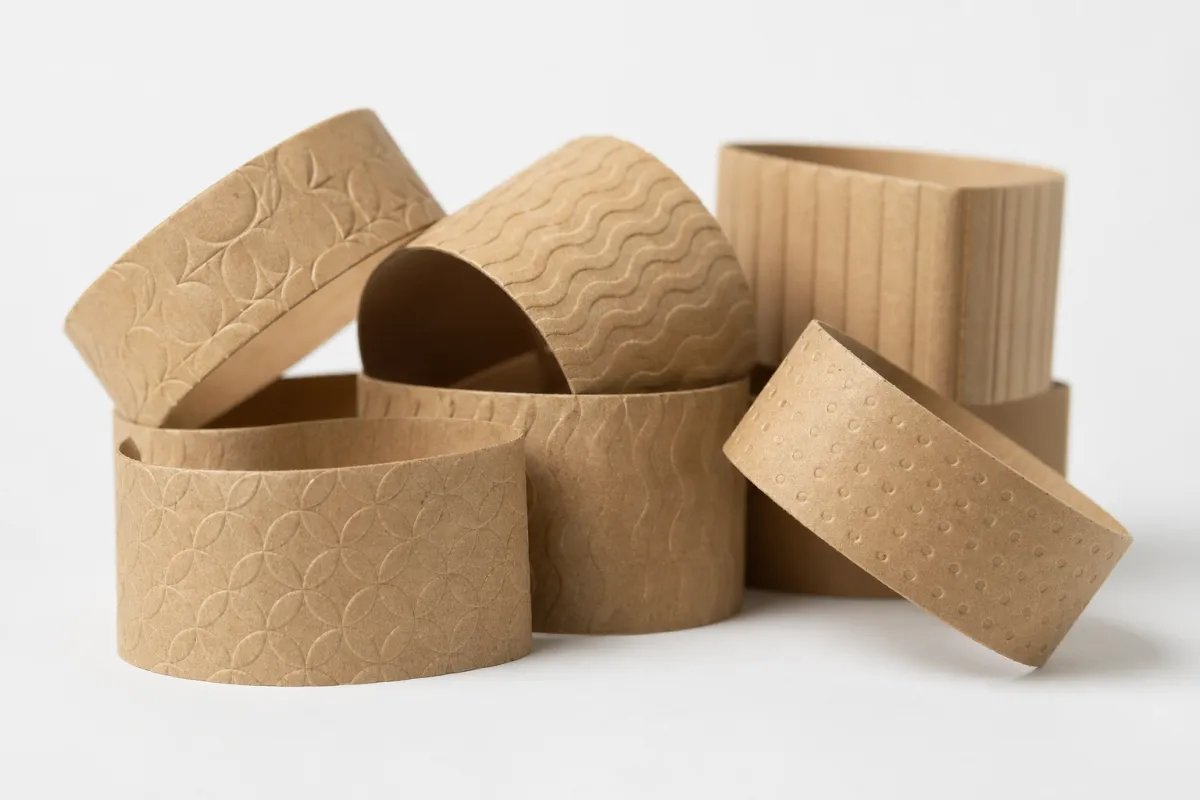
The first mistake I see is treating embossing like a luxury finish that only belongs on rigid gift boxes and expensive cosmetics. That is not how the cost for embossed kraft bands behaves on a real production floor in Dongguan or Foshan. A kraft band is a narrow paper component, often between 40 mm and 120 mm tall, so the print area is small, the substrate can be selected economically, and the emboss can sit on a logo panel instead of covering the entire surface. That is one reason the cost for embossed kraft bands can be lower than buyers expect, especially when the artwork uses one Pantone color and a single raised mark on 300 gsm to 350 gsm kraft.
Years ago, while standing beside a slitter in a folding carton plant near Shenzhen Longhua, I watched a customer compare a full printed sleeve against a 62 mm kraft band with a blind emboss. The sleeve looked polished, but the band delivered nearly the same shelf presence for less material, less ink, and fewer conversion steps. The client cut packaging spend by about 18% on that SKU, and the cost for embossed kraft bands made sense because the band sat on top of a standard carton they were already buying. That is the real value: the band adds tactile branding, shelf appeal, and a custom look without forcing a complete redesign of the package structure. I still remember the production manager in Shenzhen running his thumb across the raised logo and nodding like he had just found money in a coat pocket.
Where the money goes is straightforward. Paper stock is the base line, then comes embossing tooling, any printing plates or digital setup, die cutting, folding, and packing. If the band needs a lock tab, perforation, or window cutout, the cost for embossed kraft bands rises because the conversion step gets more involved. A simple rectangle with one emboss zone and one glue point, or a self-locking slot, keeps the quote cleaner. That is why I always tell buyers to think in terms of unit cost instead of only the headline price; the cheaper-sounding line item can become expensive once setup charges and freight from Ningbo or Yantian enter the picture. The quote sheet can look polite right up until it is not.
I have also seen embossed kraft bands outperform heavier packaging in categories like subscription kits, bakery goods, gift sets, and retail cartons. A bakery client in Guangzhou used a 48 mm kraft wrap around a pastry box, and the tactile logo made the box feel more premium than a full-color print job ever could. The cost for embossed kraft bands stayed low because the design used two colors, no lamination, and a stock that could run on a standard press without special handling. That is the sweet spot: simple geometry, one or two colors, and artwork prepared with production discipline. I wish more marketing decks would say that instead of acting like every package needs a fireworks show.
- Best value specs: 300-350 gsm kraft, one emboss area, one-color print, and a rectangular band.
- Higher cost specs: large coverage embossing, multi-panel artwork, foil, or complex closure features.
- Smart use cases: sleeves, belly bands, subscription kits, bakery cartons, and gift packaging.
What Embossed Kraft Bands Are and What Drives the Cost for Embossed Kraft Bands
A kraft band is a strip of paper that wraps around a box, pouch, jar, tray, or folded carton and uses embossing to create raised branding or texture. The band can be glued, tucked, tab-locked, or friction-fit, depending on the product and the line speed. On the factory floor in Dongguan, I usually explain the part this way: it is the packaging equivalent of a tailored belt, not a structural container. That distinction matters because the cost for embossed kraft bands is usually far more attractive than the cost of replacing an entire carton system. I have learned that if you explain it like a clothing detail instead of a packaging lecture, people finally nod instead of staring at you like you have two heads.
Buyers sometimes mix up embossing, debossing, print, and foil. Print adds color to the surface. Embossing pushes the paper upward with a male and female die set. Debossing pushes the surface down. Foil adds a metallic or pigment layer through heat and pressure. Each effect changes the cost for embossed kraft bands in a different way, and not all of them belong on the same job. A simple raised logo on natural kraft often looks more intentional than a crowded mix of foil, spot UV, and heavy coverage ink, especially on a recycled-looking substrate with visible fiber character. Honestly, too many finishes can start to feel like someone emptied the sample drawer onto one layout and called it strategy.
Common applications are easy to spot once you have spent time on a packing line. Belly bands on candle cartons, sleeve wraps for soap bars, product seals on specialty foods, subscription sleeves around a mailer, and event Packaging for Cosmetics or apparel all use the same principle. The cost for embossed kraft bands tends to stay under control in these categories because the band uses fewer square inches of material than a full carton wrap. I have seen brands use the band as a high-impact layer while keeping the primary box plain, which is a clean way to protect margin without giving up shelf presence.
Kraft has its own visual strength. The natural brown tone, recycled look, and fiber texture give a brand a grounded, honest appearance that fits minimalist systems and eco-minded products. For comparison, a 350 gsm C1S artboard carton in Suzhou can give a smoother and brighter surface, but it usually costs more than a kraft band and does not carry the same tactile texture. If you want to check how paper claims and recycled fiber language are typically handled, the FSC site is a good starting point for certification language, and Packaging.org is useful for broader packaging terminology and material context. In practice, the cost for embossed kraft bands is often justified by this visual honesty alone; people trust a package that looks straightforward and feels deliberate.
Optional add-ons matter, but they should be used with discipline. Window cutouts can reveal the product underneath. Soft-touch coatings make the band feel smoother, though they complicate recyclability and add a finishing step. Perforations help with tear-open behavior, and lock tabs support fast manual assembly on a line in Guangzhou or Wenzhou. Each add-on nudges the cost for embossed kraft bands upward, so I always ask whether the feature is solving a real handling problem or just decorating the spec sheet. That question has saved more than one buyer from approving a very expensive little flourish that did absolutely nothing.
"A good kraft band should look intentional in 2 seconds, feel better in 2 seconds, and assemble without drama on a 60-piece-per-minute line."
Specifications That Affect Fit and Finish
The fastest way to control the cost for embossed kraft bands is to get the fit right before anyone quotes the paper. I always start with finished width, wrap length, overlap, score placement, and closure style. If the band needs a 10 mm overlap for glue or a 12 mm tuck flap for a locking tab, that changes the die line immediately. A band that fits a 76 mm carton without wrinkling is not the same as a band that must hug a round jar with a 2 mm tolerance, and that is where a lot of hidden cost shows up. I have seen a beautiful design fall apart because someone guessed at the circumference instead of measuring it properly, which is not a recommended engineering method in Dongguan, Shenzhen, or anywhere else.
Paper stock is the next major lever. A 250 gsm kraft may be fine for a light sleeve, but a 350 gsm or 400 gsm kraft sheet often gives a cleaner emboss on a logo with a deep bevel or fine linework. Heavier stock can improve tactile definition, yet it may require a more careful press setup and stronger crease engineering. A lighter sheet can reduce the cost for embossed kraft bands by lowering material spend, but if it wrinkles or collapses during assembly, the labor loss wipes out the savings very quickly. I have watched more than one buyer save $0.02 on paper and lose $0.08 on line rejects. That math has a way of ruining a nice afternoon.
Emboss depth matters more than many procurement teams expect. A shallow 0.3 mm logo impression is easier to run than a 0.8 mm raised texture panel with fine type and tight corner radii. The sharper the artwork, the more the tooling has to hold detail and the more precise the registration has to be. If the artwork has thin serifs or hairline rules, I usually suggest a wider stroke and a cleaner silhouette because that protects the cost for embossed kraft bands from climbing due to rework and trial runs. A little simplification here often saves a lot of swearing later.
Print spec is another cost factor that should be discussed honestly. One-color coverage is usually the most economical. Two colors remain manageable if the coverage is limited. Full-coverage printing, flood coats, or large dark backgrounds add more ink, more drying time, and more process control. In a plant with a long calendar and a busy conversion schedule in Guangzhou, those extra minutes matter. The cost for embossed kraft bands can move by cents per piece depending on whether the band is a minimal single-mark design or a fully printed retail graphic. I am biased toward restraint here because restraint usually prints better and costs less, which is rare enough to be appreciated.
Sustainability should be designed in, not pasted on after the fact. Recyclable paper choices, minimal lamination, and water-based inks are easier to defend than a spec full of decorative layers. If a buyer wants to say the band is recyclable, I ask what the full build looks like first, because a paper band with a plastic film window is a different story from a plain kraft wrap. The right material choice can support brand claims while keeping the cost for embossed kraft bands under control, and that is usually the better trade. Nobody wants to build a green story on a stack of exceptions and a headache.
- Useful size checks: finished width, overlap, score line, and closure gap.
- Practical stock range: 250 gsm to 400 gsm kraft, with 300-350 gsm often hitting the best balance.
- Emboss detail: 0.3 mm shallow marks are easier; deep, textured panels need more precise tooling.
- Print decision: one-color or two-color is usually the cleanest route for price control.
Cost for Embossed Kraft Bands: Pricing Drivers and MOQ
Let me be blunt: the cost for embossed kraft bands is driven by six variables more than any others: size, quantity, stock choice, embossing area, print complexity, and packing requirements. Add a seventh variable and it is probably whether the artwork is production-ready or still being revised by three different people in a marketing chain. On a quote sheet, I want to see those details before anyone talks about a unit price, because an incomplete brief leads to a misleading number and a frustrated buyer. I have sat through enough of those calls to know they age a person faster than they should.
MOQ changes the economics immediately. At 1,000 pieces, the cost for embossed kraft bands carries a heavy share of tooling fees, plates, and setup charges. At 5,000 pieces, the setup is spread more fairly, and the unit cost starts to behave; in one Guangzhou example, a 48 mm kraft band with a single blind emboss landed at exactly $0.15 per unit before freight. At 20,000 pieces, you usually see the cleanest bulk pricing because the die, press calibration, and conversion waste are distributed across more units. That does not mean bigger is always better, but it does mean the pricing curve is not linear. I always tell buyers not to look at the first number and assume it is the whole story, because the first number is often just the part of the story that fits on one line.
One-time costs and recurring costs should be separated in every quote. Embossing dies, cutting dies, prepress, color proofs, and first articles are usually one-time or low-frequency expenses. Paper, printing, conversion, and packing are recurring. I have seen buyers compare two quotes without noticing that one supplier included tooling fees and the other buried them in the unit cost. The result is a false comparison. A trustworthy estimate for the cost for embossed kraft bands should itemize tooling fees, unit cost, freight, lead time, and any assembly charges so you can see the real total. If the numbers are fuzzy, the decision will be fuzzy too.
| Order Size | Plain Kraft Band | Printed + Embossed Band | Typical Notes |
|---|---|---|---|
| 1,000 pcs | $0.39-$0.55 / unit | $0.69-$0.92 / unit | Tooling fees and setup charges weigh heavily |
| 5,000 pcs | $0.15-$0.22 / unit | $0.28-$0.39 / unit | Good balance of unit cost and MOQ pressure |
| 20,000 pcs | $0.07-$0.11 / unit | $0.14-$0.20 / unit | Bulk pricing improves the cost for embossed kraft bands |
Those numbers are illustrative, not a promise, because a 48 mm sleeve with one emboss zone will not price like a 110 mm wrap with two print passes and a perforation. Still, the table shows the general shape of the market: the cost for embossed kraft bands falls as volume rises, and the sharpest drop usually happens after you clear the first tooling step. If you are comparing suppliers in Dongguan, Shenzhen, and Ningbo, ask them to quote the same paper grade, the same emboss area, and the same shipping terms. That is the only way to compare cost per piece honestly.
I learned that lesson during a supplier negotiation where one factory quoted a very attractive number on 3,000 units, but the quote assumed a lighter stock, no proofing, and freight excluded from the total. Once we normalized the spec to 320 gsm kraft, a physical proof, and carton-packed export delivery from Yantian, the cost for embossed kraft bands moved by almost 22%. The cheaper line on the page was not actually cheaper. It was just incomplete, and I still remember the awkward silence on that call.
There is also a strategic question buyers should ask: do you want one flagship band style or a family of sizes that reuse the same die? If the artwork and emboss panel stay consistent across 3 product sizes, you can dilute tooling and improve bulk pricing. That is especially useful for subscription businesses and multi-SKU retail programs in Shanghai, Hangzhou, and Guangzhou. The smartest quotes for the cost for embossed kraft bands usually come from buyers who plan reorders, not one-off purchases. Reuse is not glamorous, but it is very kind to the budget.
My advice is simple. Ask for pricing at 1,000, 5,000, and 20,000 pieces. Ask the vendor to separate tooling fees from recurring production. Ask whether plates, dies, and sampling are included. If the answer is vague, the quote is not ready to trust. The best cost for embossed kraft bands is the one you can actually reproduce on the second order without a surprise invoice. I have seen more projects go sideways from vague pricing than from bad design, which says a lot about how much paperwork matters.
How Do You Lower the Cost for Embossed Kraft Bands?
The quickest way to lower the cost for embossed kraft bands is to keep the structure simple, use a practical kraft stock, and make sure the art is ready for production before the quote goes out. A rectangular band with one emboss zone, one print color, and a single glue point usually gives the best balance of unit price, shelf appeal, and line efficiency. If you need a lower cost for embossed kraft bands, ask suppliers to quote the same paper grade, same size, same closure style, and same freight terms so you can compare apples to apples instead of comparing different jobs that only look alike on paper.
Another reliable move is to order enough volume for tooling to spread across the run. The cost for embossed kraft bands drops more sharply after the first setup step is absorbed, which is why 5,000 pieces often looks much healthier than 1,000 pieces. Reusing the same die across multiple SKUs can also improve bulk pricing, especially for Brands That Sell a family of boxes or seasonal gift sets. If the emboss panel stays consistent, the factory can keep the press setup stable, and stability is a quiet way to save money.
Finally, resist the urge to add finishes that do not solve a real problem. Foil, lamination, windows, and complex folds all nudge the cost for embossed kraft bands upward. In many cases, a clean emboss on natural kraft does more for the brand than stacking decorative layers. The customer sees texture, the carton stays honest, and the production line stays calmer. That is usually the best commercial outcome.
Order Process and Timeline for Embossed Kraft Bands
The order process starts with a quote brief, and the brief needs more than a logo file. To estimate the cost for embossed kraft bands accurately, I ask for finished size, quantity, paper preference, artwork format, closure style, and the delivery date. If the band wraps a jar or tray, I also want the product dimensions and a photo of the pack from three angles. A 5 mm mistake in wrap length can create wrinkles, and wrinkles are one of the fastest ways to turn a good concept into waste. I once spent an entire afternoon fixing a spec that was off by less than a fingernail; the paper was not impressed, and neither was I.
Prepress is where many projects either get protected or get damaged. We review the dieline, check artwork placement, verify emboss alignment, and confirm whether the logo needs to sit dead center or offset by 2 mm for visual balance. Digital proofs help with layout, but a physical sample is better when the emboss is detailed or the stock is heavy. That extra step can affect the cost for embossed kraft bands, yet it usually saves money by preventing a larger production correction later. A cheap proof that misses the problem is not cheap at all.
Manufacturing typically moves through paper conversion, embossing, printing, finishing, die cutting, folding, and final packing. On a run with 12,000 bands in Dongguan, those steps may happen on separate equipment, and each handoff adds a little risk. If the job includes a special fold, a tear strip, or a glue tab, I expect more inspection time. That is why the cost for embossed kraft bands should always be viewed together with schedule planning. A lower price means very little if the bands show up after the launch box has already shipped. That kind of delay has a special talent for ruining a team mood.
Lead time depends on whether tooling exists, how many art revisions are still open, and whether the finish is simple or layered. Repeat orders with the same die and same stock can move quickly. New dies take longer. Multi-step finishing takes longer. If a client wants a realistic target, I usually give them a planning window instead of a single optimistic date: 12 to 15 business days from proof approval for repeat specs, and 18 to 25 business days for new tooling or complex shapes. That window keeps the cost for embossed kraft bands tied to reality instead of wishful thinking. Wishful thinking is charming in novels, not so much in factory scheduling.
For buyers shipping into retail distribution, I also recommend thinking about carton packing and transit testing. A band that arrives flattened or scuffed can still be unusable if the emboss crushes in transit. In some projects, we reference ISTA handling methods to decide how the packs should be boxed and palletized. The quote does not have to be complicated, but the packaging method should be clear. That protects the cost for embossed kraft bands from hidden damage claims later. Nobody wants to discover that "fragile" was treated like a decorative suggestion.
- Quote inputs: size, quantity, artwork, stock preference, closure style, ship date.
- Proof steps: dieline review, art placement check, emboss alignment, and sample approval.
- Typical repeat timeline: 12-15 business days from proof approval for a straightforward run.
- Common delay points: new tooling, late art changes, and multi-step finishing.
Why Buyers Choose Custom Logo Things for Kraft Band Runs
What I hear from buyers most often is not "Can you make it?" It is "Can you make it right the first time?" That is where practical factory knowledge matters. We pay attention to paper behavior, press limits, and how embossing holds up on different substrates, because those details decide whether the cost for embossed kraft bands stays efficient or turns into a remake. A nice-looking sample is only useful if it can be repeated at 5,000 or 25,000 pieces without drift. The sample is the easy part; repeating it without drama is the part that earns trust.
Consistency is a major reason brands come back. On repeat orders, color control, emboss depth, and trimming accuracy need to match the previous run closely enough that the bands look like one system, not three different suppliers. In a client meeting I remember from a cosmetics brand in Shanghai, the buyer had three reorders from different vendors and each band sat 1 to 2 mm differently on the carton. That small mismatch became a shelf issue. We tightened the spec, standardized the paper, and the cost for embossed kraft bands dropped on the next order because the production team no longer had to compensate for drift. Tiny error, big annoyance. Packaging loves that trick.
We also try to reduce waste before it starts. Sometimes the smartest move is not a fancier finish; it is a narrower band, a cleaner score, or a logo moved 4 mm higher so the emboss hits the visual center. Those choices do not sound dramatic, but they can save money on paper and labor. The best cost for embossed kraft bands usually comes from a spec that respects the machine, the material, and the person folding the pack at the end of the line. I have a soft spot for specs like that because they tend to survive contact with reality.
Transparency is another value point. I prefer a quote that states assumptions plainly: stock grade, size, tooling fees, proof method, freight basis, and whether assembly is included. If a supplier refuses to spell that out, the buyer is carrying too much risk. Our approach at Custom Logo Things is to answer the awkward questions early, because a straight answer about the cost for embossed kraft bands is better than a polished surprise later. Honestly, that is how packaging relationships should work. There is enough uncertainty in production without adding mystery theater to the invoice.
And yes, the result still has to look good. A well-made kraft band can turn a simple carton into a polished retail-ready presentation, especially when the emboss catches light on a natural fiber surface. That is not hype; it is what I have seen on shelves in Guangzhou, at trade shows in Shenzhen, and in packing rooms where customers judge a package in 3 seconds. The cost for embossed kraft bands is easier to justify when the brand sees that kind of response in real use. If the box gets picked up twice because the band feels good in the hand, that is a very real commercial outcome.
Next Steps to Quote the Right Cost for Embossed Kraft Bands
If you want a clean quote, gather the essentials first: finished size, target quantity, artwork files, paper preference, and the product the band will wrap. A photo of the container, box, or pouch helps too, because a 90 mm carton and a 90 mm pouch behave very differently. The more exact your brief, the more accurate the cost for embossed kraft bands will be on the first pass. I know that sounds obvious, but I have still seen people send a single logo file and ask why the quote feels vague.
I also recommend building a like-for-like comparison sheet before you send requests to multiple vendors. Put the same stock, the same emboss area, the same print colors, and the same shipping destination on every line. That way you are comparing unit cost against unit cost, not guessing why one quote looks 15% lower. If one vendor excludes tooling fees and another includes them, the cost for embossed kraft bands is not actually comparable until the assumptions match. A fair comparison sheet saves everyone from the familiar, exhausting back-and-forth where nobody is quite sure what number they are defending.
Ask for pricing at two or three volume breaks, not just one quantity. A quote at 1,000 pieces, 5,000 pieces, and 20,000 pieces reveals where the real price slope sits and whether the MOQ is helping or hurting you. For some products, the biggest improvement happens between 2,500 and 5,000 pieces. For others, the real drop starts only after the die and setup charges are fully absorbed. Either way, the cost for embossed kraft bands becomes much easier to plan once you see the break points. It is a lot nicer to make a decision with a curve than with a guess.
Timeline matters just as much as price. If the bands must arrive before a product launch, a seasonal shipment, or a trade show in Shanghai or Shenzhen, say so up front. A rushed rework on artwork or a late approval on the dieline can erase a good unit price very quickly. I would rather quote the cost for embossed kraft bands with a realistic delivery window than promise a date the press cannot hold. The press is wonderfully honest in that way; it simply refuses to care about your launch calendar.
Send specs, artwork, and quantity, and we can quote the cost for embossed kraft bands accurately on the first pass. That is the fastest path to a useful number, a realistic lead time, and a band that looks right on the shelf instead of just looking polished on screen. If you have ever watched a beautiful mockup fail because it ignored the folding line, you already know why that matters.
FAQ
What is the average cost for embossed kraft bands at low MOQ?
Low-MOQ pricing is usually driven by setup and tooling, so the cost for embossed kraft bands per unit is higher than on volume runs. A 1,000-piece order for a 48 mm band in Dongguan may sit near $0.69 to $0.92 per unit once the emboss die and proofing are included, while a 5,000-piece run often drops closer to $0.28 to $0.39 per unit. I usually warn buyers not to compare a tiny test order to a production run and expect the numbers to behave the same way.
How does the cost for embossed kraft bands change with embossing depth?
Deeper or more detailed embossing can require tighter tooling and more careful press setup, which raises the cost for embossed kraft bands. A shallow 0.3 mm mark on 300 gsm kraft is usually easier to run than a 0.8 mm raised texture on 350 gsm stock, especially if the logo uses small type or sharp corners. If budget matters, I usually keep the embossed area focused on the logo or one signature graphic element. Deep texture can look lovely, but it also likes to test everyone’s patience, which is not exactly ideal on a busy line.
Do printed and embossed kraft bands cost more than plain kraft bands?
Yes, because printing adds plates or setup and embossing adds tooling and conversion steps, so the cost for embossed kraft bands will be higher than plain kraft. A plain 5,000-piece band may land around $0.15 to $0.22 per unit, while a printed and embossed version can move to roughly $0.28 to $0.39 per unit depending on size and shipping from Guangdong. The increase is often reasonable if the band replaces larger packaging decoration elsewhere. A one-color printed band with a single emboss zone is often the best balance of cost and impact. That combination tends to look considered rather than overworked, which is usually the goal.
How long does production usually take for embossed kraft bands?
Repeat orders with existing tooling are faster than fully custom jobs, and that affects the cost for embossed kraft bands only indirectly through rush fees or schedule pressure. For a straightforward repeat run, 12 to 15 business days from proof approval is a realistic target in Dongguan or Guangzhou; new tooling or a complex fold can push that to 18 to 25 business days. New artwork, new dies, or special finishes add time for proofing and approval. The safest move is to approve the dieline and artwork before production starts. I have seen more delays caused by late approvals than by machinery, which is saying something.
What information is needed to quote embossed kraft band pricing accurately?
Provide finished dimensions, quantity, artwork files, stock preference, and the type of closure or overlap needed so the cost for embossed kraft bands can be calculated with fewer assumptions. Include target ship date and destination so freight and lead time can be calculated correctly, whether the shipment is moving to Los Angeles, Rotterdam, or Sydney. If you want apples-to-apples pricing, ask every supplier to quote the same spec sheet. Otherwise, you are comparing different jobs and pretending they are the same one, which is a quick road to confusion.
For brands that want a tactile, clean-looking package without overbuilding the structure, the cost for embossed kraft bands usually makes strong commercial sense, especially when the spec stays disciplined and the order size matches the production method.


