Buyer Fit Snapshot
| Best fit | packaging buyers who need clearer specs, stronger internal paths, and repeatable quote decisions where brand print, material, artwork control, and repeat-order consistency matter. |
|---|---|
| Quote inputs | Share finished size, material target, print colors, finish, packing count, annual reorder estimate, and delivery region. |
| Proofing check | Approve dieline scale, logo placement, barcode or warning zones, color tolerance, and any recyclable or compostable wording before bulk production. |
| Main risk | Vague material claims, crowded artwork, or missing packing details can create delays even when the unit price looks attractive. |
Fast answer: Subscription Box Shipper Inserts: Design, Cost & Workflow should be specified like a repeatable production item. The safest quote includes material, print method, finish, artwork proof, carton packing, and reorder notes in one written spec.
What to confirm before approving the packaging proof
Check the product dimensions against the actual filled item, not only the sales mockup. Ask for tolerance on folds, seals, hang holes, label areas, and retail display edges. If the package carries a logo, QR code, warning copy, or legal claim, reserve that space before decorative graphics fill the panel.
How to compare quotes without losing quality
Compare board or film grade, print process, finish, sampling route, tooling charges, carton quantity, and freight assumptions side by side. A lower quote is only useful if the supplier can repeat the same color, closure quality, and packing count on the next order.
Subscription Box Shipper Inserts: Design, Cost & Workflow
I still remember a Tuesday shift at a Phoenix co-pack line where we were shipping 12,000 monthly beauty kits in double-wall cartons, yet damage claims stayed above 4.8%. The culprit was not corrugated failure; it was internal movement, and once we replaced loose kraft with subscription box shipper inserts, claims dropped to 1.3% within two cycles.
Why subscription box shipper inserts matter more than most teams expect
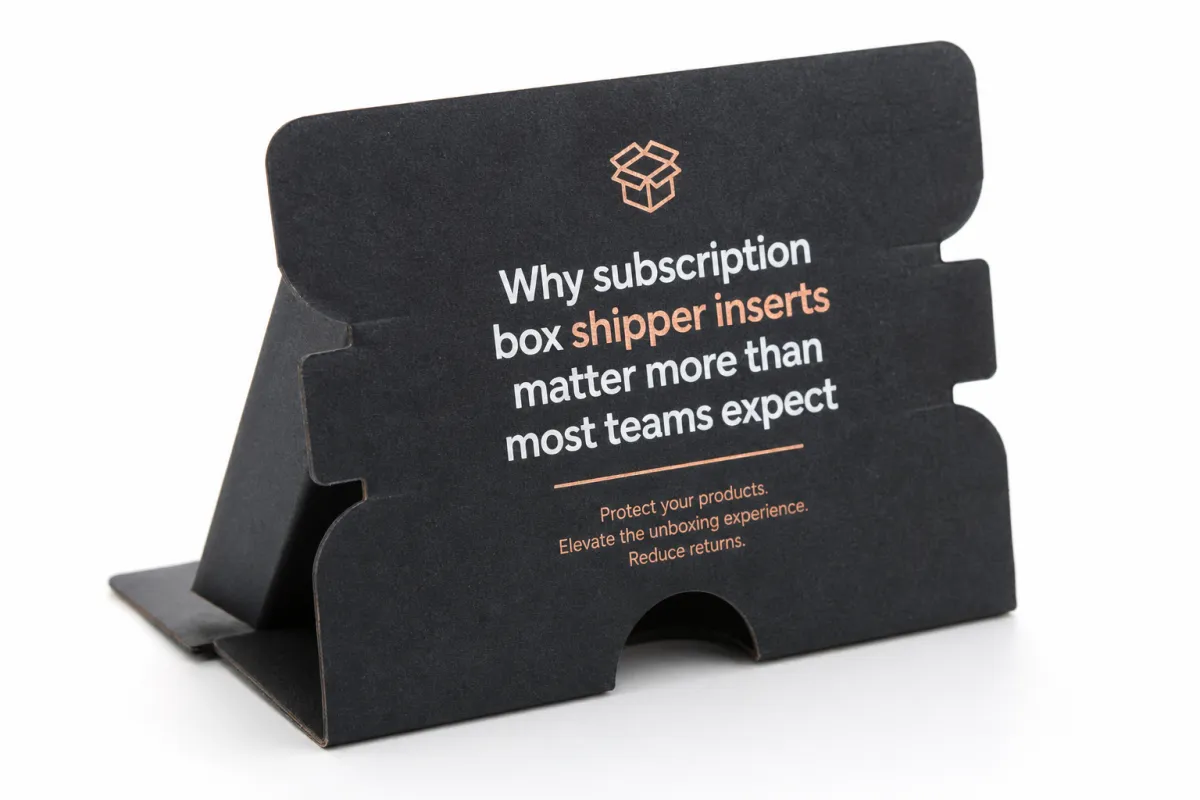
Most operations teams assume outer carton strength does the heavy lifting, but my floor audits tell a different story. Across 9 recurring programs I reviewed between Q1 and Q3 on the West Coast, more than half of complaint photos showed intact RSC shippers with broken glass droppers, dented tins, or scuffed labels inside. Internal drift of as little as 8-12 mm during trailer vibration can create repeated edge impacts, and that is exactly where subscription box shipper inserts change the equation.
On a line visit in Reno, we timed rework for a wellness brand shipping 28,000 boxes per month. Packers used hand-torn void fill, averaging 19 seconds extra per order because each box needed “feel-based” adjustment. We switched the pack station to a lock-tab insert made from 32 ECT E-flute, pre-scored for one-touch loading. Rework labor dropped by 31 hours per week, support tickets tagged “arrived damaged” fell by 42% in six weeks, and return handling time went from 4.5 minutes to 2.7 minutes per case. I have seen similar gains whenever subscription box shipper inserts are designed around pack-line behavior, not just aesthetics.
In plain language, subscription box shipper inserts are engineered internal components that hold products in fixed positions while parcels move through conveyors, sortation hubs, delivery vans, and front-door drop-offs. They can be die-cut paperboard, corrugated partitions, molded pulp nests, foam collars, or hybrids that combine two materials. The goal is simple: limit motion, separate hard-contact surfaces, and spread load paths before shock reaches fragile SKUs.
Recurring-box programs have tighter failure tolerance than one-off ecommerce orders. If a one-time order fails, you lose a transaction. If a monthly shipment fails, you risk churn, refund leakage, negative social posts, and a recurring support burden. Unboxing videos amplify every flaw. A shifted bottle or cracked cap is not just a replacement cost; it becomes a public quality signal.
Here is what I think most teams get wrong: they treat inserts as a “nice-to-have” branding layer instead of an operations control. Honestly, I think that mindset is expensive. Good subscription box shipper inserts protect products, speed packout, reduce dimensional chaos, and make forecast planning easier because damage rates stabilize.
This guide walks through mechanics, material decisions, cost drivers, timelines, common pitfalls, and execution tactics that work in live fulfillment. I will share what I have seen in Shenzhen pilot runs, Midwest co-pack launches, and supplier bid reviews where two cents per unit looked attractive but doubled complaint rates.
How subscription box shipper inserts work in real shipping lanes
Parcel handling is rough in predictable ways. A typical box moves from pack table to takeaway conveyor, drops 4-10 inches at transfer points, sits in gaylords, rides linehaul trailers with persistent vibration, gets sorted across diverters, then sees final-mile handling that may include one hard doorstep drop. If you map that path in sequence, subscription box shipper inserts act as a micro-suspension system built inside the carton.
Physics is not complicated here, but it is unforgiving. You control free space, lower product-to-product collision, and push shock into structural panels instead of fragile components. When free movement is under 3 mm on high-risk SKUs, break rates often fall sharply. When movement exceeds 10 mm, breakage spikes, especially on glass pipettes, pumps, and narrow-neck jars. Properly specified subscription box shipper inserts manage that movement window consistently.
Fit class matters more than marketing language, so I usually classify insert behavior into five categories:
- Friction fit: Product is held by panel tension, best for cartons under 1.5 lb with stable SKU dimensions.
- Pocket fit: Cavities constrain lateral motion; ideal for mixed cosmetics and accessories.
- Nested tray: Formed cavities carry vertical load and protect finishes from scuffing.
- Bridge support: Spans voids above uneven items to reduce top-load collapse.
- Multi-level stacks: Two-tier systems for tall/short SKU combinations in one footprint.
I watched a Dallas operation test all five fit classes over a 3-day trial with 2,400 boxes. Pocket fit plus bridge support gave the best balance of speed and protection, trimming pack time from 41 seconds to 29 seconds while improving post-transit pass rate from 90.6% to 97.8%. That is the practical power of well-structured subscription box shipper inserts.
Architecture choices differ by business model. Die-cut fold-in inserts are cheap to ship flat and quick to revise. Corrugated cell partitions resist side crush on heavier SKU sets. Molded pulp works well for sustainability goals and curved product shapes. Thermoformed trays with paper sleeves offer precision alignment for premium experiences, though they may trigger recyclability debates unless material recovery guidance is clear.
Fulfillment speed depends on assembly complexity. A one-touch insert with two lock tabs can outperform a four-fold structure by 8-14 seconds per order on mixed-skill shifts. On high-volume lines, that labor delta can exceed $0.06 per pack at $22/hour fully burdened labor. I always ask teams to clock real operators on real lines before approving subscription box shipper inserts, because spreadsheet assumptions can hide friction.
Key factors for selecting subscription box shipper inserts
Start with product profile, not material preference. I use a risk worksheet with five variables: fragility index, weight concentration, leak potential, finish sensitivity, and orientation rules. A 250 ml glass bottle with metal pump needs different retention than a 40 g sachet pouch, even if both fit the same visual layout. Your best subscription box shipper inserts begin with SKU behavior under shock, vibration, and compression.
Material selection is where tradeoffs get real. SBS at 24 pt can deliver sharp print and clean folds for light kits, but may lose rigidity above about 1.8 lb total load unless geometry compensates. CCNB is lower cost and acceptable for hidden structures, though edge crush performance varies by mill. E-flute corrugated (around 1.2-1.6 mm) gives a strong stiffness-to-weight ratio for many programs. B-flute adds buffering for heavier assortments but increases cube and may impact dimensional weight. Molded pulp improves cradle fit for odd shapes, while foam still earns a place for extreme shock control on fragile components, especially where ISTA 3A testing exposes repeated failures.
Brand and sustainability expectations also shape decisions. Many clients now ask for mono-material packs so curbside recovery messaging stays simple. If the outer shipper and insert are both fiber-based, consumer sorting confusion drops. FSC-certified input can strengthen sourcing credibility, and you can verify chain-of-custody options through FSC. I usually avoid heavy film lamination unless presentation value clearly offsets recycling friction.
Compliance and logistics constraints should be discussed early. Transit environments vary by carrier and zone mix, humidity can soften fiberboard in non-climate-controlled storage, and pallet patterns can concentrate compression stress along outer rows. I have seen Florida summer storage push RH above 75%, softening lightweight inserts enough to lose retention on day 12 of a 30-day inventory cycle. In those lanes, upgrading board caliper or adding structural ribs to subscription box shipper inserts is often cheaper than accepting elevated damage claims.
Line realities can make or break a design. Hand-pack stations tolerate different fold memory than semi-automated insertion lines. Glue tabs can improve rigidity but add lead-time dependencies and cure variability. Lock tabs reduce adhesives but demand tighter die tolerances. Tolerance stack-ups between product, insert, and carton tooling can easily reach 2-3 mm, so I always push for measured tolerances in supplier specs, not “nominal fit” language.
If you need a baseline transit protocol, review ISTA procedures and align sample prep with your real SKU mix. Standardized testing does not guarantee perfect field outcomes, but it creates a repeatable benchmark for comparing subscription box shipper inserts across suppliers.
Cost and pricing breakdown for insert systems
Cost conversations get clearer when you separate one-time expenses from recurring unit economics. One-time items usually include structural design, CAD work, white samples, test rounds, and die tooling. Recurring costs include board, converting, printing, assembly, and freight. For most custom subscription box shipper inserts, I budget one-time setup between $1,200 and $6,500 depending on complexity and revision count.
In a supplier negotiation last spring, one converter quoted $0.11/unit for a simple die-cut insert at 50,000 pieces, while another quoted $0.15/unit for a slightly heavier E-flute design. On paper, the first quote looked better. Field results told a different story: the cheaper option produced 2.9% damage incidents in pilot, while the sturdier option landed at 0.8%. Replacement freight and support labor erased the apparent savings within one cycle. That is why I evaluate subscription box shipper inserts using total landed impact, not piece price alone.
Primary cost drivers include board grade, caliper, sheet yield, nesting efficiency, print coverage, and assembly labor. Full flood color plus soft-touch coating can add $0.02-$0.05 per unit compared with one-color flexo on hidden structures. Pre-assembled inserts save line time but increase inbound cube and freight. Knockdown formats reduce freight spend but shift labor back to packout. The best format depends on your line rate and labor profile.
Volume tier is another major lever. Short runs under 5,000 units may favor digital print and simple dies, while offset economics usually improve beyond 20,000 units if graphics matter. I have seen breakpoints move by plant, especially between domestic and offshore converters, so always request tiered quotes at 5k, 10k, 25k, and 50k for subscription box shipper inserts.
| Insert Type | Typical Material Spec | Estimated Unit Cost (5,000 pcs) | Estimated Unit Cost (50,000 pcs) | Lead Time from Proof Approval | Best Fit Scenario |
|---|---|---|---|---|---|
| Die-cut fold-in | 24pt SBS or 18pt CCNB | $0.18-$0.29 | $0.09-$0.16 | 10-14 business days | Lightweight mixed kits, strong branding focus |
| E-flute pocket insert | 32 ECT E-flute, kraft liner | $0.22-$0.35 | $0.12-$0.21 | 12-15 business days | Fragile bottles, medium weight loads |
| B-flute partition set | 44 ECT B-flute | $0.28-$0.42 | $0.16-$0.27 | 14-18 business days | Heavier SKUs, high vibration lanes |
| Molded pulp cavity | Recycled pulp, formed tray | $0.31-$0.48 | $0.19-$0.32 | 18-25 business days | Sustainability-forward programs, curved SKUs |
| Thermoformed tray + sleeve | PET/rPET tray + printed paper sleeve | $0.36-$0.58 | $0.24-$0.41 | 20-28 business days | Premium presentation, precise orientation control |
Use a structured estimation framework in supplier RFQs: define drop/vibration assumptions, target movement threshold (for example, under 5 mm), MOQ, revision allowance, tooling amortization method, and surcharge triggers for expedited production. I include a 7-10% contingency line for early revision cycles because first-pass subscription box shipper inserts rarely go live unchanged.
Total landed math should also include complaint reduction, returns avoided, and retention impact. If better inserts cut monthly damage from 3.2% to 1.1% on 20,000 shipments with $18 average replacement burden, that is roughly $7,560 saved per month. Add the throughput benefit from faster packout, and higher-quality subscription box shipper inserts often pay back within one to three cycles.
Step-by-step process and timeline from concept to launch
Execution discipline matters more than creative brainstorming. I have run enough launch recoveries to know that skipping one early checkpoint can cost four weeks later. A practical rollout for subscription box shipper inserts usually follows five steps.
Step 1: Gather product and operations inputs
Collect exact SKU dimensions, filled weights, fragility notes, leak risk, fill sequence, carrier mix, and target shipper footprints. I ask teams for caliper measurements from three production lots per SKU, because vendor variance can exceed 1.5 mm on labels and caps. Document orientation rules clearly, such as “pump heads must face side panel” or “glass jar shoulder cannot contact carton wall.” Without these details, subscription box shipper inserts become guesswork.
At this stage, define throughput goals in numbers. If your line target is 520 boxes/hour with two operators, your insert geometry must support that pace. I also capture labor constraints by shift. In one Chicago plant, first shift averaged 14 months tenure while third shift averaged under 3 months; we needed simpler fold logic to keep performance steady.
Step 2: Build structural concepts and narrow options
Generate two or three candidate formats and score each against protection, speed, material availability, and cost. A simple scorecard works: protection (40%), pack speed (25%), sustainability (20%), unit cost (15%). This forces objective tradeoffs. I have seen teams fall in love with ornate structures that look great in renderings but slow lines by 20 seconds per pack.
For mixed-height assortments, I often prototype both a two-level paperboard bridge and an E-flute pocket tray. The bridge may save $0.03/unit, while the tray may cut damage by 1.2 points. Your choice depends on actual failure cost and churn sensitivity. Strong subscription box shipper inserts decisions come from measured tradeoffs, not preference.
Step 3: Prototype and test quickly
Move fast with white samples first, then graphics later. Conduct fit checks with real SKUs, timed line trials with actual operators, and transit simulation aligned to your shipping profile. I typically run at least 30 packed samples per concept through drop and vibration sequences, then inspect for cap loosening, glass micro-fractures, label abrasion, and leakage. If failure clusters appear, revise geometry immediately before tooling lock.
During one Shenzhen development run, we identified a recurring issue where a 30 ml bottle neck contacted a bridge panel after side-impact tests. A 4 mm cavity offset fixed it. That tiny adjustment prevented what would have become a recurring field complaint. This is why rapid testing is essential for reliable subscription box shipper inserts.
Step 4: Pilot production and fulfillment validation
Run a controlled pilot batch, usually 1,000-3,000 units depending on monthly volume. Measure pack time, defect rate, fold errors, and customer feedback tags for the first shipment wave. Capture QA photos at line start, mid-shift, and end-shift to detect consistency drift. If one shift shows higher misloads, the issue may be training cues, not design.
A strong pilot report includes numeric thresholds: damage under 1.5%, pack time under 32 seconds, assembly error under 0.7%, and customer “presentation complaints” under 0.5%. If targets are missed, adjust and rerun before full launch. Pushing flawed subscription box shipper inserts into full volume creates expensive firefighting.
Step 5: Plan full rollout and reorder cadence
Finalize artwork, approve die line files, complete first article sign-off, lock production slots, and define reorder triggers. I usually set reorder points based on 6-8 weeks of cover plus transit buffer, then map supplier lead times by lane. Domestic converters may hold at 10-15 business days; offshore can range 22-35 days including freight.
Set governance early: who approves revisions, who owns QC photos, and who monitors KPI drift after launch. Treat subscription box shipper inserts as a controlled component, just like primary packaging. Clear ownership keeps performance stable as SKUs rotate.
“We stopped treating inserts as a creative accessory and started treating them as a process control. Damage dropped from 3.7% to 1.0% in two billing cycles.” — Operations Director, national wellness subscription program
Common mistakes that undermine insert performance
First mistake: prioritizing visual drama over shock path control. I have reviewed inserts with beautiful printed folds and foil accents, yet the design left 14 mm of lateral play around glass pumps. The package looked premium in the studio and failed in transit. Durable subscription box shipper inserts start with mechanics, then build brand expression around that framework.
Second mistake: designing to one static SKU sample. Real supply chains drift. Cap heights change by 1-2 mm, labels wrap slightly differently, and fill levels vary by batch. If your cavity tolerances are too tight, you create jams and deformation. If too loose, products collide. I recommend validating fit across at least three production lots before freezing subscription box shipper inserts.
Third mistake: ignoring ergonomics and assembly load. Complex multi-fold systems may pass lab tests but collapse on high-turnover shifts where training time is limited. I once watched a co-pack line in Ohio misorient one insert panel every 18-20 boxes during peak week because the fold sequence required two hand flips under time pressure. Simplifying one tab eliminated the issue and recovered 11 boxes/hour.
Fourth mistake: choosing by lowest unit price only. A $0.04 delta can feel significant, yet hidden costs from replacements, refunds, and reputation damage can exceed that quickly. I have negotiated bids where the cheaper format increased leakage claims by 1.6 points. Total cost rose, not fell. Better subscription box shipper inserts often reduce cost at system level even if unit price is higher.
Fifth mistake: skipping iterative test rounds. Teams sometimes lock tooling after one successful bench drop, then discover failures during full-lane distribution. Emergency redesigns create scrap, delay launches, and strain supplier trust. A planned two-round test cycle with clear acceptance metrics is far safer for subscription box shipper inserts.
Here is a practical warning I give every client: “If you have not measured pack time with real operators, you have not finished design.” That single step can prevent months of avoidable churn.
Expert implementation tips and next actions for subscription box shipper inserts
If you need a clean starting point, run a 30-day sprint. Week 1: audit complaint photos from the last 90 days and tag failure modes by SKU. Week 2: classify top five high-risk products and map current internal movement points. Week 3: request two structural concepts per SKU group from suppliers. Week 4: run timed pack trials and quick transit checks, then prioritize rollout. This cadence keeps subscription box shipper inserts work focused and measurable.
I also recommend a structured supplier brief template with mandatory fields: test conditions, acceptable movement thresholds, target pack time, sustainability constraints, budget bands, MOQ, and Lead-time expectations. Ask suppliers to state assumptions explicitly, including board availability and tooling queue windows. Clear briefs produce better subscription box shipper inserts proposals and fewer revision surprises.
High-performing teams share three habits I see repeatedly. First, weekly QA-photo reviews with annotated issues and fixes. Second, packout checklists at each station showing orientation cues and fold sequence in three steps or less. Third, small-batch A/B trials before broad process changes. These habits keep subscription box shipper inserts performance stable as product mixes rotate.
Track rollout KPIs tightly during the first two billing cycles:
- Damage rate: target reduction of at least 30% versus baseline.
- Pack time per box: monitor median and 90th percentile by shift.
- Complaint category shift: verify drops in “broken,” “leaked,” and “scuffed” tags.
- Reorder predictability: track stock cover and expedite frequency.
Not every program needs the same architecture, and this depends on SKU volatility, carrier exposure, and team maturity. Still, the process is consistent: sample, test, compare landed economics, and standardize what proves stable.
If you want one direct next move, start by sampling three options of subscription box shipper inserts for your top damage-driving SKU set, run a controlled pack-and-transit trial, compare total landed cost rather than unit price alone, and then lock the format that protects product and keeps fulfillment speed on target. Done right, subscription box shipper inserts become one of the most reliable levers you have for lower damage, better retention, and calmer operations.
FAQ
How do I choose the right material for subscription box inserts?
Start with fragility and movement risk, then shortlist by protection level, recyclability, and assembly speed. For example, if your kit includes two 200 g glass jars plus a 60 ml pump, test an E-flute pocket versus molded pulp cavity and measure movement after vibration and drop sequences. Select the option that meets your damage target and pack-time threshold, not just the lowest piece price.
What do subscription box shipper inserts typically cost per unit?
For custom runs, I commonly see costs from about $0.09 to $0.41 per unit depending on material, print coverage, and volume tier. At 5,000 units, many fiber-based subscription box shipper inserts land around $0.18-$0.35, while 50,000-unit runs can drop to $0.12-$0.21 for similar geometry. Always compare landed cost including damages, labor seconds, and return burden.
How long does it take to develop custom shipper inserts for a subscription box?
A realistic cycle is often 4-9 weeks: discovery and concepting (5-10 business days), prototyping and revision (7-15 business days), tooling and production scheduling (10-20 business days). The biggest timeline drivers are revision rounds, die queue position, and artwork approval speed. If you pre-align specs and testing criteria, subscription box shipper inserts can move faster with fewer surprises.
Can one insert design handle multiple SKUs in a subscription box?
Yes, with modular cavities, perforated sections, or layered trays sized for tolerance ranges. I usually recommend designing for the largest expected SKU envelope and adding retention features for smaller variants. Validate each planned mix in a transit test set, because mixed assortments can shift center of gravity and change impact behavior for subscription box shipper inserts.
How can I reduce damage complaints without slowing packout?
Use one-touch loading geometry, clear orientation cues, and folds that operators can complete in under 3 motions. Then run timed trials with real shift teams and track both labor seconds and damage outcomes. In my experience, the best subscription box shipper inserts improve both metrics together if the design is built around line realities instead of static mockups.

