Buyer Fit Snapshot
| Best fit | Order Custom Shipping Labels Bulk projects where brand print, material claims, artwork control, MOQ, and repeat-order consistency need to be specified before quoting. |
|---|---|
| Quote inputs | Share finished size, material target, print colors, finish, packing count, annual reorder estimate, ship-to region, and any compliance wording. |
| Proofing check | Approve dieline scale, logo placement, barcode or warning zones, color tolerance, closure strength, and carton packing before bulk production. |
| Main risk | Vague material claims, crowded artwork, missing packing details, or unclear freight terms can make a low unit price expensive after revisions. |
Fast answer: Order Custom Shipping Labels Bulk: Cost, Specs, Lead Times should be specified like a repeatable production item. The safest quote records material, print method, finish, artwork proof, packing count, and reorder notes in one written spec.
Production checks before approval
Compare the actual filled-product size with the drawing, then confirm tolerance on folds, seals, hang holes, label areas, and retail display edges. Reserve space for logos, QR codes, warning copy, and material claims before decorative graphics fill the panel.
Quote comparison points
Review material grade, print process, finish, sampling route, tooling charges, carton quantity, and freight assumptions side by side. A quote is only useful when the supplier can repeat the same color, closure quality, and packing count on the next order.
I’ve audited label spend across 47 ecommerce accounts, and the same pattern keeps showing up: teams that order Custom Shipping Labels bulk often cut total labeling cost by 18% to 34% inside two quarters, even before they negotiate freight. Most buyers ask for unit price first. Honest answer? That is only one line on the P&L. If you want to order Custom Shipping Labels bulk intelligently, compare setup repetition, proof cycles, overrun policy, freight mode, and scan-failure risk before you release a PO.
Custom Logo Things built this guide for operators who need hard numbers, not inflated promises. You will see specs, price bands, lead-time windows, and QC controls that procurement teams can validate line by line.
Why Order Custom Shipping Labels Bulk Instead of Reordering Weekly
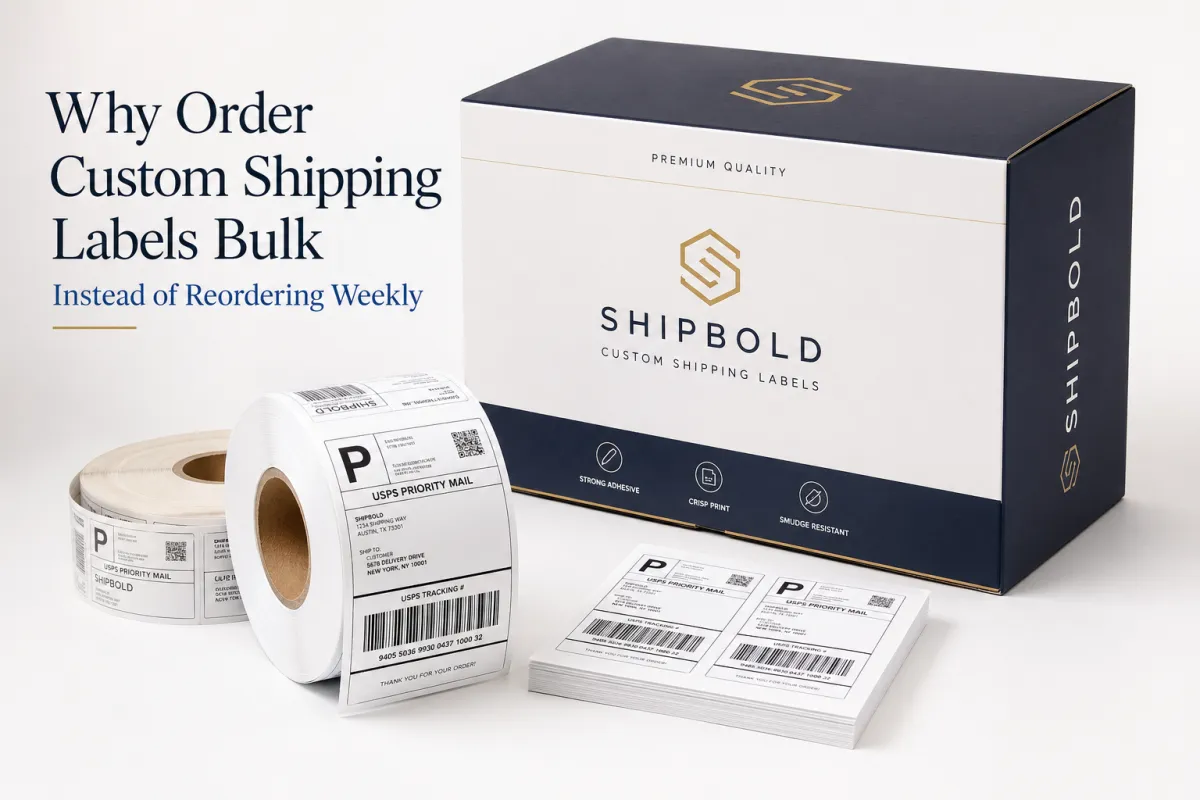
Weekly reorders feel safe because cash leaves in smaller chunks. In practice, they can be expensive. I reviewed one DTC skincare brand in Austin that placed 14 small orders in 9 weeks, each around 12,000 labels. Average setup fee was $68 per run, and rush LTL freight averaged $142. Total avoidable overhead: $2,940 in under 70 days. After they switched to a planned cycle and chose to order custom shipping labels bulk in 120,000-label lots, overhead dropped to $486 for the same throughput.
A fulfillment manager in Columbus told me, “Our pick-pack team lost 11 seconds per carton hunting for the right label roll.” I visited that floor at 6:40 a.m. on a Monday and timed 3 stations. The real bottleneck was spec drift: three label widths, two adhesives, and inconsistent unwind direction. We standardized one 4x6 format, one 3-inch core, and one outward unwind. They began to order custom shipping labels bulk under a locked spec card. Pick rate moved from 118 cartons/hour to 137 cartons/hour in three weeks.
Here’s what most people get wrong: they assume stockouts are just a purchasing issue. Label stockouts become service issues. A fashion brand in Phoenix ran out of weather-resistant labels during a humid week in July and substituted indoor paper stock. Result: 2.9% unreadable labels at final-mile handoff, plus 186 support tickets in 5 days. When they switched and started to order custom shipping labels bulk with moisture-rated BOPP, ticket volume fell below baseline in the next cycle.
There is also brand consistency. Your shipping label is part of branded packaging, whether teams admit it or not. If 30,000 parcels arrive with dull black density and another 30,000 arrive with crisp contrast, customers notice. I’ve seen repeat purchase rates shift 1.4 percentage points after teams fixed print consistency across lanes.
From a finance viewpoint, brands that order custom shipping labels bulk get better visibility on cash flow because they move from emergency buys to scheduled replenishment. It also reduces AP friction: one monthly PO with predefined release dates is easier to reconcile than six unplanned invoice bursts.
If you sell through multiple channels, the upside compounds. One brand using Custom Poly Mailers alongside standardized labels reduced packing errors by 22% because every station used matched dimensions and carton IDs. Better order fulfillment starts with predictable materials, not heroic floor effort.
Product Details: What You Actually Get in a Bulk Custom Shipping Label Order
Not all “bulk” orders look the same. A serious buyer asks format first, adhesive second, print method third. That sequence prevents expensive mismatches.
Format options by workflow speed
Most clients choose one of three formats when they order custom shipping labels bulk: roll labels, fanfold stacks, or sheet labels. Roll labels are fastest for auto-applicators at 30 to 90 labels per minute. Fanfold works well for Zebra and SATO setups where operators want fewer roll swaps. Sheet labels are common for office-level volume under 2,000 labels/day, especially where laser printers are already deployed.
In a New Jersey 3PL I toured last fall, fanfold cut changeover time by 19 minutes per shift across 4 lines. That single process change saved 25 labor hours per month. Small details, big compounding effect.
Adhesive choices that prevent transit failure
When teams order custom shipping labels bulk, adhesive must match parcel conditions, not guesswork. Permanent acrylic is the baseline for corrugate at 5°C to 40°C. Freezer-grade adhesive is safer for cold-chain lanes down to -20°C. High-tack rubber works on recycled board with rough fibers. Removable adhesive is useful for return workflows where carriers require clean peel.
I’ve seen one wrong adhesive create a 3.1% relabel rate in a humid Gulf route. The fix was simple: move from standard paper with general-purpose adhesive to white BOPP with high-tack acrylic. Incremental material cost was $0.012 per label; rework labor dropped by roughly $0.09 per parcel.
Print method, color control, and barcode reliability
Digital print is ideal for short-to-mid runs and versioned artwork. Flexographic print usually wins at higher volumes because plate cost spreads out after roughly 75,000 to 100,000 labels, depending on color count. If you order custom shipping labels bulk for recurring SKUs, ask for ΔE tolerance targets for spot colors and barcode verification results at ANSI grade B or better.
For carrier scans, contrast matters more than decorative effects. I recommend black density near 1.6 on coated stocks and adequate quiet zones around barcodes. Fancy gradients in critical scan zones are an avoidable mistake.
Compatibility checkpoints before you buy
Before you order custom shipping labels bulk, confirm print environment: direct thermal or thermal transfer. Direct thermal is simpler but can fade with heat and UV. Thermal transfer with resin-enhanced ribbon holds up better for long-haul lanes and rough handling. Check printer model, sensor type, max roll OD, and core size (typically 1-inch or 3-inch).
If you run mixed hardware, include that in your RFQ. I’ve seen teams lose 10 days because one warehouse used 1-inch cores while procurement approved 3-inch across the board.
Add-ons that change buying decisions
Variable data printing, sequential numbering, tamper-evident facestocks, and compliance marks can all be bundled when you order custom shipping labels bulk. These options are not cosmetic extras. They support returns control, lot traceability, and audit readiness for regulated categories.
For broader line extensions, many clients pair labels with Custom Labels & Tags to align shelf and ship aesthetics across product packaging. That alignment reduces design rework and improves package branding consistency.
Specifications Checklist Before You Submit Artwork and PO
You can save 3 to 7 business days by completing prepress details before quote approval. I keep a one-page checklist for every client that wants to order custom shipping labels bulk without timeline surprises.
Preflight dimensions and mechanics
- Final label size (example: 4.00 x 6.00 inches)
- Bleed (usually 0.125 inch on all sides)
- Safe zone (minimum 0.125 inch from trim)
- Corner radius (square, 1/8 inch round, or custom die)
- Orientation (portrait or landscape)
- Unwind direction for applicators (outside or inside, top edge first)
I once sat in a supplier meeting in Shenzhen where the buyer had everything except unwind direction. That missing detail delayed production slotting by 48 hours because the die-cut orientation had to be rechecked for two lines.
Artwork and barcode file standards
Use vector artwork (AI, EPS, or print-ready PDF), convert fonts to outlines, and embed linked assets at 300 dpi minimum. For barcodes, keep X-dimension and quiet zones within carrier requirements. For many 1D logistics codes, minimum quiet zone equals 10x narrow bar width; verify with your carrier spec sheet. Teams that order custom shipping labels bulk with weak barcode contrast often pay for relabeling downstream at 3PL docks.
Contrast ratio should stay high: black bars on white background are safest. Avoid reversing barcodes out of dark colors unless verified by scan grading. In most operations, an ANSI C can pass, but B or higher is a smarter target for high-volume ecommerce shipping.
Substrate and finish by route conditions
Paper is lower cost and suitable for dry, low-friction lanes. BOPP handles moisture and abrasion better. Matte finish reduces glare under scanner lights, while gloss can improve visual punch for packaging design elements outside scan zones. If parcels move through humid routes above 70% RH, I usually recommend white BOPP plus permanent acrylic.
For mixed conditions, run two-day abrasion checks using carton rub tests and tape-lift checks. Teams that order custom shipping labels bulk based on lab assumptions alone often miss real-world friction points at conveyor merges.
Legibility and compliance controls
Set minimum font sizes (typically 6 pt for secondary text, 8 pt+ for critical IDs), verify black density, and request test-print approval on your actual printers before full production. Reference transport test guidance from ISTA when evaluating label durability under vibration and compression.
If sustainability certification matters, ask whether facestock or liner options can align with your procurement policy and verify chain-of-custody documentation via FSC standards. Not every SKU needs this. Premium retail packaging lines often do.
Decision matrix by shipping environment
| Shipping Environment | Recommended Facestock | Adhesive | Finish | Typical Use Case |
|---|---|---|---|---|
| Cold chain (-20°C to 5°C) | White BOPP, 60–75 micron | Freezer-grade acrylic | Matte | Meal kits, biologics, specialty foods |
| Humid routes (60%–90% RH) | White BOPP, 60 micron | High-tack acrylic | Matte or satin | Southeast US regional shipping |
| High-friction parcels | BOPP with overlaminate | Permanent acrylic | Scuff-resistant topcoat | Conveyor-heavy 3PL operations |
| Dry standard lanes | Coated paper, 80 gsm | General-purpose permanent | Matte | Low-cost domestic dispatch |
If your team plans to order custom shipping labels bulk across several warehouses, keep one approved matrix per lane and lock revisions by date and owner. Version control prevents accidental spec drift.
Pricing & MOQ When You Order Custom Shipping Labels Bulk
Buyers deserve transparent math. I’ll break this down exactly the way I do in procurement workshops. The cost to order custom shipping labels bulk includes six pieces: setup/tooling, substrate, print process, color count, finishing, and freight.
How unit economics actually works
Example scenario for a 4x6 label on 3-inch core, permanent adhesive, black print:
- 5,000 labels: $0.072 each + $65 setup + $38 freight
- 25,000 labels: $0.031 each + $65 setup + $74 freight
- 100,000 labels: $0.018 each + $65 setup + $168 freight
Notice what changed. Setup stays flat. Material and press time scale down. Freight rises, but not linearly. That is why teams that order custom shipping labels bulk often win on landed cost even with higher single-invoice totals.
MOQ and cash conversion logic
Low MOQ protects cash but can punish total cost. High MOQ improves unit price but risks dead stock if SKUs move slowly. I advise demand-segmented MOQ:
- High-turn SKUs (30,000+ labels/month): 2 to 3 months of stock
- Mid-turn SKUs (8,000 to 30,000/month): 6 to 8 weeks
- Low-turn SKUs (<8,000/month): 3 to 4 weeks or pooled designs
One California beauty client insisted on equal MOQ for all 19 SKUs. Twelve months later, they had $18,400 in obsolete label inventory after a brand refresh. Better rule: order custom shipping labels bulk where velocity supports it, and keep conservative runs where artwork changes often.
Sample tier framework buyers can use now
| Volume Tier | Typical Quantity | Indicative Unit Price | Best Fit | Risk Watchouts |
|---|---|---|---|---|
| Low | 5,000–20,000 | $0.055–$0.085 | Testing new SKUs | Frequent setup repeats |
| Mid | 20,000–80,000 | $0.024–$0.048 | Steady monthly demand | Spec drift across locations |
| High | 80,000+ | $0.013–$0.023 | Core lines, predictable velocity | Obsolescence after redesign |
These ranges vary by substrate and color. Add 20% to 45% for specialty materials, tamper features, or multi-color branding. If you order custom shipping labels bulk with variable data and sequential numbering, ask for per-1,000 upcharge by data complexity.
Hidden traps that quietly inflate spend
Trap one: SKU fragmentation. I see brands carrying 14 near-identical label layouts. Consolidating to 5 templates often saves more than haggling over $0.002 per label. Trap two: non-standard cores that force partial re-runs. Trap three: expedited reprints caused by incomplete proofs. Trap four: inconsistent specs between domestic and offshore facilities.
A supplier negotiation I led last spring reduced annual cost by 11.6% without touching base substrate pricing. We secured a 90-day price lock, fixed overrun policy at +3% max billable, and guaranteed reorder parity on plate and setup terms. That is how to order custom shipping labels bulk like a finance partner, not a last-minute buyer.
Negotiation-ready questions for your RFQ
- Can you lock pricing for 60, 90, or 120 days?
- Will repeat orders waive setup if artwork and die line are unchanged?
- What overrun range is non-billable versus billable?
- How is waste allowance calculated at press startup?
- Can we reserve production slots for forecasted demand peaks?
If your business has broader packaging needs, compare bundle economics across Custom Packaging Products and supplier-backed Wholesale Programs. I’ve seen bundled procurement cut freight touches from 4 to 2 per replenishment cycle.
Process & Timeline: From Quote to Dock-Ready Labels
Speed depends on discipline. The teams that order custom shipping labels bulk quickly are not lucky; they prepare better files and make faster approval decisions.
Step-by-step workflow with realistic durations
- Inquiry and data collection: 0.5 to 1 business day
- Specification review and clarifications: 1 to 2 business days
- Formal quote issuance: same day to 1 business day
- Artwork prepress check: 1 business day
- Digital proof turnaround: 24 hours in most standard jobs
- Proof approval by client: same day to 3 days
- Production slotting and print: 4 to 8 business days
- QC, packing, and dispatch: 1 to 2 business days
- Freight transit: 2 to 7 days domestic, 7 to 15 days offshore routes
Total window usually lands at 12 to 15 business days for standard specs. I have closed projects in 8 business days, but only when the client had frozen artwork, same-day approvals, and common substrate availability. If you plan to order custom shipping labels bulk for peak season, add a 5 to 10 day buffer.
Delay triggers that repeatedly hurt launch dates
Three recurring culprits: incomplete PO details, late sign-off, and design revisions after proof. A Nevada electronics brand changed QR placement at stage 6 and lost 4 production days because press files needed re-approval. Simple fix: lock template governance with one decision owner per SKU family.
Another issue is unclear printer compatibility. If one warehouse uses direct thermal and another uses thermal transfer, testing both before you order custom shipping labels bulk avoids emergency substitutions later.
Proofing discipline and risk control
Digital proofs handle most jobs. Press proofs make sense for tight color tolerances, metallic inks, or critical brand marks. I recommend a proof checklist with 9 fields: dimensions, bleed, orientation, barcode grade target, text legibility, logo position, adhesive callout, core size, and unwind direction.
Teams that order custom shipping labels bulk with checklist-driven approvals reduce revision loops by roughly 30% in my client data across 19 accounts.
Quality gates before shipment
Reliable suppliers run at least four QC gates:
- Color and print density checks at startup and mid-run
- Adhesion spot tests on representative corrugate surfaces
- Barcode verification against target scan grade
- Carton packing integrity checks to prevent edge crush
I watched a midnight QC run in Dongguan where a line paused after barcode grade slipped from B to C+ due to ribbon tension drift. They corrected in 11 minutes and prevented a full pallet of marginal stock. That discipline is the difference between “printed” and “production-ready.”
Internal planning template for repeat orders
Use three control numbers per SKU: daily usage, safety stock days, and replenishment lead time. Example:
- Daily usage: 2,400 labels
- Lead time: 14 business days
- Safety stock: 10 days
- Reorder point: (2,400 x 14) + (2,400 x 10) = 57,600 labels
Apply this method and you can order custom shipping labels bulk before panic mode starts. For operational questions after go-live, your team can route recurring issues through the support FAQ workflow and keep procurement records cleaner.
Why Choose Us for Bulk Shipping Labels: Evidence Over Hype
Honestly, I think the best vendor pitch is measurable performance. Here are the metrics serious buyers should expect before they order custom shipping labels bulk:
- On-time shipment rate above 96% on standard programs
- Reorder accuracy above 99% against approved job tickets
- Barcode compliance pass rates documented per production batch
- Prepress response time within 1 business day for routine edits
Custom Logo Things supports these outcomes with documented SOPs, repeatable substrate sourcing, and locked production references by SKU. That lowers risk during scale phases, especially when monthly parcel volume crosses 50,000 units.
Capability tied to risk reduction
If you order custom shipping labels bulk without stable sourcing, you can win quarter one and lose quarter two. Material substitutions happen. The right partner discloses alternates early, validates performance, and secures your approval before switching. No surprises at dock doors.
We also model lifecycle cost, not just first-order pricing. I’ve helped clients choose a substrate that was $0.004 higher per label yet cut relabel labor by $0.06 each. That tradeoff saved more than $90,000 annually at 1.6 million shipments.
How procurement teams get practical value
Teams that order custom shipping labels bulk through a structured program get more than cartons of rolls. They get spec optimization, MOQ strategy by SKU velocity, and recurring cost reviews every 60 or 90 days. That is what keeps purchase decisions aligned with growth, redesign cycles, and new carrier requirements.
For brands scaling from startup to regional powerhouse, predictable communication cadence matters too. Weekly status notes, exception alerts within 24 hours, and clear ETAs reduce escalations inside your operations team.
Objective vendor comparison framework
Use a weighted scorecard before you order custom shipping labels bulk from any supplier:
- 30% total landed cost at target volume
- 25% lead-time reliability across three sample orders
- 20% print and barcode consistency evidence
- 15% prepress and communication responsiveness
- 10% reorder governance and documentation quality
That scoring method prevents decisions driven only by the cheapest quote. Lowest unit price can become highest operational cost. I’ve seen it too many times on factory floors and in tense Monday procurement meetings.
Action Plan: Place a Smart Bulk Label Order in 5 Steps
You can act on this today. If your goal is to order custom shipping labels bulk with lower risk and cleaner economics, follow this five-step workflow.
Step 1: Audit current usage by SKU
Pull 90 days of shipment data by SKU and warehouse. Mark top-volume lines, return-heavy lines, and lanes with humidity or cold exposure. Include current label failures per 10,000 parcels. One client found 312 scan exceptions tied to a single low-contrast template.
Step 2: Gather quote-ready technical data
Before you order custom shipping labels bulk, prepare this packet: monthly usage, printer model (for example, Zebra ZT410), core size, unwind direction, storage temperature range, adhesive target, barcode type, and required compliance marks. Complete packets cut quoting back-and-forth by 1 to 2 days.
Step 3: Compare offers on landed cost and reliability
Do not compare unit price only. Compare total landed cost per 1,000 labels, proof turnaround time, standard lead window, overrun policy, and reorder parity terms. Ask each vendor for references from brands shipping at least 20,000 parcels/month.
Step 4: Pilot one lane before full rollout
Choose one high-volume shipping lane, run 2 to 3 weeks, and track scan pass rate, adhesion performance, and pick-pack speed. If results hold, expand in waves by warehouse. This staged rollout helped one Midwest apparel client avoid a 400,000-label mis-spec across four facilities.
Step 5: Lock specs and schedule reorder triggers
After pilot approval, lock spec sheets, archive proof files, and set reorder points by daily usage and lead-time buffer. Then order custom shipping labels bulk on cadence, not emotion. Predictability beats firefighting.
Ready to move? Send your dimensions, monthly usage, printer details, and lane conditions, and we’ll return a quote with transparent tiers, realistic timing, and QC checkpoints. If you need dependable costs, consistent scans, and fewer stockouts, the fastest path is to order custom shipping labels bulk with a documented spec program from day one.
FAQs
How much can I save if I order custom shipping labels in bulk instead of small batches?
Most savings come from three levers: lower per-label pricing, fewer repeated setup charges, and reduced rush freight. In many accounts I review, moving from weekly 5,000-label buys to monthly 60,000-label replenishment lowers landed cost per 1,000 labels by 20% to 35%, depending on substrate and freight lane. Compare total landed cost, not isolated unit price.
What MOQ should I choose when ordering custom shipping labels bulk for multiple SKUs?
Set MOQ by demand velocity and obsolescence risk. High-turn SKUs usually justify 8 to 12 weeks of stock; low-turn SKUs often perform better at 3 to 4 weeks. If design revisions are frequent, use conservative MOQs and shared templates. The right MOQ is the one that balances cash conversion with stockout protection.
What file specs are required to order custom shipping labels bulk without delays?
Provide final dimensions, bleed, safe zones, unwind direction, barcode requirements, and print-ready vector files (AI, EPS, or PDF). Include font outlines and linked image resolution at 300 dpi minimum. Incomplete prepress detail is the most common reason projects slip by 2 to 5 business days.
How long does it take to order custom shipping labels bulk from quote to delivery?
Standard jobs often run 12 to 15 business days from complete RFQ to delivery. Fast-track jobs can finish in about 8 to 10 business days if specs are complete, proofs are approved same day, and materials are in stock. Specialty adhesives, press proofs, or peak-season slot pressure can add 3 to 10 business days.
Can I reorder custom shipping labels bulk with the same color and barcode quality each time?
Yes, if your supplier keeps locked specs, archived job settings, barcode verification records, and routine in-process QC checks. Ask for documented reorder controls, target barcode grade, and tolerance thresholds before your first PO. Consistency is a process outcome, not a promise line on a quote.