Custom Apparel Hang tags do a small job with outsized impact. On a crowded rack, they shape the first impression of a garment before anyone touches the fabric. In a few seconds, they can make a piece read as premium, basic, technical, casual, or disposable.
That is why the tag should be treated as part of the product package, not a last-minute print add-on. Stock, size, shape, finish, and attachment all affect perception. A $48 knit can look more valuable with a considered tag. A $12 tee can look cheaper than it is if the tag is thin, glossy, and generic.
Hang tags also carry practical information: logo, product name, size, SKU, barcode, price, QR code, origin copy, and care notes. If the brand also uses coordinated Custom Packaging Products and Custom Labels & Tags, the hang tag becomes part of a larger retail system. That consistency matters because customers notice when the details agree and when they do not.
A tag that feels out of sync with the garment pulls the product down a tier. A tag that matches the fabric weight, brand tone, and shelf position makes the item feel deliberate.
What Custom Apparel Hang Tags Do for a Brand
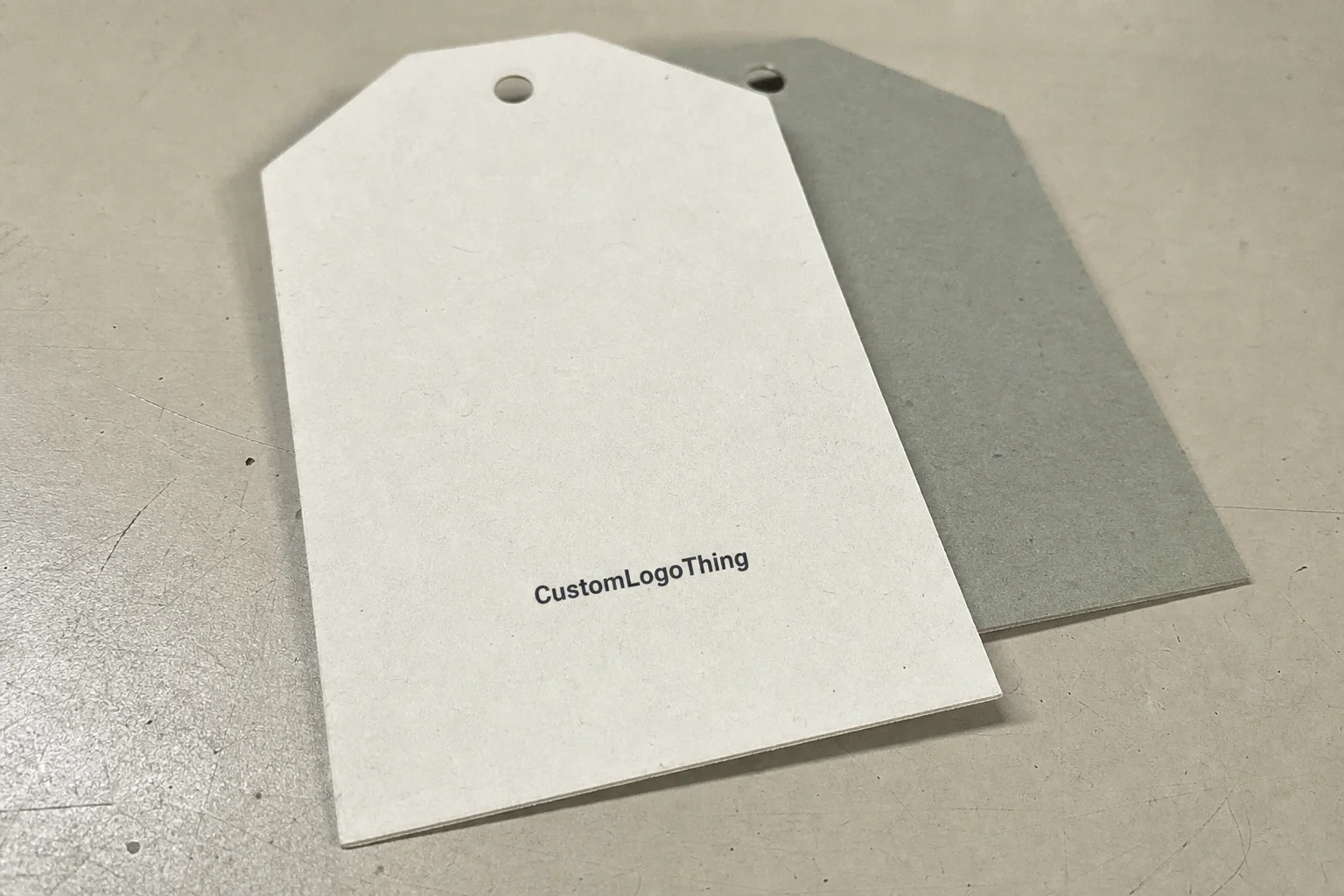
The obvious function is identification. The more important one is framing. A hang tag sets expectations before the shopper handles the garment, and those expectations influence willingness to pay. Visible cues matter because buyers often judge quality before they have enough information to judge the product itself.
For wholesale buyers, the tag also has to work as a retail tool. A clear SKU, scannable barcode, and readable size callout reduce friction for store staff. If the tag includes a QR code, it should lead somewhere useful: fit guidance, product registration, a short care page, or a brief brand story. A QR code that goes nowhere meaningful is just decoration.
The message stack should stay disciplined. One or two priorities usually work better than five. On a 2 x 3 inch tag, every extra line competes with legibility. The mistake is not adding details. The mistake is making every detail equally loud.
There is also a merchandising effect. Retailers handle hundreds of products side by side. Tags with strong contrast, clear hierarchy, and a tactile stock are easier to read at arm’s length. In-store, small details often decide whether a piece gets picked up or passed over.
One garment can feel significantly different depending on the tag attached to it. A heavyweight hoodie paired with a flimsy card can feel unfinished. A basic cotton tee with a 16pt uncoated tag, rounded corners, and a restrained foil mark can feel more intentional than the product cost suggests.
Process and Timeline: From Artwork to Carton Pack
The best jobs start with a real spec, not a vague idea. Quantity, finished size, stock, print sides, finish, hole placement, attachment method, and any variable data should be set before pricing starts. If those pieces are still moving, the quote will move too.
Prepress is where avoidable delays tend to gather. Files need the correct dieline, bleed, and safe zone. Fonts should be outlined or embedded properly. Images need enough resolution for the final size. Barcodes should be checked for scanability, not just appearance. If the job includes foil, spot UV, embossing, or another special finish, the separations need to be built carefully so the press can register them cleanly.
The standard sequence is usually straightforward: proof setup, client review, approval, printing, die-cutting or punching, finishing, stringing or assembly, inspection, and packing. A common lead time is 10 to 15 business days from final proof approval for a standard run. Specialty finishes, custom tooling, variable data, or kitting can extend that window. Rush orders are possible, but they usually trade off flexibility, cost, or both.
Most delays come from familiar places: missing artwork, revisions after approval, a barcode that changed after the proof was signed, or a hole moved without checking how the tag will hang. These are small edits on paper and expensive edits on press.
Paper Stock, Shape, and Finish Choices
Stock choice affects both feel and durability. Uncoated paper has a softer, more natural surface and writes well, which helps in some retail environments. Coated paper produces crisper color and stronger contrast, but it can feel more commercial. Laminated or soft-touch stocks resist scuffs better, which is useful when products move through multiple handling points before they reach the customer.
Weight should match the garment. A light tee usually works with a lighter card. Outerwear and premium knits often need a thicker tag so the ratio feels right. A 12pt tag on a $140 sweater can look underbuilt. A heavy, rigid tag on a low-cost tee can feel excessive.
Shape does more than decorate. Rectangles are efficient and easy to stack. Rounded corners soften the look. Circles, ovals, and custom die cuts create distinction, but they also increase tooling cost and can reduce press efficiency if the layout is wasteful. Custom shapes make sense when the silhouette is tied to the brand or product line.
Finishes move perception quickly. Matte reads restrained. Gloss is brighter and more retail-forward. Foil gives the strongest signal of premium positioning, although too much foil can make a tag feel like ornament. Embossing and debossing add tactile depth. Spot UV creates contrast, especially on dark stocks. Used with restraint, these finishes improve custom apparel hang tags without turning them into something they are not.
Attachment deserves the same attention as print. Cotton string, elastic loop, plastic fastener, and pin-style attachments all behave differently. Heavier garments can carry a more substantial attachment. Delicate fabrics may need a softer option to avoid marking or snagging.
One practical note: if the product will be packed, shipped, opened, and handled again before it reaches the consumer, choose materials with that journey in mind. A tag that looks polished in a studio can look tired after transit if the stock is too thin or the finish is too fragile.
Cost, Pricing, and MOQ Factors for Custom Apparel Hang Tags
Pricing is driven by a few variables that interact more than most buyers expect: size, stock, print complexity, finish, quantity, and attachment. Quantity is the biggest one. A 500-piece order has the same setup overhead as a much larger run, so the per-unit cost can feel high. At 5,000 pieces, the math changes quickly because setup gets spread across more tags.
For standard custom apparel hang tags, a realistic range is often $0.18 to $0.28 per unit at 5,000 pieces for a simple one- or two-color job on a straightforward stock. Add foil, embossing, soft-touch lamination, variable data, or custom die cutting, and the price can move into $0.30 to $0.65 per unit or more. Smaller runs usually cost more per unit because the fixed setup cost has nowhere to hide.
The cheapest quote is not always the best value. Ask what is included. Some suppliers fold in proofing and standard finishing. Others charge separately for dies, revisions, barcode work, kitting, or rush handling. Shipping can also distort comparisons, especially if the tags are packed with other retail packaging components or need to be separated by SKU.
| Option | Typical Use | Approximate Cost Impact | Notes |
|---|---|---|---|
| Uncoated 14pt with one-color print | Natural, minimalist brands | Lowest | Good writeability and a softer finish |
| Coated 16pt with full-color print | Bright retail packaging programs | Moderate | Sharper graphics, stronger image density |
| Soft-touch laminate with foil detail | Premium apparel lines | Higher | Better scuff resistance, stronger shelf impact |
| Custom die-cut with variable data | Launches, limited drops, SKU-heavy programs | Highest | More tooling and setup, tighter prepress control needed |
If you need an MOQ reference, many suppliers start somewhere around 250 to 1,000 pieces for custom runs, though the real minimum depends on size, finishing, and equipment. At lower quantities, unit cost rises fast. In some cases, it is more efficient to simplify the spec than to chase a tiny run with expensive features.
Paper traceability can matter if the brand has sustainability requirements. FSC certification is one common reference point for responsibly sourced paper; see FSC for chain-of-custody information. For projects that need distribution durability or transit testing, the guidance at ISTA is a useful standard to compare against.
Production Steps and Lead Time Planning
Lead time planning works better when it is built backward from the launch date. Start with the ship date, then subtract freight time, packing time, finishing time, print time, and proof approval. That is more honest than asking only how long the press run takes.
A standard order usually passes through a familiar chain. Artwork is reviewed. A digital proof is issued. The buyer approves it. The job is scheduled. It is printed, cut, drilled or punched, finished, inspected, and packed. If the order includes multiple SKUs, variable data, or inserts, packout can take longer than printing.
Seasonality changes everything. Holiday launches, wholesale calendars, trade show deadlines, and limited drops all create pressure on production capacity. A rush order may still be possible, but the tradeoff can be a higher price or a reduced finish set. A practical buffer is 5 to 7 business days for revisions, freight movement, or an unexpected reprint.
If the program includes boxes, labels, and tags at the same time, align the schedules early. The smallest item often becomes the bottleneck because it depends on the latest version of the SKU list. In packaging work, the thing that looks easiest is often the thing that breaks the launch calendar.
There is another reason to plan tightly: tags are not isolated assets. The typography, color, and finish should sit comfortably with the rest of the retail packaging. A clean box with an overworked tag looks inconsistent. A minimal label set with a highly decorative hang tag can create the same problem.
Common Mistakes That Create Rework or Delays
The most expensive mistakes usually start before the first sheet is printed. Low-resolution logos, missing bleed, incorrect dielines, and unoutlined fonts are common reasons a proof has to be rebuilt. If the supplier is redrawing artwork instead of sending the file to production, the schedule slips immediately.
Changing the job after approval creates a different kind of problem. A size change can affect layout, barcode placement, die setup, and punching positions. A finish change may force a revised press plan. A quantity change can change the unit price and, in some cases, the production method. Once the proof is signed off, treat it like a release document.
Hole placement gets overlooked because it seems simple. Too close to the edge and the tag can tear. Too far off center and it hangs poorly. A badly positioned hole can also make the string sit awkwardly, which is enough to make the garment look less polished on the rack.
Compliance is another place where shortcuts backfire. Barcode readability should be checked before print. Retailer-specific copy needs approval. Sustainability claims should match the actual material and process. If a brand says recycled, the claim should be supportable. For general guidance on environmental claims and waste reduction language, the EPA has useful resources.
Finally, keep the hang tag aligned with the rest of the package system. If the color palette, type treatment, and finish are disconnected from the labels and cartons, the line feels assembled rather than designed. That may not matter for a one-off drop. It matters a great deal at scale.
Next Steps: Build a Better Spec and Request Quotes
The fastest way to get useful pricing is to send a one-page spec sheet. Include finished dimensions, stock preference, print colors, finish, attachment style, quantity by SKU, and deadline. If there are multiple options, label them clearly. Vague requests create vague quotes, and vague quotes are hard to compare.
Reference images help more than many buyers expect. Two or three examples of edge treatment, finish level, or typography can clarify what you mean by premium, minimal, rugged, or refined. Words like those are often interpreted differently from one vendor to another.
Ask every supplier to quote the same spec. Then compare unit price, tooling, proofing, lead time, attachment method, and finish capability. If one quote is lower but uses a different stock weight or leaves out a finish, it is not the same job.
Before ordering, inspect the proof the way a retail buyer would inspect the finished piece. Check barcode size, text size, hole position, bleed, and finish callouts. Confirm the brand name spelling. Confirm SKU logic. Confirm packout method. Then lock the file. At scale, custom apparel hang tags work best when the decisions have already been made on paper, not during production.
What should custom apparel hang tags include?
Start with the essentials: brand name, product name, size, and SKU. Add price or MSRP if the retail channel needs it, plus a barcode when required. QR codes, care notes, sustainability claims, and origin details can fit as long as the hierarchy stays clear and the text remains readable.
How much do custom apparel hang tags cost?
Pricing depends on stock, size, print complexity, finish, and order quantity. Smaller runs usually have a higher unit cost because setup and tooling are spread across fewer pieces. For a fair comparison, ask each supplier to quote the same specification, not just a rough estimate.
What is the typical turnaround for custom apparel hang tags?
A standard order often lands around 10 to 15 business days after final proof approval. Rush service can shorten that window, but usually at a higher cost or with fewer finish options. Build in extra time for revisions, freight, and any reprint risk.
What materials work best for custom apparel hang tags?
Uncoated stocks suit natural, premium, or recycled-looking programs. Coated, laminated, or heavily finished stocks handle handling and moisture better. Choose the weight to match the garment so the tag feels proportional instead of flimsy or oversized.
Do custom apparel hang tags have a minimum order quantity?
Most suppliers use an MOQ because setup and tooling costs need to be recovered. Lower quantities are possible, but the per-piece cost usually rises quickly. If flexibility matters, ask whether multiple sizes or SKUs can be combined into one production run.


