Custom beach Bags with Logo work because they are useful first and promotional second. That order matters. A bag that carries towels, sunscreen, snacks, wet swimwear, and random resort debris gets used. A bag that only looks good in a mockup gets forgotten in a trunk or tossed in a closet.
That difference is the whole point. A beach bag sits in public longer than most giveaway items, which means the logo keeps moving. It shows up at the beach, then in the grocery store, then on the weekend trip nobody planned well. You do not need to oversell that. The item does the work if the build is decent and the print survives real use.
Buyers usually make the same mistake: they start with the price, then try to build a product around it. That is backwards. Start with the use case, then choose the material, then pick the decoration method, then worry about the quote. Anything else tends to produce a bag that looks cheap the second it gets sand on it.
A beach bag only earns repeat exposure if it still looks acceptable after the first messy weekend. Weak handles, faded print, and limp structure kill the value fast.
For brands building a larger packaging program, the bag can sit alongside Custom Printed Boxes, inserts, labels, or kit packaging. In that role, it is not just a carrier. It is part of the presentation layer. That matters for retail, hospitality, events, and gift sets where the customer sees the whole package at once.
Why custom beach bags with logo stick around
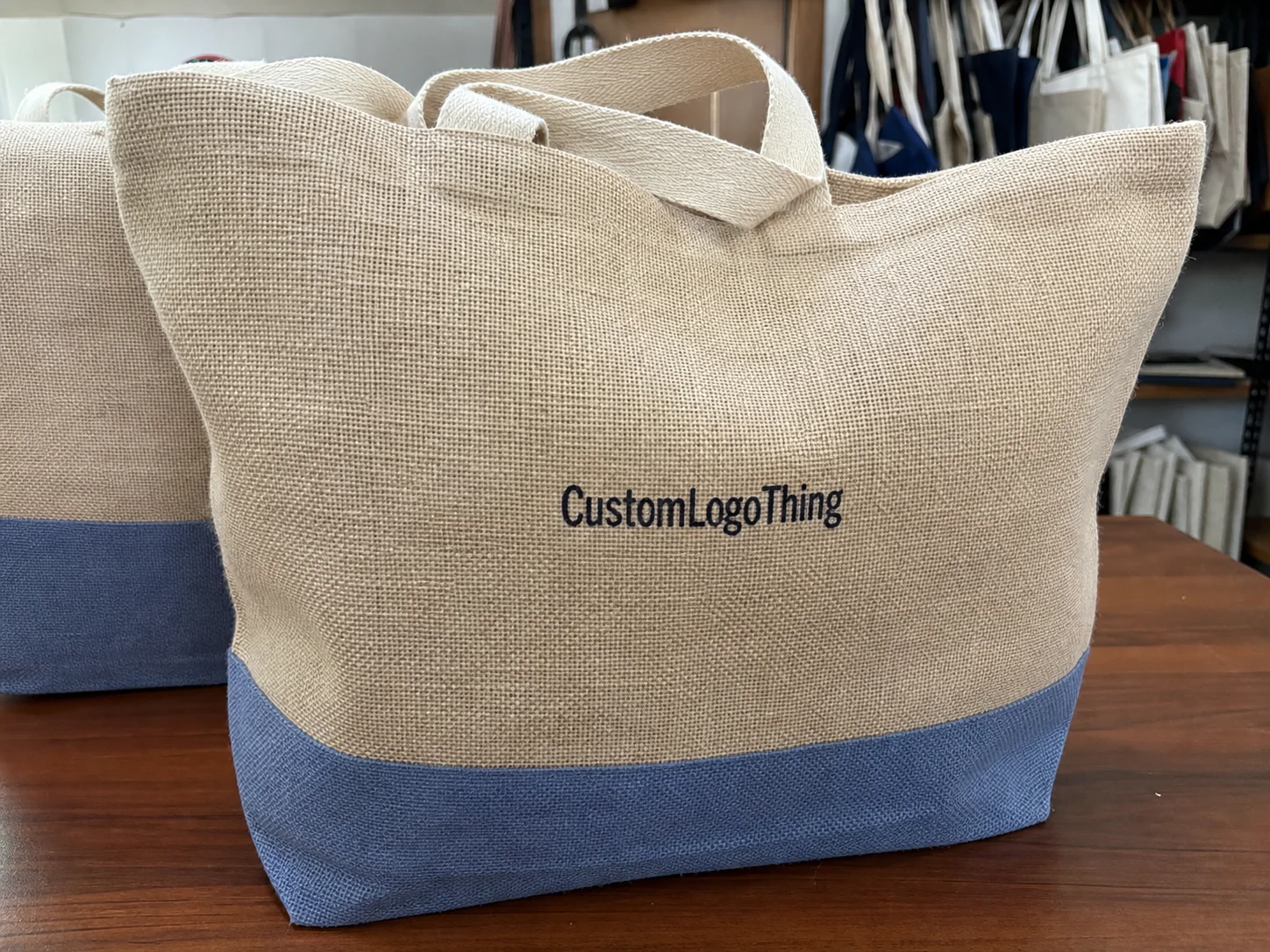
Beach bags get reused because they solve a real problem. That sounds obvious, but plenty of promo items fail that basic test. A tote with a logo is not valuable because it exists. It is valuable because people need somewhere to put the stuff that comes with a day near water.
The best bags are easy to adopt. They are large enough for the basics, sturdy enough for wet use, and simple enough that people do not feel silly carrying them. If the bag can handle a towel, flip-flops, a bottle, and a sunscreen bottle without collapsing, it will stay in circulation. If it buckles under normal use, the branding disappears with the bag.
That durability changes the economics. A notebook gets one or two looks. A decent beach tote can be seen for months. Not because the logo is magical, but because the bag keeps getting dragged into new settings. The exposure is passive and repeated, which is exactly what makes branded packaging and promotional products worth buying in the first place.
There is also a perception issue. A bag that feels substantial reads as a product, not a throw-in. That changes how people receive it at events and how they treat it afterward. Cheap goods signal cheap intent. A better-made bag signals that the brand thought through the experience, even if the actual art is just a clean logo on the front panel.
If you are planning around a resort program, a festival kit, or a retail gift-with-purchase, the bag can also carry other branded pieces. That is where packaging consistency helps. The tote, insert card, and box should not look like they came from three different projects with three different approval chains. They do not need to match exactly. They do need to look like they belong together.
Materials and print methods that hold up
Beach bags live a rougher life than desk totes. They get loaded with damp items, dragged over rough ground, packed into cars, and sat in direct sun. Material choice has to reflect that. Thin stock that looks fine on a sample board can fail quickly once it gets used in the real world.
The common material choices are woven polypropylene, laminated nonwoven, recycled PET, and canvas or poly-cotton blends. Each one solves a different problem. Woven polypropylene is cost-effective and durable enough for high-volume promotion. Laminated nonwoven gives a cleaner surface and tends to hold sharper color blocks. Recycled PET is a good middle ground if the buying brief includes sustainability language. Canvas and poly-cotton feel more premium, but they raise cost and freight, which can be fine if the bag is part of a higher-value campaign.
Print method matters just as much. Screen print is still the most practical option for bold logos, single colors, and simple artwork. Heat transfer works better for smaller runs or more detailed art. Full-color printing makes sense if the design has gradients, complex logos, or photo-like elements. The wrong method creates fuzzy edges, weak coverage, or color drift that shows up immediately in daylight. Beach bags do not hide bad decoration. They advertise it.
For buyers comparing options, these are the practical tradeoffs:
| Material / Method | Best For | Typical Unit Cost | Print Behavior | Buyer Notes |
|---|---|---|---|---|
| Woven polypropylene | High-volume giveaways, events, broad retail distribution | $0.75-$1.60 | Strong for bold screen print | Good value and decent structure; plain artwork can make it feel generic |
| Laminated nonwoven | Hospitality, festival kits, branded packaging programs | $0.95-$2.20 | Cleaner surface for simple logos and high-contrast art | Often feels more finished than basic nonwoven stock |
| Recycled PET | Sustainability-led programs, premium promos, retail packaging | $1.40-$3.20 | Works well for detailed decoration | Use it if the material story matters to your audience |
| Canvas / poly-cotton | Higher-end gifting, resort retail, upscale campaigns | $1.60-$4.00+ | Good for screen print, patches, and cleaner lifestyle presentation | Heavier hand feel and higher freight, which changes the budget fast |
Surface quality is a bigger deal than many buyers expect. A flatter front panel gives the logo a cleaner field. Too many seams across the decoration zone make print registration harder and can distort the art. If the bag has a texture, tiny type gets punished. If the base color is busy, low-contrast logos vanish. That is not a printing problem. That is a spec problem.
Ask for the minimum line weight before approving fine detail. Ask for a proof on the actual bag shape, not just on a flat template. If the supplier cannot show you how the logo will sit across the panel, you are guessing. Guessing is how buyers approve art that looks fine on screen and wrong in production.
For shipment-sensitive projects, think about how the bags will be packed and whether they need to survive long transit, stacking, or repacking inside a larger kit. Basic distribution discipline matters here. The packaging sector’s guidance from ISTA is useful if the order is part of a more delicate fulfillment flow, and broader reference material from packaging.org helps if the bag is only one component in a branded package.
Cost, MOQ, and quote math
Most quote confusion comes from buyers asking for pricing before they have settled the spec. The unit cost moves with quantity, material weight, print colors, dimensions, handle style, pockets, closures, and proofing complexity. A one-color logo on a stock tote is not the same job as a fully custom bag with reinforced seams and multicolor decoration. Suppliers know that. Buyers sometimes pretend not to.
MOQ, or minimum order quantity, is usually where setup costs stop crushing the unit price. Smaller orders carry more overhead per unit because the factory still has to prep artwork, create screens or transfer files, review proofs, and absorb some waste. Once the run gets larger, the per-unit number usually falls in a way that makes sense only if you understand manufacturing. It is not random. It is math.
Land price is the number that actually matters. That includes freight, packaging, rush fees, and any proof revisions that are billed separately. A quote that looks cheap on the front end can turn into the expensive option once shipping is added. If the budget matters, ask for landed pricing early and compare quotes on the same basis. Otherwise you end up comparing a complete order against a partial one.
These details make the quote process faster and cleaner:
- Target quantity and a realistic fallback range
- Required in-hand date, not just a preferred date
- Vector artwork if available, plus exact color references
- Preferred bag size, color, and handle length
- Print method preference, if there is one
- Need for sample, virtual proof, or both
- Any matching branded packaging or inserts that need to coordinate
For rough planning, these are the price bands buyers usually see on standard custom beach Bags with Logo orders. They are not fixed, and they are not universal, but they are useful enough to keep the discussion grounded:
- Low MOQ test runs: about $2.25-$5.00 per unit
- Mid-volume event orders: about $1.00-$2.75 per unit
- High-volume promo runs: often under $1.50 per unit on simpler builds
That spread is why two suppliers can quote the same request and land miles apart. One may include setup. Another may not. One may be quoting a thicker build with reinforced handles. Another may be quoting the thinnest acceptable version. If you only compare the headline number, you miss the real difference.
Production steps and turnaround
The process is straightforward. Inquiry, spec confirmation, artwork review, digital proof, sample approval if needed, production, quality control, and shipment. The sequence is boring. Good. Boring is what you want in manufacturing.
For a simple order, the proof stage can move quickly if the artwork is clean. Complex jobs slow down because they involve more decisions. Custom dimensions, multiple print locations, heat transfer art, premium handles, and special finishing all add time. If the beach bag is part of a larger packaging rollout, the schedule stretches again because multiple items have to line up instead of one.
Typical timing looks like this:
- Proofing: 1-3 business days if the files are ready
- Sampling: 3-7 business days if a physical sample is needed
- Production: often 10-18 business days after proof approval
- Freight: domestic shipping adds a few days; international freight adds more and rarely behaves perfectly
What slows things down? Missing Pantone references. Messy vector files. Late comments on proofs. Material shortages. Approval delays. Rarely one catastrophic issue. More often, a stack of small delays that pushes the ship date by a week or more. That is why lead time should be treated like a real constraint, not a hopeful estimate.
The key checkpoint is proof approval. Once the proof is signed off, changes can reset the clock. A buyer who wants to tweak logo placement after approval is usually asking for a new timeline, even if nobody says it out loud. If the supplier flags a problem before approval, fix it there. That is the cheap stage.
Rush orders exist, but only if the material is in stock, the art is ready, and the factory has capacity. Miss one of those conditions and the rush request turns into a surcharge plus disappointment. It is better to build schedule slack into the order than to depend on a miracle with a freight bill attached.
Size, gusset, and carry details
Size is where many buyers underspec the bag. A beach tote has to carry more than a standard handout bag. Towels are bulky. Sunscreen bottles are awkward. Wet swimwear adds weight and moisture. If the bag is too small, people stop using it. If it is oversized without structure, it becomes clumsy and falls over whenever it is set down.
Gusset depth changes behavior more than the mockup suggests. A deeper gusset adds volume and helps the bag stand upright once packed. A shallow bag can look neat in the artwork proof and still fail in use because the sides collapse. The best approach is usually to match the gusset to the actual load, not the visual preference of whoever approved the mockup in a conference room.
Handles matter too. Shoulder-length handles are usually better for beach use because people already have too many things in their hands. Short handles can work for lighter retail kits or controlled handouts, but they are less forgiving if the bag has to carry wet towels or drinks. Reinforced stitching at the handle anchor points helps a lot. Weak handle welds or loose bar-tacks are the kind of defect that show up fast and create complaints just as fast.
Closures, pockets, and inserts are optional, but they change the experience. A zipper gives more security. A snap closure helps keep contents in place. An interior pocket makes keys and phones easier to find. These additions are useful in the right program, but they add cost and can slow production, so they need a purpose instead of just sounding premium.
A practical way to match the bag to the audience:
- Family events: larger capacity, deeper gusset, reinforced handles
- Resort or hospitality: cleaner finishing, better material feel, stronger presentation
- Retail promo or gift-with-purchase: balanced size and brand visibility without making the bag awkward to carry
- High-volume giveaways: simple shape, efficient build, controlled decoration to protect budget
Small construction choices have big effects. A bag with straight stitching, even seams, and tidy handle attachment looks more expensive even when the material is not premium. A flashier bag with crooked seams or sloppy print feels fake within seconds. Buyers notice that. Users notice it faster.
Mistakes that make bags feel cheap
The first mistake is overworking the logo. Too much detail, too many colors, or tiny text can look acceptable in a mockup and fail on textured stock. Fine lines blur. Small type disappears. Complex gradients can make the design look muddy. If the logo is complicated, simplify it for the bag or choose a printing method that can handle it properly.
The second mistake is weak contrast. A logo that blends into the background dies in bright sun, which is exactly where these bags get used. If the art does not stand out in outdoor light, it is not doing the job. Beach gear has to read quickly and from a distance. Subtle is usually just unreadable.
The third mistake is buying on headline price alone. Thin stock, weak handles, poor stitching, and sloppy print coverage can save a little money and create a lot of noise later. That is especially true for custom beach Bags with Logo tied to events, because everyone sees the bag at once. A bad bag is not private. It is public.
The fourth mistake is mismatching the bag to the job. A corporate giveaway should not feel like a grocery tote. A resort item should not look like a freight sack. A retail packaging program should not ship something that feels like a sample bag pulled from the back room. The use case needs to drive the spec.
The fifth mistake is treating the bag as an isolated purchase. If the order also includes insert cards, labels, or Custom Printed Boxes, the colors and logo placement should be coordinated. The easiest way to make a branded package look careless is to let each piece wander off on its own. Consistency is not glamorous. It just works.
One more thing buyers miss: quality control is not only about the finished bag. It starts with the art file and continues through proofing, material inspection, stitching checks, print registration, carton packing, and shipment handling. A good supplier should be able to explain what gets checked at each stage. If they cannot, expect surprises later.
What to lock down before you request pricing
Before asking for quotes, decide the essentials: target quantity, event date, budget range, preferred material, decoration method, and acceptable lead time. That sounds basic because it is basic. Without those inputs, pricing becomes a guessing game and the replies will be all over the map.
Art files matter just as much. A clean vector file, exact color references, and placement notes save a lot of back-and-forth. If the logo is still being debated internally, finish that argument first. Suppliers can quote around uncertainty, but they cannot manufacture around it without risk.
Ask about proof terms, sample options, and freight assumptions. A low introductory number means very little if the shipment is expensive or the proof process adds charges. The real price is the one that includes the stuff people conveniently leave out until the second email.
If you are comparing suppliers for custom beach Bags with Logo, judge them on total cost, construction quality, turnaround, and whether the build fits the audience. The lowest quote is not automatically the best value. A bag that arrives on time, prints cleanly, and survives actual use is the better buy. Not exciting. Just correct.
For bigger branding programs, keep the order brief tight. The bag, insert, and outer packaging should work as one system. That does not require a dramatic design story. It requires consistent specs, clean files, and enough discipline to avoid last-minute changes that wreck the schedule.
Once the brief is locked, send one clear request for custom beach Bags with Logo and compare the responses on material, print quality, landed cost, and delivery timing. That is the practical way to buy. No drama. No filler. Just a bag people will actually use.
How much do custom beach bags with logo usually cost per unit?
Price depends on quantity, material, print method, and bag size. Small runs usually cost more per unit because setup gets spread across fewer pieces. Freight, sample fees, and rush charges can change the real budget, so always ask for landed pricing instead of only the factory number.
What material is best for custom beach bags with a logo?
Woven polypropylene and laminated nonwoven are common because they hold up well against sand and moisture. If the bag needs a more polished look, recycled PET or canvas can work better, but they usually raise cost and freight. Reinforced handles matter more than people think.
How long does production take for custom beach bags with logo?
Simple orders can move quickly after proof approval, but production time depends on quantity and decoration complexity. A realistic range is often 10-18 business days after approval, plus shipping. Samples and custom changes extend the schedule.
Can I order low MOQ custom beach bags with logo?
Yes. Low MOQ orders are common for events, tests, and limited campaigns. The tradeoff is higher unit cost because setup is spread across fewer bags. Standard sizes and stock colors usually keep the minimum lower.
What artwork should I send for custom beach bags with logo?
Send a vector file if possible, plus exact color references and placement notes. Fine detail, tiny text, and weak contrast are risky on textured bag surfaces. Ask for a digital proof and, if the order is important, a physical sample before production starts.


