Carpet looks forgiving. It is not. For floor graphics, carpet is one of the more difficult surfaces because it has pile, lint, fiber direction, cleaning residue, and soft movement under pressure. The right custom carpet stickers can still hold cleanly in retail aisles, trade show booths, school hallways, office events, and registration areas, but only when the film, adhesive, laminate, and carpet type are matched before production starts.
Many floor graphic failures are not design failures. They happen because someone ordered a standard smooth-floor decal, treated carpet like tile, skipped the surface test, or placed a sharp-edged graphic where carts twist against it all day. A carpet decal is a small printed product, but it behaves like a system: face film, adhesive, ink, laminate, carpet texture, installation pressure, traffic pattern, cleaning schedule, and removal window all affect the outcome.
That is the useful way to evaluate it. Not as a sticker. As a temporary floor system with limits.
What Custom Carpet Stickers Are and Where They Actually Work
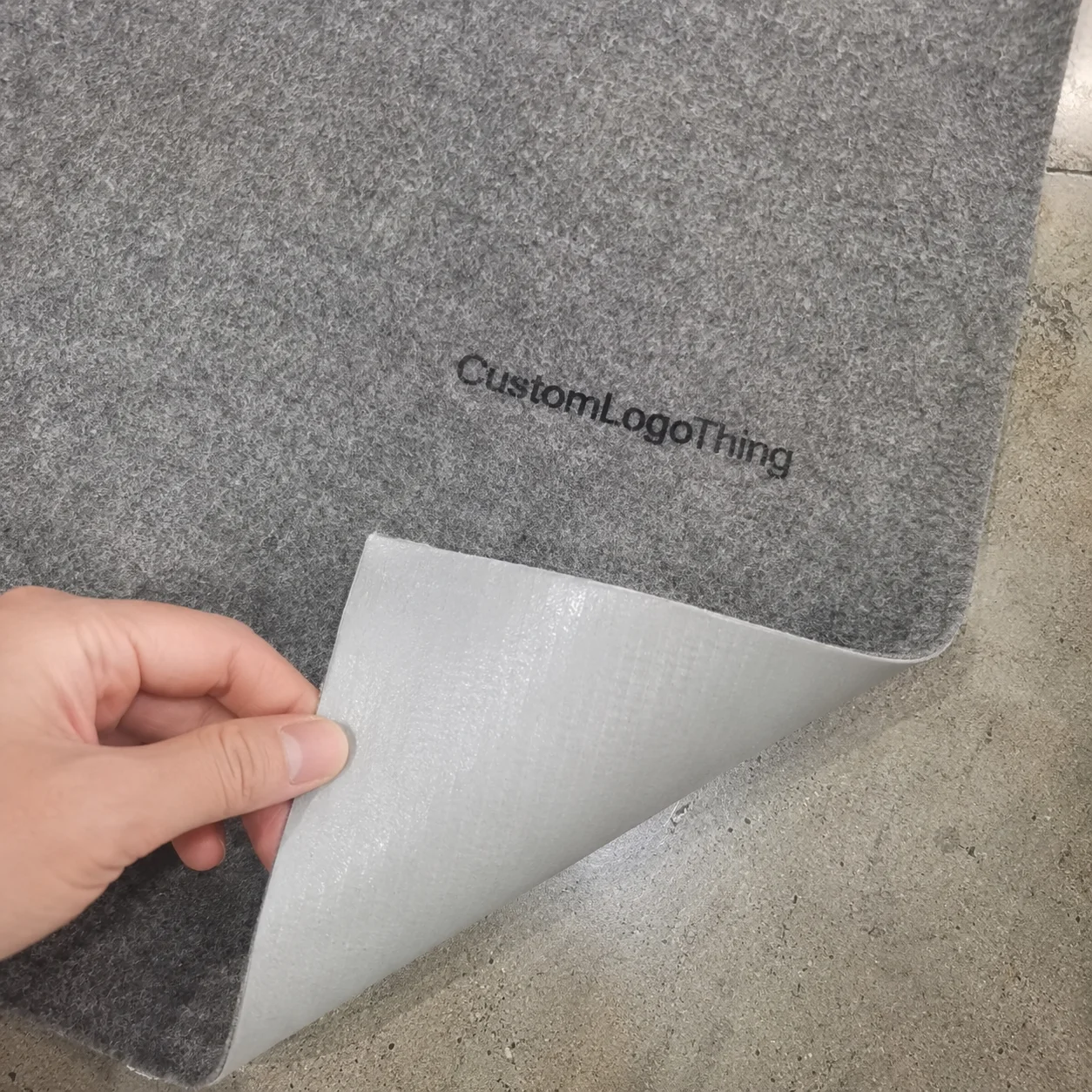
Custom carpet stickers are printed, adhesive-backed floor graphics made for low-pile carpet. They are not ordinary wall decals, and they are not the same construction usually used on sealed concrete, smooth vinyl, tile, hardwood, or glass. Carpet has fewer flat contact points, so the adhesive needs more grip and the top surface needs stronger abrasion resistance.
Buyers use several names for the same general idea: carpet stickers, carpet graphics, floor decals, floor graphics, branded floor signs, wayfinding markers, event floor signs, and temporary sponsor logos. In casual quoting, those terms blur together. In production, they should not. A “floor decal” might be designed for polished concrete. A carpet graphic should be built for carpet contact, shoe scuffing, and removal from fiber.
The strongest uses are simple and practical. Retail teams use arrows to pull traffic toward a display. Schools use hallway reminders and event routes. Trade show exhibitors add booth pathways or sponsor marks. Offices place branded graphics near check-in tables or presentation rooms. Product teams use temporary floor messaging to support a launch without rebuilding the store environment.
Design still matters, especially if the graphic belongs to a larger package branding or campaign system. Performance, though, depends on the site conditions. A bold logo on plush carpet can lift early. A plain arrow on clean low-pile carpet can outlast the campaign with no drama.
Practical buyer rule: before asking, “How cheap can we make this?” ask, “What carpet is it going on, how long must it stay down, and who removes it?” Those answers shape the material choice more than the artwork does.
Good candidates are tight commercial carpet tiles, low-pile office carpet, and clean event carpet with a firm backing. Poor candidates include shag, plush pile, ribbed entry mats, loose-fiber carpet, damp carpet, and surfaces recently treated with stain repellent. The difference can be dramatic. Two carpeted areas in the same building may behave differently if one sits near an entrance and the other sits in a dry interior corridor.
How Carpet Floor Graphics Stick Without Damaging the Surface
Most carpet floor graphics use four layers: printable face film, pressure-sensitive adhesive, release liner, and protective laminate. The face film carries the printed image. The adhesive grips the carpet fibers. The liner protects the adhesive until installation. The laminate protects the ink from shoes, rolling cases, display carts, and repeated cleaning contact.
Pressure-sensitive adhesive works by flowing into the high and low points of a surface after pressure is applied. On tile, that contact area is broad and predictable. On carpet, the adhesive has to grip fiber tips and textured valleys. That is why firm installation pressure matters. A quick hand pass rarely creates enough contact across the full piece, especially around the edges.
A roller or firm squeegee helps. So does installing on clean, dry carpet at room temperature. Cold film can be stiff. Damp carpet can weaken adhesion. Dust and lint create a weak layer between adhesive and fiber. Even a small amount of cleaning residue can change the way the adhesive wets out across the surface.
Laminate is not cosmetic protection only. A textured or matte overlaminate improves slip resistance, reduces glare under overhead lighting, and creates a sacrificial wear layer above the print. For public or safety-sensitive spaces, ask whether slip-resistance data is available. The National Floor Safety Institute and ASTM test methods are common references in floor safety discussions. Broader packaging and transport standards from groups such as ISTA also reflect the same professional habit: define the use condition, test against it, and document the limits.
Removable does not mean reusable. Once adhesive has been pressed into carpet fibers, lifting and reapplying can contaminate it with lint, stretch the film, weaken the bond, or distort the cut edge. Clean removal depends on using the right adhesive for the planned time frame, avoiding excessive heat exposure, and testing older or delicate carpet before a full rollout.
Material, Adhesive, and Safety Specs to Check Before Ordering
Before ordering custom carpet stickers, ask for the basic specification details. Confirm approved carpet types, indoor or outdoor suitability, expected service life, adhesive aggressiveness, laminate texture, minimum application temperature, and any available slip-resistance rating. If the only answer is “it sticks to carpet,” keep asking. Carpet varies too much for that answer to be useful.
Surface testing is especially valuable on carpet tiles, rental event flooring, treated entry mats, and areas cleaned with extraction machines or strong chemicals. A small sample installed for 24 to 72 hours can reveal edge lift, adhesive transfer, fiber pull, or cleaning conflicts before the full order is printed. That test is inexpensive compared with reprinting 100 pieces after a failed install.
Print quality deserves the same scrutiny. Full-color digital printing handles logos, arrows, sponsor marks, gradients, QR codes, and campaign artwork, but the file has to be built for floor viewing. Use vector logos when possible. Keep raster images at suitable resolution, often 150 to 300 dpi at final size depending on viewing distance and artwork detail. Large floor graphics are usually viewed from standing height, so contrast and message hierarchy matter more than fine texture.
Size should follow the job. A 6-inch logo may work as a subtle brand marker near a registration desk. A 12- to 18-inch arrow is easier to read in a hallway. A 24- to 36-inch circular logo can anchor a sponsor zone, booth entrance, or product launch area. Very large graphics may need to be panelized, and panels add installation risk if the carpet is soft or the layout is rushed.
Shape affects durability. Circles, ovals, rounded rectangles, bold arrows, and simple footprints usually hold up better than sharp points or delicate cutouts. Thin extensions, narrow script, starbursts, and small interior cuts give shoes more edges to catch. On carpet, every little point is an invitation.
- Best surfaces: clean, dry, low-pile commercial carpet with tight fibers.
- Risky surfaces: plush pile, loose fiber, ribbed mats, damp carpet, and stain-treated flooring.
- Better shapes: circles, rounded rectangles, bold arrows, and simple footprints.
- Higher-risk placement: stair edges, wet entrances, seams, thick transitions, and cart pivot zones.
Ask about storage and handling too. Some materials should be installed within a recommended window after production. Rolled graphics may need time to relax before application. If the order will sit in a receiving room, avoid extreme heat, cold, and humidity. Temporary floor graphics are tougher than paper labels, but they are still printed adhesive products.
Pricing, MOQ, and Unit Cost Factors for Carpet Stickers
Pricing for carpet graphics is usually driven by printed square footage, quantity, material system, laminate choice, cut shape, artwork preparation, proofing time, inspection, packing, and shipping method. A simple 24-inch by 24-inch square is not the same job as twenty contour-cut sponsor logos, even if the total square footage looks similar.
One large rectangle can cost less per square foot than many small custom-shaped pieces because small pieces add labor. The shop still has to set up the file, print, laminate, cut, separate shapes, inspect edges, count pieces, protect the faces, and pack the order. Labor shows up quickly in shaped work and multi-version sets.
Minimum order quantity varies by supplier and material. Some short runs are possible, but very small batches often carry higher unit costs because setup, proofing, print calibration, and quality checks still happen. A small event order may price well at 10 to 25 pieces. Larger retail, campus, or franchise programs may step down around 50, 100, or 250 pieces, depending on size and construction.
As a rough buying reference, smaller short-term carpet decals in modest quantities may land around $8 to $18 each. Larger laminated graphics often run $20 to $75+ per piece. Complex contour cuts, many artwork versions, rush production, and expedited freight can push totals higher. For trade shows, grand openings, and fixed launch dates, freight can become the painful line item if approval comes late.
| Option | Typical Use | Common Size Range | Budget Signal | Watchouts |
|---|---|---|---|---|
| Short-term event decal | Trade show booth, registration path, temporary sponsor logo | 12 in. to 24 in. | Lower material cost, higher unit cost on tiny runs | Confirm clean removal window |
| Promotional carpet graphic | Retail aisle, product launch, seasonal campaign | 18 in. to 36 in. | Mid-range, often priced by square footage and quantity | Needs scuff-resistant laminate |
| Multi-piece wayfinding set | Arrows, footprints, hallway route, campus event flow | Mixed sizes | Labor rises with piece count and versions | Install map and labels prevent confusion |
| Heavy-traffic system | Busy entrance, lobby path, longer promotional period | 24 in. and larger | Higher material and laminate cost | Surface test strongly recommended |
For a clean quote, send final size, quantity, carpet type, installation date, removal date, indoor traffic level, artwork file type, number of designs, and destination zip code. Compare quotes by delivered value rather than sticker price alone. A cheaper graphic that curls, scuffs, or leaves residue can cost more through reprints, labor, downtime, and brand frustration.
Process and Timeline From Artwork File to Installed Graphic
The ordering flow is simple when the surface details are clear. Confirm the carpet. Choose size and quantity. Submit artwork. Review the proof. Approve production. The supplier then prints, dries or cures the ink, laminates the sheet, cuts the shapes, inspects the pieces, packs them, ships them, and the installer applies them on site.
Artwork review usually checks bleed, safe zones, resolution, color mode, cut lines, small type, and walking-distance readability. Bleed is extra artwork beyond the final cut edge, often around 0.125 inch, so a tiny cutting shift does not leave a white hairline. Safe zone keeps logos and text away from the edge, where scuffing and trimming risks are higher.
Proof approval is the production gate. The buyer should confirm spelling, logo placement, dimensions, color expectations, cut shape, orientation, and quantity. Strong proofs show final size, cut path, and artwork version labels. That matters on multi-piece orders because an arrow rotated the wrong way is not a minor detail once the event crew is on site.
Production time depends on complexity. Simple repeat graphics can move faster than a mixed set with twelve versions, tight contour cuts, or brand color adjustments. A realistic planning window is often several business days after proof approval for standard work, with shipping time added separately. Larger jobs, color-critical art, sample testing, and rush requests need more room.
Installation planning deserves the same attention as printing. Schedule delivery before the event, especially if graphics arrive rolled. Let them relax at room temperature if recommended. Clean and dry the carpet. Test one piece first. Install during low traffic, then apply firm pressure across the face and edges. If the location has a cleaning crew, tell them where the graphics are and what not to scrub.
For teams already buying Custom Labels & Tags or larger Custom Packaging Products, the artwork discipline will feel familiar: clear files, approved proofs, readable branding, and the right material for the job. The difference is punishment. Carpet graphics take abuse from shoes instead of shelf handling, so edge design and laminate choice carry more weight.
Step-by-Step Guide to Ordering the Right Carpet Decal Set
- Define the job. Decide whether the graphic must direct visitors, promote a product, mark a sponsor zone, improve queue flow, or reinforce brand presence at an event.
- Inspect the carpet. Note pile height, texture, age, tile seams, cleaning schedule, stain treatment, and whether the area has heavy foot traffic.
- Measure the path. Measure the available space and watch how people approach, pause, turn, and stand. A decal that looks large on screen can feel small in a lobby.
- Simplify the message. Keep floor copy short, bold, and readable from several feet away. People rarely stop to study detailed floor text.
- Prepare proper artwork. Use vector logos, high-resolution images, bleed, safe margins, and clear cut instructions for arrows, circles, footprints, or custom shapes.
- Request a sample when needed. Test first when the carpet is unusual, the campaign is large, or clean removal is especially important.
- Approve carefully. Check spelling, scale, orientation, colors, quantity, and whether each piece is labeled clearly for installation.
This same disciplined thinking supports packaging design, Custom Printed Boxes, retail packaging, and product packaging programs. The surface changes, but the buying logic remains steady: define the use, match the material, check the artwork, and avoid repairing preventable problems after production.
For custom carpet stickers, one extra detail deserves attention: viewing direction. An arrow may look correct on the proof but point the wrong way in the hallway. A sponsor logo may face the entrance when it should face the camera line. Build a quick install map with numbered pieces, arrows showing walking direction, and location notes such as “outside conference room,” “left of registration,” or “before escalator.” A five-minute map can prevent an event team from installing ten pieces twice.
Common Mistakes That Cause Lifting, Scuffing, or Poor Readability
The most common mistake is using standard vinyl decals intended for walls or smooth floors. Wall adhesive may not grip carpet fibers, and the top film may not tolerate shoe abrasion. Smooth-floor decals can also fail because the adhesive system was chosen for flat contact, not fiber contact.
Skipping surface testing is the next expensive shortcut. Plush carpet, dirty carpet, rental carpet, stain-treated carpet, and areas cleaned with aggressive detergents can all behave differently. A sample test does not guarantee perfection, but it catches obvious incompatibility before the full order is installed.
Installation mistakes usually appear at the edges. Applying over dust, lint, moisture, loose fibers, seams, curled carpet edges, or high-friction pivot points can cause lifting. Carts and rolling cases are especially tough because they twist concentrated force into the edge. If possible, place graphics slightly away from the exact turn point.
Design mistakes reduce readability. Too much copy, low contrast, tiny QR codes, thin script fonts, crowded sponsor layouts, and artwork that reads upside down from the main walking direction all weaken the message. A floor graphic has one or two seconds to communicate. Short copy wins.
Size errors are just as common. A graphic that is too small disappears in a large lobby. A graphic that is too large may be stepped over before the message lands. For wayfinding, several medium pieces placed along the path often work better than one oversized graphic at the start.
Removal can create problems too. Pulling too fast, yanking straight up, leaving graphics down far beyond the recommended window, or removing after heavy heat exposure can increase residue risk. A slow pull at a low angle is usually safer, but the supplier’s instructions should control the process.
Final Checks Before You Approve Artwork
Before approving artwork for custom carpet stickers, run through a short field checklist. Confirm the carpet type. Photograph the surface up close and from standing height. Measure the space. Define traffic direction. Choose the removal date. Decide who will install and remove the graphics.
These steps are not glamorous. They prevent the most common failures.
Narrow each design to one main message. If the graphic promotes a product, make the product name or offer dominant. If it guides traffic, make the arrow and destination unmistakable. If it supports broader branded packaging or package branding, use the same colors and logo rules, but simplify the copy for floor viewing.
Ask the supplier for material compatibility guidance, laminate details, expected durability, removal notes, and whether a test sample is recommended. If your team has disposal, recycling, or environmental reporting requirements for temporary promotional materials, review general sustainability and material stewardship information from sources such as the EPA.
For multi-piece sets, build a simple install map. Number the pieces. Mark direction. Note special locations. Good packing labels help too, especially when event crews are working under time pressure and do not have the proof file open.
The best carpet graphics rarely feel complicated after installation. They sit flat, read quickly, survive the planned traffic, and come up within the intended removal window. That outcome usually comes from careful questions at the start: surface, timeline, traffic, adhesive, laminate, artwork, and installer. Miss one, and the floor will usually show it.
FAQs
How long do custom carpet stickers usually last?
Short-term carpet graphics are often used for events, promotions, or wayfinding campaigns lasting days to several weeks. More durable systems may Last Longer on suitable low-pile carpet. Actual life depends on carpet texture, foot traffic, cleaning frequency, adhesive type, laminate quality, and whether the edges are exposed to carts or pivoting shoes. For high-traffic entrances or trade show aisles, ask for a material recommendation based on the exact use window rather than choosing by price alone.
Will carpet decals leave adhesive residue after removal?
A properly matched removable carpet adhesive should come up cleanly from many commercial low-pile carpets when removed within the recommended time frame. Residue risk increases on old, delicate, dirty, plush, chemically treated, or heat-exposed carpet, so testing one piece is smart before a large order. Remove slowly at a low angle and follow the supplier’s removal instructions instead of pulling the graphic straight up.
What carpet types work best for branded floor stickers?
Low-pile, tightly woven commercial carpet is usually the best candidate because it gives the adhesive more consistent surface contact. Thick plush carpet, loose fibers, ribbed mats, shag, damp carpet, and heavily stain-treated surfaces can reduce bond strength or cause edge lifting. If the carpet is unusual, send photos and request a sample test before approving a full production run.
Can custom floor graphics be cut into logos, arrows, or footprints?
Yes. Carpet graphics can often be contour cut into branded logos, arrows, circles, footprints, rectangles, or campaign-specific shapes. Rounded corners and clean shapes usually hold up better than sharp points, thin extensions, or delicate cut details in foot-traffic areas. Artwork should include clear cut paths, bleed, and safe margins so important logo or text elements are not trimmed too close to the edge.
How should I prepare artwork for custom carpet graphics?
Use vector logos when possible, high-resolution images, strong contrast, large readable type, and simple messaging that can be understood while walking. Include final dimensions, bleed, safe zones, orientation notes, and separate files or labels if multiple designs are part of the same order. Avoid tiny QR codes, thin fonts, long sentences, and low-contrast colors because floor graphics are viewed quickly and from a distance.


