Buyer Fit Snapshot
| Best fit | Custom Cereal Boxes Manufacturer projects where brand print, material claims, artwork control, MOQ, and repeat-order consistency need to be specified before quoting. |
|---|---|
| Quote inputs | Share finished size, material target, print colors, finish, packing count, annual reorder estimate, ship-to region, and any compliance wording. |
| Proofing check | Approve dieline scale, logo placement, barcode or warning zones, color tolerance, closure strength, and carton packing before bulk production. |
| Main risk | Vague material claims, crowded artwork, missing packing details, or unclear freight terms can make a low unit price expensive after revisions. |
Fast answer: Custom Cereal Boxes Manufacturer: Board, Finish, Dieline, and Unit Cost should be specified like a repeatable production item. The safest quote records material, print method, finish, artwork proof, packing count, and reorder notes in one written spec.
Production checks before approval
Compare the actual filled-product size with the drawing, then confirm tolerance on folds, seals, hang holes, label areas, and retail display edges. Reserve space for logos, QR codes, warning copy, and material claims before decorative graphics fill the panel.
Quote comparison points
Review material grade, print process, finish, sampling route, tooling charges, carton quantity, and freight assumptions side by side. A quote is only useful when the supplier can repeat the same color, closure quality, and packing count on the next order.
Custom Cereal Boxes Manufacturer: How to Choose Right
If you are comparing a custom cereal boxes manufacturer, you are not just buying a printed carton. You are choosing the first physical impression your cereal makes in a retail aisle, on a warehouse pallet, and sometimes in a customer’s kitchen cupboard. A capable custom cereal boxes manufacturer helps a brand look deliberate, protects the product during handling, and keeps the package readable from a distance.
That influence is easy to underestimate. A cereal formula can be excellent, the nutrition panel can be accurate, and the brand story can be thoughtful, yet the package still falls flat if the board feels weak, the print looks dull, or the carton sags after a few passes through the supply chain. Packaging perception builds layer by layer: material, structure, color, and finish all carry weight. The right custom cereal boxes manufacturer understands that the box is working as both a sales surface and a protective shell.
For a growing brand, that means packaging design should never be treated like decoration. It has to support retail packaging goals, shipping realities, and line efficiency. It also has to fit the product properly, whether the cereal is packed in a liner bag, a pouch, or a more complex multi-compartment format. In practice, a strong custom cereal boxes manufacturer asks better questions than “what size do you want?” They want the fill weight, the inner bag dimensions, the target retail channel, and the shelf message you want shoppers to catch first.
I have seen brands spend heavily on product development and then get stingy on the carton, which is a funny place to save a few cents because that is the part shoppers actually touch. A box that feels flimsy can make the whole product seem less trustworthy, even if the cereal inside is excellent. That is the kind of mismatch a good custom cereal boxes manufacturer helps prevent.
Below, I’ll walk through how a custom cereal boxes manufacturer handles process, pricing, and timeline, then I’ll cover the buying mistakes that waste time and money, along with the practical checks that separate a decent quote from the right fit. If you are also comparing broader Custom Packaging Products, the same logic applies: structure, material, and print quality have to support the job the package is meant to do.
Why a custom cereal boxes manufacturer can change shelf impact
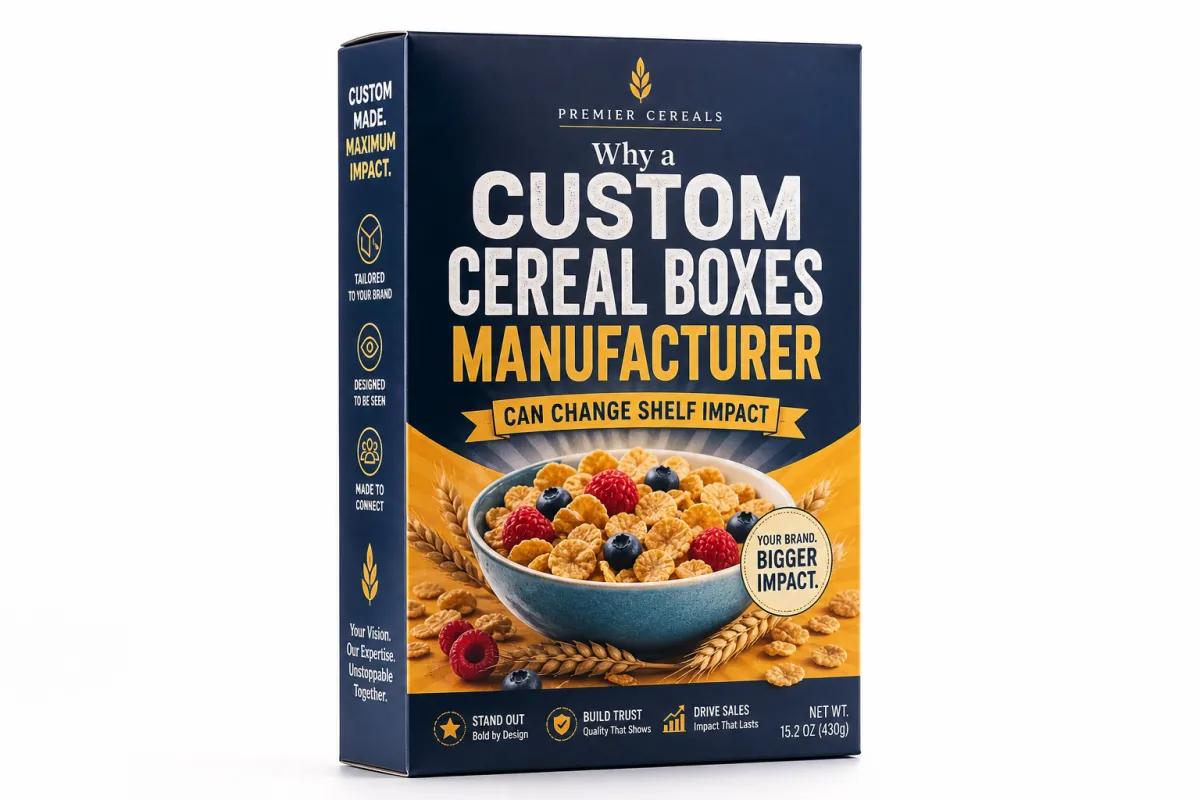
Most shoppers do not stop in the aisle and study every carton. They scan. That means the package has to communicate flavor, brand, and value in a fraction of a second. A custom cereal boxes manufacturer helps move a brand away from generic shelf presence and toward something that belongs in the category without disappearing into it. The box should read clearly from a few feet away, and it should still hold up once a case has been opened, handled, and repacked by store staff.
From a packaging buyer’s point of view, the carton is a working structure first and a branding surface second. A custom cereal boxes manufacturer can tune the board caliper, print method, and finish so the box feels cleaner and stronger than a plain stock option. A standard cereal carton might use 16 pt to 24 pt SBS or CCNB depending on size and budget, while premium or heavier products may need a sturdier spec. That choice affects everything: crush resistance, fold memory, print sharpness, and how the carton looks under store lighting.
One detail that gets missed a lot is how the carton behaves after it leaves the printer. A box that scores cleanly and folds well on day one can still disappoint if the coating scuffs in transit or the glue line opens under load. I have stood over press sheets under harsh fluorescent light and watched a finish that looked rich on screen turn oddly flat on paperboard. That is why a custom cereal boxes manufacturer should talk about substrate, ink, and finish as one system, not three separate decisions.
I see brands lose money here more often than they realize. They invest in product development, then underfund package branding. The cereal is good, but the box reads as temporary. The artwork may look strong on screen, yet on press the colors flatten because the substrate was chosen too lightly, or the ink coverage was not planned for the finish. A solid custom cereal boxes manufacturer prevents that mismatch by matching design intent to production reality.
The shelf-distance problem matters too. A carton that looks polished in a PDF can still fail in a real aisle if the type hierarchy is weak. The flavor name should not fight with the brand name, and the size statement should not hide in a corner. Good packaging design is not loud for the sake of noise; it is organized. A good custom cereal boxes manufacturer will usually push for a cleaner hierarchy so the shopper sees the right thing first, then the supporting details second.
“A cereal carton has three jobs at once: it has to protect the contents, sell the product, and survive the handling that happens between the line and the shelf. If one of those jobs is weak, the whole package feels off.”
That practical view is why experienced buyers keep returning to a custom cereal boxes manufacturer instead of treating cartons as a last-minute print order. The right partner can help a brand move from plain product packaging to something that supports retail presentation, shipping durability, and repeat ordering. For brands that want a cleaner path to planning and proofing, it often helps to review the company background on About Custom Logo Things before requesting a quote.
If your product moves through parcel channels, palletized shipping, or club-store style stacking, performance matters even more. The box should not only look good, it should resist edge crush and maintain form. For transit behavior and testing language, the library at ISTA is useful because it frames the kind of stress cartons see in actual distribution, not just on a design screen.
A smart custom cereal boxes manufacturer balances all of that without overcomplicating the project. The goal is not to turn a cereal carton into a luxury display box. The goal is to create a package that feels right for the brand, prints cleanly, ships well, and gives the shopper a reason to pick it up.
How a custom cereal boxes manufacturer manages process and timeline
The process usually starts with a brief, and the better the brief, the smoother the rest of the job goes. A custom cereal boxes manufacturer will want carton dimensions, fill weight, whether the cereal uses an inner bag or liner, the print quantity, and where the carton will be sold. A package headed for a grocery shelf may need different visual priorities than one sold through a subscription box or natural foods channel. The same box size can be designed two different ways depending on the audience.
Structural work comes next. Dieline creation is the point where the carton stops being a concept and becomes a real manufacturing file. A custom cereal boxes manufacturer uses the dieline to define panel dimensions, glue flap size, tuck style, and any special areas that affect folding or machine packing. If the cereal bag is wider than expected or the filled product creates pressure at the seams, the structure may need a revision before printing begins. That is why structural checks matter so much. A box that looks perfect in artwork but fails in fit is an expensive mistake.
Proofing bridges idea and production. The manufacturer may provide a digital proof, a structural sample, or a press proof depending on complexity. A reliable custom cereal boxes manufacturer will encourage the brand to check barcode placement, nutrition facts, ingredient copy, legal lines, and safe area margins carefully. A layout can look beautiful and still fail if the barcode sits too close to an edge or the required text is too small for compliance review. For U.S. grocery packaging, that review should also account for FDA formatting on the nutrition panel, which is where a lot of first-time buyers get tripped up.
After proof approval, the job moves into printing, finishing, and converting. That sequence sounds simple, but each handoff matters. The print team must align color expectations with the approved proof. The finish must match the carton board and coating choice. Folding and gluing have to support machine compatibility and case packing. A seasoned custom cereal boxes manufacturer watches those steps closely because a small error on the press side can show up later as a crooked carton, a weak fold, or an inconsistent flap lock.
For timeline planning, digital and offset runs behave differently. Smaller or urgent runs can move faster with digital printing, often in about 7 to 12 business days after final approval, depending on queue, finishing, and shipping distance. Offset work, specialty coatings, or heavy custom finishing often run closer to 12 to 20 business days, and more complex jobs can take longer if plates, tooling, or sample revisions are involved. A custom cereal boxes manufacturer should be direct about this instead of promising unrealistic speed. If someone gives you a too-perfect turnaround with no questions asked, that is usually a sign to slow down and ask what they are not saying.
Delays usually come from avoidable points: late artwork changes, missing barcode files, unclear copy for the nutrition panel, or an approval chain that drags on for days. If you want a custom cereal boxes manufacturer to keep the schedule tight, send final art, confirm exact quantity, and clarify who has approval authority before the job enters production. That sounds basic, but it is where many projects slip.
For products that need more disciplined material sourcing, a conversation about FSC paperboard can be useful. The FSC system gives brands a way to think clearly about responsible sourcing without turning the project into a marketing slogan. A good custom cereal boxes manufacturer should be able to explain whether recycled content, FSC-certified board, or a lighter caliper will still run well on the filling line and survive transport.
One practical way to keep the process moving is to build a simple launch checklist before you contact the custom cereal boxes manufacturer. Include dimensions, target shelf date, quantity, board preference, finish preference, and whether the run needs samples before production. That small amount of planning can save days of back-and-forth and reduce the chance of a costly revision cycle.
Cost, pricing, MOQ, and quote factors to compare
Pricing for cereal cartons is rarely just “print price.” A custom cereal boxes manufacturer looks at the whole structure: carton size, board grade, print coverage, coating, finishing, and volume. A simple four-color carton on standard SBS board will not cost the same as a box with a window cutout, soft-touch coating, and spot UV on the logo. The more design work and setup work involved, the more the quote will reflect that.
For realistic planning, smaller runs may land in the range of about $0.18 to $0.45 per carton depending on quantity, board, and finish, while larger orders can move lower once setup costs are spread across more units. A custom cereal boxes manufacturer is usually not trying to hide this; they are balancing print setup, press time, cutting, folding, and packaging labor. The exact number shifts quickly with quantity, because fixed costs behave differently on 2,000 units than they do on 20,000 units. Those figures are directional, not a promise, because paperboard markets, labor, and freight can move faster than most people expect.
MOQ, or minimum order quantity, is the smallest run a plant can produce economically. If the MOQ is 5,000, the setup cost for plates, dies, or press calibration gets spread across those boxes. That is why a larger run often lowers unit cost even when the actual box design stays the same. A smart custom cereal boxes manufacturer will explain whether the MOQ is driven by materials, press economics, or converting requirements, because that tells you how flexible the quote really is.
There are also costs that show up later if you do not ask early. Sample charges may apply if you need a structural prototype or printed mockup. Tooling or die charges may apply for a new shape. Freight can change the landed cost more than people expect, especially for lightweight but bulky cartons. Rush service may add fees. If inventory must be stored before a launch, staging or warehousing can matter too. A careful custom cereal boxes manufacturer will separate these items instead of burying them in the unit price.
| Production option | Best fit | Typical setup | Price direction | Lead time direction |
|---|---|---|---|---|
| Digital print | Short runs, test launches, frequent artwork changes | Lower setup, faster proofing | Higher per unit at small volumes | Fastest |
| Offset print | Mid to high volumes, tighter color control | More setup, better economics at scale | Better unit cost as quantity rises | Moderate |
| Offset with specialty finish | Premium shelf presentation, stronger brand signal | Extra coating or finishing step | Higher than standard offset | Longest |
| Sample or prototype run | Fit checks, retailer review, internal sign-off | Limited quantity, manual review | Not for unit economics | Depends on revision cycle |
That table helps because quotes can look close on the surface while hiding different assumptions underneath. One custom cereal boxes manufacturer may quote the same carton size as another but use a lighter board, a simpler coating, or a different packaging count per case. If you compare price alone, you may think you found the better deal when you actually found a different specification.
Landed cost matters here. It is not just the unit price; it is the full cost to get approved cartons delivered and ready for use. A quote from a custom cereal boxes manufacturer should be judged against material grade, print method, finishing, shipping terms, and whether the cartons arrive as flat-packed product packaging or another configuration. If two quotes do not match on those points, they are not truly comparable.
Here is a simple rule I give buyers: ask each custom cereal boxes manufacturer to confirm board type, thickness, print method, finish, packing count, shipping terms, and whether samples are included. If those six points are clear, the quote conversation gets much easier and the risk of surprise costs drops fast.
Step-by-step guide to ordering from a custom cereal boxes manufacturer
Ordering cereal cartons becomes much easier once you treat it like a process instead of a one-off purchase. A custom cereal boxes manufacturer can move quickly when the project brief is clean, the artwork is organized, and the approval path is short. The steps below are the same ones many packaging teams use to keep a launch on track.
-
Define the product brief. Start with box dimensions, fill weight, target retail channel, launch timing, and any shelf or retailer requirements. If the cereal is packed with an inner liner or pouch, measure that too. A custom cereal boxes manufacturer can only quote accurately if the physical product information is real, not guessed.
-
Gather the artwork assets. Put the nutrition facts, barcode, ingredients, allergen copy, legal text, and flavor callouts into one clean folder. If you need a compliance review, say so early. A custom cereal boxes manufacturer is not replacing legal counsel, but they can flag layout issues that would cause trouble in print or on a retail shelf.
-
Request a structure sample or prototype. This is where fit gets checked. Make sure the carton opens correctly, the inner bag fits, the panel proportions feel balanced, and the box stands up properly when filled. A custom cereal boxes manufacturer that offers structural sampling is saving you from discovering a bad fit after the full run is complete.
-
Review the proof carefully. Check typography, folding lines, barcode quiet zone, bleed, and color expectations. A proof should be reviewed on screen and, if possible, in a printed format. A custom cereal boxes manufacturer will usually want written approval before starting production, and that approval is the point where changes become more expensive.
-
Lock the schedule and inspect the first shipment. Keep your approved files, specs, and color notes in one place for future reorders. When the first carton run arrives, inspect random samples for print alignment, finish consistency, glue quality, and panel integrity. A good custom cereal boxes manufacturer will welcome that inspection because it builds trust for future orders.
There is a practical reason to document everything. The next time you reorder, you should not have to reconstruct the whole job from memory. Save the dieline, final artwork, approved proof, color settings, and packaging count. That file set becomes your internal spec sheet, and a reliable custom cereal boxes manufacturer can use it to keep repeat orders consistent across flavor changes or seasonal releases.
If your cereal line uses multiple SKUs, standardizing the base structure helps even more. A single carton family with different front-panel artwork can reduce confusion on the production side and make the brand feel more unified. That kind of package branding is simple, but it works. A custom cereal boxes manufacturer can often help you keep those variations manageable without sacrificing shelf clarity.
One more practical note: do not treat the first order like a design-only exercise. Treat it like a production launch. The custom cereal boxes manufacturer is responsible for the physical carton, but the brand is responsible for the information going on that carton. The smoother the handoff, the better the result.
Common mistakes when working with a custom cereal boxes manufacturer
The biggest mistake I see is ordering from a mockup without measuring the real product. A carton can look perfect in a flat render and still fail once the bag is inside. A custom cereal boxes manufacturer needs actual dimensions, not just a rough idea, because cereal cartons are sensitive to depth, tuck style, and the way the inner bag settles inside the box.
Another common problem is choosing a board that is too light for the product weight or the shipping environment. If the carton is going to travel through distribution, stand in a warehouse, or get stacked on a pallet, weak board can crush the corners and make the whole package look tired before it ever reaches the shelf. A good custom cereal boxes manufacturer can explain caliper and board strength in plain language so you can choose a spec that fits the load.
Crowded artwork is a quiet failure. Brands often want every message on the front panel, and the result is a box that looks busy and hard to shop. Nutrition facts, barcode placement, ingredient copy, and flavor cues all need room to breathe. A custom cereal boxes manufacturer may not rewrite the design, but they should warn you if the layout is so dense that it hurts readability and retail packaging performance.
There is also a quote-comparison trap. Two estimates may look similar because the quantity is the same, but the actual package specs may differ in board grade, coating, packing method, or finishing. I have seen buyers compare a standard matte box against a premium soft-touch carton and assume the higher quote is inflated, when in fact they were comparing two different products. A careful custom cereal boxes manufacturer should state exactly what is included so you can compare fairly.
Skipping sample approval is another costly mistake. Even if the artwork is approved digitally, print on paperboard can shift slightly, and structural issues often show up only when the carton is folded and filled. A custom cereal boxes manufacturer that recommends a sample stage is protecting your schedule, not slowing it down.
When cereal boxes are part of a broader launch, it helps to remember that the carton is only one layer of the product packaging system. The inner liner, the case pack, the pallet pattern, and the shelf-ready appearance all interact. A custom cereal boxes manufacturer should be part of that conversation, especially if you want the package to hold its shape through storage and distribution.
For durability-minded brands, it can be worth checking whether your packaging spec aligns with recognized transit testing logic. The ISTA resources are useful for understanding how cartons may behave under vibration, drops, and compression. A custom cereal boxes manufacturer does not need to overpromise lab language, but they should understand that the box is going to live in the real world, not a showroom.
Expert tips for stronger shelf appeal and better carton performance
If you want stronger shelf appeal, start with visual hierarchy. The brand name, flavor, and size need to read in a clean order. A custom cereal boxes manufacturer can help turn that into a carton that feels open and legible instead of crowded. In a busy aisle, clarity wins more often than decoration. The shopper should understand what the cereal is before they have time to second-guess it.
Finish choice changes perception more than many people expect. Matte finishes can make a box feel calmer and more premium. Gloss can make color feel brighter and can help graphics pop under strong retail lighting. Spot UV can pull attention to a logo or flavor mark, while soft-touch coatings create a quieter, more tactile feel. A good custom cereal boxes manufacturer will help you pick the finish that matches the brand voice, not just the finish that looks fancy on paper.
Material choice matters just as much. If sustainability is part of the brand story, recycled board or FSC-certified paperboard can be a strong choice, provided the material still runs well on the filling line and keeps its shape in transit. A custom cereal boxes manufacturer should be able to talk about trade-offs honestly. Sometimes the lightest board is not the best board. Sometimes the greener spec needs a coating or structure adjustment to perform properly.
Here is a useful rule: ask about stackability, crush resistance, and folding memory, not only print quality. A carton that looks beautiful but loses its edges on the pallet is not a success. A strong custom cereal boxes manufacturer thinks about the carton as a working object, because that is what the warehouse team, the retailer, and the shopper will handle.
Repeat orders get easier when the file system is organized. Save the final dieline, approved art, print settings, and notes about any small adjustments made during production. That small archive helps the next custom cereal boxes manufacturer run stay consistent if you switch flavors, add a seasonal variant, or increase your order size. It also protects you if a staff member changes and the original setup knowledge would otherwise disappear.
Another practical improvement is to simplify panel language. Do not let every side of the carton fight for attention. Use one side for the strongest brand message, one for the flavor story, and one for the necessary regulated copy. A custom cereal boxes manufacturer with real packaging design experience will usually steer you toward this structure because it performs better in retail packaging and reduces layout risk during production.
Finally, ask for production notes, not just artwork approval. A seasoned custom cereal boxes manufacturer can tell you whether the box is likely to fold cleanly, whether the glue area is adequate, and whether the finish choice may affect scuff resistance. That is the kind of detail that separates a decent carton from one that feels dependable in hand.
What to do next before you request a quote
Before you request pricing, build a one-page spec sheet. Include the box dimensions, fill weight, quantity, board preference, finish preference, launch timing, and any retailer compliance notes. A custom cereal boxes manufacturer can quote more accurately when the brief is specific, and you can compare bids with far less confusion.
Gather the artwork files at the same time. That means the barcode data, nutrition facts, ingredients, legal copy, and any flavor or ingredient claims that must appear on the carton. If the artwork is not final, say that clearly. A custom cereal boxes manufacturer can still help with structure and planning, but the earlier the content is locked, the smoother the quote and proof stages will be.
If possible, ask for two sample types: one structural check and one print proof. They solve different problems. The structural sample tells you whether the carton fits the product and folds correctly. The print proof tells you whether the colors, copy, and layout feel right. A good custom cereal boxes manufacturer should understand why both matter.
Then compare manufacturers on responsiveness, transparency, and schedule clarity. Fast replies matter, but so does the quality of the answers. If a supplier can explain material options, lead times, and likely cost drivers without dodging the details, that is a strong sign. A reliable custom cereal boxes manufacturer should make the process feel controlled, not mysterious.
For brands looking at a broader packaging rollout, it can help to review other Custom Packaging Products alongside the cereal carton so the whole line feels consistent. Matching carton logic across different SKUs keeps the brand easier to manage, especially when the product family grows.
The best next step is straightforward: lock your measurements, choose a realistic board and finish, gather the compliance copy, and ask a custom cereal boxes manufacturer for both a structural sample and a written quote that spells out board, print method, coating, packing count, and shipping terms. That is the shortest path to a carton that fits, prints cleanly, and survives the trip from press to shelf. If you keep the project grounded in real dimensions and clear approvals, the custom cereal boxes manufacturer you choose can become a practical production partner instead of just another vendor.
What does a custom cereal boxes manufacturer do beyond printing?
They help with carton structure, dielines, material selection, and print setup, not just the artwork side. A strong custom cereal boxes manufacturer can also guide fit, stacking strength, folding behavior, and retail-ready presentation, then support proofing and production planning so the package works as a real product packaging system.
How much do custom cereal boxes usually cost to make?
Pricing depends on size, board grade, quantity, print coverage, coatings, and special finishing. A custom cereal boxes manufacturer will usually show better unit pricing as the order gets larger because setup work is spread across more cartons. Freight, samples, and rush service can change the landed cost, so compare full quotes instead of just the headline number.
What is the typical turnaround time for custom cereal boxes?
Simple digital runs can move faster, while offset jobs and specialty finishes usually take longer. A custom cereal boxes manufacturer will normally build time around artwork approval, proofing, sample sign-off, production, and shipping. Final lead time also depends on order size, revision speed, and how far the cartons need to travel.
What artwork files do I need for custom cereal boxes?
A proper dieline, print-ready artwork, barcode placement, nutrition panel copy, and final legal text are the basics. A custom cereal boxes manufacturer can often review files before printing, but clean source files with bleed, safe areas, and the correct color setup save time and reduce revisions.
Can a custom cereal boxes manufacturer help with sustainable materials?
Yes, many manufacturers can recommend recycled board, FSC-certified paperboard, or lighter-weight structures. A custom cereal boxes manufacturer can also suggest finishes and coatings that support recyclability while still protecting the product, but the material choice still has to work on the filling line and survive shipping.

