Buyer Fit Snapshot
| Best fit | Custom Cereal Packaging Wholesale projects where brand print, material claims, artwork control, MOQ, and repeat-order consistency need to be specified before quoting. |
|---|---|
| Quote inputs | Share finished size, material target, print colors, finish, packing count, annual reorder estimate, ship-to region, and any compliance wording. |
| Proofing check | Approve dieline scale, logo placement, barcode or warning zones, color tolerance, closure strength, and carton packing before bulk production. |
| Main risk | Vague material claims, crowded artwork, missing packing details, or unclear freight terms can make a low unit price expensive after revisions. |
Fast answer: Custom Cereal Packaging Wholesale: Specs, MOQ, Pricing should be specified like a repeatable production item. The safest quote records material, print method, finish, artwork proof, packing count, and reorder notes in one written spec.
Production checks before approval
Compare the actual filled-product size with the drawing, then confirm tolerance on folds, seals, hang holes, label areas, and retail display edges. Reserve space for logos, QR codes, warning copy, and material claims before decorative graphics fill the panel.
Quote comparison points
Review material grade, print process, finish, sampling route, tooling charges, carton quantity, and freight assumptions side by side. A quote is only useful when the supplier can repeat the same color, closure quality, and packing count on the next order.
Custom Cereal Packaging Wholesale: Specs, MOQ, Pricing
Custom Cereal Packaging wholesale should make a launch easier, not turn it into a trail of separate invoices, rushed approvals, and extra hands at the packing table. The cheapest carton on paper often becomes the priciest package once labels, inserts, manual assembly, and damaged shippers enter the picture. A box that looks inexpensive can quietly drain margin in ways that never show up in the first quote, and that is where a lot of first-time buyers get caught.
For a private label cereal launch, custom cereal packaging wholesale has to do several jobs at once: protect the product, stack cleanly in storage, carry nutrition and barcode data, and compete in an aisle where shoppers give you a few seconds, maybe less. That is a brutal test for a piece of printed board. It also explains why seasoned buyers treat packaging as a system rather than a pile of disconnected parts. I once watched a 12-ounce granola cereal line lose more money on crushed corners and rework than it saved by choosing a thinner board. That kind of math gets ugly fast.
Wholesale buying pays off because it lowers unit cost, keeps print consistent across every SKU, and cuts the number of vendors involved. If the structure, print, and finish are planned together, custom cereal packaging wholesale brings fewer surprises and a cleaner production run. The main choices look simple on a worksheet: board type, box size, finish, order quantity, and lead time. The harder part is matching those choices to fill weight, shipping conditions, and the shelf environment. The shelf is kinda unforgiving; if the box slouches, shoppers notice even when they cannot explain why.
Why Custom Cereal Packaging Wholesale Beats Mixed-Source Packaging
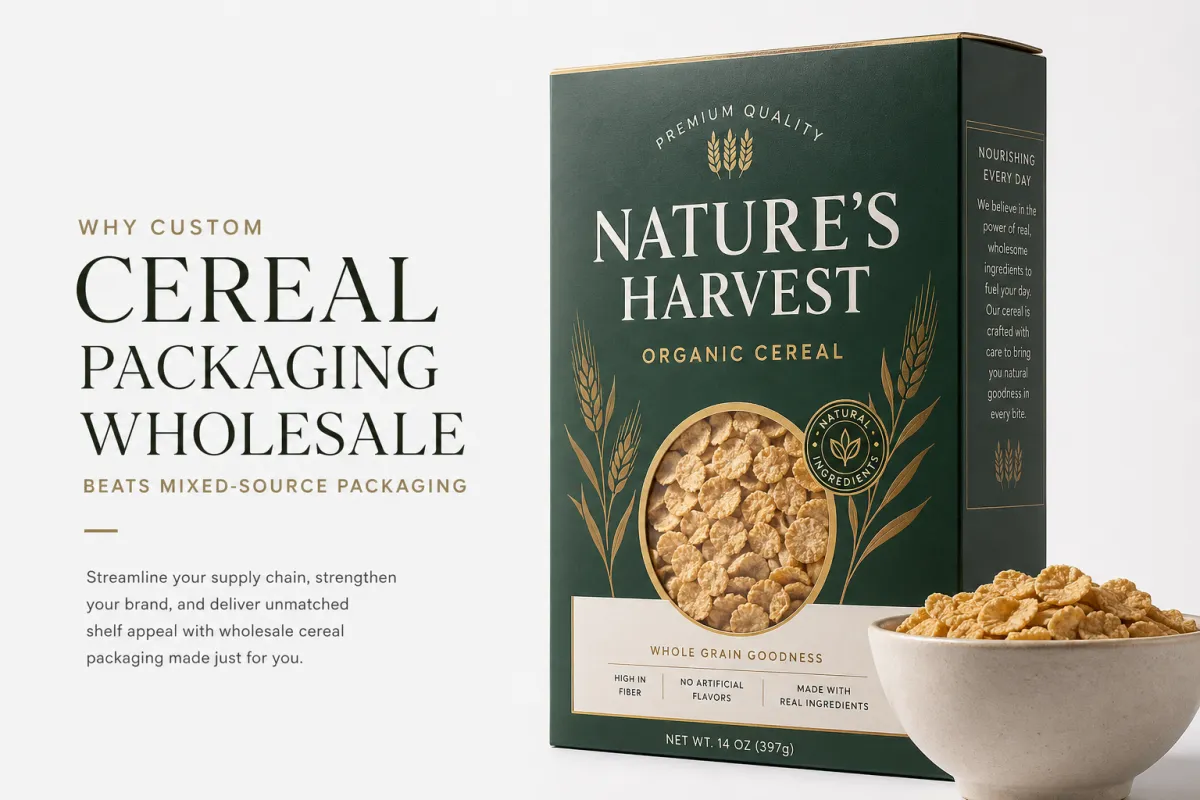
Mixed-source packaging usually looks economical until the work starts. One supplier prints labels, another ships blank cartons, and a third sells inserts or dividers. Someone still has to stage all of it, check the fit, and assemble pieces by hand. That is not streamlined operations. That is labor wearing a spreadsheet costume.
Custom cereal packaging wholesale removes those moving parts. A well-built folding carton can carry the brand message, the regulatory copy, the SKU identity, and the shelf presentation in one piece. A solid wholesale run also keeps color and dieline registration consistent from lot to lot, which matters more than many buyers expect. A carton that shifts slightly from one order to the next can look tired beside its own previous run. Retail buyers notice. Store staff notice. Shoppers may not name the problem, but they feel it.
From a packaging buyer’s point of view, the value is practical:
- Lower unit cost once quantity moves beyond the small-run stage.
- Better consistency because structure and print are produced together.
- Fewer touchpoints because labels, sleeves, and inserts do not need separate handling later.
- Cleaner shelf presentation because the carton is designed as retail packaging from the start.
That is the real appeal of custom cereal packaging wholesale. Not hype. Fewer scraps, less handling, less confusion, and a package that behaves like part of the production line instead of an afterthought. If you are launching a private label cereal, a club-store bundle, or a foodservice-size box, the package has to protect the product and carry the brand without demanding extra labor from the warehouse team.
Custom cereal packaging wholesale also helps when a brand wants to scale into multiple flavors or sizes. Once the base structure is approved, the same dieline can stay in place while the artwork panel changes. That saves time and keeps the line visually unified. It also makes retail, ecommerce, and warehouse distribution feel like one family of packaging instead of three unrelated systems. For brands selling across channels, that kind of packaging architecture matters.
A carton that looks premium but folds badly is not premium. It is just expensive.
Set expectations early. The buyer should know the board grade, exact fill size, print coverage, coating, and target quantity before asking for a quote. That is the difference between a controlled order and a confusing one with surprise costs at every turn. I have seen both, and the messy version always starts with vague specs.
Custom Cereal Packaging Wholesale Product Options
Custom cereal packaging wholesale comes in a few core formats, and each one has a job. The right structure depends on product weight, shelf display needs, and how much abuse the box will take before it reaches the customer. A carton that only needs to sit on a shelf can be lighter. A carton that has to survive a warehouse, a retail backroom, and parcel shipping needs more protection.
Folding cartons for retail shelves
Most custom cereal packaging wholesale orders begin here. Folding cartons are the standard retail choice for cereal because they print well, stack neatly, and present a smooth front panel for branding. They fit light to medium fills, often around 6 oz to 24 oz depending on the carton size and board choice. For premium brands, a well-printed SBS carton does much of the selling before the consumer even picks up the box.
The trick is fit. A carton that is even a little too roomy can let the inner bag shift and crease the panels. A carton that is too tight can split at the tuck or buckle along the score lines. Neither looks good, and both create avoidable waste. If you have ever seen a retail box “walk” open in transit, you already know how annoying a poor fit can be.
Corrugated shippers for bulk transport
Corrugated board makes sense when the product needs more protection or the box itself has to survive long transit. Some custom cereal packaging wholesale buyers use corrugated outer shippers for club-store cases or ecommerce bundles, especially when the item ships direct to the customer. A small increase in the shipper price can save far more in damage claims, repacks, and customer complaints.
There is a useful comparison here: a retail carton is there to sell, while a shipper is there to survive. Mixing those two jobs into one weak structure usually costs more than building them separately. That is not an exciting answer, but it is the right one most of the time.
Display trays and shelf-ready packs
Display trays help when cartons need to arrive ready to merchandise. They work well for promotions, warehouse clubs, and seasonal launches where quick shelf setup matters. In custom cereal packaging wholesale, this is often the smartest move for multi-pack sets or short promotional runs because the display structure doubles as transport protection and shelf-ready packaging. That reduces handling at the store level and can make a small promotion feel more polished than its budget suggests.
There are also closure and insert options that matter in day-to-day use:
- Tuck-end cartons for standard cereal boxes that need quick assembly.
- Lock-bottom structures when the base needs extra support.
- Inner liners for product stability and cleaner fills.
- Tamper-evident or resealable features if the fill or channel requires them.
Finishing choices can change the feel of the package without changing the structure. Matte and gloss coatings are the usual starting points. Spot UV highlights logos or flavor names. Foil and embossing suit brands that want a more premium retail packaging look. Window cutouts can show the product or liner, though they need restraint because cereal cartons still need enough board area to stay rigid. A shiny treatment can help, but it will not rescue a weak box. Nothing does.
One detail buyers often miss: inside-panel printing can matter just as much as the outside. If the box opens at the top and the consumer sees a branded message or usage note inside, the package feels more considered. For some brands, that extra panel turns a plain carton into something memorable instead of generic. For others, it becomes the difference between a commodity box and a branded experience.
In custom cereal packaging wholesale, the best format is the one that fits the route from factory to shelf. A fancy carton that crushes in transit is a bad carton. A plain carton that survives, stacks, and prints cleanly is often the better business decision. Packaging has a way of rewarding the practical choice.
Material and Print Specifications That Matter
Material choice is where custom cereal packaging wholesale either becomes practical or becomes expensive. The board has to match the fill weight, the display expectations, and the shipping conditions. If the package looks polished but folds soft in transit, the print job did not save it. The structure still failed.
The three most common board choices are straightforward:
- SBS for premium retail cartons where print quality and color consistency matter most.
- CCNB for value-driven runs that still need decent shelf presentation and a lower per-unit cost.
- Corrugated board for heavier products, warehouse handling, and transport protection.
For cereal, SBS is often the first choice when the package needs a crisp white surface and sharp graphics. It handles high-coverage artwork well, especially for branded packaging with clean color blocks and bright typography. CCNB suits buyers who want a respectable retail look without paying for premium board on a low-margin item. Corrugated is the better answer when the carton is part of the shipping system rather than just the shelf system. That distinction matters in food packaging because one carton may need to do double duty across storage, transport, and display.
Custom cereal packaging wholesale buyers should also pay close attention to thickness and strength. A 14pt board may be enough for small cartons, while 18pt or heavier stock can make sense for larger formats or cartons that get handled often. The wrong board is one of the most common reasons cereal boxes feel weak in transit even though the artwork looks good on screen. In practice, board caliper is one of those boring details that decides whether the package behaves or gets bullied.
Print specs need to be locked before production starts. Confirm these up front:
- CMYK or spot color setup, depending on brand requirements.
- Coating choice such as aqueous, matte, gloss, or soft-touch.
- Dieline accuracy so folds, glue areas, and flaps align correctly.
- Barcode placement with proper quiet zone and contrast.
- Nutrition panel layout with enough safe space for regulatory copy.
The print side is not decoration. The barcode has to scan. The nutrition facts have to read. The safe zones have to stay clear of folds. If you are ordering custom cereal packaging wholesale, these are not minor details. They are the details that keep the box legal, functional, and ready for retail.
Food-contact considerations matter too. The outer carton is not usually the direct food barrier, but inks, coatings, and any inner liner still need careful review. Buyers should ask whether the print system suits food packaging, especially if the box sits close to the product or uses an inner structure. For sourcing standards and packaging guidelines, bodies like the International Safe Transit Association and certification systems such as FSC can help when paper sourcing matters.
Another practical point: final artwork approval should happen before tooling starts. Once the dieline is approved and plates or dies are made, late changes cost money and time. A small copy edit can turn into a reproof, a resample, and a schedule slip. That is why custom cereal packaging wholesale runs go smoother when the files are complete on day one.
One honest disclaimer: pricing and material names vary by supplier and region. “SBS” at one plant may be called out differently at another, and the same nominal caliper can behave a little differently depending on coating, grain direction, and board make. That is normal. The fix is simple: ask for the spec sheet, not just the sales shorthand.
Custom Cereal Packaging Wholesale Pricing and MOQ
Custom cereal packaging wholesale pricing is driven by a handful of variables that never stop mattering: board grade, box size, print complexity, finish, quantity, and whether the structure needs special tooling. The fewer surprises in the spec sheet, the easier it is to get a useful quote instead of a vague number that nobody can buy against.
Here is the blunt version. Small runs cost more per unit. That is how setup work and material waste get absorbed. Once order quantities rise into the several-thousand range, pricing usually drops quickly because the setup cost is spread across more boxes. For many cereal brands, the real savings begin around 3,000 to 5,000 units per SKU. In some factories, the break point comes a little earlier; in others, it comes later. It depends on the press, the finishing line, and how custom the structure really is.
| Option | Typical MOQ | Indicative Unit Price | Best For | Notes |
|---|---|---|---|---|
| SBS folding carton, 4-color print, AQ coating | 1,000-2,500 | $0.34-$0.68 | Retail-ready cereal with clean shelf appeal | Good balance of print quality and cost for custom cereal packaging wholesale |
| CCNB carton, standard print, gloss or matte coating | 1,000-3,000 | $0.22-$0.46 | Value-driven private label lines | Lower cost, still acceptable for retail packaging |
| Heavy-board or reinforced structure | 2,500-5,000 | $0.42-$0.85 | Heavier fills or rougher handling | Better strength, higher material spend |
| Special finish with foil, emboss, or spot UV | 3,000+ | Base price + $0.06-$0.18 | Premium branded packaging | Useful for hero SKUs, not every budget line |
Those ranges are practical, not magical. A small cereal box with low-coverage artwork will price differently than a larger carton with dense graphics on every panel. The same goes for inside printing, window cutouts, and custom inserts. Custom cereal packaging wholesale gets cheaper when the spec is simple and the volume is healthy. That is math, not marketing copy.
MOQ expectations are usually similar. Many standard folding cartons can start around 1,000 units per SKU, but specialty finishes or nonstandard structures often push the minimum to 2,500 or 5,000. If the box has foil, embossing, or a unique closure style, the factory may need a higher minimum to justify tooling and setup. Buyers should ask for a pricing ladder across 1,000, 3,000, and 5,000 units so the savings curve is obvious.
Do not ignore the hidden costs either. Samples, die fees, plate fees, freight, and reprint risk all affect the real landed cost. A die fee might land in the $75-$250 range depending on complexity. Samples can run $40-$120 before freight. Freight varies with carton size because a box is mostly air until it is filled, and air costs money to move. That is one reason cereal packaging often looks “cheap” until the truck quote lands.
Custom cereal packaging wholesale buyers also need to think about reprint risk. If the box dimension changes after artwork is built, the whole layout can move. If the nutrition panel is updated late, the file may need a new proof. If the barcode is swapped at the last minute, the print file may need a clean reset. Every one of those changes can add time and cost.
Want the best price? Lock the fill weight, dimensions, coating, and quantity before requesting the quote. Simple spec sheets get sharper pricing because the supplier can see exactly what is being made. Loose specs invite padding. Nobody should pay for padding unless it is protecting the product.
One honest buying rule: if two quotes are close, the better value is usually the one that spells out board grade, finish, and approval steps more clearly. Custom cereal packaging wholesale is a production purchase, not a guess. The cleaner the quote, the fewer unpleasant conversations later.
Proofing, Production, and Timeline
Custom cereal packaging wholesale moves through a predictable sequence if everyone does their part: quote, spec confirmation, dieline setup, artwork upload, proof review, sample approval, production, and shipping. That sounds obvious. Delays still happen because someone treats one of those steps like a formality instead of a gate.
A realistic timeline usually looks like this:
- Proofing: about 1-3 business days if files are complete.
- Sampling: often 3-7 business days, depending on structure.
- Production: commonly 7-15 business days after final approval.
- Freight: separate from production and dependent on destination.
That is the normal rhythm for custom cereal packaging wholesale, assuming the artwork is ready. Late nutrition copy, missing barcode files, poor image resolution, and color correction requests are the usual reasons a project slips. They do not sound dramatic in email. They still eat schedule.
There is also a difference between a flat proof and a physical sample. A flat proof shows placement, copy, and panel flow. A sample shows structure, fold behavior, glue performance, and how the carton sits when assembled. If the box has a tight fit or a special insert, a physical sample is the safer call. It costs more than a PDF, but it is usually cheaper than a full reprint.
For transport-heavy orders, transit testing matters. If the cartons will be stacked, palletized, or sent through parcel networks, ask whether the package should be checked against ISTA test methods. That matters more for corrugated shippers and club packs, but folding cartons benefit from a transit-aware mindset too. A package that fails in shipping is not a packaging problem. It is a business problem.
Custom cereal packaging wholesale also benefits from one simple rule: the cleaner the specs are before the quote, the faster the factory can move without rework. Provide exact dimensions, fill weight, finish preference, barcode file, and target quantity up front. If a regulatory copy change is still pending, say so. Silence is how schedules get wrecked.
If the SKU information is not final, the box is not final. Hope is not a production spec.
The approval stage deserves real attention. Check the copy line by line. Confirm the barcode placement. Verify the flavor name, net weight, ingredient list, and any required claims. Make sure the art sits inside the safe zones on every panel. For custom cereal packaging wholesale, one small proofing miss can become a batch of avoidable waste.
There is another timing trap: reorders. If a first run is approved in a hurry and nobody documents the final board, coating, and dieline version, the next purchase can drift. The second run should not turn into detective work. Save the approved files, the production notes, and the carton sample together. That takes five minutes and prevents a lot of nonsense later.
Why Choose Our Custom Packaging Team
Custom Logo Things keeps custom cereal packaging wholesale practical. That means we focus on board sourcing, print consistency, structure checks, and clear quoting before the run starts. No fog. No vague promises. Just the details that decide whether the order lands cleanly.
Our job is not only to print boxes. It is to help you Choose the Right structure for the product and the channel. A cereal brand selling through retail packaging, ecommerce, and wholesale clubs does not need three unrelated box systems. It needs one smart structure, one clear spec sheet, and an artwork plan that can grow with the line. Good packaging design pays for itself in fewer headaches and fewer reorders.
Buyers also care about communication. They want to know what the carton includes, what it does not include, and where the cost is coming from. A strong custom cereal packaging wholesale quote should show board grade, print method, finish, tooling, samples, and freight assumptions. If those lines are clear, you can compare options without playing detective.
Here is the kind of quality control that matters for cereal packaging:
- Box squareness so the carton sits upright and stacks cleanly.
- Print alignment so panels, flaps, and folds stay consistent.
- Coating consistency so the finish looks even under store lighting.
- Carton fit so the fill does not rattle or jam.
Repeat buyers care about one thing more than flashy copy: consistency. Once the structure is approved, reorders should look and behave the same way. That keeps shelf-facing stable and reduces the chance that a new run changes the whole package experience. For custom cereal packaging wholesale, consistency is where the long-term savings live.
We also keep the buying process straightforward through our Custom Packaging Products and Wholesale Programs. Those pages help buyers compare structure options, volume tiers, and production paths without wasting time on guesswork.
Custom cereal packaging wholesale is not the place for guesswork dressed up as enthusiasm. If the box has to look good, ship well, and cost less over time, the structure has to be chosen with care. That is the part most people get wrong. They start with the art. They should start with the carton.
What Should You Check Before Ordering Custom Cereal Packaging Wholesale?
The fastest path to a clean order is simple. Gather the carton dimensions, fill weight, target quantity, finish preference, and final artwork before requesting a quote. If you can provide a dieline-ready file set, even better. That is how custom cereal packaging wholesale moves from idea to production without the usual back-and-forth circus.
Before approval, compare three things side by side: a sample, a flat proof, and the production quote. That gives you a practical view of how the structure will behave, how the art will print, and how the cost scales with volume. If the sample fits but the quote is too high, adjust the board or finish. If the price looks good but the structure feels soft, fix the structure before the run.
It also helps to confirm these items before the job is locked:
- Regulatory copy for nutrition, ingredients, and claims.
- Barcode placement with the correct quiet zone.
- Shipping date so freight can be planned around the production window.
- Reorder expectations if the SKU will come back in volume.
That last point matters more than people expect. If the cereal line is likely to reorder, the first run should be built like the beginning of a system, not a one-off purchase. Standardizing custom cereal packaging wholesale now makes repeat production easier later. That saves money and prevents the “why does the new box look slightly different?” conversation nobody enjoys.
If the package needs to hit retail shelves hard, make sure the box design uses the front panel well. Strong typography, a clean flavor callout, and a clear brand mark do more work than clutter ever will. Good package branding is not about cramming every claim onto the front. It is about giving the shelf a reason to stop the shopper for a second.
Ask for the dieline. Send the specs. Approve the sample. Then let production do its job. That is the straightest route for custom cereal packaging wholesale, and honestly, it is the least annoying one too.
Custom cereal packaging wholesale works best when the buyer treats the carton like a production asset, not a decoration. The right board, the right finish, the right quantity, and the right approval process turn packaging from a cost center into something that actually supports the brand. That is the whole point.
What is the typical MOQ for custom cereal packaging wholesale?
Standard folding cartons often start around 1,000 units per SKU, but specialty finishes or more complex structures can push the minimum higher. Many buyers see better pricing at 3,000 or 5,000 units, so it helps to compare tiers before placing the order. If repeat runs are likely, ask for a pricing ladder so the savings curve is clear. That way you are not guessing where the unit cost actually starts to make sense.
How long does custom cereal packaging wholesale production usually take?
Artwork proofing often takes a few business days if the files are complete. Production commonly runs about 7 to 15 business days after final approval, depending on structure and finishing. Shipping time is separate, so buyers should lock the delivery target early instead of assuming it will sort itself out. If a supplier promises a much faster turnaround, ask what gets skipped. Speed without proofing usually means trouble later.
Which material is best for custom cereal boxes wholesale?
SBS is a strong choice for retail-facing cartons when print quality matters most. CCNB works well for budget-conscious runs that still need decent shelf presentation. Corrugated board makes more sense for heavier fills, longer shipping lanes, or cartons that need more protection in transit. The right choice depends on how the box will travel, not just how it will look on a mockup.
Can custom cereal packaging wholesale include nutrition facts and barcodes?
Yes, but the copy should be final before proof approval because layout changes can affect the whole panel design. Barcodes need the proper quiet zone and correct placement so scanners read them cleanly. It is smarter to confirm the regulatory copy before production than to try fixing it after the box is already printed. A small layout error can ripple across the whole run, and that is an expensive lesson.
Should I request samples before placing a wholesale cereal box order?
Yes, especially if the carton must fit a specific fill weight or shelf display setup. A sample helps you check structure, color, finish, and closure behavior before you commit to bulk production. It is far cheaper to catch a size or print issue in sampling than after a full run. If the sample and proof disagree, trust the physical sample and fix the file.
Bottom line: for custom cereal packaging wholesale, lock the carton size, board grade, finish, barcode, and quantity before you approve a quote. If those five pieces are stable, the rest of the job gets easier to price, easier to proof, and much less likely to blow up in production.


