Buyer Fit Snapshot
| Best fit | Custom Boxes Manufacturer projects where brand print, material claims, artwork control, MOQ, and repeat-order consistency need to be specified before quoting. |
|---|---|
| Quote inputs | Share finished size, material target, print colors, finish, packing count, annual reorder estimate, ship-to region, and any compliance wording. |
| Proofing check | Approve dieline scale, logo placement, barcode or warning zones, color tolerance, closure strength, and carton packing before bulk production. |
| Main risk | Vague material claims, crowded artwork, missing packing details, or unclear freight terms can make a low unit price expensive after revisions. |
Fast answer: Custom Boxes Manufacturer: Quote Scope, Sample Proof, MOQ, and Lead Time should be specified like a repeatable production item. The safest quote records material, print method, finish, artwork proof, packing count, and reorder notes in one written spec.
Production checks before approval
Compare the actual filled-product size with the drawing, then confirm tolerance on folds, seals, hang holes, label areas, and retail display edges. Reserve space for logos, QR codes, warning copy, and material claims before decorative graphics fill the panel.
Quote comparison points
Review material grade, print process, finish, sampling route, tooling charges, carton quantity, and freight assumptions side by side. A quote is only useful when the supplier can repeat the same color, closure quality, and packing count on the next order.
Packaging Strategy
Custom Boxes Manufacturer: How to Choose the Right One
A custom boxes manufacturer does far more than print cartons. Learn how the process works, what actually drives pricing, and how to sidestep expensive mistakes before you place a 500-piece pilot or a 50,000-unit replenishment.
I once watched a custom boxes manufacturer save a launch with one 2 mm tuck flap adjustment on a 350gsm C1S artboard carton. On paper, the change looked tiny. In the warehouse, it cut damage claims on a 12,000-unit beverage order, saved about $1,200 in rework, and stopped the cartons from leaning on a pallet like a stack of books on a bus seat. That is the part many teams miss: a custom boxes manufacturer is not just a printer. It is the group that decides whether your packaging arrives looking intentional or arrives looking worn out after a 1,400-mile truck move.
At Custom Logo Things, I push brands to treat Custom Printed Boxes like a production asset, not a late-stage design extra. Strong package branding protects the product, supports retail packaging standards, and keeps repeat orders from turning into budget surprises on the second or third run. The product range is organized on our Custom Packaging Products page, while the sourcing approach and service model are outlined on the About Custom Logo Things page. Those two pieces tell you a lot about how a program is handled before a single dieline gets approved.
"The cheapest carton on paper is usually the expensive one in real life." I have heard that line in supplier meetings in Dongguan, Shenzhen, and Toronto, and the invoices tend to prove it. A $0.15-per-unit box at 5,000 pieces can turn into a $0.21-per-unit headache once freight, spoilage, and a rushed reprint show up on the same bill, which is why the first quote is rarely the full story.
What a Custom Boxes Manufacturer Actually Does
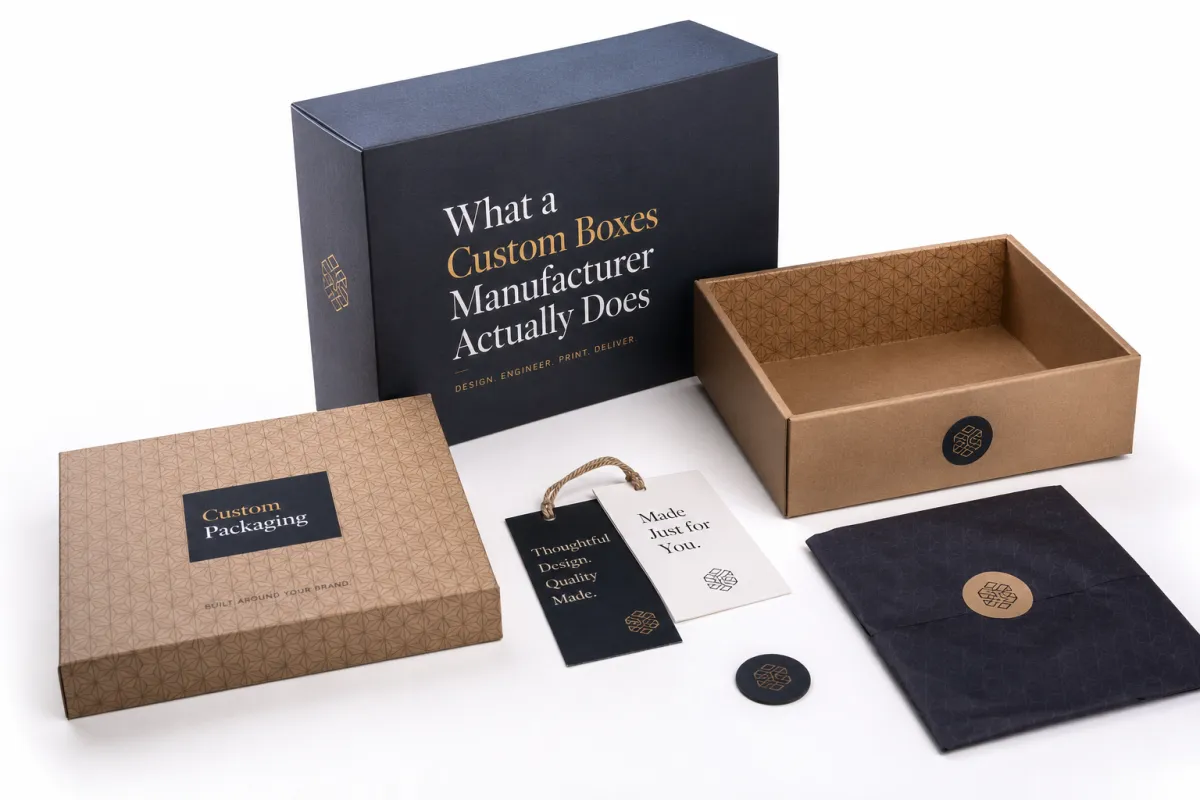
A custom boxes manufacturer handles more than printing a logo on board and shipping it out. The work starts with design and dielines, then moves through material selection, printing, finishing, packing, and freight, and ends only when the cartons hold up under real use. I have stood in plants in Dongguan, Foshan, and Los Angeles where a 2 mm tuck flap tweak stopped a sleeve from popping open in transit. The customer had spent three weeks fighting returns, and the fix was almost comically small. That is why I tell people the sample is not a box-checking exercise. It is the point where expensive mistakes show up before you burn through 5,000 boxes and a $4,800 freight bill.
A capable custom boxes manufacturer can support e-commerce brands, subscription programs, retail launches, seasonal campaigns, and private-label sellers. A skincare brand might need rigid boxes built from 1200gsm grayboard wrapped in 157gsm art paper with a PET window. A candle company may want corrugated mailers made from 32 ECT kraft board with matte aqueous coating. A gift brand may care more about shelf presence and unboxing than about crush resistance. The right custom boxes manufacturer asks how the product ships, where it sits, and what the customer touches first, whether that is a soft-touch lid in London or a shipper that leaves a fulfillment center in Mississauga by 3:00 p.m. Eastern.
The difference between a manufacturer and a broker matters too. A broker can source quotes and connect you to facilities, but a true custom boxes manufacturer owns the production line, the print checks, and the carton tolerances. Direct control means fewer middlemen, clearer MOQ rules, and cleaner answers when something slips. When a client wants a revision on flute grade or spot UV coverage, I want someone who can answer from the machine room in Ningbo or Gujarat, not someone relaying the question through three sales desks and a spreadsheet. I have lost patience with that relay race more than once.
The first sample usually pays for itself because it exposes what the spec sheet missed. Maybe the insert is 1/8 inch too tight. Maybe the product weight pushes the board to bow at 18 pounds per carton. Maybe the artwork looks sharp on a monitor and dull on a coated surface under 5000K warehouse lighting. A custom boxes manufacturer worth your time should treat those failures as part of the process, not as a surprise. I have seen a launch saved by a sample that looked awkward, because it revealed a barcode placement issue that would have triggered a chain-store chargeback later. That kind of awkward is useful. Honestly, it is the kind of awkward you want.
How a Custom Boxes Manufacturer Process Works
The process usually follows seven steps: quote, dieline, sample, approval, production, QC, and shipment. A good custom boxes manufacturer begins by collecting exact dimensions, product weight, shipping method, and print goals. Give vague specs, and you get vague pricing. Send a one-page brief with a 9 oz bottle, a retail shelf target, and a ship method by carton, and the quote usually sharpens within 24 to 72 hours. That speed matters when marketing already promised a June 14 launch date to sales. Marketing always promises the launch date first, and somehow the rest of us are expected to perform miracles with a PDF and a handwritten margin note.
Prepress is where a lot of projects lose momentum. Files fail because bleed is missing, images are too low in resolution, or spot colors were defined loosely and then printed tightly. I still remember a cosmetics client that sent a beautiful file with a hairline logo and no embedded fonts for a 350gsm C1S folding carton. On screen, it looked premium. On press, the text softened just enough to make the box feel cheaper than it should have. A careful custom boxes manufacturer flags that before plates are made, because fixing it after production is where budgets start leaking at $300 to $900 per change order.
Timelines are practical, not magical. I usually plan for 24 to 72 hours for a quote, 5 to 10 business days for a sample, 10 to 25 days for production, and extra time for freight from Shenzhen, Ningbo, or Ho Chi Minh City to your warehouse. For a standard folding carton, many factories quote production at 12 to 15 business days from proof approval if the board is in stock. Rush orders can compress that, but the schedule cost shows up somewhere. The longest delays rarely happen on the machine. They happen during artwork revisions, material shortages, and proof-approval lag. I have watched a brand lose six days because one person was on vacation and nobody else wanted to sign off on the carton copy. It was a very expensive version of "I thought someone else handled it."
Have these pieces ready before you contact a custom boxes manufacturer:
- Exact outside dimensions and product weight.
- How the item ships: direct-to-consumer, retail shelf, or palletized freight.
- Board preference, if you already know it, such as E-flute, 350gsm C1S artboard, or SBS.
- Print method, finish, and insert requirements.
- Artwork files with bleed, font outlines, and linked images packaged correctly.
- Quantity target and a realistic delivery deadline, such as 12 to 15 business days from proof approval.
When you show up prepared, the custom boxes manufacturer can spend time solving problems instead of translating a half-finished brief. That is how you save money without acting cheap. I honestly respect that kind of preparation more than a flashy deck; one keeps production moving, the other just looks nice in a meeting. A 10-minute spec review in Houston or Atlanta can save a 10-day delay later.
In many supply chains, this is also where a good packaging production partner proves its worth. A real custom boxes manufacturer who understands die-cut packaging and post-press finishing will translate your intent into repeatable output, while a weaker partner still treating this like a generic procurement transaction will hand you versions that drift every cycle. The latter is how people get “the right spec” on paper and “the wrong box” in the truck.
How do I know which custom boxes manufacturer is right for my budget and timeline?
Start by comparing what changes between two quotes and what stays stable. If the quote shifts by 20 percent when you tweak glue speed or print direction, then you are seeing a manufacturer still balancing a brittle process, not a team that has lived through normal variation before. A reliable custom boxes manufacturer can explain why two suppliers differ on the same dieline by pointing to machine time, make-ready, and freight assumptions, not with vague promises.
Ask this simple sequence, in order:
- Can they quote from the same artwork package and deliver within 24 to 72 hours?
- Do they own the full run or outsource key steps?
- Can they prove consistency across reorders with a signed spec sheet?
- Do they show landed cost, including freight and handling, not just factory unit pricing?
If the answers stay clean and specific, you likely have a viable partner. If you get broad claims and no numbers, keep moving. I have watched teams lose two weeks because a supplier avoided one uncomfortable follow-up question. That kind of silence is not neutral. It is a warning.
Custom Boxes Manufacturer Pricing: What Really Drives Cost
Pricing is not random, even if it sometimes feels that way. A custom boxes manufacturer builds the price from board grade, size, print coverage, coating, inserts, finishing, and quantity. Small runs cost more per unit because setup gets spread across fewer boxes. That is why 500 boxes and 5,000 boxes are not the same conversation. One of my favorite factory-floor reminders came from a corrugated packaging operator in Dongguan who told me, "If you want the machine to stop and start for you twice, that restart will find its way into the invoice." He was not joking, especially when a die-cut line needs a fresh setup and a retool at 7:30 a.m.
Quantity changes the math fast. A 500-piece order might land in the $1.80 to $3.25 per unit range for a simple digitally printed mailer, while 2,000 pieces can move closer to $0.85 to $1.65 if the structure stays simple and the artwork stays stable. At 5,000 units, a basic run in 350gsm C1S artboard with matte aqueous coating can drop to about $0.15 to $0.42 per unit for a straightforward folding carton, depending on size and ink coverage. At 10,000 units, the same structure may fall into the $0.12 to $0.30 range. Those are planning ranges, not promises. A custom boxes manufacturer still has to account for make-ready, plate cost, machine time, and spoilage. The bigger the run, the less setup hurts your per-unit price.
The biggest price traps are usually the fancy additions people choose late. Complex structures need more cutting and folding time. Custom inserts increase tooling and assembly. Metallic ink, foil stamping, embossing, and soft-touch lamination look great, but each one adds process steps. Rush orders are another trap. I have seen a brand approve a foil window and then ask for a five-day turnaround. The quote jumped by a few hundred dollars because the schedule got ugly. That is not greed. That is the math of the line, whether the job runs in Shenzhen, Mumbai, or a plant in Northern Italy.
Freight, duties, and warehousing can rival the factory quote, especially on bulky corrugated packaging. A box that looks inexpensive at the plant can become expensive once it fills a container or takes up rack space. A custom boxes manufacturer should be able to discuss landed cost, not only ex-works pricing. If the supplier cannot help you think through delivery from Ningbo to California or from Toronto to Ohio, then you are only seeing half the bill. I tell clients to ask for a landed estimate every time because a box does not ship itself.
Here is a simple way to read a pricing quote from a custom boxes manufacturer: ask what is fixed, what is variable, and what can change after approval. Board, print process, finish, and quantity are the main levers. Freight, overage, and storage are the slippery ones. If the quote hides those costs, I get suspicious. A clean quote is not only about price. It also shows whether the supplier is trying to help you understand the order or just trying to win it. And yes, those two things are often very different.
| Order Size | Common Build | Typical Planning Range per Unit | Best Use Case |
|---|---|---|---|
| 500 units | Digital print, simple mailer, no insert | $1.80-$3.25 | Pilot launches and tight test runs |
| 2,000 units | Offset or hybrid print, standard corrugated | $0.85-$1.65 | Growing e-commerce or retail tests |
| 5,000 units | Offset print, 350gsm C1S artboard, matte aqueous coating | $0.15-$0.42 | Stable demand and repeat orders |
| 10,000+ units | Lower-setup production with streamlined specs | $0.12-$0.30 | Established programs with predictable volume |
That table is not a sales pitch. It is the kind of planning frame I wish more teams used before they sent art to a custom boxes manufacturer. If your brand is still testing, spend for a pilot. If your reorder history is real, push for a better board and a better finish. The mistake is assuming the lowest unit price is the best deal. It usually is not. The invoice has a way of sneaking up on people who only chase the cheapest number, especially once a $280 freight surcharge and a $95 reprint enter the picture.
Key Factors to Compare Before You Pick a Supplier
Material choice comes first. E-flute works well for lighter retail packaging and cleaner print surfaces. B-flute has more crush resistance and fits shipping jobs better. Rigid board gives you a premium feel, especially for gift sets and cosmetics. SBS can be a smart choice for folding cartons where shelf appearance matters more than freight abuse. Recycled content matters too, but only if it still fits the product. I have seen brands chase recycled fiber and then lose stacking strength because nobody checked the load. That is a very expensive way to feel virtuous, particularly if the boxes stack four pallets high in a Dallas or Rotterdam warehouse.
Print quality and finishing tell you a lot about a custom boxes manufacturer. Offset print is excellent for detail and color control. Digital print is useful for lower volumes and fast turns. Flexo can be efficient for plain corrugated packaging. Then you have lamination, foil, embossing, debossing, spot UV, and soft-touch. Each finish changes the customer's first touch. It also changes the budget. A board with a matte film and silver foil can feel luxury at retail, but you should know what that extra touch costs before you sign the proof. Otherwise, the box gets glamorous and the margin gets nervous, especially on a $2.49 retail item with a 38 percent gross margin.
Structural performance is where a nice-looking box earns its keep. Ask about stacking strength, drop resistance, shelf presence, and fit tolerance. If the product rattles inside, the carton is not finished. I once spent an afternoon with a client's assembly team in a warehouse outside Shanghai, watching them pack jars into a carton that was 4 mm too wide. They had stuffed in paper because it looked harmless. It was not harmless. The fill cost them 22 seconds per unit, and the movement cost them breaks. A capable custom boxes manufacturer should care about the fit, not just the print.
Sustainability claims need proof. I want to see FSC documentation if the brand says it wants certified paper, not just a green logo on a slide. I also look at recycling claims, soy inks, and coating compatibility with local waste streams. For testing and transit standards, I often check resources from ISTA and ask whether the box needs an ISTA 3A drop profile or a similar test method. If a supplier says "eco-friendly" five times and cannot show a spec sheet, I assume the claim is decoration, not a manufacturing detail from a plant in Vietnam or Wisconsin.
Service level matters more than sales polish. Does the custom boxes manufacturer send a clean dieline? Do they answer sample questions fast? Can they support a reorder without changing the board, the ink density, or the fold? I have had smooth projects with smaller factories because the communication was crisp. I have also had problems with large suppliers that moved slower than a stuck pallet jack in a cold-storage facility. A fancy showroom does not print a single box. A disciplined production team does.
One more filter: consistency across reorders. A custom boxes manufacturer should lock the approved spec sheet so the second run matches the first run, not "close enough." If your retail packaging or product packaging varies from shipment to shipment, your shelf photos and unboxing experience drift, and that hurts package branding. Consistency is not glamorous, but it pays the bills. It also keeps customer service from having to explain why the "same" box looks slightly different on the March reorder from the December run.
Ask also whether the manufacturer can act as a true packaging conversion partner for future variants. If your next launch adds an insert upgrade, a language change, or a shorter shipping carton, you want the same production discipline, not a new team of strangers. The best custom boxes manufacturer teams keep their conversion notes in one place so changeovers are faster and less risky.
Step-by-Step Guide to Working With a Custom Boxes Manufacturer
Step 1: gather the numbers. Before you contact a custom boxes manufacturer, write down the carton dimensions, the product weight, the shipping method, and the brand goal. If you need the box to survive direct-to-consumer shipping, say that. If it sits on a retail shelf under 4000-lux lighting, say that too. The supplier cannot guess your handling requirements from a logo file. I wish they could, because that would save a lot of email threads, but reality is less charming and usually ends with someone asking for the weight after the dieline is already open.
Step 2: compare identical specs. Request three quotes with the same dimensions, substrate, print method, and finish. Otherwise, you are not comparing prices. You are comparing guesses. A common mistake is sending one supplier a rigid box request, another a corrugated mailer request, and a third a folding carton request, then wondering why the quotes do not line up. A good custom boxes manufacturer will appreciate a clean spec sheet because it saves them from quoting three different products by accident, which is a waste of time in any factory from Ahmedabad to Anaheim.
Step 3: approve the dieline and order a prototype. The dieline should match the product, not the other way around. I always push for a physical sample before committing to a run, especially if the carton carries glass, cosmetics, or anything with an insert. I learned that the hard way during a candle project where the insert looked perfect on screen but pinched the jar neck by just enough to scratch the label. The prototype caught it. That saved a reprint and a very awkward client call. I still remember looking at that scratched label and thinking, "Well, that would have been a spectacularly dumb way to spend money."
Step 4: review the proof like a skeptic. Check color, barcode placement, legal copy, fold lines, and the direction of the grain if the structure needs it. A custom boxes manufacturer will usually catch obvious issues, but they are not responsible for your marketing claim or your compliance text. I look at the proof in three passes: first for structure, second for artwork, and third for anything that can trigger a retailer rejection. One misplaced UPC can turn a clean run into dead stock. Dead stock has a very rude habit of sitting in a warehouse for months and making everyone feel bad, especially if it is 2,400 units and the sell-through forecast was already optimistic.
Step 5: inspect the first lot and lock the spec sheet. The first production lot should be checked for print consistency, glue quality, cut accuracy, and shipping damage. Once it passes, lock the spec sheet so reorders stay true. I prefer a short sign-off note that records board grade, finish, ink standard, and acceptable variance. That one page saves a lot of arguing later. A custom boxes manufacturer that respects this process is usually easier to scale with than one that treats every reorder like a fresh experiment.
If you are pairing box sourcing with broader branding work, the packaging team at Custom Logo Things can keep the rest of the program aligned. Good package branding is not one box in isolation. It is the same language across the carton, insert, label, and shipper, whether the run starts in Mexico City, Guangzhou, or New Jersey.
Common Mistakes When Hiring a Custom Boxes Manufacturer
The first mistake is choosing on unit price alone. I know that sounds obvious, but I still see it. A quote that looks lower by $0.08 can become more expensive once freight, defects, and reprints enter the picture. A custom boxes manufacturer should be judged on the whole job, not just one line in the estimate. I have seen a buyer celebrate a low carton price and then lose the savings on a second truckload because the boxes were packed inefficiently. Nothing like celebrating a bargain and then paying for it twice, with a warehouse crew in Memphis explaining why the cartons collapsed at the pallet edge.
The second mistake is sending loose artwork files. No bleed. No dieline. No embedded fonts. Maybe a PDF with layers named "final_final_2." That is not production-ready. It is a time bomb. When the art team and the production team do not share the same file discipline, the supplier has to spend hours cleaning up the job before they can even quote it correctly. A serious custom boxes manufacturer can help fix files, but that should not become the default plan. A $60 preflight fix is better than a $600 plate adjustment after approval.
The third mistake is ignoring dimensions. A box that is 5 mm too large can waste void fill, rattle in transit, and look lazy on shelf. A box that is 3 mm too small can crush the product or slow down fulfillment. On one kitchenware project, the brand insisted the carton "felt close enough." The fulfillment center proved otherwise by sending me a photo of dented corners stacked under a mislabeled pallet. A 4 mm change would have solved it. The reorder cost was far higher than the measurement fix, and the project lost two weeks while the new board was sourced.
The fourth mistake is forgetting to ask about sample cost, lead time, and overage tolerance. A custom boxes manufacturer may charge for a prototype, and that is fair. But if you do not ask upfront, the sample fee can surprise your budget. The same goes for overage. Some runs include a small buffer; some do not. Get the number in writing. The fifth mistake is assuming every supplier can handle both tiny runs and scale without quality drift. Some can. Many cannot. Ask what happens when you go from 1,000 units to 20,000. Ask who owns QC. Ask how they keep color stable across reorders. Silence is an answer too, and not the comforting kind.
I have a sixth mistake, because apparently the first five are not enough: brands often forget to connect the box to the business model. A subscription box is not the same as retail packaging. An e-commerce shipper is not the same as a luxury rigid set. A custom boxes manufacturer can build all three, but the spec, the finish, and the freight profile change. If you do not name the channel, you are asking for a box that looks right and functions wrong. A carton built for a 16-ounce candle in Denver should not be specified the same way as a Premium Perfume Box headed to Paris.
The final mistake I see is confusing a generic vendor with a packaging supplier relationship. If your chosen partner has no appetite for process detail, your project becomes a gamble. A good custom boxes manufacturer should be willing to discuss not just art, but die-line tolerances, glue types, and test methods. That is where operations stops being a negotiation and starts becoming execution.
Expert Tips and Next Steps Before You Order
Use a one-page spec sheet. I do not mean a sprawling deck with twenty slides. One page. Dimensions, substrate, print method, finish, quantity, deadline, shipping destination, and special requirements. That sheet gives a custom boxes manufacturer enough data to quote fast and quote honestly. I have seen a tidy brief shave two days off a sourcing cycle because nobody had to email back and forth for missing basics. My favorite kind of email is the one I do not have to send, especially when the plant is in Suzhou and the client is on Pacific time.
Ask for a sample board, not just a PDF. Paper and corrugated board behave differently in hand, under load, and under light. A custom boxes manufacturer should be willing to send a board swatch or a prototype so you can judge texture, stiffness, and fold memory. If the product is premium, include the finish in the sample review. Soft-touch lamination feels very different from gloss, and the customer notices that difference the second the box leaves the shelf. People are quicker to judge packaging than they are to judge a novel, which is slightly unfair but absolutely true.
Negotiate on tooling, inserts, and freight before you start shaving pennies off the print line. That is where smart savings live. I once saved a beauty client more than $2,000 simply by changing the insert strategy from a full custom tray to a tighter paperboard cradle that the same custom boxes manufacturer could run without a separate assembly step. The print looked the same. The structure got smarter. The invoice got lighter. On a 7,500-unit run, that kind of change can be the difference between a profitable launch and a nervous one.
Build a 10 to 15 percent buffer for spoilage, shipping damage, and last-minute art fixes. I wish every brand planned for that cushion. Not because factories are careless, but because production is a physical process. Glue runs, blades dull, freight gets rough, and file changes happen late. The buffer keeps a project from turning into a crisis because of a tiny miss. A custom boxes manufacturer with honest QC will tell you the same thing if you ask straight. The answer may not be exciting, but it will save you from future headaches.
If your packaging has any sustainability target, verify the claim with documentation. FSC paperwork, recycled content statements, and recycling guidance should be on file before the order starts. For policy context and waste reduction resources, I also keep an eye on EPA packaging and recycling guidance. That is not a badge to slap on a spec sheet. It is a reference point for better decisions, whether the boxes are made in Oregon, Guangdong, or Ontario.
My last piece of advice is simple: compare quotes, review a prototype, then place a pilot order before you scale. A custom boxes manufacturer should earn the bigger run. That is how I have seen brands avoid expensive reprints, reduce damage claims, and build packaging that supports the product instead of fighting it. If the pilot works, scale it. If it does not, fix it before the next pallet ships. A 500-piece trial is much cheaper than discovering a structural flaw on a 25,000-unit replenishment.
That is the core of working with a custom boxes manufacturer. You are not buying cardboard. You are buying control over cost, fit, print quality, and customer perception. Get those four things right, and your custom boxes manufacturer becomes part of your margin strategy, not just your supply list. And frankly, that is the part I find most satisfying: watching a package do its job so well nobody notices the drama it avoided, from the pressroom in Guangzhou to the loading dock in New Jersey.
FAQ
What information does a custom boxes manufacturer need for an accurate quote?
Send exact box dimensions, product weight, shipping method, quantity, material preference, print coverage, and any special finish like foil or soft-touch. A custom boxes manufacturer also needs the delivery destination and deadline because freight and rush timing can change pricing by hundreds of dollars on a modest order. If you already know the board spec, include it, such as 350gsm C1S artboard, E-flute corrugated, or 1200gsm rigid board.
How long does a custom boxes manufacturer usually take?
Quotes often come back in 1 to 3 days if the spec sheet is complete. Samples usually take 5 to 10 business days, depending on structure and print complexity. Production is often 10 to 25 days, and many folding-carton jobs run in 12 to 15 business days from proof approval when materials are in stock. Freight adds its own clock, especially for shipments leaving Shenzhen, Ningbo, or Los Angeles. A custom boxes manufacturer that gives you those ranges upfront is usually more reliable than one that promises miracles.
How much does a custom boxes manufacturer charge per box?
The per-box price depends on quantity, board grade, print method, finishing, and how much setup is required. Small runs cost more per unit because the setup cost is spread across fewer boxes. A 5,000-piece run in 350gsm C1S artboard might land near $0.15 per unit for a straightforward build, while a 500-piece digital run can be several times higher. Always ask for landed cost, not only factory price, so shipping, duties, and warehouse handling do not surprise you later.
Is it better to work with a custom boxes manufacturer or a broker?
A custom boxes manufacturer gives you direct control over specs, QC, and production timing. A broker may help source options, but you usually pay an added margin and lose some visibility on who is actually running the job. Before you sign anything, ask who owns the quality check, sample approval, and problem resolution. If the answer is vague, ask again in writing. A plant in Dongguan or a converter in Mexico City should be able to name the people responsible for the run.
Can a custom boxes manufacturer handle small custom runs?
Yes, if they offer digital short-run production or low-MOQ programs. Expect a higher unit price because setup costs are spread across fewer boxes. Ask about tooling fees, minimums, and whether a pilot run can be used before scaling. A custom boxes manufacturer that supports both pilot orders and reorders is much easier to grow with, especially if your first order is 250 units and your second order is 8,000.
Takeaway: before you place an order, lock the spec sheet, compare landed cost, approve a physical prototype, and then run a small pilot. That sequence catches most of the costly mistakes before they turn into reprints, damage claims, or a warehouse full of boxes that looked fine on a screen and wrong in real life.