Custom Chocolate Bar boxes do two things at once: protect the bar and shape how the product is perceived before anyone opens it. That matters because chocolate is often bought quickly, with little time to explain origin, flavor, or craft. The carton has to communicate value fast.
From a buyer’s perspective, the right box is not the fanciest one. It is the one that fits the bar, runs cleanly on the packing line, and supports the price point. A low-cost everyday bar and a premium gift bar can both use paperboard cartons, but they will not use the same board, finish, or structure.
That is the real packaging decision: whether the format supports the business model. If the product sells at a modest retail price, the spec needs to stay efficient. If it is positioned as seasonal, giftable, or premium, the carton can carry more decorative weight, but only if the added cost still makes sense.
What custom chocolate bar boxes actually change at shelf level
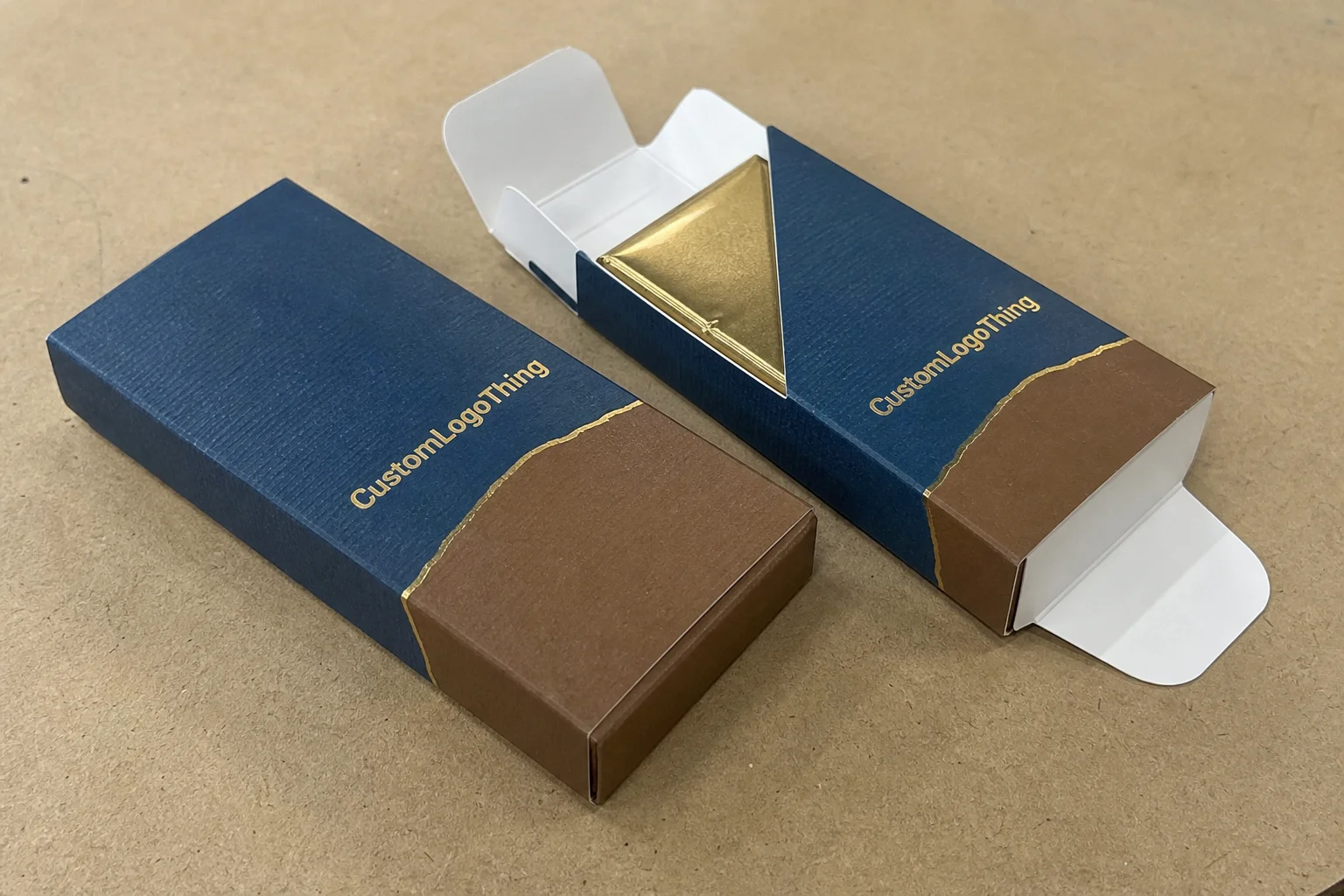
Most chocolate bars get only a few seconds of attention on shelf. A carton helps compress the message into shape, texture, color, and a few printed cues. That is why a plain wrapper and a printed box are not interchangeable. The box adds hierarchy.
In retail, buyers often judge the package before they read the copy. Matte finishes and restrained typography can signal craft or ingredient focus. Gloss, foil, and strong contrast can signal indulgence or gifting. Those cues affect where the bar sits in the category and whether the shelf price feels justified.
There is also a practical side. Properly sized cartons reduce corner scuffing, help with stacking, and protect printed wrappers from shelf wear. That matters in specialty retail and e-commerce, where a dented edge can look like product damage even if the chocolate itself is fine.
If you want a broader reference point for packaging expectations, the Packaging Machinery Manufacturers Institute and related packaging groups are useful for grounding assumptions around production and performance.
A box that only contains the bar is a cost. A box that helps the bar sell is doing work.
How the box structure works from dieline to filled carton
Chocolate bar cartons usually start as a flat dieline that folds into a tuck-end box, sleeve, tray-and-sleeve combination, or auto-lock bottom. Each structure changes how the carton looks, how it packs, and how much it costs to make.
The starting point should be the wrapped bar, not the artwork. Teams often approve a design first and discover later that the finished bar is wider than expected, or that wrapper thickness leaves too little room. A tight carton can crush corners; a loose carton can shift in transit and sit crooked on shelf.
For wrapped bars, the carton needs to account for three things:
- The actual finished size of the wrapped bar.
- The tolerance range of the wrapper and fill operation.
- The clearance needed for manual, semi-automatic, or automatic insertion.
Board choice changes how the structure behaves. Carton board in the 14pt to 24pt range is common, depending on product weight and the level of shelf presence needed. Thinner board can print cleanly and keep cost down. Stiffer board improves corner protection, but poor scoring can cause cracking at the folds.
Production usually follows the same path: dieline approval, artwork fit check, proofing, printing, coating, die-cutting, creasing, folding, gluing, packing, and shipment. The cleanest jobs are the ones where dimensions are locked before layout work starts. If the size changes late, barcodes move, legal copy shifts, and each SKU needs rework.
If you are building a broader packaging line, the same logic applies across Custom Packaging Products. Standardizing one board spec or structural family can save more than redesigning every SKU from scratch.
Cost, pricing, and MOQ drivers you need to know
There is no serious way to price chocolate bar cartons without quantity, print coverage, board, and finish. Those are the levers that move the quote. A simple one-color carton in volume can be economical. A short run with foil, spot UV, and a custom insert can climb quickly.
Higher quantities lower unit cost because prepress, plates, cutting rules, and press make-ready get spread across more cartons. Lower quantities do the opposite. That is why MOQ matters so much for smaller brands. A startup may need 1,000 units to test a flavor, but the per-unit cost can still land 25% to 80% higher than a 5,000-piece run, depending on structure and finish.
| Format | Typical use | Relative unit cost at 5,000 | Notes |
|---|---|---|---|
| Simple tuck-end carton | Everyday retail bars | $0.18-$0.28 | Efficient to print, pack, and store |
| Sleeve with tray | Premium or giftable bars | $0.26-$0.42 | Better perceived value, more assembly steps |
| Auto-lock bottom carton | Heavier bars or display-ready packs | $0.24-$0.38 | Stronger bottom support, slightly more complex tooling |
| Carton with foil or spot UV | Seasonal or premium lines | $0.34-$0.60+ | Higher shelf impact, more setup and finishing cost |
The biggest cost drivers are board grade, number of colors, coating type, special finishes, insert complexity, and any handwork during packing. A clean four-color carton is one thing. A carton with metallic foil, soft-touch lamination, and tight register is something else entirely.
When comparing quotes, ask for the same board thickness, print method, coating, insert assumptions, and shipping terms. Otherwise one quote looks cheaper because it leaves out freight, tooling, or finishing. That is not a fair comparison.
For transit risk, some teams also reference standards from ISTA. That does not replace sample testing, but it helps frame what a carton should survive once it enters distribution.
Process and lead time: from brief to delivery
Lead time depends more on decisions than on press capacity. The main steps are familiar, but delays usually come from missing dimensions, late artwork changes, or a barcode that lands on a fold.
A normal workflow is: quote, brief review, dieline setup, artwork fit check, sample or proof approval, printing, coating, die-cutting, gluing, packing, and shipment. Straightforward orders move quickly once approved. Complex orders slow down in prepress if legal copy is incomplete or panels are not aligned to the crease pattern.
Typical timing usually falls into a few buckets:
- Sample or prototype cartons often take 5 to 10 business days after dieline approval.
- Bulk production commonly takes 12 to 20 business days after final approval.
- Rush work costs more because it compresses machine time and can limit available finishes.
These numbers stretch if the structure changes after artwork begins or if a finish needs extra curing. The best way to reduce risk is to lock the size early and keep the spec stable. If you manage several flavors or seasonal editions, build one master spec sheet before requesting quotes.
Material, finish, and food-safety decisions that matter
Material should fit the product, not the mood board. For most chocolate cartons, paperboard in the 14pt to 24pt range covers a wide spread of needs. Thicker board adds stiffness and shelf presence. Thinner board lowers cost and can perform better on faster folding lines.
Finish is where many brands spend too much. Matte and satin coatings usually give a cleaner premium read than high gloss, especially for ingredient-led chocolate. Soft-touch feels good in hand, but it makes more sense for premium bars, gifts, and limited editions than for low-margin everyday items. Foil and spot UV can help, but only if they reinforce hierarchy.
A simple rule helps: use finishes to guide the eye, not to cover the box. Emphasize the brand mark, the flavor name, or one key visual. A restrained accent usually does more than a full set of effects applied because the mockup looked empty.
Food safety needs clear thinking as well. The outer carton is usually not the direct food-contact layer, but the packaging system still matters. If the chocolate is fully wrapped, the carton mainly serves as secondary protection. If it is not fully wrapped, the package may need a barrier layer or a direct food-contact material. Confirm that before production.
For sustainability claims, accuracy matters more than slogans. Recyclable-looking is not the same as recyclable. FSC-certified board can support sourcing claims if the supply chain is documented, and certification details can be verified through FSC. For general recycling guidance, the EPA recycling guidance is a useful reality check.
Step-by-step buying checklist for the right carton spec
The cleanest packaging programs are built backward from the product. Start with the wrapped bar, then move to structure, print layout, finish, and logistics. That order prevents one-off decisions that create rework later.
- Measure the real product. Use the wrapped bar dimensions, not the nominal size from a spec sheet.
- Choose the carton format. Decide whether a tuck-end, sleeve, tray, or more rigid structure fits the price point.
- Set the print system. Confirm colors, barcode placement, flavor variants, and whether one die-line can cover several SKUs.
- Pick the finish. Matte, gloss, soft-touch, foil, and spot UV behave differently in production and on shelf.
- Review the dieline. Check folds, glue areas, bleed, and legal copy before artwork is released.
- Approve a sample. Inspect fit, fold quality, and color under real lighting, not just on a screen.
The sample matters because many problems only show up in hand. A box can look fine on a monitor and still fail because the tuck is too tight, the barcode sits across a crease, or the glue line is visible from the front.
If the line is expanding, standardizing the outer carton across several flavors can save money and reduce inventory friction. One size may cover multiple variants if the wrapped bars stay consistent. That also makes reorders easier.
For teams building a wider packaging system, browsing Custom Packaging Products early can help you see when a carton is overbuilt for the product or underbuilt for the shelf position.
Common mistakes that make chocolate packaging more expensive
The most expensive packaging errors are ordinary ones: wrong dimensions, late artwork changes, and finish decisions made before the structure is settled. Those choices create rework and slow down production.
One common mistake is leaving too much internal slack. Brands often call it easy insertion, but the bar then rattles in transit and sits crooked on shelf. The fix is not always a tighter carton. Sometimes it is a better wrapper spec or a small insert that actually centers the product.
Another mistake is overspending on finish. A carton with foil, embossing, and soft-touch may look strong in a mockup, but it can damage margin on a bar that sells at a modest retail price. Premium cues should be selective.
Skipping sample approval is the third classic problem. That is how a weak seam, a print shift, or a barcode issue gets discovered after production has started. Check the prototype, inspect the folds, and verify the final print under daylight or retail-style lighting.
The last mistake is commissioning a custom structure that offers no real functional benefit. Sometimes a standard carton will do the job better, faster, and at lower cost. Customization only makes sense when it changes shelf performance, protection, or brand perception in a measurable way.
Next steps for a cleaner quote and smoother production
The fastest way to get a useful quote is to send a complete specification. Include dimensions, quantity, artwork files, finish preferences, packing method, and shipping destination. If there are multiple bar sizes or flavors, list them clearly.
For orders that justify it, ask for one structural sample and one print sample. They answer different questions. A structural sample confirms fit and fold. A print sample confirms color, finish, and registration. If both pass, production usually behaves.
Compare landed cost, not just unit price. Freight, duties, rework, sampling, and rush charges can change the real number quickly. Once the dimensions are locked, the artwork is proofed, and the sample is approved, custom chocolate bar boxes stop being an abstract packaging exercise and become a controlled production item.
FAQ
What size should custom chocolate bar boxes be for standard bars?
Size the carton to the wrapped bar’s actual dimensions, not the nominal size on a product sheet. Leave enough clearance for insertion, but not so much that the bar shifts in shipping. If the line has several flavors, a shared outer size can simplify production and reduce reorder friction.
What affects the price of custom chocolate bar boxes most?
Quantity, board type, print coverage, coatings, and special finishes usually drive price the most. Structural complexity and tight tolerances can also raise setup and tooling costs. Sampling, freight, and late revisions are the hidden cost items that often push the budget upward.
How long does it take to produce custom chocolate bar boxes?
Simple orders can move quickly, but sampling and approval still take time. Artwork revisions, structural changes, and special finishes are the usual schedule delays. Plan around final approval rather than the first quote, because production does not really begin until the spec is locked.
Do I need food-safe packaging for chocolate bar boxes?
The outer carton is usually not the direct food-contact layer, but the complete packaging system still needs to suit the product. If the chocolate is not fully wrapped, confirm whether a barrier layer or food-contact material is required. Verify compliance with the supplier before production, not afterward.
What should I send when requesting a quote for custom chocolate bar boxes?
Send exact dimensions, order quantity, artwork files, finish preferences, and your shipping destination. Include whether you need samples, inserts, or multiple SKUs so the quote reflects the actual job. The cleaner the spec, the fewer surprises in Pricing and Lead time.
Well-made custom chocolate bar boxes are about fit, structure, cost control, and the details that make a product feel intentional. Get those right, and the carton does more than hold chocolate. It helps the bar earn its place on the shelf.


