Custom Metal Tags for Bags: Pricing and Lead Times
Custom metal tags for bags do one useful thing extremely well: they change the read of a bag without changing the bag itself. A plain canvas tote, a travel pouch, or a compact duffel can move a noticeable step up the value ladder once a small metal badge adds weight, reflection, and brand presence.
These tags are usually attached to the front panel, zipper pull, handle area, side seam, or interior flap. They can carry a logo, collection name, edition number, or a serial mark for controlled releases. That makes them common in fashion accessories, gift packaging, promotional merchandise, and retail packaging programs where the finish has to look intentional from the first touch.
The tactile effect matters. Metal feels more permanent than print, more deliberate than a woven patch, and less disposable than a sticker. A brushed plate or cast badge often does more for perceived quality than a larger graphic treatment that sits flat and forgettable. If your packaging line already uses Custom Labels & Tags or coordinated Custom Packaging Products, the metal piece can tie the whole set together without adding visual clutter.
What follows is the practical version: how these tags are made, what drives price, which details create delay, and where buyers usually make expensive mistakes. The goal is not to romanticize a small part. It is to understand where the part earns its keep.
Why a small metal tag can make a bag feel premium
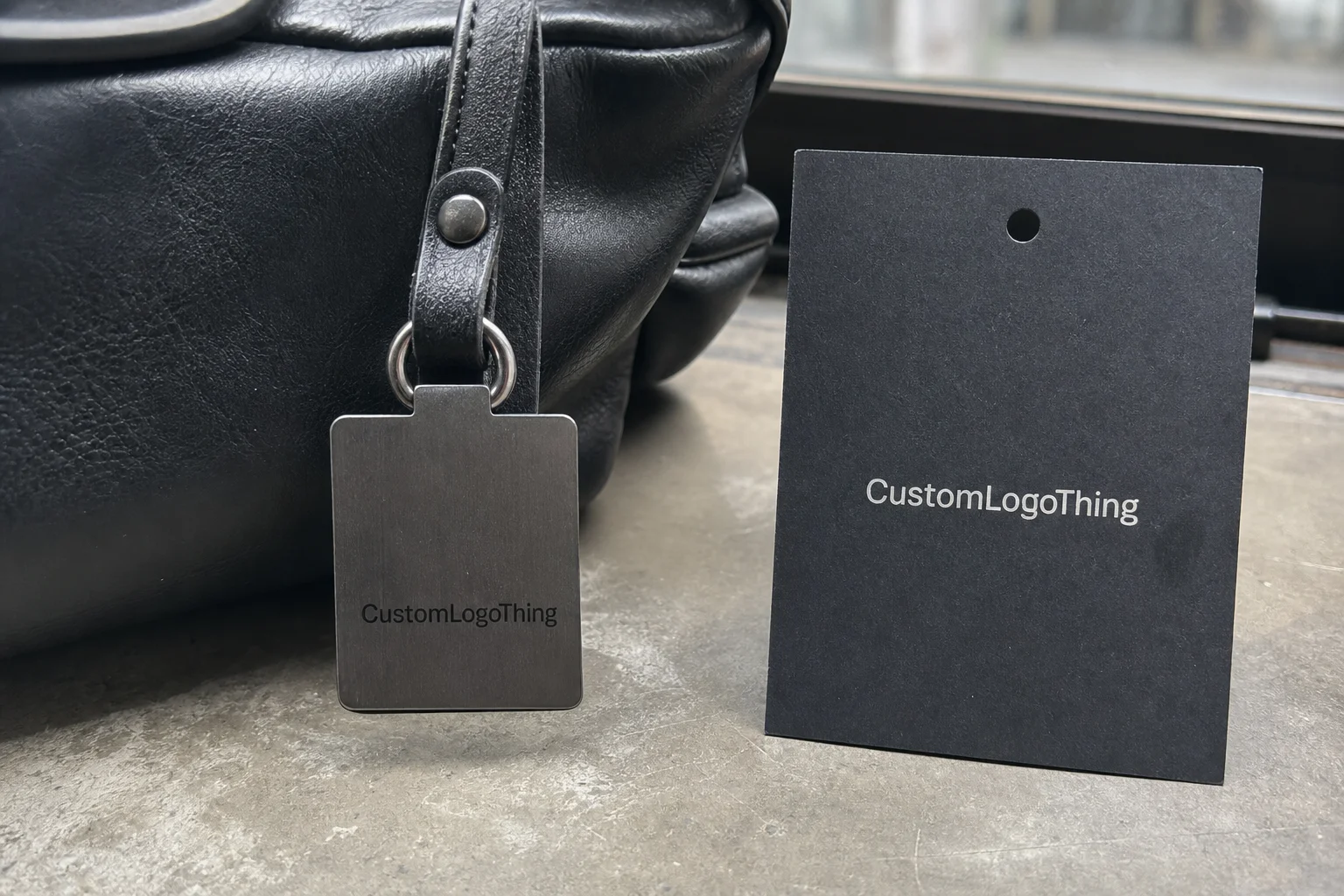
A bag does not need a redesign to feel more premium. In many runs, the body stays identical and the perceived value shifts because of one branded metal detail. That is why custom metal tags for bags appear so often on fashion totes, cosmetic cases, commuter sleeves, and limited-run promotional bags.
Metal carries visual weight. It reflects light differently than fabric and usually reads as durable rather than temporary. A narrow aluminum plate, for example, can make a soft pouch feel more engineered; a brass badge can push the same pouch closer to a luxury presentation. The material is doing part of the branding work before the customer ever reads the logo.
That effect is useful in packaging programs where the bag is only one piece of the customer experience. A well-placed tag can signal collection identity, mark a limited run, or support traceability. On products that will be photographed, the badge often becomes the point of focus because it catches light in a way woven or printed graphics do not.
There is also a practical reason buyers like metal. It creates a consistent physical cue across SKUs. A simple shape can be reused across different bag bodies, which helps with line consistency and reduces the number of visual decisions that need to be made later in production.
A buyer usually notices the difference first in hand, not on screen. Weight, edge finish, and attachment quality tell the story before the logo does.
How metal bag tags are designed, formed, and attached
The process starts with artwork, but the artwork cannot be treated like a flat print file. A metal tag needs line work that survives forming, plating, and attachment. Logos are usually converted into a metal-ready drawing before tooling begins, and the design often needs simplification. If a line is too thin on screen, it may disappear once the piece is cast, stamped, or filled.
Common production methods include die casting, stamping, engraving, etching, and CNC cutting. The right choice depends on detail, depth, volume, and finish. Die casting is often used for shaped badges with raised elements. Stamping is efficient for simpler profiles. Etching and laser work can help when the logo needs crisp lines and smaller production runs. None of these methods are interchangeable; they make different tradeoffs between cost, detail, and texture.
Material choice changes the entire feel of the part. Zinc alloy is popular for shaped badges because it captures detail well and accepts plating and enamel fill. Brass gives a heavier, warmer feel and is often selected for higher-end lines. Stainless steel is valued for strength and corrosion resistance, especially when the design calls for a clean, modern look. Aluminum is lighter and can be useful on smaller bags or soft goods that should not carry much extra weight.
Attachment is where many orders are won or lost. A tag can be mounted with rivets, screws, split rings, tabs, leather loops, sewn-in placements, or adhesive backing for lighter use cases. The bag material matters. Canvas, PU leather, nylon, and woven polypropylene all respond differently to load and puncture. A mount that works on a structured tote may distort a soft pouch. For that reason, the attachment plan should be settled before mass production starts, not after the sample is already approved.
There are also basic fit checks that should not be skipped. The tag should sit flat, stay legible at the final size, and avoid sharp edges. Hole spacing needs to match the bag construction closely, often within a tight tolerance, because a small mismatch can make assembly awkward or impossible. If the tag is meant to sit near a fold or seam, the motion of the bag should be tested; a part that looks fine on a desk can start rubbing badly once the product is carried.
Key factors that affect durability, appearance, and fit
Size and thickness are the first two checks. A tag that is too thin can bend in handling or transit. A tag that is too large can distort a soft front panel or simply look heavy on a compact bag. The balance depends on the substrate. A leather tote can carry more hardware than a lightweight nylon cosmetic bag.
Logo complexity is the next pressure point. Fine scripts, hairline borders, tiny symbols, and layered elements often look better in a design file than they do in metal. Once the piece is reduced to tag size, detail can collapse or fill in during plating and enamel work. A cleaner mark usually reproduces better, costs less to correct, and gives fewer rejects in production.
Finish selection affects both appearance and wear. Polished surfaces can feel more upscale, but they show fingerprints and small scuffs quickly. Brushed surfaces hide wear better and usually suit products that will be handled every day. Black plating creates strong contrast on light bags, while antique finishes add depth and texture. If the bag is a travel item or a trade-show piece, durability often matters more than shine.
Use environment changes the spec. A giveaway bag gets handled differently from a commuter tote. A pouch used inside a gift set gets treated differently from a weekend bag that travels through airports and trunk space. Moisture, abrasion, and repeated rubbing affect how a tag ages. For transit-heavy programs, some teams also check pack-out and distribution assumptions through groups like the International Safe Transit Association so the sample reflects shipping conditions rather than only shelf display.
Edge treatment is the last detail buyers tend to underestimate. Rounded or polished edges improve comfort and reduce snagging. A sharp edge may pass a photo review and still be wrong in use. The same is true for relief depth: too shallow and the logo disappears under plating; too deep and the part starts to look coarse. Good execution here is usually invisible, which is another way of saying the part only looks simple after the tooling has been done properly.
Custom metal tags for bags: cost, MOQ, and quote drivers
Pricing depends on a handful of variables that show up in almost every quote: material, size, finish, logo detail, attachment method, tooling, and order quantity. That is why custom metal tags for bags are hard to price from a single photograph. A small brushed badge with one color fill is a different manufacturing job from a multi-layer plated tag with custom hardware.
For a typical run of 5,000 pieces, simple stamped zinc tags may land roughly around $0.18 to $0.38 per unit. Heavier brass pieces or more complex plated designs can move into the $0.35 to $0.80 range or higher. Those figures are only planning numbers, not promises. Thickness, cavity count, plating steps, enamel fill, and assembly labor can shift the quote quickly. Tooling is usually separate and can range from about $45 to $180 for straightforward work, with more complex shapes costing more.
MOQ is not arbitrary. Manufacturers set it based on setup time, plating batch efficiency, inspection labor, and scrap control. On a small run, setup dominates. On a larger run, that same setup gets spread over more pieces, which usually lowers the unit price. That is why a cleaner specification often saves more money than squeezing the last cent out of a quote.
Here is a practical comparison of common options:
| Tag option | Typical look | Relative unit cost | Best use case |
|---|---|---|---|
| Zinc alloy with enamel fill | Detailed, branded, color-friendly | Low to medium | Fashion bags, promotional lines, logo badges |
| Brass with antique or polished finish | Heavier, warmer, premium | Medium to high | Luxury retail, gift packaging, limited editions |
| Stainless steel with brushed finish | Clean, modern, durable | Medium | Travel bags, utilitarian programs, frequent handling |
| Aluminum with matte finish | Lightweight and understated | Low to medium | Soft pouches, lighter bags, budget-conscious lines |
The fastest way to get a useful quote is to send dimension targets, artwork, finish preference, attachment style, quantity, bag material, and any assembly requirement. If the tag needs to arrive mounted, packed with inserts, or kitted with other branded packaging items, that has to be stated up front. A quote for the tag alone is not the same as a quote for the tag plus assembly plus pack-out.
For programs that include paperboard sleeves, cards, or cartons, material sourcing can matter beyond the metal piece itself. Paper components with FSC certification can support a more consistent sustainability story, especially in retail packaging where the buyer evaluates the full set, not just the badge. The standard is described by the Forest Stewardship Council.
Process and lead time from artwork to shipment
The production sequence is simple on paper and less simple in execution. First comes artwork review. Then the supplier prepares a technical drawing or proof. After approval, tooling is made. A sample or pre-production check follows. Then the run goes into production, finishing and assembly are completed, and final inspection closes the order.
Delays usually start at the proof stage. Low-resolution artwork, vague dimensions, uncertain hole placement, and late revisions slow the schedule more than most buyers expect. If the font weight changes after proof approval or the tag shape gets revised after tooling has started, the timeline slips. The easiest way to avoid that is to keep the bag spec and tag spec together from the start, so the person approving the proof is looking at the same construction that will actually be used.
Lead time varies by design. A simple single-finish tag with clean artwork often moves faster than a plated, enamel-filled, or multi-part tag that needs more setup and inspection. As a planning range, simple orders can sometimes ship in about 10 to 15 business days after proof approval. More involved orders often need 15 to 25 business days or more before shipment. Transit time sits on top of that.
International shipping deserves a buffer of its own. Customs clearance, peak-season congestion, and carrier delays can add time after production is complete. If the bag line has a retail launch date, the safe approach is to work backward from the shelf date rather than the purchase order date. That leaves room for sample review and any small correction that might be needed before the full run is released.
When the tag is one element in a broader packaging program, scheduling needs to be coordinated. The bag, the tag, the insert, and the outer carton all affect the final handoff. If one component lands early and another comes in late, pack-out can stall even when the individual items are all finished correctly.
Common mistakes when ordering bag tags in metal
The first mistake is trying to keep too much detail in the design. Thin lines, tiny type, layered effects, and decorative flourishes often collapse once they are translated into metal. A logo that reads well on a screen can lose clarity the moment it is reduced to a 20 or 30 mm tag. The better choice is usually the cleaner one.
The second mistake is mismatching the tag weight with the bag construction. A heavy badge on a soft lightweight pouch can drag the front panel and distort the seam. The bag has to support the hardware, not just display it. If the base material is thin, a smaller or lighter tag usually performs better and ages more gracefully.
Finish mismatch causes trouble too. A mirror-polished plate can feel out of place on a rugged canvas line. An antique finish can look wrong on a sharp, minimal tote. The tag should belong to the product family. If it looks imported from another collection, the whole piece feels less resolved.
Skipping the sample is a risk that never looks urgent until it is too late. On paper, the finish may seem right. In hand, the relief depth may be too shallow, the color tone may shift, or the attachment may sit awkwardly against the bag. A single sample can prevent a full run of avoidable rework, especially when the order includes multiple SKUs or a display-ready retail packaging set.
Another common problem is forgetting spare pieces. Buyers often order exactly the production count and nothing more. That leaves no room for rejects, service replacements, or pack-out extras. A small overage is cheap insurance. Production always benefits from a little breathing room.
Expert tips and next steps for a cleaner order
Start with a short specification sheet. Size, material, finish, attachment method, quantity, and bag type should be on the same page. That gives the supplier enough information to quote accurately and reduces the back-and-forth that usually eats into lead time.
If the logo includes fine text or layered branding, ask for a proof or sample instead of approving from a screen mockup alone. Digital previews hide small failures. Metal does not. This matters most on finishes that are difficult to judge digitally, such as antique brass, black plating, brushed nickel, or any treatment where the contrast is subtle rather than loud.
Where possible, consolidate SKUs. If several bag styles can share a tag size or a base tooling shape, the setup work becomes easier to spread across the order. That does not fit every collection, but when it does, it can trim cost and simplify inventory. The same logic applies when you are ordering related items such as inserts, cards, or Custom Packaging Products for a broader launch.
Confirm the mounting plan before production starts. If sewing, punching, riveting, or loop attachment happens in a separate step, the bag manufacturer, hardware supplier, and packaging team need the same hole spacing and placement reference. A tag that looks right but arrives with the wrong spacing is scrap, not inventory.
The most reliable orders are the ones that are treated as construction projects rather than artwork orders. The artwork matters, but so do the thickness, the finish, the edge treatment, the attachment method, and the shipping plan. Get those details right and the tag does its job quietly. That is usually the goal.
What are custom metal tags for bags used for?
They add branding, identification, and a more premium tactile finish to totes, backpacks, pouches, duffels, and gift packaging. They also help products stand out at retail because the metal detail catches light and signals higher perceived value.
Which metal finish works best for bag tags?
Brushed and matte finishes hide fingerprints and wear better for everyday handling. Polished, antique, and black-plated finishes are often chosen when the bag needs a stronger fashion or luxury look.
How much do custom metal tags for bags cost?
Pricing depends on size, material, finish, artwork complexity, attachment method, and order quantity. Unit cost usually improves at higher quantities because setup and tooling are spread across more pieces.
What lead time should I expect for a metal bag tag order?
Lead time varies by design complexity, proof approval speed, finishing steps, and shipping method. Simple orders move faster; detailed or highly finished tags need more time for tooling and production checks.
What information do I need for a quote?
Prepare logo artwork, dimensions, preferred finish, attachment method, quantity, and the bag material the tag will be mounted on. Including these details up front leads to a faster and more accurate quote with fewer revisions.