Custom Clothing Tags do more than identify a brand. They carry the first tactile signal a shopper gets from a garment, and they quietly tell the buyer whether the piece was treated like a disposable item or finished with care. Size, care details, fiber content, and branding all have to fit into a very small space, which is why the tag is closer to a packaging decision than a decoration.
That connection matters. A clean label, a well-cut hang tag, or a balanced care panel sits in the same system as custom printed boxes, tissue, stickers, and retail inserts. Each piece shapes expectation before the garment is even tried on. If the label feels flimsy, the rest of the product starts at a disadvantage.
A tag is small, but it carries a lot of judgment. Frayed edges, weak contrast, or cheap-feeling stock stand out fast, even when the customer cannot explain exactly why the piece feels less valuable.
Why a small tag changes how a garment is perceived
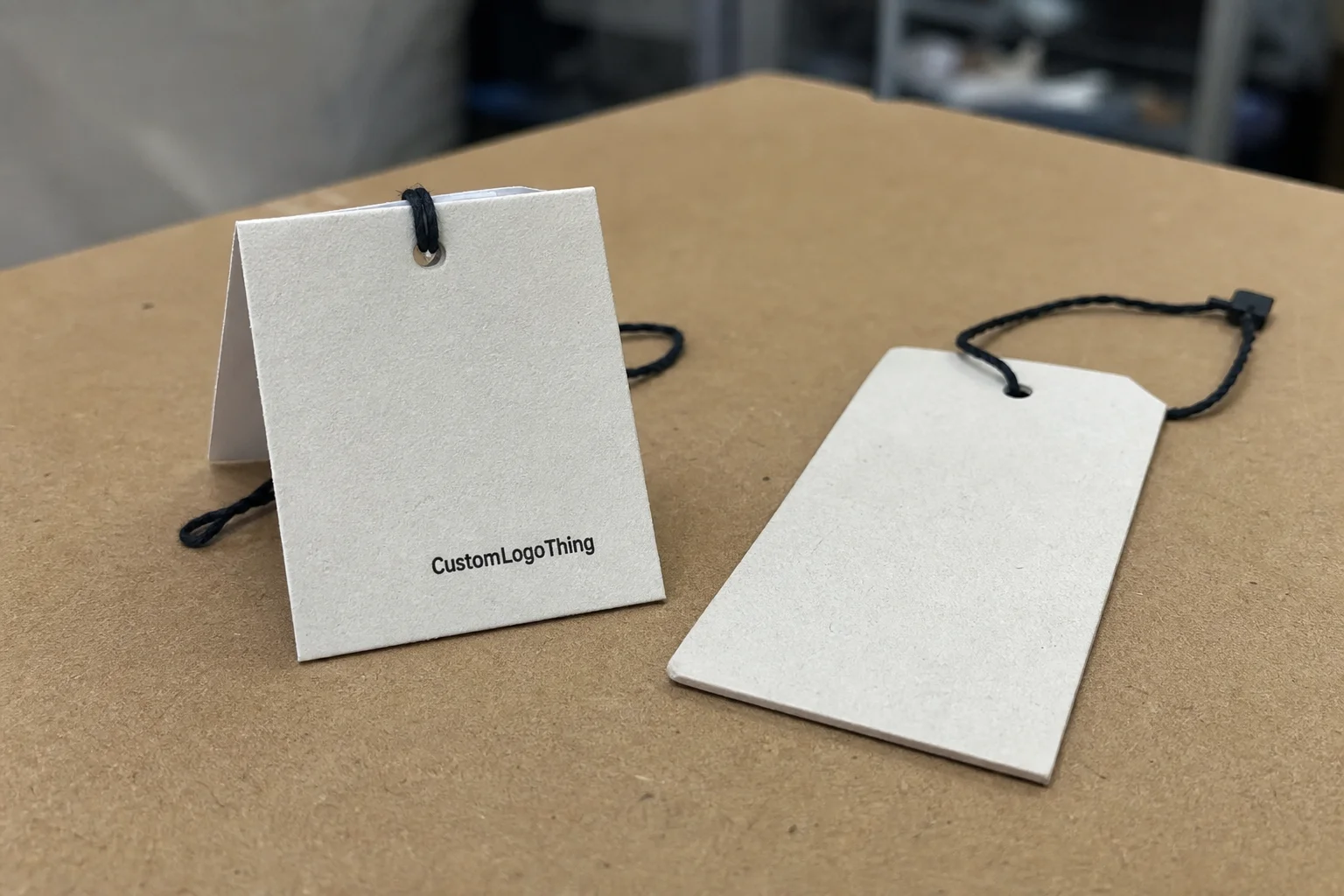
Retail buyers and end customers usually make quality judgments in seconds. They notice the stitch line, the hand feel of the fabric, the weight of the hang tag, and the legibility of the information printed on it. A woven label with clean edges can make a basic tee feel intentional. A fuzzy print or crooked cut does the opposite and can drag down the perceived value of the entire garment.
That is why custom clothing tags are not just a print item. They are part of the product presentation system. The garment, the label, the insert card, and the outer packaging need to agree on tone and finish. When those parts are mismatched, the inconsistency is obvious even if each component looked acceptable on its own.
The function of the tag matters as much as the look. It has to hold size information, care instructions, fiber content, country of origin details, barcode or SKU data, and brand messaging without turning into a cluttered block of text. Hierarchy is the difference between a tag that feels deliberate and one that looks like it was squeezed in at the last minute.
That is especially true for premium basics, childrenswear, activewear, and giftable apparel. A soft satin label, a tight-weave cotton label, or a heavy paper hang tag can each support a different brand position. None of them is automatically better. The right choice depends on the garment, the wash cycle, and the price point the customer is being asked to accept.
One mistake buyers make is treating the tag as separate from the product. It is not. It is touched, read, and judged as part of the clothing itself. For ecommerce brands, the label also has to survive pack-out, shipping, and storage without curling, smearing, or scuffing. The path from print bench to customer is longer than many teams account for.
Production steps and turnaround: from art file to packed order
The production process is more predictable when the brief is complete. For custom clothing tags, a supplier usually needs dimensions, material, color count, finish, fold style, attachment method, and exact copy before quoting accurately. If any of those items are vague, the first number you see may look attractive and then change once the real specifications are confirmed.
- Artwork submission: send a vector file when possible, usually AI, EPS, or PDF, with text outlined and colors clearly identified.
- Spec confirmation: lock in size, stock or fabric, fold, edge treatment, finish, and any required compliance text.
- Proofing: review the layout for spelling, line weight, spacing, contrast, and placement before production starts.
- Sampling: for a new line or any label that sits against skin, a physical sample is worth the extra time because it reveals hand feel and readability in real light.
- Production: woven labels are loom-produced, printed labels are cut and finished, heat-transfer labels are cured, and hang tags are printed, die-cut, and packed.
- Inspection and packing: quantities are counted, obvious defects are screened out, and the order is packed for freight or receiving.
Turnaround depends on the method. A simple printed satin label can often ship in 7 to 12 business days after proof approval. Woven labels usually run closer to 10 to 18 business days, especially when the art has fine detail or multiple colors. Hang tags can be quicker on standard stock, but foil, embossing, custom die cuts, or specialty strings add time. Heat-transfer labels usually fall in the middle because the artwork may be simple, yet the setup still needs curing and testing.
Approval speed matters more than most buyers expect. A same-day response to proof comments can keep the job on track. Three revision rounds can delay production even if the factory is moving quickly. That is why the schedule should be tied to the actual launch date, not to a loose target ship date that assumes everything goes right.
Shipping and receiving are part of the production timeline too. Labels packed with inserts or retail kits can get bent corners, scuffed coatings, or loosened stacks if the pack-out is careless. If the order will travel through a warehouse, the receiving flow matters as much as the print method. Standards and test methods from ISTA are useful when you need to think about the full journey, not just the finished item.
Pricing, MOQ, and the main drivers of unit cost
Unit cost comes down to a handful of variables: material, size, color count, finishing, quantity, and how much handling is required after print. The smaller the run, the more setup work gets absorbed by each piece. That is why minimum order quantity, or MOQ, matters so much. A 500-piece run almost always costs more per unit than a 5,000-piece run, even if the artwork never changes.
The cheapest quote is usually the least informative quote unless the spec is already locked. A low number can hide thinner stock, simpler finishing, a reduced color count, or a production method that does not fit the garment. The better question is not what costs the least. It is what spec fits the product and what that spec costs at the required quantity.
| Option | Typical use | Common MOQ | Typical unit price at 5,000 pieces | Notes |
|---|---|---|---|---|
| Woven damask label | Premium basics, denim, knitwear | 1,000-3,000+ | $0.10-$0.24 | Strong wash durability, crisp detail, higher setup for complex art |
| Printed satin label | Apparel that needs a soft hand feel | 500-2,000+ | $0.08-$0.18 | Good for care copy and branding, common in retail packaging programs |
| Cotton label | Casualwear and heritage looks | 1,000+ | $0.09-$0.20 | Natural texture, softer appearance, print detail depends on weave and ink coverage |
| Heat-transfer label | Activewear, base layers, close-to-skin garments | 500-1,500+ | $0.12-$0.30 | No fabric bulk, but artwork and substrate compatibility matter a lot |
| Paper hang tag | Retail presentation and branding | 1,000+ | $0.06-$0.22 | Stock choice, coating, die cut, and stringing change the final cost quickly |
Special finishes change the economics quickly. Embossing, foil stamping, spot UV, edge painting, and specialty thread colors all add setup, inspection, and some spoilage risk. For Paper Hang Tags, 350gsm C1S artboard with matte or soft-touch lamination is a common starting point. Add foil or a custom shape, and the unit price moves up faster than many first-time buyers expect.
Sustainability claims should be grounded in a material choice that can actually be verified. FSC-certified stock is a reasonable option for hang tags and cartons when the brand story depends on responsible sourcing, and it is straightforward to verify through FSC. That does not make recycled stock the right answer for every job, but it does create a credible paper trail when the rest of the package design supports it.
Custom Clothing Tags That Match the Garment
The best material depends on how the garment is worn and how often it will be washed. Woven fabric labels are the workhorse choice because they hold up well through repeated laundering and keep a crisp brand mark. Printed satin feels smoother against skin and is common for childrenswear, lingerie, and lightweight apparel. Cotton gives a more natural look, which works well for workwear, heritage brands, and understated basics. Heat-transfer labels are useful when bulk matters and the interior finish needs to stay flat.
Hang tags are a different decision. They are about presentation, not wash resistance. Matte paper looks restrained and modern. Gloss adds color intensity and can help a tag stand out in retail photography. Soft-touch lamination changes the tactile impression immediately, but it also raises expectations for the rest of the package. If the mailer, insert card, or sticker system feels cheap, the tag starts exposing the mismatch instead of hiding it.
That is where package branding and garment labeling have to work together. The label should echo the same visual language as the box, tissue, and insert card. If your broader packaging uses neutral colors and tight typography, a loud tag will feel out of place. If the line is bold and colorful, a stripped-back tag can disappear. Consistency usually beats decoration.
There is also a difference between display impact and wear comfort. A tag may look excellent on a hanger and still be wrong if it scratches the neck or if the print fades after a few washes. For repeated laundering, check the ink system, the thread count, and whether the edge finish is clean enough to prevent fraying. For premium pieces, ask for a sample and review it under real lighting before placing a large order.
Short runs deserve extra caution. Digital proofs are useful, but they do not show how a label will behave in the hand or after a wash cycle. If the garment is close to skin, sampling is usually the cheapest insurance in the process. It is easier to correct a texture or legibility issue on a sample than to explain a return spike later.
Material and finish choices at a glance
The table below helps compare the most common routes before asking for a quote. It keeps the conversation grounded in function rather than vague preference.
| Material or finish | Best for | Strength | Main caution |
|---|---|---|---|
| Woven label | Durability and clean branding | Excellent wash resistance | Very small text can blur if the art is too dense |
| Printed satin | Soft hand feel | Comfort against skin | Very light colors can lose contrast |
| Heat-transfer | Minimal bulk | Clean interior finish | Compatibility with fabric and wash testing matters |
| Matte paper hang tag | Simple retail presentation | Low cost and clear printing | Can scuff if pack-out is rough |
| Foil or spot UV hang tag | Premium lines and gifting | Strong shelf presence | Adds cost and can extend lead time |
A step-by-step ordering checklist for a smooth first run
A clean first run starts with the garment, not the vendor. Define the use case first: branding, care instructions, compliance, merchandising, or all four. Then set the final size, the attachment method, and whether the tag will sit against skin or remain purely decorative. That order keeps the spec honest and makes the quote useful.
- Confirm the garment and how the label will be used on it.
- Lock the specs: dimensions, material, color count, fold style, and attachment method.
- Prepare the copy for care, fiber content, origin, barcode, or size marks.
- Ask for a proof and compare it against the written brief, not just the artwork file.
- Check legibility at actual size, including line weight, tiny text, and contrast.
- Plan receiving so the tags arrive before folding, packing, or launch work begins.
Before approving the proof, check the details that most often get missed: the order of the information, the spacing around logos, and whether the tag will remain readable once it is sewn, looped, or attached with a fastener. If the line needs a barcode or SKU, make sure the print contrast is strong enough for scanning after handling.
For launches that include broader merchandising, the tag spec should sit inside the rest of the package system. That means the hang tag, mailer, insert card, and the Custom Labels & Tags all need to agree on tone, copy, and visual density. If the order will move through a warehouse or ecommerce flow, it helps to think about receiving the same way you think about product handling.
One practical habit reduces a lot of stress: build a buffer between approval and go-live. A revision round, a missing barcode, or a freight delay can eat more time than the production line itself. If the launch date is fixed, order earlier than feels necessary and let the schedule absorb the friction.
Common mistakes that make labels look cheap or fail early
The most common mistake is trying to force too much art into too little space. Thin lines, tiny serif fonts, and crowded care copy may look fine on a screen and then fall apart in production. On woven labels, the limit is often detail resolution. On printed labels, contrast and coating choices matter just as much. If the tag cannot be read at arm’s length, it is probably doing too much.
Another frequent problem is ignoring fabric compatibility. A label that works on denim may feel wrong on a stretch knit or brushed fleece. Heat-transfer labels need the right substrate and the right application temperature. Printed labels need inks and coatings that can survive wash cycles. If those variables are skipped, the result can be peeling, curling, fraying, or neck irritation.
Color mismatch is expensive because it is easy to miss in a proof. Pantone targets, thread charts, and actual stock all drift in production. That does not mean perfect matching is impossible. It means buyers should ask how the chosen method handles color variation and what tolerance is realistic. A deep black on a monitor can become a warm charcoal if the thread or stock is wrong.
Attachment placement matters too. If the tag sits where it rubs the skin or catches on a seam, the garment may get returned even when the print itself is correct. That is especially true for childrenswear and activewear. If the product ships in kits or bundled with a mailer, think about the full delivery chain, not just the label. Transit testing methods from ISTA are useful whenever the outer pack and insert system need to survive handling.
The business-side mistake is quoting too early. If you request ten prices before the final spec exists, the quotes are not actually comparable. One supplier may assume a simpler fold, another may include trimming, and a third may price a lower grade of stock. That kind of comparison creates false savings and usually leads to rework later.
Expert tips and next steps for a cleaner launch
The cleanest way to buy labels is to treat the brief like a production document. Gather the garment spec, the brand copy, the target quantity, the preferred finish, and the deadline before asking for quotes. That makes it easier for vendors to price the same job and removes a lot of noise from the process. It also helps you compare custom clothing tags against the rest of the launch budget instead of judging them in isolation.
If the label will sit close to skin, order a sample or physical proof. That applies to printed satin, heat-transfer, and any woven option with detailed copy. A proof can look fine on a monitor and still feel stiff, scratchy, or visually dense in hand. For premium lines, one small sample run is often cheaper than replacing a full batch after launch.
Brands also do better when they think about the full path from approval to receiving inventory. Production is only one step. Freight, receiving, counting, and staging all take time, and each one can move the launch if it is not planned. That is true whether the project includes custom printed boxes, a retail hang tag program, or a mixed pack of insert cards and apparel labels. The strongest programs treat those pieces as one coordinated system rather than separate purchases.
If you are deciding between Custom Labels & Tags and other Custom Packaging Products, start with the garment and work backward from the customer experience. Ask what the shopper will feel first, what they need to read second, and what has to survive the wash cycle or the freight cycle. That order usually leads to a better material choice and fewer surprises in production.
For custom clothing tags, the best result comes from a clear spec, a realistic timeline, and a material choice that matches the garment instead of trying to save it. If the label is built for the right use case, it supports the brand quietly and does its job without calling attention to itself.
Frequently Asked Questions
What are custom clothing tags made from?
They are commonly made from woven fabric, printed satin, cotton, heat-transfer material, or paper stock for hang tags. The right choice depends on whether the tag needs to survive washing, sit comfortably against skin, or present a more retail-focused finish. Material also affects print clarity, durability, and unit cost, so the best option is usually the one that fits the garment and the use case.
How much do custom clothing tags usually cost?
Cost depends on size, material, color count, finishing, quantity, and whether you need special folds, cuts, or packaging. Lower quantities usually carry a higher unit cost because setup work is spread across fewer pieces. The most useful quote is one built from final specs, because vague requests often hide extra charges or make comparisons misleading.
What is the typical turnaround for custom clothing tags?
Turnaround depends on artwork readiness, proof approval time, production method, and shipping distance. A clean brief and fast proof approval usually shorten the schedule, while revisions, special finishes, or multiple versions extend it. Brands should always build in buffer time so tags arrive before garment receiving, packing, and launch dates.
What MOQ should I expect for custom clothing tags?
MOQ varies by material and production method, and woven or specialty options often require more volume than simple printed pieces. Smaller runs are possible, but the price per tag usually rises because setup and preparation costs are spread over fewer units. If you are testing a new line, ask for the smallest viable run that still reflects the final quality you want customers to see.
How do I make custom clothing tags look premium?
Use a material and finish that match the garment price point and the brand story, not just the lowest quote. Keep the layout clean, maintain strong contrast, and choose typography that stays readable at the final size. Pay attention to edges, attachment method, and proofing so the finished tag feels deliberate rather than improvised.


