Custom Convention Bags: Order Event Bags That Get Used
Custom convention bags have one job: hold up under show-floor reality. That means brochures, chargers, product samples, catalogs, notebooks, and a few extra items that attendees pick up before noon. If the bag collapses, digs into the hand, or looks cheap after two minutes of use, the brand loses the exact kind of visibility it paid for.
The better question is not whether the bag looks good in a mockup. It is whether it still works after the attendee has walked three halls, stood in line, and stacked two more handouts on top of what was already inside. That is where the spec matters. Size, material, handle style, print coverage, and finishing all affect whether the bag feels useful or disposable.
Buyers usually get better results when they treat the bag like part of the full event system. The booth, inserts, handouts, sample boxes, and carrier should all make sense together. Otherwise the whole setup starts looking improvised, which is a polite way of saying it looks rushed.
What custom convention bags need to do on the show floor
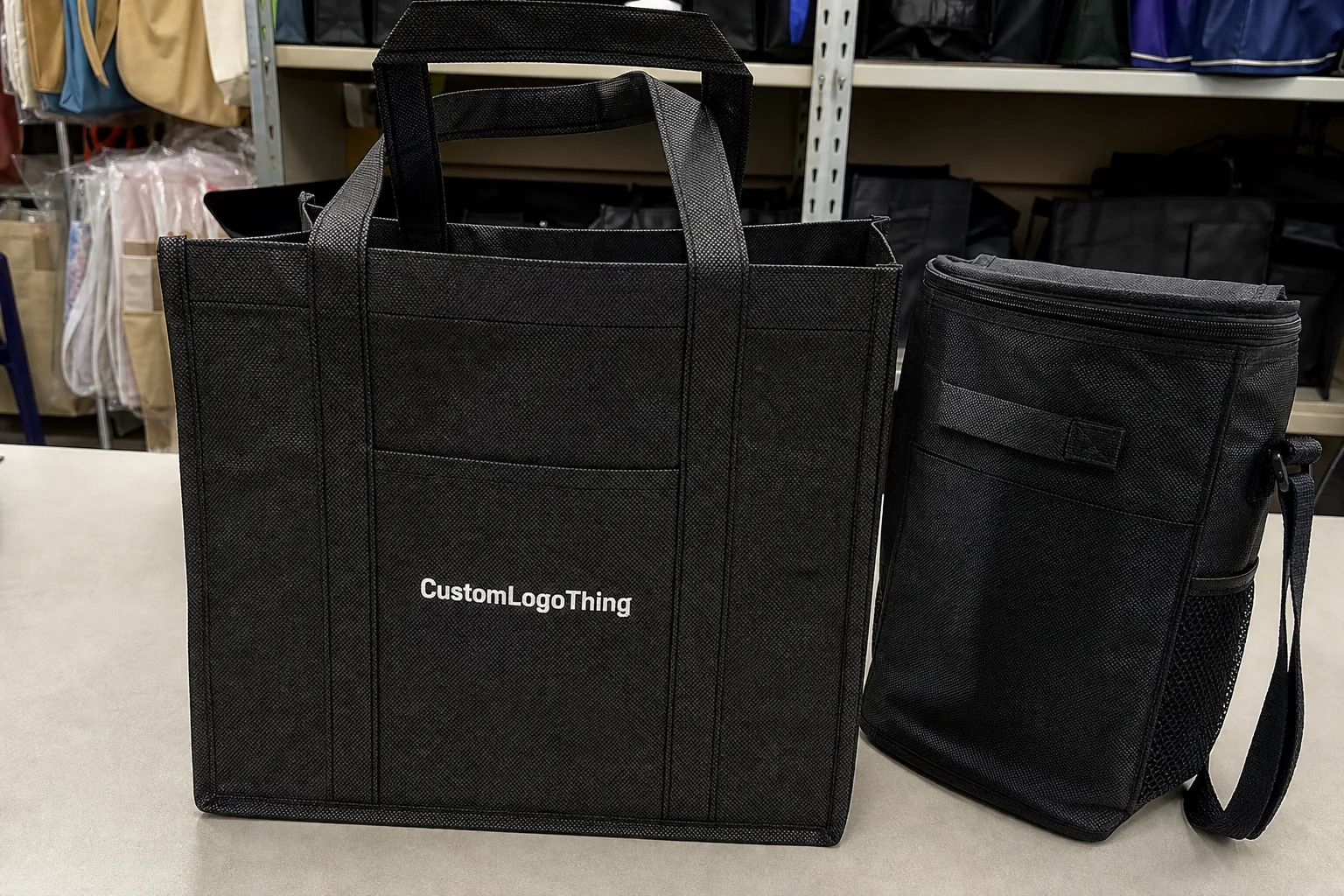
Convention traffic is hard on anything flimsy. Attendees are already juggling a phone, badge, bottle, notebook, and whatever they just collected from the last booth. A bag that opens awkwardly or sags at the bottom becomes a problem fast. Nobody wants to fight a giveaway bag while trying to keep moving.
A good event bag has to load quickly and stay stable. It should hold its shape enough that the contents do not spill every time someone turns sideways or ducks through a crowd. The handles need to feel comfortable in hand, not like an afterthought. And the print should be visible from a distance, because the bag will be seen in motion long after it leaves the booth.
That mobility matters. Custom convention bags keep working in elevators, lobbies, shuttle lines, airports, and hotel corridors. They travel farther than a brochure and usually outlast a flyer by a mile. That is why the bag is more than packaging. It is moving media.
Here is the part buyers sometimes miss: a bag that only works when it is full is still a bad bag if the usual load is lighter. Oversized bags look awkward. Undersized bags strain seams. The right spec starts with the actual contents, not the artwork. Decide what the attendee is really carrying, then size around that.
A convention bag earns its keep when it still looks decent after the second or third stop on the attendee’s route.
If the bag is part of a broader branded packaging program, consistency matters. Signs, inserts, Custom Printed Boxes, and the bag itself should feel like they belong to the same system. That is what makes the event feel organized instead of assembled five minutes before doors opened.
Choosing the right material, size, and closure
Material choice drives performance and feel. Low-density poly is flexible and forgiving, which helps when the contents are bulky or uneven. It has a softer hand and is often used for lighter loads. Higher-density film tends to feel crisper and can look cleaner for simple handouts or smaller kits. Neither is automatically better. The right choice depends on what the bag has to carry and how long it needs to stay in use.
For heavier contents, reinforced or gusseted construction usually makes more sense. The gusset gives the bag depth, and the reinforcement spreads stress across the seam and handle area instead of concentrating it in one spot. That matters when the load includes catalog stacks, boxed samples, apparel, or bottles. A thin, flat bag is the wrong tool for that job. Cheap is only cheap until it rips in front of a buyer.
Size should follow the biggest item in the kit. If the largest piece is a brochure set, a slimmer bag with a modest gusset may be enough. If the package includes apparel, a bottle, or a thick sample set, the bag needs more depth and stronger handles. Going too large is not a free win either. Bigger bags use more material, cost more to ship, and look wasteful if they arrive half empty.
Handle style changes the experience more than most people expect. Die-cut handles are common and economical. Patch handles add reinforcement. Soft loop handles feel better for long carry times and heavier loads. Zipper closures or flap closures make sense when the bag needs to stay useful after the show, especially for multi-day conferences or travel-heavy attendees. If the contents need to stay protected, closure is not decoration. It is function.
Print behavior is tied to material. Some surfaces carry ink cleanly, while others soften fine type or make gradients muddy under convention lighting. If the layout depends on small type, thin rules, or a detailed logo lockup, ask for a proof at actual size. A design that looks sharp on a screen can lose definition on film if the contrast is weak or the coverage is too busy.
For buyers comparing event packaging across a larger program, it helps to review the full product line at Custom Packaging Products. That makes it easier to keep the event bag aligned with the rest of the branded packaging instead of treating it as a one-off purchase.
| Option | Best Use | Typical Price Impact | Buyer Note |
|---|---|---|---|
| Low-density poly, die-cut handle | Brochures, lightweight handouts | Lowest | Fast to distribute and fine for simple loads |
| Gusseted poly, reinforced handle | Catalogs, mixed swag, moderate weight | Moderate | Better shape and stronger seam support |
| Soft loop handle, heavier gauge film | Premium giveaways, repeat use | Higher | More comfortable over a long event day |
| Zipper or closure bag | Multi-day conferences, protected contents | Highest | Useful when the bag needs to stay in circulation |
Cost, pricing, and MOQ basics for convention orders
Pricing usually comes down to five variables: size, material thickness, number of print colors, order quantity, and finishing. Add reinforced handles, extra gussets, specialty closures, or custom pack-out instructions, and the quote moves. Heavy ink coverage can also raise cost because it needs more setup and more control during production. A simple one-color bag and a fully printed heavy-gauge bag are not the same product, even if they carry the same logo.
For large runs, a basic die-cut poly bag may land in the low cents per piece. Reinforced or zipper-style bags can move into the higher cents or low-dollar range depending on size, print coverage, and shipping. That spread is normal. The mistake is comparing a light handout carrier against a premium reusable bag and pretending they should price the same.
Quantity matters because setup costs get spread across more units. A larger order usually lowers the unit price, but not always the total spend. If the spec becomes heavier, the freight changes, or the schedule gets tight, the savings can disappear quickly. Rush work has a way of doing that. So does late artwork.
MOQ is usually about production efficiency, not an arbitrary wall. A factory needs enough pieces to justify setup, color calibration, and finishing time. In some cases, ordering a little above the minimum improves the unit price enough to justify the extra inventory. In others, it does not. The only honest way to compare is to quote the real use case, not a generic bag request.
Good buyers compare apples to apples. Same size. Same material. Same handle style. Same print coverage. Same delivery point. If any of those change, the price comparison is noise.
Production steps and lead time from artwork to delivery
The workflow is straightforward, but every sloppy file adds friction. The usual path is quote approval, artwork review, proofing, setup, printing, curing or finishing, inspection, and shipment. If the order includes split deliveries or special packing instructions, those details need to be locked early. Most missed deadlines come from changes after the schedule is already set. Printing is rarely the only problem.
Lead time depends on artwork readiness and current factory load. A clean vector file with correct dimensions, clear logo placement, and proper color references moves faster than a low-resolution file with guesswork baked into it. The fewer corrections needed, the less the order stalls. That sounds obvious because it is. Still, plenty of event deadlines get torched by small file mistakes.
For a standard run, many buyers should expect roughly 12 to 15 business days from proof approval to completed production, then shipping on top of that. Peak season can stretch the timeline. So can specialty materials, heavy ink coverage, or a large pack-out. If the event date cannot move, the only sensible move is to build a shipping buffer and stop pretending everything will go exactly right.
Shipping is part of the plan, not a footnote. Convention bags are often sent to a show contractor, a warehouse, or multiple event locations. Each handoff creates another chance for delay. If the shipment is going directly to a convention center, check receiving rules early so the cartons are labeled correctly and the delivery window is realistic.
If the bag is part of a larger kit, sync the production schedule with the other items. A late insert can hold up the full order. A late outer carton can do the same. That is why packaging planning should treat the bag as one piece of a system, not a separate purchase order that somehow ignores the rest of the event.
For buyers who want a broader view of how heavy loads and shipment handling affect packed goods, trade guidance from organizations like ISTA can be useful. It helps frame the bag as a functional carrier, not just a printed surface.
Common mistakes that make event bags feel cheap or fail early
The most common mistake is buying on price alone. Thin film, weak handles, and sloppy seam construction can undo the entire point of the bag. If the contents include dense catalogs, boxes, or beverage bottles, a bargain spec can fail in public. That is a fast way to make the brand look careless.
Another miss is designing for decoration instead of readability. If the logo is too small, the contrast is weak, or the layout is crowded, the bag stops doing branding work the moment it moves away from the booth. A convention floor is loud and visually busy. Tiny type does not win there. Simple usually wins.
Carry weight is another area where people guess instead of checking. A bag that works for brochures may be completely wrong for bottles, apparel, and a stack of giveaways. The handle stress, bottom seam strength, and gusset depth should all be matched to the actual load. If the team cannot describe the heaviest likely load, the spec is not ready.
Last-minute changes are expensive in ways buyers underestimate. Once print, packing, or shipping has been scheduled, changing quantity, imprint, or delivery destination can trigger fees and delay the order. Stability is boring. Stability also saves money.
For buyers who care about sustainability or material sourcing, broader standards can help with the decision. The EPA has practical guidance on material management and waste reduction at EPA Sustainable Materials Management. That matters because reuse and disposal should be considered upfront, not after the show when everyone is staring at a pile of bags nobody plans to keep.
Honestly, the cheapest-looking bag is usually the one specified with the least detail.
Expert spec checks for branding, durability, and compliance
One of the simplest checks is also one of the most useful: review the artwork at full bag size, not just on a screen. Full-size review makes logo placement, line weight, and spacing much easier to judge. A design that reads fine on a laptop can get muddy once it stretches across a flexible surface with folds, seams, and handles interrupting the layout.
Durability should be checked against the heaviest planned load, not the average load. If the bag might carry dense catalogs or drinks, confirm the film gauge, handle reinforcement, and seam strength accordingly. Ask for material testing if the order is high stakes. Depending on the substrate, that can include tensile properties under ASTM D882 or a more suitable test method for the chosen construction. The point is not to make the project academic. The point is to make sure the bag survives the job it was hired to do.
Compliance is partly about the venue and partly about the customer experience. Some shows have recycling preferences, some venues have bag-distribution rules, and some programs expect specific material claims. If the bag includes paper components or inserts, certifications such as FSC may matter. If a recycled-content claim is used, it needs to be supportable. Loose claims are a bad trade for a small branding win.
Clarity matters in a practical sense too. If the bag is part of an exhibit program, the company name should be visible at a glance. That is especially important on crowded floors where people only catch the bag for a second. The print should identify the exhibitor without making anyone stop and study it.
These are the checks worth keeping in front of you before approving custom convention bags:
- Confirm the largest item in the kit and size the bag to that load first.
- Verify the artwork at actual dimensions, not only in a digital mockup.
- Match handle style to carry weight and comfort over a long event day.
- Check whether the venue, show contractor, or destination warehouse has labeling rules.
- Ask for a proof or sample if the design uses fine type, gradients, or heavy coverage.
That kind of review sounds basic because it is. Basic is good. It keeps the bag from becoming the expensive part of a bad attendee experience.
What to do next before you request quotes
Before asking for quotes, gather the details that actually drive the build: target quantity, bag dimensions, intended contents, preferred handle style, print area, and the date that cannot move. If the bags need to ship to more than one location, say so. If they need to fit inside another event kit, say that too. Specific briefs get better quotes. Vague briefs get vague answers and extra revisions.
A reference image or rough layout helps more than most buyers expect. It gives each supplier the same target and cuts down on assumptions. That matters when the bag is part of a larger packaging design that also includes inserts, cartons, and other branded materials. One clear reference is worth more than a long email thread full of guesswork.
Ask for a sample, proof, or prior production example if the bag has to carry meaningful weight or represent a high-visibility brand moment. A sample tells you more about handle comfort, seam strength, and print finish than a spec sheet ever will. That is especially true for custom convention bags, where the difference between “fine” and “gets reused” often comes down to reinforcement and material feel.
When the quote comes back, confirm the price breaks, carton pack, production timing, and delivery destination before approval. If the bag is part of a broader event order, make sure the schedule works with every other piece. The bag is not just a carrier. It is part of the attendee experience and a visible piece of the brand presentation. If it is built well, people keep using it. That is the whole point.
Use one simple rule: choose the bag for the load, not for the mockup. Do that, and custom convention bags start doing real work instead of acting like disposable handouts.
FAQs
What size custom convention bags work best for brochures and swag?
Start with the largest item in the kit, then add enough room for stacked handouts and normal movement so the opening does not bind. A brochure set needs less depth than apparel or boxed samples, so the gusset matters as much as the face dimensions.
How do custom convention bag prices change by quantity?
Higher quantities usually reduce the unit price because setup costs are spread across more bags. The quote can rise again if the order adds extra colors, heavier material, special handles, or a rush schedule.
How long does production usually take for convention bags?
For standard runs, a common production window is about 12 to 15 business days after proof approval, plus shipping time. Peak season, special materials, and late artwork can extend that timeline.
Which handle style is best for heavier convention giveaways?
Reinforced die-cut, patch, or loop handles are better choices for dense catalogs, bottles, or bundled swag. The handle should match the load, not just the look.
What artwork setup helps custom convention bags print cleanly?
Use high-contrast logos, vector art when possible, and enough space around text so the print stays readable at distance. Ask for a proof at actual size if the design includes fine detail, gradients, or small type.


