Buyer Fit Snapshot
| Best fit | Custom Corrugated Shipping Boxes Wholesale for Brands projects where brand print, material claims, artwork control, MOQ, and repeat-order consistency need to be specified before quoting. |
|---|---|
| Quote inputs | Share finished size, material target, print colors, finish, packing count, annual reorder estimate, ship-to region, and any compliance wording. |
| Proofing check | Approve dieline scale, logo placement, barcode or warning zones, color tolerance, closure strength, and carton packing before bulk production. |
| Main risk | Vague material claims, crowded artwork, missing packing details, or unclear freight terms can make a low unit price expensive after revisions. |
Fast answer: Custom Corrugated Shipping Boxes Wholesale for Brands should be specified like a repeatable production item. The safest quote records material, print method, finish, artwork proof, packing count, and reorder notes in one written spec.
Production checks before approval
Compare the actual filled-product size with the drawing, then confirm tolerance on folds, seals, hang holes, label areas, and retail display edges. Reserve space for logos, QR codes, warning copy, and material claims before decorative graphics fill the panel.
Quote comparison points
Review material grade, print process, finish, sampling route, tooling charges, carton quantity, and freight assumptions side by side. A quote is only useful when the supplier can repeat the same color, closure quality, and packing count on the next order.
Custom Corrugated Shipping Boxes Wholesale for Brands sounds dull until a crushed pallet lands on your dock and the “cheap” carton turns into a very expensive problem. Custom Corrugated Shipping Boxes Wholesale decisions can quietly decide whether your fulfillment budget stays controlled or gets eaten one damaged order at a time.
If you ship hundreds or thousands of units a month, this is not branding theater. It is an engineering choice wearing a cardboard costume. A pretty box is nice. A box that protects the product, fits the line, and does not punish your freight bill is nicer.
Need Custom Corrugated Shipping Boxes wholesale? Start with the box, not the logo. A clean print file cannot rescue a bad fit, a weak flute choice, or a carton that collapses under stack pressure. I have seen teams spend weeks arguing about color chips while the real issue was a box that added two inches of dead air and a chunk of dimensional weight to every shipment. Cute. Also expensive.
The carton is one of those annoying decisions that has a direct line to margin. If it is wrong, the damage shows up in repacking, returns, freight re-runs, storage waste, and customer complaints. None of that looks dramatic in a sample photo. All of it looks very real in your cost-per-order report.
What Should You Know Before Ordering Custom Corrugated Shipping Boxes Wholesale?
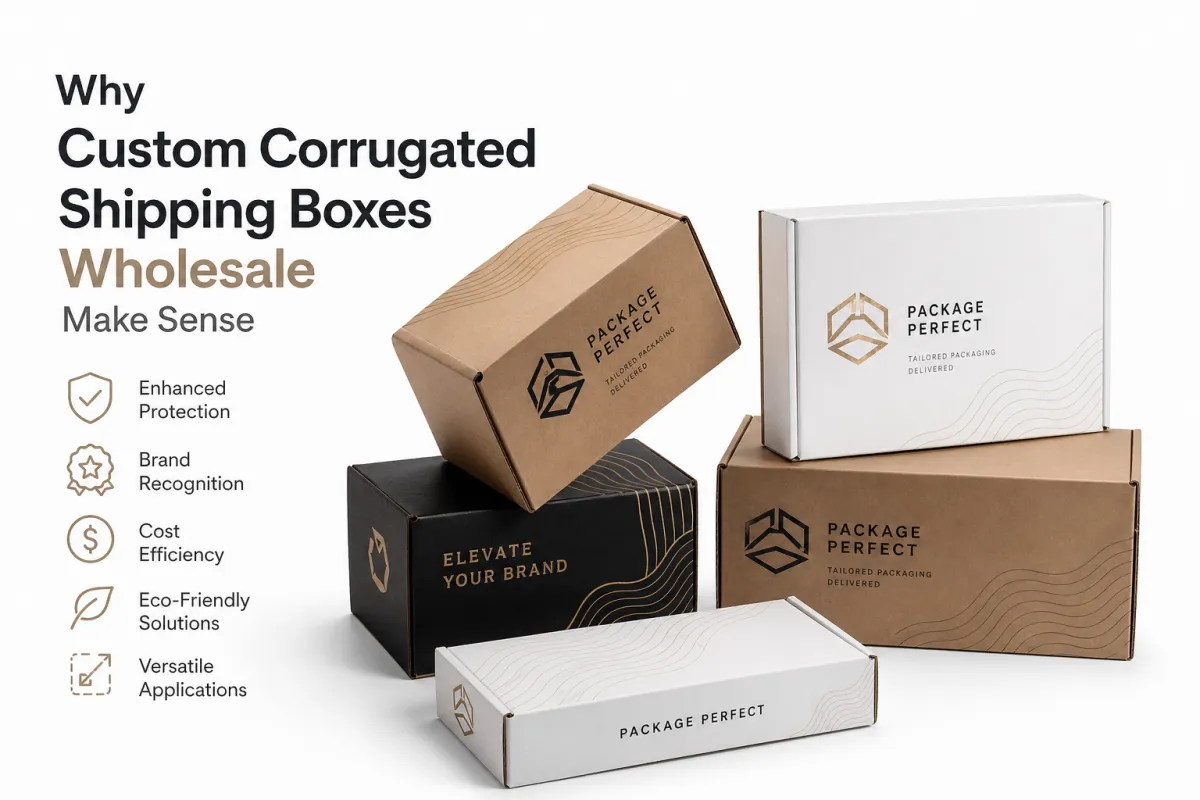
Before you place a Custom Corrugated Shipping boxes wholesale order, lock down the boring details first: product weight, inside dimensions, board grade, flute choice, and how the carton will move through your warehouse. That is the part that saves money later. Not the foil logo. Not the mockup everybody claps over in the meeting. I’m not saying branding does nothing. I am saying branding should not be allowed to bully physics.
Think in terms of corrugated cartons, shipping cartons, and fulfillment workflow. If the box works in storage, packs fast, survives transit, and keeps dimensional weight under control, it earns its keep. If it does not, it becomes a very expensive rectangle.
Why Custom Corrugated Shipping Boxes Wholesale Make Sense
Here is the part people skip: packaging is not just a container. It is part of the product journey. A seller shipping heavy, oddly shaped cable kits learned that the hard way. The stock carton was “big enough,” which is a delightful phrase right up until the top panel crushes in transit and the corners fold like cheap lawn chairs. The box bill was small. The replacement shipments, return freight, and refunds were not.
That is where Custom Corrugated Shipping boxes wholesale changes the math. Repeating one controlled spec keeps packing behavior consistent. Pickers stop fighting random size variation. Packers stop stuffing filler into cartons that should never have been oversized. Warehouse systems behave better when the carton does not keep changing its mind. The box also stacks better on pallets and trailers, which matters more than people admit in meetings.
I have also seen the opposite. A brand kept ordering “almost the same” carton from different suppliers because the unit price looked lower on paper. It was not lower. The line jams, tape waste, and rework ate the savings in a hurry. The finance team found out three months later, which is usually how these little packaging crimes get exposed.
What changes when you order wholesale vs. ad-hoc stock
Spot-buying stock cartons feels easy at first. That convenience gets expensive fast. A new lot comes in slightly different, then another, then the “same” box is off by a few millimeters and your pack line starts acting up. Carton count per bundle shifts. Sidewall stiffness changes. A little drift becomes a recurring problem.
Wholesale buying works better when the SKU repeats and the carton spec needs to stay locked. You set the structure once, set the tolerance once, and stop paying the re-education tax on every reorder. In many programs, custom corrugated shipping boxes wholesale can bring unit economics down by 15-35% once production is stable and the artwork stops changing every five minutes. That is not magic. It is what happens when the same thing gets made the same way on purpose.
Fact check: A shipping box does more than hold a product. It absorbs impact, handles stack compression, and protects against abrasion during loading and transit. It also shapes the brand experience. A box that opens cleanly and arrives intact does more for perceived quality than a glossy mockup ever will.
What you gain in real-world logistics
- Predictable packing speed — same closure method, same insert count, same fit every time.
- Lower transit damage rate — especially when ECT and flute selection match the load.
- Better cube efficiency — fewer oversized boxes means less dimensional weight pain.
- Cleaner margin control — unit cost improves once the run size is worth the setup.
“We moved from three stock carton sizes to one approved custom structure, and packing labor dropped by almost 22% without touching warehouse software.”
Breakable, heavy, awkward, expensive. If the product fits any of those labels, the carton deserves real attention. The last mile is where weak edges crush, where movement inside the box turns into corner damage, and where one bad score line becomes your problem instead of the supplier’s. A carton is not just packaging. It is part of the failure mode.
If you are treating packaging like a disposable afterthought, you are missing the leverage point. A stable specification matters more when you are running ongoing custom corrugated shipping boxes wholesale orders and trying to keep replenishment predictable.
Custom Corrugated Shipping Boxes Wholesale: Box Types and Build Options
One box style does not fit every use case. Structure matters. So does how the box gets packed, stacked, and opened. That sounds obvious, but obvious gets ignored all the time.
Common structures worth knowing:
Regular slotted containers (RSC)
RSC is still the workhorse for most ecommerce cartons. The flaps meet in the middle, closure is simple, and the build plays nicely with tape, tabs, or adhesives. High-volume packing lines like predictable shapes. Finance teams like the lower base cost. In a custom corrugated shipping boxes wholesale program, RSC is often the best answer for repeatable SKUs and straightforward inserts.
Mailer-style and mailer-like collapsible formats
Mailer-style cartons are a strong fit when the product is light but the pack still needs a tighter profile. They reduce wasted air, which shipping carriers somehow charge for anyway. Manual packers usually like them too, because the fold and close flow is simple. The tradeoff is structural validation. A nice-looking mailer still needs drop and corner testing if the product is worth protecting. A pretty failure is still a failure.
Die-cut and tuck-top styles
Die-cut and tuck-top formats show up when the brand wants a cleaner opening, a more polished front edge, or a specific fold path. They can assemble quickly once dialed in. They also add tooling and proofing complexity, which is the part no one puts in the product photo. If the box needs custom grips, precise openings, or a display-friendly feel, this is usually the lane.
Shipper cartons and reinforced options
Reinforced cartons make sense for heavier, high-value products that live a hard life in transit. Extra wall layers, stronger corners, and self-locking features reduce damage without forcing you into a wildly oversized build. For mixed carrier lanes or long-haul freight, this is where brands often get the biggest return from the spec change.
Board choice is where people often underthink the job:
- Single-wall is usually enough for lightweight to mid-weight ecommerce shipping and moderate stacking.
- Double-wall is safer for heavier or higher-value products and usually better for distance shipping.
- Triple-wall is niche, but it earns its keep for harsh handling, industrial drops, or serious stack pressure.
Flute profile is not decorative. It changes compression behavior and cushioning.
- A flute (around 4.5-5.0 mm): strong cushioning, better for voided loads, lower print sharpness.
- B flute (around 2.5-3.0 mm): a solid middle ground for print and protection.
- C flute (around 3.5-4.0 mm): common for mixed ecommerce loads and decent stacking.
- E flute (around 1.2-1.8 mm): tighter folds and cleaner print, usually for lighter goods.
- F flute (under 1 mm): thin, premium-looking, and less cushioned than larger flutes.
If the box is meant to look sharp on arrival, smaller flutes help. If the box has to survive rough handling, stronger board and a better ECT rating usually matter more than looking refined on a shelf. Packaging people love to pretend those goals always align. They do not.
Inserts, partitions, dividers, glued corners, self-locking tabs, and custom die lines are not ornamentation. They can cut rework and keep fragile items from moving around. One good insert can turn a 3% damage rate into something manageable. One bad insert can trap the product in the wrong spot and make returns worse. That kind of detail is why experienced buyers stop treating the carton as a generic box.
Print choices affect both cost and process:
- Unprinted kraft — lowest cost, good for bulk fulfillment and minimal branding.
- One-color logo — simple, clean, and easy to control on cost.
- Full-color exterior — strongest visual impact, slower and more involved to produce.
- Inside print — subtle branding that works well for unboxing without overdoing the outside.
If your buyers are price-sensitive and the product itself does the selling, one-color often wins. Fancy ink should earn its place with volume data, not optimism. The same is true for any custom corrugated shipping boxes wholesale program that needs to stay profitable after launch.
Custom Corrugated Shipping Boxes Wholesale Specifications
If the quote is vague, the production will be vague too. That is how boxes drift off spec and everyone acts surprised later. Clear input keeps the order from turning into a debate. Vague requests produce vague cartons. That is not a mystery. It is just bad prep.
Before you ask for a quote on custom corrugated shipping boxes wholesale, have these details ready:
- Inside dimensions: length, width, height in mm; include product tolerance and clearance.
- Product envelope: weight in grams or kilograms, including inserts and any filler.
- Board grade: target strength, ECT requirement, and moisture resistance needs.
- Flute type: A/B/C/E/F and the reason behind the choice.
- Print coverage: full coverage, spot color, varnish, one-color, or no print.
- Supply format: flat-packed cartons or pre-glued/assembled.
Strength metrics you should ask about, in plain terms
ECT (Edge Crush Test) measures stacking strength under compression. If your cartons are going to sit high on pallets or travel through multiple handoff points, you need a realistic ECT target. Common references like 32 ECT and 44 ECT help buyers compare options, but the right number still depends on board grade, flute, and the abuse your freight actually takes.
Burst strength matters when impact is the bigger risk. Corner hits, rough loading, and repeated handling all push the carton differently. A good supplier should be able to map burst and compression against your route, not just hand you a number and call it a day.
You also need the shipping environment, not just the product dimensions:
- Shipping distance: a short ground loop is not the same as mixed hub-and-spoke travel.
- Stack duration: cartons may sit for days before they move.
- Humidity: paperboard changes behavior in damp transfer points.
- Load pattern: corner loading shows up fast in manual handling.
Reference standards matter. If a supplier cannot explain how the build lines up with ISTA expectations for transit simulation, that is a warning sign. If they can talk through ASTM methods and provide test reports, better. Packaging guidance from packaging industry resources and FSC-aligned claims should also be checked when sustainability claims are part of the sale. Trust the paperwork less than the evidence.
Tolerances that save your sanity later
Small variances happen. Big ones create expensive nonsense.
- Panel dimension variance: often acceptable within ±2 mm on small cartons; larger boxes may have wider approved tolerances.
- Squareness: right-angle consistency matters for tape machines and automated packing.
- Print registration: two-color and CMYK work should stay within agreed tolerance so logos do not drift at fold lines.
Manual packing lines can live with a little variation. Semi-automated lines are less forgiving. Once the box starts wandering outside tolerance, jams and mis-glue turn into schedule problems.
File and artwork requirements for clean production
Most production delays start with sloppy files. The fix is boring and effective:
- Submit a validated dieline PDF or SVG and mark bleed clearly, usually 3 mm.
- Send vector logo artwork in EPS, AI, or vector-layer PDF format.
- Specify Pantone and CMYK or spot-color details with backup matching options.
- State proof preference: PDF soft proof and physical mock-up for higher-value SKUs.
- Limit review cycles and lock changes after approval.
A fully approved proof is not a nice-to-have. It is the line between a clean run and a costly reprint, especially when packaging quality affects how buyers judge the product before they even open it.
Warehouse and shipping integration details
Logistics assumptions should be part of the quote. If they get discovered after the order lands, you are already late.
- Palletization plan: how many cartons per pallet at the standard load?
- Case pack logic: does the setup match your current carton quantity?
- Bundle count: shrink-wrapped bundles or corrugated shipper counts?
- Line fit: does the box work with current pack stations and tape settings?
A custom corrugated shipping boxes wholesale quote that ignores warehouse mechanics usually underestimates risk by 5-10% over six months. The box has to fit your process as well as the product. Otherwise you save a penny and spend a dollar fixing it later.
Pricing and MOQ for Custom Corrugated Shipping Boxes Wholesale
This is where a lot of brands get distracted by good-looking samples. The structure still has to make financial sense across the order cycle. For custom corrugated shipping boxes wholesale, pricing only gets useful once the cost drivers are clear. Unit price alone is a bad judge. Landed cost tells the truth.
Main cost drivers
- Board grade: single-wall, double-wall, or specialty reinforcement.
- Format: flat RSC is usually cheaper than engineered die-cuts with more complexity.
- Dimensions: carton volume affects sheet utilization and trimming loss.
- Print complexity: full-color and special inks add steps.
- Inserts/partitions: extra die work and assembly add cost.
- Tooling: cutting dies and press plates are easier to absorb at larger volumes.
- Packaging and freight: storage and delivery can erase savings if landed cost is ignored.
Indicative ranges only. Real pricing shifts by supplier, location, material sourcing, and seasonality:
| Option | Typical Structure | MOQ Band | Indicative Unit Cost | Common Lead Time | Where it works best |
|---|---|---|---|---|---|
| Stock-size RSC | Single-wall, minimal print | 1,000–3,000 | $0.35–$0.50 at 5,000 pcs | 12–15 business days | Low-risk lightweight ecommerce shipping |
| Custom RSC with one-color logo | Single-wall + simple color match | 2,000–5,000 | $0.55–$0.75 at 5,000 pcs | 15–18 business days | Branded packaging where consistency matters |
| Die-cut reinforced carton | Double-wall + custom die line | 5,000–10,000 | $0.95–$1.35 at 5,000 pcs | 20–28 business days | Heavy or fragile products |
| Fully printed campaign carton | Double/triple wall + full graphics | 5,000+ | $1.20–$1.80 at 5,000 pcs | 22–35 business days | Premium retail packaging and display-sensitive launches |
The same base carton can often drop around 10-20% in per-unit cost at 10,000–20,000 units if the artwork stays fixed and the insert design does not change. If you keep ordering 2,500-piece bursts and editing the spec every time, you are paying retooling tax again and again. That kind of habit looks flexible from the outside and sloppy from the accounting side.
MOQ expectations: how not to over-order or under-qualify
Simple stock-like formats can start with flexible MOQs, especially when print is light. Add die-cutting, full-color interiors, glued structures, or inserts, and the minimum climbs. The reason is not mysterious. Setup time, waste, and finishing complexity all go up.
For buyers asking “What is usual MOQ?”, the useful answer is a range tied to the structure. Simple runs may begin in the low thousands. Heavier builds usually make sense at higher bands. If your volume repeats, a stable MOQ now is usually cheaper than three separate smaller runs later.
Hidden costs to confirm before you sign
- Tooling charges for dies, flexo plates, and emboss fixtures
- Proof and revision fees
- Sample fees and sample freight
- Freight, palletization, and supplier-side storage
- Split-shipment handling if launch timing slips
- Warehouse re-packing if fit changes after launch
Rework is expensive. Often more expensive than the custom die cutting itself. Get the spec right, then argue about MOQ.
Simple buying rule
If the carton is a repeat SKU, buy the next two runs as one program. That is the core reason custom corrugated shipping boxes wholesale beats one-off procurement in most steady operations. You get a lower blended cost, fewer surprises, and fewer damage-driven costs downstream. The savings are not just the box price. They show up in lower repack labor, cleaner replenishment planning, and fewer replacement shipments.
Process and Timeline for Wholesale Corrugated Boxes
If this process feels long, that usually means someone is trying to skip the boring parts. Procurement teams know better. Boring is good. Boring means repeatable. Repeatable means fewer surprises, and fewer surprises means fewer phone calls nobody wants to make on a Friday afternoon.
Order flow you can trust
- Submit carton and product specs.
- Confirm structure, material, and tolerances.
- Review dieline and structural recommendations.
- Approve proof and measurements.
- Approve sample for high-value or fragile SKUs.
- Run pre-production checks.
- Start full production and prepare shipment.
Timing depends on complexity:
- Standard flat RSC, simple print: often 12–15 business days after final files.
- Custom die-cut or inserted builds: usually 18–28 business days.
- Complex multi-artwork or high-coverage brands: 30–40 business days is common.
Where delays actually happen
Most delays do not come from machines. They come from missing information.
- Missing dimensions or changing carton targets.
- Artwork edits after proof approval.
- No agreed performance requirement for edge crush or compression.
- Late print correction requests.
- Wrong pallet count assumptions and messy logistics inputs.
How to speed up your own timeline
Send the useful stuff first. Not “we’ll follow up.” Send actual data:
- Product dimensions and weight, plus photos from two angles.
- Estimated monthly output and whether this is recurring or one-off.
- Shipping method mix: parcel, pallet freight, air, road, or a combination.
- Packaging constraints and brand guide references.
That one packet cuts the back-and-forth. If the files and product photos are already ready, you can shave days off the schedule without spending another dollar.
Final delivery planning
Do not stop at “carton approved.” Plan the trip after the carton leaves production.
- Coordinate palletized loads to match your warehouse route.
- Reserve receiving dock space for the expected load window.
- Confirm whether the launch date is fixed or flexible.
- Plan quarantine receiving if you want to inspect the first pallet before release.
If your launch window is strict, align print approvals to shipping dates. The fastest custom corrugated shipping boxes wholesale jobs are the ones with no unanswered questions. Bad documentation does not speed things up. It multiplies the mess.
Why Choose Us for Wholesale Corrugated Boxes
Most suppliers can print on a box. Fewer can help you avoid a bad structure before it becomes an expensive habit.
A real partner in wholesale cartons is worth more than a price list. You are paying for judgment as much as production. If the conversation never gets beyond “how many colors do you want,” you are probably not talking to the right people.
Sizing, material guidance, and production checks
Good teams help validate dimensions before final artwork gets locked. They check the fit against the shipping route and recommend board changes when the product needs it. Packaging teams often optimize for graphic real estate first and cube efficiency second. That order can be cute in a mockup and expensive in a fulfillment center. For custom corrugated shipping boxes wholesale, the practical sequence matters.
They should also catch bad combinations early: high-coverage print on ultra-thin profiles, oversized inserts for a tiny carton, or die-cuts that weaken score lines near load-bearing edges. Those are the sorts of mistakes that look clever for about ten minutes, then cost you a quarter.
Quality control that matters
Repeat buyers care about consistency, not luck. QC should cover board quality, cut precision, print registration, glue bond strength, and final sample sign-off. If something is outside the agreed tolerance, production should stop before the full run goes out the door.
The real question is not whether boxes can be made. The question is whether the same box can be made at volume, repeatedly, on schedule, with the same performance. That is where weak suppliers fall apart.
Experience on unusual products
The difficult jobs are the ones people quietly avoid: dense power tools, fragile glass, strange-shaped bundles, heavy multipacks, and temperature-sensitive goods. A good partner does not flinch when the product is awkward. They know when single-wall is too risky, when double-wall is justified, and when insert design can solve the problem without overbuying board grade.
If your catalog mixes retail packaging and direct ecommerce shipping, practical packaging advice becomes valuable fast. You want fewer PDFs and more answers. Nobody needs another inspirational deck about paper fibers.
Reorder cycle continuity
Most of the savings show up after the first approval. If the spec is captured well, the next order should be quicker: same structure, same tolerances, same cost band. Strong partners keep prior files organized, compare version changes, and spot problems before they become a line item.
There is also the sustainability angle, though it matters more on the balance sheet than on a slide deck. Right-sized cartons, fewer damaged shipments, and less void fill all reduce waste. That is not branding fluff. It is a cleaner operation. It is also one less excuse to buy more material than you need.
Next Steps for Custom Corrugated Shipping Boxes Wholesale
At this point, the decision is more operational than creative. Do the homework once, then buy again without guessing.
Here is a practical action list:
- Measure the product using the real packaging dimensions, including worst-case orientation.
- Confirm gross unit weight and expected pack quantity per carton.
- Estimate monthly volume and reorder cadence for at least three cycles.
- Set structural strength requirements before finalizing print.
- Decide whether inserts, dividers, or self-locking features are actually needed.
- Finalize graphics only after the structure is approved.
For an accurate quote, send this starter package in one message:
- Exact inner dimensions and weight, including protective materials.
- Product photos showing top, side, and corner profile.
- Target destination and carrier mix, including primary routes.
- Planned MOQ band and preferred launch window.
- Logo files and final print rules for one-color, full-color, or inside-only coverage.
Decision sequence that prevents overdesign
Use this sequence:
- Compare board grade and flute first.
- Lock the structure dimensions and internal fit.
- Freeze print scope and finish decisions.
- Run the sample proof, then confirm production.
Plain version: do not let packaging design outrun engineering. If the structure fails, premium printing will not save the shipment or the budget. It will just make the failure look nicer.
If you are mapping a new program, start with the carton mechanics, then build the branding around that structure. Compare Custom Packaging Products for format options, confirm carton-specific specs in Custom Shipping Boxes, and use Wholesale Programs to pressure-test MOQ, freight, and reorder timing before you commit. The order matters. Always has.
Sample and approval path
If the carton carries real value or the product is fragile, request a pre-production sample before full run approval. Check fold quality, insert fit, corner stability, print clarity, and closure behavior. Then approve the run with a final checklist. Do not greenlight by image alone if the product can be damaged in transit. Your pack team will notice the difference immediately, and so will your returns report.
Last rule: custom corrugated shipping boxes wholesale works best when spec discipline beats launch panic. Clear dimensions, known volume, and a reorder plan before the first stock lands. That is how you avoid the expensive scramble later. Set the box spec once, test it properly, and keep the next order boring.
FAQ
What do I need to quote custom corrugated shipping boxes wholesale accurately?
Send inside dimensions, product weight, monthly volume estimate, shipping method, and print requirements. Include any inserts, double-wall needs, and expected stacking height in your distribution chain. If the cartons are part of a custom corrugated shipping boxes wholesale program, also note whether the warehouse uses manual packing or semi-automated lines.
What is the usual MOQ for custom corrugated shipping boxes wholesale?
MOQ depends on style and complexity. Simple RSC runs can start lower, while die-cut, heavy-print, or reinforced builds usually need higher minimums to stay cost-effective. If the order repeats, compare 2,000, 5,000, and 10,000-piece bands before you settle on a run size.
How long does production take for wholesale corrugated boxes?
Simple builds often move in about 12–15 business days after artwork and specs are approved. Inserts, custom tooling, complex print, and late revisions can push that to 20–35 business days. custom corrugated shipping boxes wholesale projects move fastest when the engineering details and artwork are finished before the supplier starts cutting.
Can I print my logo on custom corrugated shipping boxes wholesale?
Yes. Most buyers use one-color logos, one- or two-color front branding, or full-color exterior print depending on budget. Some brands move the design inside the carton and keep the outside clean. Print complexity affects Price and Lead time, so decide the coverage before you ask for the final quote.
Which corrugated style is best for ecommerce shipping?
For many lightweight ecommerce SKUs, single-wall is enough and keeps cost under control. Heavy or fragile goods often need double-wall and better flute selection, especially for longer routes or higher stack counts. The right answer depends on weight, shipping distance, and acceptable damage rate, not just carton size.

