Buyer Fit Snapshot
| Best fit | Custom Digital Printed Boxes Bulk projects where brand print, material claims, artwork control, MOQ, and repeat-order consistency need to be specified before quoting. |
|---|---|
| Quote inputs | Share finished size, material target, print colors, finish, packing count, annual reorder estimate, ship-to region, and any compliance wording. |
| Proofing check | Approve dieline scale, logo placement, barcode or warning zones, color tolerance, closure strength, and carton packing before bulk production. |
| Main risk | Vague material claims, crowded artwork, missing packing details, or unclear freight terms can make a low unit price expensive after revisions. |
Fast answer: Custom Digital Printed Boxes Bulk: Pricing, Specs, Orders should be specified like a repeatable production item. The safest quote records material, print method, finish, artwork proof, packing count, and reorder notes in one written spec.
Production checks before approval
Compare the actual filled-product size with the drawing, then confirm tolerance on folds, seals, hang holes, label areas, and retail display edges. Reserve space for logos, QR codes, warning copy, and material claims before decorative graphics fill the panel.
Quote comparison points
Review material grade, print process, finish, sampling route, tooling charges, carton quantity, and freight assumptions side by side. A quote is only useful when the supplier can repeat the same color, closure quality, and packing count on the next order.
The ugliest waste I have seen in a carton program was not ink, not lamination, and not even a bad dieline; it was a 19 mm size mismatch that sent a client paying to move air from Dongguan to Long Beach. I remember staring at the freight sheet and thinking, "That box is basically a tiny apartment for nothing." That is why custom digital printed boxes bulk matters. If the size, quantity, and demand curve line up, the packaging budget stops leaking into freight, dunnage, and rework, and a 40-foot container does not turn into a very expensive lesson in empty space.
I have watched a brand save more by trimming headspace by 8 mm than by switching from gloss to matte, and the math was brutal in a good way: 8 mm saved 7% on pallet volume and reduced void fill by 22% across a 4,000-unit shipment. I have also seen the reverse, where a sharp print job looked perfect on a PDF and then failed on a pallet because the case count was off by 12 units. Packaging teams often obsess over the visible stuff because it feels safer than arguing about board calipers and pallet heights, which is less glamorous but far more expensive when ignored. In my view, custom digital printed boxes bulk is a sourcing decision first and a print decision second, especially when the cartons are leaving a plant in Guangdong or Suzhou and landing in a warehouse that charges by cubic foot.
For buyers at Custom Logo Things, the practical question is direct: how do you get a branded package with a predictable landed cost and enough flexibility to handle seasonal art without filling a warehouse in Atlanta or Rotterdam with dead stock? The answer starts with structure, moves through board grade, and ends with the approval path. If you want to compare products while you read, our Custom Packaging Products, Manufacturing Capabilities, and Wholesale Programs pages are the quickest place to verify what we can build at volume.
Most buyers overpay in one of two places: oversized cartons or underspecified artwork. Spread a $140 prepress charge across 300 units and the cost lands at $0.47 per box before the board even hits the press. Spread the same charge across 5,000 units and it drops to $0.028 per unit, which is why volume changes everything. That is the economics of custom digital printed boxes bulk, and it is why the rest of this piece stays with the numbers rather than packaging theater. I say that as someone who has sat through more "premium unboxing" pitches than I care to admit, and half of them fell apart the moment a shipper box got measured in the real world.
How custom digital printed boxes bulk cut cost and waste
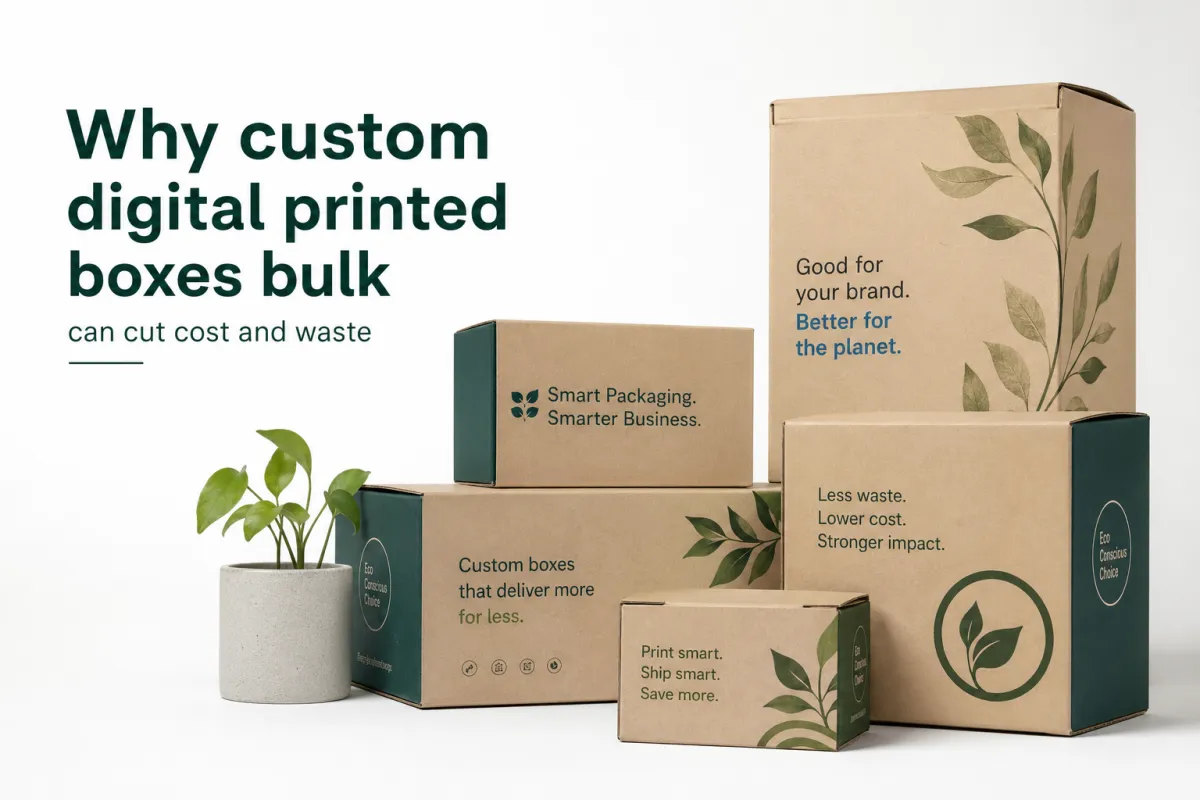
custom digital printed boxes bulk can lower unit cost because fixed work gets spread across more cartons. A dieline review, color preflight, barcode check, and proof approval can cost nearly the same whether the order is 250 or 5,000 units, and the plant still has to run the same artwork-prep steps. On a 250-unit job, those tasks can add several cents per box; on a 5,000-unit order, they become fractions of a cent. That is one reason custom digital printed boxes bulk often beats a short-run mindset, even for brands that refresh artwork often, especially when the print line is moving fast in Dongguan or Ningbo.
The other savings are physical, not graphic. A carton that matches the product at 102 x 78 x 44 mm can reduce void fill, tighten case packs, and improve pallet count. I have seen a skincare client cut void fill by 22% by removing 6 mm of unnecessary headspace inside the carton, which reduced carton wrap by 1.8 rolls per 1,000 units. That kind of correction matters because packaging is not only about shelf appeal; it also affects freight density, damage risk, and how many boxes a warehouse team can move per hour. In a 4,000-unit run, those details add up fast. A warehouse manager once told me, with a look that suggested he had not slept since Tuesday, that the wrong box size turns every forklift movement into a tiny tax on the business. He was not wrong.
During one plant visit in Guangdong, I watched a line operator stop every 40 cartons because a tuck flap fought the insert. The artwork looked perfect on the screen. The inside geometry was wrong by 2.5 mm. That gap created 18 extra seconds of handling per case, and the labor cost was larger than the print upgrade the buyer had negotiated for three weeks. That is the part people miss with custom digital printed boxes bulk: the most expensive line item is often the mismatch between design intent and the actual box physics. I still remember the operator sighing, tapping the box with two fingers, and muttering something I cannot print here. Fair enough.
"We thought print coverage was the big cost, but the carton height was the real problem. Once the board size dropped by 9 mm, the whole pallet plan improved." That was a quote from a subscription client after their second freight audit, and it is the kind of correction that usually only shows up after a test shipment. The funny thing is, the art stayed the same. The savings came from geometry, not aesthetics, and the ship-from location changed from a 52-pallet load in Guangzhou to a 46-pallet load in Shippensburg.
Here is the useful promise: if you understand sizing, volume, and structure before you request a quote, you can make custom digital printed boxes bulk work harder for your margin. In the next sections, I will break down the box styles, specs, pricing tiers, and order steps I would ask for in a serious procurement meeting. I have asked these questions in rooms where everyone pretended to love packaging and only three people actually knew the difference between flute types, 350gsm C1S artboard, and 32ECT corrugated board.
Custom digital printed boxes bulk: product options and use cases
Not every carton format behaves the same under digital print. For custom digital printed boxes bulk, the most common structures are mailer boxes, tuck end cartons, sleeve packaging, retail cartons, and product shipper formats. Each one solves a different operational problem. A mailer box handles direct-to-consumer fulfillment. A tuck end carton protects a retail SKU on a shelf. A sleeve can elevate a simple tray or pouch without pushing board cost too high. I like Sleeves for Brands that want to look more expensive than their budget suggests, which, frankly, is most of them.
- Mailer boxes: best for subscription kits, influencer packs, and ecommerce bundles that need a strong first impression at 1,000 to 10,000 units, often in E flute at 1.2 to 1.5 mm thickness.
- Tuck end cartons: common for cosmetics, supplements, and small electronics where shelf facing and barcode placement both matter, usually in 300gsm to 400gsm SBS or C1S artboard.
- Sleeves: useful for brand refreshes, seasonal labels, and layered package branding over existing trays or rigid containers, often starting at $0.15 per unit for 5,000 pieces.
- Retail cartons: ideal for store shelves, display hooks, and secondary packaging that needs a clean front panel and a clear 30 x 20 mm barcode zone.
- Product shippers: built for courier networks, especially when the box must survive parcel drops from 1.0 m and warehouse stacking up to 4 layers high.
Material choice is just as important. Corrugated board, especially E flute or B flute, makes sense for shipping protection because the flute adds crush resistance without turning the carton into a brick. Paperboard, such as 300gsm to 400gsm SBS or 350gsm C1S artboard, works better for shelf presentation, lighter products, and tighter folds. I have seen brands try to force a retail carton into a shipping role, and they end up paying twice: once for damage and once for a redesign. For custom digital printed boxes bulk, the board should match the journey, not just the marketing deck. That part sounds obvious until you watch a package split open on a conveyor in Chicago because someone picked a prettier board instead of the right board.
Use cases tell the story. Cosmetics teams want clean white backgrounds, precise logo registration, and small batch changes for shade variants. Supplement brands often need tamper evidence, ingredient panels, and room for batch codes. Food companies need compliance-friendly layouts and barcode clarity. Apparel and accessory brands usually care about unboxing and fast seasonal art swaps. Subscription kits and promotional mailers often need versioning across 3 or 4 SKUs, which is where digital print earns its keep because artwork changes are easier than with plate-heavy methods. That flexibility is a major reason buyers keep choosing custom digital printed boxes bulk for programs that refresh every quarter, whether the orders are shipping out of Guangdong or a fulfillment center in Dallas.
Digital printing also wins on test-and-learn programs. If a brand wants 500 units with one headline, 500 with another, and 1,000 with a regional offer for Austin, Toronto, or Manchester, the workflow can handle that without a long plate changeover. I have negotiated those orders with suppliers who wanted to push everything into a higher MOQ, and the reality is simple: if your launch plan depends on 2 or 3 artwork versions, custom digital printed boxes bulk is often the cleaner operational choice. It is also the less painful one when legal asks for a last-minute disclaimer change at 4:47 p.m., which somehow happens more often than anyone would like.
Specifications that affect fit, print quality, and shelf appeal
If a buyer sends only a logo and a guess, the quote process slows down by days. For custom digital printed boxes bulk, the core specs are internal dimensions, board grade, flute or caliper, finish, and any inserts or partitions. Internal dimensions matter more than outside size because even a 1.5 mm difference can affect fit on a tight cosmetic jar or a folded apparel item. Board grade changes stiffness, crease behavior, and cost. Caliper tells you how thick the material really is, which matters more than the marketing description on the sample sheet. A 350gsm C1S artboard does not behave like a 350gsm SBS sheet, and a B flute shipper is not a substitute for E flute on a delicate shelf carton.
Artwork specs are where many jobs stumble. I ask for dielines in a native vector format, 3 mm bleed on every print edge, a safe area of at least 2 mm, and 300 dpi image assets for any placed graphics. Barcodes need a quiet zone, and the logo file should be clean enough to survive a resize without stair-stepping. CMYK should be confirmed early, because RGB artwork can look bright on a monitor and dull on press. For custom digital printed boxes bulk, a 15-minute preflight check can save a 15-day delay. I wish that sentence were dramatic exaggeration. It is not, especially when the production line is running in Guangzhou or Kunshan and the proof approval is the only thing holding the schedule together.
Finish selection changes the final behavior of the box. Matte coatings mute reflection and suit premium skincare lines. Gloss raises contrast and can make color blocks pop on retail packaging. Soft-touch lamination feels expensive, but it adds cost and can scuff if the carton is dragged across rough shelves. Aqueous coating is a practical middle road for many Custom Printed Boxes because it protects the print without adding much weight. Spot UV works when you want a logo or product name to catch the light. White ink matters for dark substrates and specialty looks, although it adds another layer of complexity for custom digital printed boxes bulk. If your art director says, "Can we just make it pop?" the answer is usually yes, followed by three follow-up questions and a pricing adjustment of roughly $0.03 to $0.09 per unit depending on quantity.
I still tell buyers to test three things before approving the full run: structural fit, print color, and barcode readability. A structural sample verifies that the tuck tabs, inserts, and fold lines work with the real product. A printed proof shows color balance and copy placement. Barcode testing should happen under the warehouse scanner you actually use, not just in a design file. For transit shippers, I prefer referencing ISTA test protocols, especially ISTA 3A style checks for parcel handling. If your procurement team wants sourcing documentation too, FSC-certified board gives them a clear chain-of-custody framework to review.
There is also a practical reason to document the specs tightly: packaging design changes are cheaper before ink hits the board. I have sat through calls where a buyer changed the carton depth after proof approval and then wondered why the pallet configuration collapsed. That kind of delay is avoidable if the dimensions, coatings, and insert layout are locked before production starts on custom digital printed boxes bulk. I have learned, usually the hard way, that a five-minute spreadsheet check can spare everybody a very long afternoon in a plant queue outside Dongguan.
Pricing, MOQ, and volume breaks for custom digital printed boxes bulk
Price is shaped by a short list of variables: quantity, size, board type, print coverage, finishing, and packaging complexity. A 215 x 165 x 55 mm mailer in 1-color digital print behaves very differently from a 280 x 180 x 90 mm rigid-looking retail carton with spot UV and an insert. For custom digital printed boxes bulk, each extra panel, each extra coating step, and each extra die detail has a measurable cost. That is why I always ask buyers to define the product weight and the shipping lane before I discuss unit price. Freight math and print math have a nasty habit of colliding in the same quote, especially on export jobs from Shenzhen to Los Angeles.
| Box format | Best use | Typical bulk price at 500 units | Typical bulk price at 5,000 units | Notes |
|---|---|---|---|---|
| Mailer box, E flute | Subscription kits, ecommerce orders | $0.78-$1.10 | $0.42-$0.68 | Good print surface, stronger shipping protection |
| Tuck end carton, 350gsm SBS | Cosmetics, supplements, light retail SKUs | $0.62-$0.95 | $0.31-$0.55 | Strong shelf presentation, lower board weight |
| Sleeve packaging, 300gsm C1S | Branding over trays, seasonal updates | $0.28-$0.45 | $0.14-$0.24 | Lower material cost, but less structural value |
| Product shipper, B flute | Courier transit, heavier products | $1.05-$1.60 | $0.58-$0.95 | More board, more protection, more freight resilience |
Those figures are illustrative, not a promise, because the final quote depends on print coverage, inserts, and whether the job uses matte, gloss, or soft-touch finishing. Still, the pattern holds. The per-unit rate drops as quantity rises because make-ready work gets spread out. For custom digital printed boxes bulk, the sweet spot often sits between 500 and 2,500 units for a launch program, then shifts higher once the design settles and demand becomes predictable. I have seen a brand order 400 units to "play it safe" and then pay more for the second reorder because the first buy was too tiny to absorb setup costs. Safe, in that case, was just expensive with better manners.
MOQ is usually tied to a few practical constraints. Sheet utilization matters. Board size matters. Finishing line speed matters. A simple mailer might run at 250 units if the artwork is stable and the material is common. A complex carton with internal partitions may need 500 or 1,000 units to stay efficient. Digital printing often supports lower entry quantities than offset or flexo because there is no plate charge and less setup overhead. That makes custom digital printed boxes bulk useful for brands that want to test a SKU without committing to a year of inventory, whether the factory is in Yiwu, Suzhou, or a contract packer in Mexico City.
Hidden costs can distort the landed price more than the unit quote. Proof shipping, insert tooling, pallet wrapping, rush fees, and artwork corrections can move a job by 8% to 15% if nobody tracks them. I also watch freight carefully. A box that nests badly can cost more to ship than one that prints more expensively but packs tighter. In one supplier negotiation, I saw a $0.04 unit savings disappear because the cartons added 14% more pallet height. That is the sort of math that matters in custom digital printed boxes bulk. It is also the sort of math that makes a room go very quiet when someone finally runs the numbers out loud.
Process and timeline for custom digital printed boxes bulk
The cleanest order flow starts with a spec sheet, not with a vague request for a quote. For custom digital printed boxes bulk, the sequence should be: request the dieline, submit dimensions and artwork, review the proof, approve samples if needed, move into production, then finish, pack, and ship. If any one of those steps is rushed, the schedule slides. I have seen a four-day delay turn into a two-week delay because a barcode was approved in the wrong location. Nobody forgets that twice, especially after the cartons have already been booked on a vessel out of Shenzhen.
- Request the quote: send product dimensions, quantity, target ship date, and destination postal code.
- Review the dieline: verify panel sizes, flap depth, and insert space before artwork starts.
- Submit artwork: provide vector logo files, images at 300 dpi, and any barcode numbers.
- Approve the proof: check spelling, color values, and fold lines before release.
- Run production: print, cut, crease, fold, glue, and inspect the cartons.
- Pack and ship: confirm case pack counts, pallet height, and freight terms.
What slows a job down most often? Missing dimensions, low-resolution graphics, late copy changes, or a barcode that has never been scanned on the real warehouse equipment. Even a tiny issue can hold up custom digital printed boxes bulk because the proof needs to be right before the press starts. I would rather spend 30 minutes on a preflight call than 3 days remaking cartons after a production error. That is not me being dramatic; that is me trying to protect everyone from the sound of a production manager explaining why 2,000 units now need another round.
For timeline planning, I prefer honest ranges. A straightforward run of 2,000 mailers can often move from final proof approval to shipment in 12-15 business days, and that assumes a standard matte coat with no insert. If the job includes spot UV, white ink, a custom insert, or a multi-SKU versioning plan, that can stretch to 18-22 business days. Rush orders are possible in some cases, but they usually trade speed for cost. If a supplier promises every version of custom digital printed boxes bulk in 5 days with no caveats, I would ask more questions. A lot more questions, especially if the production claim comes from a plant that is actually 12 time zones away.
Digital print helps because the setup cycle is shorter than plate-based methods. There is no plate production window, and artwork revisions are easier to manage before the proof goes live. That is why brands with 2 or 3 seasonal graphics often prefer this route for retail packaging and branded packaging programs. I have watched a buyer cut launch risk in half by moving from a plate-heavy plan to a digital one with tighter proof controls. It did not fix every problem, but it did remove one very loud source of anxiety from the calendar, and it shaved 4 business days off the prepress stage.
Why choose us for custom digital printed boxes bulk
My standard for a packaging partner is simple: does the team reduce uncertainty before the order starts? For custom digital printed boxes bulk, I look for measurable strengths, not polished adjectives. Good partners can explain board thickness in millimeters, show how the fold will behave, and tell you what happens to the final quote if you add a partition or upgrade to soft-touch. That kind of clarity is worth more than a sales pitch because it protects your launch date and your margin, whether the job is running in Dongguan, Quanzhou, or a domestic plant in Ohio.
What matters most is in-house support across sizing, structure, and artwork checks. If a vendor can review the dieline, confirm the insert position, and catch a barcode issue before the press runs, that is a major operational advantage. It also reduces the number of people you need to coordinate. For buyers building out custom digital printed boxes bulk programs, fewer handoffs usually means fewer mistakes. That is especially true for fast-moving retail packaging and product packaging projects with 2 or 3 SKU variants. I have seen one missing email thread sink an entire reorder; it was not elegant, just avoidable, and it cost the buyer 9 days on a timetable that should have taken 14.
Quality control should be visible. I want to see color checks, cut accuracy, clean folding, adhesive strength, and carton integrity documented in the workflow. A good bulk run should not vary wildly from one pallet to the next. I have stood beside a folding line where a 0.5 mm cut drift caused a flap to spring open on every seventh carton. That is the type of issue a disciplined QC process catches early. I also like to see sourcing discipline, especially if the buyer needs FSC paperwork or transit testing that references packaging industry standards and best practices alongside ISTA handling checks.
"Tell me the true lead time, the true board grade, and the true unit cost. I can make a decision from that." A procurement manager said that to me in a buyer meeting in Minneapolis, and she was right. Clear facts beat vague promises every time. Also, it spared everyone a very awkward hour with three different spreadsheets and one badly brewed coffee.
Transparency is part of the value too. A serious quote should show quantity tiers, coating options, freight assumptions, and whether samples are included. If the supplier explains what is included and what is not, the buyer can compare apples to apples across several vendors. That is the level of honesty I try to keep at Custom Logo Things, because custom digital printed boxes bulk only works as a purchasing strategy if the numbers are visible from the start. I would rather have a blunt quote than a flattering one that turns into a surprise invoice later, especially when the shipment crosses from Qingdao to Vancouver and every extra pallet is suddenly a line item.
Next steps to order custom digital printed boxes bulk confidently
If you want a clean buying process, start with the box, then the artwork, then the price. Not the other way around. For custom digital printed boxes bulk, the fastest path is to measure the product in three dimensions, confirm the target quantity, choose the material and finish, and gather logo files before you ask for a quote. A buyer who sends 100% of the specs up front usually gets a tighter number and a faster proof, and that often means a 12-15 business day path instead of a 20-day scramble.
- Measure the product in millimeters and include any insert or closure requirement.
- Pick the expected order quantity, even if it is only a first run of 250, 500, or 1,000 units.
- Choose the board grade and finish, such as 350gsm SBS, E flute corrugated, matte coating, or soft-touch.
- Send vector logo files, barcode numbers, and any regulatory copy that must appear on the panel.
- Ask for a dieline and proof review before production begins.
The best decision sequence is usually: verify the structure, approve the artwork, compare the quantity tiers, then lock the schedule. That order protects you from the common failure points I see in custom digital printed boxes bulk projects: mismatched dimensions, rushed graphics, and freight surprises. If you are trying to launch a new SKU or refresh a tired carton line, the smarter move is to get the spec right before you chase a cheap unit price. Cheap units have a funny way of becoming expensive once the wrong box lands in the wrong warehouse, and the wrong warehouse can be anywhere from Newark to Newcastle.
When brands do this well, they end up with stronger package branding, fewer write-offs, and a cleaner reorder cycle. When they do it poorly, they end up with pallets of Boxes That Fit nothing and sell slowly. I have seen both outcomes in the same month. The difference was not the ink. It was the prep. The practical takeaway is simple: lock dimensions first, then artwork, then quantity, and only then compare quotes. If you need custom digital printed boxes bulk, send the measurements, volume target, shipping destination, and finish request so the quote is built on real numbers instead of guesses.
FAQs
What is the minimum order for custom digital printed boxes bulk?
MOQ depends on the box style, board grade, and finishing, but digital printing usually supports lower entry quantities than offset or flexo. I have seen useful starting points at 100, 250, 500, and 1,000 units, and the right number is the one that matches launch demand without locking cash into extra inventory. If a supplier tells you every job must start at a huge minimum, ask whether that is production reality or just habit, because a simple sleeve in 300gsm C1S can sometimes run far lower than a complex B-flute shipper.
How long do custom digital printed boxes bulk orders usually take?
The schedule usually includes dieline review, artwork approval, production, finishing, and shipping. For a simple run, 12-15 business days after final proof approval is a reasonable planning target, while insert-heavy or special-finish jobs can take 18-22 business days. I always tell buyers to build in a little cushion, because a courier delay out of Shenzhen, a customs hold in Los Angeles, or a last-minute copy change can turn a tidy timeline into a small headache.
What affects the price of digital printed boxes in bulk the most?
Quantity, size, board grade, print coverage, and finishing choices drive the price most. Inserts, special coatings, and more complex structures raise the total, and freight or rework from artwork errors can change the landed cost even if the unit quote looks fine. In practice, the cheapest quote on paper is not always the cheapest quote in the warehouse, especially if the cartons are being palletized 48 inches high and the freight charge is billed by volume.
Can I review samples before placing a bulk order?
Yes. A structural sample helps you check fit, while a printed proof lets you confirm color, copy, and barcode placement. I recommend using samples to verify fold accuracy, insert alignment, and scanner readability before production starts. That extra step feels slow until it saves you from a box that looks nice and performs badly, which is a very expensive kind of pretty, whether the sample came from Dongguan or from a domestic sample room in Illinois.
Do you help with artwork and dielines for custom printed boxes bulk?
Yes. A dieline can be supplied or created from your product dimensions and box style, and a preflight check should catch bleed, resolution, safe area, and barcode issues before printing. Final proof approval keeps custom digital printed boxes bulk moving without surprises and protects the schedule. I like that part of the process because it is one of the few moments where everyone can still fix things without a truck being involved, and a 3 mm bleed check is much cheaper than a 3,000-unit reprint.

