Buyer Fit Snapshot
| Best fit | Custom display boxes wholesale projects where brand print, material claims, artwork control, MOQ, and repeat-order consistency need to be specified before quoting. |
|---|---|
| Quote inputs | Share finished size, material target, print colors, finish, packing count, annual reorder estimate, ship-to region, and any compliance wording. |
| Proofing check | Approve dieline scale, logo placement, barcode or warning zones, color tolerance, closure strength, and carton packing before bulk production. |
| Main risk | Vague material claims, crowded artwork, missing packing details, or unclear freight terms can make a low unit price expensive after revisions. |
Fast answer: Custom display boxes wholesale: Pricing, Specs, Process should be specified like a repeatable production item. The safest quote records material, print method, finish, artwork proof, packing count, and reorder notes in one written spec.
Production checks before approval
Compare the actual filled-product size with the drawing, then confirm tolerance on folds, seals, hang holes, label areas, and retail display edges. Reserve space for logos, QR codes, warning copy, and material claims before decorative graphics fill the panel.
Quote comparison points
Review material grade, print process, finish, sampling route, tooling charges, carton quantity, and freight assumptions side by side. A quote is only useful when the supplier can repeat the same color, closure quality, and packing count on the next order.
A display carton does not have to change the product to change the sale. That is the point of Custom Display Boxes wholesale. Buying teams track sell-through by facings, turns, and replenishment speed, not by gut feel. On a retail shelf, a product either gets noticed or gets ignored. There is not much middle ground.
From a packaging buyer's point of view, custom Display Boxes Wholesale is not about decoration first. It is about unit economics. A good display can reduce handling time, sort inventory cleanly, protect stock during transit, and give a brand more shelf presence in the same footprint than loose cartons or plain shipper boxes. Fancy is nice. Functional pays the bills.
I have watched enough launches to know the pattern. The brands that win are not always the loudest. They are the ones that make the store easier to shop and easier to restock. That is kinda the whole trick.
Why Custom Display Boxes Wholesale Improve Sell-Through
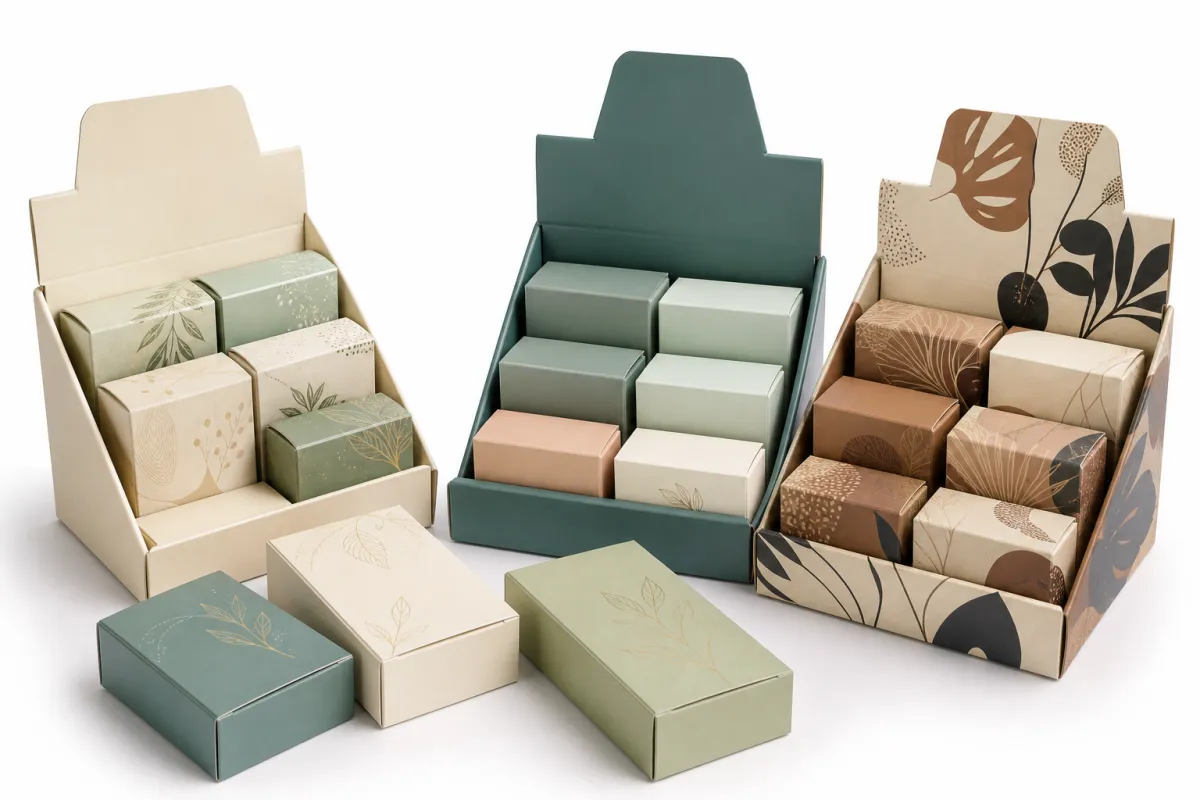
Retail space costs real money. That fact changes everything. If a countertop or shelf slot has only a few inches to work with, custom display boxes wholesale becomes a way to buy visibility without paying for extra square footage. The box becomes part of the selling system. It presents the product, organizes the inventory, and tells staff what is ready to refill.
A display box can also change how often a product gets picked up before the product itself changes at all. Shoppers do not always walk in knowing what they want. They stop, scan, and react. A sharp display, strong branding, and a clean front panel can grab attention fast. That matters most for impulse items, seasonal runs, accessories, and small packaged goods where the decision happens in seconds. In that setting, custom display boxes wholesale is doing real work on the floor.
Wholesale display packaging also lowers labor. Staff can restock by the tray instead of handling each unit. That sounds minor until the store is busy and the display needs to stay neat. A unit that takes 90 seconds to restock instead of 15 does not just cost more labor. It also gets left half-full, crooked, or ignored when the floor gets hectic. Good retail packaging keeps products aligned, visible, and easier to count. That is not a branding slogan. That is operations.
Damage is the other place where display packaging earns its keep. Loose stacks in shipping cartons usually take more abuse than products sitting in a purpose-built display structure. Better fit, divider board, and reinforced bases can reduce scuffs and crushed corners. A display will not replace every shipping safeguard, and nobody should pretend otherwise, but it can cut the handling damage that eats into margin. For custom display boxes wholesale, that matters just as much as shelf appeal.
Display cartons also make inventory easier to audit. A retail associate can see remaining stock at a glance, which reduces over-ordering and keeps fast movers from running dry. Faster replenishment, cleaner sorting, stronger impulse appeal, fewer damaged units. Those are concrete outcomes, not marketing fluff. That is why serious buyers keep coming back to custom display boxes wholesale for launches and repeat retail programs.
The cheapest quote is not the lowest landed cost if the display takes too long to assemble, ships badly, or falls apart after the first restock.
Brand value matters too, even if people love to act like it does not. A plain corrugated shipper says, "This is inventory." A branded display says, "This is worth noticing." That difference affects perceived quality, and perceived quality affects conversion. For custom printed boxes used as display packaging, the presentation is part of the product experience. Good branded packaging can make a small item feel more deliberate, more giftable, and more worth the counter space.
For brands selling through multiple channels, custom display boxes wholesale can bridge online and offline presentation. The same artwork language used in product packaging can carry into retail packaging, so the shelf display feels like part of a system instead of a one-off print job. Buyers like that because the line looks organized. Retailers like that because it is easier to shop.
The best part is that the display keeps doing the job after the sales rep leaves. That is where a lot of packaging either earns its keep or gets quietly blamed for the mess.
Custom Display Boxes Wholesale Product Options and Use Cases
There is no single display structure that fits every SKU. A lightweight lip balm, a boxed accessory, and a 2-pound pouch need different support. The best custom display boxes wholesale program starts with the product itself: size, weight, stackability, and how often people will touch it. Packaging design should follow those facts instead of fighting them.
Countertop displays are often the quickest path to shelf presence. They work well in pharmacies, convenience stores, beauty counters, and checkout zones where space is tight and decisions happen fast. Floor displays make more sense for larger assortments, club-store programs, and seasonal promotions where the footprint can be bigger and the unit count higher. PDQ trays, short for "pretty darn quick" in retail language, are built for speed. Retail-ready display cartons focus on getting a case onto the shelf with minimal handling. Multi-compartment units separate SKUs, colors, or flavors without depending on loose dividers. Those are the core categories in custom display boxes wholesale.
Use case matters as much as structure. Trade shows need lightweight displays that assemble quickly and survive repeated handling. Beauty counters want cleaner front panels, better graphics, and finishes that feel more polished. Pharmacy shelves care about legibility and easy replenishment. Seasonal retail wants quick turnaround and graphics that can change without rebuilding the whole structure. A buyer comparing custom display boxes wholesale options should think about channel behavior first and box shape second.
The structure itself changes performance. Tear-off fronts make it easier to turn a shipping carton into a display. Divider boards keep small units from slumping. Reinforced bases help a display hold up under product weight and customer interaction. Inserts stop bottles, packets, or cartons from shifting during transit. Those details are not decorative. They are the difference between a display that merely looks good and one that stays useful on the shelf. For custom printed boxes in wholesale runs, structure and print need to work together.
Sometimes a standard structure is the smarter move. If the product fits cleanly into a common counter tray or shelf-ready tray, using an existing dieline can reduce setup time and tooling cost. If the product is heavy, tall, tapered, or fragile, a fully custom dieline usually earns its keep. In those cases, custom display boxes wholesale lets you tune the dimensions, insert depth, and load path to the product instead of forcing the product into a generic shell.
I have seen brands spend more on a fancy custom build and still get beat by a plain tray that fit the shelf better. That is not a design failure. It is a planning failure.
Here is a practical way to think about the choice:
- Countertop display - Best for impulse items, small cartons, cosmetics, and add-on products near checkout.
- PDQ tray - Best for quick retail conversion, case packs, and fast shelf replenishment.
- Floor display - Best for multi-SKU assortments, launch programs, and seasonal promotions.
- Retail-ready tray - Best when the retailer wants minimal labor and fast setup.
- Multi-compartment unit - Best for mixed products that need clear sorting and presentation.
For broader format planning, Custom Packaging Products can help buyers compare display packaging with other retail packaging structures before they commit to one direction. That comparison matters because not every item needs a fully custom build. Sometimes a modified standard with better graphics, a stronger board grade, and cleaner merchandising does the job better. The point of custom display boxes wholesale is not to make the structure complicated. It is to make it fit.
Materials, Printing, and Structural Specifications
Material choice drives a big chunk of both performance and price. For lightweight retail displays, SBS paperboard is common because it gives strong print quality and a clean surface for branded packaging. For heavier products or units that need better shipping strength, corrugated board is usually the better choice. Kraft board can work well when a natural look is part of the packaging design. Paperboard is often selected for custom printed boxes where visual presentation matters more than load-bearing strength, while corrugated structures are chosen when protection matters most.
For many custom display boxes wholesale projects, the board grade does more than hold the product. It changes how the print appears, how the finish behaves, and how the box resists scuffing. A 16pt SBS display tray feels different from an 18pt board display or an E-flute corrugated unit. That difference shows up in folding, freight performance, and how the structure holds up after repeated restocking. Buyers miss this all the time. The mockup looks close enough, then the store version behaves differently. Funny how that works.
Printing choices matter just as much. CMYK works well for full-color photography and broad artwork coverage. PMS spot colors are better when brand consistency is non-negotiable and one specific tone has to stay exact across product packaging and retail packaging. Full-bleed artwork gives stronger shelf impact, but it can increase waste if the layout is sloppy. Barcode placement should be planned early, not bolted on later. If the display must scan at receiving or in inventory systems, the code needs to stay visible and readable after assembly. For custom display boxes wholesale, print planning is part of the structure, not a separate chore.
Finish selection changes appearance and durability. Matte coatings cut glare and give a more restrained look. Gloss makes color pop and can work well for beauty, candy, or seasonal promotions. Soft-touch feels premium, but it usually costs more and can show handling marks differently than standard coatings. Aqueous coating is a practical middle ground for many programs. UV varnish can boost highlight contrast and protect high-wear areas. If the display will get touched a lot by shoppers or staff, scuff resistance matters just as much as visual style. That is one reason custom display boxes wholesale often gets specified around the retail environment instead of the mood board.
Buyers should also define structural details before asking for a quote. The right spec set usually includes:
- Exact product dimensions, including any overhang or odd shape.
- Product weight per unit and total load per display.
- Count per display and how the product will be arranged.
- Assembly style, such as flat-pack, fold-and-lock, or pre-glued.
- Whether the display needs tear-off panels, headers, or inserts.
- Shipping method and whether the unit must survive parcel, pallet, or mixed freight.
There is a compliance side to this, too. Shelf-ready perforations, clear product windows, and flat-pack shipping compatibility can make a display easier for retailers to approve. If the project needs sustainability documentation, FSC chain-of-custody support may matter, and buyers can review guidance from the Forest Stewardship Council during sourcing. For transit performance, some teams also ask whether the structure has been considered against relevant testing paths such as ISTA protocols. That does not guarantee success, but it does move the conversation from guesswork to engineering. In custom display boxes wholesale, that is a much better starting point.
One final point: the strongest material is not always the right material. If the display sits on a counter for a short promotional run, an overbuilt corrugated structure may burn budget for no good reason. If the unit ships long distances and gets handled repeatedly, a thinner board may fail early. The right answer depends on product weight, retail environment, and the finish you want on the shelf. That holds true for custom printed boxes and display cartons alike.
That is the part people skip when they are staring at a quote sheet. The board spec is not just a line item. It is a decision about how much abuse the display is expected to take before it starts looking tired.
Custom Display Boxes Wholesale Pricing and MOQ
Pricing for custom display boxes wholesale comes down to a small set of variables that matter more than the rest: material grade, size, structure type, print coverage, finishing, and order volume. If two quotes look similar but one includes thicker board, richer coating, and a more complex die cut, they are not really comparable. The lowest line item can hide a higher total cost if assembly labor, setup charges, or freight are bigger on the back end.
In practical terms, unit price usually drops as quantity rises. That part is no mystery. Setup cost gets spread over more pieces, so the per-unit figure falls. The break-even point can shift if the structure is highly custom or the finish is premium. A simple PDQ tray might price well at 1,000 units and improve again at 5,000. A large floor display with shelf inserts may not see the same drop because material use and labor are higher. That is why custom display boxes wholesale quotes should be reviewed by quantity tiers, not by a single number.
MOQ is another place where buyers need to stay practical. Standard shapes and simple print setups often allow lower minimums than fully custom structures. A startup launch may begin with a few hundred units, especially if the design uses an existing dieline. A multi-SKU retail rollout may need 1,000 or 2,500 pieces to make the math work. For custom display boxes wholesale, MOQ reflects setup cost, tooling complexity, and production efficiency. It is not just a supplier mood swing.
Here is a useful way to compare option levels without mixing up different products:
| Display type | Typical use | Indicative wholesale range | Notes |
|---|---|---|---|
| Retail-ready PDQ tray | Checkout, pharmacy, convenience | $0.22-$0.48 per unit at 5,000 pcs | Best when speed and low labor matter more than premium finishes. |
| Printed countertop display | Cosmetics, accessories, small goods | $0.28-$0.65 per unit at 5,000 pcs | Good balance of shelf impact and manageable cost. |
| Corrugated counter display | Heavier items, longer shipping lanes | $0.42-$0.95 per unit at 5,000 pcs | Higher strength, better shipping durability, often E-flute or similar. |
| Floor display with header | Seasonal or multi-SKU retail programs | $3.50-$8.50 per unit at 1,000 pcs | Pricing varies sharply with size, shelf count, and print coverage. |
Those numbers are planning ranges, not promises. A complex finish, large artwork area, or odd structure can move them fast. Shipping matters too. A quote that looks good before freight can lose the advantage once palletizing, destination, and delivery timing are included. Buyers comparing custom display boxes wholesale should ask for landed cost, not just a factory number. That one change makes the comparison far more honest.
There are ways to control cost without weakening the display. Simplifying color counts helps. Standardizing dimensions across multiple SKUs reduces tooling variation. Moving from soft-touch to aqueous coating can preserve the look while improving budget efficiency. Adjusting board thickness can cut expense if the product load is modest. A cleaner artwork layout may reduce print waste. None of these should be done blindly, but they are worth testing when the goal is to keep custom display boxes wholesale cost-effective.
If you need a wider buying path, Wholesale Programs can help compare program levels, quantity bands, and repeat-order planning before you lock in a structure. The best wholesale decision is not always the cheapest first order. It is the one that gives you the right mix of price stability, production consistency, and retail performance over the life of the product.
Ask every supplier for the same spec set: dimensions, material, print colors, finish, quantity, sample cost, and shipping method. If those inputs do not match, the quotes do not mean the same thing.
From Quote to Delivery: Process and Timeline
The cleanest custom display boxes wholesale projects follow a predictable workflow. First comes the specification request. Then an estimate. Then structure approval. After that, artwork review, proofing, sampling, production, and shipping. If a supplier cannot explain those steps clearly, the buyer usually pays for the confusion later. A structured process does more than save time. It keeps avoidable rework out of the schedule.
Fast quoting starts with complete information. Product dimensions, target quantity, artwork files, print method, preferred finish, deadline, and destination all help. A vendor can estimate more accurately when those basics are available. If the package has to fit a retail fixture or a known shelf height, include that too. For custom display boxes wholesale, a half-finished brief usually creates the same delay twice: once in quoting and again in sampling.
Typical timeline stages often look like this: estimate in 24-48 hours for straightforward projects, structure approval in a few days, sample or prototype in 5-10 business days, production in roughly 12-20 business days after proof approval, and transit on top of that. The exact timing depends on complexity, factory load, and shipping route. If the display includes unusual insert work or premium finishing, build in more time. That is especially true for custom printed boxes with heavy artwork coverage or special die cuts.
There is a real difference between a standard sample, a printed proof, and a production run. A standard sample checks fit and function. A printed proof checks color placement, barcode position, and layout balance. A full production sample is closer to the final build and helps when a retailer requires sign-off or when the unit is unusually heavy. Buyers of custom display boxes wholesale should know what each stage confirms, because approving the wrong stage can leave a functional problem hidden until the full run is already in motion.
Delays usually show up in a few places. Dieline revisions take longer than expected when the product changes after the first draft. Artwork approval slows when multiple stakeholders weigh in on color, copy, or compliance text. Sampling stalls if the brand gives vague feedback. Shipping adds friction if the delivery address is unclear or the receiving window is tight. In other words, the production schedule is only as good as the decisions around it. That is true for custom display boxes wholesale whether the order is 500 units or 50,000.
If the order is urgent, the answer is usually simplification, not miracles. A stock structure can cut design time. Press-ready artwork can reduce revision cycles. Fewer special finishes can speed production. A flat-pack format may improve freight speed and lower damage risk. None of those choices fit every brand, but they are often the difference between making a launch date and missing it. For wholesale display packaging, speed usually comes from clarity.
One practical tip: keep a short approval checklist. Confirm dimensions, quantity, material, finish, barcode placement, shipping method, and final sign-off date before production starts. That small habit saves a lot of back-and-forth later. It is not glamorous. It works. That is why custom display boxes wholesale projects stay on schedule when the boring details get handled early.
In my experience, the teams that move fastest are not the ones rushing. They are the ones who know what they are approving and do not keep changing the target every two days. Amazing concept, I know.
Why Choose Us for Custom Display Boxes Wholesale
What matters most in a wholesale packaging partner is not the loudest promise. It is the ability to produce the same result again and again. For custom display boxes wholesale, that means consistent dimensions, stable print quality, accurate dielines, and a proofing process that catches structural issues before production begins. Buyers do not need marketing fog. They need packaging that shows up ready for retail.
Experienced support reduces avoidable rework. If a display panel is too shallow, if the insert spacing is off by a few millimeters, or if the base board is not strong enough for the product weight, those problems are much cheaper to solve before production starts. A good manufacturing process checks those risks early. That is why packaging engineering matters so much in display packaging. It is also why the best custom display boxes wholesale programs usually include a dieline review, not just an artwork upload.
In-house support also helps with the details buyers often underestimate. Artwork checks confirm whether bleeds are correct and whether the barcode stays readable. Material selection clarifies when paperboard is enough and when corrugated board is the better answer. Shipping coordination helps avoid damage and timeline drift. When the supplier handles those moving parts well, the buying team can spend more time on sales planning and less time chasing status updates. That is real operational value in branded packaging.
Service quality should be judged against what buyers actually need: predictable lead times, clear communication, and stable pricing. A lot of suppliers can quote a price. Fewer can hold a schedule when the project changes. Fewer still can keep quality stable across repeat orders. For custom display boxes wholesale, that consistency often matters more than saving a small amount on the first order. One missed launch can cost more than several cents saved per unit.
Repeat-order support matters too. Seasonal programs often come back with only a few edits. Multi-SKU lines may expand over time. Retail buyers may ask for a slightly different footprint or a graphics update. A partner who keeps previous specifications organized can move faster on those reruns. That matters for both custom printed boxes and display structures because the second order should be easier, not harder, than the first.
There is one more trust signal worth paying attention to: sample availability. A supplier that can produce a structural sample or a printed proof gives the buyer a real chance to confirm fit, assembly, and shelf behavior. That is especially useful for launches and retailer approvals. If the display is tied to a promotion with a fixed start date, a sample can prevent expensive surprises. For custom display boxes wholesale, that confidence is worth more than a glossy promise.
The goal is simple: the box should help the product move, not become another headache on the receiving dock. If a supplier understands that, the rest gets easier.
A good packaging partner should talk like an engineer, not a brochure. If the answer is always "yes" without asking about load, shelf height, or shipping method, that is not service. That is guesswork with nicer lighting.
Next Steps for Ordering Custom Display Boxes Wholesale
If you are ready to move forward, start with the facts. Gather product dimensions, quantity, preferred structure, target launch date, and any retail compliance notes before requesting a quote. The more complete the brief, the faster the response and the more useful the pricing. That is especially true for custom display boxes wholesale, where a small difference in size or finish can shift the quote enough to change the buying decision.
Next, prepare the artwork files and brand colors. If you already know the print method, include that too. It is also smart to ask for a dieline before final art placement, because the structure can affect where key graphics and barcodes belong. For many buyers, the best next step is to request three things at once: a sample, a dieline, and a landed-cost estimate. That gives a clearer picture of fit, appearance, and total value than a unit price alone.
A short decision checklist can keep the order moving:
- Confirm the board material and thickness.
- Choose finish level, from matte or gloss to soft-touch or UV.
- Set MOQ expectations against your launch volume.
- Review shipping method and receiving constraints.
- Approve artwork only after barcode and bleed checks.
- Lock the timeline before production begins.
If your program includes multiple SKUs or future replenishment runs, build the structure with repeat ordering in mind. A good wholesale display program should be easy to reorder, easy to store, and easy to explain to retail partners. That is where custom display boxes wholesale shows its real value: not just in the first shipment, but in the next one and the one after that.
The smartest buyers do not just compare quotes. They compare the full path from concept to shelf. That means structure, print, finish, MOQ, shipping, and approval timing all deserve equal attention. Once those pieces line up, custom display boxes wholesale can do what it is supposed to do: improve visibility, reduce handling friction, and support the sale without making the retail team work harder than necessary.
So the practical move is simple: define the product, confirm the shelf constraints, and get a sample before you commit to a full run. That is how you avoid pretty-looking packaging that falls apart in a real store.
Frequently Asked Questions
What is the usual MOQ for custom display boxes wholesale?
MOQ varies by structure, size, and print complexity, but wholesale runs usually start where setup costs can be spread across the order. Standard shapes and simpler finishes often allow lower minimums than fully custom structures. Ask for pricing at multiple quantities so you can see the cost jump between the first run and scale pricing for custom display boxes wholesale.
How do I get the best price on custom display boxes wholesale?
Use the same specs when comparing quotes: dimensions, material, finish, print colors, and quantity. Simplify the structure or reduce special finishes if the display does not need premium embellishment. Ordering a larger quantity usually lowers the unit price more effectively than changing a small detail, especially on custom display boxes wholesale runs with setup charges.
How long does production usually take for wholesale display boxes?
Timeline depends on sample approval, artwork readiness, and the complexity of the box. A straightforward order moves faster if the dieline is approved quickly and files are press-ready. If you need the boxes by a fixed launch date, build in time for proofing and shipping, because custom display boxes wholesale projects often slow down at the approval stage rather than on the press floor.
Which materials are best for custom display boxes wholesale?
Paperboard works well for lightweight retail displays with strong print presentation. Corrugated board is better for heavier products or displays that must survive shipping and frequent handling. The right choice depends on product weight, retail environment, and the finish you want on the shelf, which is why material selection is central to custom display boxes wholesale planning.
Can I order a sample before placing a wholesale run?
Yes, and it is often the safest way to confirm size, structure, print placement, and assembly. A sample helps catch fit issues before production, especially for multi-item or heavy-product displays. Requesting a sample is especially useful when the order is tied to a launch or retailer approval, and it is a smart step in almost every custom display boxes wholesale purchase.
For buyers comparing options across channels, the right display is the one that fits the product, the shelf, and the budget without creating extra work downstream. That is the real test of custom display boxes wholesale: strong presentation, sensible pricing, and a production path that stays predictable from quote to delivery. Start with a sample, insist on the same spec set for every quote, and choose the structure that will still work after the first restock. That's the part that usually separates a good display from a costly mistake.

