Buyer Fit Snapshot
| Best fit | Recyclable Display Boxes Wholesale for Retail Packaging projects where brand print, material claims, artwork control, MOQ, and repeat-order consistency need to be specified before quoting. |
|---|---|
| Quote inputs | Share finished size, material target, print colors, finish, packing count, annual reorder estimate, ship-to region, and any compliance wording. |
| Proofing check | Approve dieline scale, logo placement, barcode or warning zones, color tolerance, closure strength, and carton packing before bulk production. |
| Main risk | Vague material claims, crowded artwork, missing packing details, or unclear freight terms can make a low unit price expensive after revisions. |
Fast answer: Recyclable Display Boxes Wholesale for Retail Packaging should be specified like a repeatable production item. The safest quote records material, print method, finish, artwork proof, packing count, and reorder notes in one written spec.
Production checks before approval
Compare the actual filled-product size with the drawing, then confirm tolerance on folds, seals, hang holes, label areas, and retail display edges. Reserve space for logos, QR codes, warning copy, and material claims before decorative graphics fill the panel.
Quote comparison points
Review material grade, print process, finish, sampling route, tooling charges, carton quantity, and freight assumptions side by side. A quote is only useful when the supplier can repeat the same color, closure quality, and packing count on the next order.
The most expensive display is rarely the one with the highest unit price. It is the one that eats up labor, arrives damaged, or starts sagging before the promotion has a chance to earn its keep. That is a big reason recyclable Display Boxes Wholesale keep getting attention from retail teams: one well-built structure can handle branding, merchandising, and shipping efficiency at the same time, while giving store staff one less thing to assemble, move, or toss out.
Buyers usually look at these programs with a pretty practical eye. recyclable display boxes wholesale can ship flat, assemble quickly, and still stand up to real retail abuse like replenishment, customer handling, and the occasional rough trip through a stockroom. Brands that care about a cleaner store message often care less about polished buzzwords and more about what the display actually does on the floor. If it sells the product, protects the shipment, and leaves behind an easier recycling path, it has done its job.
Custom Logo Things supports that kind of decision with Wholesale Programs built for repeat ordering and a broader range of Custom Packaging Products for branded retail presentation. The useful part is not theory. It is being able to match structure, board, print, and budget to the selling environment instead of guessing from a catalog image.
Why Recyclable Display Boxes Wholesale Win on the Shelf
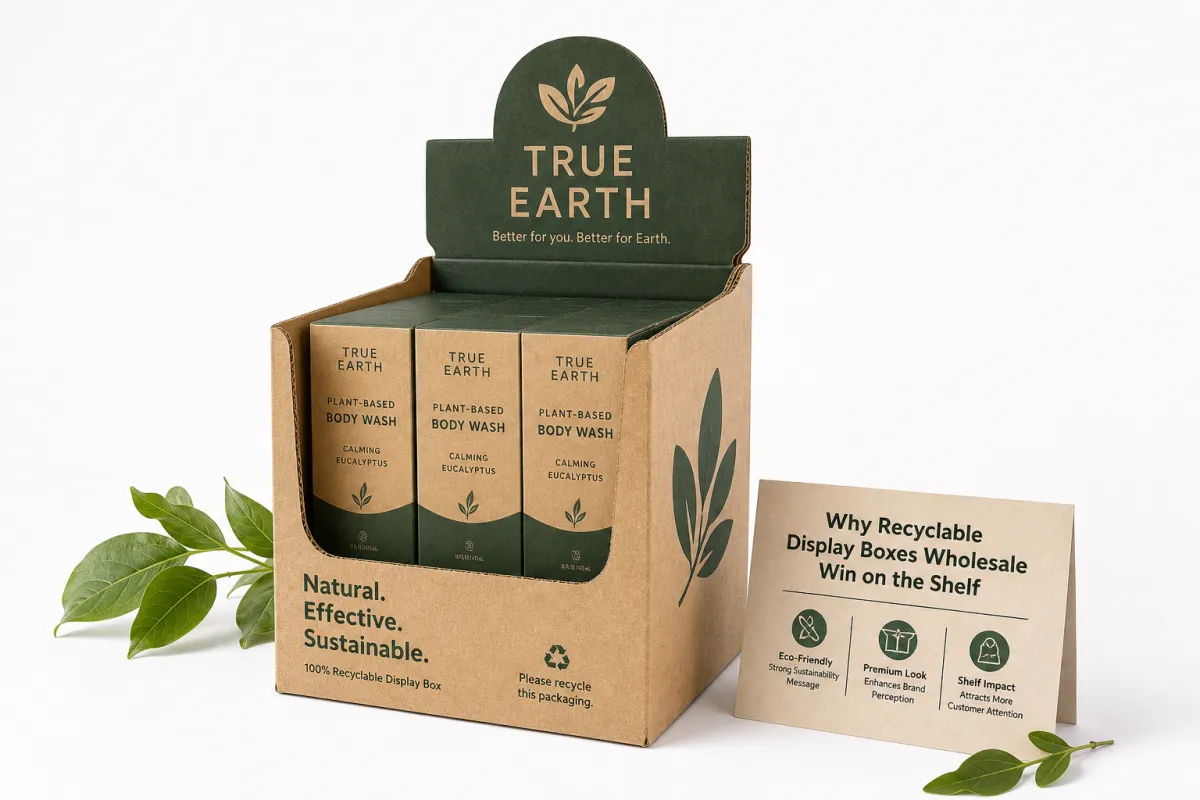
Retail shelves are crowded, and that is exactly where recyclable display boxes wholesale earn their place. A strong display box is not just a holder for product. It is often the first sales message a shopper sees and the last piece of store communication anyone has time to manage. The structure has to do more than contain items. It needs to announce price, category, and urgency in a few seconds, while still looking tidy after a week on the floor.
The labor savings are easy to miss until a buyer compares setup time across a chain. A carton that ships flat, opens cleanly, and serves as its own signage can replace separate tickets, loose trays, or temporary plastic fixtures. Across dozens or hundreds of stores, that difference starts to matter. If an associate can set a display in under a minute instead of hunting for parts and piecing together a mixed fixture, the saved time adds up fast. recyclable display boxes wholesale are attractive because they compress those tasks into one package and make the store process easier to repeat.
Standard shipping cartons move product well. Plastic fixtures can look polished in a permanent installation. Neither one usually gives the same blend of cost control, print coverage, and end-of-season disposal convenience. A recyclable display structure reduces friction at receiving, at merchandising, and again when the promotion ends. Procurement teams notice that, even when the marketing group is focused on the artwork.
There is another reason buyers keep moving toward recyclable display boxes wholesale: sustainability expectations have become part of the buying brief, not an optional talking point. Retailers want cleaner materials, clearer recycling pathways, and fewer mixed components. Paper-based display units make that discussion easier because they can often fit into paper recovery streams when the structure is built correctly. The important word is correctly. A recyclable display box earns its place because it respects the shelf, the warehouse, and the waste bin.
Some brands still make the choice more complicated than it needs to be. They chase premium fixtures before they understand the real value of fast setup, efficient shipping cube, and consistent assembly. A display only needs to be as complex as the product demands. For many launches and seasonal runs, recyclable display boxes wholesale deliver a stronger return because they balance presence with discipline.
"If a display cannot be built fast, filled fast, and removed fast, the store ends up paying for it somewhere else."
That is a plain statement, yet it matches what buyers usually discover during a pilot run. The display that wins is not always the most ornate. It is the one that survives the pace of real retail.
Recyclable Display Boxes Wholesale: Product Formats and Uses
recyclable display boxes wholesale come in several formats, and the right one depends on product weight, SKU count, store traffic, and how much labor the retailer can spare. The format shapes the selling job. A countertop display works differently from a floor unit, and a sidekick arrangement behaves differently from a PDQ tray. If the box format does not fit the product and the environment, the display becomes clutter instead of conversion.
Countertop display boxes are common for small, impulse-friendly items such as lip balm, travel-size toiletries, snack packs, mints, and accessories. They sit close to the point of decision, which means graphics and product access matter in equal measure. Floor display boxes handle larger assortments or heavier products, especially in clubs, discount chains, and mass retail. Sidekick units extend from a shelf or fixture and often carry accessories, small consumables, or promotional add-ons. PDQ trays are built for quick replenishment, while dump bins are useful for bulk promotions, seasonal overstock, and grab-and-go assortments.
recyclable display boxes wholesale also work across a wide range of categories:
- Cosmetics: compact units with die-cut fronts, clean print, and easy refill access.
- Snacks: stronger bases, product visibility, and top-loading convenience.
- Supplements: tamper-conscious layouts, clear panel messaging, and stable stacking.
- Accessories: hang tabs, partition inserts, and a small footprint for counter use.
- Seasonal promotions: fast setup, bold graphics, and short-run flexibility.
Structure changes selling power more than many buyers expect. A die-cut window can reveal color or texture. A front lip can keep product from sliding forward. Tear-away panels can convert a shipper into a display in seconds. Reinforced bases matter for dense products such as bottled supplements, mini devices, or bundled kits. Insert design matters just as much. If the insert is too loose, the product drifts. If it is too tight, staff will avoid restocking it. recyclable display boxes wholesale give enough structural room to solve those problems before they show up in the store.
The best formats are designed with logistics in mind as well. Flat-packed units reduce warehouse pressure. Clean scoring lines speed up assembly. Retailer-friendly pack counts lower handling time during store launches. If a program is meant to run across several regions, consistency matters as much as visual appeal. Buyers do not want one version for the pilot and a different version for the full rollout unless the product truly calls for it.
That is why recyclable display boxes wholesale are often chosen for chain programs and regional test markets alike. They are flexible enough for a small pilot and repeatable enough for scale. That combination is hard to beat.
Recyclable Display Boxes Wholesale Specs That Affect Performance
Material choice is where many recyclable display boxes wholesale programs succeed or fail. A buyer may focus on artwork and price, but the board grade decides whether the unit feels crisp on the shelf or starts bending after a few replenishments. The most common material families are kraft board, SBS, corrugated, and recycled-content paperboard. Each one has a place.
Kraft board works well when a brand wants a natural look and a straightforward recycling story. SBS gives a smoother print surface and stronger color reproduction, which is why it is often chosen for premium cosmetics, health products, and high-graphic retail displays. Corrugated is the workhorse for heavier or bulkier displays. Recycled-content paperboard can be a strong middle ground when the goal is to balance appearance, cost, and environmental credentials.
Finish options deserve attention too. Aqueous coating is common because it protects the print without creating a difficult recycling issue. Matte lamination can create a refined look, but buyers should confirm whether the target recycling stream accepts the finish or whether a paper-only specification is the better fit. Print varnish can add scuff resistance and give artwork cleaner separation. In recyclable display boxes wholesale, the finish should support the display, not get in the way of recovery.
Several structural specs are worth checking before approval:
- Board thickness: 14pt, 18pt, 24pt, and heavier corrugated builds each suit different load requirements.
- Flute style: E-flute is common for retail presentation, while B- or C-flute structures can carry more weight.
- Load capacity: a display for lightweight lip products needs a different base than one holding glass bottles or boxed kits.
- Locking tabs: these speed assembly and keep the structure stable without extra hardware.
- Insert design: partitions, risers, and support inserts keep product from shifting during shipping and handling.
Print strategy affects performance as well. CMYK is the default for most branded graphics, but spot colors can keep logos crisp and consistent across high-volume runs. Full-wrap graphics create a stronger billboard effect, though they can increase prepress time and make panel alignment more important. Heavy ink coverage can influence cost and drying time, especially on thicker board. That matters in recyclable display boxes wholesale programs where production speed and visual impact have to work together.
On the sustainability side, the simplest rule is usually the best one: avoid mixed materials unless they solve a real performance problem. Plastic windows, metalized layers, or oversized lamination can complicate recycling. If a buyer wants a cleaner end-of-life path, the structure should use one primary fiber-based material wherever possible. Recycling practices vary by region, so a display should be specified with the local recovery stream in mind rather than on a generic assumption.
There is also a standards angle. Display packaging that travels through distribution can be tested for handling performance, and many buyers compare structures against ISTA-style transit expectations. The ISTA testing framework gives teams a useful way to ask a more practical question: will this survive the trip from warehouse to shelf?
That is the real filter for recyclable display boxes wholesale. Pretty is not enough. The unit has to keep its shape, support the product, and still make sense when the promotion ends.
Pricing, MOQ, and Unit Cost for Wholesale Programs
Pricing for recyclable display boxes wholesale is not mysterious, but it is easy to misread if quotes are compared line by line without matching the build. The main cost drivers are material choice, board grade, print method, dimensions, finishing, packaging configuration, and order volume. A small countertop display with one-color print does not live in the same cost family as a fully printed floor unit with inserts and Custom Die Cuts.
MOQ, or minimum order quantity, usually changes based on how custom the structure is. A standard-size tray may run at a lower threshold than a large branded floor display. Print setup, tooling, and material waste all influence the number. Buyers sometimes ask for one simple MOQ answer, but that rarely helps. A more practical way to think about it is this: the more unique the dieline and print setup, the more volume the order needs before the numbers make sense. That is true for most recyclable display boxes wholesale programs.
Here is a buyer-focused comparison that helps separate format from value:
| Display Format | Typical Build | Common MOQ Range | Indicative Unit Cost | Best Fit | Notes |
|---|---|---|---|---|---|
| Countertop display box | 14pt SBS or lightweight corrugated | 250-1,000 | $0.22-$0.55 | Impulse items, cosmetics, travel goods | Fast setup and strong front-facing print matter most |
| PDQ tray | Paperboard with simple locking structure | 500-5,000 | $0.18-$0.42 | Replenishment, club stores, multipacks | Efficient for shelf-ready shipping and quick refill |
| Sidekick unit | Paperboard or corrugated with hang features | 1,000+ | $0.60-$1.50 | Accessories, add-on items, aisle merchandising | Retailer fixture approval may be required |
| Floor display box | 18pt to E-flute or stronger corrugated | 500-2,000 | $1.20-$3.80 | Heavier products, multi-SKU promotions | Base reinforcement and transit performance are critical |
| Dump bin | Corrugated with reinforced base | 250-1,000 | $1.50-$4.00 | Seasonal promotions, bulk display, clearance | Needs stability and high-capacity fill volume |
The table is helpful, but it is only the opening pass. A slightly higher unit price can still lower total program cost if it cuts assembly time, damage, or replacement rates. That is where many recyclable display boxes wholesale decisions get smarter. A display that saves 30 seconds per store may look more expensive on paper, yet it can become the less costly option once labor is included. Retail buyers know this. Procurement teams usually appreciate it once the math is laid out clearly.
When comparing quotes, ask for the full landed picture:
- Price per piece at your target quantity
- Tooling or dieline charges, if any
- Sample or prototype cost
- Freight and packaging cost
- Rush fees or reprint contingencies
That approach makes it easier to compare recyclable display boxes wholesale suppliers fairly. A low unit price is not a bargain if freight is unpredictable or the structure needs extra manual assembly. Buyers should think in terms of program cost, not just carton cost.
"The cheapest quote is not always the cheapest program. The real number is what the display costs after freight, assembly, and store handling."
Process, Timeline, and Lead Time From Quote to Delivery
The order flow for recyclable display boxes wholesale should feel structured rather than improvised. The cleanest projects usually move through the same stages: brief, dieline confirmation, artwork review, sample approval, production, packing, and shipment. Skip one of those steps and the schedule usually pays for it later.
The first inquiry matters more than many buyers realize. If you provide product dimensions, target retail environment, quantity, print files, and the delivery date, the supplier can usually narrow the options quickly. That cuts down on back-and-forth. For recyclable display boxes wholesale, speed is not only a manufacturing issue. It is often a briefing issue.
Lead time changes with the complexity of the build. A simple tray with standard print may move quickly after proof approval. A custom floor display with multiple inserts, special finishes, or retailer-specific requirements will take longer. Physical samples add time, but they also reduce risk. For buyers who need to present a prototype internally or to a retailer, that extra step is usually worth it. The same goes for artwork revisions. Small changes can move fast; larger structural changes always take longer.
From a planning point of view, the biggest schedule risks are usually approval delays rather than production itself. Once the brief is locked, material is available, and proof is signed off, the factory timeline becomes much more predictable. A realistic planning window for many recyclable display boxes wholesale orders is often around 12-15 business days from proof approval for straightforward builds, though more complex programs can take longer. Add time for shipping, receiving, store onboarding, and test merchandising. Those steps are part of the project, even if they are not part of the print run.
Here is a practical sequence buyers can use:
- Send dimensions, product weights, artwork, and quantity targets.
- Confirm structure, board grade, and finish choices.
- Review a sample or digital proof for fit and color accuracy.
- Approve the final version only after checking assembly and shelf presence.
- Build in delivery time for warehousing and store setup.
That sequence keeps recyclable display boxes wholesale programs from drifting into avoidable rush charges. It also helps the buyer separate what is urgent from what is simply unplanned.
A useful habit is to plan reorders before the first run is fully deployed. Seasonal displays and promotional units often need a second production round, and the second order is smoother if the original dieline and print file are already approved. That is one of the quiet advantages of working with repeatable recyclable display boxes wholesale structures.
Why Choose Us for Recyclable Display Boxes Wholesale
Buyers come to Custom Logo Things because they want packaging that can be explained internally and executed cleanly in the field. That sounds basic, but it is where many suppliers fall short. The best recyclable display boxes wholesale partner does not just print a box. It helps turn a retail objective into a structure that can be produced reliably, shipped efficiently, and set up without drama.
Design support is often the difference between a guess and a good decision. Structural guidance helps determine whether the display should use paperboard, corrugated board, partitions, or a different reinforcement pattern. Print consultation helps the artwork work with the material instead of fighting it. Sample development reduces the chance that a buyer finds a problem after full production starts. That matters especially for recyclable display boxes wholesale programs, where one bad structural choice can scale across hundreds of stores.
Quality control matters just as much as creativity. Wholesale buyers need consistent dimensions, consistent color, and consistent assembly behavior from one shipment to the next. If the first run fits and the second run drifts, the retailer notices. If the second shipment stacks differently in the warehouse, the operations team notices. Reliable recyclable display boxes wholesale supply is built on repeatability, not just good presentation.
That is why our team focuses on a few practical advantages:
- Clear quoting: line items that make cost comparisons easier.
- Structural accuracy: recommendations based on product weight and store use.
- Brand consistency: artwork and color attention across repeat orders.
- Retail fit: displays designed to work in real aisles, not just on a mockup screen.
- Program support: room for replenishment, updates, and future SKUs.
For buyers who need to move quickly, communication matters just as much as the build. A supplier should be able to answer questions about MOQ, sample timing, packaging configuration, and freight without making the process feel opaque. That is the standard we aim for with recyclable display boxes wholesale. It is also why many buyers prefer a supplier that can support both a first order and a repeat program without re-learning the entire spec sheet.
There is a second benefit that often gets overlooked: a structured supplier relationship can support retailer standards more easily. If the retailer wants cleaner fiber-based materials, a specific shelf-ready format, or a revised footprint, the supplier should be able to adjust without forcing a complete restart. That flexibility keeps the packaging program moving instead of stalling on revisions.
If you are comparing options, our Wholesale Programs can help you line up quantities and timelines, while our broader Custom Packaging Products catalog gives you a wider view of board styles and retail-ready formats. For many buyers, that is the quickest way to move from concept to a production-ready recyclable display boxes wholesale plan.
Next Steps to Order Recyclable Display Boxes Wholesale
The easiest way to get a strong quote for recyclable display boxes wholesale is to start with the facts. Gather the product size, approximate weight, quantity, display style, print requirements, and delivery destination before requesting pricing. That one step saves time on both sides and leads to better recommendations.
If the product is unusually heavy, fragile, or irregularly shaped, ask for a structural recommendation first. Do not force the display into a format just because it sounds familiar. A stronger base, a custom insert, or a different box style may cost a little more, but it can prevent product damage and store-level frustration later. In practical terms, recyclable display boxes wholesale should protect the sell-through, not just the shipment.
Reviewing a sample or digital proof is the next checkpoint. Confirm artwork placement, assembly method, panel dimensions, and retail fit. This is where many projects either gain confidence or expose a hidden issue. If the front lip obscures branding, or the base feels too narrow, that is the time to fix it. The same is true if the display needs to fit a very specific shelf or counter depth.
For seasonal and promotional programs, plan the reorder cycle early. A second run often moves faster than the first if the structure already exists, but the artwork still needs to be updated and approved. A buyer who thinks ahead can keep recyclable display boxes wholesale in motion without forcing last-minute revisions. That is a better use of time than chasing emergency production.
The practical path is simple:
- Send the product specs.
- Compare two or three build options.
- Approve the best structure and print direction.
- Set the production timeline with room for shipping and store onboarding.
Do that, and recyclable display boxes wholesale become much easier to manage. The project turns into a controlled packaging program instead of a series of guesses. That is the difference between a display that looks good on paper and a display that performs in the aisle.
What are recyclable display boxes wholesale made from?
They are typically made from recyclable paperboard, kraft board, or corrugated board, depending on the load, print needs, and retail format. The best choice for recyclable display boxes wholesale depends on whether the unit sits on a counter, ships flat, or needs extra strength for heavier products. Keeping the build to one primary fiber-based material makes recycling simpler and helps the display fit more cleanly into paper recovery streams, though local recycling rules still matter.
What is the usual MOQ for recyclable display boxes wholesale orders?
MOQ varies by box size, print setup, and whether the design is fully custom. Larger runs usually lower unit cost, while smaller programs may need a higher per-piece price to cover setup. Ask for MOQ alongside sample and tooling details so you can compare recyclable display boxes wholesale quotes on the same basis.
How long does it take to produce recyclable display boxes wholesale?
Lead time depends on proof approval, material availability, print complexity, and order volume. Simple layouts move faster than fully custom display structures with special finishes or inserts. Build in time for samples and revisions so your recyclable display boxes wholesale schedule stays realistic instead of getting squeezed by late approvals.
Can recyclable display boxes wholesale support heavy products?
Yes, if the board grade, structure, and base reinforcement are matched to the product weight. Corrugated or stronger paperboard designs are better for heavier items or high-touch retail environments. A supplier should confirm load limits before production begins, especially for recyclable display boxes wholesale used in floor or dump-bin formats.
How do I get an accurate quote for recyclable display boxes wholesale?
Share product dimensions, quantity, artwork files, finish preferences, and delivery location. Ask for pricing by unit, setup, sample, and freight so the total landed cost is clear. If you are comparing suppliers, use the same specifications for every quote to keep recyclable display boxes wholesale pricing comparable.
For brands that want retail presentation without unnecessary waste, recyclable display boxes wholesale offer a practical answer: faster setup, simpler disposal, cleaner merchandising, and a better fit with current store expectations. The best results come from matching the display style to the product weight, the store environment, and the true cost of handling, then locking that spec before the rush starts.


