Buyer Fit Snapshot
| Best fit | Custom Display Boxes Supplier projects where brand print, material claims, artwork control, MOQ, and repeat-order consistency need to be specified before quoting. |
|---|---|
| Quote inputs | Share finished size, material target, print colors, finish, packing count, annual reorder estimate, ship-to region, and any compliance wording. |
| Proofing check | Approve dieline scale, logo placement, barcode or warning zones, color tolerance, closure strength, and carton packing before bulk production. |
| Main risk | Vague material claims, crowded artwork, missing packing details, or unclear freight terms can make a low unit price expensive after revisions. |
Fast answer: Custom Display Boxes Supplier: Board, Finish, Dieline, and Unit Cost should be specified like a repeatable production item. The safest quote records material, print method, finish, artwork proof, packing count, and reorder notes in one written spec.
Production checks before approval
Compare the actual filled-product size with the drawing, then confirm tolerance on folds, seals, hang holes, label areas, and retail display edges. Reserve space for logos, QR codes, warning copy, and material claims before decorative graphics fill the panel.
Quote comparison points
Review material grade, print process, finish, sampling route, tooling charges, carton quantity, and freight assumptions side by side. A quote is only useful when the supplier can repeat the same color, closure quality, and packing count on the next order.
A display box can look terrific in a render and still vanish on the shelf. That usually happens for structural reasons, not because the artwork missed the mark. A Custom display boxes supplier may deliver a glossy, camera-ready piece of packaging, yet if the tray flexes under weight, the product sits too tightly, or the unit is awkward to restock, the display loses the fight before a shopper even notices the brand name. I have seen that happen with launches that looked polished right up until the first store reset. Then the pretty box turned into a problem.
The right custom display boxes supplier does far more than print board. Structure, material choice, finishing, dieline setup, production timing, and freight planning all shape the final result. Those choices affect shelf impact, pickup rate, and sell-through in ways a mockup can hide. A clean front panel paired with the wrong substrate still sags in transit, splits at a corner, or looks cheaper than a competitor's plain but well-built packaging. The difference between a counter display and a corrugated shipper is not cosmetic; it is operational, and the market tends to punish anyone who treats it otherwise.
Comparing vendors means comparing systems. Some suppliers are print-focused. Some are converters with solid equipment but limited advisory depth. A dependable custom display boxes supplier should speak clearly about packaging design, load-bearing needs, shipping limits, and finish tradeoffs without sounding scripted. That difference separates custom printed boxes that merely exist from Product Packaging That actually helps merchandise move. In practice, the best partners think like both engineers and merchandisers, which is a rare combination and kinda the whole point.
The practical side matters most. Below, I break down how a custom display boxes supplier usually works, what shapes pricing, how to compare quotes without getting fooled by incomplete numbers, and where buyers most often lose money. The concept is simple. The details carry the cost.
Why a Custom Display Boxes Supplier Matters More Than the Box
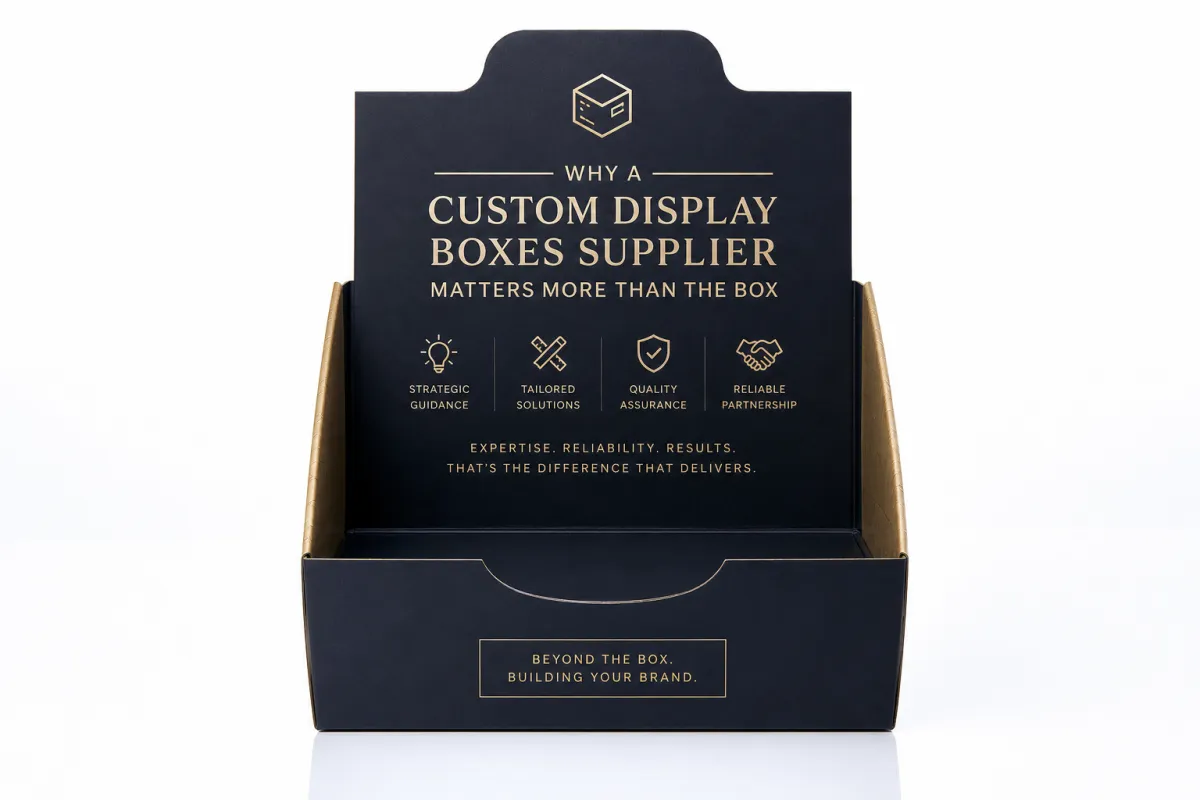
Retail display packaging has a blunt job: get noticed quickly and stay intact long enough to sell through. That sounds obvious until a counter display collapses after a second replenishment or a floor unit starts leaning like a tired signpost. A strong custom display boxes supplier understands that shelf presence and structural durability belong together. A bowed front panel reads as neglected. A torn tray tells the retailer the brand did not plan for real use.
The supplier shapes five outcomes that buyers often underestimate. Size and fit matter because the display has to match product weight and dimensions. Artwork placement matters because logos disappear into folds if the dieline is ignored. Finish matters because matte kraft, soft-touch lamination, and high-gloss coating tell very different brand stories. Durability matters because the unit has to survive pallet movement, back-room handling, and store resets. Assembly matters because a display that is frustrating to build often ends up half-used or ignored by retail staff.
Weak supplier decisions can hurt pickup rate while the packaging still looks fine in a render. That contrast is common in retail packaging. A display spends most of its life in ugly conditions: stacked on pallets, opened in a warehouse, dragged across fixtures, and touched by people who are not emotionally invested in the brand. The best custom display boxes supplier sits somewhere between engineer, print technician, and logistics planner. If a vendor can explain why a locking tab should be moved 3 mm or why a heavier board is worth the added freight, that is a real signal that they know the job.
A display that looks premium on screen and folds in a club store is not premium. It is expensive cardboard with a deadline.
If the roles seem fuzzy, the distinction helps. A packaging printer usually handles image output. A converter turns board into a finished form. A full-service custom display boxes supplier brings structure advice, material sourcing, printing, finishing, and production coordination into one accountable process. That matters because packaging branding often breaks down when three vendors each assume the other one solved the problem. I have watched a launch lose a week because no one owned the dieline revision. Nobody enjoys that meeting.
Reorders expose supplier quality fast. A good partner keeps the dieline, color targets, coating specs, and assembly notes on file. The second run should match the first run closely, not look like a distant cousin. For a broader packaging reference, the Institute of Packaging Professionals is useful for terminology and fundamentals without sales noise.
Sustainability can influence supplier selection too. If the display is going into a retail environment that watches sourcing closely, ask about FSC-certified board where appropriate and ask for plain-language explanations of substrate options. A reliable custom display boxes supplier should be able to talk honestly about traceability instead of waving around trendy labels. The FSC site explains what those claims actually cover, which is helpful because certification language can get fuzzy fast.
The box matters. The supplier matters more. The box is the result. The supplier is the process, and process is where most packaging failures hide.
How a Custom Display Boxes Supplier Handles the Process and Timeline
A competent custom display boxes supplier should outline the workflow before quoting a ship date. The usual path begins with product specs: dimensions, weight, unit count, retail setting, and whether the display needs to be counter-ready, floor-ready, ship-ready, or pallet-ready. After that, the supplier suggests a structure based on board strength, footprint, and how the retailer will actually use the unit. Artwork setup, proofing, sampling, production, and freight coordination follow. None of it is glamorous. All of it keeps the order from becoming expensive chaos.
Timeline depends on file readiness and the number of custom decisions still in motion. A straightforward proof-only project with clean art can move through review in a few business days. A full prototype usually takes longer because the supplier has to cut, fold, glue, test, and often adjust the structure before production begins. Full production commonly takes about 12 to 18 business days after proof approval, though quantity, coatings, and workload can push that number around. Add time if the design includes foil, embossing, or unusual die work. Packaging does not hurry just because the launch calendar feels urgent.
Most delays are predictable. Missing dielines burn days. Slow approvals burn weeks. Finish changes after proofing can force a remake of plates or cutting tools. Board shortages, coating delays, or freight bottlenecks can move delivery further out. A solid custom display boxes supplier should warn early if a requested material is tight in the market, not after promising a date that sounded good in email. That is where the cheap quote gets expensive.
Buyers often overlook the handoff points, yet those are the moments that reveal supplier discipline. Design feasibility comes first: can the structure carry the load and keep artwork out of critical folds? Print readiness follows: are barcodes, copy, bleed, and safe zones correct? Proof approval is next: does the sample match the brand color instead of simply matching the screen? Ship date confirmation closes the loop: do inventory, cartons, pallet specs, and transit time all line up?
Some brands ask about transit testing methods such as those covered by ISTA if the display has to survive distribution rather than just sit in a warehouse photo op. A custom display boxes supplier that understands those tests can save you from discovering weak corners after the shipment has already been battered by a truck ride and a retail back-room routine. I have seen a display pass a studio check and fail after one route to a regional DC; the difference was a very ordinary vibration cycle, not dramatic damage.
Fast turn is possible. It depends on discipline. The cleanest projects are the ones where the buyer sends complete specs on day one, the supplier confirms the structure immediately, and nobody decides to redesign the front panel after proofs are already circulating. A dependable custom display boxes supplier often saves more time by asking difficult questions early than a cheap quote does by sounding friendly.
Key Factors to Compare Before You Choose a Supplier
Comparing one custom display boxes supplier to another takes more than reading the bottom line on a quote. Materials, finishing, structure, minimum order quantity, and communication quality shape the real value. Leave those out and the numbers stop meaning the same thing. Teams then pick the cheapest option and discover later that the low price was attached to a lower-spec build. That happens more often than anyone likes to admit.
Material choice comes first. Corrugated board suits heavier loads, ship-friendly displays, and units that need more crush resistance. Paperboard or SBS works better for lighter products, crisp graphics, and small counter displays. Some projects use a hybrid structure: printed outer shell with corrugated support inside. A good custom display boxes supplier should explain why a 14pt board fits one project while a 1.5mm corrugated build makes more sense for another. If that explanation never arrives, keep looking.
Print and finish quality follows close behind. Color consistency matters because brand color is recognition, not decoration. Cut accuracy matters because sloppy trim makes even a premium design look undercooked. Lamination, spot UV, foil, and embossing can sharpen presentation, but each one adds cost and time. I have watched brands spend money on a flashy finish and then lose shelf visibility because the typography was unreadable from three feet away. Pretty does not equal effective.
Structural strength needs testing against real use. Ask how much weight the display is designed to hold, whether the tray can handle repeat stocking, and whether the footprint matches standard retail dimensions. If the display includes tear-away sections, those lines should be easy to follow without damaging the rest of the unit. A high-quality custom display boxes supplier will talk about load distribution, locking tabs, and glue points as practical issues, because they are practical issues.
MOQ and scalability can decide the project before the first proof lands. Some suppliers are comfortable at 250 units for a pilot. Others make sense only at 5,000 pieces or higher. Neither answer is automatically wrong. The economics simply differ. A seasonal promotion may only need a smaller run. A multi-store rollout needs a supplier that can scale without forcing a redesign every time the quantity changes.
Communication quality is probably the most underrated filter. A responsive custom display boxes supplier does more than answer quickly. They explain the tradeoffs plainly. They tell you if artwork will cross a fold, if a coating will raise cost, or if the timeline is unrealistic. That honesty saves money. Salespeople who say yes to every request usually collect the bill later, which is not exactly a feature.
What a decent comparison actually looks like
Use a real side-by-side review instead of guessing from a quote summary. Ask each custom display boxes supplier to confirm the same inputs: exact size, board type, print coverage, finish, assembly style, and shipping terms. If one quote includes a laminated outer shell and another leaves it out, the lower price is not lower at all. It is incomplete. A side-by-side sheet forces the conversation back onto facts, which is where it belongs.
Here is a simple comparison format that works well for buyers reviewing retail packaging options:
| Option | Typical Use | Typical Unit Price at 5,000 | Strength Notes | Best For |
|---|---|---|---|---|
| 14pt SBS counter display | Lighter products, small cosmetics, sample packs | $0.18-$0.32 | Crisp print, lighter load capacity | Short promotions, premium shelf visuals |
| E-flute corrugated display | Moderate-weight products, ship-to-store programs | $0.42-$0.78 | Better crush resistance, more durable in transit | Retail restocking, stronger shelf life |
| Hybrid printed shell with insert | Heavier products or high-value launches | $0.65-$1.20 | Better structure, more parts to assemble | Brand-heavy product packaging programs |
| Floor display with tear-away panels | Multi-SKU retail campaigns | $1.10-$2.40 | Largest footprint, strongest merchandising impact | Big-box retail, seasonal resets |
That table is not a quote. It is a tool for stopping people from pretending every Custom Printed Boxes project should cost the same. It should not. Different structures do different jobs, and the supplier should be able to explain why.
Ask whether the supplier owns or stores the dieline, tooling notes, and final art files. Reordering becomes easier if they do. If they do not, the next run turns into a scavenger hunt. A strong custom display boxes supplier treats file management as part of the product, not an afterthought. That kind of boring discipline is often what keeps a program from wobbling six months later.
What Does a Custom Display Boxes Supplier Charge?
Pricing from a custom display boxes supplier usually breaks into a few predictable buckets: material, printing, finishing, tooling, labor, packaging, and freight. The final number looks tidy. The road to that number is not. Buyers get into trouble when they ask for a unit price before settling size, board, finish, and quantity. That is like asking what a car costs before deciding whether it needs a hatchback body or a truck bed.
Size is one of the biggest drivers. A display holding six small jars does not use the same amount of board as a floor unit for larger bottles. Board grade matters too. Thicker or heavier board raises material cost, but it can lower transit damage and support better retail performance. Print coverage also changes pricing. Full-wrap graphics with dense ink coverage cost more than a simple one-color run. Add spot UV, foil stamping, or embossing and the number climbs again.
Quantity shapes the curve in a way many buyers dislike but manufacturing never hides. Small runs often look expensive because setup, plates, die cutting, and proofing are spread over fewer pieces. A run of 500 may carry a much higher per-unit cost than 5,000, even if raw material cost barely changes. That is normal. A trustworthy custom display boxes supplier should show the curve instead of pretending a tiny order shares the same economics as a production run.
Prototype pricing confuses buyers too. A sample or prototype often includes extra setup, test cutting, hand assembly, and sometimes expedited handling. It is not priced like production because it is not doing the same job. It exists to catch problems early. If the prototype costs more per unit than the final run, that is expected. A sample that reveals a weak tab or a color mismatch saves more money than a cheap sample that teaches nothing.
Then come the charges people call hidden only because nobody reads the quote closely. Shipping can be a major line item, especially for bulky display packaging. Palletization and special packing add labor. Rush fees apply when the calendar is already crowded. Extra proof rounds may cost more if the artwork keeps changing. Storage or split shipments can also change the total. A serious custom display boxes supplier should itemize these instead of burying them under a vague miscellaneous line and hoping no one notices. If the quote looks suspiciously tidy, I would ask a second time.
Practical budgeting ranges
For a straightforward counter display in a moderate quantity, buyers often see pricing in the low cents per unit for simpler materials and higher for more complex structures. Once stronger corrugated board, specialty finishes, or multiple print surfaces enter the picture, the range can move upward quickly. At higher quantities, setup cost spreads out and the unit price usually falls. At lower quantities, the reverse happens. That is manufacturing, not a trick, even if the spreadsheet makes it feel personal.
Here is a better way to budget with a custom display boxes supplier: ask for three scenarios. One at the lowest quantity you might accept, one at the target quantity, and one at the stretch volume if the launch goes well. That gives you a real price curve. It also helps you decide whether a pilot run makes sense before you commit to a larger order of custom printed boxes.
- Low scenario: useful for testing demand or a small retail pilot.
- Target scenario: the quantity you actually expect to order.
- Stretch scenario: the volume you would need if the display performs well.
That simple exercise often reveals whether a quote is genuinely competitive or merely dressed up to look friendly. A good custom display boxes supplier should not flinch when you ask for tiered pricing. Transparent pricing makes better decisions possible.
If your project depends on FSC-certified board, special coatings, or other sourcing requirements, ask early. Sustainability specifications can shift availability and cost. The supplier should explain whether the material can be traced and what certification language is actually supported. That is how branded packaging stays honest instead of drifting into marketing fluff.
Step-by-Step Guide to Ordering From a Custom Display Boxes Supplier
Ordering from a custom display boxes supplier gets much easier when you treat it like a process rather than a guess. The cleaner the brief, the fewer expensive revisions later. Most bad packaging orders start with vague emails and end with someone in finance asking why the display costs more than the product inside it. Avoid that by following a real sequence.
Step 1: Define the display job
Before sending anything, write down product weight, dimensions, SKU count, retail environment, target quantity, and launch date. Is the display going on a countertop near checkout, in a floor bay, or inside a club store where products get handled like gym equipment? A good custom display boxes supplier needs that context to recommend the right structure. Do not skip this. The box is not psychic, no matter how much people wish it were.
Step 2: Ask for a structure recommendation
After the supplier understands the brief, ask whether the design should be ship-ready, shelf-ready, or pallet-ready. Those are not the same thing. Ship-ready displays need more transit protection. Shelf-ready versions focus on fast merchandising and visual impact. Pallet-ready units are built for large-scale retail setups and usually need stronger board and more careful stacking. The right custom display boxes supplier should explain which approach fits the use case and why.
Step 3: Review the dieline and art proof
This stage is where people get lazy and later regret it. Check every copy line. Check barcode placement. Check safe zones, folds, and cut lines. Check whether the logo disappears into a crease or whether a product image gets chopped by a flap. A disciplined custom display boxes supplier will send a proof that shows where the artwork sits on the structure. Use it. Do not assume the factory will fix problems during production. That is how mistakes become expensive souvenirs.
Step 4: Approve the sample with the actual users in mind
If the display will be assembled by store staff or warehouse teams, ask those people to see the sample. A structure that looks clever in a sales presentation can become a headache in real life. Measure build time. If a simple counter unit takes more than a minute or two, the design may be too fussy. A competent custom display boxes supplier should care about that because assembly speed affects retail execution, and retail execution affects sell-through.
Step 5: Lock the order details in writing
Do not leave quantity, materials, finish, timeline, shipping terms, and revision rules scattered across emails. Put them into one written approval. Confirm what happens if a change comes in after proof signoff. Confirm who pays for rework if the issue came from late artwork changes. Confirm whether the supplier will palletize, carton-pack, or ship flat. A strong custom display boxes supplier makes this straightforward because confusion costs more than paperboard.
Experienced buyers rely on this sequence for a reason. It makes reordering easier, keeps expectations grounded, and gives everyone a paper trail. That matters in custom display boxes supplier relationships because problems are rarely mysterious. They are usually undocumented, or they were documented in three different inboxes and nobody noticed.
Keep your internal team aligned before proofs go out. Marketing, operations, and sales should not each request a different version of the display after the supplier has started tooling. That pattern pushes deadlines and raises costs. A little discipline now saves a lot of apology later, which is a nice trade in any department.
Common Mistakes Buyers Make With a Supplier
The first mistake is choosing the lowest quote without checking board grade, finishing, or assembly complexity. Cheap is not always cheap. It can become expensive very quickly if the display arrives underbuilt, needs a remake, or fails in retail. A smart buyer compares the actual spec from each custom display boxes supplier, not only the price line.
The second mistake is sending artwork before the structure is locked. That creates awkward label placement, hidden copy, and graphics that fight the folds. Packaging design is not a poster. It wraps, folds, and carries weight. If the dieline changes later, the art has to move too. A good custom display boxes supplier will usually tell you to wait on artwork until the structure is approved. That advice deserves attention.
The third mistake is ignoring the retail environment. Moisture, repeated handling, temperature shifts, and stacking pressure all affect product packaging. A display that works fine in a dry warehouse may warp in a humid store back room. A display that looks fine for one weekend promotion may fail during a three-month replenishment cycle. If the product needs to sit on a shelf for weeks, say so early. A knowledgeable custom display boxes supplier will choose the structure accordingly.
The fourth mistake is not asking who owns the dieline and final files. That sounds boring until you need a reorder and nobody can find the approved structure. Then the schedule gets ugly. Keep your files organized. Confirm that the supplier can share the final dieline, print-ready artwork, and approval records. Future-you will appreciate it, which is rare enough to matter.
The fifth mistake is underestimating lead time. Buyers often forget that approvals take time, freight takes time, and revisions take time. They assume the supplier is slow when the real issue is that nobody signed off on the proof for nine days. A reliable custom display boxes supplier can move fast, but only if the buyer keeps decisions moving too.
Another mistake is asking the display to do everything. It cannot. If the product needs real protection, the shipping carton should handle that burden. The display should focus on merchandising. Mixing those jobs too aggressively usually creates a clumsy structure that is neither attractive nor durable. The best custom display boxes supplier will separate shipping needs from shelf needs instead of forcing one box to solve both problems badly.
Branding can also cloud judgment. A display can look sharp and still fail because product access is awkward, the tray is too deep, or the tear-off section is hard to use. Retail packaging should support sales. If it annoys store staff, it works against you. That part is unglamorous, but it is true.
Expert Tips and Next Steps Before You Order
If you want a better result from a custom display boxes supplier, ask for proof rather than promise. Samples from similar projects tell you much more than a polished pitch deck. Look for examples with similar load, finish, and retail use. A supplier that already solved a comparable structural problem is usually safer than one offering vague confidence.
Create a comparison sheet for each custom display boxes supplier you speak with. Keep it simple: price, MOQ, lead time, board type, finish options, structural advice, proofing process, and communication speed. That makes side-by-side review much easier. It also helps non-packaging stakeholders understand why the cheapest quote may not be the best value.
Ask for one budget version and one premium version. That exposes the tradeoffs quickly. Maybe the budget version uses simpler graphics and a lighter board. Maybe the premium version adds lamination, foil, or a stronger corrugated insert. Once the difference is visible, the decision becomes clearer. You are not buying just a box. You are buying brand impression, durability, and retail execution. That is why custom printed boxes are rarely apples-to-apples across suppliers.
If the display is tied to a seasonal launch, a national rollout, or a high-value product, test a small pilot run first. The pilot can catch structural issues, assembly pain points, and color mismatches before the full commitment. It costs less to fix a weak design at the sample stage than after 10,000 units are already on a truck. A practical custom display boxes supplier will usually support that approach because it reduces risk for both sides.
For brands building a broader packaging program, think about how display packaging fits with the rest of your Custom Packaging Products. The same supplier may be able to align retail packaging, shipper cartons, and branded inserts so the full package system feels coherent instead of assembled from three different ideas and a prayer. That sort of alignment is not flashy, but it keeps the brand from looking stitched together.
One more technical check: if the display has to perform in distribution, ask whether the structure has been reviewed against transit stress, not only visual specs. That is where organizations like ISTA matter, because transport failure does not care how good the front panel looks. It only cares whether the unit survives the route.
My practical advice stays simple. Gather your specs, shortlist two or three suppliers, request itemized quotes, review dielines carefully, and do not approve anything until the sample matches the real retail use case. The right custom display boxes supplier should make all of that easier, not harder. If they cannot explain the tradeoffs in plain language, keep moving. Your brand deserves better than a pretty box that falls apart the moment it meets a shopping cart.
Before you place the order, verify three things: the structure fits the product weight, the quote includes every finish and freight line, and the sample is tested in the same retail environment where the display will live. If those three boxes are checked, you are ready to choose the custom display boxes supplier that can actually build what the shelf needs, not just what the mockup promised.
FAQ
How do I choose the right custom display boxes supplier?
Compare structural knowledge, not only print samples. A supplier that understands load, retail use, and finishing tradeoffs is usually safer. Ask for proof of similar projects, a clear timeline, and an itemized quote so you can compare one custom display boxes supplier against another without guessing where the differences are hiding.
What affects custom display box pricing from a supplier the most?
Size, board type, print coverage, special finishes, and quantity usually drive the biggest swings. Small runs often carry setup and tooling costs that make unit pricing look higher than expected. Shipping, rush fees, and extra proof rounds can also push the total above the first quote from a custom display boxes supplier.
How long does a custom display boxes supplier usually take?
Simple projects can move quickly if artwork is ready and approvals are fast. More complex structures, special finishes, or multiple revision rounds add time at every step. Freight and production scheduling matter too, so ask for a full timeline, not just a production estimate from the custom display boxes supplier.
Do I need a prototype before ordering from a supplier?
Yes, if the display has to hold weight, fit a retail fixture, or carry expensive products. A prototype helps catch structural problems, color surprises, and assembly issues before full production. For repeat orders with a validated design, a proof may be enough, but only if the structure has already been tested by the custom display boxes supplier.
What should I send to a custom display boxes supplier first?
Send product dimensions, weight, quantity, target retail setting, and your preferred launch date. Include brand files, barcode details, and any packing or shipping requirements you already know. The more complete the brief, the fewer revision loops and surprise costs you will face with a custom display boxes supplier.

