Buyer Fit Snapshot
| Best fit | Custom Double Thick Wall Boxes projects where brand print, material claims, artwork control, MOQ, and repeat-order consistency need to be specified before quoting. |
|---|---|
| Quote inputs | Share finished size, material target, print colors, finish, packing count, annual reorder estimate, ship-to region, and any compliance wording. |
| Proofing check | Approve dieline scale, logo placement, barcode or warning zones, color tolerance, closure strength, and carton packing before bulk production. |
| Main risk | Vague material claims, crowded artwork, missing packing details, or unclear freight terms can make a low unit price expensive after revisions. |
Fast answer: Custom Double Thick Wall Boxes: Built to Defend Your Product should be specified like a repeatable production item. The safest quote records material, print method, finish, artwork proof, packing count, and reorder notes in one written spec.
Production checks before approval
Compare the actual filled-product size with the drawing, then confirm tolerance on folds, seals, hang holes, label areas, and retail display edges. Reserve space for logos, QR codes, warning copy, and material claims before decorative graphics fill the panel.
Quote comparison points
Review material grade, print process, finish, sampling route, tooling charges, carton quantity, and freight assumptions side by side. A quote is only useful when the supplier can repeat the same color, closure quality, and packing count on the next order.
Custom Double Thick Wall Boxes: Built to Defend Your Product is not a slogan; it is a practical decision for cartons that must handle compression, impacts, and chaotic handling while still arriving intact. I have stood on a warehouse floor while a fragile order took a hard corner drop and watched an ordinary box buckle like wet cardboard while a custom double thick wall boxes job held shape and kept the product alive. That moment is usually when people stop debating packaging theory and start asking for a real structure upgrade.
These boxes are not “just extra cardboard.” They are engineered corrugated systems with tuned wall depth and controlled stiffness, meant to handle repeated top loads, dense pallet dwell, vibration, and routing chaos. For products with exposed edges, high component count, premium brand presentation requirements, and longer retail cycles, custom double thick wall boxes often become the practical way to stop variability from turning into claims and returns. In my experience, the first signal is always simple: fewer failures on the same line, with less firefighting after shipping.
If you are comparing structures, start from the package set and compare with related formats in our Custom Packaging Products options before adding thickness. The starting point is not emotion, it is a checklist. What is the gross weight, how many handling events happen before delivery, are there humidity swings, and what does one return actually cost in labor and service time? If those questions trigger friction, custom double thick wall boxes usually beat add-on cures like tape-heavy packs or expensive foam that only hides the larger structural gap.
What Are Custom Double Thick Wall Boxes and Why Do You Notice the Difference?
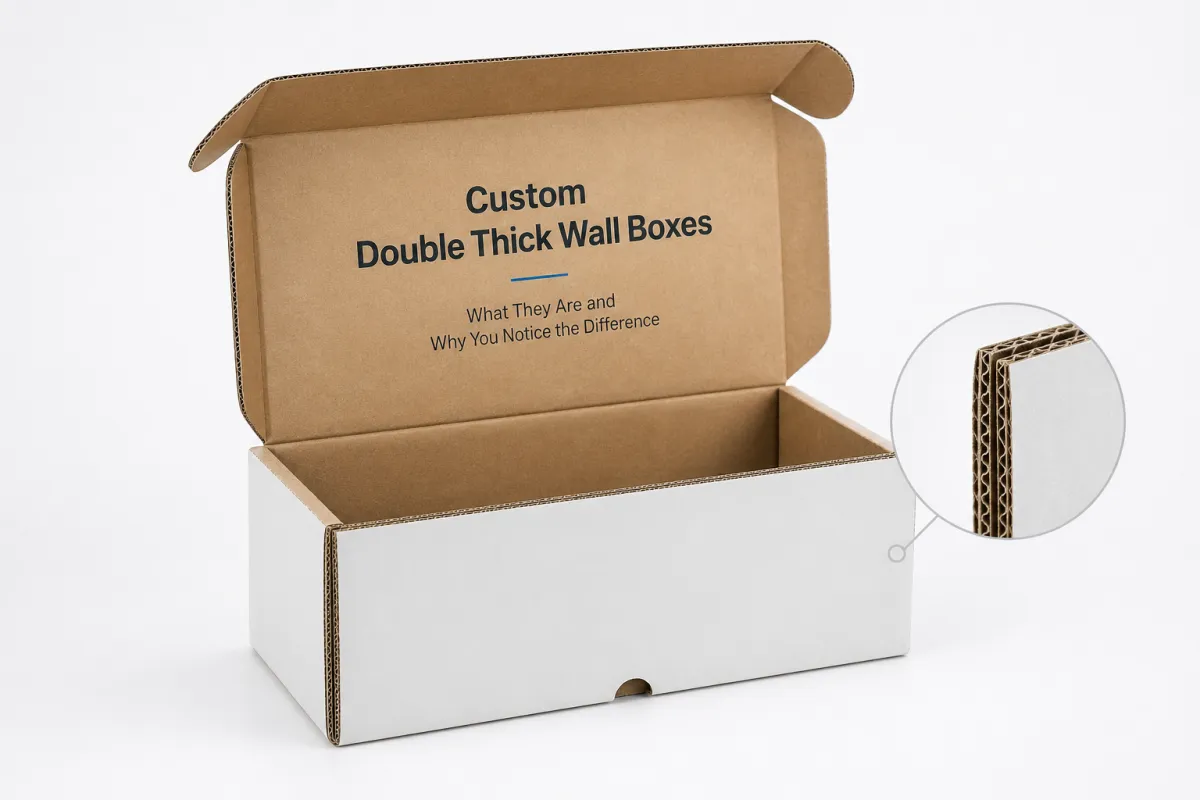
People call custom double thick wall boxes “just thicker cartons” at a distance, which is mostly right but not specific enough. A better description is load-aware corrugated architecture, where ply count, flute geometry, and wall layout are designed around the load map rather than a generic template. Extra plies spread stress, lower panel flex, and slow deformation at side and corner zones where weakness normally starts. In edge crush test terms, that structure gives a margin you can actually use when handling gets rough.
A visible difference is obvious to warehouse staff before it is obvious to a buyer. A standard carton can look fine leaving the line, then split or bow at a corner after a few transfer points. A properly tuned custom double thick wall boxes package is not invincible, but it resists repeated knocks and vertical pressure much better over time. That is the key: durable through the journey, not just at point-of-departure.
It is no surprise they appear in heavy electronics, industrial parts, and retail packaging where a crushed edge damages trust as quickly as a functional defect. A damaged package edge says “careless handling” even if the product is technically intact, and that perception can cost more than replacement freight. That is why custom double thick wall boxes are often matched with stronger kraft board specs and clearer incoming acceptance gates.
Real-world failures usually cluster around predictable stress modes: puncture, crush, flex fatigue, corner collapse, and humidity distortion. A carton can survive one axis and still fail another, which is why custom double thick wall boxes should be specified per route and SKU profile, not copied blindly from a “stronger box” stereotype.
- Puncture risk: metal straps, pallet hook edges, or protruding internal parts.
- Crush risk: stacked payloads, dwell in cross-dock hubs, and top-load pressure.
- Flex fatigue: vibration and micro-impacts across mixed carrier networks.
- Corner collapse: weak score geometry and poor closure pressure distribution.
- Humidity distortion: damp storage, condensation cycles, and climate swings en route.
A practical signal I return to is this: weight, drop history, stack height, route length, moisture exposure, and repair cost. If two or more are red flags, the conversation should shift from “Should we use a stronger carton?” to “What wall architecture fits this SKU without overbuilding everything for one use case?”
The strongest carton is not the one with the most board layers by default. It is the one aligned to product profile, route profile, and handling profile after the carton leaves your facility.
The logic is direct: custom double thick wall boxes are not a decorative upgrade and not an emotional upgrade either. They are a risk-management tool, balancing protection, stack reliability, and shelf impact with fewer surprises than a one-size-fits-all stock solution.
How Custom Double Thick Wall Boxes Work: Load Paths, Board Layers, and Protection
The mechanism is plain force management. A carton does not get “tougher” by accident; it channels force through better paths. Added wall depth creates additional material layers for impact and compressive energy to travel through instead of concentrating at a weak edge.
Four load pathways define performance: static load, impact load, sustained crush, and moisture response. Static load is your stack logic. Impact load captures drops and jolts. Crush load is what happens during dwell and vibration stacking. Moisture response tracks fiber stability under humidity shifts. Any design that ignores one path usually gives a false sense of security.
Flute strategy matters more than it looks on paper. B-flute gives different puncture and stack characteristics than C-flute, while hybrid systems can tune stiffness, cushioning, and print behavior for specific SKU classes. In some programs, a hybrid layup with targeted reinforcement delivered better edge stability than simply adding another full ply everywhere.
For many fulfillment use cases, custom double thick wall buildups usually sit in a 4-ply to 6-ply range, with practical wall depth commonly around 6 to 10 mm depending on flute pairing. In practical ecommerce and distributor lanes, teams often begin around middle-grade ECT performance and step higher only if pallets stack beyond common density thresholds or dwell times become long.
Board grade alone does not control outcomes. Edge crush, burst, and tear tests are useful, but flange geometry, score depth, and closure logic can dominate field behavior when distribution and handling are uneven. custom double thick wall boxes perform best when these variables are treated as one system, not separate spec bullets.
Surface finishes matter too, especially where print is part of the retail expectation. Glossy coatings and coatings for scuff resistance can improve appearance, but they can also change moisture uptake and stiffness behavior. In other words, a finish that looks good can still undercut long-distance reliability if the finish profile conflicts with the structural target.
For teams with limited time, this short engineering memory map works well before signing the first order for custom double thick wall boxes:
- Load path: Does the carton retain shape under expected static stacking?
- Impact path: Does it absorb shocks without splitting, buckling, or tear migration?
- Crush path: Can it hold edge stiffness through dense warehouse dwell?
- Moisture path: Do humidity changes shift stiffness enough to change failure timing?
Standards and certifications still matter. ISTA testing frameworks help simulate drop and vibration behavior, and ISTA references bring consistency to load testing language. On the sustainability side, supplier alignment to FSC gives a clearer trail than a marketing statement, though it does not replace structural validation. I have seen teams confuse compliance checkboxes with actual physical performance; they are related but not the same thing.
Key Factors for Custom Double Thick Wall Boxes: Material, Weight, and Performance Targets
Teams that get consistent outcomes start by documenting variables that move results, then verifying each with suppliers. Board grade, flute family, ply count, edge crush target, burst resistance, and tear behavior are the hard variables. If a vendor cannot walk through these clearly, the spec is often still too broad for production scale.
Mass is only the first gate. A light but oddly shaped item can fail earlier than a denser unit because pressure points are concentrated. Internal void management is equally important: if inserts and foam are undersized, internal movement can produce localized stress before the carton even starts seeing stack pressure. I have seen this exact issue happen where the outer box passed tests, but the product shifted inside like a loose battery in transit.
Moisture and temperature cycles are major practical factors in real operations. For routes with periodic humidity exposure, teams often specify slightly different liners or surface treatments and leave a realistic moisture-conditioning window for testing, because ambient lab results often look better than what happens in a coastal warehouse. In humid corridors, 5 to 10% dimensional variation in wall stiffness over a cycle is not unusual.
Transit behavior is often geometry-driven. Irregular profiles, protruding hardware, and temperature variation alter internal pressure paths. A carton can pass lab tests and still fail in real fulfillment because orientation, pallet pattern, and line vibration were never in the prototype conversation. Packaging structure only works when it is treated as a complete logistics system, not a single physical object.
A reliable sequencing rule has worked in both startup and mature manufacturing environments:
- Prioritize mechanical durability for SKUs where return, replacement, or service costs are meaningful.
- Only then tune print and exterior style to avoid unnecessary weight or complexity.
- Finish by locking operational handling methods so design and execution match.
This sequence protects margin and reduces the “we discovered it on launch week” loop. It sounds obvious because it is a pattern I have watched repeat across enough programs to trust it.
The clearest comparison still happens side-by-side; here is the framework I use with sourcing and operations teams:
| Option | Typical Strength Profile | Approx. Cost Impact | Best Use Case |
|---|---|---|---|
| Single-wall carton | Basic protection, light loads, limited stack resistance | Lowest | Light retail goods, low-risk fulfillment |
| Standard double-wall carton | Better compression and puncture resistance | Moderate | Medium-weight shipments, general transport |
| Custom double thick wall boxes | Engineered for higher stack loads, repeated impacts, and route-specific abuse | Higher, but often justified by lower damage rates | Heavy, fragile, high-value, or long-haul shipments |
Package bulk can quietly kill savings. Over-sized cartons often require extra fill, add freight weight, and create internal movement that drives rework. Some teams overcorrect by adding wall depth, then spend more later on handling and void correction. custom double thick wall boxes only earn their keep when depth, plies, and layout map to the actual failure points.
One structural win is usually to design cartons and internal support together. Reviewing the full catalog of Custom Packaging Products is useful when teams need to decide whether a function belongs in wall design, insert geometry, or secondary cushioning.
In many plants, a practical production target for carton build-up starts around 4-ply reinforcement around high-risk edges, then only expands to full-structure changes if the route includes repeated top-load events, usually above common transfer counts for 2- to 3-layer pallet stacks. That gradual approach keeps cost and lead time stable while fixing the actual failure point.
How to Specify Custom Double Thick Wall Boxes: A Step-by-Step Selection Guide
Programs using custom double thick wall boxes well always begin with numbers, not adjectives. “Stronger carton” is not a spec; it is a goal waiting for measurable inputs.
Step 1: Build a clean data sheet. Capture unit mass, external size, internal geometry, accessory layout, and pallet stack patterns. Include incident reports if available; repeated corner splits usually identify the real issue faster than generic quality comments.
Step 2: Map route stress. Note transport mode, transfer frequency, humidity exposure, and whether the carton gets long holding times between legs. Mixed parcel-LTL networks usually need a different profile than short-route courier paths.
Step 3: Confirm the product-to-box clearances with intent. You want enough clearance to prevent direct impact transfer to fragile nodes, but not so much that components bounce and abrade against walls. Too much empty space and too much force concentration are both bad in different ways.
Step 4: Validate structural details before artwork lock. Review flute profile, ply stack, reinforcement zones, and closure construction. If multiple SKUs are involved, group by weight and risk band so production complexity stays in check.
Step 5: Test samples under realistic conditions. Measure fill ratio, corner stiffness, seam closure performance, vibration response, and stack simulation. A plain sample that performs consistently is worth more than an ornate sample that fails under line conditions.
Step 6: Freeze dieline and closing method early, then lock graphics around those decisions. Fold and score positions should never be compromised later by brand-only edits, especially if shelf-ready presentation matters.
Step 7: Set acceptance criteria and owners before release. Define dimensional tolerances, grade targets, compression acceptance, and visual thresholds in writing. Shared accountability across engineering, sourcing, and warehouse teams prevents argument loops once volume starts.
Step 8: Confirm with production before full release. Ask your converter for sample counts that match your risk level; many teams use two to three pilot lots by 2 to 3 handling scenarios to avoid over- or under-spec’ing expensive wall area.
A useful line to remember: higher-value goods and tougher routes usually need explicit specs, not just a stronger-looking box. Otherwise, every team interprets “strong enough” through their own lens and the package behaves like a compromise.
Common Mistakes When Ordering Custom Double Thick Wall Boxes and How to Avoid Them
Most teams over-size first, then discover the cost is now in freight, fill, and packing time. Bigger dimensions can look safer, but they often create new handling inefficiencies and do not necessarily reduce structural failure risk.
Thickness is helpful but not automatic. Poor score placement, weak closure geometry, or concentrated corner stress can still cause failures. custom double thick wall boxes are a system, not a thickness checkbox.
Humidity is another blind spot. Fiber behavior changes under high moisture, and if that is not modeled at route level, your lab benchmark will overstate real-world performance. In humid corridors, I have seen acceptable cartons become marginal because nobody planned for condensation swings.
SKU drift is the silent killer. Small weight changes between variants can move you into a different stress class, and that often gets missed in fast moving catalogs. Grouping by banded weight ranges is safer than pretending one specification can cover mixed real loads.
Quality control gaps create a familiar failure pattern. If sample sign-off is weak and floor feedback is delayed, production drift from approved geometry to actual output is almost guaranteed. A technically sound custom double thick wall boxes design can still fail in execution.
Unwritten intent is worse than a weak spec. “Make it stronger” sounds decisive in meetings but becomes ambiguous at the conversion stage. Without written targets, marketing can optimize print while engineering optimizes stiffness, and both feel like they won while field performance quietly loses.
These controls usually prevent the biggest execution mistakes:
- Design: Lock dimensions, fit assumptions, and load targets before artwork advances.
- Sourcing: Fix board grade, flute profile, and volume commitments in the contract.
- QA: Require compression, drop, and closure testing on pre-production samples.
- Receiving: Verify incoming lots against approved physical references.
- Operations: Capture packing-floor feedback in the first two runs, before full rollout.
This sounds bureaucratic on paper, but it is mostly common sense. It is the gap between “we think this will work” and “we actually can ship it.”
Cost Factors and Pricing of Custom Double Thick Wall Boxes: Where the Budget Really Goes
Cost starts with a visible line item list: board profile, production setup, print complexity, coating, inserts, logistics, and post-production checks. Some costs are obvious on invoices; others, like rework cycles and extra labor, hide under operations. Those hidden costs are exactly where teams underestimate the true economics.
Scale helps, but not always in the way people expect. Small runs absorb setup and sampling into each unit, while high-volume runs stretch those fixed costs out over a longer schedule. The right comparison is not lowest unit price on quote date, but expected total landed cost over the shipment cycle.
Use this framing: base material plus setup plus print/finish plus logistics plus QA, then subtract avoided costs from returns, replacements, and support load. A custom double-thick wall boxes upgrade can raise unit cost and still lower total cost per sale when failure risk drops.
Indicative cost bands around 5,000 units can help planning, while exact figures move with region, supplier structure, material volatility, and spec depth. In most programs, custom double thick wall boxes move most on board grade, print coverage, and freight cube, not only carton profile.
| Complexity Tier | Typical Unit Cost Range at 5,000 pcs | What Drives the Price | Cost-Saving Move That Keeps Protection |
|---|---|---|---|
| Low complexity | $0.35-$0.60 | Plain kraft board, simple print, no inserts | Reduce ink coverage and standardize dielines |
| Mid complexity | $0.60-$1.10 | Custom print, partial coating, basic die-cut features | Use one insert style across multiple SKUs |
| High complexity | $1.10-$2.25+ | Heavy print coverage, premium finish, custom inserts, tighter tolerances | Simplify graphics or reduce non-functional finish areas |
Those ranges are planning baselines, not promises. If your route includes high return rates, even small structural upgrades can be paid back quickly. In one warehouse-heavy program we measured, a modestly stronger structure cut service interrupts enough to cover the upgrade in one quarter; your numbers may differ, so test against your own incident rate.
Operational gains are also real. Better sealing consistency, fewer line rejects, and less rework mean labor time drops even when materials cost more. If you track only carton cost, you miss most of the economic picture.
Process and Timeline for Custom Double Thick Wall Boxes: From Quote to Shipment
A practical timeline usually follows this sequence: quote, spec confirmation, sample production, test and approval, pre-production QA, full run, and dispatch. Gates exist for a reason; skipping them usually turns a timeline debate into a quality debate on week five.
Core timing drivers are file readiness, paper specification certainty, tooling complexity, and print method. The cleaner your inputs are, the tighter your schedule gets. Late changes to closure design, score lines, or print usually expand the schedule whether you expect it or not.
Small pilot runs and low-volume launches often take longer because sample iteration is part of the plan. High-volume replenishment can be faster once the spec is stable. A practical expectation in many operations is two to three sample waves for new SKUs, with 1 to 2 weeks between waves for test-and-adjust where route risk is moderate and 2 to 3 weeks where it is severe.
Design revisions are not a failure, but they are not free. Changing insert strategy, score depth, or flute selection triggers resampling and, if done late, can break your shipping window. A “minor” revision is rarely minor when it alters fold alignment or compression behavior.
Cross-functional communication is the least glamorous but most reliable timing control. Engineering defines load logic. Sourcing secures production consistency. Planning confirms capacity. Warehouse validates handling. Fulfillment reports how the pack performs at line speed. If one function is late to the loop, the release date usually moves later anyway.
Supply chain variance also exists outside your direct controls. Fiber availability, customs delays, printer bottlenecks, and incoming inspections can create shifts even in mature runs. Building a 1 to 2 week buffer and fixed review windows is boring, but it saves panic months later.
The teams that deliver consistently pair a visible checkpoint schedule with explicit gate owners. Deadlines can be revised; hidden assumptions cannot be managed if they are never surfaced. Use the Custom Packaging Products range early to validate print and structural options while your schedule is still flexible.
Expert Tips and Action Plan: A Practical Roadmap for Custom Double Thick Wall Boxes
Before final approval, run each candidate against three checks: structural integrity, internal fit stability, and damage-risk coverage. Structural integrity covers load and stack behavior. Fit stability verifies motion control inside the box. Damage-risk coverage checks whether historical weak points are addressed, not just statistically plausible ones.
Run a pilot first, and keep it realistic. Two SKUs with real damage exposure are usually enough to expose whether your assumed architecture maps to the route. Pilot data is easier to defend than intuition when teams argue for a full rollout.
Monitoring should continue after launch. Field incidents in the first cycle often reveal where your stress model missed a handling transfer point. If route or mix shifts with season, run a refresh review before the next peak period instead of waiting for a surprise spike in returns.
Wall depth is not always the fix. Reinforced corners, local doublers, selective barrier coatings, and smarter inserts can outperform global thickening in many cases. I usually see better outcomes when reinforcements are targeted by failure mode and not spread uniformly for comfort.
Here is a 30-day action plan I have used repeatedly with custom double thick wall boxes programs:
- Choose 2 to 3 SKUs with the highest correction or return cost in the last 90 days.
- Collect damage logs, exact unit weight, current packaging specs, and route profile notes.
- Build two structural sample concepts and test fit, closure behavior, and stack stability.
- Set pass criteria for compression, edge performance, drop response, and internal movement.
- Consolidate board, print, and QA requirements in one signed package document.
- Run a controlled pilot, then expand only by weight band after stable results are confirmed.
That path turns debate into execution. Teams stop arguing about “stronger” in the abstract and start tracking what actually matters on the dock, in transit, and at the customer door.
The practical takeaway is this: custom double thick wall boxes are usually not about adding wall for peace of mind, they are about removing uncertainty from the transport chain. Use a clear spec, test with your real route data, and make one controlled pilot decision before scaling. It is a bit of extra work up front, but it is usually the cheapest way to stop the same damage pattern from showing up every quarter.
Frequently Asked Questions
When should you choose custom double thick wall boxes instead of standard custom boxes?
Choose custom double thick wall boxes when a shipment faces repeated vibration, heavy static weight, rough transfers, high stacking, or humidity that can weaken fiber response. In operations where one visible failure hurts the brand or where repair/replacement costs are meaningful, this option is usually justified.
How do custom double thick wall boxes compare with regular double-wall cartons in performance?
The difference is not only wall count. A properly designed custom double thick wall boxes structure is tuned to the load profile, which usually improves corner retention, deformation resistance, and handling stability compared with less tailored double-wall solutions.
What should be the first cost metric to ask for when pricing custom double thick wall boxes?
Ask for a full landed-cost breakdown at the start: material, setup, print, coating, freight, inserts, and QA. Compare that against expected losses from returns, replacements, and service follow-up, then validate assumptions with your damage baseline.
How long does it typically take to get custom double thick wall box samples and final production?
A staged path is safest: generate samples, run predefined checks, approve structure, then open production release. Timing depends on file quality, tooling complexity, and order size, with the biggest gains coming from early sign-offs before sample review ends.
Can custom double thick wall boxes be used with inserts, pads, or additional cushioning without losing protection?
Yes, if the package system is recalculated together. Inserts and pads change load transfer and internal movement, so they must be tested as part of the same package, not bolted on afterward. A custom double thick wall boxes design with matched internal support usually performs better than one that relies on stacking fixes at the end.

