Buyer Fit Snapshot
| Best fit | Custom Packaging for Startup Product Launches projects where brand print, material claims, artwork control, MOQ, and repeat-order consistency need to be specified before quoting. |
|---|---|
| Quote inputs | Share finished size, material target, print colors, finish, packing count, annual reorder estimate, ship-to region, and any compliance wording. |
| Proofing check | Approve dieline scale, logo placement, barcode or warning zones, color tolerance, closure strength, and carton packing before bulk production. |
| Main risk | Vague material claims, crowded artwork, missing packing details, or unclear freight terms can make a low unit price expensive after revisions. |
Fast answer: Custom Packaging for Startup Product Launches: Quote Scope, Sample Proof, MOQ, and Lead Time should be specified like a repeatable production item. The safest quote records material, print method, finish, artwork proof, packing count, and reorder notes in one written spec.
Production checks before approval
Compare the actual filled-product size with the drawing, then confirm tolerance on folds, seals, hang holes, label areas, and retail display edges. Reserve space for logos, QR codes, warning copy, and material claims before decorative graphics fill the panel.
Quote comparison points
Review material grade, print process, finish, sampling route, tooling charges, carton quantity, and freight assumptions side by side. A quote is only useful when the supplier can repeat the same color, closure quality, and packing count on the next order.
Most buyers touch your packaging before they ever touch the product. That first contact can feel tiny from the inside of a startup, but outside the building it acts like a verdict. So when founders talk about custom packaging for startup product launches, they are not talking about decoration. They are talking about the first sales pitch, the quiet risk check, and the thing that can either steady confidence or drain it.
If your launch depends on first impressions, custom packaging for startup product launches should sit inside the product plan, not beside it. A box is never just a box. It is a signal, a shield, a shipping decision, and sometimes the reason people trust a brand they have never heard of. It also shapes the unboxing experience, which now travels faster than many ad campaigns. If you want to compare common formats early, a useful starting point is Custom Packaging Products.
I have seen teams spend months refining a product and then give packaging two rushed meetings and a shrug. That is usually where the trouble starts. Packaging shows up in customer photos, courier scans, warehouse labor, return reasons, and shelf presence. It is the operational face of the brand.
Custom Packaging for Startup Product Launches: A Smart Plan
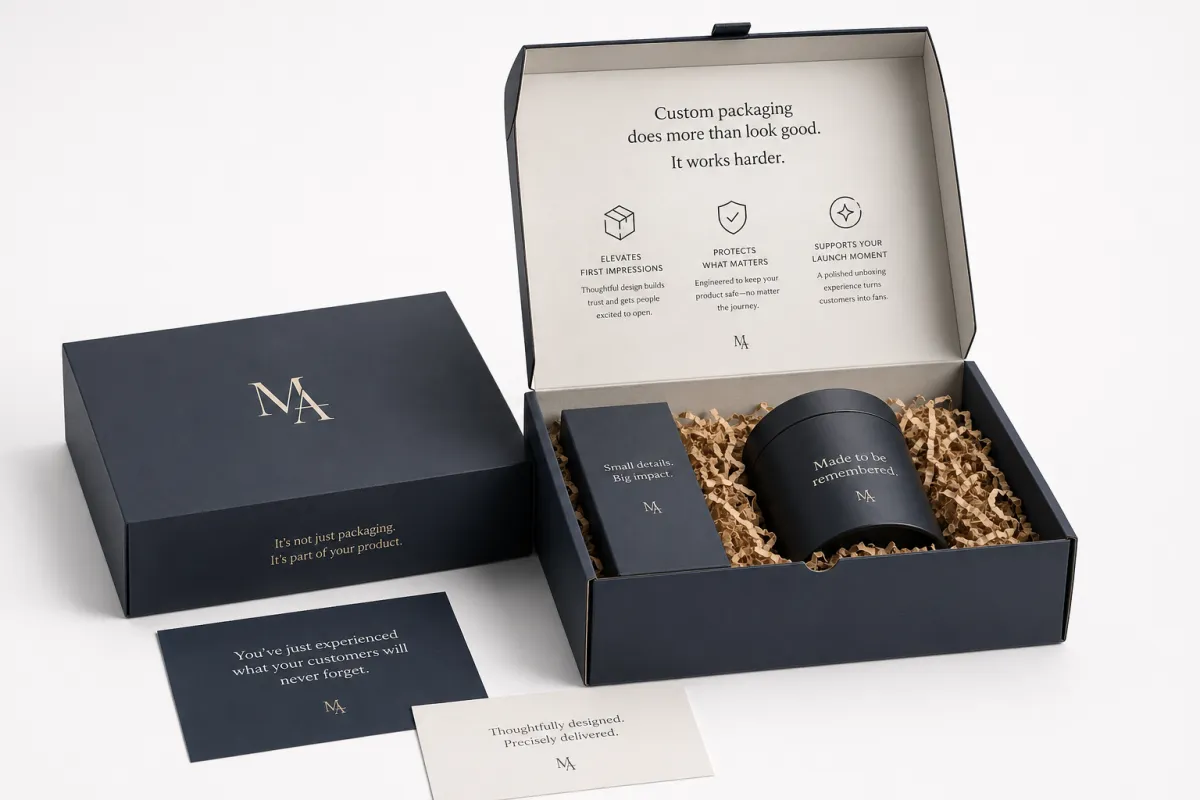
Packaging is infrastructure. Founders forget that at their peril. It affects margins, warehouse speed, breakage rates, repeat buying, and how a brand lives in memory after delivery. For a new company, custom packaging for startup product launches often sits near the top of the list of decisions that shape whether the launch looks credible or improvised.
Before anyone starts chasing finishes and color swatches, it helps to define what custom packaging actually means in startup terms. It includes the outer carton or mailer, the structural fit that keeps the product from rattling around, the inserts that hold shape, the printed surfaces that carry the brand, the labels and seals, and the details that keep shipping, storage, and opening from turning into a mess. In plain terms, custom packaging for startup product launches carries both protection and story. It is packaging design, operations planning, and brand theater working at once.
Young brands care this early because they have to earn belief before they have built recognition. A clear, controlled custom packaging for startup product launches system helps with:
- Unboxing cues that match the promise the product makes
- Lower damage rates through a structure that fits the item properly
- Better retail presence when the unit leaves the carton and lands on a shelf or demo table
- More shareable post-purchase photos from customers, creators, and media
Early-stage teams often ask a fair question: should they use standard packaging first, or commit to custom from day one? The answer depends on risk. If the launch is small, the margin is thin, and the product is easy to ship, stock packaging can make sense for a pilot. If the product is premium, fragile, or built around a strong launch moment, generic packaging can undercut the story before anyone has a chance to experience the product itself.
Stock, Then Upgrade, or Launch Fully Custom from Day One?
For pre-orders and discovery campaigns, a hybrid approach often wins. A startup can start with a dependable structural stock box and layer in Custom Printed Boxes, inserts, and branded internal components. That still qualifies as custom packaging for startup product launches, because the system is intentional, repeatable, and easier to scale once demand becomes real.
My practical rule stays simple. If fragility is high or the audience expects a premium experience, generic packaging is a gamble. If the product can survive rough handling and the first run is under 300 units, stock-grade packaging can buy time while the team collects data. That is not a lack of ambition. It is sequencing the spend so cash goes where the risk actually is.
There is also a less glamorous truth: founders are often optimizing for the photo and the investor deck long before they optimize for the fulfillment table. I get why. The reveal is exciting. But the package has to survive the truck ride, the warehouse stack, the humid loading dock, and the person opening it at 9 p.m. with one hand and a letter opener in the other.
What Custom Packaging for Startup Product Launches Actually Does
During a launch, custom packaging for startup product launches performs four jobs at once: it protects, positions, converts, and simplifies operations. Skip one and the system still runs. Skip two and the cracks show quickly. Skip all four and the launch becomes a cleanup operation.
It sets expectation before the first sip, pop, plug, or shake
Most startup teams underestimate how quickly people judge quality. A clean, predictable structure feels more premium before the product is even opened. In practice, custom packaging for startup product launches changes the way customers read reliability. A box that bulges, a lid that folds awkwardly, or a label that arrives smeared can make the product behind it feel less trustworthy, even if the item itself is excellent.
Packaging branding is broader than logo placement. It is the sequence of material, closure, color, fit, and the way the package behaves in the hand. The first signal is physical. The second is emotional. The third is memory, which is usually where the repeat purchase starts.
It reduces damage and support costs
Protection does not photograph well, which is part of the problem. Founders naturally focus on what customers will notice, then miss what warehouse staff and couriers will do to the box before it arrives. Launches create stress points: multiple handoffs, crowded sorting tables, weekend fulfillment shifts, and occasional repacking that nobody planned for. If the internal structure is weak, support tickets climb. If the custom packaging for startup product launches setup is tuned properly, complaints about bent corners and arrived-damaged items fall sharply. I have seen launch teams reduce complaint volume by around 15% after improving inserts and corner reinforcement without changing the outer footprint.
That number is not magic. It is the result of fewer impacts reaching the product and fewer weak points in the pack-out sequence. A tighter fit, a better board grade, and a smarter insert often do more than fancy print. Not glamorous, but real.
It supports channel strategy
A direct-to-consumer item can prioritize home delivery, opening speed, and visual polish. A product headed for retail needs different behavior: scan-friendly barcode placement, shelf-ready dimensions, and a visual hierarchy that still reads from three feet away under fluorescent lights. The goal is not a single heroic box. The goal is product launch packaging that performs in logistics, on shelf, and in social content.
That is why custom packaging for startup product launches is a business tool, not an accessory. It acts like a tiny quality-control layer, quietly catching mistakes before customers do. That matters more than a glossy finish that solves nothing.
And yes, sometimes the most useful packaging decision is the one that nobody notices. If the box opens cleanly, stacks well, and arrives intact, the customer experiences the product instead of the shipping mistake. That is the win.
How Custom Packaging for Startup Product Launches Works
Speed matters, but speed without a workflow creates expensive mistakes. Treat the process like an engineering handoff, not an art request. Whether the team is building a launch kit, a custom mailer, or a retail-ready carton, the chain stays mostly the same. That is how custom packaging for startup product launches tends to Work in Practice.
Step Flow: From Idea to Rack-Ready
- Product specifications: Final dimensions, weight tolerance, storage constraints, and any legal marks are gathered.
- Packaging goals: Choose one dominant goal first, then rank the others in order of importance.
- Dieline selection: Select the structure based on fit, handling, and automation compatibility.
- Artwork and packaging design: Build final artwork with bleed-safe edges, finish notes, and print specs in CMYK or Pantone.
- Sampling: Request a physical sample or a rapid prototype to test strength, stack behavior, and finish quality.
- Revisions: Fix the issues that affect launch readiness, not the ones that only look good in a meeting.
- Production: Lock files and move into manufacturing after proof approval.
- Fulfillment handoff: Confirm packing order, labor steps, and warehouse handling with the operations team.
One mistake shows up constantly: founders think they are on step 4 while they are still on step 1. That gap is expensive. If custom packaging for startup product launches starts before dimensions are final, no amount of visual polish can rescue the result.
Real Timeline: Practical, Not Fancy
- Weeks 8-10: Brief, quotations, structure concept, and sample plan.
- Weeks 6-8: Artwork, proofing, and the first sample build.
- Weeks 4-6: Revisions, drop and stack tests, and final adjustment decisions.
- Weeks 2-4: Final approval, production run, and delivery prep.
That timeline is not glamorous. It is useful. Launches turn messy when people treat packaging as something that can be fixed in the final week. A day saved at prepress can cost a week at reprint, and those are not equal trades.
Coordination matters more than most teams admit. Designers own the presentation. Manufacturers own feasibility. Logistics owns shipping behavior. Operations owns throughput. When those roles are unclear, the outcome is familiar: mismatched labels, reversed orientation, wasted inventory, and warehouse staff solving problems no one documented.
For founders, custom packaging for startup product launches should include a review gate before each handoff. That sounds procedural because it is procedural. Launches do not reward vibes.
Picture a skincare startup shipping a glass bottle in a cardboard sleeve. The designer wants a large window, the manufacturer says the wall thickness is enough for local routes, and nobody checks the courier path through a heavy sortation hub. The first batch arrives with chips and corner crush. A joint review earlier in the process would have pointed to stronger corrugation and a more disciplined insert. Less drama, fewer returns, calmer mornings for the team.
How Much Does Custom Packaging for Startup Product Launches Cost?
Money is where enthusiasm gets tested. Founders usually feel confident about the product, then hesitate at the packaging quote. That reaction is normal. Packaging can quietly eat into margin if nobody models the numbers early.
The biggest cost drivers for custom packaging for startup product launches tend to be:
- Material type such as kraft paper, recycled kraft, B-flute corrugate, rigid paperboard, PET, or compostable film
- Print method such as digital, flexo, offset, or UV spot
- Structure such as mailer, custom printed boxes, rigid carton, pillow bag, or clamshell
- Unit size and shape constraints
- Insert complexity such as die-cut dividers, molded pulp, foam, or corrugated channels
- Finishes such as matte, gloss, spot UV, soft-touch, foil, or embossing
- Quantity and how often the run repeats
Price Reality: Low, Mid, Premium
| Budget band | Typical quantity | Common materials/specs | Estimated unit cost for 5,000 pcs | What changes |
|---|---|---|---|---|
| Low | 500-1,500 | Printed mailer, single-color, no heavy inserts | $0.25-$0.90 | Good for pilots, lower visual impact, faster learning |
| Mid | 1,500-5,000 | Full-color kraft mailer or small rigid carton, simple insert | $0.80-$2.40 | Balanced brand presence, safer handling, better retail photos |
| Premium | 3,000+ | 150-350 gsm rigid board, custom printed boxes, premium finish | $1.90-$6.50 | Strong positioning, higher quality-control pressure, larger MOQ commitment |
Those numbers shift with market, shape, and finishing. A simplified 5,000-piece run with a single color and basic tooling can sit much lower, sometimes near $0.18-$0.28 per unit when the shape is efficient and the turnaround is ordinary. Add one custom insert and the price can jump by $0.20-$0.40 quickly. Small details compound faster than most spreadsheets suggest. If you are comparing structure choices, Custom Packaging Products is a practical place to review common formats side by side.
Minimum order quantities are the real hidden lever
MOQ is where early cash often disappears. Smaller batches usually cost more per unit, but they protect the company from sitting on dead stock. For a first launch, 1,000-piece runs are common when uncertainty is high. If demand is steady and cash flow can handle it, 3,000 pieces may lower unit cost by 20-40%. If demand is still foggy, 3,000 pieces can become storage debt with a nicer print finish.
Hidden costs are the ones that hurt most because they rarely appear in the first quote:
- Sample kits, sometimes across 1-4 rounds
- Design revision cycles
- Freight surcharges for oversized parcels
- Storage and handling for extra inventory
- Rush fees that can add 15-35%
Budgeting should treat packaging as a project, not a one-off purchase. A launch budget with a custom packaging for startup product launches model needs proofing, freight, and at least one contingency round. If the base plan cannot absorb those costs, the issue is not thrift. The issue is underplanning.
Margins make the stakes sharper. For a product with a 5-15% margin, one finish upgrade can wipe out the unit economics. If the target landed cost is $18 and packaging moves from $2.80 to $4.00, the math changes immediately. Investors notice that. Operations notices it even faster.
Quality vs. cost tension is manageable
The best rule is to lock structure and print decisions first, then test the cost alternatives around them. If the box fails a drop test, no amount of foil will save the customer experience. Function earns priority. Style comes after the structure proves itself.
From a buyer's point of view, custom packaging for startup product launches is one of the rare line items that can be tied directly to observed outcomes. Fewer returns. Better photos. Lower support load. That is a story numbers can defend.
Key Factors That Shape the Right Packaging Choice
Most packaging mistakes are not about taste. They are about ignoring physics and pretending the box lives in a vacuum. The right structure starts with the product's dimensions, weight, and fragility. Everything else follows from that.
Fragility, weight, and dimensions win first
If the product can break, the packaging has to prevent that. Full stop. No slogan attached to custom packaging for startup product launches can rescue a cracked corner or a crushed component. Build with tolerance in mind, usually around +/-2 mm for width and depth, plus enough space for inserts and a shock layer that actually does something.
For heavy items, move to stronger boards or better inserts before adding premium effects. Common starting points are 16-24 pt paperboard for lighter items and B-flute or similar corrugate for heavier shipments, though the best choice depends on weight and handling. For light but bulky items, reinforced seams and anti-shift separators matter more than flashy decoration. For liquids, secondary containment is not a nice-to-have. It is the difference between a clean delivery and a claim ticket. Parcel hubs should always be treated as rough handling, because they usually are.
Brand positioning decides complexity
Premium skincare and supplement launches need calm cues: controlled texture, clean interiors, low-noise opening, and a finish that does not feel frantic. A hardware accessory startup needs different language: durable corners, visible tamper confidence, and impact resistance. Coffee brands often need aroma-safe barriers. Apparel brands usually win with lighter structures and stronger visual identity. One format never fits every category.
That is why custom packaging for startup product launches has to connect to packaging strategy, not just art direction. A brand can look polished in print and still feel unreliable if the insert shifts or the opening sequence feels clumsy.
Sustainability, shipping, and unboxing goals
Sustainability is not a decorative label. It influences buying behavior and it shapes how a company operates. Recycled board, lower-ink coverage, water-based coatings, and recycled-content adhesives can reduce the environmental load without blowing up costs. If the audience cares about responsible sourcing, verify claims instead of implying them. FSC chain of custody for paperboard matters when the brand story includes it.
For broader packaging sustainability and material guidance, review resources like Packaging Industry guidance. For transport performance expectations, check ISTA testing references before calling anything ship-ready. Printing a badge on a box is easy. Passing a parcel route is the actual test.
Sustainability also has a hidden operational angle. Lighter structures reduce freight weight. Fewer components shorten pack-out time. One well-designed recyclable system can lower waste and labor together. That is the kind of tradeoff finance teams actually like.
Compliance and retail constraints are non-negotiable
Food, cosmetics, and regulated products bring their own rules. Ingredient lists, warning copy, lot codes, and visibility requirements are not optional extras. If the launch touches allergen disclosures or restricted claims, compliance sign-off needs to sit inside the packaging timeline, not at the edge of it.
Retail adds another layer. Barcode size, quiet zones, and scan contrast can be dictated by the channel. If expansion into stores is part of the plan, ask whether the format supports the future shelf and scan setup. A bad barcode clear zone can stall a launch longer than a bad photo ever will.
Keep all of that in view and custom packaging for startup product launches stops looking like a style debate. It starts looking like execution discipline.
Step-by-Step Launch Packaging Timeline
If one section deserves a printout, it is this one. Most launch delays happen at review gates, not at the machine that prints the box. The timeline below fits a clean 10-week runway. Stretch it if the category is regulated or the design includes new tooling.
Use this as your working schedule
Work backward from go-live day. Eight to twelve weeks is a realistic window for first-time custom work with one revision cycle and no major surprises.
| Stage | Owner | Deliverable | Decision point |
|---|---|---|---|
| T-minus 12 weeks | Founder + sourcing lead | One-page brief: dimensions, budget ceiling, channel mix | Go/No-go on custom vs stock structure |
| T-minus 10 weeks | Packaging lead + designer | 3 structural options + estimated pricing | Approve structure and material family |
| T-minus 8 weeks | Designer + manufacturer | Print-ready artwork, dielines, finish mockups | Proof sign-off with no late surprises |
| T-minus 7 weeks | Manufacturer | Sample pack run, stack + drop test notes | Approve or revise for fit and strength |
| T-minus 5 weeks | Operations + fulfillment team | Packing sequence SOP and labor time estimate | Green light for mass build |
| T-minus 3 weeks | Operations + founder | Final production run and delivery schedule | Confirm freight booking and storage space |
| T-minus 1 week | Sales + support | Launch-ready inventory and complaint script | Final release readiness check |
The trap most teams fall into is approving artwork before internal dimensions are locked. Manufacturing needs the exact product size, the weight in grams, any accessories, and whether a bundle differs from the base SKU. If those variables are missing at print approval, the calendar turns into guesswork.
Build a contingency window of 5-7 business days after the first sample and before the final order. Pretending every sample will pass on the first round is a costly habit. That one-week cushion often prevents two weeks of post-launch panic.
Who owns what
For clarity:
- Founder/PM: budget owner, milestone owner, and final sign-off
- Designer: packaging design, print accuracy, and brand consistency
- Supplier: material feasibility, tooling, and sample quality
- Fulfillment lead: packing speed, seal logistics, and return handling
When each person knows their checkpoint, custom packaging for startup product launches starts to resemble production management instead of crisis management.
The best teams usually lock design and vendor specs by week eight. That gives them room to negotiate details without rebuilding the entire box in launch week. Rebuilding packaging in launch week is how teams discover they have been planning on optimism rather than facts.
Common Mistakes Startups Make With Custom Packaging
Most packaging mistakes are not foolish. They are rushed. Startups feel pressure, then push packaging decisions into a tiny window where everyone is tired and the warehouse is already asking for answers.
Designing for screenshots instead of real shipping conditions
A mockup can look beautiful on screen and still fail in the real world. Screen renders do not tell you anything about stack pressure, corner hits, humidity, or how a box behaves after twelve miles in a courier van. If the product has weight, shape variation, or accessories, the mockup is the weakest possible proof point. A production-like sample comes first, not last.
When this mistake lands, the fallout is usually predictable:
- Crushed corners during transport
- Returns and replacements that eat time and margin
- Support teams rewriting packing guides overnight
That is not a small problem on a tight launch budget. It is a budget problem, a labor problem, and a reputation problem all at once.
Overbranding and over-finishing
Startup teams naturally want premium signals. Gold foil, soft-touch varnish, embossing, ribbons, magnetic closures, and specialty coatings all look impressive in a presentation. The trouble is that none of those effects rescue a package that ships badly. A precise matte laminate and a clean dieline beat five decorative choices that slow assembly and fail in transit.
There is a temptation to keep adding finishes because each one feels like proof of seriousness. That is the trap. A single tactile cue, placed well, usually does more than three decorative layers fighting for attention.
Last-minute ordering and rush dependency
Late ordering can work if the design is locked and the structure is straightforward. Most startups do not live in that world. They live in the world of changing opinions, updated copy, and fresh requests after the first sample arrives. Rush fees are expensive. Material choices narrow. Error rates rise. Speed sounds efficient until the reprint invoice arrives.
Over-ordering before market feedback
Ten thousand premium cartons before the first 300 sales is not a strategy. It is a bet with warehouse space attached. Overstocking only looks safe in a spreadsheet. In real life, it ties cash to a decision that has not been validated yet.
Ignoring fulfillment labor
Founders get surprised by this constantly. A package that looks elegant in CAD can be annoying in a real fulfillment center. If every unit needs hand-taping or extra folding, the labor line rises fast. Every added step has a cost, and every cost competes with ad spend, product development, or the next shipment.
Custom packaging for startup product launches is not a decorative wrapper for a social post. It is a system with friction, costs, and consequences. Treating it like a poster usually ends badly.
Expert Tips for Better Custom Packaging Results
Good packaging is rarely expensive because it is fancy. It is expensive because teams try to do too much at once. Keep the process traceable. Keep the stack simple. Test more than your instincts would prefer.
Build one system that supports DTC, retail, and creator use
The cleanest setup is modular: one box or mailer family with variants for direct-to-consumer inserts, retail-ready inserts, and PR or influencer presentation. Three separate packaging programs are only worth it if the volumes justify the added complexity. A modular setup reduces SKU sprawl and keeps margins from leaking through the side door.
If the brand can standardize one dimension family, inserts can change without rebuilding the structural system. That is how custom packaging for startup product launches stays manageable when order volume climbs faster than the team expected.
One premium detail, clean structure
One well-chosen branded cue usually beats noisy overdecoration. A sharp foil edge, a single textured zone, or a precisely cut insert gives the package personality without inflating cost. The result reads deliberate, not loud.
"A cleaner design with one strong tactile element usually performs better than a crowded one," is a pattern I see again and again across launch programs. Too much novelty can read as inconsistency before the product even gets a chance.
Test logistics, not only visuals
Ask for stack tests, drop tests, and warehouse handling checks before final approval. If the launch includes influencer kits, test that exact path too. A sleeve that looks elegant on a desk may open too easily after repeated handling in a courier route.
Use a simple rule. Every test should check appearance and movement. If the package looks right but shifts in transit, it is not ready. If it survives transit but looks cheap, add one finish and stop there. More is not always better. Better is better.
Design for reorderability from day one
Never assume the first quantity will be the last. The package should be easy to reorder at a higher run or refill in a smaller batch without rebuilding the entire file tree. Clean naming, clear stocking logic, and a second vendor relationship can save weeks later. The goal is not perfect prediction. The goal is reliable restocking.
The core principle stays the same: custom packaging for startup product launches should help the product sell, then ship, then survive. If the sequence runs backwards, the team is not scaling packaging. It is scaling excuses.
I also recommend one honest internal question before sign-off: if the customer never saw the outer branding, would the package still protect the product and fit the operation? If the answer is no, the design is still carrying too much pretty and not enough purpose.
What to Do Next Before You Order
Execution time. You can keep reading, or you can start making the launch safer today. The strongest move is a short, explicit planning cycle before the order for custom packaging for startup product launches goes out.
Build your one-page packaging brief
- Finalized product dimensions with tolerance
- Planned shipping method: parcel, courier, freight, or retail drop
- Target order quantity and buffer stock assumptions
- Brand tone and unboxing goals
- Budget ceiling and hard material restrictions
Put everything in one place. If the team cannot explain these items in ten minutes, the launch timeline is already carrying extra risk.
Get at least two vendor comparisons
One quote is not enough. Compare at least two suppliers on structure, finish, turnaround, and sample quality. If possible, request one digital proof and one physical sample from each. A real choice becomes easier when you can hold both options in your hands. You may also map product-level specs by category under Custom Packaging Products pages when aligning the final line item with the launch plan.
Adding a third option can still help, but only if the sourcing lead can keep the process moving. Too many comparisons create decision fog and waste a surprising amount of calendar time.
Set a launch calendar that includes hard approval gates
Backward planning works for a reason. Start from shipping day and build toward it with a latest-safe proof deadline. My own preference is a latest-safe artwork gate at least 10 business days before production. That sounds strict because it is strict.
Confirm fulfillment flow before final approval
Most "ready to print" surprises show up in operations, not in design review. Confirm whether the team needs unit-level bagging, whether tape and labels are already in stock, and whether the fulfillment line can handle the chosen structure. A beautiful package that needs micro-assembly can become a labor problem almost instantly.
If the launch is close, custom packaging for startup product launches should be treated as a scoped project with milestones and sign-off points. If the workflow is vague, the launch is gambling with nicer graphics.
Get your first pilot moving
Once the planning is done, request a small production lot. A 200-1,000 piece pilot catches what mockups never reveal: how folds behave in humidity, how seals release in real hands, and how fast the package can be assembled when the warehouse is busy. Then scale from evidence instead of hope.
Conclusion: Launch Packaging That Works Like a Tool
Here is the hard truth. custom packaging for startup product launches works when it is treated as a cross-functional system, not a branding accessory. Protect the product. Fit the product. Make the process repeatable. Do those things first and the returns drop, margins stabilize, and customers respond with fewer doubts.
I trust practical decisions because they survive contact with the real world. Keep custom packaging for startup product launches simple, test-driven, and tied to margin math. Confirm specs, compare at least two suppliers, and account for hidden costs early. One strong feature can carry the experience. Ten expensive distractions usually cannot.
The launch window is short. Competitors can copy surface details; they cannot copy execution discipline. Build packaging that looks right, moves quickly, and survives the real world, and you will avoid the post-launch scramble that usually eats the week after shipping.
The actionable takeaway is simple: lock the product dimensions, choose one packaging structure, test a physical sample against real shipping conditions, and leave room in the budget for freight, rework, and one surprise. That sequence does more for launch success than any finish choice ever will.
FAQ
How much does custom packaging for startup product launches usually cost?
Cost depends on material, size, print method, finishing, and quantity. A practical range often sits between $0.25 and $6.50 per unit depending on complexity and volume. For 5,000 pieces, simple structures can land much lower, while premium rigid formats climb quickly. Sampling, freight, and rush fees still shape the final total.
How long does the packaging process take before a startup launch?
A practical process usually runs 8-12 weeks from approved brief to production-ready packaging. Most delays happen during sampling and revision, not during printing. Faster schedules are possible if specs are locked early, but that is controlled acceleration rather than luck.
What packaging type works best for a startup product launch?
There is no universal winner. Mailers work well for lightweight direct-to-consumer shipments. Rigid cartons are better when protection and premium perception matter. Inserts matter whenever movement is a risk. Start with fit and protection, then add branding. That order works for most launches.
Should a startup invest in premium finishes right away?
Only if the finish supports the sales promise and the unit economics can absorb it. One strong premium detail often performs better than multiple decorative effects. Clean structure, reliable print quality, and easy assembly matter more at launch than every possible texture and coating.
How do you avoid overordering packaging for a first launch?
Base the order on realistic sell-through, not on best-case excitement. Start with a pilot if demand is unclear. Keep files and supplier relationships ready so reordering stays fast. Overordering can feel safe, but it can quietly drain cash and slow the next campaign.

