Plain envelopes can do the job, but they rarely make a mail piece feel intentional. Custom envelope labels give you a faster, more flexible way to brand, identify, address, or organize mail without committing to direct envelope printing, which is especially useful when quantities shift, artwork changes, or the mailer needs to move through several hands before it reaches the recipient.
From a packaging buyer’s perspective, the value is control. You can keep envelope stock simple and let the label handle the messaging, the return address, the sorting instructions, or the visual identity. That matters in direct mail, invoices, invitations, sample packets, and short-run campaigns where a crooked label or weak adhesive can make the whole piece look rushed.
The catch is that labels are small products with a lot of spec decisions behind them. Material, finish, shape, adhesive, and format all affect print quality, application speed, and how the envelope holds up in transit. Buyers who pay attention to those details usually spend less over time because they avoid reprints, hand-fixing, and dead inventory.
Custom envelope labels: what they are and why they stop sloppy mail
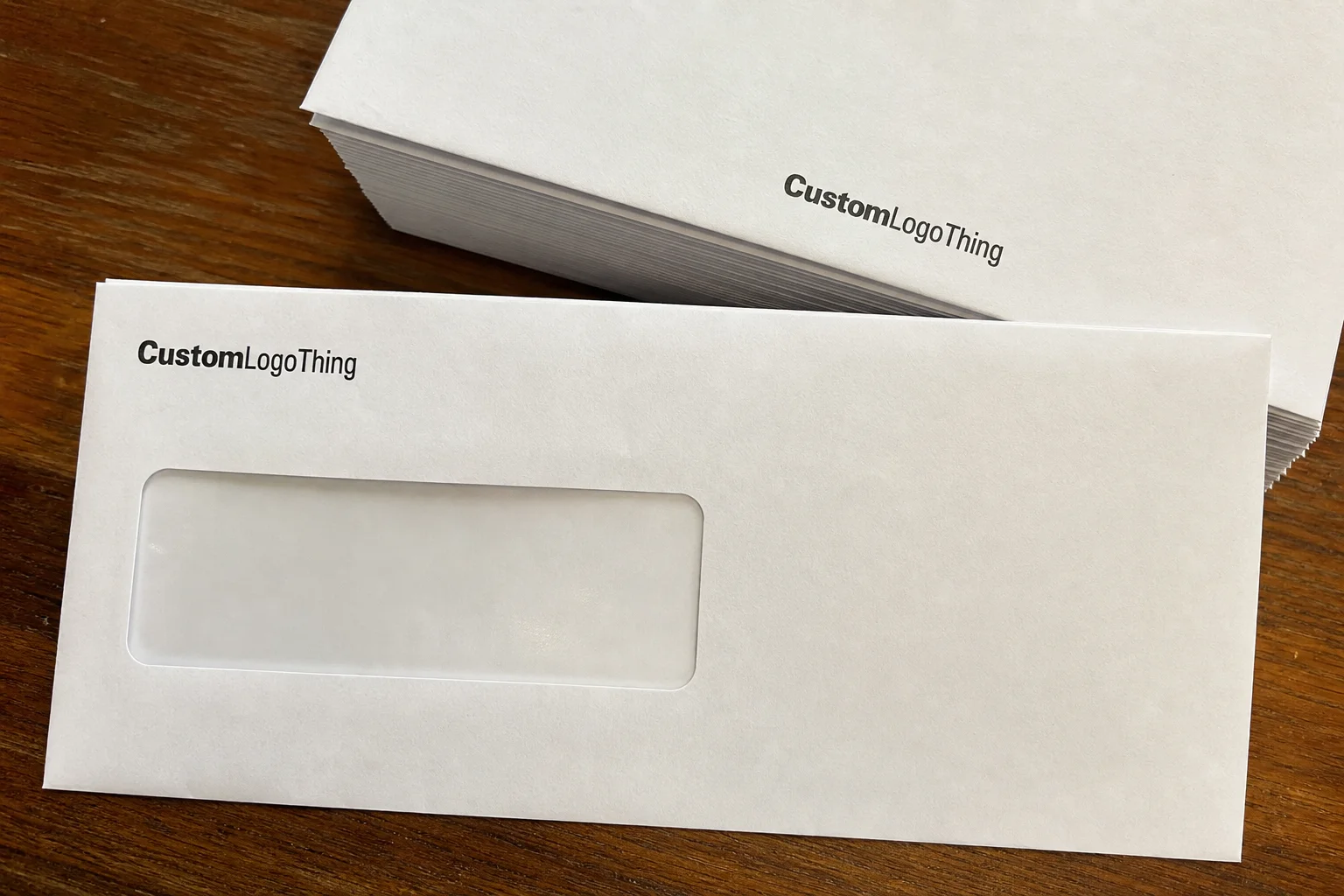
Custom envelope labels are adhesive labels printed for use on envelopes for branding, addressing, return information, sealing, or internal mail organization. They may be small return-address stickers, front-panel brand labels, flap seals, or routing labels for office and fulfillment workflows. Same product family, different jobs, and the right spec depends entirely on how the envelope will be handled.
Here is the practical reality. A plain envelope can look fine in a stack, but once a label is misaligned, too small, or printed on the wrong stock, the piece immediately loses polish. If the adhesive lifts during delivery, the mailer looks worse than if it had been left plain. Labels are not decorative extras; they are part of the mail piece’s function and presentation.
These labels are commonly used for:
- Invoices and account statements
- Invitations and event mailers
- Direct mail campaigns
- Sample packets and media kits
- Internal sorting and department routing
- Promotional mailings with variable names or addresses
The most common substrate choices are paper, matte-coated paper, gloss-coated paper, and synthetic materials. Paper stock is fine for indoor use and standard office mail. Coated options sharpen print and deepen color. Synthetic labels cost more, but they hold up better against moisture, abrasion, and rough handling, which becomes relevant as soon as envelopes are stored in humid conditions or sorted multiple times.
“If the label is cheap but the adhesive fails, you didn’t save money. You just bought rework.”
That line holds up because label failures usually show up in labor, not just in product cost. Once a team has to restick, reprint, or hand-sort damaged mail, the low unit price stops looking like a win.
How custom envelope labels work in real mail workflows
The production path is straightforward, but every step affects the result. It usually starts with artwork, then moves into size confirmation, print method selection, die-cut or sheet layout, adhesive choice, finishing, and proof approval. If any of those pieces are off, the issue usually appears at application or during delivery.
Most buyers use labels in one of three ways. Manual application is common for small office runs. Semi-automatic application appears in higher-volume mail rooms. Mailhouse and fulfillment workflows usually need labels that stack cleanly, peel consistently, and apply without slowing operators down. A label that looks great on screen but jams the line has already failed.
Placement deserves more attention than it gets. On a typical envelope, a return address may sit in the upper left, the recipient panel may be centered, a seal label may cross the flap, or a branding label may cover most of the front panel. On a #10 envelope, there is very little room to waste. Crowding the address block or interfering with a postal barcode area can create avoidable mail handling problems.
If the labels will be overprinted or used for variable data, compatibility with the print environment matters. Laser heat, toner adhesion, and inkjet absorption all behave differently. A stock that curls, smears, or lifts under printer heat is not a small inconvenience; it is the wrong material for the workflow.
Label size affects both readability and handling. Small labels are tidy and efficient, but text can become cramped. Large labels increase brand presence, yet they can catch on adjacent mail or bend during sorting if the edges are poorly cut. The more handling the envelope will see, the more important clean die-cutting and stable adhesion become.
For buyers balancing Custom Labels & Tags with broader Custom Packaging Products, consistency is the thread that ties everything together. The envelope should feel like part of the same brand system as the box, insert, or outer package. That is package branding, even if the “package” is simply a mailing envelope.
Key specs that affect label quality, durability, and appearance
The face stock is the first major decision. Paper labels usually sit at the budget end and work well for office mail, invoices, and short lifecycle pieces. Coated labels improve print sharpness and color depth. Synthetic labels cost more, but they resist moisture and abrasion better, which makes them a practical choice when envelopes may travel through multiple touchpoints or sit in less controlled storage.
Finish changes both look and usability. Matte has a softer, more restrained appearance and is easier if anyone needs to write on the label. Gloss brings out color and makes logos stand out, which can be useful for premium mailers or retail tie-ins. Uncoated stock is the practical choice when stamping or handwriting needs to remain easy.
Adhesive selection is just as important as face stock. Standard permanent adhesive covers most mail applications. Removable adhesive works better for temporary identification or internal sorting. High-tack adhesive is the safer option for textured, recycled, or less uniform envelope surfaces where standard adhesive can fail early. Buyers often discover this the hard way when a corner starts lifting and the entire run looks inconsistent.
Shape and size also matter. Rectangles are usually the most economical and fastest to produce. Rounded corners reduce edge lift and tend to look cleaner in hand. Custom shapes can support a premium identity, but they usually increase setup complexity and waste, especially if artwork changes frequently. Reordering the same size and format usually delivers better long-term value than rebuilding the shape for every campaign.
Color contrast should never be sacrificed for design flair. Dark text on a light background is easiest to read and the most forgiving in real mail handling. Brand colors should match as closely as the print process allows, but readability comes first. If the address cannot be read quickly, the label is not doing its job.
| Label option | Best use | Typical tradeoff | Relative cost |
|---|---|---|---|
| Paper, matte finish | Office mail, invoices, internal sorting | Least durable; not ideal for moisture | Low |
| Coated paper, gloss finish | Branding, promotional mail, retail packaging tie-ins | Less writable; glare can be an issue | Medium |
| Synthetic, matte or gloss | Outdoor exposure, rough handling, shipping inserts | Higher unit price | High |
| High-tack specialty adhesive | Textured or recycled envelopes | Harder to reposition | Medium to high |
Order quantity changes the economics more than most buyers expect. A 1,000-piece run often costs significantly more per label than a 10,000-piece run because setup is spread over fewer units. Still, bigger is not always better. If names, offers, or return information change often, overbuying turns into waste very quickly. Smaller repeat orders can be the smarter choice for frequently updated campaigns.
If the labels need to sit within a broader branded packaging system, the spec should align with the rest of the print standards. That means consistent color handling, a readable type hierarchy, and a finish that does not clash with the envelope stock itself.
Custom envelope labels cost: what changes the quote
Most of the price drivers are predictable, which is why they are easy to overlook. Quantity, size, material, finish, color count, adhesive type, and cut complexity all affect the quote. Add rush production, artwork cleanup, or specialty finishing, and the price moves again. There is no hidden formula here; it is mostly production math.
Short runs cost more per piece because setup gets divided over fewer labels. Larger runs reduce unit cost, but they also increase storage risk. If a campaign changes every month and you buy far beyond current need, the savings on paper can disappear into obsolescence.
Budget paper labels usually sit at the lower end of the pricing range, especially in standard sizes and simple one- or two-color layouts. Premium weather-resistant or specialty-finish labels cost more because the stock and finishing steps are more expensive. In practical terms, small-run custom envelope labels are often priced much higher per unit than mid-volume repeat orders, though the exact number depends on size, finish, and quantity. If a quote seems unusually low, check whether it includes proofs, cutting, and shipping or only the print line item.
Digital printing is usually the better fit for smaller orders or variable-data work. Flexographic printing often becomes more efficient on larger repeat jobs because the setup cost is spread over more pieces. The decision is usually simple: if the artwork changes often, digital tends to be safer. If the same label runs repeatedly in high volume, flexo may offer better economics.
Packaging and shipping can change the final spend more than expected. Sheets are generally easier to pack and ship, while rolls can speed up application in a mail room or fulfillment setting. Rush shipping can erase savings from the production quote, so the true comparison is landed cost, not just print cost.
For mail tied to retail packaging or a coordinated direct mail program, consider whether the label needs to match other printed assets. Matching color and finish to boxes, inserts, or outer mailers can strengthen brand consistency, but it may add cost if the spec becomes more complex. That tradeoff is worth making sometimes, but not for every campaign.
Process and timeline: from artwork to delivery
The ordering process is usually simple if the file is prepared correctly. It starts with a quote request, followed by spec confirmation, artwork submission, proofing, production, finishing, and shipment. The biggest delays usually come from artwork questions, not printing itself. A team can lose days debating a logo shift after the proof has already been built.
Proofing is what protects the run. A digital proof checks layout, spelling, cut lines, and variable fields before production begins. If color matters, a proof on actual stock is more reliable than a screen preview. That distinction matters more on coated stock and darker brand colors, where digital displays can mislead buyers about saturation and contrast.
Lead time depends on format and complexity. Standard sizes and sheet labels generally move faster than custom shapes or specialty finishes. If the order requires Custom Die Cutting, expect more time. If multiple materials or unusual adhesives are involved, add more. Production schedules are real schedules, and they do not move faster because a deadline was missed upstream.
Rush jobs are possible when the design is straightforward and the spec is stable. Clean vector artwork, standard sizing, and a simple adhesive choice make expedited production far more realistic. Messy files and unresolved details turn rush into an expensive problem.
Recurring campaigns benefit from standardization. Address changes, seasonal offers, and compliance updates can force artwork revisions more often than planned. A buyer who keeps the core layout consistent usually saves time on future orders and reduces the chance of print variation.
For reference on packaging and material standards, industry organizations such as Packaging Machinery Manufacturers Institute, FSC, and ISTA are useful starting points, especially when sustainability, source transparency, or shipping performance is part of the brief.
Step-by-step ordering guide for better results
- Define the use case. Branding, addressing, return information, compliance, and internal sorting all point to different specs.
- Choose the envelope type and surface. Smooth white stock behaves differently from recycled, textured, or coated envelopes, and the adhesive has to match the surface.
- Pick the size, shape, material, and finish. Keep the label readable and proportional, but avoid a format so large that it slows application or crowds the layout.
- Prepare artwork correctly. Use proper bleed, outlined fonts, and high-resolution graphics. Tiny text that looks crisp on a monitor can soften fast in print.
- Request a proof. Check placement, margins, color, and any variable-data fields. One missed digit can compromise an entire run.
- Approve a quantity that fits the campaign. Buy for the mail you actually have, not the volume you hope to find later.
If labels will be applied by hand, prioritize easy peel and clean edges. If they will be used in a mail room or semi-automated setup, ask about roll format, core size, and unwind direction. Those details sound minor until they slow the line.
When the brand also uses coordinated Custom Printed Boxes and inserts, keep the label system aligned with that visual language. The goal is a coherent package branding experience, not a sticker that looks like it belongs to a different job entirely.
Common mistakes buyers make with custom envelope labels
The first mistake is choosing the wrong adhesive. Recycled, textured, or coated envelopes can be unforgiving. If the label lifts at the corner, the mail piece looks sloppy and the office ends up fixing something that should have worked from the start.
Second: buying a label size that crowds the address block. Too small feels accidental. Too large feels clumsy. Either way, the label reads like an afterthought instead of a design choice.
Third: ignoring print limitations. A rich brand color on the wrong stock can turn dull, muddy, or flat. That happens most often when buyers assume every paper behaves the same way. It does not.
Fourth: skipping the proof. This is still one of the most common errors. Teams will spend days reviewing messaging and then approve production without checking spacing, cut lines, or small address fields. The result is predictable.
Fifth: overbuying. If the mailing changes every month, large inventory becomes dead inventory. The unit price may look better, but the campaign economics get worse.
Sixth: forgetting application speed. Manually labeling thousands of envelopes takes real labor. If the format does not support the team applying the labels, the labor cost rises quietly and can wipe out the savings from a low print quote.
Expert tips for cleaner mail pieces and better ROI
Give each label one primary job. Identification, branding, or promotion. Trying to force all three onto a small adhesive panel usually creates a crowded layout and a weaker message. Simple labels are faster to read and generally look more deliberate.
Keep contrast high. Dark type on light stock remains the most reliable option for envelope labeling. If the design has to include a logo, return address, and barcode, leave enough white space around each element so the layout does not collapse visually.
Match finish to function. Matte works well when people need to write or stamp on the label. Gloss is better when color and brand presence matter more. Synthetic labels make sense when moisture or abrasion is part of the journey. There is no universal best choice, only the right choice for the use case.
Ask for a sample or proof on the actual envelope type if appearance matters a lot. Mockups are useful, but actual stock reveals the truth. That is especially relevant for recycled papers, textured envelopes, and darker brand colors.
Standardize size and material when the volume is recurring. Repeatability reduces setup time, simplifies reordering, and keeps campaigns visually consistent. That consistency matters in both packaging and broader package branding systems.
Variable-data layouts can also stretch a label system further. One format can handle different names, locations, or promotional messages without rebuilding the entire design every time. That is useful for segmented mailings, internal routing, and compliance-driven updates.
In many cases, the smartest spend is not the cheapest label. It is the label that applies quickly, sticks properly, and keeps the envelope looking clean from the sorting table to the recipient’s hand.
What are custom envelope labels used for?
They are used for branding, addressing, return information, sorting, sealing, and short-run promotional mailings. They also help standardize envelopes when direct printing would be too expensive or too limiting.
Are custom envelope labels better as sheets or rolls?
Sheets are usually easier for small office use and manual application. Rolls work better for higher-volume labeling or semi-automated application because they move faster and are easier to feed in continuous workflows.
How much do custom envelope labels usually cost?
Price depends mainly on quantity, size, material, finish, and whether the order needs custom cutting or rush production. Small runs cost more per label, while larger runs lower unit cost but increase inventory risk.
What file do I need to order custom envelope labels?
A print-ready vector file is best, usually PDF, AI, or EPS with outlined fonts and proper bleed. High-resolution raster files can work for simple jobs, but low-quality artwork will show flaws quickly.
How long does production take for custom envelope labels?
Standard sizes and simple specs usually move faster than custom shapes or specialty finishes. Timeline depends on proof approval, current production load, and shipping speed after printing.
Custom envelope labels are one of the simplest ways to improve the look and function of mailed pieces without making the workflow more complicated than it needs to be. Choose the Right stock, keep the layout readable, match the adhesive to the envelope surface, and order the quantity that fits the actual campaign. That combination keeps the labels working for you instead of creating extra labor, extra waste, and avoidable reprints.

