Buyer Fit Snapshot
| Best fit | Custom Essential Oil Boxes Wholesale Supplier Options projects where brand print, material claims, artwork control, MOQ, and repeat-order consistency need to be specified before quoting. |
|---|---|
| Quote inputs | Share finished size, material target, print colors, finish, packing count, annual reorder estimate, ship-to region, and any compliance wording. |
| Proofing check | Approve dieline scale, logo placement, barcode or warning zones, color tolerance, closure strength, and carton packing before bulk production. |
| Main risk | Vague material claims, crowded artwork, missing packing details, or unclear freight terms can make a low unit price expensive after revisions. |
Fast answer: Custom Essential Oil Boxes Wholesale Supplier Options should be specified like a repeatable production item. The safest quote records material, print method, finish, artwork proof, packing count, and reorder notes in one written spec.
Production checks before approval
Compare the actual filled-product size with the drawing, then confirm tolerance on folds, seals, hang holes, label areas, and retail display edges. Reserve space for logos, QR codes, warning copy, and material claims before decorative graphics fill the panel.
Quote comparison points
Review material grade, print process, finish, sampling route, tooling charges, carton quantity, and freight assumptions side by side. A quote is only useful when the supplier can repeat the same color, closure quality, and packing count on the next order.
Custom essential oil Boxes Wholesale Supplier options shape far more than a mockup session makes it seem. A Custom Essential Oil Boxes Wholesale Supplier can determine whether a 500-unit launch protects margin or quietly drains it through cracked bottles, stained sleeves, and replacement shipments nobody budgeted for. I still remember one 3,000-piece order where a single loose cap turned a tidy wholesale run into a small accounting mess in under 48 hours. The fix was not a fancier logo or a shinier laminate. It was a tighter insert, a 350gsm C1S artboard sleeve, and a supplier in Dongguan who understood the bottle before they started talking about the brand colors. Structure first. Decoration second. That order is not glamorous, but it saves money.
That priority matters because packaging can look polished on a screen and still fail in a warehouse lane, on a courier belt, or under retail handling. If you are comparing a custom essential oil Boxes Wholesale Supplier with a generic carton vendor, the real question is simple: who can protect the oil, present the brand, and repeat the same build on the next purchase order without drifting off spec? A good supplier should also be able to explain whether the cartons should ship from Shenzhen, Guangdong, or a closer consolidation point in Foshan, because freight routing changes landed cost more than many teams expect. The phrase sounds straightforward; the execution usually is not. And, honestly, that is where a lot of buyers get caught.
The buyers I trust most do not start with foil swatches or embossed samples. They start with bottle dimensions, fill count, closure style, shipping route, and the breakage rate they can actually survive without losing sleep. That mindset turns custom printed boxes into useful branded packaging, not another line on a spreadsheet that only looks good in a presentation deck. It also keeps decisions grounded in numbers, like whether a 10 ml roller bottle needs a 28 mm cavity or a 30 mm one, and whether the pallet will travel by air from Guangzhou or by ocean from Yantian. A strong custom essential oil Boxes Wholesale Supplier uses those numbers to shape the build, not just the quote.
Why Does a Custom Essential Oil Boxes Wholesale Supplier Matter?
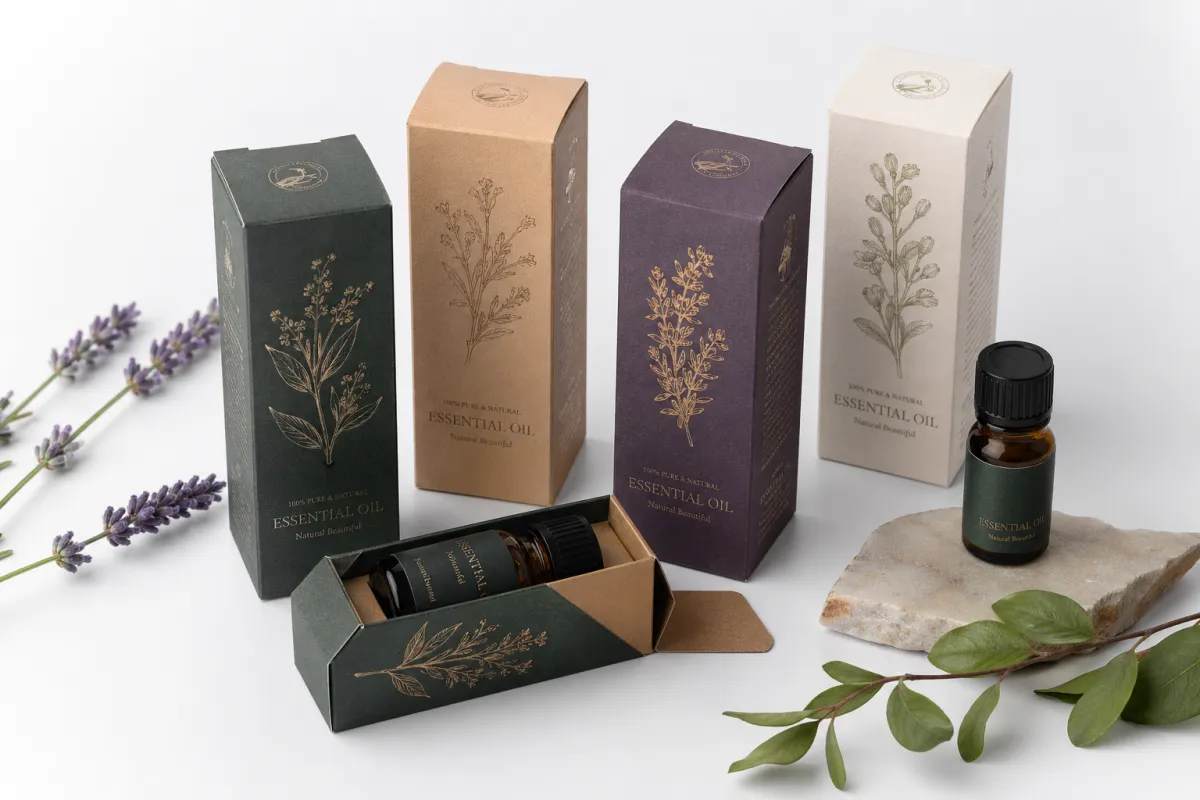
A custom essential oil Boxes Wholesale Supplier matters because essential oils are small, dense, and unforgiving of weak packaging. A 10 ml amber bottle that rattles inside a carton may look harmless in a mockup. Multiply that by 5,000 units on a pallet and the picture changes fast. One cracked bottle, one leaky cap, one stained sleeve, and dozens of units lose their profit before the order even reaches a shelf. I have watched a client assume a 2.4% damage allowance on paper, then see real breakage climb toward 6.1% after the first shipment landed. Paper math is optimistic like that. Reality is less polite, and a custom essential oil boxes wholesale supplier who knows transit stress can help close that gap.
Structure should come before graphics. A custom essential oil Boxes Wholesale Supplier should help you decide whether a tuck-end carton, sleeve, rigid setup, or mailer format fits the route your product will actually travel. Shipping from a fulfillment center to Amazon prep in Las Vegas calls for a different build than a boutique shelf display in Austin or a 12-store regional rollout in the Midwest. The artwork may stay identical. The board caliper, insert fit, and flap design should not. A carton built for 400 miles of ground freight from Chicago to Nashville is not the same carton built for a two-day air hop into Phoenix. That is why Essential Oil Packaging demands more than a nice render.
One mistake buyers make all the time is assuming the supplier only prints artwork. A good custom essential oil boxes wholesale supplier reduces risk. That means aligning the box to the bottle count, cap height, transit method, and display requirement. It also means the same structure can be reordered six months later without a surprise change in the cut, coating, or color profile. For a fast-growing brand, repeatability is not a bonus. It is a necessity, especially if your sales team is forecasting a second run of 8,000 pieces before the first container arrives in port. The best suppliers treat repeat orders as a test of discipline, not a chance to improvise.
My ranking for wholesale buyers is blunt: protection first, shelf appeal second, MOQ third, lead time fourth, repeatability fifth. If a supplier cannot explain how the insert keeps a 15 ml bottle centered, or if they dodge questions about board thickness, that is a signal to slow down. A strong custom essential oil boxes wholesale supplier should speak about packaging design with the same confidence they bring to freight, because both affect landed cost in very real ways. A weak answer here often becomes a $0.22 unit problem later.
- Protection: prevents leakage, abrasion, and cap pressure during transit.
- Shelf appeal: supports retail packaging that reads clearly at 3 to 6 feet.
- MOQ: determines how much cash gets tied up in inventory.
- Lead time: affects launch dates, retail resets, and replenishment windows.
- Repeatability: keeps the next order aligned with the first.
At a converted packaging line near Shenzhen, an operator showed me two versions of the same 6-bottle kit. The first used an insert with a 0.8 mm variance, and the bottles clicked against one another on a vibration table. The second used a tighter die-line and a denser paperboard insert. The sound vanished. That ten-minute demo said more than a stack of polished brochures ever could. The right custom essential oil boxes wholesale supplier does not just promise protection; they prove it in the structure, usually with a sample made in Dongguan or Guangzhou before full production starts. That is the difference between essential oil packaging that performs and packaging that simply photographs well.
If you are moving from test batches into repeat wholesale, a supplier also helps you avoid the hidden cost of redesign. Reworking package branding after the first retail season can cost more than the initial print run if the new carton needs a different die, a new plate set, or an updated insert. That is why seasoned buyers ask a custom essential oil boxes wholesale supplier about reprint consistency before they ask about special finishes. Honestly, I think that order of questioning saves more money than most teams realize, especially when a second run moves from 2,000 to 10,000 units. A reliable supplier is part manufacturer, part risk analyst.
For buyers building a wider line, comparing the carton spec against other items in the range saves time later, which is why our Custom Packaging Products catalog matters as a planning reference. The same supplier logic often applies across custom printed boxes for oils, serums, and small wellness kits, even when the dimensions shift by a few millimeters. A 5 ml dropper, a 10 ml roll-on, and a 15 ml blend should feel like cousins, not strangers, on the production sheet. The best custom essential oil boxes wholesale supplier understands that the system matters as much as the SKU.
Custom Essential Oil Boxes Wholesale Supplier Product Details
A practical custom essential oil boxes wholesale supplier should quote several box styles without forcing the buying team to guess. For standard retail packs, tuck-end cartons remain the most efficient choice because they store well and suit mid-volume wholesale orders. Rigid boxes create a stronger first impression and hold shape better under handling, which matters for higher perceived value. Sleeve formats fit gift sets and seasonal collections. Mailer-style packaging suits e-commerce and subscription shipping. A supplier pushing only one structure is not solving the brief; they are squeezing the brief into their own production habit, usually because their line is set up for one die format in Shenzhen or a neighboring industrial district. A broader supplier menu also makes it easier to compare essential oil packaging options by function rather than by trend.
The insert is where many orders succeed or fail. A 5 ml bottle needs a different cavity depth than a 15 ml bottle. A roller bottle needs different neck clearance than an amber dropper. A serious custom essential oil boxes wholesale supplier will ask for bottle body diameter, cap diameter, shoulder height, and overall filled height before drawing the dieline. I have seen a buyer approve a box from a catalog spec sheet, only to learn the actual bottle had a wider shoulder and no longer fit the window insert. The reorder waited while the cavity was re-cut, and nobody enjoyed that detour. A 31 mm cavity that works on paper is useless if the cap swells to 33 mm after a heat-sensitive oil sits in a warm warehouse in Ningbo. In this category, paperboard inserts are not an accessory; they are part of the product.
Print and finish choices should match the sales channel. CMYK remains the workhorse for full-color artwork. PMS color matching matters when a brand needs an exact green, blue, or charcoal across multiple SKUs. Foil stamping adds sharp contrast, embossing creates tactile detail, and spot UV helps a logo catch light on a shelf. Soft-touch lamination feels premium, yet it can change scuff resistance and the way oils mark the surface. A dependable custom essential oil boxes wholesale supplier will talk through those tradeoffs instead of quoting the most expensive finish by default. On a 5,000-piece run, that difference can be the gap between $0.15 and $0.41 per unit.
Retail details matter more than many brand teams expect. A carton for essential oils should leave room for scent name, bottle count, ingredients, warnings, barcode placement, and tamper cues. If you sell in multiple states or export regions, the copy block tightens fast. The right custom essential oil boxes wholesale supplier should help you preserve legibility at 8-point type while still making room for marketing claims and a legal panel. That balance belongs to retail packaging, not a last-minute scramble at proof stage, especially when California, Texas, and Canadian bilingual requirements all land on the same layout. A box that reads well and scans cleanly is usually the one that ships best, too.
| Box Style | Typical Use | Approx. Unit Price at 5,000 pcs | Best Fit |
|---|---|---|---|
| Tuck-end carton | Standard 5 ml to 15 ml retail packs | $0.15 to $0.28 | Fast-moving wholesale and shelf display |
| Sleeve + tray | Sampler sets and branded gift packs | $0.31 to $0.62 | Better unboxing and layered presentation |
| Rigid box | Premium kits and higher-ticket bundles | $0.98 to $2.35 | Luxury positioning and long shelf life |
| Mailer box | Direct-to-consumer shipping and subscriptions | $0.58 to $1.38 | Shipping strength and brand impact |
Those figures are not a promise. They are the range I use when I assess proposals from a custom essential oil boxes wholesale supplier. Final unit price depends on board grade, insert type, coating, order volume, and whether the box needs a specialty structure. A 500-unit run can cost double or triple the 5,000-unit price because setup labor does not politely shrink to fit the mood of the buyer. In one actual quote, a 500-piece rigid box was $1.92 each, while 5,000 pieces dropped to $1.14 each once the grayboard and foil plate charges were spread across volume. That is the sort of spread that changes a margin forecast quickly.
For compliance-minded brands, material choice matters too. Recyclable paperboard and FSC-certified stock can support sustainability claims if the supply chain documentation is clean. I often send buyers to the FSC certification site when they need to verify paper sourcing language for packaging copy. A responsible custom essential oil boxes wholesale supplier should be able to tell you which board grades can support that claim and which cannot. A 350gsm C1S artboard or a 2 mm grayboard rigid shell can both be documented properly if the mill records are current. For brands under scrutiny, that paperwork matters as much as the print finish.
Barcode space is not optional if the carton is headed to wholesale distribution. I have seen brands squeeze the code onto a side panel, then discover the gloss coating caused scanner issues on a receiving dock. A precise custom essential oil boxes wholesale supplier will plan a quiet, flat, high-contrast barcode zone and keep it away from foil, embossing, or heavy visual texture. Otherwise, somebody at the warehouse ends up squinting at a scanner like it personally insulted them, usually after 7 a.m. on a Monday in a distribution center outside Dallas. A clean barcode zone is one of those tiny details that prevents big delays.
Specifications That Protect Fragile Oils in Transit
Specifications decide whether the box protects the product or merely frames it. Board thickness is the first variable I check. For smaller essential oil kits, 300gsm to 400gsm paperboard can work for shelf display, while 1.5 mm to 2.5 mm rigid board is better for premium sets or shipping-heavy orders. A capable custom essential oil boxes wholesale supplier should explain how caliper, flute profile, and coating interact, because a glossy surface on weak board still crushes under stack weight. On a 40-pound master carton, that weakness shows up fast, usually by the third or fourth warehouse handoff. Packaging that looks light on the spec sheet often behaves even lighter in transit.
Insert stock changes the equation as much as the outer carton. A dense paper insert can keep bottles from knocking together, but a low-density insert can flex after 200 miles of vibration. In one warehouse test I watched, a carton with a simple die-cut insert passed a short drop cycle, then failed after repeated corner drops because the cavity loosened. The buyer had asked for branded packaging; the supplier delivered that. What they had not tuned yet was the transit behavior. That gap is exactly why a custom essential oil boxes wholesale supplier earns its fee, whether the line runs in Foshan or on a specialized insert machine near Guangzhou. A paperboard insert that holds shape can save an entire wholesale run.
Die-line accuracy is another quiet risk. A box can look perfect in a PDF and still fail on the line if the tolerance is off by even 1 to 2 mm. Bottles start to rattle, flaps open too loosely, or shoulders rub against the insert edge. For a custom essential oil boxes wholesale supplier, this is not a small prepress issue; it is structural and it affects breakage, scuffing, and customer confidence. Good suppliers will ask for sample bottles before finalizing the cut, and I prefer that every time over a guess based on a catalog sketch from a trade show in Yiwu. The dieline is where the math becomes physical.
Sustainability and compliance need space in the design, not just a claim on the sales sheet. If you want recyclable materials, say so early. If you need room for hazard text, ingredient disclosure, or country-of-origin marks, build that into the dieline from the start. A disciplined custom essential oil boxes wholesale supplier will also know how to design for carton reuse, which matters for gift sets and subscription kits where the outer package is opened, stored, and handled several times. For general packaging standards and testing context, I often point teams to ISTA testing resources, because transit is where many beautiful packages fail. A 1.2 mm E-flute mailer may look plain, but it can outperform a decorated carton by a wide margin in a 24-inch drop test.
Channel use case should drive the spec. E-commerce shipping needs more crush resistance and stronger insert retention than a retail shelf pack. Subscription boxes may need lighter board but stronger corner hold. Gift sets often justify soft-touch lamination, foil, or embossing because the recipient sees the box before the bottle. A trusted custom essential oil boxes wholesale supplier should map the spec to the channel instead of pushing one build across all formats. That means a mailer for parcel carriers in Atlanta and a premium rigid setup for a retail chain in Los Angeles will not share the same structure, even if the logo stays identical. The channel is part of the design brief, not an afterthought.
Here is the practical test I use in client reviews: if you can shake the sample gently and hear movement, the structure probably needs work. If you can press the top panel with a thumb and it bows noticeably, the board is likely too light for wholesale handling. A good custom essential oil boxes wholesale supplier will not argue with that test; they will help you fix it before production. The same is true if a 15 ml bottle slides more than 1 mm inside the cavity, because that tiny movement multiplies across 6,000 shipments. Small motion becomes large loss once the pallets start moving.
"The carton looked premium on the render, but the bottle moved 3 mm inside the cavity. Once we tightened the insert and switched to a 350gsm board, the breakage issue disappeared." That was a line I heard from a procurement manager after a pilot run, and it captures the difference between artwork and actual performance. The pilot was only 600 pieces, but it saved a far larger reorder a month later.
For brands building a broader assortment, keeping the packaging system aligned with package branding pays off. A 5 ml roll-on, a 10 ml dropper, and a 15 ml blend do not need identical boxes, but they should share a coherent system of board tone, logo placement, and warning language. That consistency is easier to hold when the custom essential oil boxes wholesale supplier understands the full line rather than a single SKU. A supplier in Shenzhen that handles all three formats can also keep the color target within a Delta E of 2 to 3, which is where most brand teams stop arguing.
Custom Essential Oil Boxes Wholesale Supplier Pricing and MOQ
Pricing gets easier to read once the real cost drivers are separated. A custom essential oil boxes wholesale supplier usually prices by material grade, print complexity, insert type, box size, and order quantity. A simple single-color tuck-end carton in kraft stock may sit near the low end of the range, while a rigid magnetic-close kit with foil, embossing, and a molded insert moves far higher. For wholesale buying, the cheapest quote is not always the lowest landed cost. I wish that were true, but procurement has a way of exposing wishful thinking. A quote that looks elegant at $0.17 per unit can end up closer to $0.26 once specialty coating and carton packing are added. This is where careful essential oil packaging planning saves real money.
MOQ matters because setup time for die cutting, plates, proofing, and finishing does not shrink much for small runs. I have seen buyers focus on a $0.05 unit difference and miss the fact that the 500-unit order carried the same $180 plate charge as a 5,000-unit order. A reliable custom essential oil boxes wholesale supplier should give tiered pricing at 250, 500, 1,000, and 5,000 units so you can see where the curve bends. In many cases, 1,000 units land in a better cost zone than 500 without demanding the cash outlay of a larger buy. One real comparison I reviewed showed 500 units at $0.39 each and 5,000 units at $0.15 each for a basic folding carton. The scale effect is blunt, but it is useful.
Sample charges and freight deserve their own line. A physical sample may cost $25 to $80 depending on structure, and a custom prototype with hard tooling or special insert work can climb higher. Freight can shift the story fast. Air shipment on a 300 kg carton order can add hundreds of dollars, while ocean or consolidated freight may be cheaper but slower. A thoughtful custom essential oil boxes wholesale supplier will quote the boxes, the samples, the tooling, and the transit separately so you can calculate true landed cost instead of quote-only pricing. For a 20-foot container leaving Shenzhen, the difference between port handling and door delivery can easily add $300 to $700.
To keep the budget honest, I usually compare two paths: a premium rigid pack for the top-tier kit and a lighter folding carton for the core line. That comparison often shows that the better commercial move is not the fanciest box. It is the box that gives the brand enough protection and enough shelf presence without eating the margin. A strong custom essential oil boxes wholesale supplier will help you decide based on the channel, not only the aesthetic. A $1.10 rigid box may be justified for a $48 gift set; it is not justified for a $12 starter SKU that needs to stay under a 35% packaging-to-product ratio.
Here is a budgeting frame that works in practice:
- Core carton cost: board, printing, coating, and cutting.
- Insert cost: cavity complexity, thickness, and bottleneck clearance.
- Setup cost: plates, die, proofing, and sample revisions.
- Freight cost: air, sea, or domestic linehaul.
- Risk cost: breakage allowance and replacement units.
Once those five items are in view, the quote from a custom essential oil boxes wholesale supplier becomes much easier to compare. Two suppliers can quote the same unit price and still land thousands of dollars apart once freight, samples, and damage risk are counted. Procurement teams that buy only on unit rate often regret the decision after the first receiving report. In one spreadsheet, a 5,000-piece order looked identical until the 2% breakage reserve and $240 freight delta were folded in. That spreadsheet looked neat right up until the warehouse did the math.
I handled a supplier negotiation where the box price looked 12% cheaper on paper, but the insert required a separate assembly step and the freight pallet count jumped by 18%. The final landed cost was higher, not lower. A disciplined custom essential oil boxes wholesale supplier should be willing to explain those hidden costs before you commit. If they cannot, they are not really pricing the job; they are only pricing the print. That is how a $0.21 box turns into a $0.33 box without warning.
For brands with broader procurement needs, our Wholesale Programs page is useful because the same buying logic applies across cartons, mailers, and coordinated custom printed boxes. A supplier that can support one SKU well usually handles the next SKU better if the process is already documented. That is especially true when the same factory in Guangdong is producing multiple pack sizes across a 90-day replenishment cycle. A steady custom essential oil boxes wholesale supplier keeps that cycle readable.
Production Process and Timeline From Quote to Delivery
A professional custom essential oil boxes wholesale supplier should have a clear workflow, and if they do not, delays usually surface later in proofing or freight. The process should begin with quote intake, followed by dieline confirmation, artwork proofing, sampling, production, QC, and delivery. Each step needs a decision owner. If three people sign off on artwork and none of them owns the final bottle dimensions, the order can stall for days while everyone waits for someone else to approve the insert depth. In a 4,000-piece run, even a 2-day stall can push the shipping window past a booked pickup. The cleanest production schedules come from clean handoffs.
Timing ranges depend on structure. Straightforward folding cartons can move from approved artwork to production in about 10 to 15 business days, assuming the supplier already has the board and finishes in house. Rigid boxes, multi-bottle kits, or custom inserts usually need more time because samples and adjustments enter the schedule. A dependable custom essential oil boxes wholesale supplier will tell you whether the job needs one proof round or two, because that can shift the calendar by a full week. For reference, a standard carton with a 350gsm C1S artboard can often ship 12 to 15 business days from proof approval, while a rigid box with a 2 mm grayboard shell may need 18 to 22 business days. That range is why early planning matters.
Rush orders are possible, but they usually compress margin and raise error risk. I have seen a brand approve artwork at 4:30 p.m., then ask for a next-week ship date before the ink proof was even checked. That is how mistakes enter production. A serious custom essential oil boxes wholesale supplier will ask for final bottle dimensions, final copy, and a single decision maker before they promise any lead time. They will also tell you whether the job is running in Shenzhen, Dongguan, or a satellite plant in Zhongshan, because plant location changes queue time. A rushed order rarely gets better by being vague.
Freight method also changes the launch date. Air freight can shave transit time, but it adds cost and can create receiving congestion if the cartons arrive before the warehouse team is ready. Ocean freight is cheaper for larger runs, yet the schedule may stretch out the receiving window by several weeks. The best custom essential oil boxes wholesale supplier will map the production schedule against the shipping method so you know the date the cartons leave the press and the date they actually reach your dock. A pallet leaving Ningbo for Los Angeles can take 16 to 28 days port-to-door depending on the sailing and customs timing.
One pattern I see often: the artwork is approved, but the bottle dimensions are still uncertain by 1 or 2 mm. That small gap can add days because the supplier has to re-check the insert. If you want the timeline to move cleanly, lock five items early:
- Bottle dimensions, including shoulder and cap height.
- Closure type, such as dropper, roller, or pump.
- Quantity split by SKU.
- Destination address and receiving rules.
- Final artwork copy, including warnings and barcode.
A capable custom essential oil boxes wholesale supplier will appreciate that preparation because it reduces revision cycles. It also makes the reorder path easier, which matters if you plan to scale into multiple retail accounts. In packaging, speed usually comes from clarity, not from shouting louder at the inbox. A complete brief can shave 2 to 4 business days off the proof loop, which is a meaningful number when a retail reset is already booked. That is especially true when the same supplier must coordinate folding cartons, inserts, and shipment paperwork at once.
I remember one factory floor where the manager pointed to a stack of rejected cartons and said, "These were all fixable problems, but each one started with an incomplete brief." That was blunt, and it was correct. If you want the order to finish on time, give the custom essential oil boxes wholesale supplier enough information to quote, sample, and produce without guessing. A 15-minute call with final dimensions beats a 15-day delay caused by a missing shoulder measurement. The shortest timeline usually belongs to the most complete brief.
Why Choose Us as Your Custom Essential Oil Boxes Wholesale Supplier
We approach essential oil packaging the way procurement teams actually buy it: by measuring the bottle, the route, and the reorder pattern before anything else. As a custom essential oil boxes wholesale supplier, we understand leakage risk, insert fit, and the way a carton has to look under fluorescent retail lighting and warehouse handling alike. That combination matters because the box is doing two jobs at once. It is carrying the product and carrying the brand. A carton that performs in a showroom but fails on a pallet is only half a solution. That is why a practical custom essential oil boxes wholesale supplier thinks in both aesthetics and logistics.
What clients usually notice first is color discipline. A dark green logo on a kraft carton can drift badly between runs if the supplier does not hold the print standard tightly. We work to keep that drift under control so your brand packaging looks the same on the first shipment and the fifth. A good custom essential oil boxes wholesale supplier should treat color matching as a repeat-order issue, not only an initial proof issue. We target the same Pantone reference across runs, even when the order is split between 1,000 units and 7,500 units two months apart. That consistency is what keeps shelf sets looking like a family.
We also give direct guidance on structure. If a 10 ml bottle needs a tighter shoulder pocket, we say so. If a 6-bottle sampler fits better as a sleeve-and-tray than a tuck-end pack, we say that too. In a recent buyer call, the team wanted a rigid box because it sounded premium, but their channel was e-commerce with moderate weight limits. The better solution was a reinforced mailer with a branded insert, and the customer saved more than $0.40 per unit. That is the kind of decision a good custom essential oil boxes wholesale supplier should help you make, especially when the difference between a 1.8 mm chipboard tray and a 350gsm board sleeve changes freight weight by several pounds per carton.
Support services matter just as much as print quality. We can help with dielines, material guidance, prototype sampling, and bulk coordination so your design team is not left translating print jargon into procurement reality. If you need to compare formats across a larger range, our custom logistics for product packaging tie into the same production logic. A custom essential oil boxes wholesale supplier that can manage those details saves time at the design table and at the receiving dock. That matters whether the cartons are shipping into Los Angeles, Toronto, or a regional warehouse in Ohio. It also keeps essential oil packaging consistent across reorder cycles.
We are practical about what custom work should cost. A supplier that promises a premium feature on every box is usually overselling the project. We would rather help you reserve foil or embossing for the hero SKU and use a cleaner, more economical carton on the rest of the line. That approach keeps package branding coherent without locking cash into unnecessary finishes. A $0.15 carton with clean typography can do more for a core line than a $1.70 box nobody can justify on the P&L.
"The best packaging quote was not the lowest one. It was the one that matched the bottle, the ship date, and the warehouse reality." I have heard that from more than one buyer, and it is exactly how a serious custom essential oil boxes wholesale supplier should be judged. One purchaser told me their best decision was choosing a vendor in Guangdong who could keep the next reorder within 3 business days of the first.
There is also a service difference between a specialist and a generic box broker. Generic vendors often treat essential oil cartons like any other SKU, which is how you end up with weak inserts, a barcode jammed against foil, or artwork that leaves no room for warning text. A focused custom essential oil boxes wholesale supplier understands that oils are more sensitive than candle boxes, and that sensitivity changes the spec, the layout, and the freight plan. A 10 ml bottle with a 20 mm shoulder is a different risk profile from a glass dropper kit in a 2 mm grayboard rigid shell.
For buyers who want a supplier relationship built around repeat orders rather than one-off quotes, the practical advantage is consistency. You are not re-explaining bottle dimensions every quarter, and you are not re-approving the same insert geometry after each reorder. That is where a reliable custom essential oil boxes wholesale supplier saves real time, especially if you manage multiple fragrance or wellness SKUs. One documented spec sheet can prevent three rounds of email and one unnecessary sample fee. It also makes the procurement team look more organized than they probably feel.
Next Steps Before You Request a Wholesale Quote
Before you request pricing from a custom essential oil boxes wholesale supplier, gather the details that move the quote. The fastest way to cut back-and-forth is to send bottle dimensions, closure type, quantity, destination, artwork files, and target ship date in the first message. If you have a 5 ml or 10 ml bottle, include the cap height and the shoulder profile, not just the label size. A supplier can work much faster with a complete brief than with a half-filled form and a hopeful grin. If you can include a sample bottle shipped to Shenzhen or Dongguan, even better. A complete set of inputs helps the supplier judge both structure and essential oil packaging risk.
Then ask for a sample, a landed-cost quote, and a mockup. Those three items show different things. The sample shows fit and finish. The landed-cost quote shows the true unit economics. The mockup shows how the custom essential oil boxes wholesale supplier has interpreted the artwork and whether the structure fits the channel. A buyer who skips the mockup often ends up paying for a mistake that could have been caught at proof stage. A $35 sample can save a $2,400 reprint, and that is a bargain most finance teams understand immediately. It is also one of the fastest ways to separate a strong supplier from a weak one.
I also recommend a short internal approval checklist. It should include design, procurement, operations, and whoever owns the compliance copy. That prevents the common delay where marketing approves the look, procurement approves the price, and operations learns later that the insert cavity is 2 mm too shallow. A disciplined custom essential oil boxes wholesale supplier will respect that process because it speeds up production and lowers the odds of revision. It also keeps the final carton aligned with the barcode, the warning language, and the freight label on the master case.
Here is the simplest handoff I can give you: if you send complete specs to a custom essential oil boxes wholesale supplier, the quote is faster and the risk is lower. That is not sales talk. It is what I have seen in factory meetings, supplier negotiations, and shipment audits. Clear dimensions, clear copy, clear count, clear destination. Those four pieces can cut days from a procurement cycle and protect the first wholesale run from errors that are expensive to unwind. A well-prepared brief also makes it easier to compare a Shenzhen factory quote against one from Guangzhou or Ningbo without guessing at hidden costs.
For brands trying to build a stable supply path, the next move is simple: compare the sample, compare the landed cost, and compare the reorder terms. Then choose the custom essential oil boxes wholesale supplier that gives you proof, not just promises. That is how strong wholesale packaging decisions are made, and it is how retail packaging stays consistent after the launch photo is long forgotten. In practical terms, that means a box specified at 350gsm C1S artboard for the core line and a 2 mm grayboard rigid sleeve for the gift set, each with its own cost logic. For a growing brand, that split usually beats one-size-fits-all packaging.
Frequently Asked Questions
What MOQ should I expect from a custom essential oil boxes wholesale supplier?
MOQ usually depends on box style, print method, and whether inserts are included. Simple folding cartons often start lower than rigid boxes or multi-bottle kits, and a custom essential oil boxes wholesale supplier may quote 250 units for a basic tuck-end box but 500 or 1,000 units for a rigid format. Ask for tiered pricing at 250, 500, 1,000, and 5,000 units so you can see the real break point. In practice, I have seen a 5,000-piece carton drop to $0.15 per unit while a 500-piece order stayed near $0.34. The MOQ question is never just about quantity; it is about cost shape.
How long does production take for custom essential oil boxes wholesale orders?
A straightforward carton order can move quickly once artwork and dimensions are approved, often in 10 to 15 business days for production before freight. Custom inserts, rigid construction, or special finishes usually add sampling and production time, and the biggest delay is often the proofing stage. A good custom essential oil boxes wholesale supplier will tell you early if a second proof round is likely. For standard folding cartons, I usually expect 12 to 15 business days from proof approval, while a rigid box run can take 18 to 22 business days. Lead time gets shorter only when the brief is complete.
Which box style is best for essential oil bottles in wholesale packaging?
Tuck-end cartons work well for standard retail packs and lighter shipping needs, while rigid boxes are better for premium sets and higher perceived value. Mailer-style packaging is the strongest choice for direct-to-consumer shipping and subscription kits. The right answer depends on the route, and a custom essential oil boxes wholesale supplier should match the structure to the channel instead of forcing one format across all SKUs. A 10 ml dropper shipping from Chicago to New York has different needs than a gift set displayed in a Dallas boutique. That is why essential oil packaging should be chosen by channel first.
What print finishes hold up best for essential oil boxes?
Coated boards with laminated or varnished finishes are usually more durable for handling and shipping. Foil and embossing work well for premium branding, but should be balanced against cost and MOQ. If bottles may leak in transit, choose finishes that resist oil stains and surface scuffing, and make sure the custom essential oil boxes wholesale supplier understands the transit risk before choosing a finish. Soft-touch lamination on a 350gsm C1S artboard can feel elevated, but matte aqueous coating often handles scuffing better in bulk shipments. The finish should support the product, not distract from it.
Can a wholesale supplier match my bottle insert and shipping needs?
Yes, but the supplier needs exact bottle dimensions, closure details, and the number of bottles per box. Insert cavities should account for headspace, cap shape, and movement during transit. For shipping-heavy orders, ask for a drop-test minded structure and a master carton plan, because the best custom essential oil boxes wholesale supplier will design for the trip, not only for the shelf. A 6-bottle set headed for ocean freight out of Ningbo needs a different insert than a 2-bottle retail pack moving by parcel from Los Angeles. The right paperboard inserts can make that difference.
If you want a supplier that can handle measured details instead of guessing them, start with the specs, not the artwork. A reliable custom essential oil boxes wholesale supplier will always respond better to a clear bottle size, a clear quantity, and a clear delivery target. That is how you protect margin, reduce breakage, and build a packaging program that can grow with the product line. It is also how you avoid the expensive habit of discovering, after 5,000 units are printed, that the bottle shoulder was 2 mm wider than the sample. For brands that get this right, the box is not an afterthought; it is part of the product strategy. The actionable move is straightforward: lock the bottle dimensions, request a sample and landed-cost quote from your custom essential oil boxes wholesale supplier, and choose the structure that survives the route you actually ship.